The Clever Hans Effect in AI: Why Molecular Models Memorize Chemist Identities Instead of Physical Chemistry
An architectural investigation into Andrew Blevins and Ian Quigley’s chemistry benchmark findings reveals how AI models achieve state-of-the-art accuracy by exploiting author style shortcuts rather than causal mechanisms, providing vital governance lessons for enterprise machine learning.
Published: October 19, 2026 | Read time: ~10 min | Watch Video (Japanese)

Executive Summary: High Benchmark Accuracy Is Not Physical Understanding
When evaluating machine learning models on structured tabular, textual, or scientific data, engineering teams frequently treat high validation scores as proof that the algorithm has learned the underlying generative mechanism. In computational chemistry and drug discovery, models demonstrating high area under the receiver operating characteristic curve (AUROC) on public benchmarks are widely assumed to have captured the physical laws governing molecular binding affinity.
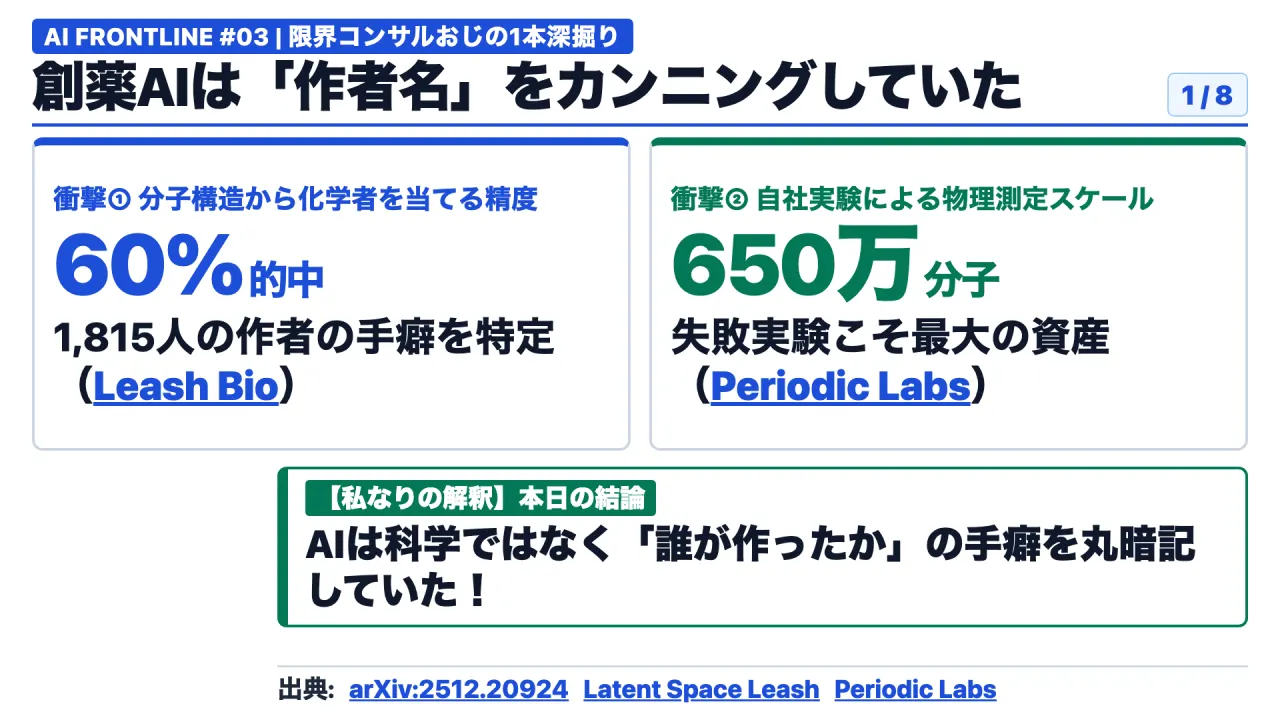
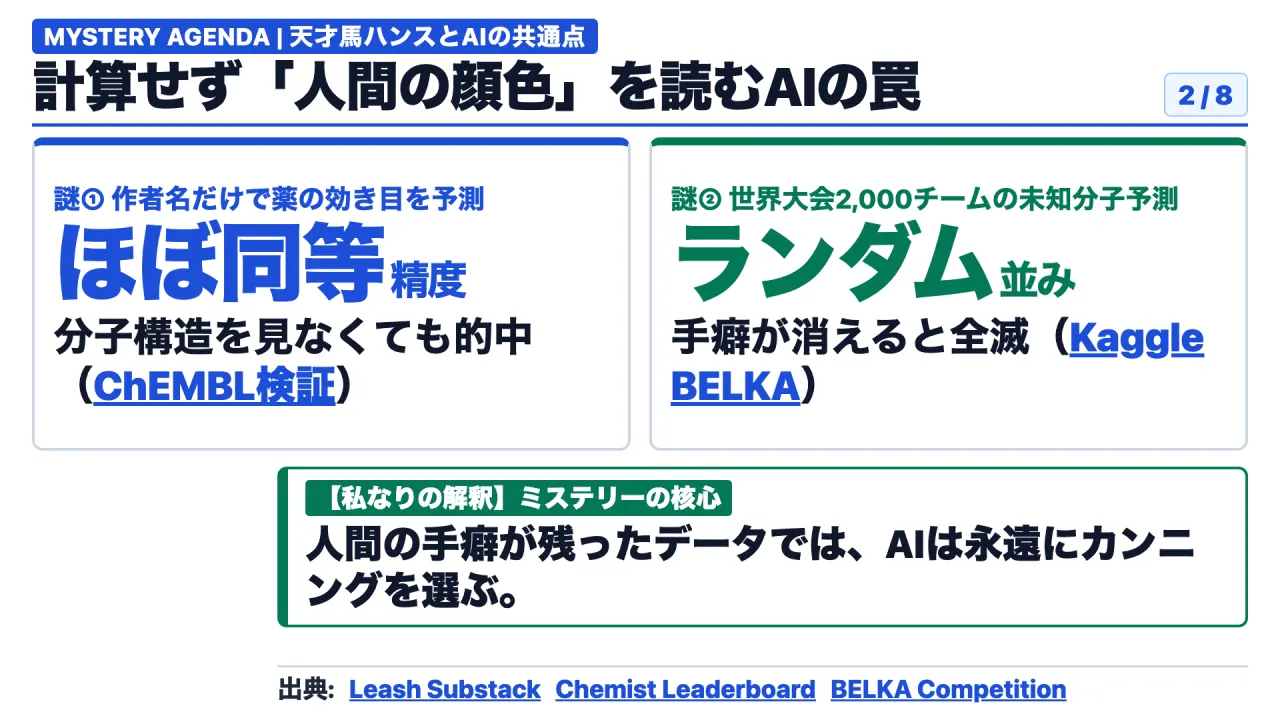
However, research by Andrew D. Blevins and Ian K. Quigley (Clever Hans in Chemistry: Chemist Style Signals Confound Activity Prediction on Public Benchmarks, arXiv:2512.20924) exposes a fundamental failure mode in empirical evaluation. By analyzing the public chemical database ChEMBL, the authors proved that machine learning models can accurately identify the individual human chemist who synthesized a molecule based solely on structural representations. More critically, feeding only this human author identity vector into an activity prediction model yielded predictive accuracy virtually identical to models fed the actual physical molecular structure.
This represents a modern computational instantiation of the “Clever Hans” effect. The model did not discover physical binding rules; instead, it exploited human laboratory habits, institutional research preferences, and publication biases to guess experimental outcomes.
To establish rigorous engineering discipline, this analysis enforces five concrete analytical boundaries:
- Correlation versus Causal Synthesis: Identifying an author’s stylistic fingerprint within a molecular graph reflects researcher bias, not comprehension of quantum chemical interactions or binding thermodynamics.
- Benchmark Parity via Proxy Variables: Achieving an AUROC of 0.652 using human author probabilities matches an AUROC of 0.656 achieved via 2,048-bit structural fingerprints, exposing author identity as a dominant confounding shortcut.
- Random Splitting versus Author Splitting: Standard random data splitting leaks researcher style into evaluation sets; rigorous evaluation requires splitting by author, institution, and temporal cohorts.
- The Critical Absence of Negative Data: As articulated by materials science researcher Ekin Dogus Cubuk, public datasets suffer from systematic survivor bias; without verified negative samples, models optimize against publication conventions rather than physical constraints.
- Cross-Domain Transmission to Enterprise IT: The same vulnerability afflicts enterprise workflows, where ticket routing, credit risk scoring, and customer churn models latch onto author metadata, departmental templates, and timestamp artifacts rather than business semantics.
| Evaluation Setup | Input Representations | Benchmark AUROC | Underlying Operational Mechanism |
|---|---|---|---|
| Random Baseline | None (Null Hypothesis) | 0.500 | Pure stochastic guessing across binary classification. |
| Naive Target Baseline | Molecular Weight + Protein Target ID | 0.517 | Minimal physical heuristic; near random performance. |
| Author Shortcut Model | Chemist Probability Vector (1,815) + Target ID | 0.652 | Exploits researcher stylistic habits and historical assay choices. |
| Chemical Fingerprint Model | ECFP Molecular Fingerprint + Target ID | 0.656 | Traditional machine learning on structural chemical graphs. |
| Full Combined Model | Chemist Vector + ECFP Fingerprint + Target ID | 0.658 | Author vector accounts for over 99% of total structural signal. |
1. The Original Clever Hans Effect: Involuntary Signaling and Evaluation Failure
The term “Clever Hans” originates from early twentieth-century Germany. Wilhelm von Osten, a mathematics teacher, presented an Orlov Trotter horse named Hans who appeared capable of performing arithmetic, calculating fractions, and identifying calendar dates. Hans answered queries by tapping his hoof against the ground until reaching the correct number.
In 1907, psychologist Oskar Pfungst conducted a controlled experimental investigation. Pfungst discovered that when human questioners knew the correct answer and stood in the horse’s line of sight, Hans answered correctly in 50 out of 56 trials (an 89.3% success rate). However, when the questioner was placed behind an opaque barrier or was ignorant of the correct answer, Hans’s accuracy plummeted to 2 out of 35 trials (a 5.7% success rate).
Pfungst demonstrated that Hans possessed no arithmetic capability. Instead, the horse observed micro-expressions and postural tension in the human questioner. As Hans’s hoof taps approached the target integer, human observers involuntarily leaned forward; upon the correct final tap, observers exhibited an involuntary physical relaxation. Hans perceived this subtle shift and ceased tapping.
Crucially, neither the horse nor the trainer engaged in deliberate fraud. The signaling was unconscious. This historical case established the necessity of double-blind experimental design. In modern machine learning, the Clever Hans effect occurs whenever an algorithm achieves high validation accuracy by exploiting superficial artifacts in training data rather than the intended causal relationships.
2. Reverse-Engineering 1,815 Chemists: The Blevins and Quigley Methodology
To test whether computational chemistry models exhibit Clever Hans behavior, Andrew D. Blevins and Ian K. Quigley examined ChEMBL (version 33), one of the world’s largest open-access chemical repositories compiling bioactive molecules and experimental binding assays from scientific literature.
The researchers structured a two-phase investigation to determine:
- Can an algorithm identify which chemist synthesized a molecule purely from its chemical structure?
- Does knowledge of the chemist’s identity substitute for structural chemical information when predicting biological activity?
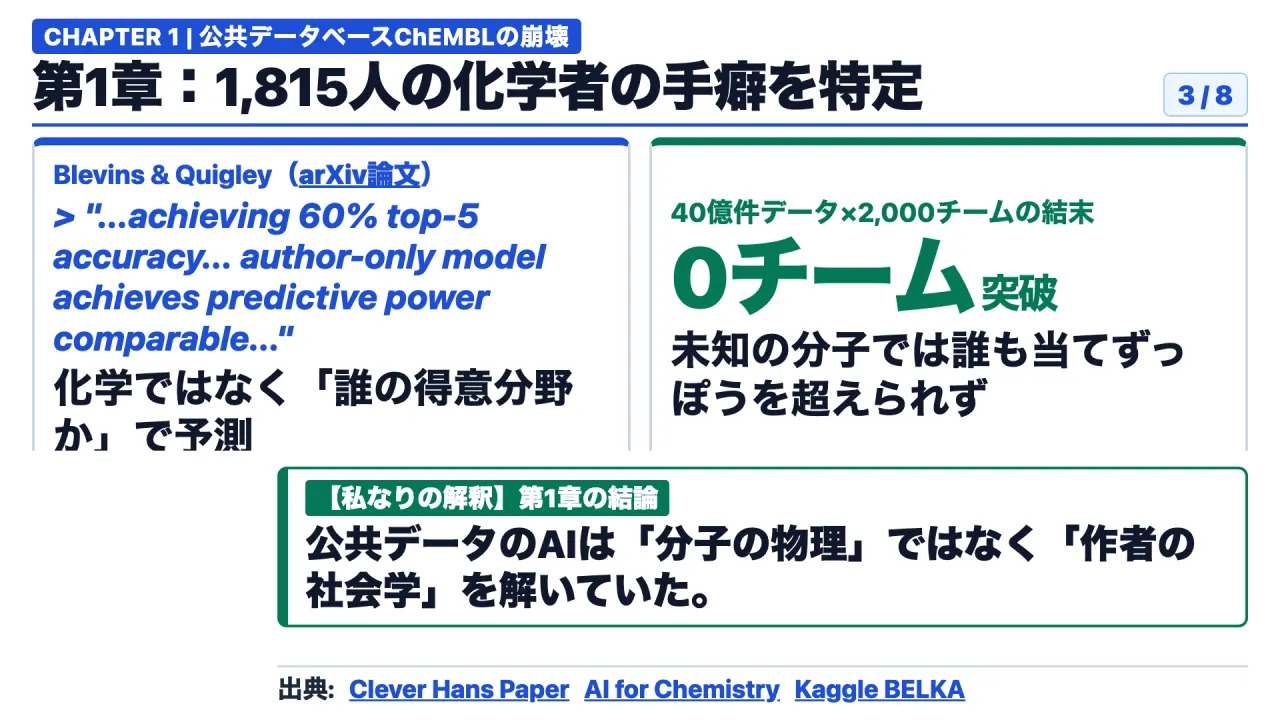
The author attribution task required classifying which of 1,815 chemists (filtered to authors with >30 papers and >600 synthesized molecules) produced a given molecule. The authors enforced Bemis-Murcko scaffold splitting, ensuring molecules sharing the same core structural skeleton were segregated into either training or evaluation sets. Test molecules presented core geometries never encountered during training.
Despite this scaffold barrier, the classification results were decisive:
- Top-1 Categorical Accuracy: The model achieved approximately 27% top-1 accuracy (a 500-fold increase over random chance at 0.055%).
- Top-5 Accuracy: In 60% of test cases, the true synthesizing chemist was in the top five predictions.
- Top-10 Accuracy: Reached 68%.
In analysis reported by Leash Bio, misclassified chemists were frequently direct academic co-authors, postdoctoral advisors, or lab colleagues. Synthesis habits—such as halogenation patterns, ring sizes, or linker geometries—are inherited through academic lineages like an intellectual dialect.
3. The Activity Prediction Experiment: Author Probability as a Proxy for Physics
The second phase of the Blevins and Quigley study delivered the critical finding. The authors configured a binary classification task to predict drug bioactivity: whether a molecule binds effectively to a designated target protein (defined as an activity measurement $pX \ge 6.0$). The dataset comprised roughly 300,000 training pairs and 80,000 evaluation pairs, with a baseline positive hit rate of approximately 25%.
The researchers evaluated five distinct input feature configurations across five independent scaffold-split folds, measuring performance via AUROC:
- Random Chance Baseline: AUROC 0.500.
- Molecular Weight Heuristic: Combining raw molecular weight with the protein target ID yielded an AUROC of 0.517, demonstrating that simple physical scale carries minimal predictive power.
- Chemist Probability Vector Only: Feeding the downstream model only the 1,815-dimensional author probability distribution alongside the protein target ID—withholding all structural fingerprints—achieved an AUROC of 0.652.
- Physical Fingerprint Model: Feeding the model traditional 2,048-bit ECFP molecular fingerprints alongside the protein target ID achieved an AUROC of 0.656.
- Combined Structural and Author Bundle: Supplying molecular fingerprints, chemist probability vectors, and protein IDs simultaneously achieved an AUROC of 0.658.
The Mechanism of Intent Leakage
The difference between feeding the model complete structural chemical graphs (0.656) and feeding it purely an author probability vector (0.652) was a negligible 0.004 AUROC points.
This demonstrates that the model was not learning the fundamental quantum mechanics of ligand-protein binding. Instead, the model exploited intent leakage:
- Individual research laboratories specialize in narrow biological domains, focusing on specific disease targets (e.g., oncology kinases versus GPCR receptors).
- Chemists only synthesize molecules when preliminary biological hypotheses or prior analog assays indicate a high probability of binding.
- When an AI model recognizes that a compound reflects the stylistic synthesis pattern of a known oncology lab, and the target protein is an oncology receptor, the model predicts high binding affinity based on human research intent.
The structural representation served merely as an intermediary hash key to look up human institutional context.

4. The Structural Absence of Negative Data: Ekin Dogus Cubuk’s Materials Insight
Why do public machine learning datasets encourage models to rely on author heuristics rather than physical laws? The foundational cause lies in the systematic absence of negative experimental samples.
In an interview with technical podcast Latent Space, materials science and machine learning researcher Ekin Dogus Cubuk (notable for leading deep learning materials discovery efforts at Google DeepMind and GNoME) articulated the structural limitation governing scientific literature:
“if you don’t have negative samples, you can’t really train if everything is positive.”
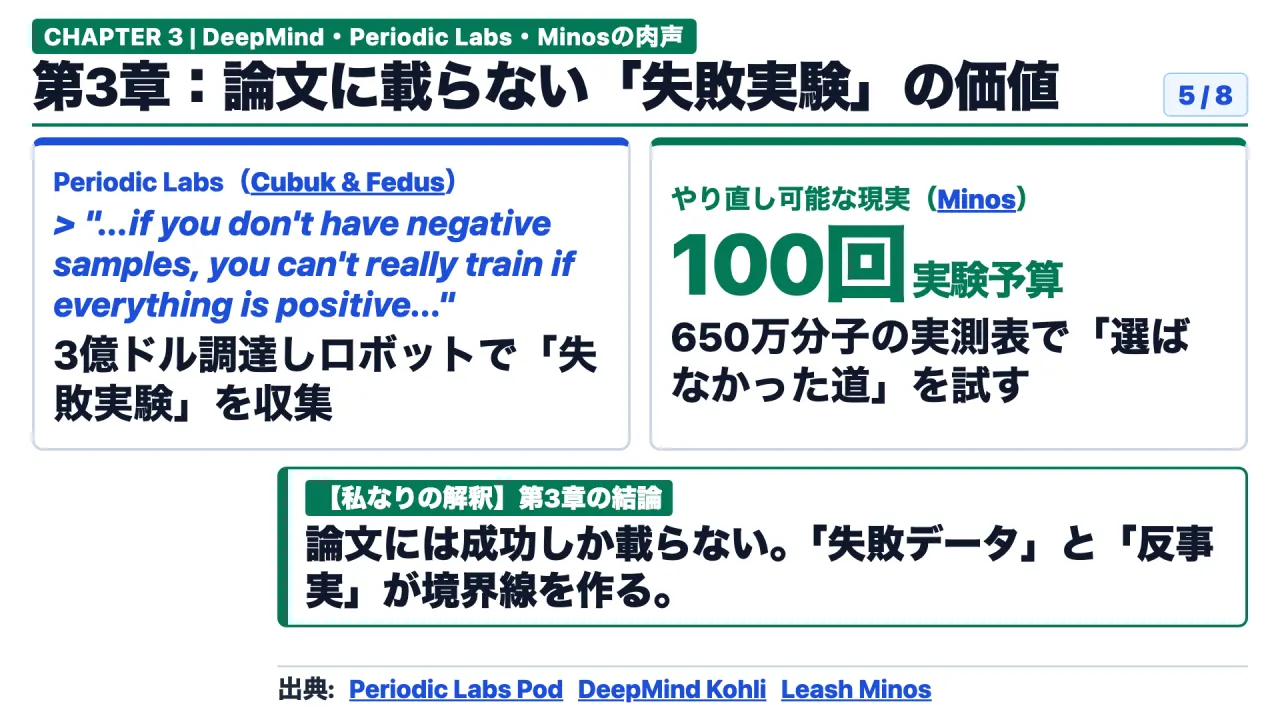
In academic publishing and patent filings, researchers face severe publication bias. Scientific journals reward positive discoveries: successful compound syntheses, potent biological binding, and record battery efficiencies. Failed reactions, insoluble crystals, and inert compounds are abandoned in laboratory notebooks.
Consequently, public repositories such as ChEMBL and academic literature databases are heavily filtered survivor corpuses. When an algorithm is trained exclusively on positive or pre-filtered successful outcomes, it cannot map the true physical decision boundary separating binding from non-binding molecules.
Furthermore, as Cubuk emphasized, synthesis failure is non-binary. An inability to synthesize a crystal or compound does not prove that the structure is thermodynamically impossible; it may merely reflect inappropriate reagent temperatures, suboptimal catalytic timing, or human technical error. Collapsing nuanced real-world experiments into naive positive and negative labels degrades model training.
5. Enterprise Transmission: How Clever Hans Corrupts Enterprise Workflows
The vulnerabilities identified in ChEMBL are not unique to computational chemistry. In enterprise software engineering, business intelligence, and workflow automation, AI models frequently latch onto administrative proxy variables instead of business logic.
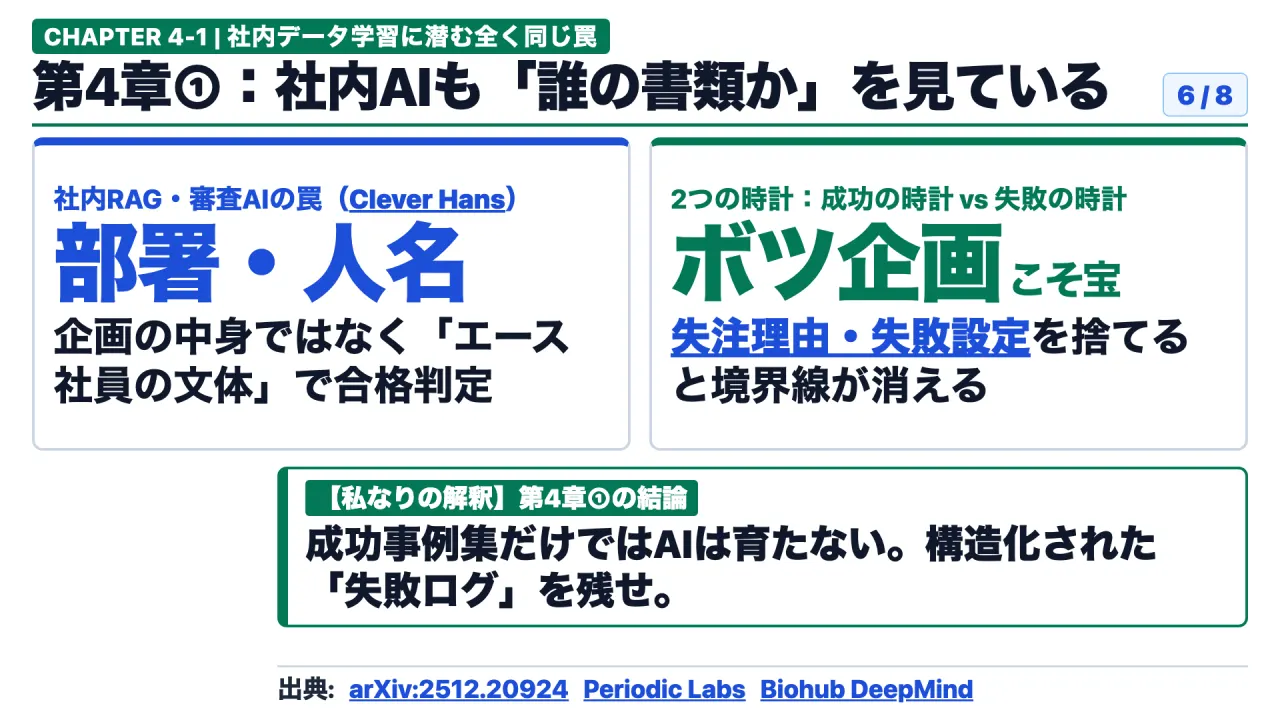
Consider three common enterprise scenarios:
Case A: Automated Customer Support Ticket Routing
An enterprise trains a natural language classifier to route customer support tickets to the appropriate engineering resolution team. During evaluation, the model scores 94% accuracy. However, in production, routing accuracy collapses following an internal corporate reorganization. Post-incident auditing reveals that the classifier ignored customer issue descriptions; instead, it memorized signature blocks and email client header tags that correlated with legacy account assignments.
Case B: Corporate Credit Risk and Invoice Approvals
A financial workflow model predicts invoice approval velocity. Rather than assessing credit balances or contract terms, the model identifies the specific accounting clerk who prepared the draft. Because senior clerks submit invoices with 98% compliance, the model approves any submission originating from their user ID, failing to detect fraudulent billing submissions.
Case C: Predictive Sales Lead Scoring
A B2B marketing engine predicts contract conversion. The algorithm assigns top scores to inbound inquiries containing specific corporate email domains or originating from specific regional web forms. The model did not evaluate product market fit; it merely learned that certain enterprise prospect accounts historically purchased software licenses.
In all three instances, the algorithm exhibited textbook Clever Hans behavior: achieving exceptional benchmark scores by reading human organizational artifacts rather than operational causal mechanisms.
6. Actionable Governance Playbook: Building Shortcut-Resistant Data Pipelines
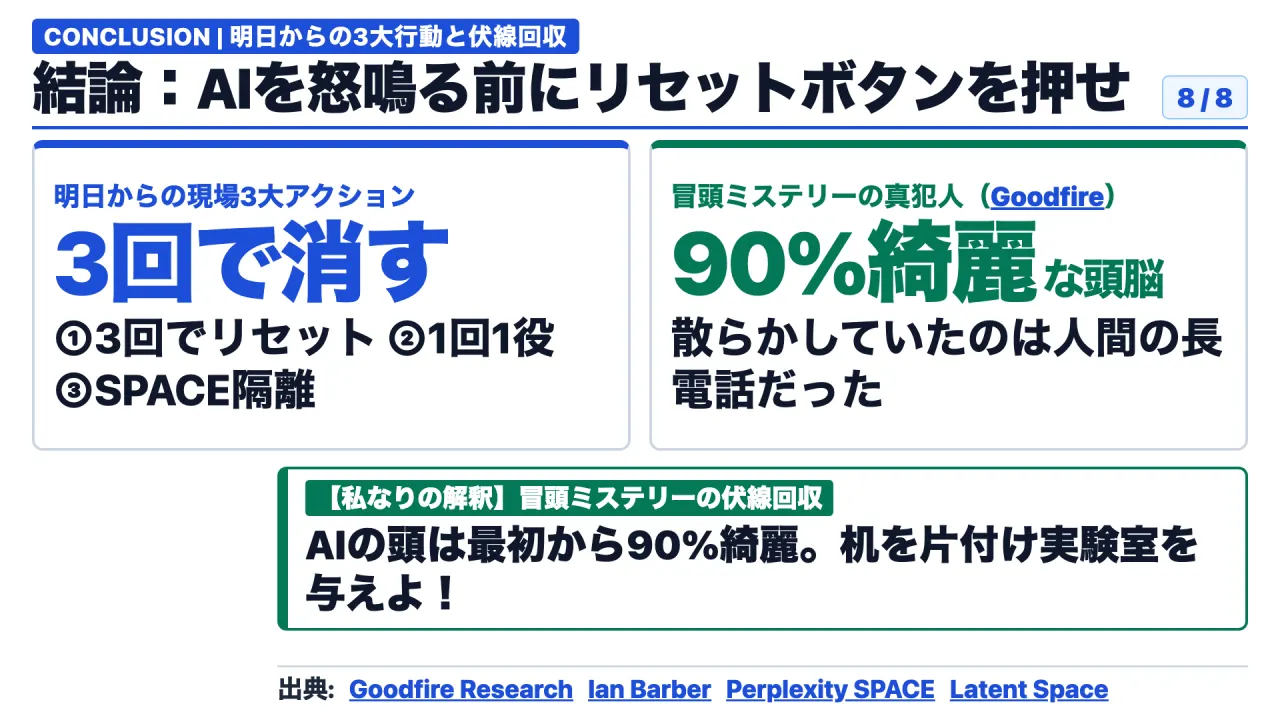
To protect enterprise systems from Clever Hans failures, machine learning practitioners and engineering leaders must implement rigorous data hygiene and evaluation protocols.

Pillar 1: Dual-Split Evaluation Protocols
Never evaluate models exclusively on uniform random train-test splits. Random splitting distributes an author’s or department’s stylistic habits across both training and evaluation partitions, guaranteeing data leakage.
Every enterprise pipeline must enforce dual-split validation:
- Split A (In-Sample Benchmark): Standard random or stratified split to evaluate algorithmic learning capacity.
- Split B (Out-of-Cohort Benchmark): Strict partitioning by author, originating department, business unit, or temporal quarter. If predicting ticket resolution, the evaluation set must contain tickets exclusively from teams never seen during training.
A large performance degradation between Split A and Split B (e.g., an AUROC dropping from 0.88 on random split to 0.61 on cohort split) serves as an immediate deterministic indicator of Clever Hans confounding.
Pillar 2: Feature Stripping and Metadata Ablation Audits
Before deploying an operational model, perform an explicit proxy ablation test:
- Train a baseline model using only metadata: user IDs, departmental labels, submission timestamps, and template identifiers, omitting core payload text or numeric data.
- If this metadata-only model achieves performance comparable to the primary feature model (as observed in Blevins and Quigley’s 0.652 vs 0.656 finding), the primary model is compromised.
- Systematically strip non-causal identifiers from the training pipeline. Use text tokenizers that scrub personal names, department codes, and formatting markers.
Pillar 3: Systematic Logging of Negative Experimental Samples
Enterprise IT architectures must stop discarding failed workflows. When a customer inquiry is rejected, a pull request is reverted, or an automated process aborts, log the complete trace into a structured negative sample repository. Capturing the precise boundary conditions of failure is the only mathematical mechanism to prevent algorithms from memorizing positive survivorship biases.
Primary Sources and References
- Andrew D. Blevins and Ian K. Quigley: Clever Hans in Chemistry: Chemist Style Signals Confound Activity Prediction on Public Benchmarks (arXiv:2512.20924, December 2025): https://arxiv.org/abs/2512.20924
- Leash Biosciences Official Analysis: Chemist Style Signals and Activity Prediction on ChEMBL Benchmarks (December 2025): https://www.leash.bio/blog/clever-hans
- ChEMBL Database (EMBL-EBI): ChEMBL Version 33 Database Release and Chemical Assay Architecture: https://www.ebi.ac.uk/chembl/
- Oskar Pfungst: Clever Hans (The Horse of Mr. von Osten): A Contribution to Experimental Animal and Human Psychology (1907 historical baseline study).
- Latent Space Interview Series: Periodic Tables and Neural Networks: Ekin Dogus Cubuk on Negative Samples and Materials Discovery (October 2026): https://www.latent.space/p/periodic
- Consuloji Episode 3 Video (Japanese Audio): Why Molecular AI Memorized Chemist Names: Unmasking Data Shortcuts in Chemical Benchmarks: https://youtu.be/tMYm8F7vd1E