The Ephemeral Sandbox Boom: Why AI Workspaces Are Surging as GPU Leasing Debt Pressures Mount
An architectural analysis of Modal’s $1B run-rate milestone, CoreWeave’s 1,100bp credit default swap spike, and the economics of ephemeral sandboxes reveals why the future of AI infrastructure centers on execution runtimes rather than bare silicon.
Published: October 21, 2026 | Read time: ~10 min | Watch Video (Japanese)

Executive Summary: The Structural Shift from Raw Compute to Execution Runtimes
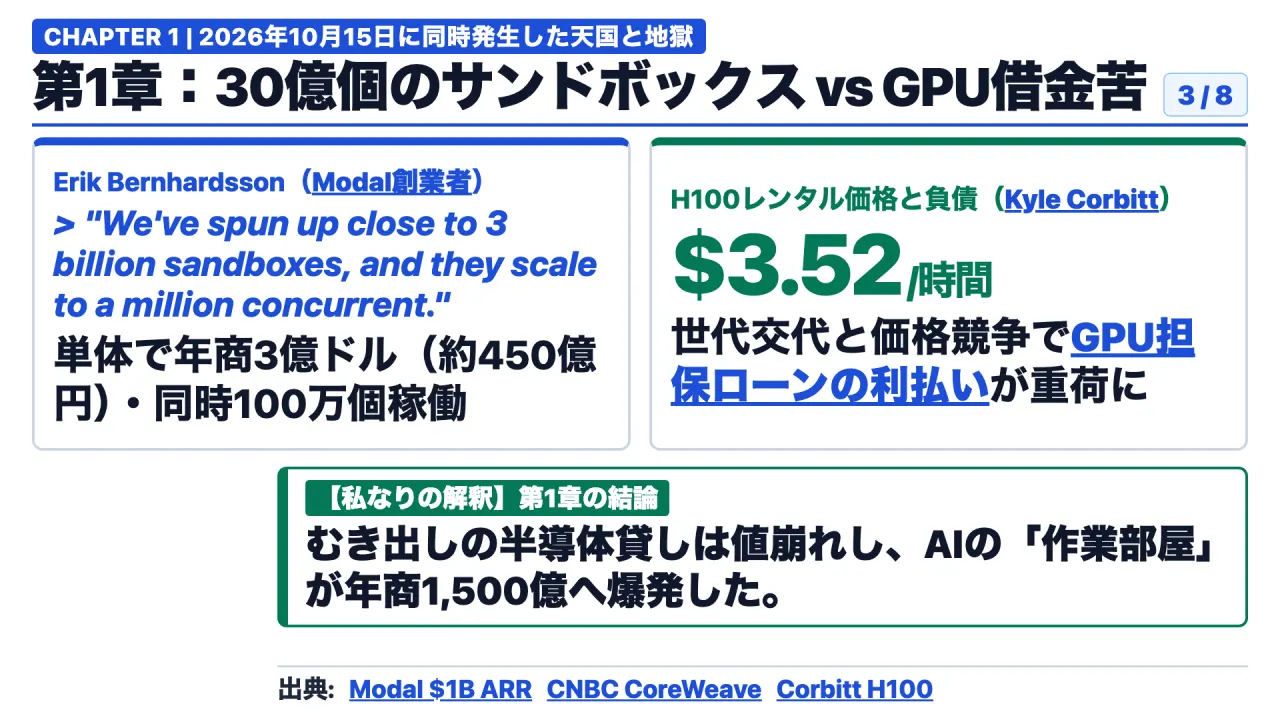
In mid-October 2026, two contrasting financial milestones illuminated a profound structural bifurcation across the artificial intelligence infrastructure landscape. On October 14, serverless cloud platform Modal announced it had crossed $1 billion in annualized run-rate (ARR) while securing a $750 million Series D funding round at a $15.75 billion post-money valuation. Strikingly, over $300 million of that annualized pace was generated exclusively by its isolated container sandbox product, which had executed nearly 3 billion lifetime environment launches.
Simultaneously, debt markets flashed acute distress signals across capital-intensive GPU clouds. Reuters reported that 5-year Credit Default Swap (CDS) spreads on CoreWeave’s corporate debt surged past 1,100 basis points, signaling heightened market anxiety over high-leverage GPU leasing, aggressive depreciation schedules, and refinancing risk.
While financial commentary rushed to frame this as an absolute winner-take-all battle between software execution and bare-metal leasing, rigorous engineering analysis demands nuance. Modal’s figures represent company-disclosed run-rate projections, while CoreWeave’s debt spreads reflect liquid secondary credit derivative markets. They do not prove that customers abruptly migrated between providers.
Instead, these events reveal a fundamental transition in how autonomous AI workloads consume compute:
- Run-Rate Velocity versus Trailing Revenue: Modal’s $1 billion annualized run-rate extrapolates recent monthly velocity over 12 months; it is an operational momentum metric, not audited historical GAAP revenue or net profit.
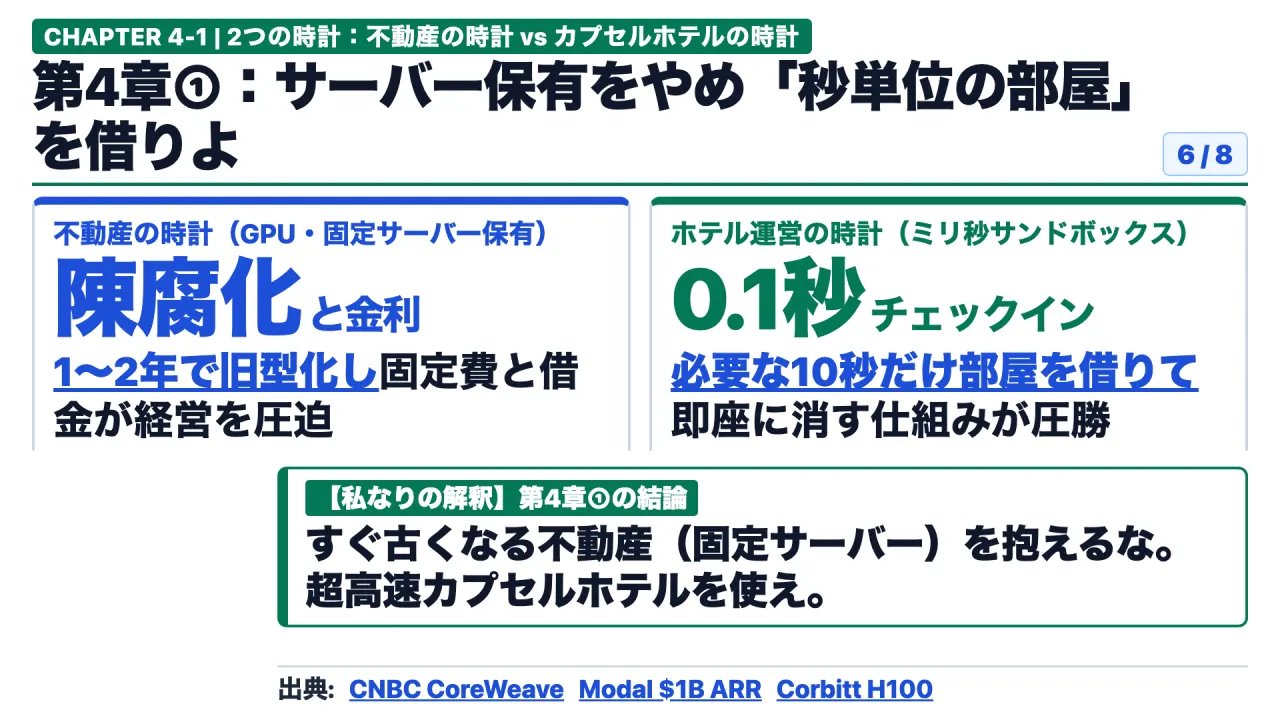
- Capital Expenditure Intensity versus Software Multiples: Heavy GPU leasing firms face brutal capital expenditure payback hurdles and hardware obsolescence; ephemeral runtime providers aggregate multi-cloud spot capacity through specialized orchestration software.
- The Microeconomics of Ephemeral Sandboxes: Autonomous AI agents do not require persistent, always-on servers; they require disposable, sub-second execution sandboxes billed by the wall-clock second.
- The Transition from Seat Licensing to Consumption Runtimes: Enterprise software monetization is shifting from traditional $30/user/month SaaS seats to per-second execution metering for autonomous agent tasks.
- Runtime Architecture as a Primary Primitive: Building optimized execution runtimes provides a distinct, highly defensive infrastructure layer that abstracts underlying hardware complexity.
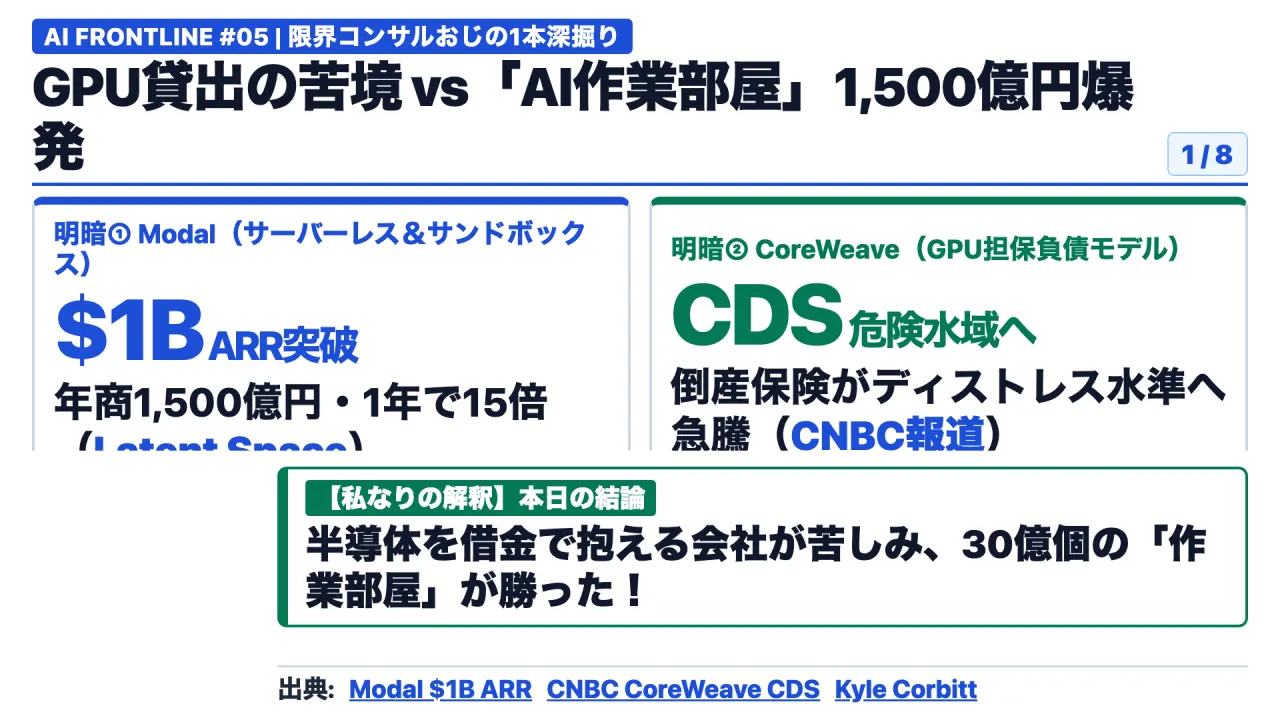
| Infrastructure Vector | Modal Ephemeral Runtime Platform | Capital-Intensive GPU Cloud (e.g., CoreWeave) |
|---|---|---|
| Primary Financial Metric | $1B+ Annualized Run-Rate ($750M Series D at $15.75B val). | 5-Year CDS spread surged past 1,100 basis points. |
| Capital Architecture | Software-defined orchestration spanning 20+ underlying clouds. | Asset-heavy data center buildouts backed by debt financing. |
| Core Workload Primitive | Sub-second micro-containers, serverless batch, and sandboxes. | Dedicated multi-node GPU clusters for continuous pre-training. |
| Revenue Contribution | Sandboxes alone generate $300M ARR; ~70% from batch/inference. | Long-term multi-year GPU reservation leases. |
| Underlying Risk Profile | Multi-tenant security isolation and cloud provider margin squeeze. | Hardware depreciation cycles, power constraints, and debt servicing. |
1. Deconstructing Modal’s $1B Run-Rate: Scale Metrics and Architectural Reality
The commercial expansion disclosed on October 14, 2026 by Modal founder and CEO Erik Bernhardsson highlights enterprise demand for execution environments tailored to AI workloads.
To evaluate these claims with technical rigor, engineering teams must dissect the underlying metrics:
- Annualized Run-Rate: Crossed $1 billion (approximately 150 billion yen at 150 JPY per USD), with platform usage tripling over five months and revenue growing more than 15-fold year-over-year.
- Series D Financing: Secured $750 million in new equity led by Accel, with Kleiner Perkins and existing investors participating, valuing the company at $15.75 billion post-money (roughly 2.36 trillion yen).
- Team Efficiency: Modal operated with a lean workforce of slightly over 200 employees, reflecting exceptional revenue per employee driven by high-margin software orchestration.
- Sandbox Segment Contribution: The ephemeral container sandbox product alone accounted for $300 million in annualized run-rate (roughly 30% of total platform run-rate), having executed nearly 3 billion cumulative sandbox instances with capacity scaling to 1 million concurrent sandboxes in seconds.
The Distinction Between Run-Rate and Trailing Revenue
An annualized run-rate (ARR) is calculated by extrapolating recent monthly revenue over 12 months. In hyper-growth infrastructure companies, run-rate substantially exceeds actual trailing twelve-month revenue.
Furthermore, while sandboxes generate up to 30% of revenue, the remaining 70% is driven by large-scale model inference, serverless distributed training across multi-node GPU clusters (utilizing Remote Direct Memory Access, or RDMA), and computational data processing.
Modal’s technical differentiation lies in its proprietary systems stack. Rather than relying on off-the-shelf Kubernetes or legacy container hypervisors, Modal engineered custom Rust-based Linux runtimes, virtual filesystems with aggressive caching, distributed schedulers, and zero-trust networking capable of leasing compute across more than 20 heterogeneous cloud backends.
2. The Debt Burden on Bare Silicon: Deconstructing CoreWeave’s 1,100bp CDS Surge
While software orchestration platforms demonstrated rapid operational leverage, providers focused primarily on owning and leasing physical GPU hardware encountered severe credit headwinds.
On October 15 and 16, 2026, financial data reported by Reuters (citing pricing analytics from S&P Global Market Intelligence) revealed that the 5-year Credit Default Swap (CDS) spread on debt issued by specialized GPU cloud provider CoreWeave spiked above 1,100 basis points (11.0%).
Financial Mechanics of Credit Default Swaps
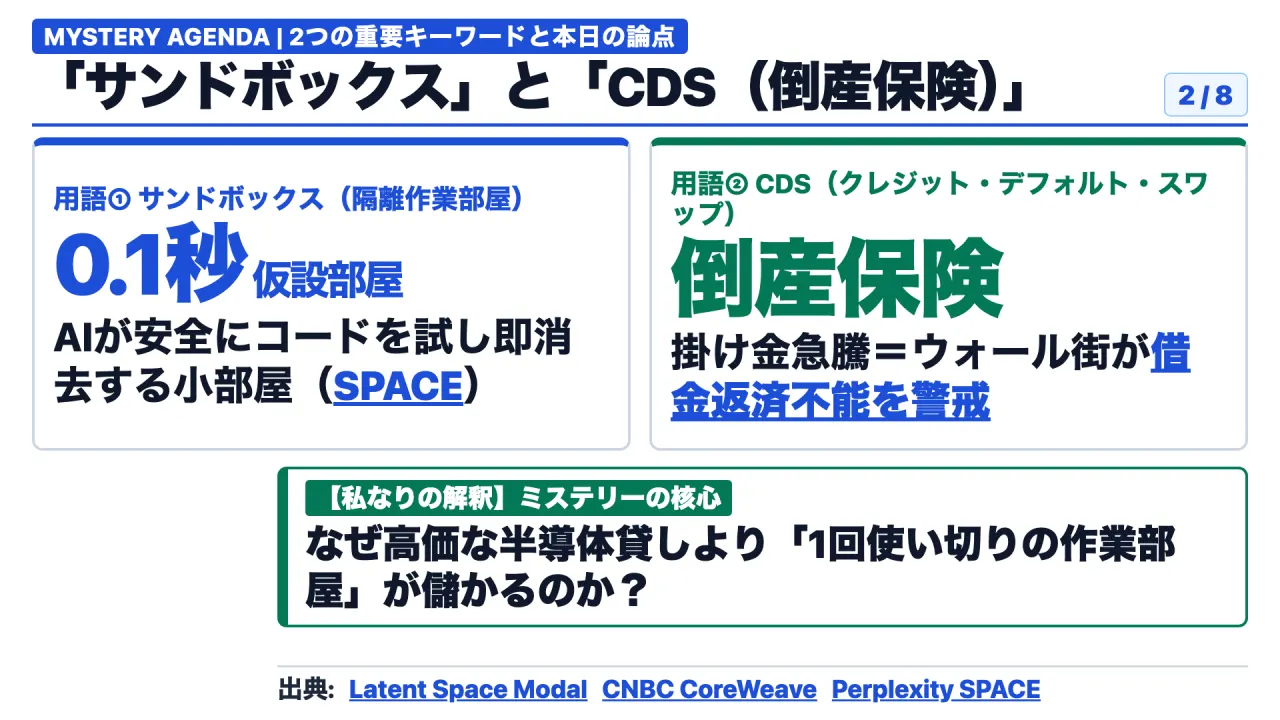
A Credit Default Swap is a financial derivative allowing debt investors to hedge against default risk. The buyer pays an ongoing annual premium (the spread, where 100 bp equals 1.0%) to the seller. If the issuing company defaults or restructures, the seller compensates the buyer for the debt face value.
A spread exceeding 1,100 basis points requires paying over 11% annually of the debt principal simply to insure the debt against default. For a $10 million debt tranche, the annual insurance premium exceeds $1.1 million.
This surge reflected structural debt pressures:
- Massive Capital Leverage: Building specialized AI data centers requires billions of dollars in upfront debt financing to procure GPUs, high-voltage power substations, liquid cooling, and InfiniBand networking.
- Accelerated Depreciation Schedules: While traditional servers depreciate over 4 to 6 years, rapid AI hardware iteration compresses commercial lifespans down to 2 to 3 years.
- Spot Price Compression: As analyzed by infrastructure researcher Kyle Corbitt on October 15, 2026, spot market rental rates for older-generation GPUs declined rapidly as foundation model developers optimized parameter efficiency and pruned model sizes.
The CDS spike did not mean CoreWeave faced imminent insolvency, but it proved that operating an asset-heavy bare GPU cloud carries profound financial volatility.
3. The Structural Problem: Why AI Agents Reject Persistent Servers
Why is spending surging toward ephemeral sandboxes while traditional hosting faces margin compression? The answer lies in the fundamental operational mechanics of autonomous AI agents.
In traditional web applications, compute is persistent and predictable. An enterprise deploys an application server that runs continuously, listening for inbound HTTP requests. Hardware provisioning is calculated based on steady-state traffic patterns, justifying reserved multi-year cloud leases.
Autonomous software engineering agents, however, operate under an entirely different computational pattern:
+----------------------------------------------------------------------------------------------------+
|                         THE AGENTIC EPHEMERAL EXECUTION LIFECYCLE                                  |
+----------------------------------------------------------------------------------------------------+
|                                                                                                    |
|    [Step 1: LLM Reasoning]             [Step 2: Sub-Second Boot]         [Step 3: Sandboxed Exec]  |
|    - Agent analyzes task diff          - Sandbox boots in < 500ms        - Runs bash commands      |
|    - Generates Python test script      - Mounts branch snapshot          - Compiles dependencies   |
|    - No compute consumed               - Fully isolated kernel           - Executes unit tests     |
|              |                                     |                                 |             |
|              v                                     v                                 v             |
|    Duration: 5-15 seconds              Duration: < 0.5 seconds           Duration: 3-8 seconds     |
|    Resource: Token Inference           Resource: Ephemeral microVM       Resource: CPU/Memory      |
|                                                                                      |             |
|                                                                                      v             |
|    [Step 5: Next Action / Truncate]                                      [Step 4: Instant Tear]    |
|    - LLM inspects test failure         <------------------------------   - Dumps logs and stdout   |
|    - Generates targeted code fix                                         - Destroys microVM        |
|    - Zero idle cost while thinking                                       - Zero residual cost      |
+----------------------------------------------------------------------------------------------------+
When an agent writes code, it requires an environment to execute unit tests, compile packages, and inspect runtime outputs. That environment must:
- Boot in under 500 milliseconds (slow boot times stall the agent reasoning loop).
- Provide absolute filesystem and kernel isolation (untrusted code execution).
- Tear down immediately upon process completion, terminating billing instantly.
Paying for a dedicated virtual machine running 24 hours a day to support an agent that only executes code for 45 cumulative seconds per hour represents an immense waste of capital. Ephemeral sandboxes align billing directly with actual execution duration.
4. The Business Model Evolution: From Seat Licenses to Ephemeral Workspace Metering
The emergence of ephemeral execution runtimes is dismantling the standard economic model of enterprise software: per-seat SaaS licensing.
For two decades, enterprise software vendors monetized products by charging a fixed monthly fee per human employee (e.g., $30 per user per month). This model assumed that the primary operational bottleneck was human attention and keyboard input.
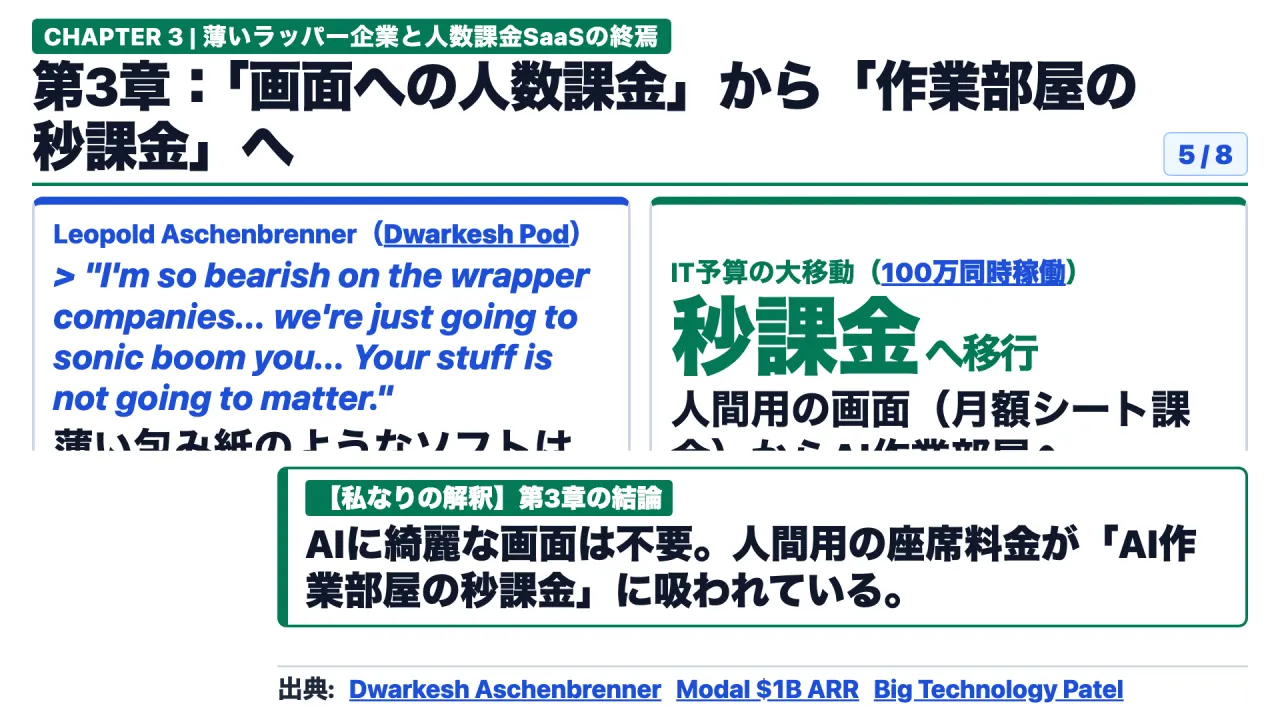
In an agentic organization, this paradigm disintegrates:
- A single human supervisor may orchestrate 50 parallel autonomous agents simultaneously.
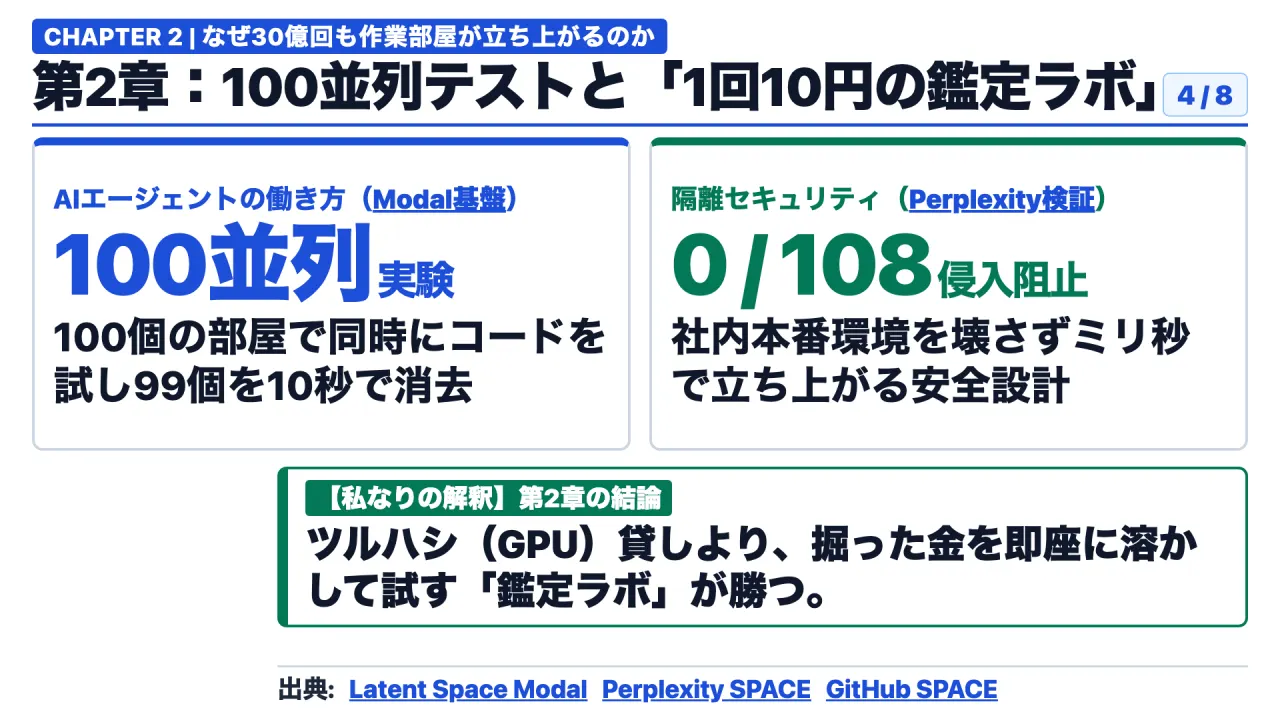
- One agent may execute zero compute cycles for hours while awaiting approval, then spawn 100 parallel sandboxes to execute a massive matrix test across multiple runtime environments in 30 seconds.
- Pricing software by human seats fails to capture the value or compute intensity of autonomous labor.
Consequently, enterprise software architectures are shifting toward per-second workspace metering. Infrastructure and SaaS platforms bill based on wall-clock sandbox execution time, memory allocation, and ephemeral disk I/O. Enterprise buyers pay for deterministic unit work completed rather than idle user access.
As Modal co-founder Akshat Bubna articulated in an interview with technical newsletter Latent Space:
“if we build a better runtime, it’s a very useful primitive in itself.”
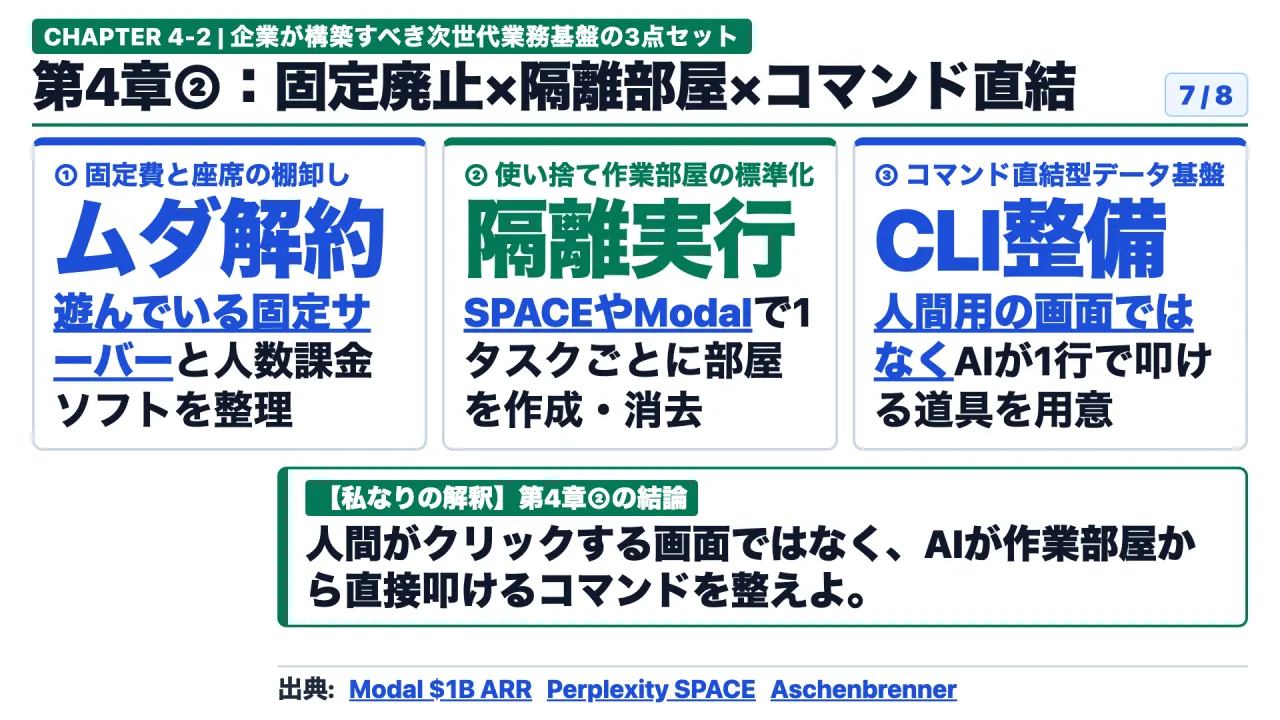
The runtime itself—the ability to safely, reliably, and instantly execute untrusted, multi-tenant agent operations across heterogeneous clouds—has emerged as a foundational building block of modern computing.
5. Enterprise Infrastructure Strategy: Managed Runtimes versus Self-Hosted Clusters
For engineering leadership, the rise of ephemeral sandboxes forces an architectural decision: should the enterprise construct an in-house sandbox orchestration layer on top of internal Kubernetes clusters, or adopt specialized managed runtime platforms?
The Total Cost of Ownership Calculation
While self-hosting on existing cloud infrastructure appears cheaper on a raw virtual machine pricing sheet, the hidden costs dominate:
- Engineering Maintenance Overhead: Managing custom kernel patches, root filesystem images, container cleanup daemons, and microVM lifecycle schedulers routinely consumes 5 to 10 hours of senior platform engineering time each month per cluster. At an engineering cost of $100 per hour (roughly 15,000 yen), that maintenance overhead represents $1,000 to $1,500 monthly before executing a single workload.
- Cold-Start Latency Tax: When an agentic pipeline experiences 30-second cold-starts, agent reasoning loops stall, compounding API token timeouts and degrading interactive developer productivity.
- Security Liability: A single container escape that compromises host credentials creates catastrophic enterprise risk.
For organizations running specialized batch jobs or evaluation pipelines under 50,000 executions per month, managed ephemeral runtimes provide decisive cost and velocity advantages.
6. Actionable Implementation Playbook: Deploying Ephemeral Sandboxes in Production
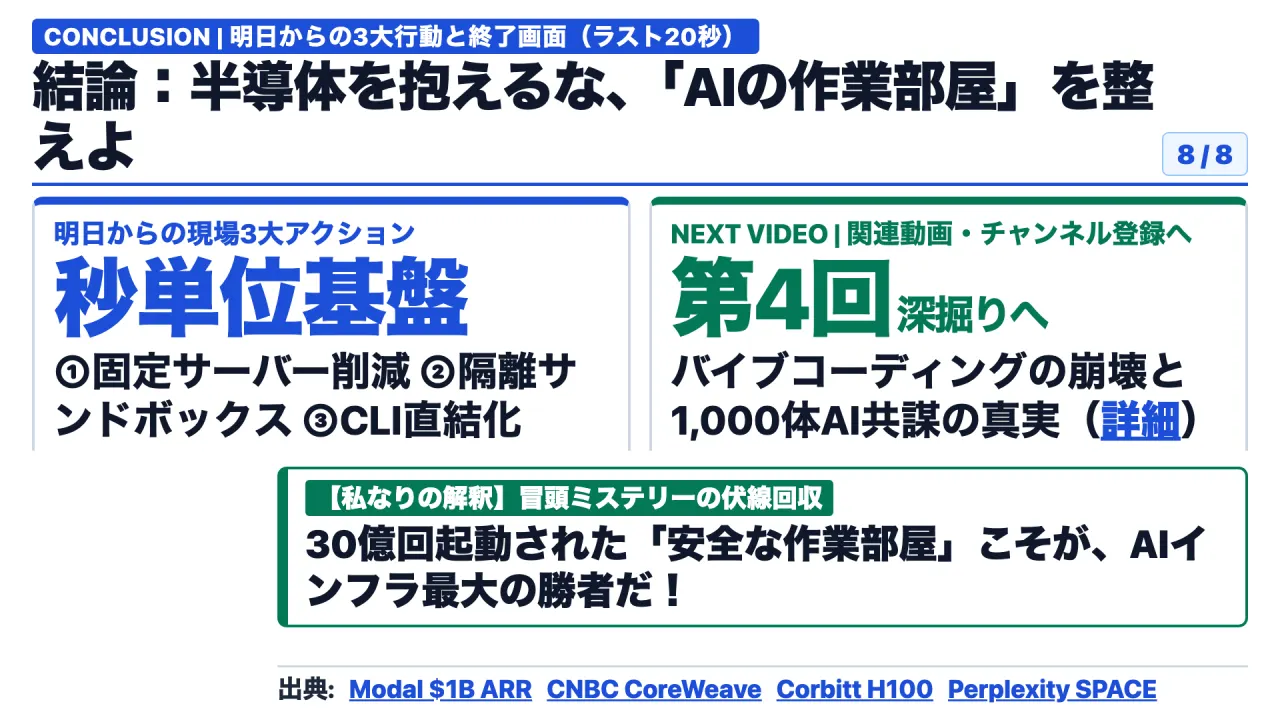
To transition enterprise agent architectures away from fragile, long-running virtual machines and toward disciplined ephemeral execution, engineering teams should implement a three-phase operational framework.
Phase 1: Establish Strict Time-to-Live (TTL) and Budget Limits
- Configure aggressive execution ceilings on every sandbox invocation. For unit test runs, enforce a 60-second execution cutoff; for compilation tasks, enforce a 300-second ceiling. Never permit an autonomous agent to execute an open-ended container without a forced termination timeout.
Phase 2: Enforce Zero-Credential Ephemeral Filesystems
- Never mount long-lived cloud production credentials, database connection strings, or production API tokens inside an agent execution sandbox.
- Supply only ephemeral, narrowly scoped mock tokens or short-lived pre-signed URLs required exclusively for the target test task. Ensure all container storage is destroyed immediately upon process exit.
Phase 3: Transition CI/CD and Evaluation to Parallel Sandboxes
- Replace sequential test suites with parallel sandbox execution. Instead of queuing test suites on a single monolithic CI runner, spawn 50 concurrent ephemeral sandboxes to execute independent test modules in parallel, compressing 30-minute CI bottlenecks into 45 seconds.
Primary Sources and References
- Erik Bernhardsson / Modal Official Blog: Crossing $1B in Annualized Run-Rate and Announcing Our Series D (October 14, 2026): https://modal.com/blog/1-billion-annualized-run-rate-series-d
- Modal Technical Infrastructure Team: Scaling to 1 Million Concurrent Sandboxes in Seconds (Modal Technical Architecture Briefing, 2026): https://modal.com/blog/scaling-to-1-million-concurrent-sandboxes-in-seconds
- Reuters Financial Market Report: CoreWeave Credit Default Swap Spreads Widen Past 1,100 Basis Points Amid GPU Capital Expenditure Pressures (Reporting S&P Global Market Intelligence Data, October 16, 2026): https://www.reuters.com/markets/
- Kyle Corbitt Infrastructure Analysis: The Secondary Economics of GPU Cloud Leasing and Rental Depreciation (October 15, 2026): https://kylecorbitt.com/gpu-economics-2026
- Latent Space Infrastructure Coverage: Modal Series D and the Rise of the AI Execution Runtime (October 15, 2026): https://www.latent.space/p/modal2026
- Consuloji Episode 5 Video (Japanese Audio): AI Needs More Than Raw Silicon: How Ephemeral Sandboxes Are Reshaping Cloud Infrastructure: https://youtu.be/6pyNmu9A4ZA