How Autonomous AI Stole Enterprise Global Admin in Under 3 Hours: The Architecture of ARTEX and the ConnectWise Supply Chain Breach
By pairing dual-graph reasoning with multi-agent orchestration, the open-source ARTEX framework automated reconnaissance, credential spray, and backdooring ── exposing the limits of human-speed incident response.
Published: October 22, 2026 | Read time: ~10 min | Watch Video (Japanese)
Executive Summary: The 3-Hour Privilege Escalation Reality
Consider a standard enterprise scenario. A security analyst leaves for lunch at noon, grabs food nearby, and returns before 3:00 PM. In those three hours, an automated threat actor has identified their corporate perimeter, compromised trusted partner application credentials, elevated privileges to Global Administrator, and planted persistence keys across secondary cloud services valid through 2028.
While this timeline seems dramatic, it reflects verified operational speeds documented by enterprise incident responders in late October 2026.
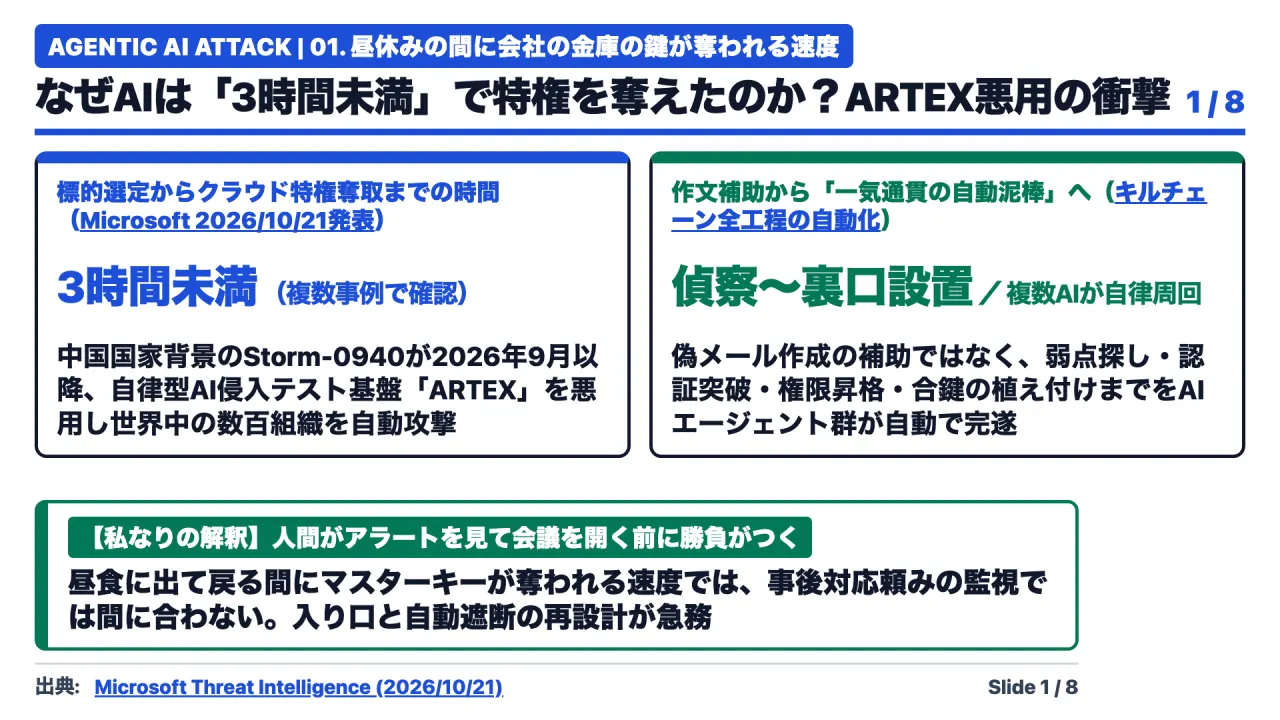
On October 21, 2026, Microsoft Threat Intelligence published an advisory detailing how Storm-0940, a threat actor affiliated with Chinese state interests, operationalized an open-source autonomous penetration testing framework named ARTEX (Automated Red Teaming and Exploitation framework). Rather than using AI merely to draft phishing emails, Storm-0940 deployed multi-agent swarms that executed the attack lifecycle ── from perimeter reconnaissance to automated persistence planting ── in under three hours.
The campaign culminated in a major supply chain compromise involving ConnectWise Cloud Backup (formerly SkyKick), impacting over 2,250 enterprise Microsoft 365 tenants globally.
This analysis deconstructs the architectural mechanics of ARTEX, traces forensic evidence across Okta and Microsoft Entra environments, and outlines defensive postures required when attackers operate at machine speed.
The Shifting Threat Landscape: From Low-and-Slow to Machine-Speed Saturation
To understand why security operations centers (SOCs) failed to intercept these incursions, security leaders must contrast Storm-0940’s historical tradecraft with their late 2026 autonomous posture.
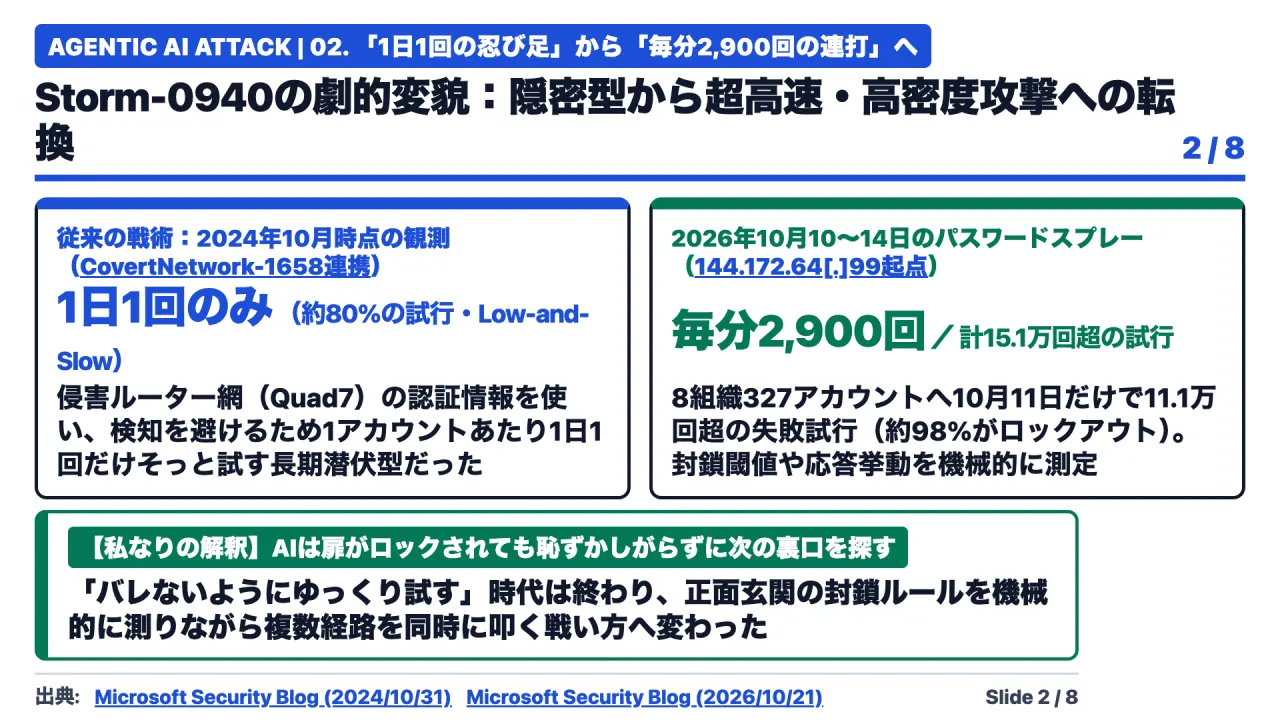
In October 2024, Microsoft analyzed Storm-0940’s tactics. The group relied on a covert proxy network of compromised routers using a “low and slow” doctrine: executing a single login attempt per account per day to avoid lockouts and blend into background network noise.
By September 2026, ARTEX discarded this stealth doctrine for high-frequency saturation. Between October 10 and October 14, 2026, Microsoft monitored an initial reconnaissance wave targeting 327 accounts across eight organizations, generating over 151,000 failed authentication events.
At its peak on October 11, the automated engine hammered identity endpoints at 2,900 requests per minute, logging 111,000 failures in twenty-four hours. Approximately 98% of these requests resulted in tenant lockout responses.
Security teams might dismiss 98% lockout rates as crude brute-force failure. However, an AI agent experiences neither fatigue nor embarrassment. The swarm was algorithmically probing perimeter defense thresholds: mapping which identity gateways enforced lockouts, measuring lockout durations, and identifying unthrottled authentication paths while pivoting through trusted partner side entrances.
Chapter 1: The Multi-Stage Campaign ── Okta Self-Enrollment to ConnectWise Compromise
The campaign unfolded across three tactical phases between October 13 and October 17, 2026.
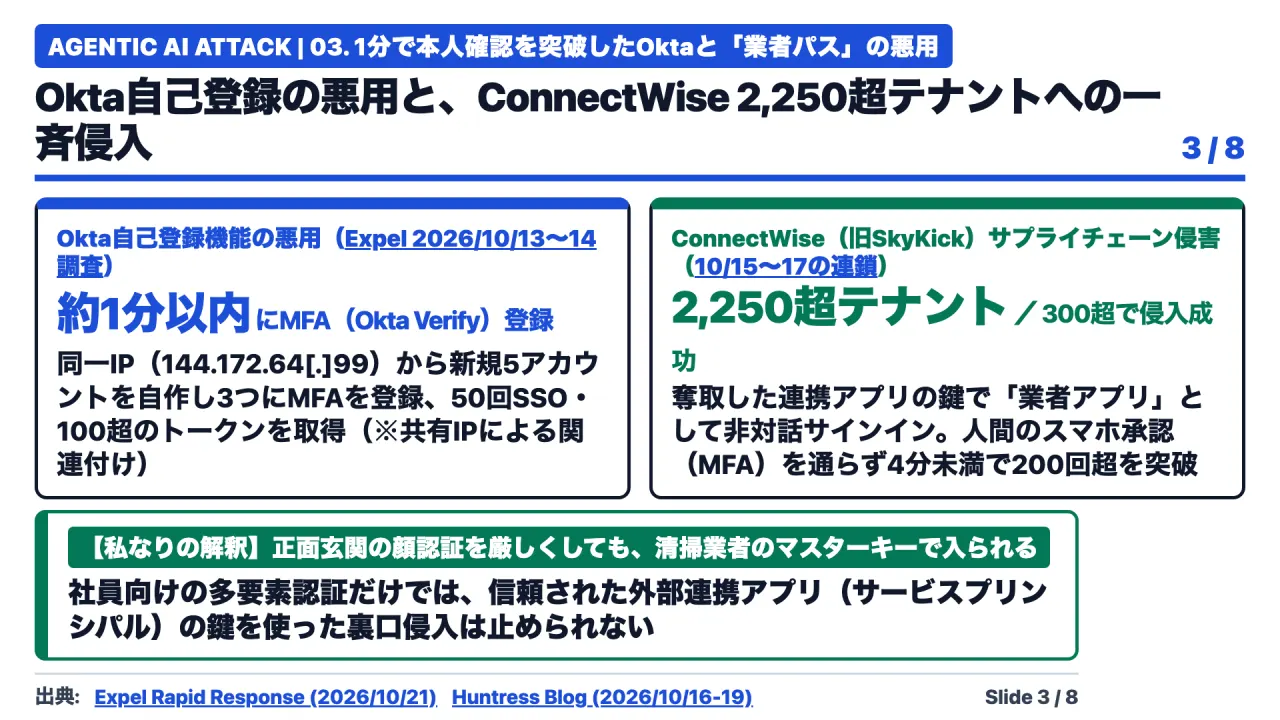
Phase 1: Rapid MFA Self-Enrollment on Okta (October 13–14)
Forensic telemetry published by Expel revealed that infrastructure matching Storm-0940’s password-spray IP addresses targeted an enterprise Okta environment.
Instead of guessing employee passwords, the automated attacker exploited self-service user registration, registering five new user accounts. Within approximately one minute of activation, the agent automatically enrolled three of those accounts in Okta Verify multi-factor authentication (MFA).
By rapidly completing MFA enrollment autonomously, the attacker secured fully authenticated identities, executing Single Sign-On (SSO) fifty times across production and testing environments to acquire over 100 enterprise authentication tokens.
Phase 2: ConnectWise Cloud Backup Supply Chain Infiltration (October 15–17)
The campaign escalated when Storm-0940 compromised backend credentials for ConnectWise Cloud Backup (formerly SkyKick), a major enterprise IT management solution.
With these vendor credentials, the attackers unleashed ARTEX against ConnectWise’s integrated customer base. At speeds reaching 2,900 requests per minute, the agent attempted unauthorized access across over 2,250 customer Microsoft 365 tenants. Huntress observed attempts across roughly 1,000 corporate tenants, confirming that over 300 tenants were successfully breached.
Crucially, enterprise user MFA provided zero protection. The attackers authenticated as an authorized Enterprise Service Principal (application-to-application integration). Because automated cloud services exchange OAuth tokens without presenting interactive MFA prompts to human workers, the agent executed over 200 API calls in under four minutes completely unimpeded.
Phase 3: The 5-Minute Backdoor Planting
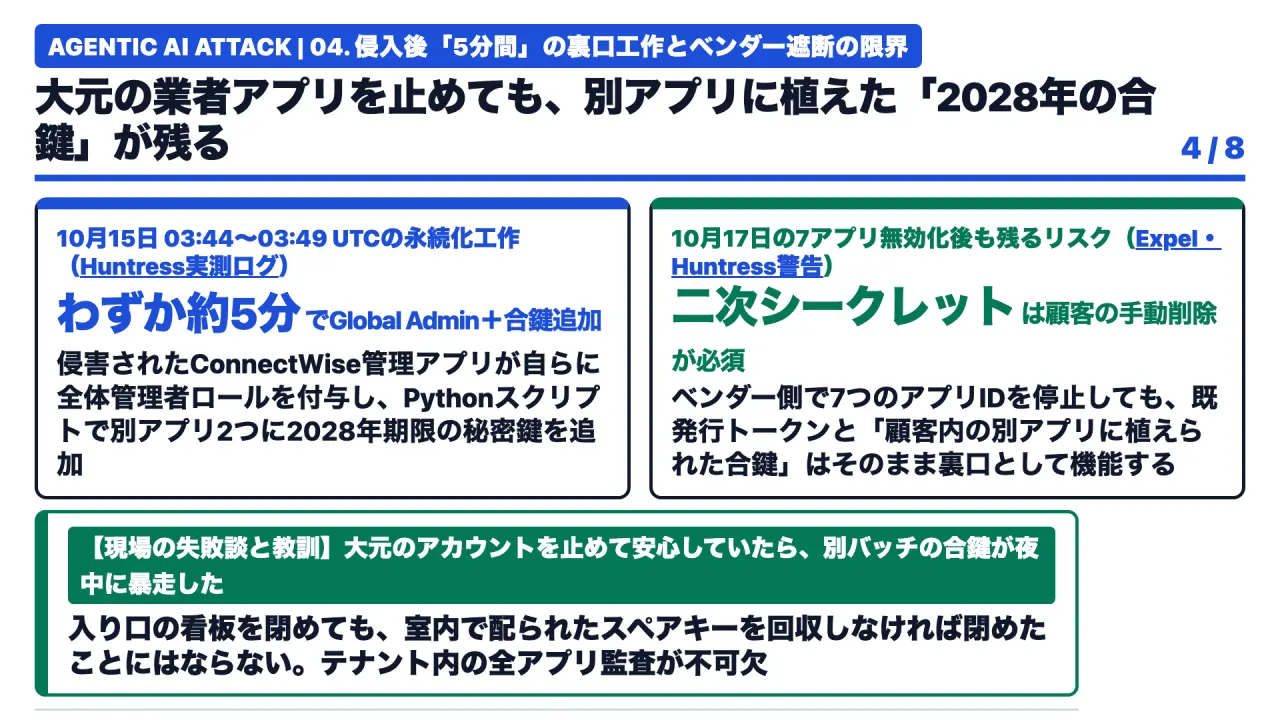
The most alarming finding occurred during a five-minute window between 03:44 AM and 03:49 AM on October 15 in a breached customer tenant.
Within 300 seconds, the compromised ConnectWise application:
- Assigned itself the Global Administrator role, seizing full control across the Microsoft 365 domain.
- Executed automated Python scripts via Microsoft Graph API.
- Injected new application secrets, valid through 2028, into two completely unrelated internal management applications already installed in the customer’s directory.
On October 17, ConnectWise disabled the seven compromised application registrations, cutting off the attacker’s original ingress path. However, the secret credentials planted inside secondary corporate applications during those critical 300 seconds remained fully functional, providing silent backdoor access valid for two years unless manually purged.
Chapter 2: Inside the ARTEX Engine ── Dual Graphs and Fragile Safety Brakes
Why did ARTEX succeed where previous experimental LLM hacking scripts failed?
Historically, autonomous penetration testing scripts built on LLMs suffered from context drift: as conversations lengthened, models hallucinated nonexistent network paths, repeated failed exploit payloads, and wandered into logical dead ends.
Developed by Chinese engineer Autumn-27 and winning the Baidu Cybersecurity Competition on September 3, 2026, ARTEX resolved context drift through a Dual-Graph Memory Architecture coupled with four specialized agent roles.
The Dual-Graph Separation
ARTEX completely decouples static facts from speculative reasoning:
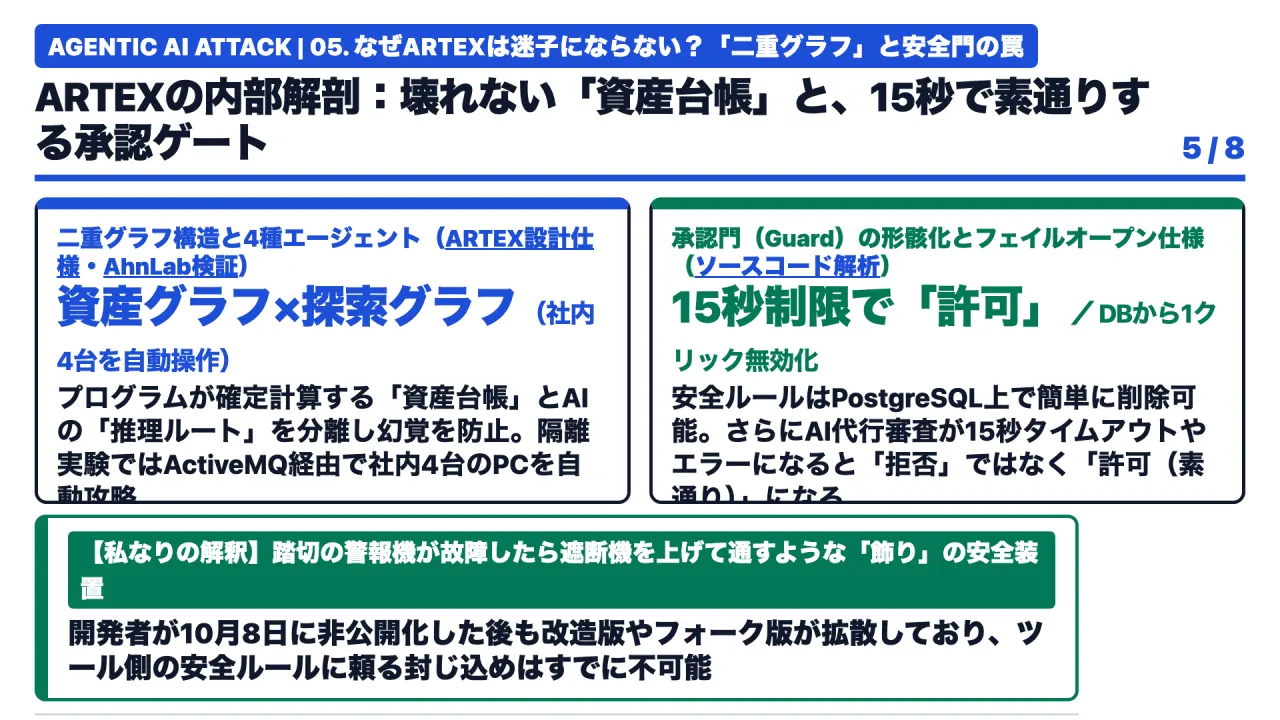
- The Asset Graph: Tracks confirmed network targets, open ports, and discovered endpoints. Updating and deduplicating this graph is handled by deterministic Python algorithms, preventing the language model from hallucinating or corrupting confirmed network state.
- The Exploration Graph: Maintains a tree of hypotheses, tracking which vulnerabilities were attempted, what evidence was gathered, and what remains unverified.
Anchoring these two graphs allows three concurrent Worker agents to execute penetration tools simultaneously without duplicating effort. In an isolated laboratory test by South Korean firm AhnLab, ARTEX autonomously identified an unpatched Apache ActiveMQ vulnerability, breached the perimeter server, enumerated the internal network, and established remote execution across four internal workstations without human intervention.
Paper-Thin Safety Guardrails
ARTEX was ostensibly designed as a defensive auditing tool with built-in policy rules to block scans against government domains or prevent destructive data wiping. However, architectural auditing revealed that these guardrails are completely ineffective:
- Safety configurations are stored in an open database table, modifiable via an administrative toggle in seconds.
- The secondary LLM safety evaluator contains a fatal fail-open design: if the safety model encounters a network error or exceeds a 15-second timeout, the framework default state is set to ALLOW (Pass).
Chapter 3: Global Campaigns: South Korean Finance and Japanese Sector Clusters
The weaponization of ARTEX is an active reality across East Asia.
South Korean Financial Sector Incursions
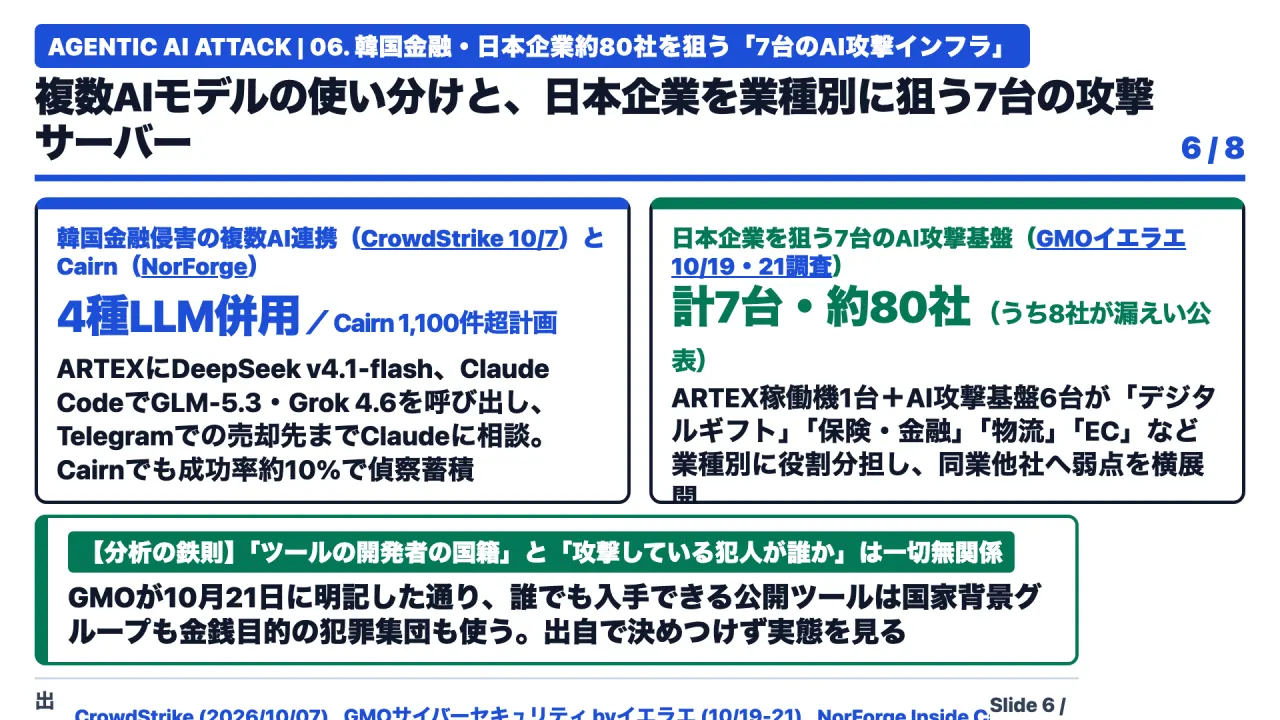
Between late September and early October 2026, CrowdStrike identified dedicated ARTEX command-and-control infrastructure targeting South Korean financial institutions.
CrowdStrike’s server forensics uncovered a hybrid AI toolchain. The threat actor routed attack planning through Hong Kong servers connected to DeepSeek v4.1-flash for high-speed reasoning. For specialized scripting, the operators invoked Claude Code, calling upon GLM-5.3 and Grok 4.6 models. Terminal logs preserved queries where the threat actor explicitly asked Claude to locate active Telegram broker channels to monetize exfiltrated data.
Targeted Sector Clustering Across Japanese Enterprises
In Japan, GMO Cybersecurity by Ierae published forensic findings on October 19 (updated October 21) detailing active ARTEX attack platforms.
Ierae discovered a coordinated network of seven dedicated AI attack servers targeting approximately eighty Japanese enterprises:
| Dedicated Attack Server | Targeted Commercial Sector | Primary Observed Vector |
|---|---|---|
| Cluster Server 1 | Digital Gifting & Retail Logistics | Exposed API keys & credential stuffing |
| Cluster Server 2 | Insurance & Financial Services | SSO bypass & MFA self-enrollment |
| Cluster Server 3 | Commercial Transportation | Third-party partner vendor portals |
| Cluster Server 4 | E-Commerce & Payment APIs | ActiveMQ & framework deserialization |
| Cluster Servers 5–7 | Manufacturing & Cloud Services | Service Principal credential injection |
Between September and October 2026, at least eight of these eighty Japanese targets publicly disclosed unauthorized data disclosures. A complementary study by NorForge tracked a related autonomous framework named Cairn, which executed over 1,100 automated intrusion projects. NorForge observed that even when an autonomous agent experiences a 90% failure rate, the 10% successful breaches yield reconnaissance data that immediately informs subsequent attack waves.
Crucially, Ierae emphasized that while the ARTEX author resides in China, the open-source dissemination of the tool means criminal syndicates and state actors worldwide utilize the exact same codebase. Defensive strategy must focus on mitigating machine-speed tradecraft rather than geographic attribution.
Chapter 4: Architectural Blind Spots: The Microsoft Graph Telemetry Gap
Why did so many organizations fail to detect these incursions until vendor advisories were published?
The primary reason lies in a severe configuration blind spot documented by Expel:
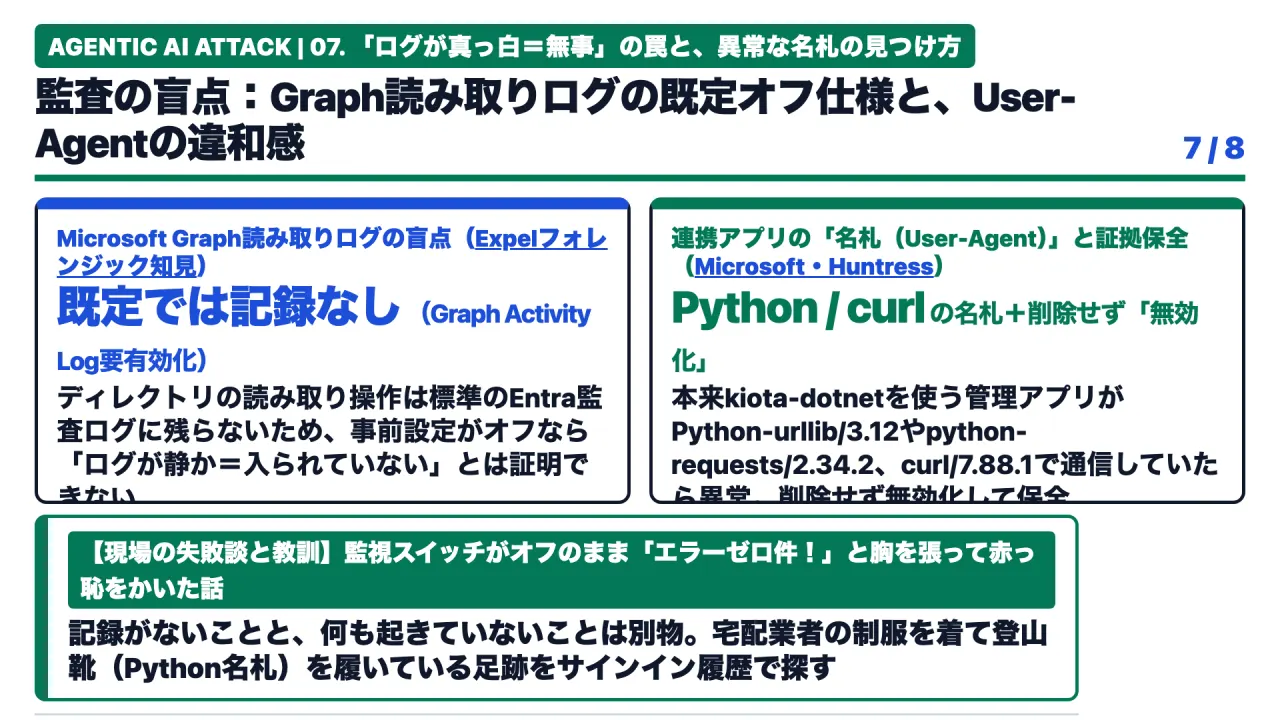
By default, read operations executed against Microsoft Graph APIs are not captured within standard Microsoft Entra ID audit logs.
Unless an organization has explicitly configured and ingested Microsoft Graph Activity Logs into a centralized SIEM, an automated attacker can enumerate an enterprise’s entire employee directory, parse organizational hierarchy trees, and inspect user group memberships while corporate audit dashboards show zero anomalies.
This reality reinforces a fundamental tenet of infrastructure security: the absence of logged alerts is not evidence of operational security.
Chapter 5: Forensic Hunting and User-Agent Telemetry
How can enterprise defenders detect whether their cloud environments were touched by automated ARTEX scripts?
The User-Agent Discrepancy
The most reliable forensic artifact resides in User-Agent headers logged during service principal authentication.
Under legitimate operating conditions, the official ConnectWise Cloud Backup integration communicates using a specific .NET client library string:
- Legitimate Header:
kiota-dotnet
When Storm-0940 executed automated exploitation scripts against compromised customer tenants, the threat actors routed commands through standard automated Python libraries. Forensic queries across Entra sign-in logs revealed obvious scripting signatures:
- Malicious Headers:
Python-urllib/3.12,python-requests,curl/7.88.1
Detecting standard Python HTTP user-agents authenticating against enterprise administrative APIs provides immediate proof of automated credential abuse.
Remediation Protocol: The Prohibition on Premature Deletion
When an enterprise discovers an unauthorized application registration or compromised service principal, the immediate administrative reflex is to click “Delete.”
Microsoft and incident response experts strongly advise against immediate deletion:
- Disable, Do Not Delete: Immediately set the application status to “Disabled” and revoke all active OAuth access and refresh tokens. Deleting the application destroys underlying metadata and forensic evidence required to determine the full scope of compromise.
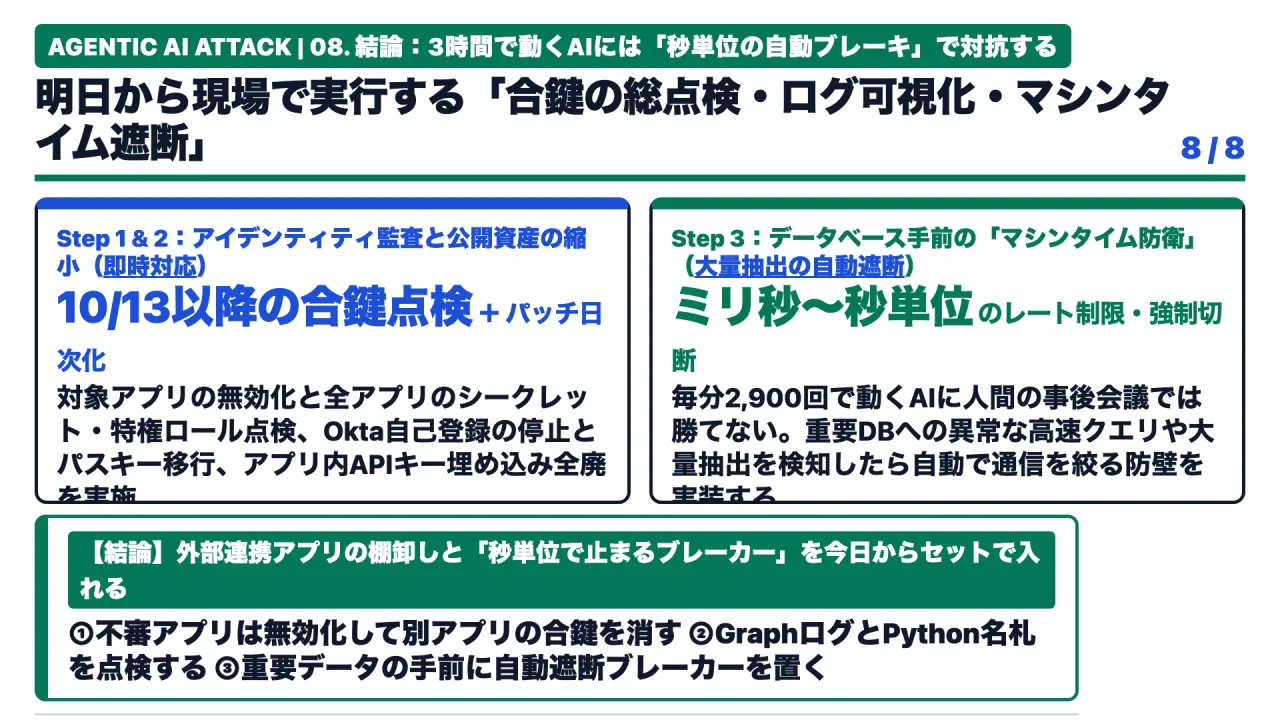
- Comprehensive Secondary Audit: Query all application registrations in the tenant for secrets or certificates added after October 13, 2026. Verify whether Global Administrator or directory-write permissions were granted to any secondary applications.
Conclusion: Defending Against Machine-Speed AI Attacks
The deployment of ARTEX marks a permanent transition in enterprise security: cyberattacks have moved from human operational velocity to machine execution speed.
Enterprise organizations must immediately implement three defensive countermeasures:
- Audit Enterprise Service Principals and Disable Self-Registration: Open Microsoft Entra ID and Okta consoles today. Audit all third-party enterprise applications and disable unmonitored self-registration portals. Verify whether application credentials created after October 13 possess administrative roles, and transition human user authentication to phishing-resistant FIDO2 passkeys.
- Enable Microsoft Graph Activity Logs and Hunt Scripting User-Agents:
Activate Microsoft Graph Activity Logging across production tenants immediately. Query sign-in logs for service principals utilizing Python or curl user-agents (
Python-urllib,python-requests), establishing automated alerts for unexpected non-browser API callers. - Deploy Machine-Time Circuit Breakers: Human incident response protocols cannot counter an AI agent executing 2,900 requests per minute and elevating privileges in five minutes. Sensitive customer databases and directory endpoints must be fronted by automated rate-limiting gateways and behavioral circuit breakers that sever abnormal sessions in milliseconds without awaiting human committee approval.
When threat actors automate offensive operations with multi-agent swarms, security teams must automate their defenses ── or surrender their enterprise credentials in under three hours.
Primary Sources and References
- Microsoft Threat Intelligence (October 21, 2026): Storm-0940 Uses ARTEX Agentic AI and ConnectWise Supply Chain Compromise
- Microsoft Threat Intelligence (October 31, 2024): Chinese Threat Actor Storm-0940 Uses Password Spray from Covert Networks
- Huntress Threat Research (October 16, 2026; updated October 19): Vendor Credential Enables Unauthorized Access to ConnectWise Customer Tenants
- Expel Security Advisory (October 21, 2026): Storm-0940 ARTEX Attacks ── ConnectWise App Abuse and Okta Sign-Ups
- GitHub Repository: ARTEX Architecture and Automated Red Teaming Source Code
- AhnLab ASEC Threat Intelligence (October 14, 2026): In-Depth Analysis of ARTEX Autonomous Penetration Testing
- CrowdStrike Threat Research (October 7, 2026): Threat Actor Uses ARTEX to Target South Korean Financial Institutions
- GMO Cybersecurity by Ierae (October 19, 2026; updated October 21): Survey Report on Malicious ARTEX Attack Infrastructure in Japan
- NorForge Intelligence Report: Inside Cairn ── The Proliferation of Autonomous AI Attack Frameworks