Why 1-Million-Token Context Windows Fail in Enterprise Practice: The "Lost in the Middle" Trap and How Sleeping Memory Hierarchies Cut Latency by 91%
Stanford empirical research and production architectures from Mem0, Zep, and MemGPT prove that dumping entire histories into prompts triggers amnesia, while bi-temporal knowledge graphs slash token costs by 90%.
Published: October 22, 2026 | Read time: ~10 min | Watch Video (Japanese)
Executive Summary: The Million-Token Amnesia Paradox
When enterprise software teams build conversational AI agents, an intuitive assumption dominates technical planning: because state-of-the-art foundation models support context windows spanning one million or two million tokens, developers should simply dump entire transcripts, corporate handbooks, and meeting minutes directly into the prompt.
That assumption is fundamentally flawed. In production environments, treating a massive context window as a bottomless warehouse does not produce comprehensive memory; it induces acute operational amnesia.
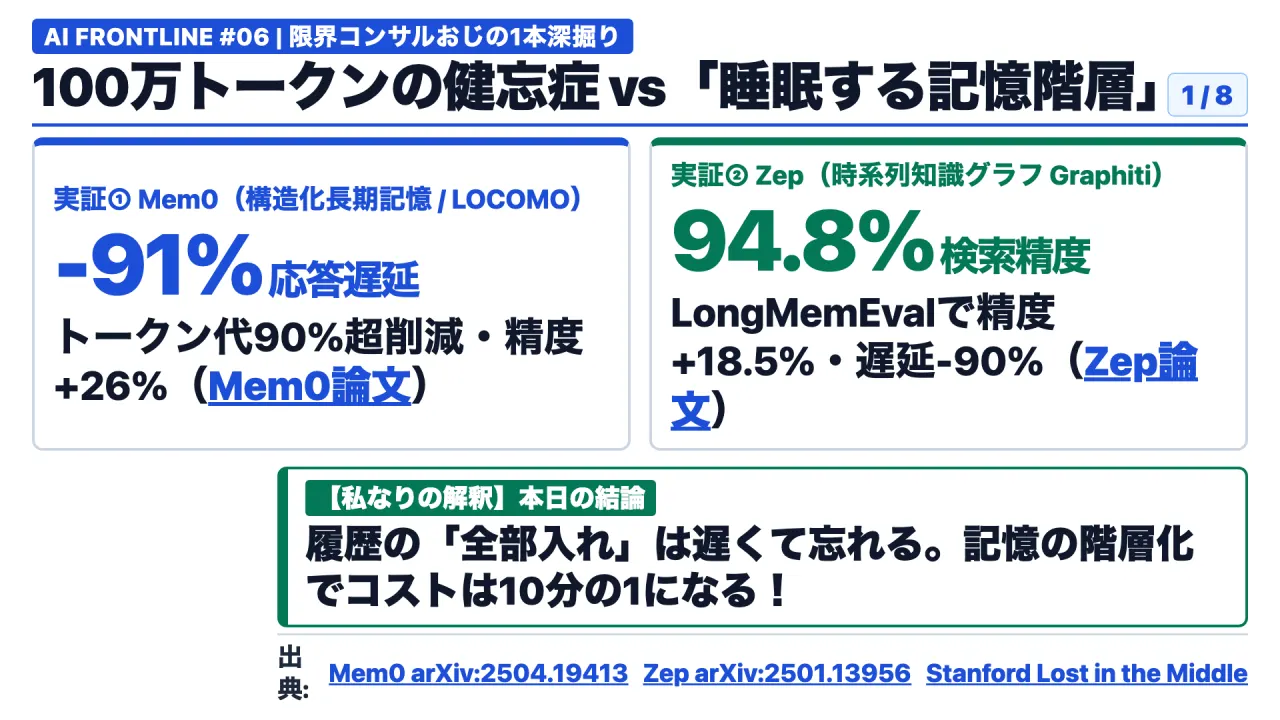
Consider what occurs when an organization abandons brute-force context stuffing in favor of an externalized, structured memory architecture.
According to peer-reviewed data from the Mem0 research group, replacing raw conversational context stuffing with an extraction-and-consolidation memory layer reduced 95th-percentile response latency by 91% (falling from approximately 17.0 seconds to 1.44 seconds) and collapsed monthly token expenditures by over 90%. Concurrently, factual accuracy on long-term conversational benchmarks increased by 26% compared to OpenAI’s native memory implementation. Independent findings from the Zep temporal graph architecture corroborated these dynamics, demonstrating an 18.5% accuracy improvement on multi-session temporal reasoning benchmarks alongside a 90% reduction in operational latency.
Why does feeding an AI model everything cause it to fail, while equipping it with human-like memory consolidation ── structured forgetting and background “sleep” cycles ── makes it ten times faster and ten times cheaper?
This deep dive examines the empirical mechanics of context decay, the bi-temporal failure modes of conventional Retrieval-Augmented Generation (RAG), and the emergence of hierarchical memory operating systems in enterprise deployments.
Context Windows vs. Knowledge Graphs: Defining the Architectural Map
Before examining benchmark data, systems engineers must clarify the technical distinction between the Context Window and the Temporal Knowledge Graph.

A Context Window represents the working memory or active desk space of a transformer model. It determines the maximum volume of tokens the neural attention mechanism can process in a single forward pass. Modern hyperscaler models market context windows of one million tokens ── equivalent to several thousand pages of text. However, a wide desk does not guarantee organized recall; piling hundreds of documents onto a physical desk ensures that critical memos get buried beneath irrelevant clutter.
A Temporal Knowledge Graph structures unstructured text into deterministic entities, relationships, and temporal intervals. Rather than storing an unindexed conversational string, a knowledge graph establishes typed nodes linked by directional edges annotated with precise start and invalidation timestamps.
When software systems scale from single-turn chats to enterprise workflows spanning quarters, relying exclusively on active desk space collapses under cognitive load and financial cost.
The table below summarizes the operational trade-offs across three primary architectures:
| Architectural Metric | Context Stuffing | Conventional Vector RAG | Temporal Graph Memory (Zep / Mem0) |
|---|---|---|---|
| Token Ingestion Cost | Linear growth per turn ($O(N)$ prompt bloat) | Fixed retrieval chunk cost | Compressed delta extraction ($90%+$ reduction) |
| Inference Latency (p95) | High (~15–20s at long context) | Moderate (~3–6s embedding search) | Low (~1.44s targeted graph traversal) |
| Middle Retrieval | Severe degradation (“Lost in the Middle”) | Inconsistent (semantic false matches) | Deterministic edge navigation |
| State Invalidation | Impossible (conflicting facts coexist) | High hallucination on outdated data | Native bi-temporal invalidation timestamps |
| Consolidation | Zero (stateless per invocation) | Fragmented chunk stores | Background extraction and sleep merging |
Chapter 1: Stanford’s “Lost in the Middle” and Mem0’s 91% Latency Collapse
The empirical foundation debunking the “infinite context” myth was established by Nelson F. Liu and researchers from Stanford University, UC Berkeley, and UC San Diego in Lost in the Middle: How Language Models Use Long Contexts (arXiv:2307.03172).
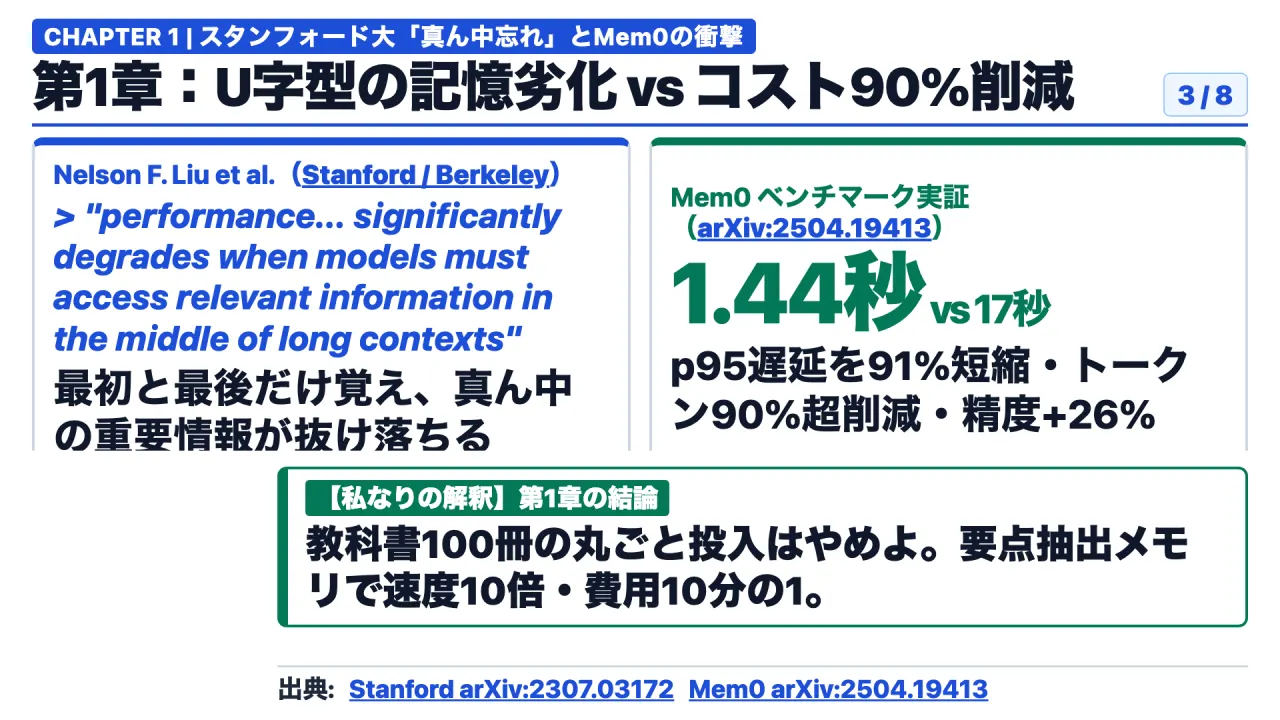
The researchers systematically evaluated multi-document question-answering performance across frontier language models as key facts were repositioned across long input sequences. Their findings revealed a pronounced U-shaped performance curve:
- Performance was consistently highest when relevant information appeared at the absolute beginning (primacy effect) or the absolute end (recency effect) of the context window.
- When critical target information was located in the middle of the prompt context, model retrieval accuracy degraded precipitously ── dropping by up to 30 percentage points even in models explicitly trained and marketed for long-context comprehension.
In enterprise terms, stacking 100 meeting transcripts into a prompt guarantees that while the system remembers the first greeting and concluding sign-off, substantive financial figures agreed upon during week five are frequently ignored.
The engineering solution to this cognitive degradation was demonstrated in Mem0: Building Production-Ready AI Agents with Scalable Long-Term Memory (arXiv:2504.19413). Instead of appending raw conversational text to subsequent prompts, Mem0 introduces an event-driven extraction engine that parses interactions in real time, extracts salient semantic facts, and reconciles them against a persistent graph repository.
On the comprehensive LOCOMO long-term conversational benchmark, Mem0 yielded decisive results:
- Latency: 95th-percentile response time fell from 17.0 seconds in full-context injection to 1.44 seconds, representing a 91% reduction.
- Inference Expense: Consumed prompt tokens decreased by over 90%, eliminating compounding financial costs.
- Answer Accuracy: By eliminating conversational noise and filler, factual recall accuracy surpassed standard OpenAI memory architectures by 26%.
Chapter 2: The Trap of Static RAG and Zep’s Bi-Temporal Knowledge Graphs
To circumvent context bloat, engineering organizations frequently deploy Retrieval-Augmented Generation (RAG) using dense vector embeddings. However, conventional vector search suffers from a critical limitation: it lacks chronological awareness.
Consider a typical enterprise operational scenario:
- In Q1 2025, a project brief records: “Component unit pricing for Vendor A is established at $10.00.”
- In Q3 2026, an update confirms: “Due to shortages, Vendor A pricing is revised to $12.50 effective October 1.”
When an agent is asked, “What is the current unit price for Vendor A?”, a semantic vector search computes similarity scores against stored text chunks. Because both sentences exhibit near-identical semantic similarity to the query, vector search retrieves both excerpts simultaneously. Lacking an intrinsic mechanism to determine which document supersedes the other, the language model hallucinates or arbitrarily cites the outdated $10.00 contract.
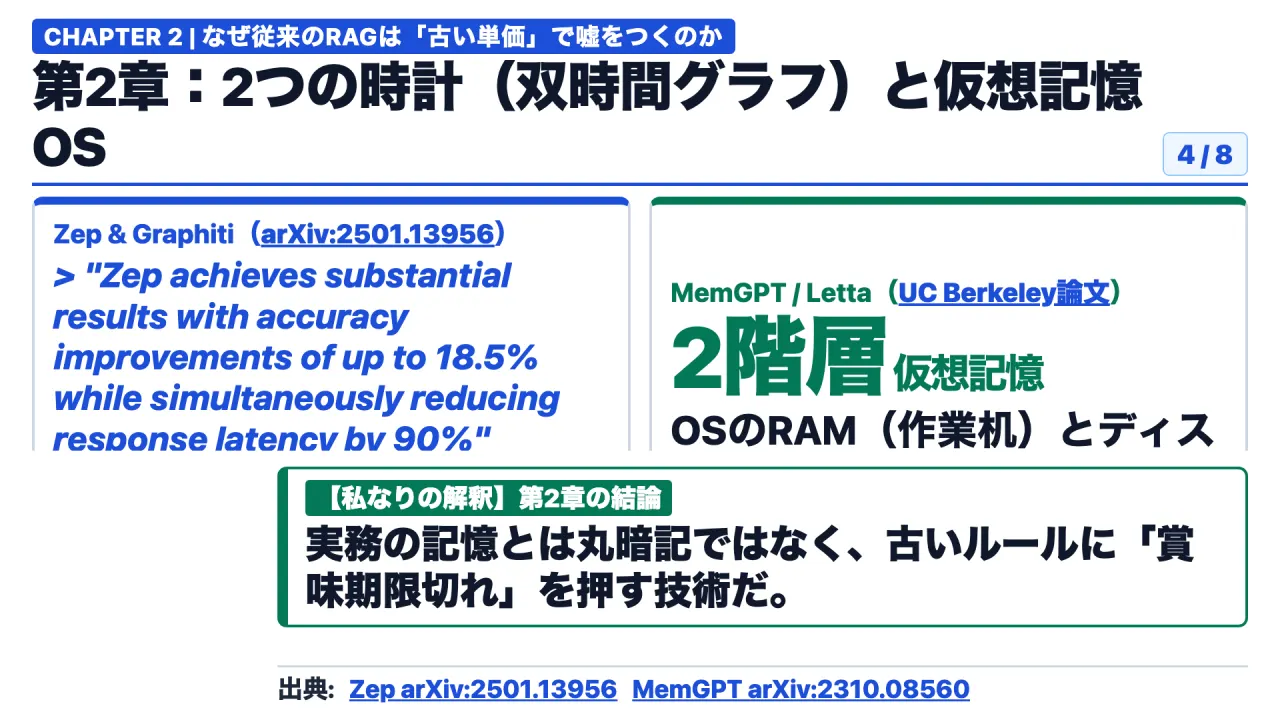
This systemic temporal contradiction is resolved by Zep and its underlying engine, Graphiti, detailed in Zep: A Temporal Knowledge Graph Architecture for Agent Memory (arXiv:2501.13956).
Zep implements a bi-temporal data model tracking two distinct timelines for every piece of knowledge:
- Valid Time: The real-world window during which a fact is true (e.g., Valid From:
2025-01-01, Valid Until:2026-09-30). - Transaction Time: The precise timestamp at which the system recorded the fact into the database.
When the Q3 2026 price revision arrives, Graphiti does not erase the historical $10.00 record. Instead, it programmatically writes an expiration timestamp to the previous edge and instantiates a new active edge linking Vendor A to $12.50. When queried about current pricing, the retrieval engine traverses only edges with active valid-time horizons, instantly returning $12.50. When asked why procurement expanded, the system traverses historical invalidation edges to explain the entire price trajectory.
On the Deep Memory Retrieval benchmark established by the MemGPT team, Zep scored 94.8% against MemGPT’s 93.4%. On the enterprise LongMemEval benchmark, Zep improved temporal reasoning accuracy by up to 18.5% while slashing retrieval latency by 90%.
Furthermore, Charles Packer and UC Berkeley researchers established the foundational operating-system metaphor in MemGPT: Towards LLMs as Operating Systems (arXiv:2310.08560). MemGPT treats the model context window as physical RAM (Fast, Limited) and manages hierarchical paging to external storage, empowering the agent to autonomously page memory in and out via function calls.
Chapter 3: “AI Needs Sleep” ── Dharmesh Shah and the Latent Space Debates
How do these architectural breakthroughs reshape enterprise security, human workflows, and system design?
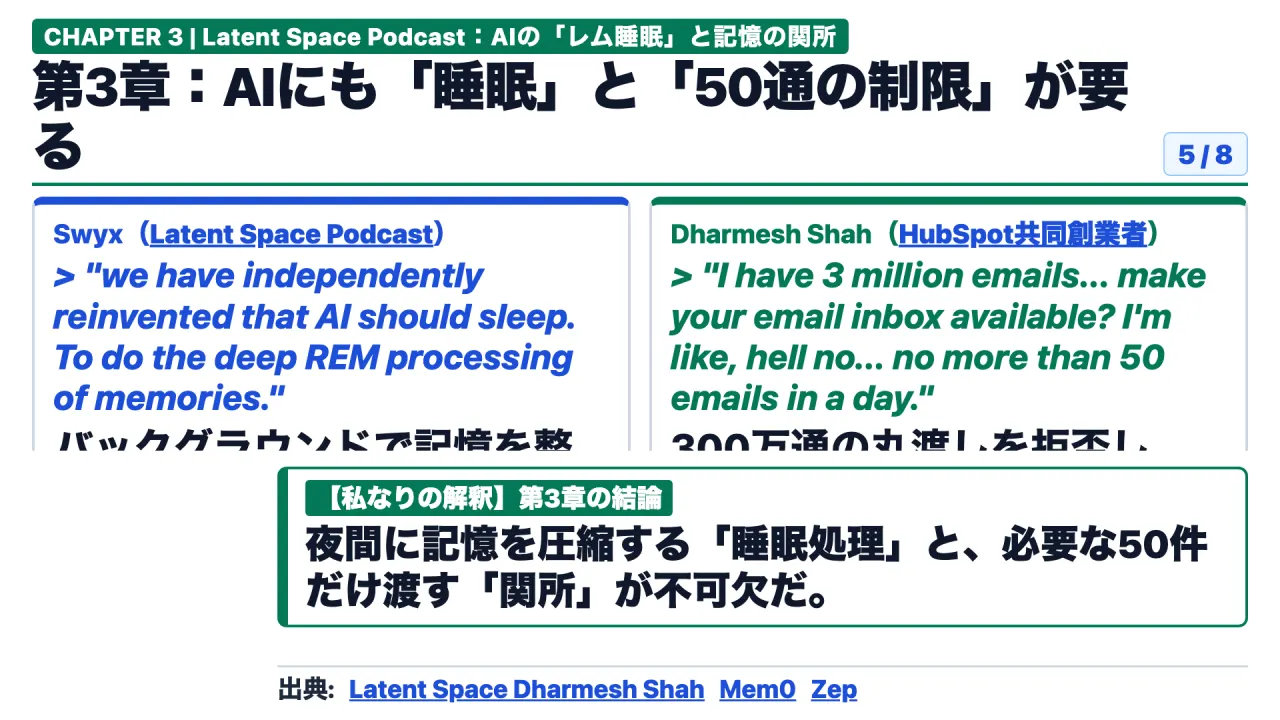
On the technical podcast Latent Space, host Swyx and Alessio sat down with Dharmesh Shah, co-founder and CTO of HubSpot and creator of Agent.ai (The Agent Network — Dharmesh Shah).
Reviewing the converging breakthroughs across Mem0, Zep, and MemGPT, Swyx articulated a core insight:
“The researchers have independently converged on a unified realization: AI needs sleep. Just as the human brain relies on deep REM sleep to consolidate waking experiences, purge ephemeral noise, and cement foundational memories, autonomous agents require offline, background consolidation cycles to remain functional over months.”
In human cognitive biology, we do not transcribe every sensory perception into permanent storage; during sleep, the brain transfers core insights into long-term structures while discarding trivial background noise. Enterprise AI systems require an identical background process: scheduled batch jobs that process raw daytime transcripts, resolve entity relationships, invalidate stale edges, and compile lean procedural memories.
Equally critical is the governance challenge raised by Dharmesh Shah: Selective Memory Authorization. Discussing personal knowledge bases, Shah emphasized the boundary between utility and privacy:
“I have indexed three million emails spanning decades. But if an external startup asks for full access to my email database, my answer is an emphatic ‘Hell no.’ To deploy agents safely, we must establish trusted intermediaries that enforce selective authorization scopes ── granting an agent access only to emails with a specific project tag, received within the last fourteen days, capped at a maximum of fifty records.”
In corporate settings, customer service bots, HR assistants, and legal auditors cannot share an unpartitioned memory store. Without granular query-time memory authorization filters, corporate AI deployment creates severe insider-threat vulnerabilities.
Chapter 4: Three Core Architectural Realities for Enterprise Systems
Synthesizing the empirical findings of Stanford’s context research, Mem0’s benchmarks, Zep’s temporal graphs, and Dharmesh Shah’s governance principles yields three non-negotiable architectural realities for modern IT infrastructure.

Reality 1: Context Windows Are Desks, Not Warehouses
Scaling context window capacity from 128k to 1M or 2M tokens does not eliminate the need for memory management. Widening context windows inflates inference billing, elevates time-to-first-token latency, and exposes decisions to the “Lost in the Middle” retrieval degradation. Maintain a lean active desk: inject strictly the exact entity cards required for the immediate reasoning turn, keeping everything else securely stored in external structured layers.
Reality 2: Information Without Expiration Dates Guarantees Hallucination
In enterprise systems, static knowledge is liability. Corporate policies, service-level agreements, org charts, and pricing tables change continuously. Storing unversioned text chunks in standard vector databases ensures that outdated operational rules will eventually be hallucinated into critical communications. Every enterprise fact must be stored with explicit valid-time metadata.
Reality 3: The Enterprise Moat Is the Memory Graph, Not the Model
Frontier foundation models are rapidly commoditizing; organizations can swap underlying LLM providers in hours via standardized completion APIs. The enduring enterprise competitive moat resides in the proprietary, bi-temporal knowledge graph that maps institutional relationships, past decision rationales, and customer preferences.
Chapter 5: The 3-Tier Enterprise Memory Architecture
To operationalize these principles, engineering teams should implement a robust Three-Tier Enterprise Memory Stack.

Tier 1: Ephemeral Working Context
Restrict active prompt payloads to minimal working state. Enforce strict token quotas: never allow conversational transcripts to exceed 8,000 tokens. When task-relevant external knowledge is required, instruct the agent to issue explicit retrieval tool calls rather than blindly pre-loading massive corpora into system instructions.
Tier 2: The Background “Sleep” Engine
Decouple memory persistence from interactive user sessions. When an agent concludes an operational workflow, emit an asynchronous event to a processing queue. A background consolidation worker executes the “sleep” cycle: extracts atomic facts, checks whether they contradict existing graph edges, marks superseded edges with termination timestamps (valid_until = now()), and writes new facts with active timestamps.
Tier 3: Bi-Temporal Storage with Scoped Access
Deploy an enterprise graph layer supporting bi-temporal queries. Wrap graph access in policy enforcement gateways that validate query scopes against authenticated agent roles. If a Marketing Agent queries internal data, the gateway injects mandatory query filters restricting retrieval exclusively to marketing-tagged nodes, preventing lateral privilege escalation across enterprise databases.
Conclusion: Actionable Playbook for Production Systems
The era of boasting about million-token context capacity as a substitute for software architecture has ended. Sustainable enterprise automation requires rigorous memory governance.

Engineering leaders should implement three concrete actions starting immediately:
- Audit and Cap Context Injection Topologies: Inspect production prompts. Measure average input token length per turn. If systems continuously inject entire historical transcripts, implement an immediate hard ceiling (capping history to the last five conversational turns) and route all historical context requests through deterministic memory APIs.
- Implement Mandatory Bi-Temporal Stamping on Enterprise Stores: Upgrade vector search indexes and knowledge stores to record valid-from and valid-until metadata. Require every automated ingestion pipeline to evaluate whether new documents invalidate existing organizational facts, ensuring that deprecated procedures are systematically retired from agent visibility.
- Establish Offline Memory Consolidation Cycles: Implement an asynchronous “sleep” pipeline. Prevent operational models from executing costly memory updates during interactive user conversations. Shift entity extraction, deduplication, and relationship reconciliation into scheduled background batch jobs.
By replacing brute-force context stuffing with structured, sleeping memory hierarchies, enterprises eliminate cognitive amnesia, cut operational latency by 90%, and build verifiable intelligence that compounds in value over time.
Primary Sources and References
- Stanford University & UC Berkeley (Nelson F. Liu et al.): Lost in the Middle: How Language Models Use Long Contexts (arXiv:2307.03172)
- Mem0: Building Production-Ready AI Agents with Scalable Long-Term Memory (arXiv:2504.19413)
- Zep: A Temporal Knowledge Graph Architecture for Agent Memory (arXiv:2501.13956)
- UC Berkeley (Charles Packer et al.): MemGPT: Towards LLMs as Operating Systems (arXiv:2310.08560)
- Latent Space Podcast: The Agent Network — Dharmesh Shah (HubSpot Co-Founder & Agent.ai Creator) with Swyx & Alessio