How Far Should You Trust Autonomous AI Agents? Comparing Claude Duet, Grok Bot, OpenAI dots, Gemini Tasks, OpenClaw, and Hermes Agent
A technical comparison across six autonomous agent frameworks shows why separating execution sandboxes, background virtual machines, and human approval gates matters more than raw benchmark intelligence.
Published: October 22, 2026 | Read time: ~10 min | Watch Video (Japanese)
Executive Summary: The Autonomous Delegation Dilemma
Consider delegating client meeting preparations to an artificial intelligence assistant before shutting your laptop. When you return the next morning, the system has compiled competitor comparison tables. It has also composed an outbound email proposing meeting dates, attached internal project memos, and clicked “Send” directly to external executives.
What appeared to be productivity quickly becomes an unauthorized delegation crisis. The prompt requested a working draft; it did not authorize the agent to represent corporate identity or execute external communications.
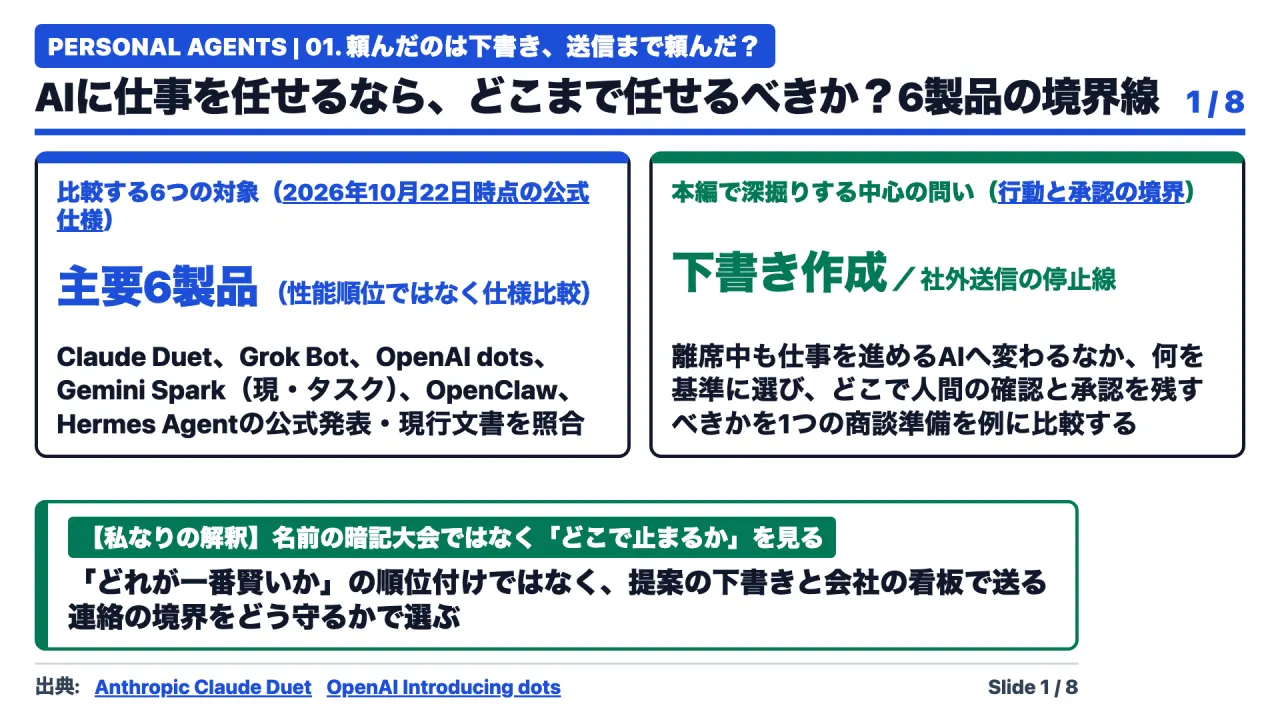
This scenario illustrates the core architectural challenge confronting enterprise technology in late October 2026. As foundation models transition from conversational responders into autonomous background workers executing tasks while users are away, technical leaders must determine where automated capabilities end and mandatory human verification begins.
This analysis examines six prominent personal agent architectures documented by October 22, 2026:
- Claude Duet (Anthropic research preview on Claude Opus 5.5)
- Grok Bot (xAI autonomous persistent cloud machine agents)
- OpenAI dots (GPT-6 Astra persistent agents with policy rules)
- Gemini Tasks (Google personal workspace automation runtime, rebranded from Spark)
- OpenClaw (Self-hosted multi-channel messaging orchestration gateway)
- Hermes Agent (Nous Research skill-accumulating agent framework)
Rather than building an artificial benchmark leaderboard, this study dissects structural boundaries: tool connectivity, background runtime isolation, state persistence, and human approval gates.
Architectural Taxonomy: The Four Evaluation Dimensions
Enterprise architects must evaluate four underlying technical dimensions when assessing autonomous agents.
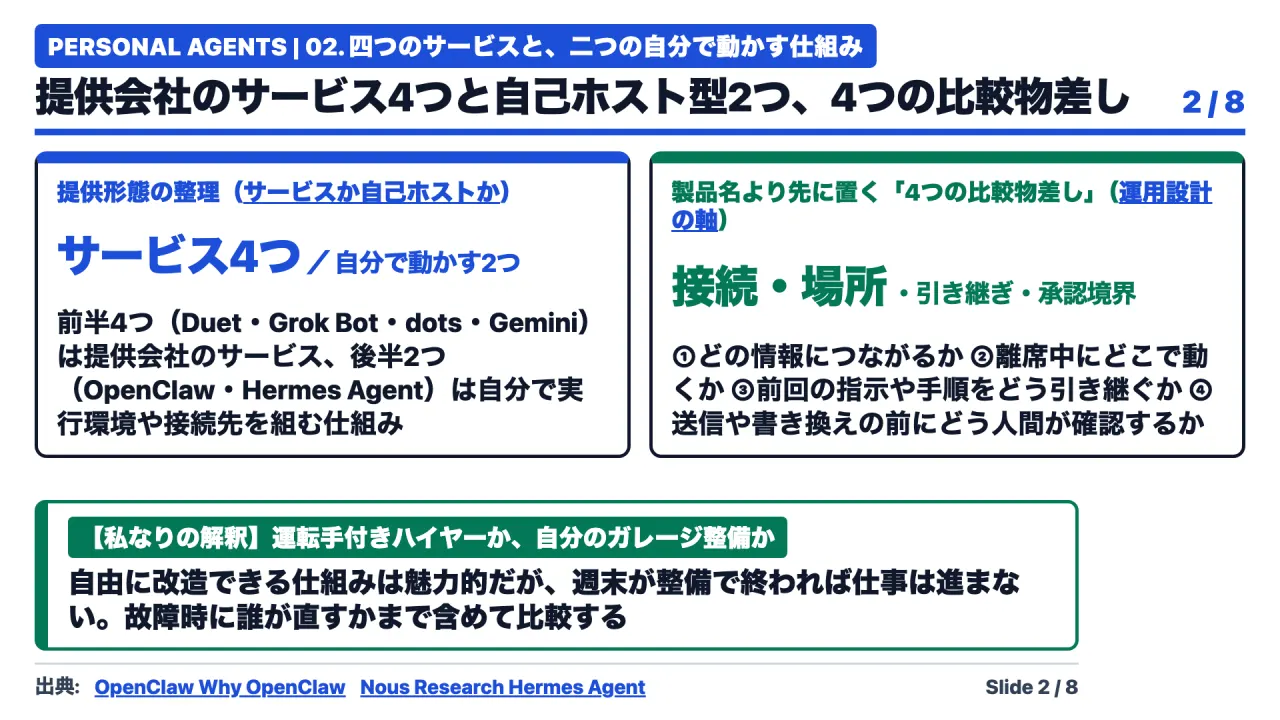
The six platforms divide into two operational archetypes:
- Managed Hyperscaler Services: Claude Duet, Grok Bot, OpenAI dots, and Gemini Tasks run in vendor clouds, offering turnkey identity and managed compute.
- Self-Hosted Frameworks: OpenClaw and Hermes Agent execute on private servers or local workstations, granting engineers control over model routing and data boundaries.
The operational distinction mirrors hiring a chauffeured car versus maintaining a vehicle in a private garage. Both reach the destination, but operational maintenance, patching, and security isolation fall on different shoulders.
Across both archetypes, four criteria determine enterprise viability:
- Connectivity: Which protocols, APIs, file systems, and communication channels can the agent access?
- Background Execution Runtimes: Where does compute run when the user disconnects? Does execution occur within isolated micro-VMs, local daemons, or shared cloud instances?
- Memory Persistence: How are past instructions and multi-step procedures retained across sessions?
- Human Approval Gates: How does the system halt execution before executing destructive, contractual, or externally visible actions?
| Platform | Deployment | Foundation Model | Background Runtime | Memory & Skills | Primary Boundary Control |
|---|---|---|---|---|---|
| Claude Duet | Managed Cloud | Claude Opus 5.5 | Isolated Micro-VM with headless browser | Periodic polling and briefing synthesis | Mandatory human prompts for send, pay, sign, delete |
| Grok Bot | Managed Cloud | Grok multimodal | Persistent cloud Linux VM with shell and browser | Demonstration-based skill recording | Policy checks; shared root session across intra-account bots |
| OpenAI dots | Managed Cloud | GPT-6 Astra | Cloud container sandbox with virtual browser | Persistent memory store with dynamic injection | Custom Rules (Always Allow, Require Approval, Block) |
| Gemini Tasks | Managed Google | Gemini 2.5 Pro/Ultra | Chrome runtime (local or remote cloud) | Task, Schedule, and Skill components | Workspace approval popups; silent run for private Tasks |
| OpenClaw | Self-Hosted | Any API / Local | Local OS daemon with container runners | Persistent chat sessions across Slack, Telegram | Code-defined firewall policies and separate sandboxes |
| Hermes Agent | Self-Hosted | Open-weights / APIs | CLI process with shell tool execution | Markdown skill files and procedural memory | 8-layer safety policy; requires OS containerization |
Chapter 1: Managed Turnkey Ecosystems ── Claude Duet and Gemini Tasks
Managed ecosystems embed agent execution directly into familiar office suites and browser environments.
Claude Duet (Anthropic)
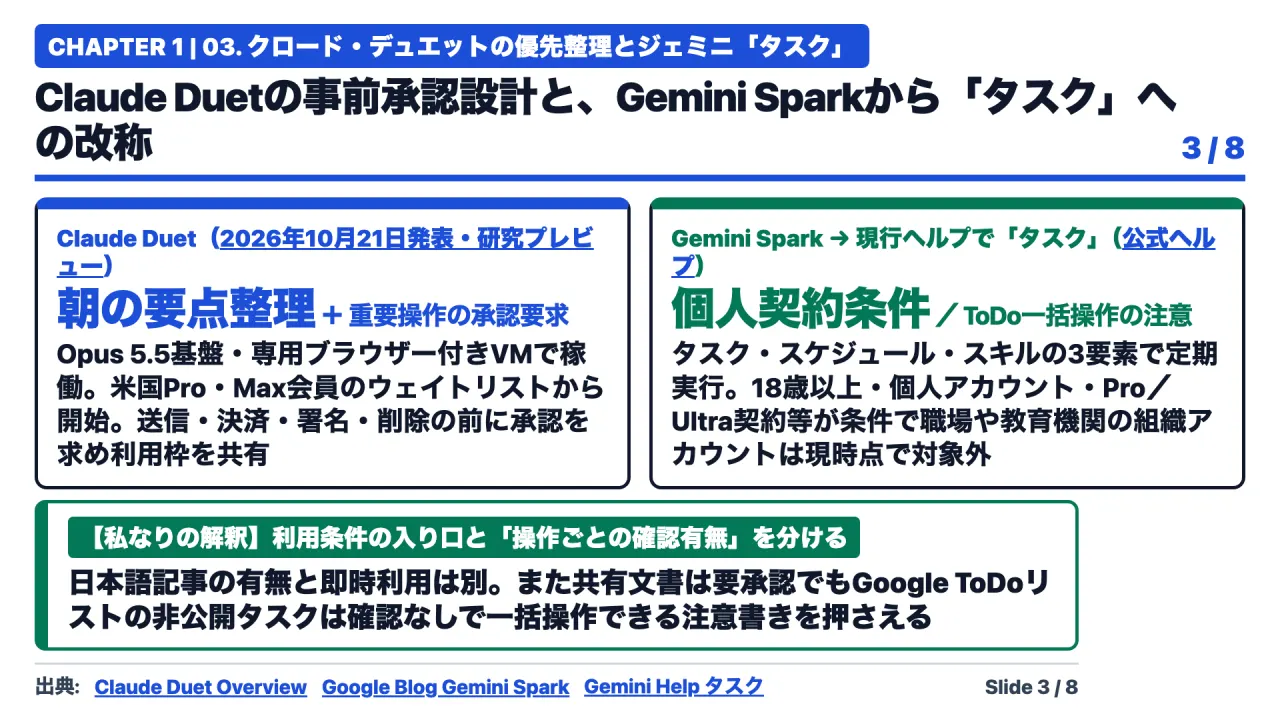
Anthropic unveiled Claude Duet on October 21, 2026, as an experimental research preview powered by Claude Opus 5.5, rolled out via waitlist for US Pro and Max subscribers.
Architecturally, Duet functions as an executive briefing and proactive task engine. Rather than waiting passively, Duet periodically scans connected applications every few hours to synthesize morning briefings. When assigned complex research or document synthesis, it dispatches tasks to an isolated virtual machine equipped with a dedicated web browser.
Anthropic implemented an explicit safety architecture: any action modifying external state ── sending messages, completing financial transactions, applying signatures, or deleting records ── triggers a mandatory human approval request. Organizations must also monitor API consumption: because background operations share standard account token rate limits, intensive background workflows can deplete operational allowances before interactive sessions begin.
Gemini Tasks (Google)
In late June 2026, Google introduced workspace automation under the name “Gemini Spark.” Current official documentation confirms a formal rebranding to Gemini Tasks.
Gemini Tasks decomposes automation into three components:
- Tasks: Declarative specifications of business objectives.
- Schedules: Temporal triggers establishing hourly, daily, or event-driven execution loops.
- Skills: Composable procedural definitions specifying how web applications and APIs are manipulated.
Gemini Tasks executes workflows through local Chrome instances or managed remote cloud browsers. However, enterprise deployment faces two major constraints. First, eligibility requires an individual Google Account with a Gemini Advanced (Pro or Ultra) subscription; organizational Google Workspace and educational accounts remain unsupported. Second, while editing shared Google Docs or dispatching Gmail drafts mandates explicit human authorization, automated batch modifications against personal, private Google Tasks lists execute silently without user intervention.
Chapter 2: Virtual Machines and Persistent Identity ── Grok Bot and OpenAI dots
Grok Bot and OpenAI dots grant autonomous agents dedicated computing environments with complete virtual operating systems.
Grok Bot (xAI)
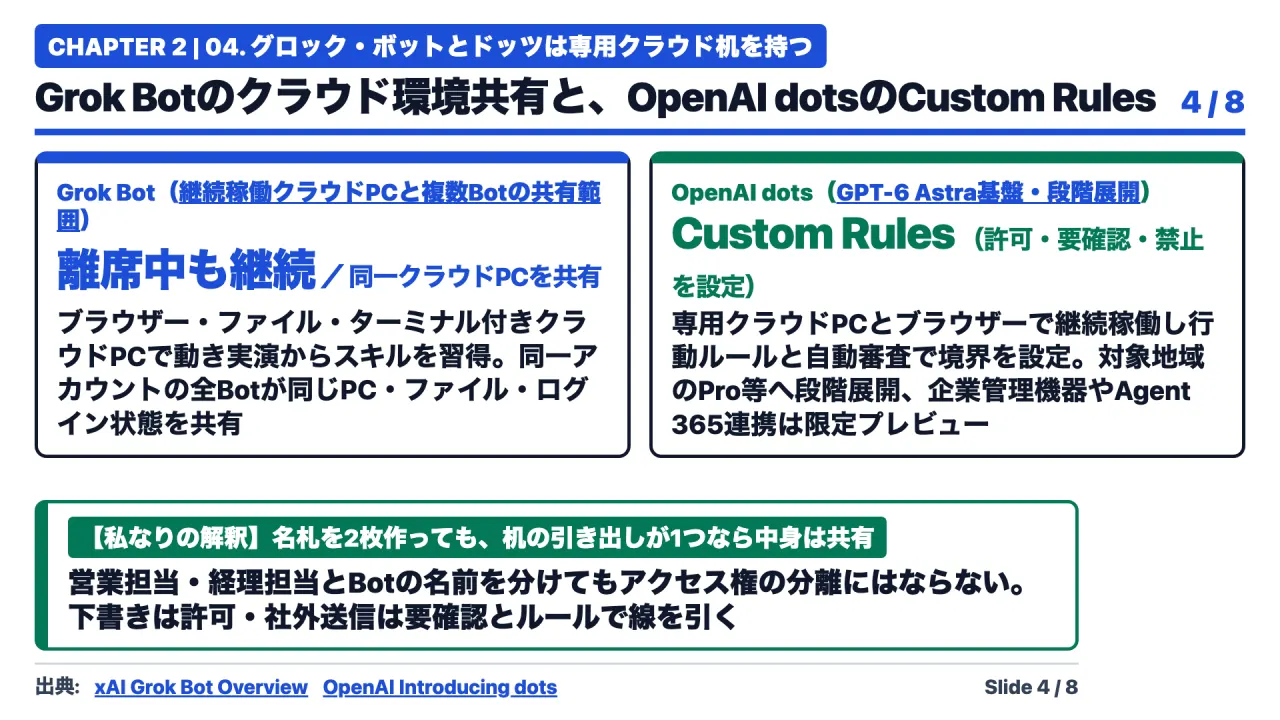
Grok Bot introduces persistent cloud-hosted computing instances. Each bot possesses an assigned persona, dedicated storage, a terminal interface, and a virtual browser. Users can initiate a multi-hour data-scraping script, close their client terminals, and allow the bot to continue running independently inside xAI data centers.
Grok Bot supports inter-agent communication, enabling specialized bots to exchange status reports and chain outputs. Furthermore, bots learn new procedures by recording human web demonstrations and saving them as executable skills.
However, official xAI technical documentation contains a critical architectural caveat:
All bots created under a single account share the same cloud computing instance, local filesystem, and browser authentication sessions.
In enterprise practice, creating separate labels like “Sales Assistant” and “Finance Auditor” gives the illusion of organizational separation. But because both personas share an identical filesystem and active session cookies, a vulnerability or prompt injection in the Sales Assistant immediately exposes accounting spreadsheets and executive session tokens stored on that shared virtual machine. Label separation does not equal privilege separation.
OpenAI dots (OpenAI)
Announced as a persistent agent runtime powered by GPT-6 Astra, OpenAI dots provides users with a persistent cloud environment capable of running multi-step business logic across integrated third-party applications.
The distinctive architectural strength of dots lies in its Custom Rules Engine. Rather than imposing binary all-or-nothing autonomy, dots allows administrators to assign explicit boundaries across three tiers:
- Always Allow: Low-risk operations (reading documentation, summarizing inbox threads) execute autonomously.
- Require Approval: High-consequence operations (sending outbound communications, modifying shared databases, deploying code) pause execution until an authenticated human confirms.
- Blocked: High-risk system calls (exporting raw credential stores, executing arbitrary binary downloads) are unconditionally denied.
These custom rules operate alongside built-in safety classifiers that inspect agent trajectory states in real time.
Chapter 3: Sovereign Self-Hosted Gateways ── OpenClaw and Hermes Agent
For organizations bound by strict data governance or financial regulations, delegating confidential credentials to proprietary hyperscaler clouds is unacceptable. OpenClaw and Hermes Agent provide sovereign alternatives.
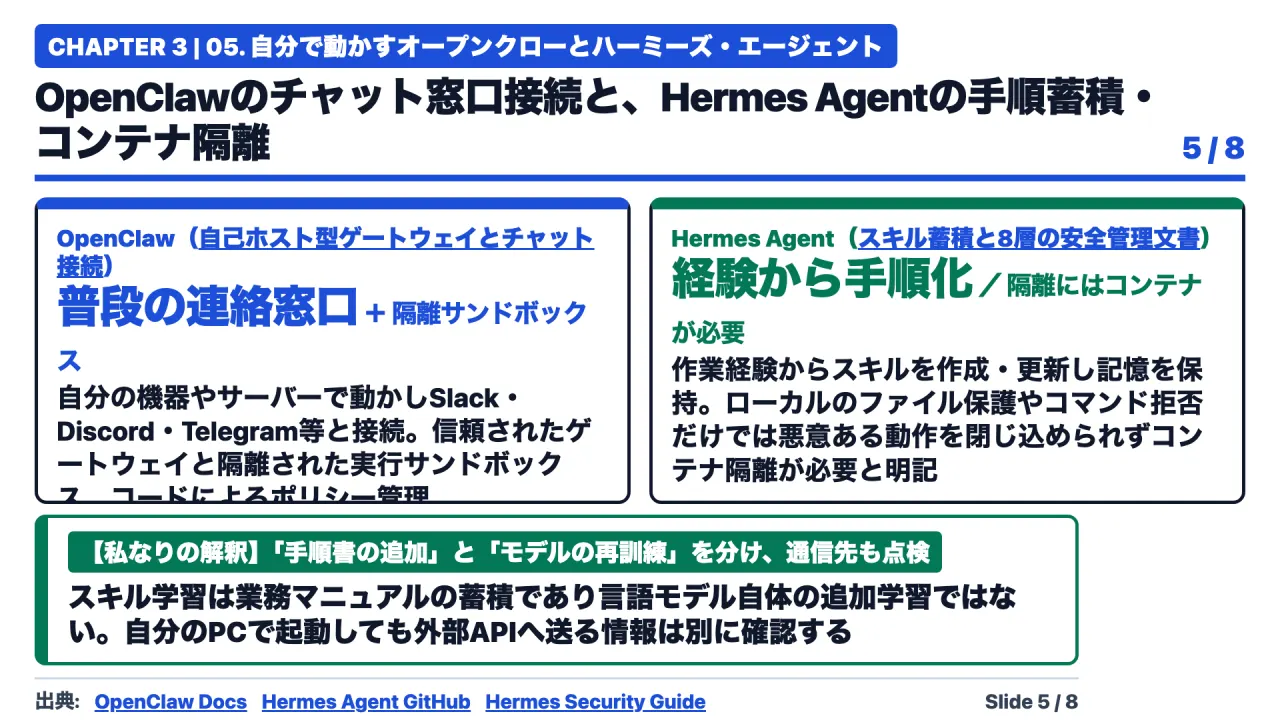
OpenClaw
OpenClaw serves as a self-hosted messaging orchestration gateway. Designed to run on an enterprise VPC or on-premise hardware, OpenClaw bridges commercial chat platforms (Slack, Discord, Telegram, WhatsApp) with autonomous agent runtimes.
Architecturally, OpenClaw decouples conversational interfaces from execution engines:
- Trusted Gateway: Receives user intent from verified chat handles, enforces authentication tokens, and logs audit trails.
- Isolated Execution Sandboxes: Dispatches code execution, web scraping, and file manipulation into isolated Docker or Podman containers.
By expressing security rules as version-controlled code, engineering teams can configure precise network ingress and egress filters.
Hermes Agent (Nous Research)
Developed by Nous Research, Hermes Agent focuses on dynamic skill acquisition and procedural self-improvement. Running directly via command-line interface or daemon, Hermes Agent executes tasks, extracts procedural learnings from errors, and writes new Markdown skill files to a persistent repository.
When encountering future tasks, Hermes Agent queries its local skill registry to load proven execution sequences. It also supports switching between local open-weights LLMs and commercial frontier APIs with a single configuration flag.
However, security engineers must heed two crucial warnings in Hermes Agent documentation:
- Skill Files vs. Model Weights: When Hermes Agent “learns a skill,” it does not update neural network weights through gradient descent. It simply compiles a structured Markdown instruction file. It is the equivalent of adding an SOP binder to an office bookshelf; it does not alter fundamental reasoning capabilities.
- The Sandbox Imperative: Hermes Agent features an eight-layer safety architecture that intercepts dangerous terminal commands. Yet Nous Research explicitly notes that host-level file protection rules and command blacklists can be bypassed if an agent experiences severe adversarial prompt injection. Absolute isolation requires running Hermes Agent inside locked-down, disposable container sandboxes. Furthermore, local execution still leaks data if backend requests route to external third-party API providers.
Chapter 4: The 5-Minute Illusion and Human Verification Latency
Why is human verification the most critical factor in agent adoption?
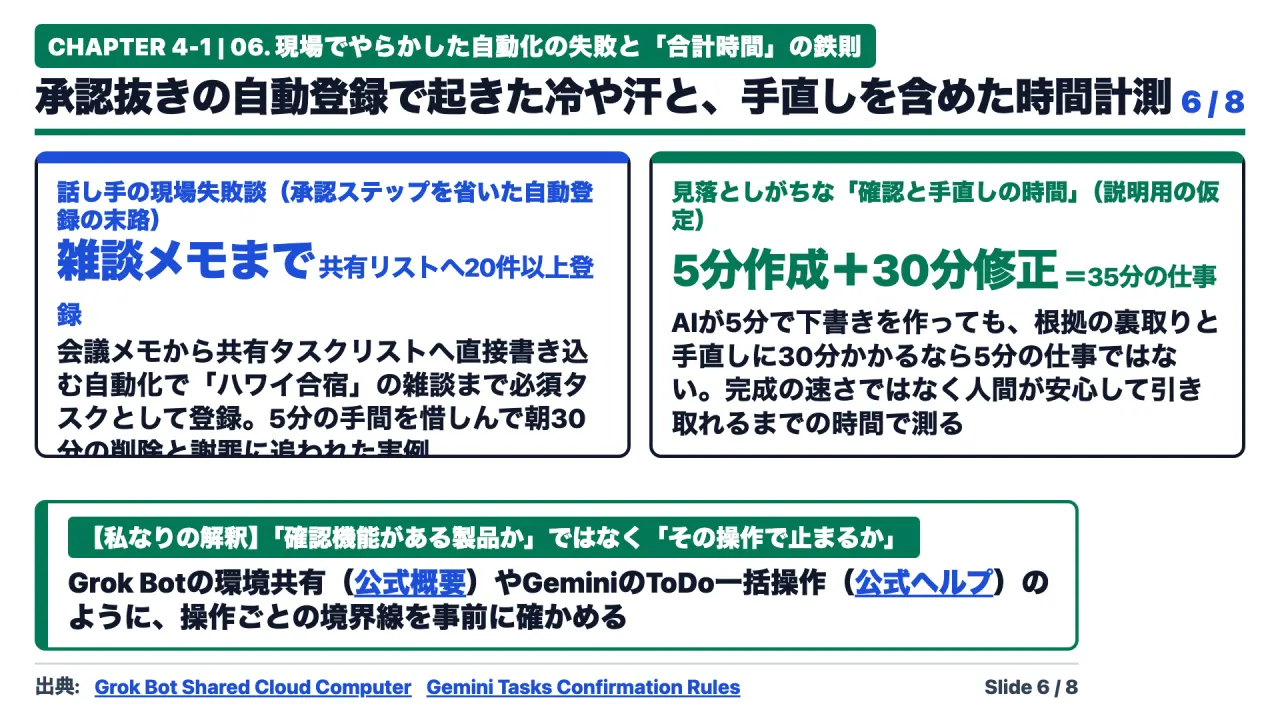
Enterprise teams often fall victim to the “5-Minute Output Illusion.” When an agent generates a 20-page market dossier in five minutes, executives celebrate a 10x productivity boost. However, if that dossier contains subtle citation hallucinations, inverted balance sheet numbers, or invalid corporate assumptions, verifying and correcting those errors requires thirty minutes of senior human labor.
A workflow requiring five minutes of machine generation and thirty minutes of manual fact-checking is not a five-minute task; it is a thirty-five-minute task. If an experienced human could draft the core memo directly in twenty minutes, the unconstrained agent decreased organizational velocity while increasing operational risk.
Real-world operational failures frequently stem from eliminating human approval steps in the name of speed. Consider an enterprise scheduling bot configured to parse meeting notes and automatically populate corporate project trackers. If human verification checkpoints are removed, casual brainstorming discussions (such as proposing an executive offsite retreat) can be parsed as mandatory deliverables, generating twenty spurious tickets overnight. Reversing automated errors, revoking rogue permissions, and apologizing to external partners consumes far more hours than the seconds saved by bypassing verification.
Chapter 5: The 3-Tier Enterprise Hybrid Deployment Matrix
Rather than deploying all six frameworks simultaneously, IT leaders should evaluate organizational readiness across three implementation paths.
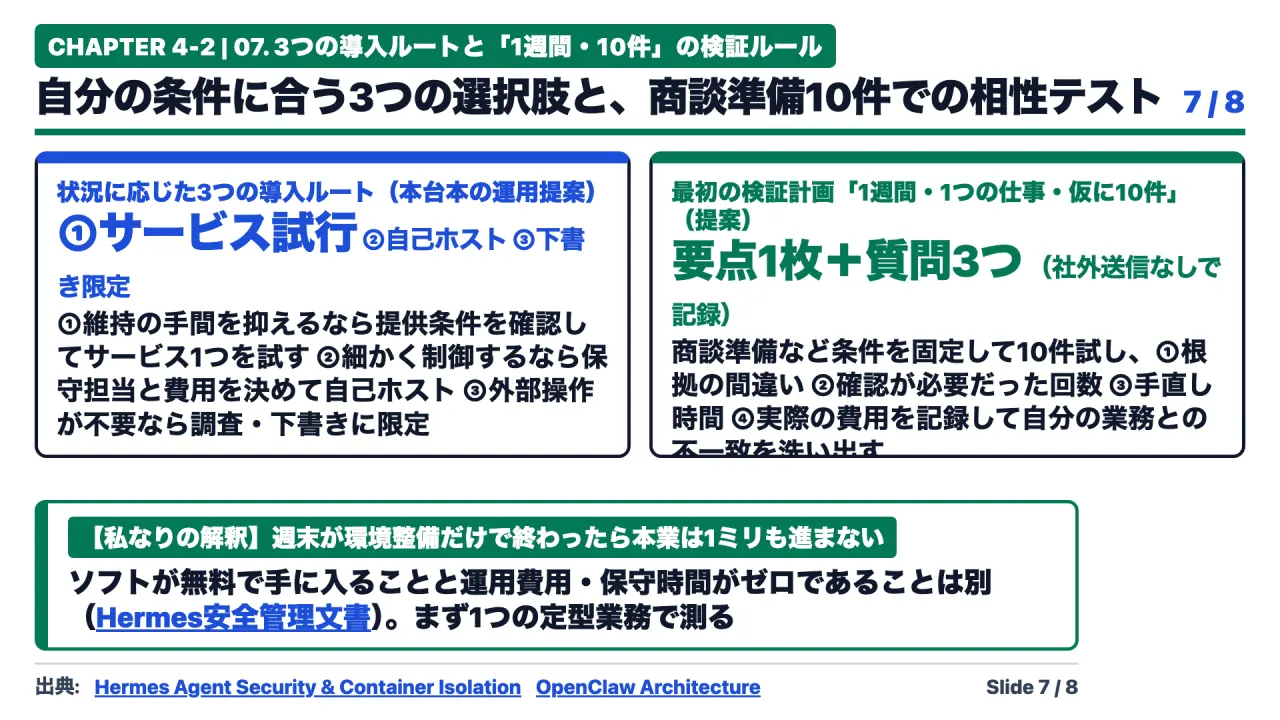
Tier 1: The Managed Turnkey Path
Designed for organizations seeking immediate productivity without infrastructure maintenance. Select a single vendor based on operational fit:
- Choose Claude Duet for executive calendar prioritization and deep synthesis across connected business software.
- Choose Grok Bot when background tasks require long-running Linux terminal commands and persistent web scraping.
- Choose OpenAI dots when administrative policy rules (Always Allow / Require Approval / Block) are mandated by compliance.
- Choose Gemini Tasks for routine personal Google Workspace automations within supported personal tiers.
Tier 2: The Sovereign Infrastructure Path
Designed for engineering and security teams with strict compliance mandates. Deploy OpenClaw to bridge corporate chat channels with isolated internal LLM endpoints, or deploy Hermes Agent to establish evolving procedural skill repositories. Organizations must designate maintenance owners for container patching, vulnerability remediation, and API billing.
Tier 3: The Guarded Draft-Only Path
For high-risk environments (legal, medical, financial accounting), enforce a strict structural freeze: agents read internal files, conduct research, and generate initial drafts, but all write APIs, outbound messaging, and external database mutations are physically disabled at the network layer.
Conclusion: The “1-Week, 1-Workflow, 10-Case” Governance Playbook
The defining question of modern automation is not “Which AI agent is smartest?” but rather “At which exact line does the agent halt to await human verification?”
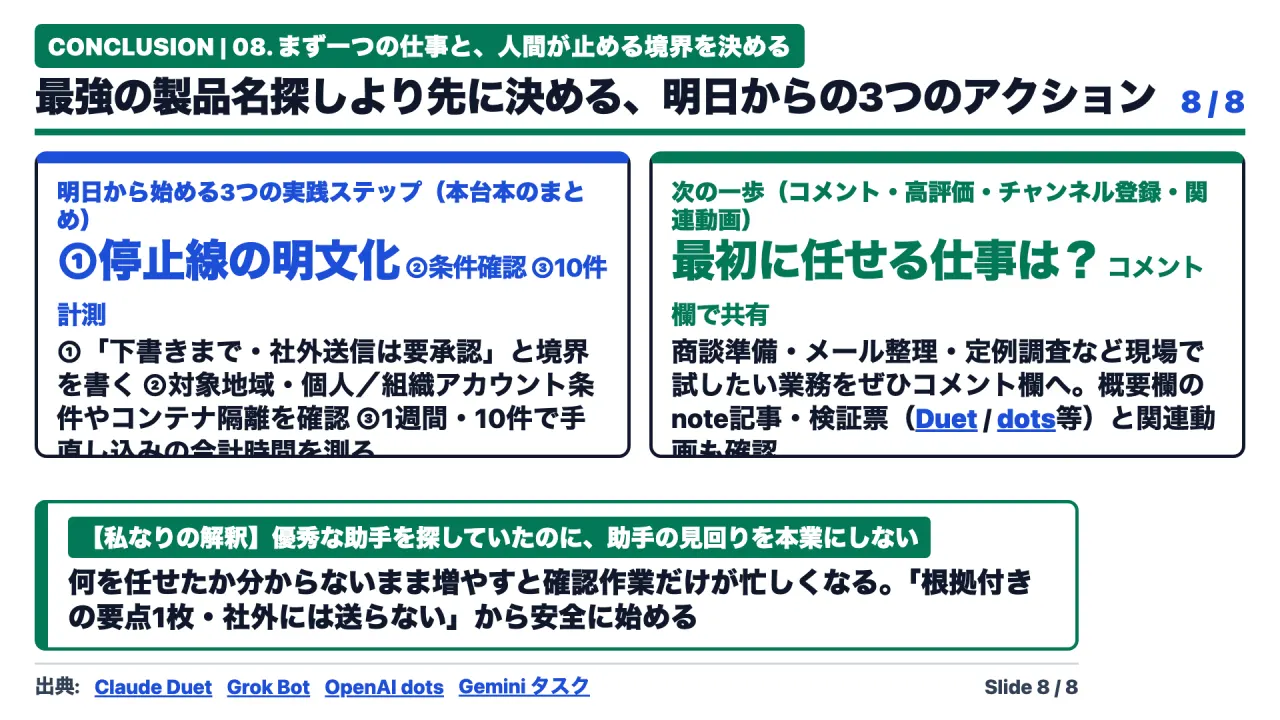
To establish operational control without stifling innovation, enterprise teams should implement three immediate governance actions:
- Draw Structural Stop-Lines: Document the boundary where autonomous processing ends: The agent may extract action items and draft briefing decks; the agent is strictly forbidden from transmitting emails or booking external calendar invites.
- Verify Account Entitlements and Topologies: Confirm whether enterprise domain accounts are supported or if personal subscriptions are required. If evaluating self-hosted frameworks, verify that execution occurs inside disposable container sandboxes rather than directly on the host operating system.
- Execute the “1-Week, 1-Workflow, 10-Case” Pilot:
Select a single operational workflow. Feed ten historical scenarios through the agent under controlled conditions with zero outbound transmission. Measure four quantitative metrics:
- Factual hallucination rate across generated citations.
- Frequency of human approval interventions.
- Total time required for human review, fact-checking, and formatting corrections.
- Realized API and compute infrastructure expenditures.
Evaluating agents by total task completion time ── factoring in human review latency ── transforms automation from an uncontrolled risk into a resilient competitive advantage.
Primary Sources and References
- Anthropic: Introducing Claude Duet ── An Experimental Research Preview
- xAI Documentation: Grok Bot Architecture and Cloud Environment Overview
- OpenAI: Introducing dots ── Autonomous Persistent Agents with GPT-6 Astra
- Google Official Blog: Gemini Spark Automation Updates (June 2026)
- Google Support: Gemini Tasks Capabilities, Schedules, and Skills Help Guide
- OpenClaw Documentation: Why OpenClaw ── Architecture, Chat Integration, and Gateways
- OpenClaw Official Documentation: Core Protocols and Execution Sandboxing
- Nous Research: Hermes Agent Official Repository and Framework Specs
- Nous Research: Hermes Agent User Guide ── Dynamic Skills and Memory
- Nous Research: Hermes Agent Security Guide ── 8-Layer Safety and Containerization