When a Prime Minister Warns of PHP Flaws and Urges Website Shutdowns: Sanae Takaichi's Emergency Dispatch (CVE-2026-109618/19), Five Global Precedents, and the Power to Pull the Plug
An in-depth analysis of Japan Prime Minister Sanae Takaichi’s unprecedented social media warning on the CVSS 9.2 php2shell remote code execution flaws, comparative lessons from the White House, WannaCry, and Log4j, and why enterprise governance must pre-authorize emergency service shutdowns.
Published: October 22, 2026 | Read time: ~10 min | Watch Video (Japanese)
Executive Summary: The 9:55 PM Prime Ministerial Advisory
On the evening of October 21, 2026, at 9:55 PM Japan Standard Time, Japanese Prime Minister Sanae Takaichi published an emergency cybersecurity advisory from her verified public X account (@takaichi_sanae).
The communication was unprecedented in the history of national cyber governance. A sitting head of state explicitly named an open-source programming language—PHP—warned of two critical vulnerabilities scheduled for patch release at 11:00 PM that same evening, and delivered explicit operational guidance to enterprise and municipal website operators:
“If applying the security patch immediately proves difficult, temporarily taking down your websites is considered an effective measure to reduce operational risk.”
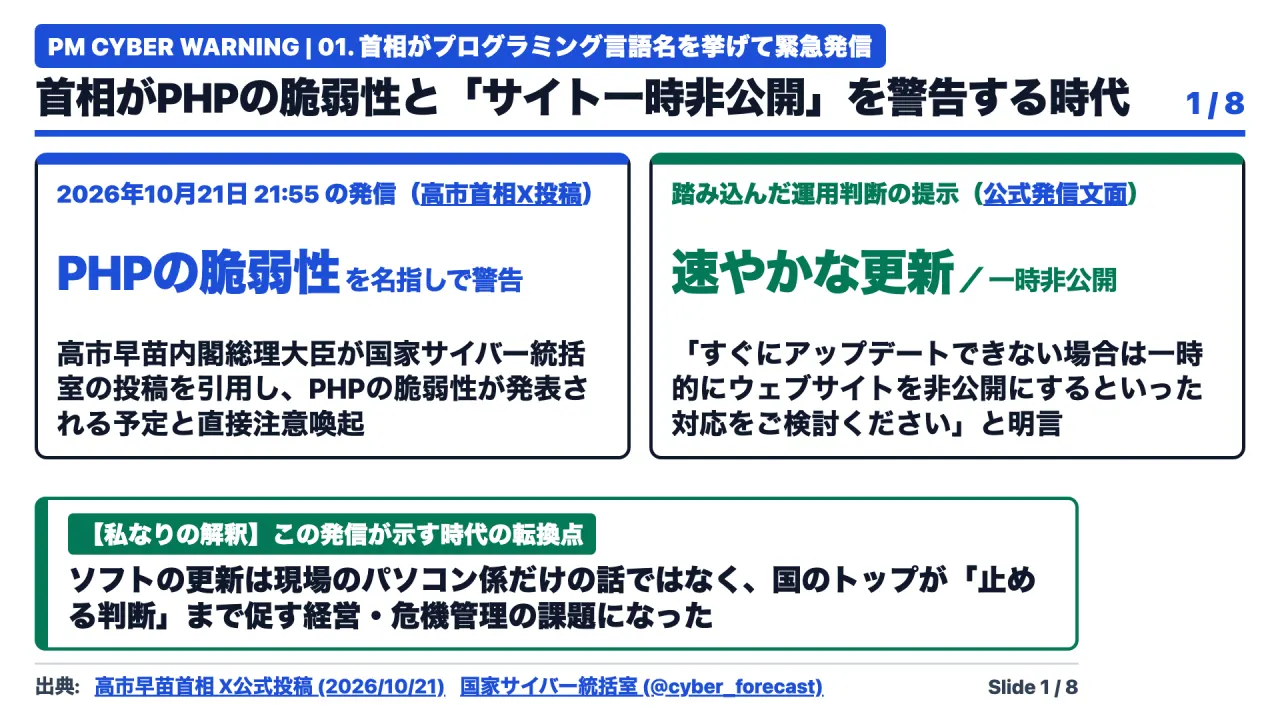
Historically, operational advisories detailing patch release schedules and temporary maintenance takedowns were restricted to engineering Slack channels, Computer Emergency Response Teams (CERTs), and IT infrastructure bulletins. Having the head of government broadcast a specific programming runtime warning 70 minutes ahead of vendor patch availability marks a structural shift in national cyber defense.
This analysis deconstructs three core dimensions of the October 21 incident:
- The Technical Anatomy of
CVE-2026-109618andCVE-2026-109619(php2shell): Why AI-driven vulnerability discovery led to an emergency 24-hour embargo collapse. - Global Precedents in State Intervention: Comparing Takaichi’s statement against five historical actions by the United States and the United Kingdom (White House C/C++ reports, Microsoft Exchange declarations, Log4j shutdowns, and WannaCry crisis responses).
- The Governance Vacuum: Why the Prime Minister’s call to “temporarily shut down websites” resolved the single greatest bottleneck in incident response: the absence of pre-authorized executive authority for technical teams to pull the plug.
1. What Happened on the Night of October 21, 2026
To understand the urgency behind the Prime Minister’s dispatch, one must examine the timeline and underlying technical mechanics:
| Parameter | Confirmed Facts and Primary Documentation |
|---|---|
| Origin & Timestamp | Prime Minister Sanae Takaichi (@takaichi_sanae), October 21, 2026, at 9:55 PM JST. |
| Core Directives | 1. Identify all public web properties executing PHP runtimes. / 2. Prepare for emergency patch deployment scheduled for 11:00 PM JST. / 3. If immediate patching is infeasible, proactively transition websites to maintenance mode. / 4. Monitor National Cyber Operations (@cyber_forecast). |
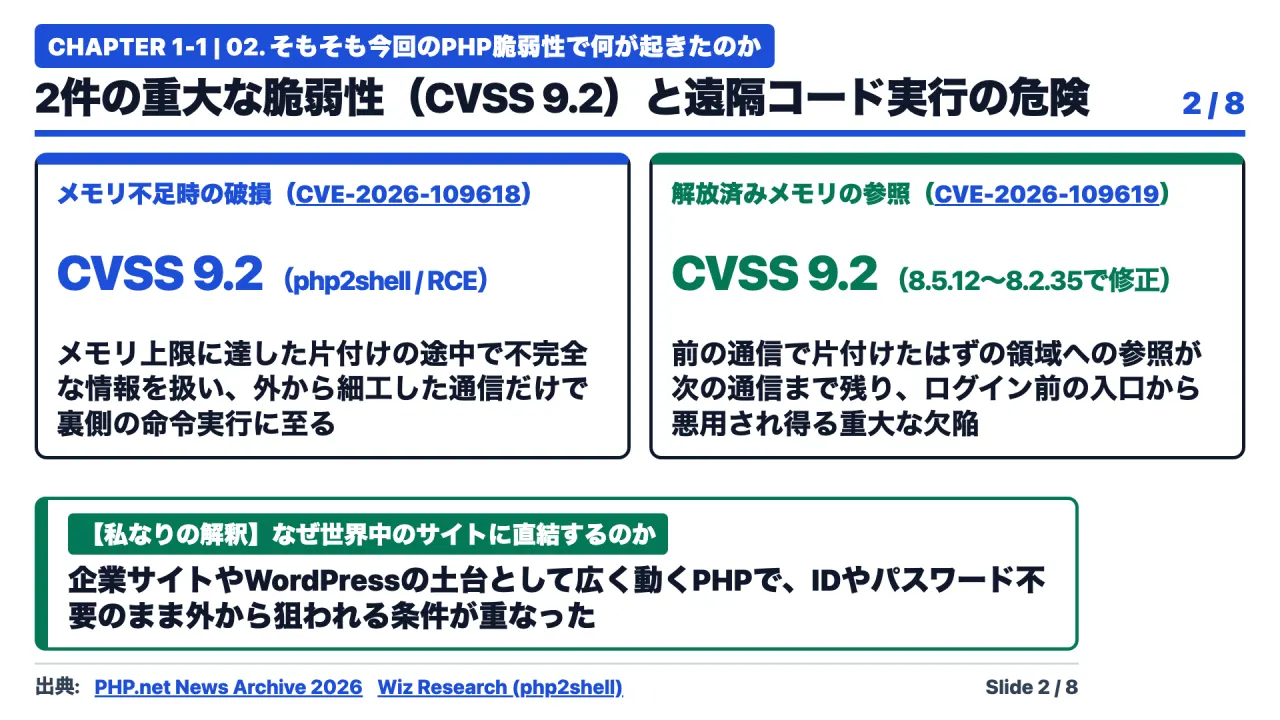
| Vulnerabilities | CVE-2026-109618 (OOM longjmp() unwinding RCE) and CVE-2026-109619 (Cross-request worker UAF RCE). Score: CVSS v4.0 9.2 (Critical). Known as php2shell. |
| Patched Releases | PHP 8.5.12, 8.4.27, 8.3.36, and 8.2.35 (Released October 21, 2026, 11:00 PM JST). Backport patches provided for legacy EOL branches. |
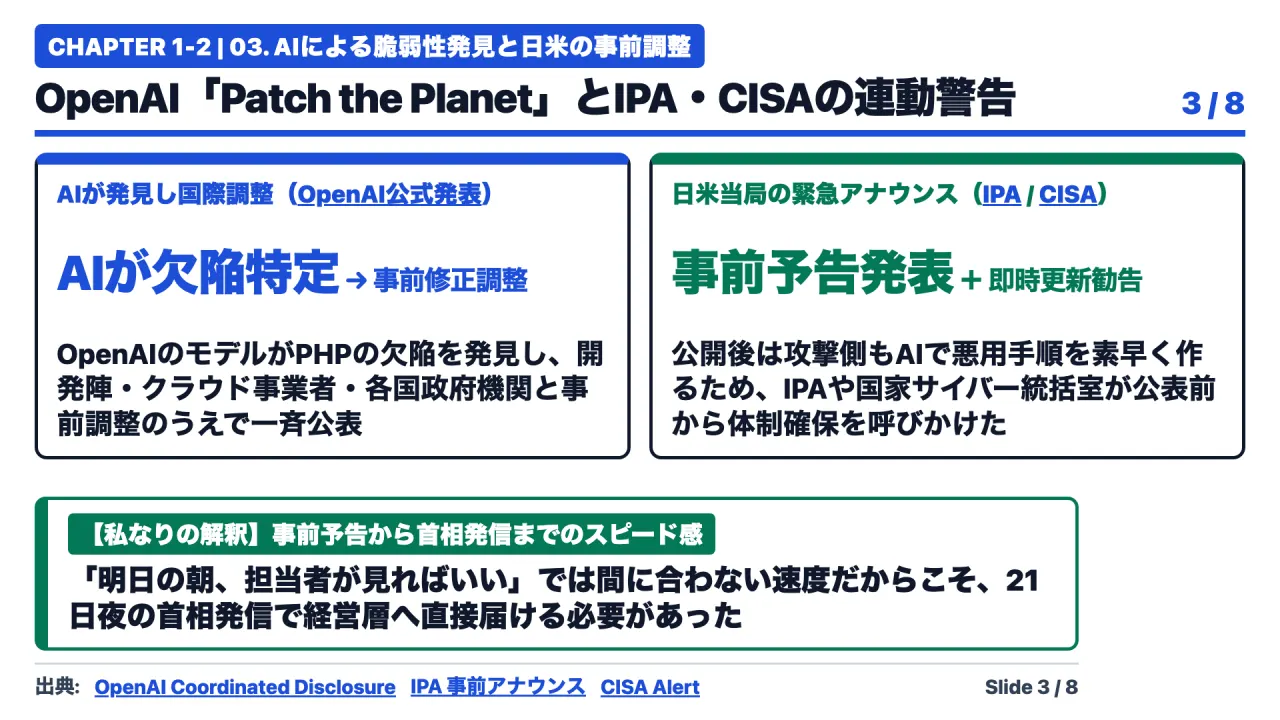
| AI Discovery & Embargo Leak | Discovered independently in August 2026 by Calif researchers via OpenAI’s Patch the Planet program (GPT-5.6 Sol) and Wiz Research. Scheduled for disclosure on October 22, but leaked on October 20, forcing a 24-hour advance release. |
| Government Context | Spearheaded by the National Cyber Operations (NCO) within the Cabinet Secretariat, established July 1, 2025 under the Active Cyber Defense Act and operational on October 1, 2026. |
Technical Severity: Pre-Authentication Remote Code Execution
PHP powers approximately 70% of server-side web systems globally, underlying enterprise portals, WordPress instances, and public-sector digital service desks.
The two flaws collectively designated php2shell represented extreme systemic risk because they enabled unauthenticated remote code execution (Pre-auth RCE) prior to the execution of any user application code:
CVE-2026-109618(Out-of-Memory Longjmp State Corruption): When a PHP process hits its configured memory boundary (memory_limit), the runtime invokeslongjmp()to abort execution and initiate shutdown routines. If memory allocation fails during intermediate data structure allocation, uninitialized internal memory pointers remain accessible during shutdown, allowing a crafted HTTP request to execute arbitrary system code.CVE-2026-109619(Persistent Worker Use-After-Free Across Requests): In persistent execution environments such as PHP-FPM or Apachemod_php, worker processes handle consecutive incoming requests without terminating. When a prior request aborts abnormally, dangling pointers referencing deallocated request memory persist in global state. A subsequent request handled by the same worker can manipulate early initialization parameters (such assession.upload_progress) to trigger a Use-After-Free condition, achieving complete daemon takeover.
The discovery mechanism marked a historical milestone: frontier reasoning models (OpenAI GPT-5.6 Sol and Wiz Research agents) identified subtle memory management flaws in 20-year-old C routines that had evaded decades of human inspection. Because defensive AI can rapidly locate vulnerabilities, offensive actors can leverage equivalent models to synthesize weaponized exploit payloads within hours of patch release.
2. Global Precedents: Five Historical State Interventions Compared
Did international precedent exist for head-of-state intervention in specific software flaws? Examining historical archives across the United States, Canada, and the United Kingdom reveals five relevant milestones:
| Event & Jurisdiction | Issuing Authority | Targeted Software / Language | Nature of Government Intervention | Contrast with Japan’s PHP Incident |
|---|---|---|---|---|
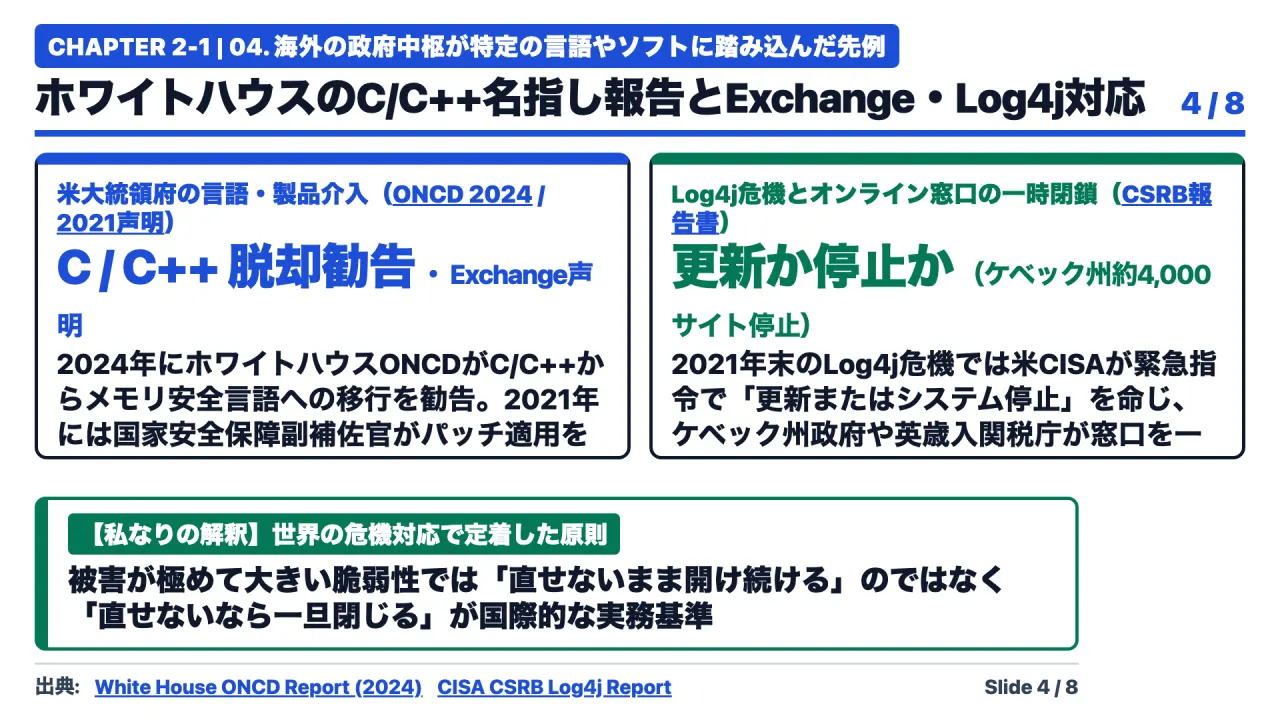
| 1. Feb 2024 (United States) | White House Office of the National Cyber Director (ONCD) | C and C++ programming languages | Published Back to the Building Blocks, urging enterprise adoption of memory-safe languages like Rust. | High-level technical policy on programming languages, but represented medium-term architectural guidance, not an immediate operational countdown. |
| 2. Mar-Apr 2021 (United States) | White House (Press Sec Jen Psaki & Deputy NSA Anne Neuberger) | Microsoft Exchange Server (ProxyLogon flaws) | Formed Unified Coordination Group (UCG); issued a White House Statement demanding immediate patching of mail servers. | Direct executive demand naming a proprietary product, but communicated by deputies and issued weeks after initial patch availability. |
| 3. Dec 2021 - Jan 2022 (US, Canada, UK) | US CISA Director, White House NSC, Quebec Gov, UK HMRC | Apache Log4j (CVE-2021-44228 / Log4Shell) |
CISA issued Emergency Directive 22-02 commanding agencies to patch or disconnect systems. Quebec shuttered ~4,000 portals; UK HMRC closed portals. White House held a Software Security Summit. | Most direct operational precedent for “temporary takedowns,” but warnings originated from agency directors rather than heads of government social media. |
| 4. May 2017 (United Kingdom) | Prime Minister Theresa May | Microsoft Windows (SMBv1 EternalBlue / WannaCry) | Prime Minister delivered televised national statements following catastrophic disruptions across National Health Service (NHS) hospitals. | Direct prime ministerial intervention, but functioned as post-incident disaster management after hospital networks were paralyzed. |
| 5. May 2021 / Mar 2022 (United States) | President Joe Biden | Enterprise software supply chain (SolarWinds, Shields Up) | Signed Executive Order 14028 mandating SBOMs and zero-trust; issued direct statements urging corporate CEOs to harden infrastructure. | Presidential communication to private enterprise, but articulated broad national preparedness rather than naming specific runtimes or timestamps. |
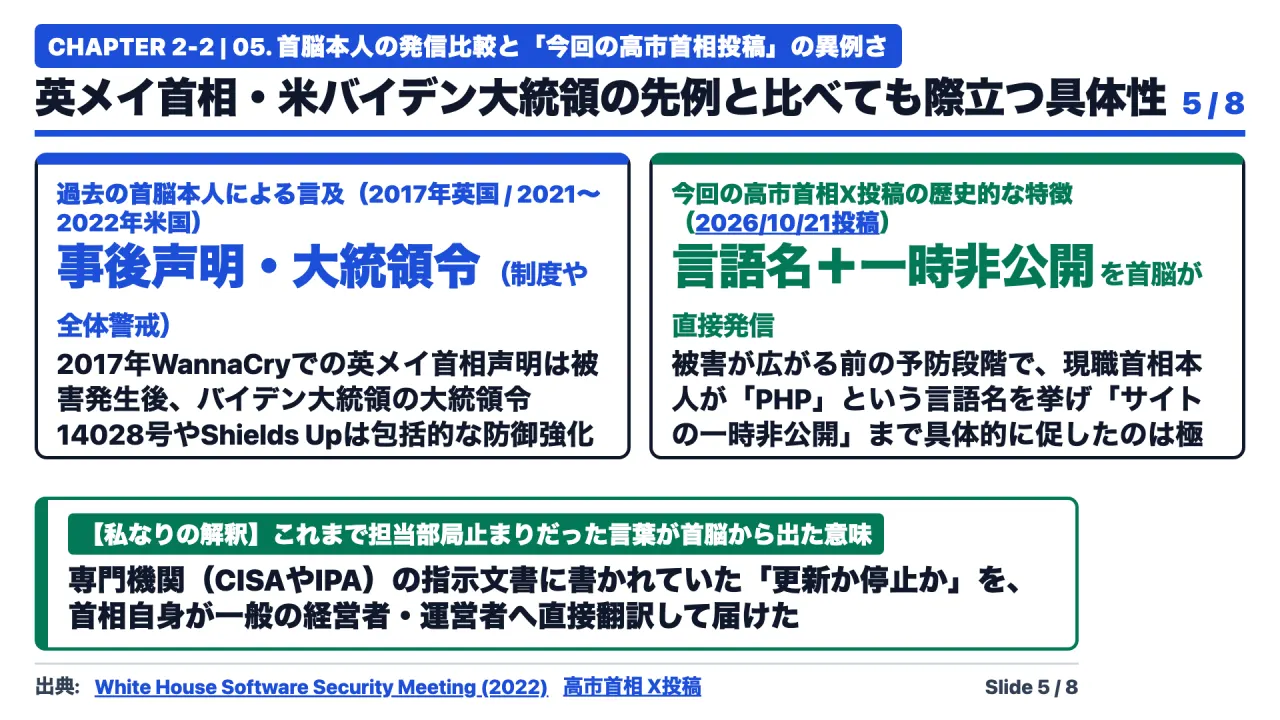
When juxtaposed against these five international benchmarks, Sanae Takaichi’s October 21 statement exhibits three distinct characteristics:
- Preemptive Proactive Countdown: Dispatched 70 minutes prior to public patch release, alerting operators before widespread exploitation could initialize.
- Direct Head-of-State Attribution: Delivered directly from the Prime Minister’s personal verified platform rather than filtered exclusively through administrative agencies.
- Executive Validation of Service Shutdowns: The Prime Minister explicitly endorsed service takedowns as a legitimate risk-mitigation strategy, providing technical teams with executive air cover.
3. Why “Temporarily Shutting Down Websites” Was the Right Call
Reactions across social networks expressed surprise that a national leader advocated taking websites offline. However, from an operational systems perspective, endorsing temporary website takedowns was both technically necessary and organizationally transformative.
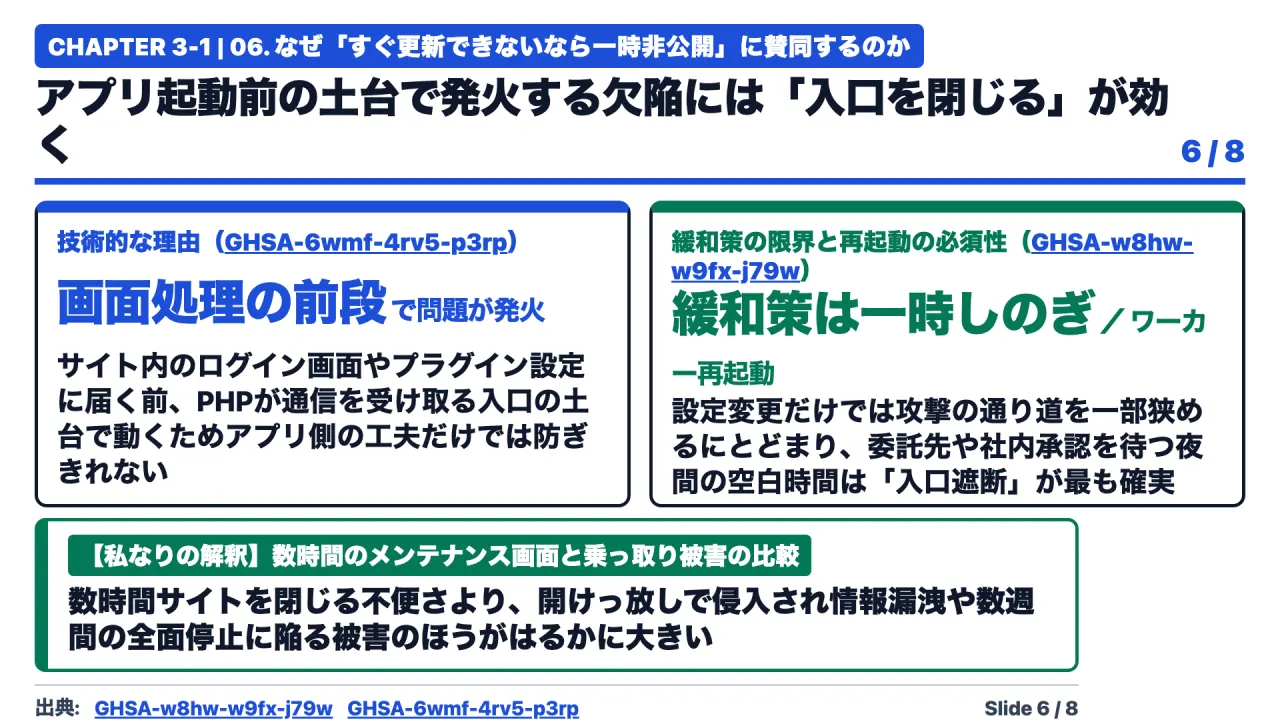
The Technical Imperative
The technical reality of CVE-2026-109618 and CVE-2026-109619 left little room for compromise:
- Application Logic Is Bypassed: Because the vulnerabilities trigger within early request ingestion and late process termination, Web Application Firewalls (WAFs) and application-level filters (such as WordPress security plugins) cannot reliably inspect or neutralize the payload.
- Incomplete Configuration Mitigations: Official security advisories (
GHSA-w8hw-w9fx-j79wandGHSA-6wmf-4rv5-p3rp) confirmed that provisional configuration changes—such as disablingsession.upload_progress.enabledor settingmemory_limit=-1—merely restricted known trigger variations without eliminating underlying memory flaws. Settingmemory_limit=-1introduced secondary denial-of-service risks through uncontrolled host memory exhaustion.
Under these conditions, maintaining an unpatched, internet-exposed PHP daemon overnight between 11:00 PM and business hours represents severe negligence. Switching incoming traffic at the reverse proxy, load balancer, or Content Delivery Network (CDN) to a static 503 maintenance page completely severs TCP connections to backend PHP-FPM workers, providing guaranteed perimeter defense.
The Organizational Imperative: Breaking the Authority Vacuum
While the technical logic of service takedowns is sound, the real-world barrier inside enterprises is governance: who possesses the operational authority to pull the plug?
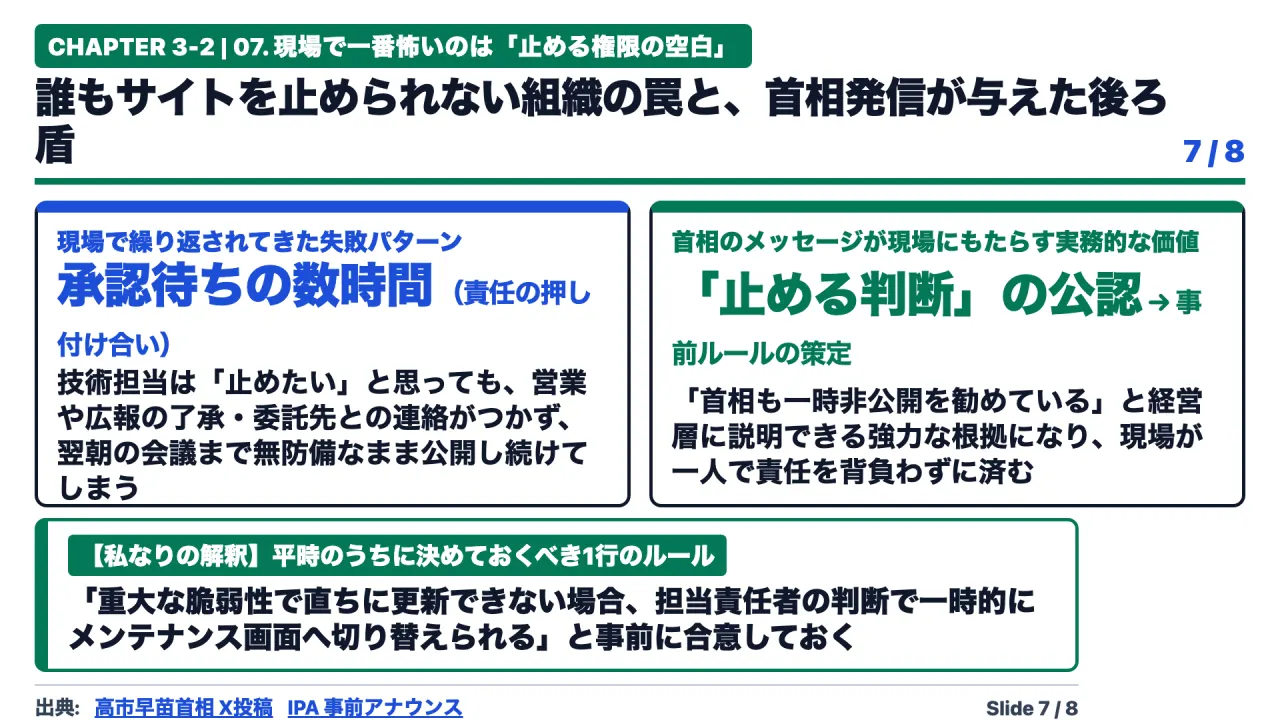
In typical corporate environments, technical teams discovering a severe zero-day face paralysis:
- Marketing resists downtime because a product promotion is active.
- Sales leadership fears losing checkout revenue.
- Legal and compliance teams debate contractual availability SLAs.
- Outsourced maintenance vendors lack authority to modify client DNS records without written approval.
By the time cross-functional committees convene the following morning, unpatched servers have been compromised by automated botnets.
Prime Minister Takaichi’s public statement fundamentally dismantled this authority vacuum. When the head of government and the National Cyber Operations publicly declare that taking systems offline is an effective risk-reduction strategy, internal power dynamics invert. An IT security lead can present leadership with a definitive ultimatum:
“The Prime Minister and national cyber authorities have advised that unpatched systems should be taken offline immediately. We are transitioning our web portals to a static maintenance page until updates and regression tests complete at 8:00 AM.”
4. The Actionable Playbook: Establishing the Authority to Halt Services
The October 21 incident delivers clear governance lessons for private enterprises, municipalities, and technology leaders.
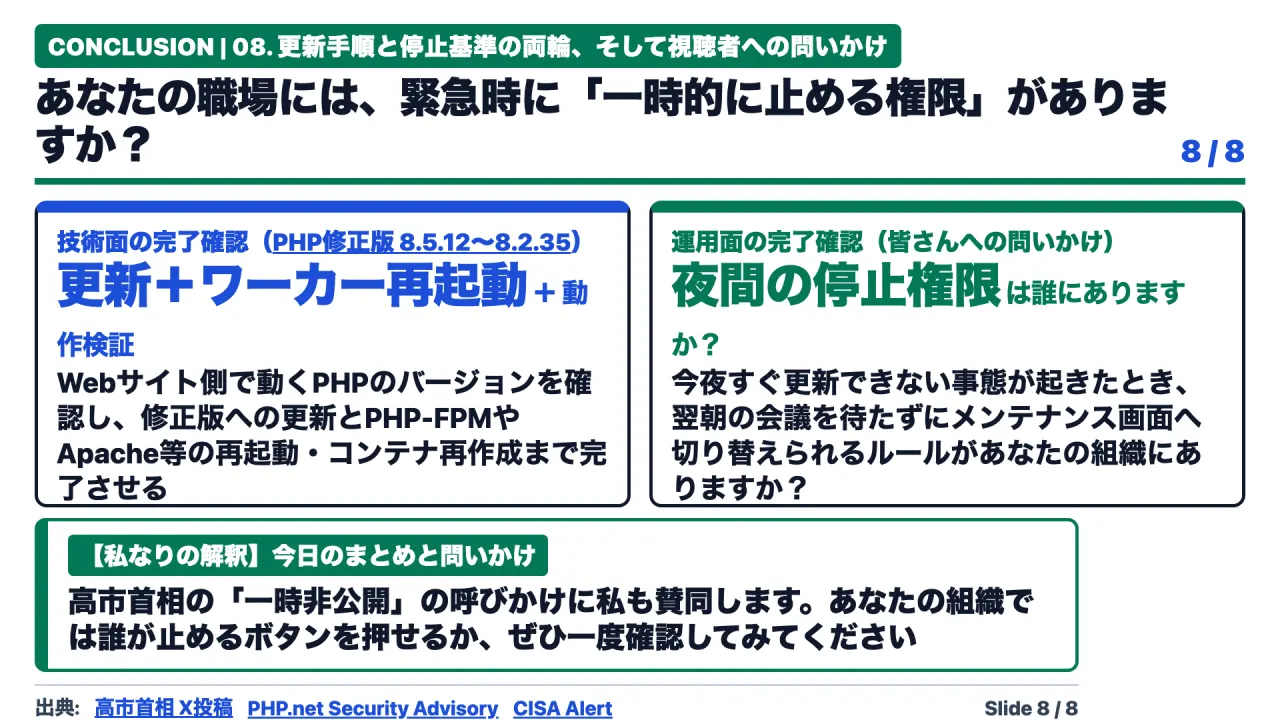
Organizations must implement two structural capabilities:
Technical Verification Checklist
- Catalog All Runtime Topologies: Maintain an accurate inventory of every public-facing endpoint, container, and legacy virtual machine executing PHP runtimes (PHP-FPM, Apache
mod_php, Nginx fastcgi). - Execute Full Process Restarts: Updating system packages via package managers is insufficient if long-running worker processes remain in memory. Restart PHP-FPM daemons, cycle web servers, and redeploy container base images to guarantee patched libraries load into active execution space.
Governance Checklist: The One-Line Emergency Protocol
To avoid future operational paralysis, corporate boards and executive committees should formalize an explicit emergency shutdown rule:
Emergency Shutdown Policy Rule:
"Upon public confirmation of an actively exploited or zero-day vulnerability rated
CVSS 9.0 or higher where vendor patches cannot be immediately validated, the Chief
Information Security Officer (or designated technical lead) is pre-authorized to
transition public-facing services to static maintenance mode without prior executive
committee approval, subject to mandatory post-incident reporting within 12 hours."
Organizations that establish this pre-authorized shutdown mandate safeguard their data, their customers, and their legal standing. Those that require cross-functional approval to sever network access will inevitably find themselves compromised.
Primary Sources and References
- Prime Minister Sanae Takaichi Official Post: Emergency Advisory on Critical PHP Vulnerabilities (October 21, 2026, 21:55 JST)
- Cabinet Secretariat National Cyber Operations (NCO): Official Cyber Warning Feed (
@cyber_forecast) - IPA Information-technology Promotion Agency, Japan: Emergency Pre-Advisory on PHP Security Updates (October 21, 2026)
- PHP Group Release Announcement: PHP Security Releases 8.5.12, 8.4.27, 8.3.36, and 8.2.35 (October 21, 2026)
- GitHub Security Advisory:
CVE-2026-109618Advisory (GHSA-w8hw-w9fx-j79w) - GitHub Security Advisory:
CVE-2026-109619Advisory (GHSA-6wmf-4rv5-p3rp) - OpenAI Security Research: Coordinated Disclosure of Critical Vulnerabilities via Patch the Planet (October 21, 2026)
- Wiz Research: php2shell: Critical PHP Remote Code Execution Vulnerabilities (October 2026)
- US Cybersecurity and Infrastructure Security Agency (CISA): Alert: Critical Vulnerabilities in PHP Require Immediate Patching (October 21, 2026)
- White House ONCD: Back to the Building Blocks: A Path Toward Secure and Measurable Software (February 2024)
- White House Statements: Statement by Deputy National Security Advisor Anne Neuberger on Microsoft Exchange Patches (April 13, 2021)
- White House Statements: Readout of White House Meeting on Software Security (Apache Log4j Response) (January 13, 2022)
- US CISA CSRB: Cyber Safety Review Board Report on Log4j (July 2022)