When the Help Desk Front Door Is Breached, a Patch Is Not Enough: Inside the BeyondTrust Remote Support Zero-Day (CVE-2026-102764) and the Mandiant ARMORY CASTLE Investigation
An architectural analysis of the CVSS 9.3 arbitrary file manipulation flaw in BeyondTrust Remote Support, in-the-wild exploitation by threat cluster ARMORY CASTLE, and why patching an appliance without credential revocation and forensic reconstruction leaves corporate networks exposed.
Published: October 22, 2026 | Read time: ~10 min | Watch Video (Japanese)
Executive Summary: The Remote Support Perimeter Dilemma
Across enterprise IT environments, remote support software functions as an indispensable utility. When an employee’s workstation encounters an operating system crash, when an executive needs software provisioned, or when a remote server requires emergency configuration, IT help desks and managed service providers (MSPs) rely on remote desktop appliances to tunnel directly into endpoints behind corporate firewalls.
However, when the gateway providing privileged remote access is itself compromised by an unauthenticated vulnerability, the trust model inverts: the very tool deployed to troubleshoot internal networks becomes an adversary’s primary beachhead.
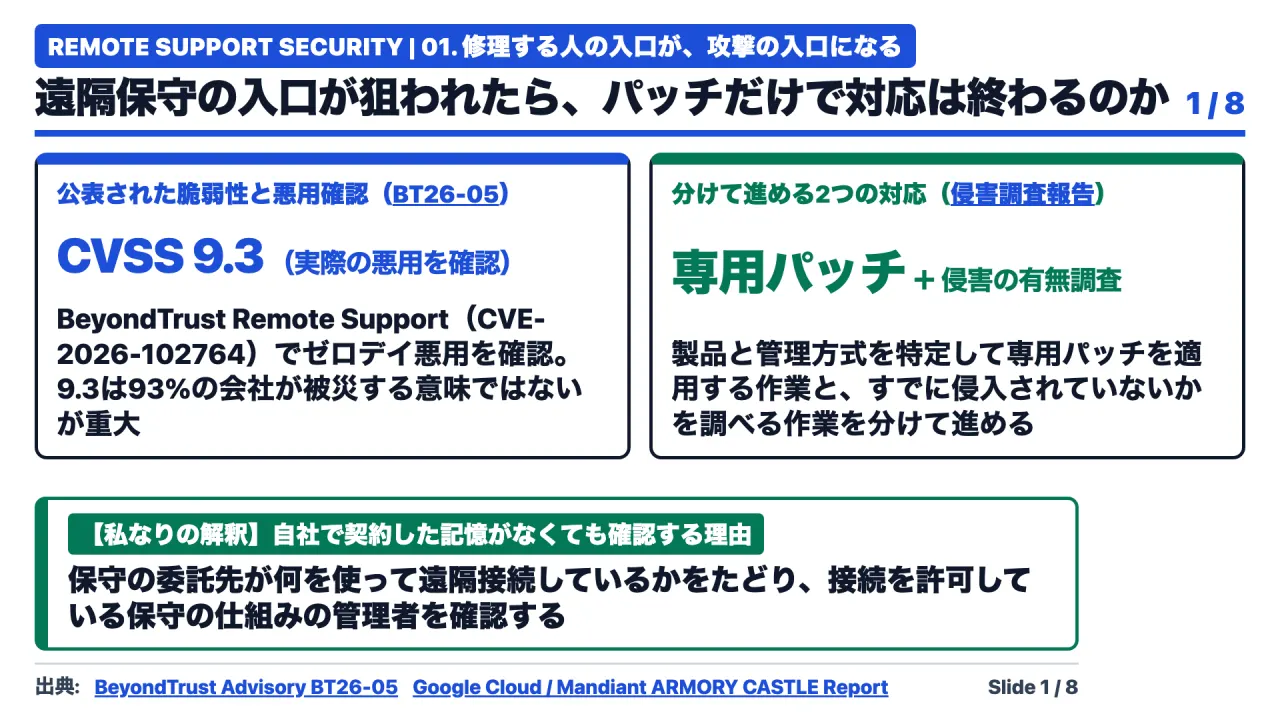
In October 2026, security advisories from BeyondTrust (BT26-05) alongside threat intelligence reports from Google Cloud and Mandiant revealed that threat actors had achieved active in-the-wild exploitation of BeyondTrust Remote Support (RS) appliances via a critical flaw tracked as CVE-2026-102764 (CVSS v4.0 score of 9.3).
The technical and governance implications of this event center on a recurring operational failure in cybersecurity:
Applying a software patch closes an entry vulnerability, but it does not evict an adversary who has already crossed the threshold. In systems that store or broker administrative credentials, remediating a compromised appliance requires a strict three-phase protocol: isolating the appliance, forensically verifying whether compromise occurred, rebuilding from a trusted base image if breached, and systematically rotating all downstream credentials.
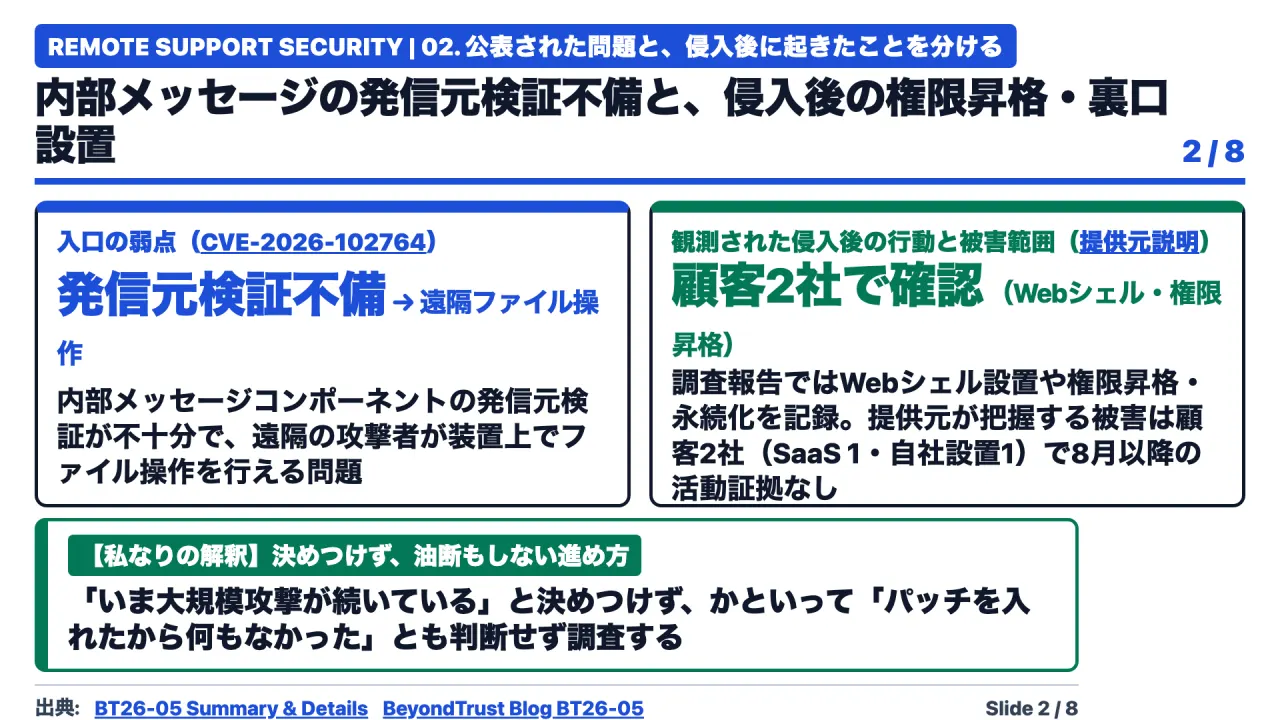
1. Deconstructing CVE-2026-102764: Mechanics and Impact
On October 9, 2026, BeyondTrust released security advisory BT26-05, followed by technical updates detailing an unauthenticated vulnerability residing in the internal messaging architecture of Remote Support.
Vulnerability Mechanics
The flaw stems from insufficient validation of origin for internal inter-process messages within the appliance firmware:
- CWE Classifications: Classified under CWE-346 (Origin Validation Error) and CWE-73 (External Control of File Name or Path).
- Attack Vector: An unauthenticated remote attacker capable of reaching the appliance’s network interface can transmit specially crafted network payloads. Because the internal message parser fails to verify that commands originate exclusively from authenticated local system services, the appliance processes the external commands with elevated system privileges.
- Impact: The vulnerability allows arbitrary file creation, modification, and execution within the appliance operating system without requiring valid administrative credentials.
Scope of Affected Software
The advisory delineates specific product boundaries across BeyondTrust’s catalog:
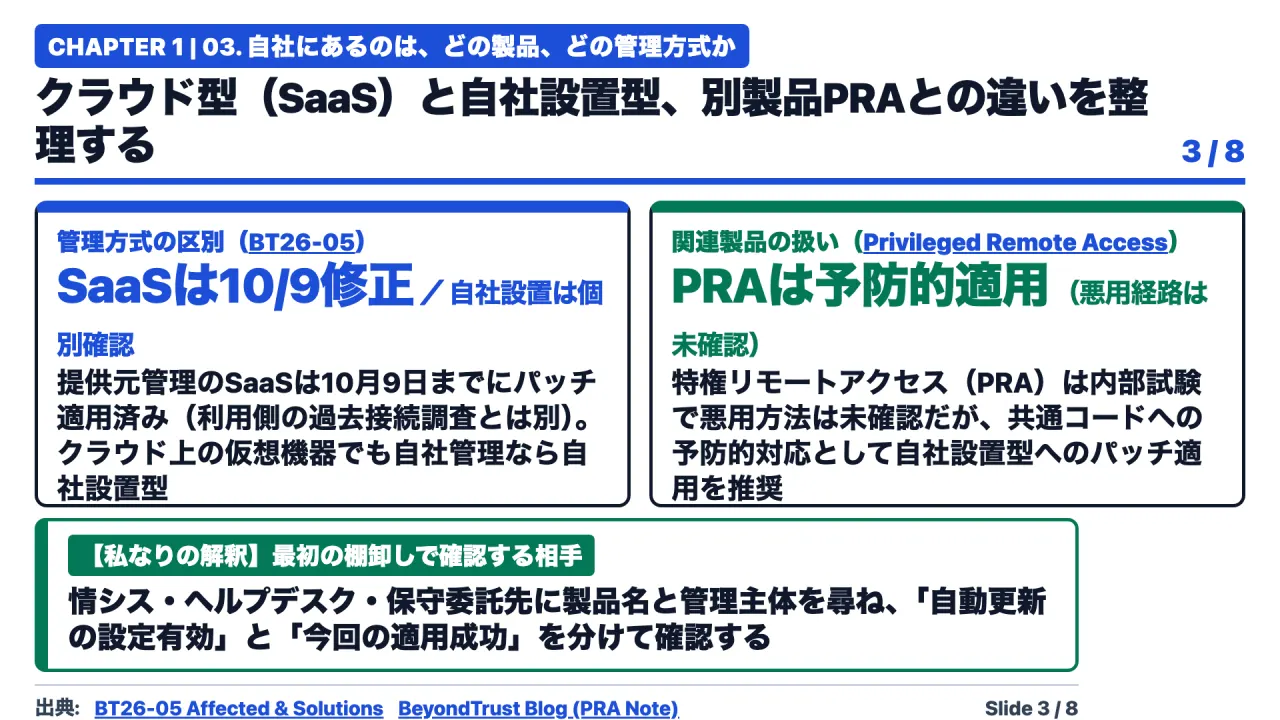
| Product Name | Affected Versions | Dedicated Remediation Patch | Confirmed Active Exploitation |
|---|---|---|---|
| BeyondTrust Remote Support (RS) | Version 26.2.3 and earlier |
BT26-05-RS (Applicable to 24.3.1 through 26.2.3) |
Yes (Confirmed by vendor and Mandiant) |
| Privileged Remote Access (PRA) | Shared codebase components | BT26-05-PRA (Precautionary update) |
No (Exploit method unverified in testing) |
| BeyondTrust Cloud Deployments | Cloud-managed SaaS instances | Automated cloud update completed by October 9, 2026 | Mitigated by provider |
For on-premises and customer-managed cloud virtual appliances (AWS, Azure, private VMware hypervisors), administrators cannot rely on base version numbers alone. An appliance running version 26.2.3 remains vulnerable until the dedicated patch BT26-05-RS has been explicitly applied and verified in the installed package ledger.
For deployments operating on versions earlier than 24.3.1, direct application of the patch is unsupported; administrators must first upgrade the underlying appliance software to an eligible release before installing the security update.
2. In-the-Wild Exploitation: Mandiant and Threat Cluster ARMORY CASTLE
Unlike theoretical vulnerabilities uncovered in academic isolation, CVE-2026-102764 was leveraged by advanced persistent threat actors prior to broad public disclosure.
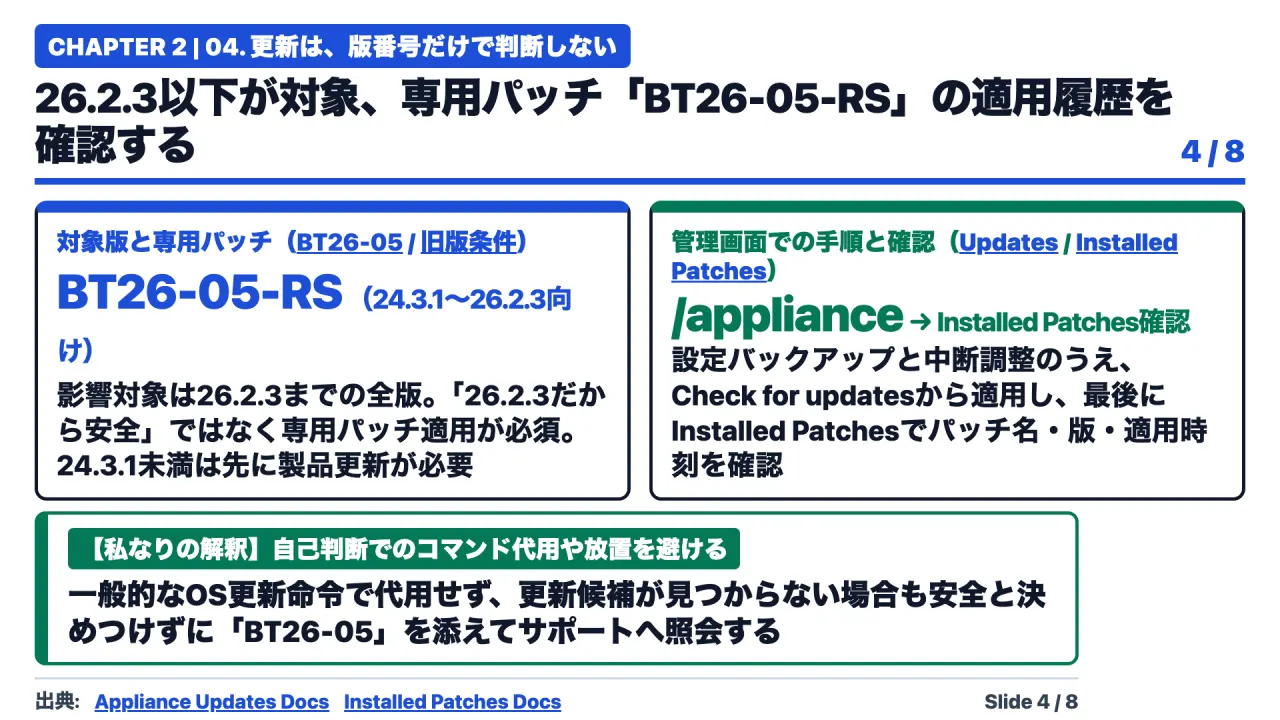
A comprehensive incident investigation conducted by Google Cloud Threat Intelligence and Mandiant tracked the operational activity under threat cluster ARMORY CASTLE:
- Confirmed Victimology: BeyondTrust verified that the exploit was successfully executed against two enterprise customer environments. The vendor noted that zero active telemetry pointed to ongoing exploitation post-August 2026.
- Post-Exploitation Actions: Once arbitrary file manipulation was achieved on the appliance, the adversary escalated privileges to root, deployed custom webshells to establish persistent out-of-band administrative access, and systematically accessed internal configuration tables.
- Anti-Forensic Log Deletion: Crucially, the threat actors executed shell scripts that deliberately purged appliance transaction logs, connection histories, and authentication records to hinder incident response efforts.
This active log manipulation underlines a core security tenet: the absence of error logs on a local appliance is not evidence of absence of compromise.
3. The Operational Fallacy: Why Patching Alone Leaves the Enterprise Exposed
When vulnerability advisories are published, enterprise IT workflows frequently treat remediation as a mechanical checklist item: identify the affected host, deploy the vendor patch, restart the daemon, and mark the ticket resolved.
In the context of remote support and privileged access gateways, this approach represents an acute architectural failure.
The Stolen Key Metaphor
To understand why simple patching is insufficient, consider an enterprise physical security analogy:
The Gateway Breach Sequence:
+---------------------------------------------------------------------------------+
| Step 1: Intruder exploits flawed lock mechanism on building perimeter door.    |
| Step 2: Intruder enters administrative office and clones master ring of keys.   |
| Step 3: Security replaces perimeter door lock with patched hardware.            |
| Status: The door is secure, but the adversary holds valid keys to every room.   |
+---------------------------------------------------------------------------------+
BeyondTrust Remote Support appliances act as high-trust nexus points. They process, manage, and temporarily cache:
- Local appliance administrator passwords and API tokens.
- Lightweight Directory Access Protocol (LDAP) and Active Directory service account credentials used to sync user directories.
- Elevated session credentials used by technicians to authenticate into downstream corporate laptops, databases, and domain controllers.
- Active cryptographic session tokens and persistent client connection certs.
If threat actors utilized CVE-2026-102764 to establish root-level execution, patching the messaging flaw on Day 5 does nothing to invalidate the Active Directory service account secrets exfiltrated on Day 2. Armed with valid credentials, the adversary can bypass the appliance entirely, pivoting directly into internal network infrastructure via Virtual Private Networks (VPNs) or Remote Desktop Protocol (RDP) channels.
4. Triage and Remediation Protocol: Mandiant Option 2 vs. Option 3
For organizations maintaining self-hosted Remote Support deployments that were internet-accessible during the window of vulnerability, security teams must structure response operations around the formal triage framework established by Mandiant and BeyondTrust.
Phase 1: Appliance Verification and Immediate Containment
- Verify Asset Ownership and Management Boundaries: Audit whether the enterprise or third-party MSP contractors operate BeyondTrust Remote Support or Privileged Remote Access. Confirm whether appliances are vendor-hosted SaaS or customer-managed instances.
- Determine Exposure Window: Query firewall, DNS, and perimeter router telemetry to identify the exact timeframe the appliance’s management interface (
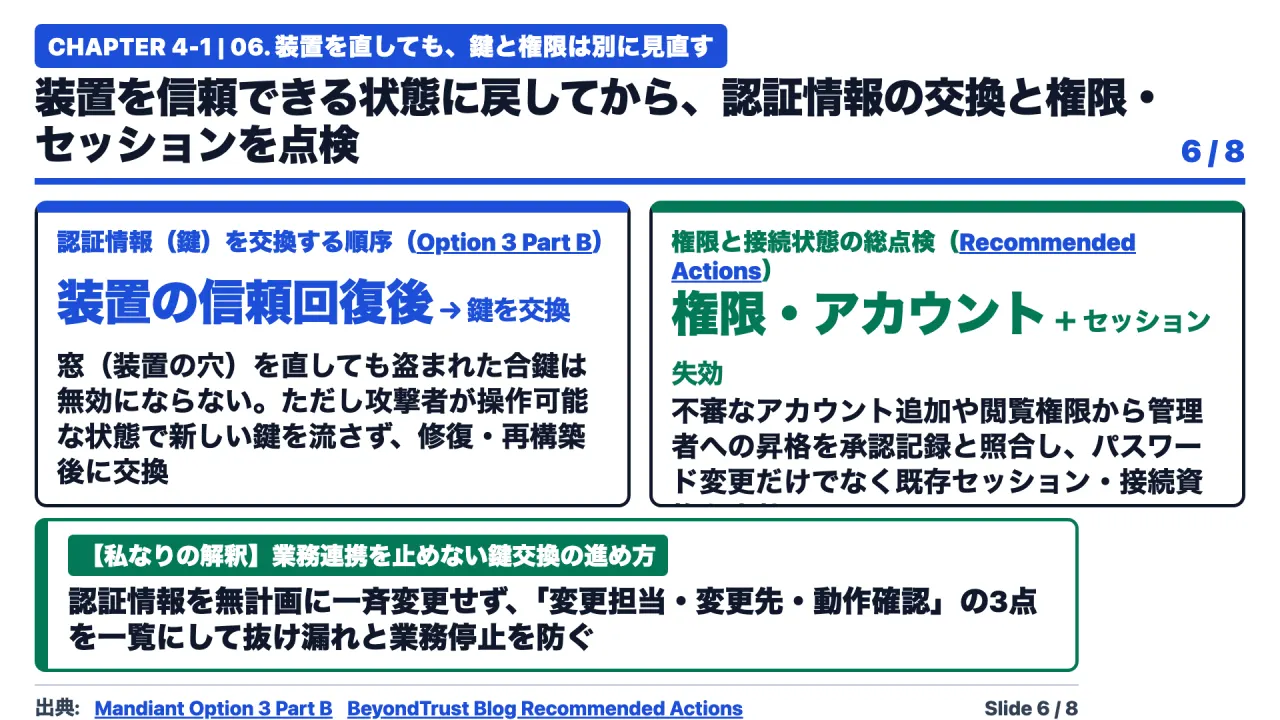
/appliance) or client ports were routable from public IP ranges. - Emergency Network Isolation: If an appliance was exposed and anomalous activity is suspected, temporarily isolate the appliance at the network perimeter (via upstream firewall rules) while preserving its volatile state.
Phase 2: Choosing the Remediation Pathway
Organizations must explicitly bifurcate their operational response based on forensic confidence:
Pathway A: The Standard Remediation Path (Uncompromised Appliance)
Applicable only if comprehensive external network logs confirm the appliance was never exposed to unauthorized networks, or if specialized forensic inspection confirms zero indicators of compromise (IoCs):
- Navigate to
/appliance>Updates>Check for Updates. - Apply patch
BT26-05-RS(orBT26-05-PRA). - Verify patch presence in the
Installed Patchesconsole. - Create an administrative configuration backup.
Pathway B: Mandiant Option 3 (Suspected or Confirmed Compromise)
If the appliance was internet-facing without multi-factor IP restrictions, or if log gaps, unauthorized accounts, or unusual outbound connections are identified:
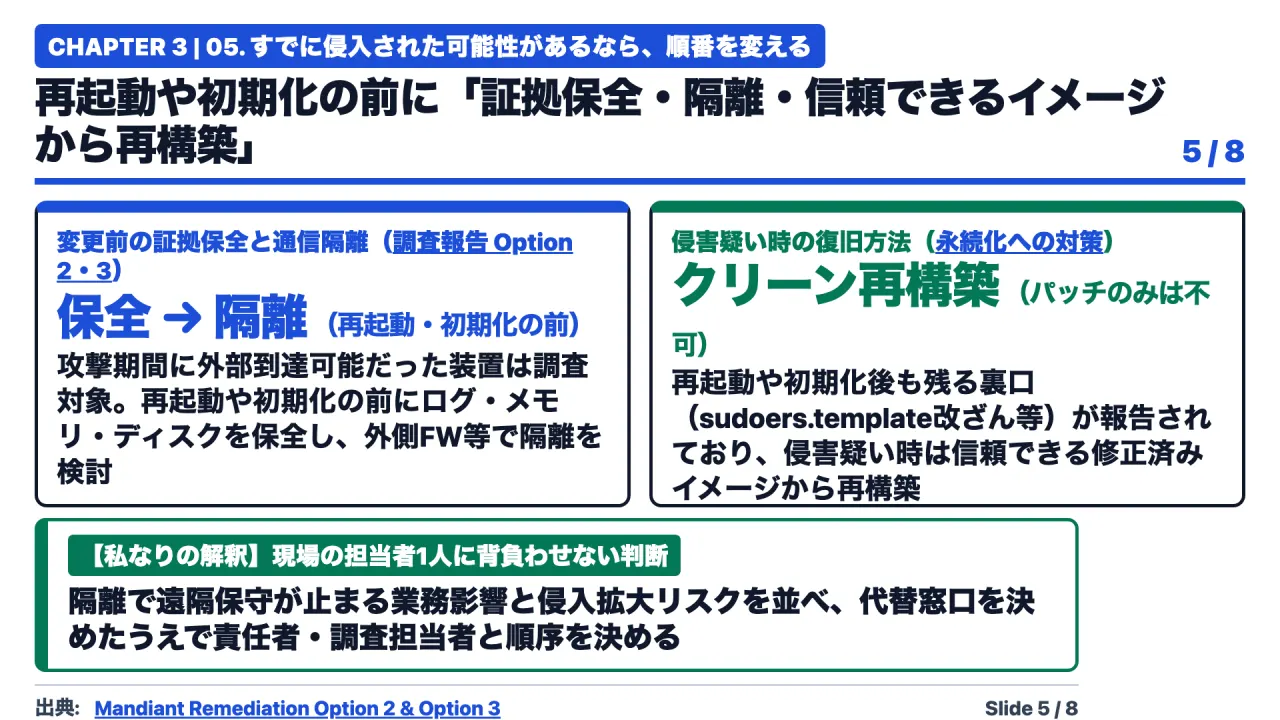
- Do Not Simply Patch: Overwriting binaries on a compromised host destroys forensic artifacts and leaves webshells intact.
- Forensic Preservation: Capture a full volatile memory dump and a byte-level disk snapshot of the virtual machine before rebooting or terminating the instance.
- Complete Appliance Destruction and Rebuild: Discard the virtual appliance entirely. Deploy a fresh, trusted appliance base image from the vendor repository.
- Configuration Restoration: Re-apply core configuration from a known-good backup created prior to the exposure window, or reconfigure manually. Apply all current security patches before restoring network routing.
5. Comprehensive Credential and Session Revocation
Once the underlying appliance is either certified clean or reconstructed from trusted media, security teams must execute an exhaustive credential rotation sequence.
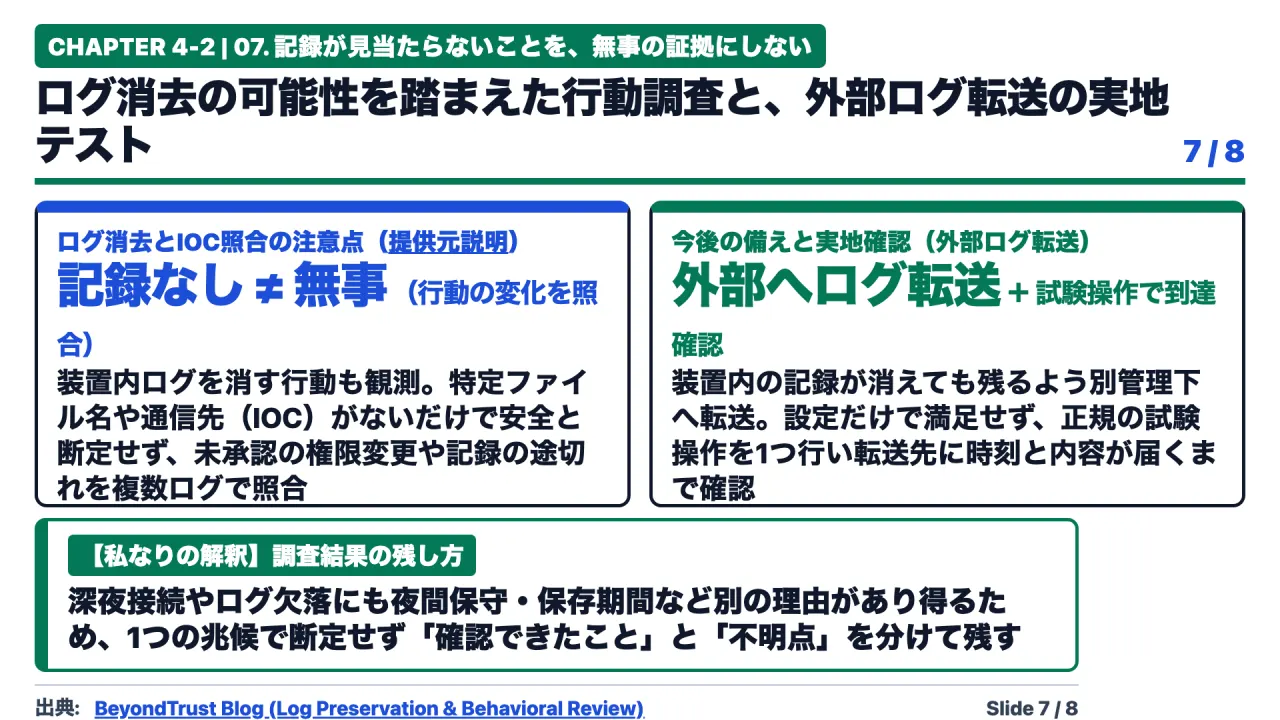
Executing this sequence haphazardly introduces operational failure. If an administrator resets Active Directory passwords while an attacker still maintains an active webshell on the unpatched appliance, the attacker captures the new credentials in plaintext.
The Five-Step Rotation Sequence
Sequence of Execution:
[1. Isolate/Rebuild Appliance]
           │
           ▼
[2. Terminate Active Sessions]
           │
           ▼
[3. Rotate Appliance Secrets]
           │
           ▼
[4. Rotate Directory Accounts]
           │
           ▼
[5. Rotate Downstream Secrets]
- Terminate All Active Sessions: Within the management console, force-terminate all active remote support sessions, technician connections, and jump-client tunnels.
- Rotate Local Appliance Secrets: Change passwords for all local administrator accounts, appliance backup encryption keys, and internal API integration tokens.
- Rotate Directory Service Credentials: In Active Directory or Identity Providers (Entra ID, Okta), reset the passwords for all service accounts configured within the appliance for user synchronization or authentication lookup.
- Invalidate Client Tokens and Certificates: Regenerate appliance SSL/TLS certificates and force re-issuance of connection tokens for deployed Jump Clients.
- Rotate Downstream Managed Credentials: For any endpoint or privileged target system accessed via the appliance during the exposure window, cycle local administrator passwords and service account keys.
6. Strategic Takeaways: Hardening Remote Management Infrastructure
The BeyondTrust BT26-05 incident exposes broader governance vulnerabilities in how modern enterprises procure, deploy, and monitor remote maintenance platforms.
Enterprise security leaders should implement three long-term architectural controls:
1. Eliminate Direct Public Exposure of Management Consoles
Administrative portals—specifically /appliance interfaces—should never be directly reachable from the public internet. Restrict access through zero-trust network access (ZTNA) brokers, dedicated administrative jump hosts, or strict source-IP access control lists (ACLs) limiting connectivity to verified corporate ranges.
2. Implement Out-of-Band Immutable Telemetry Ingestion
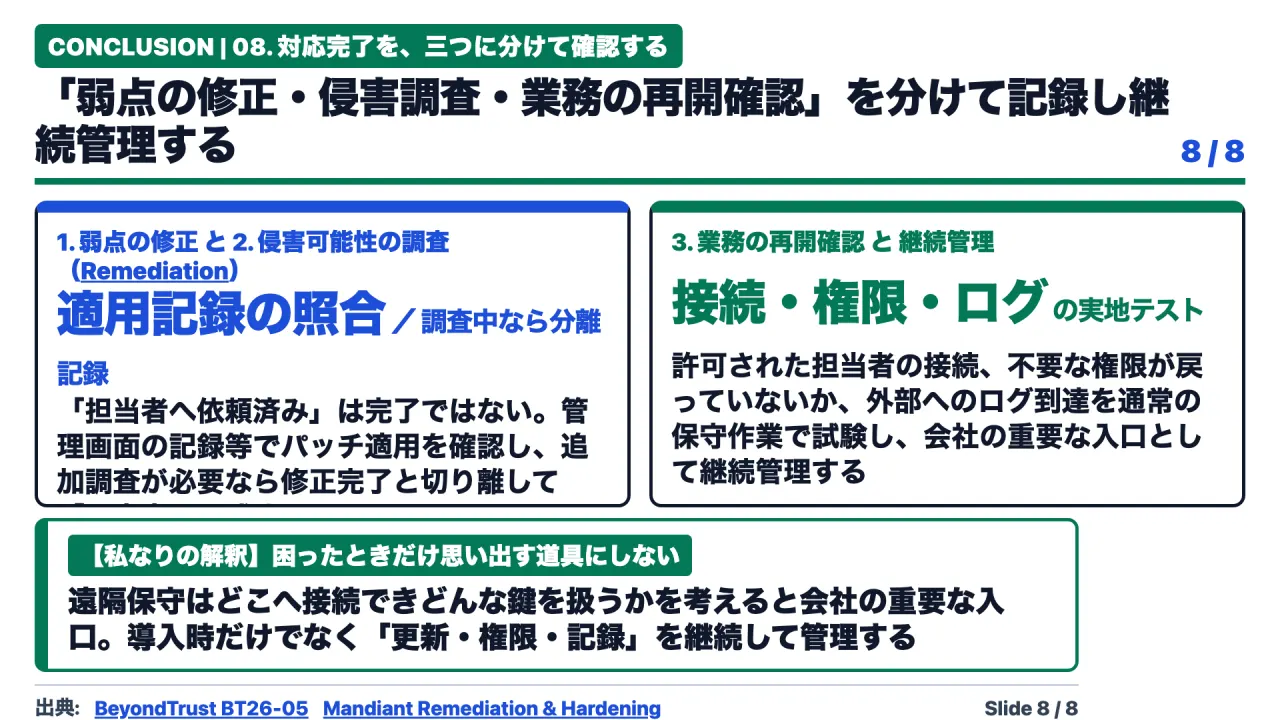
Because threat actors targeting appliance firmware routinely delete local event ledgers, local audit logs cannot serve as a reliable source of truth. Configure real-time, encrypted syslog forwarding to an external Security Information and Event Management (SIEM) or data lake. Validate this pipeline regularly by generating test audit events and confirming receipt in the central repository.
3. Establish Clear Criteria for Operational Shutdowns
In many organizations, incident responders hesitate to isolate remote support infrastructure because doing so disrupts daily help-desk operations. Executive management must pre-authorize operational rules granting security leads explicit authority to sever internet access to privileged appliances immediately upon confirmation of a CVSS 9.0+ remote code execution vulnerability.
Primary Sources and References
- BeyondTrust Security Advisory: Security Advisory BT26-05: Remote Support and Privileged Remote Access (October 2026)
- BeyondTrust Corporate Blog: Update and Context on Advisory BT26-05 (October 2026)
- BeyondTrust Technical Documentation: On-Premises Appliance Updates and Patch Application Guide
- BeyondTrust Technical Documentation: Verifying Installed Patches and Appliance History
- BeyondTrust Technical Documentation: Critical Appliance Upgrade Prerequisites and Migration Paths
- BeyondTrust Technical Documentation: Appliance Upgrade Procedures and Service Interruption Planning
- Google Cloud Threat Intelligence & Mandiant: ARMORY CASTLE: Threat Actor Exploitation of BeyondTrust Remote Support Gateways (October 2026)