Why 95%-Accurate Robot AI Fails 98.3% of the Time in Production: Dyna-2's 1-Million-Hour World-Action Model and the Reality of Autonomous Physical Agents
Through 100 million hours of egocentric video pre-training and real-world deployment at Din Tai Fung, Dyna Robotics proves that overcoming the 79-step compounding failure law requires predictive visual simulation, self-recovery workflows, and wheeled semi-humanoid hardware over viral bipedal demos.
Published: October 23, 2026 | Read time: ~10 min | Watch Video (Japanese)
Executive Summary: The Harsh Mathematics of Physical AI
Across social media and academic conferences, demonstrations of humanoid robots executing backflips, dancing, or picking up fragile objects create the impression that general-purpose physical automation is imminent. Yet, when state-of-the-art robotic models are transitioned from curated staging environments to production commercial facilities—such as industrial kitchens, hotel laundries, or manufacturing lines—they routinely suffer catastrophic failure.
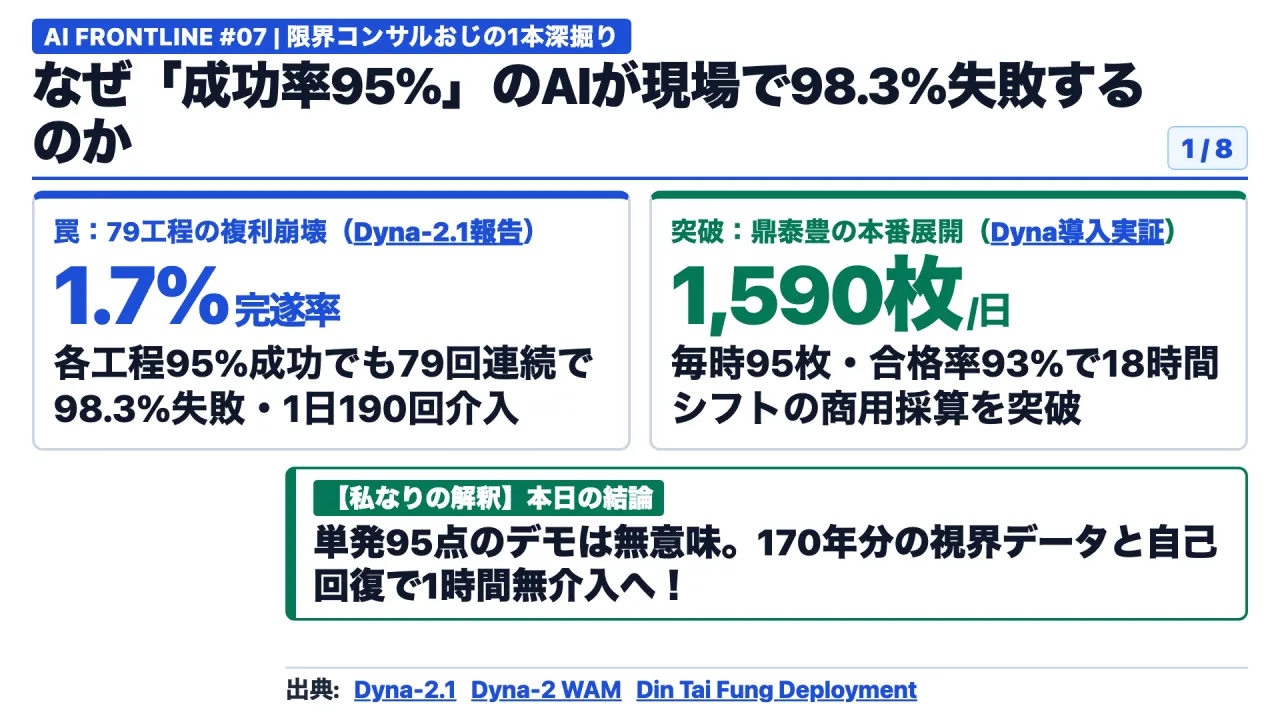
This operational breakdown is governed by a fundamental mathematical reality: the compounding probability of multi-step sequential tasks.
Consider an automated laundry workflow in a commercial hotel: washing, transferring to dryers, folding towels, sorting by size, and stacking onto storage shelves across a continuous cycle of 79 discrete sub-tasks. If a frontier robotic agent executes each individual sub-task with an impressive 95.0% success rate, standard probability dictates the likelihood of completing an entire 79-step cycle without human intervention:
Cycle Success Probability = 0.950^79 ≈ 1.7%
Failure Rate Per Cycle = 98.3%
Intervention Frequency = ~190 times per 24 hours (~Once every 8 minutes)
At a 98.3% cycle failure rate, an autonomous system becomes an operational liability, forcing facility staff into “robot babysitting hell.”
Yet, Dyna Robotics achieved commercial viability at the global restaurant chain Din Tai Fung, where its autonomous system Taku folds 1,590 cloth napkins daily at a 93% quality pass rate, surpassing break-even return on investment.
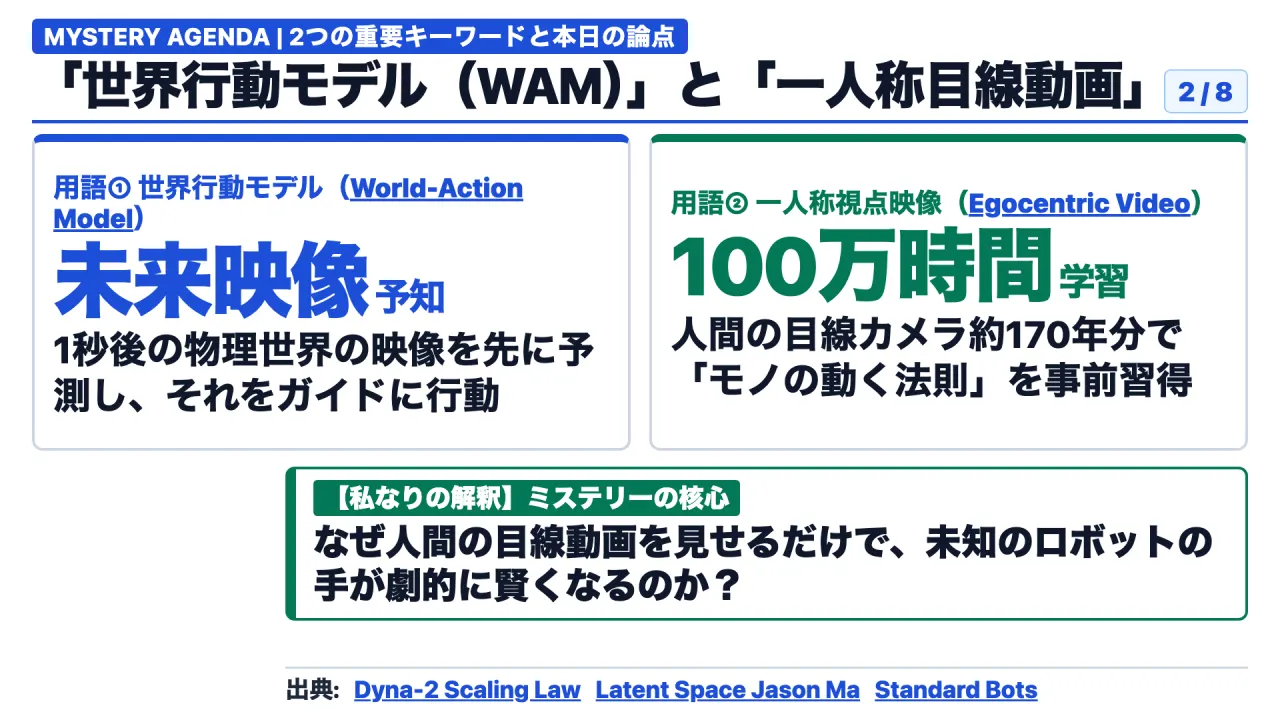
This deep dive examines how Dyna Robotics, Standard Bots, and leading roboticists resolved this operational crisis. By analyzing Dyna’s technical papers, deployment data, and executive discussions on the Latent Space podcast, we unpack the 1-million-hour World-Action Model (Dyna-2), the physics of wheeled semi-humanoids, and the engineering rules for autonomous physical systems.
1. The Humanoid Bubble: What 10 Months in Production Revealed
In May 2026, Dyna Robotics co-founder York Yang published What 10 Months in Production Taught Us About the Robotics “Bubble”, exposing the gap between venture capital valuation and factory floor reality.
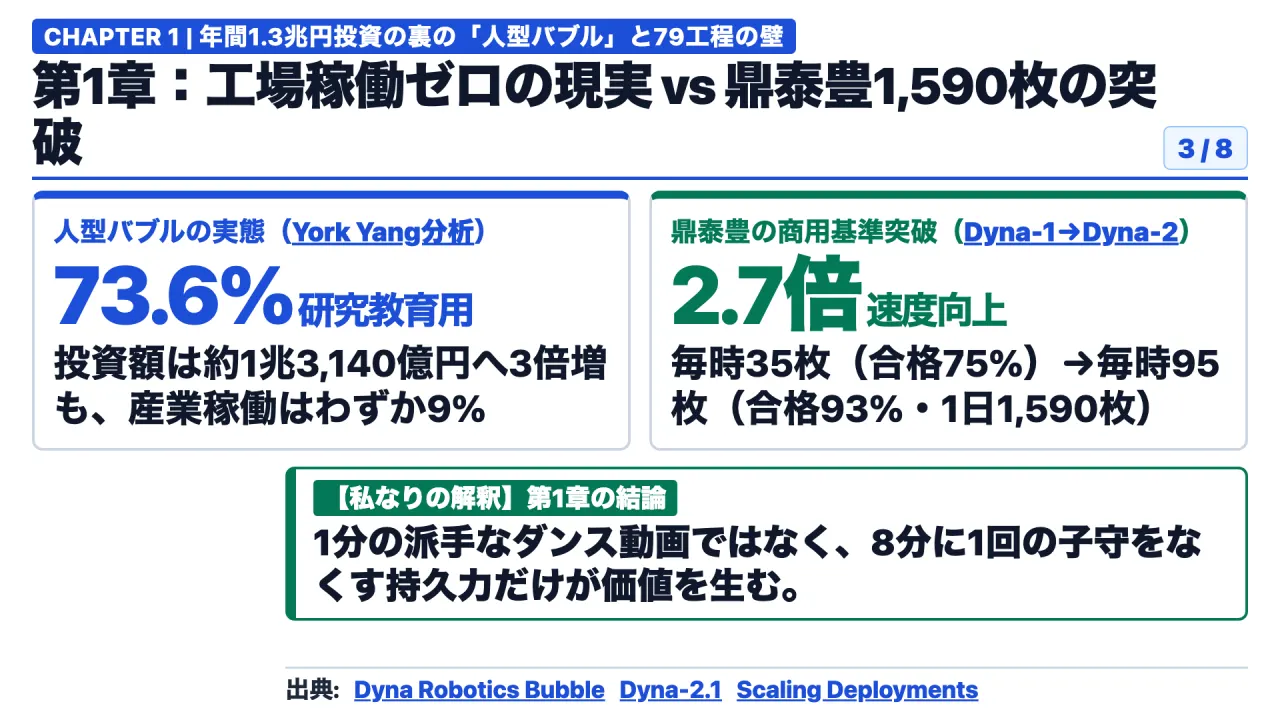
Between 2022 and 2025, global venture funding for robotics enterprises expanded from $2.86 billion to $8.76 billion, with Chinese manufacturers announcing over 330 distinct humanoid models.
However, production corporate filings reveal a stark contrast:
- Tesla Optimus Telemetry: In Tesla’s January 2026 earnings conference call, Elon Musk conceded that zero Optimus humanoid units were performing sustained, useful production labor in Tesla manufacturing facilities.
- Unitree IPO Filing: In its March 2026 prospectus, Unitree disclosed that of its humanoid robot revenue from January through September 2025, 73.6% was generated from university laboratories and educational institutions. Industrial customer deployments accounted for just 9.0%—and the vast majority were deployed as marketing props, corporate receptionists, or trade show greeters.
The Din Tai Fung Commercial Benchmark
The standard for industrial utility was demonstrated in Dyna Robotics’ commercial deployment at Din Tai Fung, the premier dumpling restaurant chain in the United States. Din Tai Fung maintains rigorous quality standards for its dining table cloth napkins: each napkin requires a precision pocket for chopsticks, with seams aligned within millimeter tolerances. Each restaurant location requires 1,500 verified napkins per 18-hour operating shift.
| Deployment Generation | Model Architecture | Throughput (Napkins/Hour) | Quality Pass Rate | Daily Production (18h Shift) | Commercial Viability |
|---|---|---|---|---|---|
| Dyna 1 (2025) | Standard VLA (Teleoperation Pre-training) | 35 napkins/hr | 75.0% | ~480 table-ready napkins | ROI Failure (Requires human re-folding) |
| Dyna 2 (2026) | World-Action Model (Dyna-2 + 1M Hr Pre-training) | 95 napkins/hr (2.7x) | 93.0% | 1,590 table-ready napkins | Commercial Success (Autonomous deployment) |
The initial 2025 system folded only 35 napkins per hour with a 75% pass rate, producing ~480 usable napkins daily. In contrast, Dyna 2 achieved 95 napkins per hour at a 93% quality pass rate, delivering 1,590 table-ready napkins per shift. Production enterprise labor demands not viral one-minute dance clips, but the mechanical endurance to sustain 99.9% reliability over continuous hours.
2. Dyna-2: A 1-Million-Hour Scaling Law for World-Action Models
To understand Dyna 2’s breakthrough, one must examine the foundational bottleneck in physical robotics: the absence of internet-scale robotic data.
Large language models leverage trillions of tokens scraped from the public internet. In robotics, however, continuous multidimensional joint angles, torque measurements, and tactile sensor readings cannot be scraped from websites. Collecting robot teleoperation data by assigning humans to drive robot arms with joysticks costs hundreds of dollars per hour, capping academic datasets at a few thousand hours.
The Egocentric Video Paradigm Shift
Dyna Robotics bypassed this data starvation by altering their training paradigm. In Dyna-2: A 1-Million-Hour Scaling Law for World-Action Models (August 2026), the research team trained their foundational model on 1,000,000 hours of egocentric video—first-person footage captured via head-mounted and chest-mounted cameras by chefs, mechanics, factory workers, and cleaners. This represents approximately 170 years of continuous human waking vision.
Crucially, zero robot telemetry was utilized during pre-training.
Instead of standard Vision-Language-Action (VLA) architectures—which take a single visual frame and directly output motor joint velocities—Dyna implemented a World-Action Model (WAM) combining Transformer backbones with diffusion flow-matching. In just four computational steps, WAM simultaneously predicts:
- The physical visual frames of the world 1.0 to 2.0 seconds into the future.
- The continuous kinematic trajectories required to realize that visual state.
Visual-Kinematic Prediction Loop:
+-------------------+      Visual State      +-------------------------+
| Camera Stream (t) | ---------------------> | Diffusion Flow-Matching |
+-------------------+                        +-------------------------+
                                                          |
                                  [4-Step Diffusion Core] |
                                                          v
                                             +-------------------------+
                                             | Predicted Frame (t+1s)  |
                                             | Kinematic Action Path   |
                                             +-------------------------+
The Transfer Scaling Law
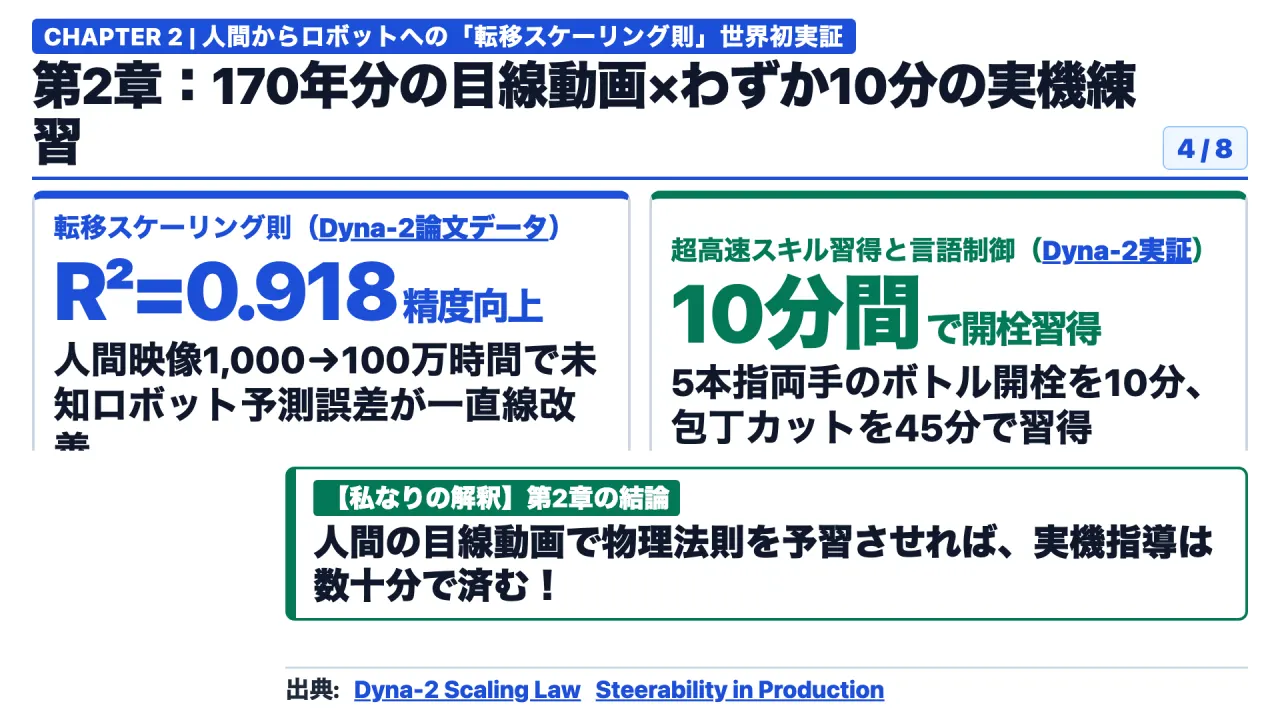
Dyna’s empirical findings established the first rigorous human-to-robot transfer scaling law. Scaling egocentric human video from 1,000 to 1,000,000 hours caused action prediction error on unseen physical robots to decrease along a power law:
Action Prediction Error vs. Human Video Hours: R^2 = 0.884
Cross-Embodiment Accuracy vs. Scale: R^2 = 0.918
Because 170 years of human video taught the model intuitive physics—how deformable fabrics stretch, how liquids slosh, and how friction behaves—downstream adaptation required minimal robot teleoperation:
- Bottle Uncapping with 5-Finger Hands: Mastered with just 10 minutes of teleoperation fine-tuning.
- Culinary Knife Slicing: Mastered with 45 minutes of demonstration.
- Dynamic Box Stacking: At Din Tai Fung, the model interpreted natural language prompts (“Stack in the third column of the five-slot carrier”) to place folded napkins into 10 visually ambiguous bin coordinates without codebase modifications.
3. Ground Truth from Latent Space: Wheels, Torsos, and Edge Compute
On the Latent Space podcast, Dyna Robotics Chief Scientist Jason Ma and Standard Bots AI Lead Leif Jentoft discussed the engineering realities of operating physical robots in live production environments.
Visual Simulation as Physical Chain-of-Thought
Jason Ma articulated the cognitive mechanism powering World-Action Models:
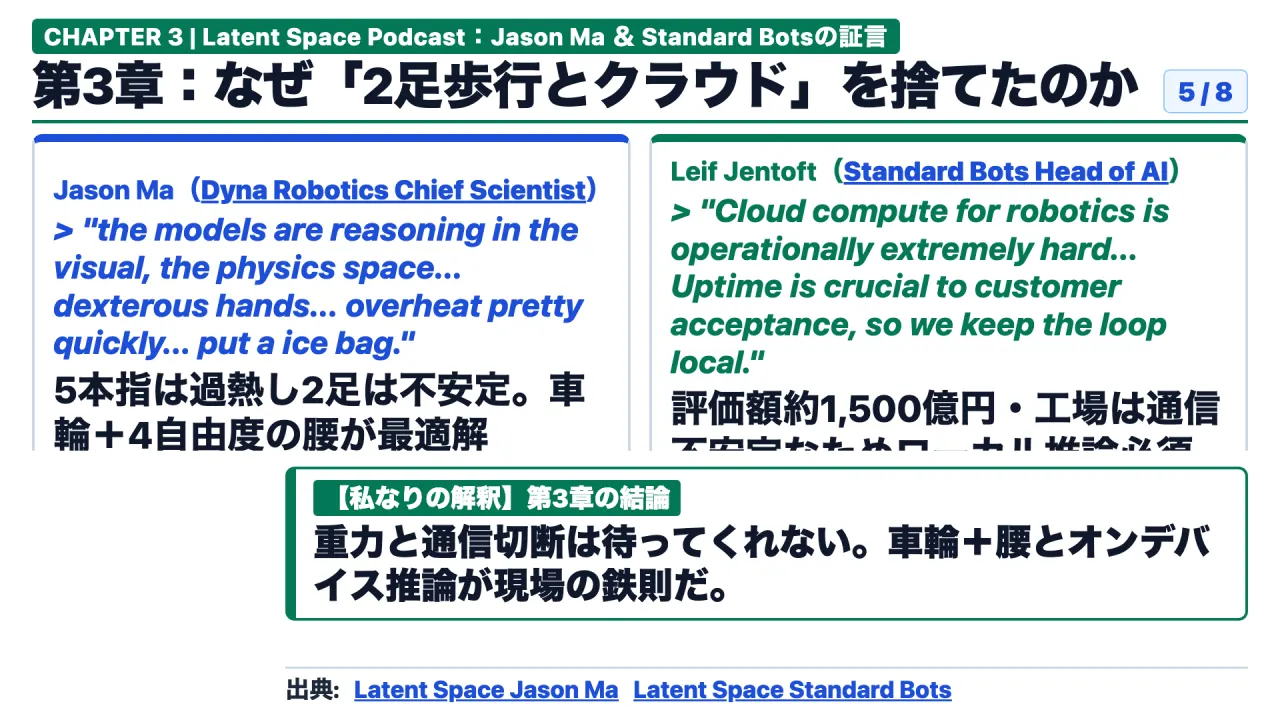
“The core breakthrough of a World-Action Model is that it generates future visual representations before calculating actuator torques. In language models, Chain-of-Thought prompting forces the model to write scratchpad reasoning steps before outputting a conclusion. Generating future visual frames is the robotic equivalent of Chain-of-Thought: the agent reasons through space and physical dynamics visually before executing physical movement.”
The “Wheels + Torso” Pragmatism
While venture-backed robotics marketing centers on bipedal humanoids, Dyna’s flagship commercial agent, Taku (derived from the Japanese word for artisan, Takumi), employs a hybrid mechanical topology: a four-wheeled mobile base paired with a flexible four-degree-of-freedom human-scale torso.
Ma explained why bipedalism and five-fingered hands are operational liabilities:
“We call Taku a semi-humanoid. Choosing wheels over legs is an unavoidable operational trade-off. Bipedal actuation consumes immense electrical power, introduces severe tipping hazards, and complicates facility safety certifications. Furthermore, the best five-finger dexterous hands available overheat under continuous duty cycles—in research laboratories, engineers literally apply ice packs between runs to cool joint actuators. For production operations, durable two-finger parallel grippers paired with a mobile base and a flexible torso that can reach deep into laundry drums provide 100% of the utility at a fraction of the failure rate.”
The Local Compute Imperative
Leif Jentoft, whose company Standard Bots deploys industrial robotic arms across NASA, Amazon, and Lockheed Martin manufacturing plants, emphasized why physical AI cannot depend on cloud APIs:
“Relying on cloud compute for closed-loop robotic control is impossible. Industrial warehouses and machine shops have dead zones, metal interference, and spotty Wi-Fi. Latency and uptime are existential. In chat interfaces, a three-second API latency hiccup is a minor annoyance. When an industrial robot wielding a high-speed tool or cutting blade freezes for three seconds due to packet loss, human operators panic. Gravity does not wait for a cloud round-trip. All core control loops must execute locally on the edge.”
4. Deconstructing the Architecture: Three Lessons for Production Engineering
Synthesizing Dyna’s 1-million-hour scaling law, Din Tai Fung’s deployment metrics, and Standard Bots’ industrial experience yields three structural lessons applicable to physical robotics and software agents alike:
Lesson 1: Build for Workflow Resilience Over Single-Task Precision
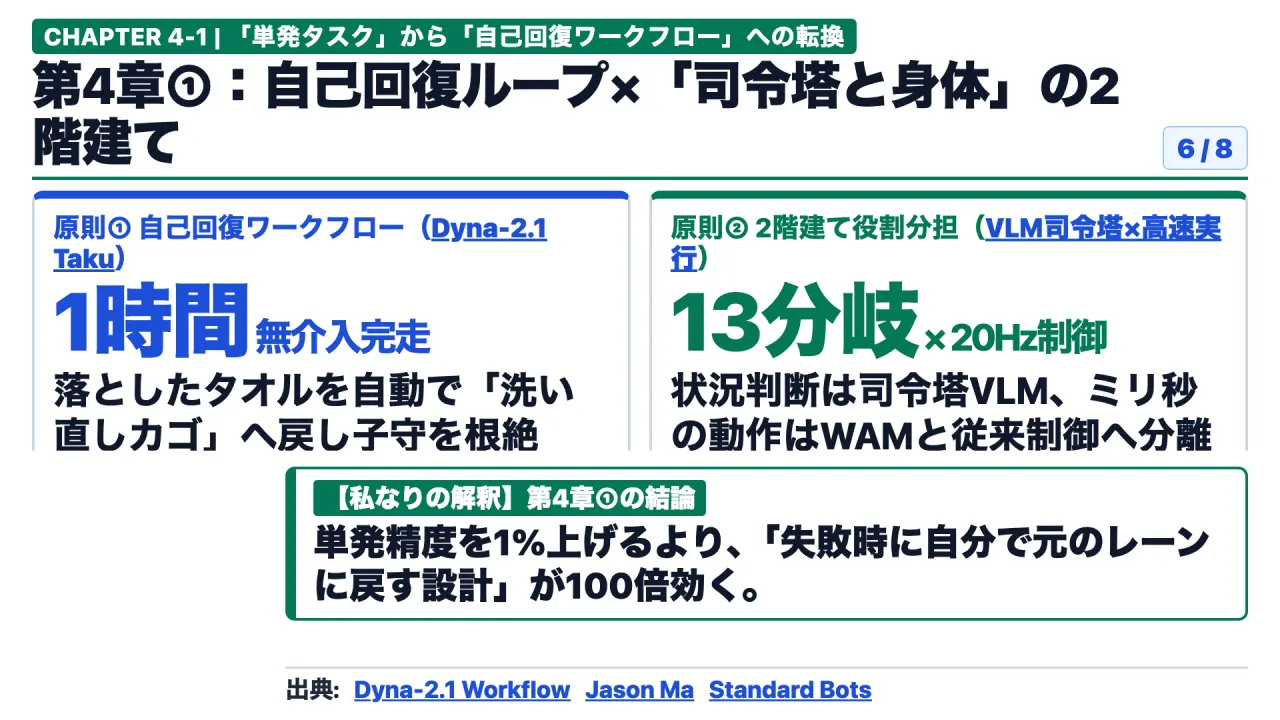
Improving a single task’s success rate from 95% to 96% does not prevent the compounding collapse across a 79-step cycle. Commercial success requires autonomous self-recovery loops:
- In hotel laundry operations, when Taku accidentally drops a towel on the floor, the system does not halt with an unhandled exception. It detects the dropped state, redirects the soiled towel into a designated “rewash bin,” and pulls a fresh item from the cart.
- Engineering workflows must prioritize automated fault detection and state recovery over chasing brittle, theoretical 99% single-step accuracy.
Lesson 2: Two-Tier Hierarchical Decoupling (VLM + Local WAM)
Production physical systems require decoupling slow deliberation from high-frequency execution:
- Upper Cognitive Tier (Vision-Language Model): Operates at low frequencies (0.5 to 1.0 Hz), observing overall environment state (such as dryer countdown timers) and navigating 13 high-level workflow decision branches.
- Lower Physical Tier (World-Action Model & Deterministic Kinematics): Runs locally on the robot hardware at high frequencies (10 to 20 Hz), calculating collision avoidance, force feedback, and motor trajectories in real time.
Lesson 3: “Deployment Is the Eval” — 1TB Daily Telemetry Pipelines
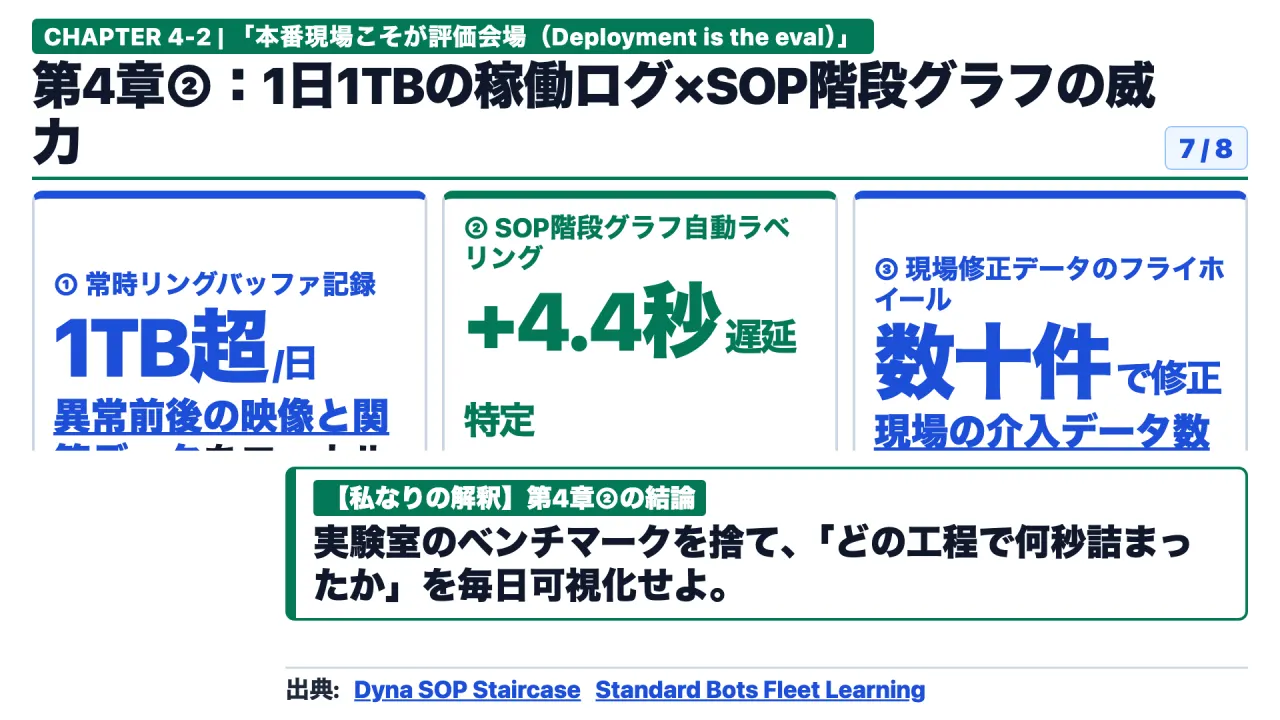
Dyna Robotics’ operational edge lies in continuous production observability. At Din Tai Fung, an unexpected drop in napkin throughput occurred while system logs reported nominal performance.
Because Dyna ingests over 1 terabyte of operational telemetry daily, its observability pipeline automatically mapped robot behavior against a 11-step Standard Operating Procedure (SOP) milestone ladder:
SOP Milestone Step 1 (Pinch-Lift Initial Napkin Edge):
---------------------------------------------------------------------------------
Baseline Duration:  2.1 seconds  [Normal Fabric Batch]
Observed Duration:  6.5 seconds  [+4.4s Delay due to Fabric Friction Spike]
Impact:             Overall daily shift throughput fell by 180 units.
Resolution:         Telemetry triggered immediate pinch-angle policy update.
---------------------------------------------------------------------------------
Visualizing latency per milestone immediately revealed that Step 1 (pinch-lifting the first napkin from a compressed stack) was taking an extra 4.4 seconds due to increased textile friction in a new linen batch. Telemetry pinpointed the bottleneck, allowing engineers to deploy a targeted policy update within hours.
5. Strategic Takeaways: The Next Phase of Physical AI
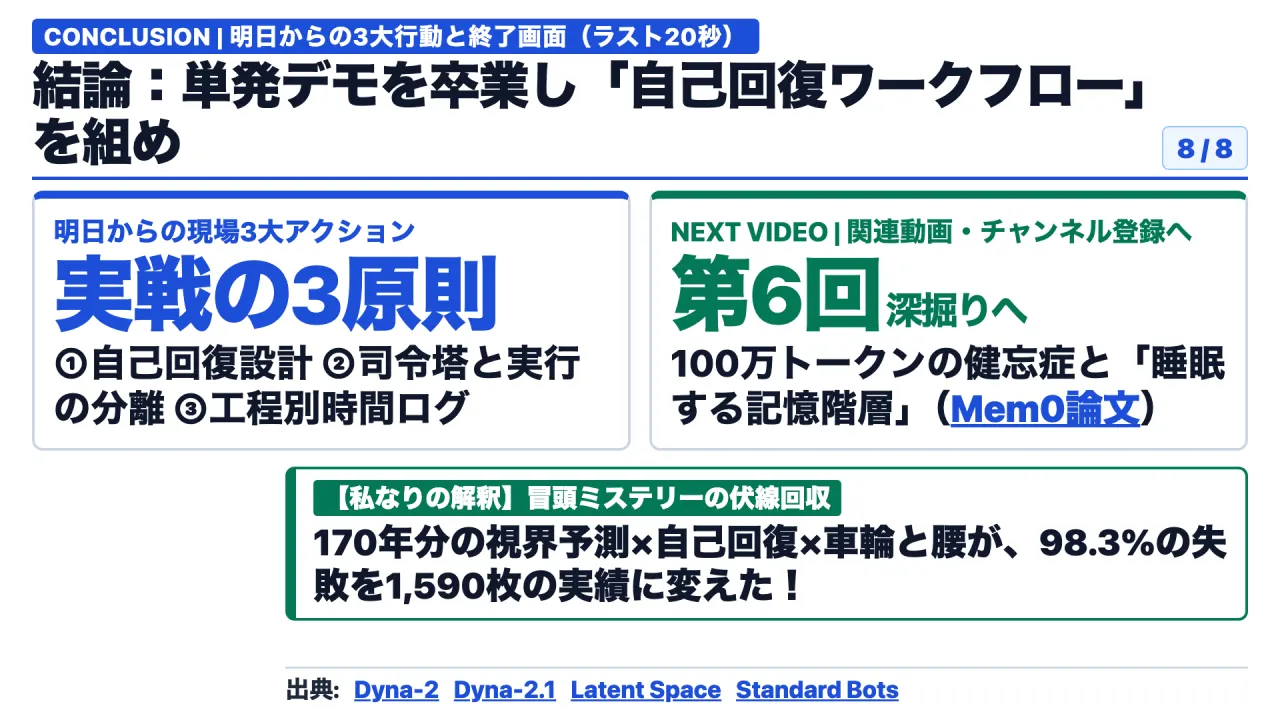
As physical artificial intelligence matures, enterprise leaders must anchor their strategies in three operational principles:
- Shift Focus from Bipedal Spectacle to Semi-Humanoid Utility: Prioritize platforms featuring wheeled bases, flexible torsos, and robust parallel grippers. In flat-floored commercial and manufacturing spaces, semi-humanoids deliver superior battery life, safety compliance, and mechanical reliability.
- Mandate Local Edge Autonomy: Ensure all mission-critical motion planning and visual prediction models execute on edge silicon directly within the chassis. Network connectivity should be reserved for asynchronous telemetry ingestion and fleet policy distribution.
- Instrument Continuous SOP Telemetry: Transition evaluation from artificial academic benchmarks to live workflow telemetry. Deconstruct multi-step business processes into timestamped milestone ladders, continuously tracking where seconds are lost and automating recovery loops when execution fails.
Primary Sources and References
- Dyna Robotics: What 10 Months in Production Taught Us About the Robotics “Bubble” (York Yang, May 2026)
- Dyna Robotics Technical Report: Dyna-2.1: A Physical Agent for End-to-End Workflows (September 29, 2026)
- Dyna Robotics Research: Dyna-2: A 1-Million-Hour Scaling Law for World-Action Models (August 2026)
- Dyna Robotics Case Study: Not Just a Model, But a Product — Scaling Customer Deployments (August 2026)
- Latent Space Podcast: Dyna-2: General Purpose Physical Agents with Hour-Long Autonomy — Jason Ma, Dyna Robotics (October 13, 2026)
- Latent Space Podcast: Building AI for Reliable Execution: Lessons From Industrial Robotics — Leif Jentoft, Standard Bots (October 10, 2026)