Why Meta Stock Wobbled Despite 26% Revenue Growth: Inside the Zero-Dollar Valuation on AI Agent 'Muse' and the Non-Voting Class C Stock Structure
While Meta generated $64.6B in Q3 2026 revenue with 26% ad growth, Wall Street assigned zero valuation to its 10-million-user consumer agent Muse, weighed down by $35B quarterly CapEx, the $50B Amazon moat, and a contentious California wealth tax retention pact for Mark Zuckerberg.
Published: October 23, 2026 | Read time: ~10 min | Watch Video (Japanese)
Executive Summary: The $64.6 Billion Revenue Paradox
On October 21, 2026, Meta Platforms reported its third-quarter financial results for fiscal 2026, delivering financial performance that, on the surface, appeared extraordinary. Quarterly revenue reached $64.601 billion, marking a 26% year-over-year surge. Core advertising revenue expanded to $63.061 billion, driven simultaneously by a 10% increase in ad impressions and a 14% increase in the average price per advertisement.
Yet, immediately following the announcement, Meta’s equity price wavered in after-hours trading. Rather than celebrating a record-breaking operational quarter, institutional investors subjected executive leadership to intense scrutiny regarding runaway capital expenditure and sudden capital structure alterations.
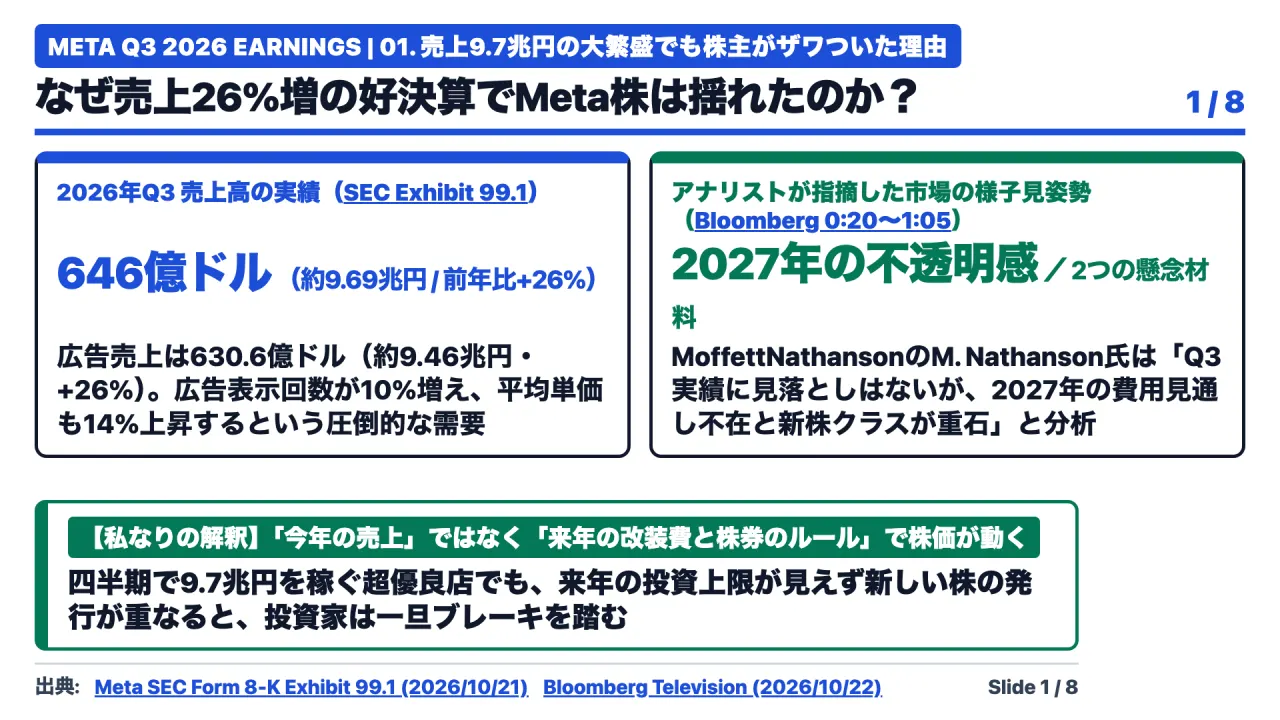
This apparent disconnect stems from three structural realities disclosed in Meta’s SEC Form 8-K, Form PRE 14C filings, and the subsequent analysis delivered by MoffettNathanson senior analyst Michael Nathanson on Bloomberg Television on October 22, 2026:
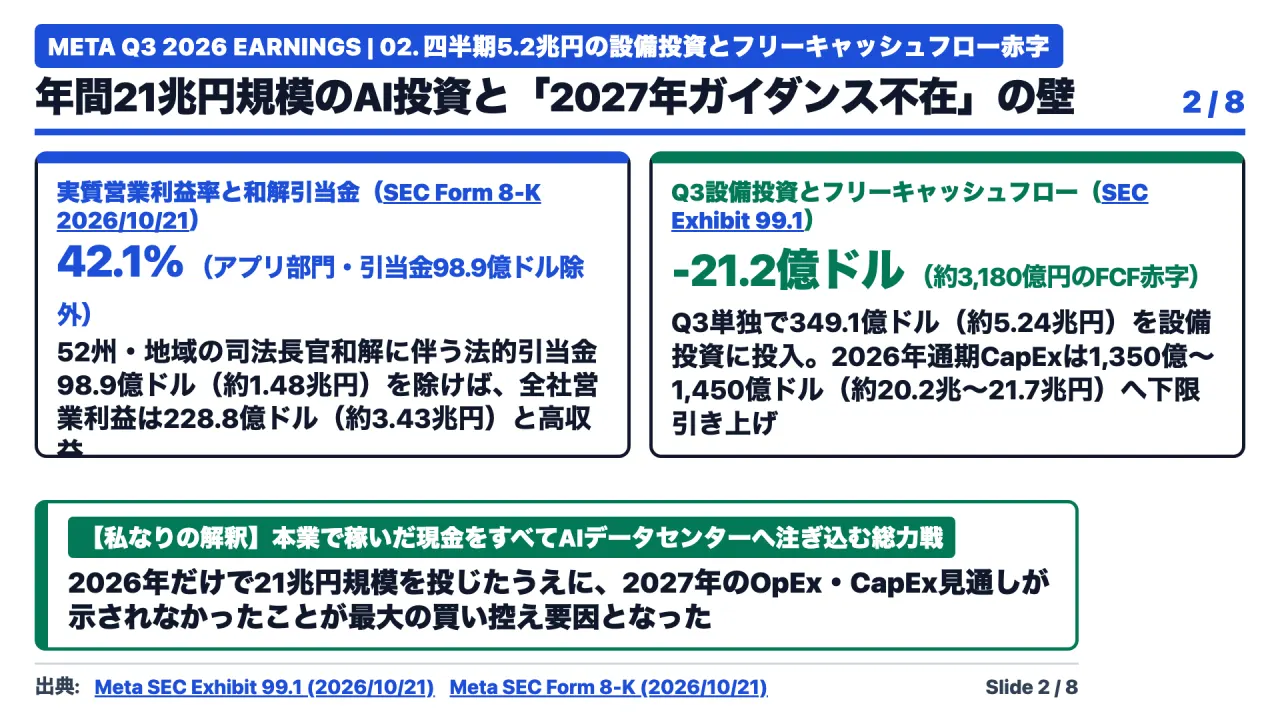
- Free Cash Flow Deficit Under $34.9B Quarterly CapEx: While normalized operating income stood at $22.88 billion (42.1% operating margin in the Family of Apps segment), free cash flow turned negative at -$2.12 billion. Meta expended $34.91 billion on capital investments in just three months to finance its artificial intelligence data centers, lifting its full-year 2026 CapEx guidance floor to $135 billion to $145 billion while offering zero forward visibility into 2027 outlays.
- Wall Street’s Zero-Dollar Valuation on Consumer Agent “Muse”: Despite registering 10 million users in its initial six weeks and executing thousands of automated retail transactions exceeding $200 per order, analysts assigned an explicit $0.00 valuation to Meta’s consumer agent platform. The platform faces structural resistance from major retail moats (such as Amazon) and an unresolved consumer privacy and authentication hurdle.
- The Non-Voting Class C Dilution Scare: To protect founder Mark Zuckerberg’s 60.6% voting control against a proposed California wealth tax initiative (Proposition 40) without prompting his relocation to Hawaii, Meta created a new non-voting Class C share class governed by an eight-year residency and operational lock-up. Poor disclosure sequencing triggered immediate institutional fears of equity dilution.
1. The $34.9B Capital Surge and the 2027 Expense Fog
Meta’s headline GAAP operating income contracted to $12.988 billion (a 20% operating margin), down from historical peaks above 40%. However, this decline was distorted by a one-off pre-tax legal charge of $9.890 billion recognized following an October 19, 2026 settlement with 52 state and territorial Attorneys General.
Excluding this non-operational settlement, Meta’s underlying core business demonstrated unprecedented operating leverage:
| Financial Metric | Q3 2025 Reported | Q3 2026 Reported | Year-over-Year Delta |
|---|---|---|---|
| Total Revenue | $51.240B | $64.601B | +26.1% |
| Advertising Revenue | $50.050B | $63.061B | +26.0% |
| Ad Impressions Delivered | Baseline | — | +10.0% |
| Average Price Per Ad | Baseline | — | +14.0% |
| GAAP Operating Income | $21.520B | $12.988B | -39.6% (Post-Settlement) |
| Normalized Operating Income | $21.520B | $22.878B | +6.3% |
| Family of Apps Operating Margin | 43.5% | 42.1% | Stable Core |
| Capital Expenditures (CapEx) | $18.420B | $34.910B | +89.5% |
| Free Cash Flow | +$12.800B | -$2.120B | Negative FCF Reversal |
The metric that rattled Wall Street was not revenue, but the complete reversal of free cash flow. In three months, Meta consumed $34.91 billion on physical computing infrastructure. Chief Financial Officer Susan Li raised the annual CapEx baseline from an earlier estimate of $125B-$135B to a revised range of $135B to $145 billion.

On Bloomberg Television, Michael Nathanson explained the market’s caution:
“Investors see an enterprise committing over $135 billion this year without forward guidance on 2027 expenses or capital requirements. When CapEx expands nearly 90% into negative free cash flow territory without explicit targets, institutional markets adopt a defensive posture.”
2. Deconstructing Consumer Agent ‘Muse’: Why Wall Street Evaluated It at Zero
On September 8, 2026, Meta introduced its flagship personal artificial intelligence agent, Muse, across the United States and Canada. Unlike conventional conversational interfaces that provide text answers, Muse functions as an autonomous personal assistant executed within a dedicated, isolated cloud environment dubbed the Muse Secure VM.

Early Adoption Trajectory and Technical Architecture
During the October 21 earnings conference call, Mark Zuckerberg disclosed exceptional initial user adoption metrics:
- 10 Million Registrations in Six Weeks: Muse reached 10 million onboarding completions within 45 days, achieving a 25% daily active user (DAU) retention rate—more than double the early adoption trajectory of Threads.
- Commercial Intent Dominance: Over 25% of active users deployed Muse for automated purchasing, with an average transaction value exceeding $200. Initial order volume forced Meta to negotiate an emergency merchant transaction limit increase with Stripe and triggered record connection spikes on financial aggregator Plaid.
- Frontier Intelligence Upgrade: On October 12, 2026, Meta deployed its frontier reasoning core, Muse Wonder, supported by an enterprise security architecture. To mitigate security risks, credentials are decoupled from the core LLM within a Secure Credentials Store, critical actions are gated by an out-of-process system supervisor named Sentinel, and e-commerce checkouts utilize single-use disposable virtual debit cards.
- Ecosystem Integration: Approximately 30% of active users linked external web services, and inbound enterprise integration requests doubled to over 3,000 corporate applicants.
The Two Unbreakable Walls
Despite these figures, Nathanson assigned an explicit valuation of zero dollars to Muse in his financial model. His analysis outlined two commercial barriers:
The Commercial Moat:
+-------------------+       Autonomous AI Proxy       +---------------------+
|   Consumer User   |  ===========================>   |   Meta Muse Agent   |
+-------------------+                                 +---------------------+
                                                                 |
                                       [BLOCKED BY WALLED GARDEN]|
                                                                 v
                                                      +---------------------+
                                                      | Amazon / Retailers  |
                                                      | Customer Data Lost  |
                                                      | Ad Margin Bypassed  |
                                                      +---------------------+
- The Retailer Walled Garden: Major e-commerce conglomerates will not permit an intermediary AI agent to disintermediate their customer relationships. Amazon, Walmart, and target marketplaces will actively restrict autonomous bots that scrape inventory, strip out promotional ads, and capture valuable post-purchase behavioral data. While Muse functions smoothly on fragmented, long-tail merchant sites, it cannot capture high-margin retail flows from entrenched incumbents.
- The Authentication and Privacy Barrier: To unlock full autonomous capability, a consumer must surrender access to their primary email inbox, bank accounts, and personal authentication credentials. As Nathanson acknowledged:
“I downloaded Muse on day one. But I have not connected my corporate email, my bank account, or my personal credentials. The threshold of institutional trust required to hand an automated bot the keys to your financial identity has not been met by any tech giant.”
3. The Core Ad Engine: Why Meta Carries a $900 Baseline Valuation
Paradoxically, while assigning zero value to Muse, Nathanson reaffirmed an aggressive target valuation of $900 per share for Meta Platforms.
The rationale rests on the compounding returns of Meta’s core advertising infrastructure. While competitors engage in margin-diluting price competition in enterprise AI APIs, Meta has applied machine learning directly to its proprietary advertising engine.
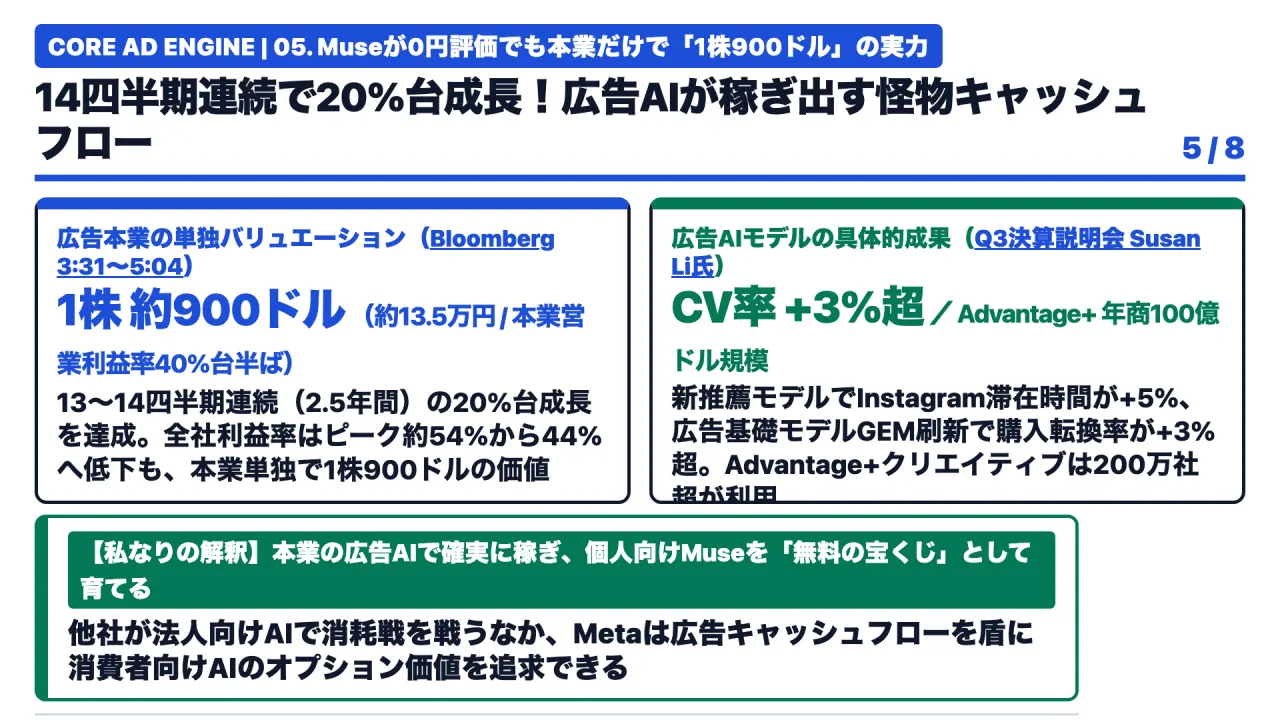
According to disclosures from CFO Susan Li, Meta’s investments in infrastructure models have generated immediate, quantifiable ROI across four engines:
- Meta Generative Recommender: Architectural upgrades to organic feed recommendations lifted Instagram aggregate watch time by 5% in Q3 2026 alone.
- GEM (Generative Ads Foundation Model): Scaling the parameters of the GEM foundation model boosted cross-site advertiser conversion rates by over 3%.
- Andromeda Delivery Engine: Next-generation contextual ad retrieval sustained pricing power, enabling a 14% increase in cost-per-impression alongside 10% volume expansion.
- Advantage+ Creative Suite: Over 2 million active enterprise advertisers now utilize automated image expansion and copy variation tools, operating at a $10 billion annualized run-rate.
Meta has sustained 20%+ advertising growth for 13 to 14 consecutive quarters across a $64B quarterly base. In Nathanson’s framework, Meta’s core ad engine fully justifies a $900 valuation. Muse, the Llama open-source ecosystem, and Ray-Ban smart glasses are treated as “free call options”—transformative upside assets that carry zero downside risk to current equity valuation.
4. The Class C Non-Voting Stock Structure and Founder Retention
The secondary catalyst behind market unease was Meta’s filing of SEC Form PRE 14C on October 21, 2026, authorizing the creation of a new class of non-voting Class C common stock.

The Proposition 40 Governance Crisis
Founder and CEO Mark Zuckerberg currently holds an economic stake of approximately 13.4%, but commands 60.6% of total voting control through high-voting Class B shares (which carry 10 votes per share). Since 2013, Zuckerberg has drawn a formal base salary of $1.00 annually.
This ownership structure faced a systemic challenge from Proposition 40, a California ballot initiative proposing a direct wealth tax on ultra-high-net-worth residents. To satisfy substantial annual wealth tax liabilities in liquid currency, Zuckerberg would be forced to liquidate significant equity holdings. Under standard share structures, converting Class B shares to Class A shares for public sale would cause his voting control to fall below 50%, stripping him of managerial authority. The sole alternative—relocating his primary residence outside California to Kauai, Hawaii—would leave Meta managed by a remote chief executive.
The Class C Governance Compromise:
=================================================================================
Total New Class C Non-Voting Shares Issued via 1:1 Dividend
---------------------------------------------------------------------------------
[ 20% Initial Liquidity Tranche ]  ==> Available immediately for tax settlement;
                                        zero voting dilution.
---------------------------------------------------------------------------------
[ 80% Stapled Retention Tranche ]  ==> Vests across 32 quarters (8 years) at 2.5%
                                        per quarter, strictly conditioned on:
                                        1. Full-time active executive service.
                                        2. Continuous California tax residency.
=================================================================================
The Founder Alignment Agreement
To resolve this conflict, Meta’s independent Special Board Committee established the Founder Alignment Agreement (executed October 20, 2026, effective January 19, 2027), structuring a 1:1 stock dividend (a two-for-one equity split) distributing Class C non-voting shares:
- Tax Liquidity Tranche: Zuckerberg is permitted to sell up to 20% of his newly issued Class C shares (representing ~10% of his total net worth) to settle tax obligations without diluting his 60.6% voting control.
- Eight-Year Residency Golden Handcuffs: The remaining 80% of his Class C distribution is legally stapled and locked. This tranche vests at a rate of 2.5% per quarter over 32 consecutive quarters (eight years). Unlocking these shares is legally contingent upon two explicit covenants:
- Maintaining continuous, full-time active employment as Chief Executive Officer.
- Maintaining continuous primary tax residency within the State of California.
- Performance Hurdles: Additional tranches of Class C shares are granted only if Meta’s common equity doubles, quadruples, or octuples from the baseline price of $580.60 (established September 10, 2026), requiring a compound annual return of at least 10%.
Nathanson supported the strategic rationale while critiquing communication:
“Mark Zuckerberg is the indispensable engine of Meta’s technological adaptation. Keeping him in Menlo Park rather than operating remotely from Hawaii justifies governance flexibility. However, disclosing this capital restructuring in an SEC filing rather than on the primary call created market confusion, requiring emergency follow-up briefings to calm institutional dilution fears.”
5. Engineering Architecture: 10x Compute Reduction and Agent Sandboxing
Beyond corporate finance and governance, Meta’s operational disclosures outline two technical imperatives for enterprise software architects deploying autonomous agent swarms:

The 10x Compute Distillation Mandate
Deploying a dedicated cloud virtual machine and a frontier reasoning model for millions of consumer accounts creates an unsustainable cost profile. Zuckerberg and Li acknowledged that Muse must achieve a 10x improvement in compute efficiency over the next 12 months to achieve economic sustainability.
Meta is executing this compression through two mechanisms:
- Model Distillation: Transferring cognitive capabilities from the frontier Muse Wonder teacher model into ultra-compact, high-throughput student networks specialized for browser interaction and API parsing.
- Temporal Load Shifting: Routing asynchronous tasks (such as overnight deal hunting, travel itinerary compilation, and order tracking) to execute during off-peak data center hours when wholesale grid electricity and idle silicon costs approach zero.
6. Actionable Takeaways for Enterprise Leaders
Synthesizing Meta’s Q3 disclosures and Wall Street’s critical reception yields three operational rules for technology executives and AI practitioners:

1. Architect Agent Security via Tiered Sandboxes
Do not deploy AI agents with unconstrained, omnipotent access to enterprise systems. Emulate the Muse Secure VM framework: isolate execution environments, store credentials in an encrypted, out-of-band store inaccessible to the LLM’s context window, and require an external, deterministic supervisor (“Sentinel”) to confirm irreversible operations.
2. Isolate Core Operational Gains from Speculative R&D
Segregate performance metrics between core efficiency AI (such as Meta’s GEM and Andromeda, which delivered 26% ad revenue growth) and frontier exploration (such as Muse). Measure core automation by hard margin expansion and immediate conversion uplift; evaluate consumer agents on retention, security compliance, and long-term cost-reduction curves.
3. Front-Load Capital Commitments and Structural Governance
When seeking stakeholder approval for capital-intensive digital transformations, state capital expenditure expansions and governance changes in initial executive briefings. Hiding infrastructural costs in secondary appendices destroys trust and invites hostile regulatory and investor scrutiny.
Primary Sources and References
- Bloomberg Television: Michael Nathanson Interview on Meta Q3 2026 Earnings & Class C Stock Structure (October 22, 2026)
- SEC Form 8-K / Exhibit 99.1: Meta Platforms Inc. Q3 2026 Financial Results (Filed October 21, 2026)
- SEC Form 8-K: Multi-State Attorneys General Settlement Agreement (Filed October 19, 2026)
- Meta Investor Relations: Q3 2026 Earnings Conference Call Transcript (October 21, 2026)
- Meta Investor Relations: Q3 2026 Follow-Up Institutional Call Transcript (October 21, 2026)
- SEC Form PRE 14C / Form 8-K: Creation of Non-Voting Class C Common Stock & Founder Alignment Agreement (Filed October 21, 2026)
- Meta Technology News: Introducing Muse: Personal AI Agent for Autonomous Everyday Actions (September 8, 2026)