Why an 8-Billion Parameter Orchestrator Outperforms Standalone GPT-5: Five Benchmarks Proving the Power of Thin Routing and Context Isolation
Empirical evidence from NVIDIA, Meta, Mount Sinai, AOrchestra, and Anthropic demonstrates that replacing monolithic frontier models with compact 8B routers or deterministic dispatchers slashes token consumption by up to 65x while surpassing single-model benchmark accuracy.
Published: October 23, 2026 | Read time: ~10 min | Watch Video (Japanese)
Executive Summary: The Fallacy of the Monolithic Frontier Orchestrator
When building multi-agent systems, engineering teams frequently assume that the orchestrator overseeing planning, tool invocation, and verification must be the largest frontier model available (such as GPT-5 or Claude Opus 4.1). Standard practice packs extensive domain documentation, database schemas, coding guidelines, and error recovery policies into a single monolithic prompt.
However, empirical findings published between 2025 and 2026 by NVIDIA Research, Meta Engineering, Mount Sinai School of Medicine, HKUST (AOrchestra), and Anthropic demonstrate the opposite:
Directing complex agent workflows through a single monolithic frontier model loaded with complete domain context degrades accuracy, compounds latency, and triggers massive cost inflation. Deploying a compact 8-billion parameter model trained on delegation, or implementing a deterministic “thin router” paired with context-isolated workers, consistently achieves superior benchmark accuracy, cuts costs by 30% to 70%, and reduces token consumption by up to 65-fold.
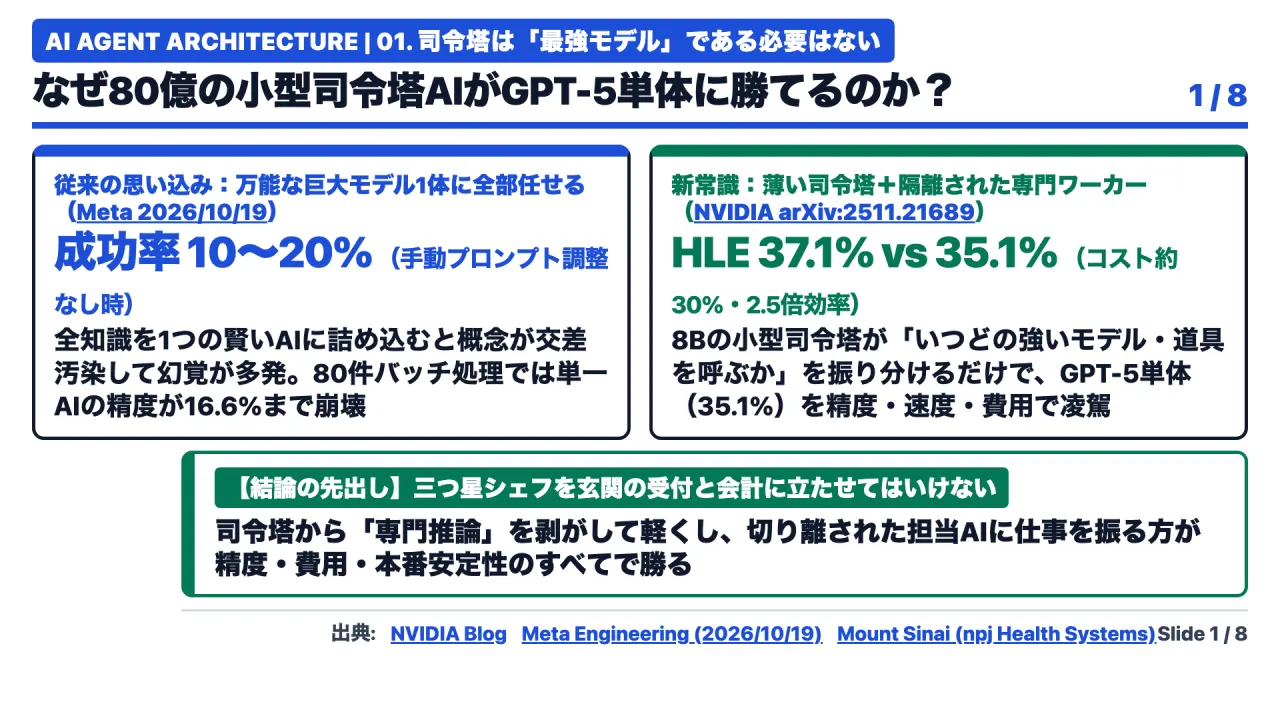
This operational bottleneck resembles hiring a world-class three-star Michelin chef to manage the front desk, check coats, answer phones, process payments, and cook every dish across an 80-table dinner service. Under heavy load, attention collapses: payment receipts are scribbled into recipe cards, and service halts. In AI architectures, overloading a single model with excessive scope triggers cross-contamination of instructions, attention dilution, and hallucinatory tool routing.
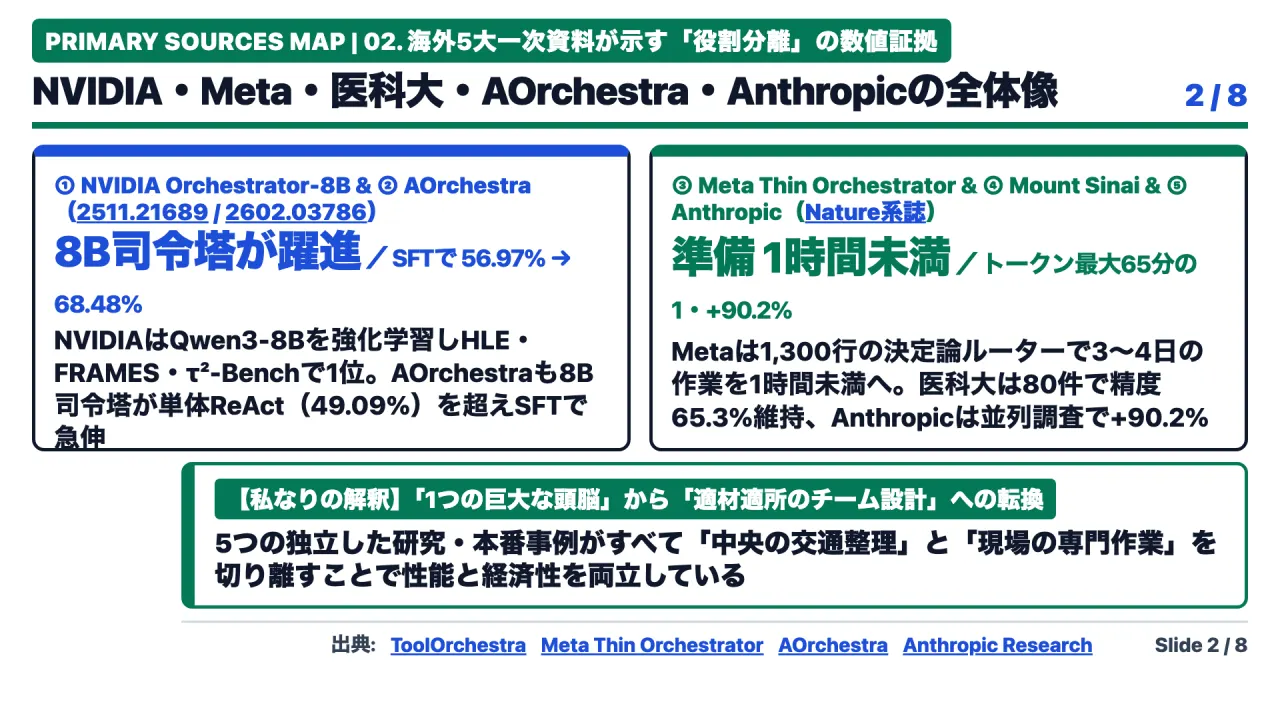
| Research / Framework | Orchestrator Implementation | Worker Architecture | Benchmark Results | Architectural Takeaway |
|---|---|---|---|---|
| NVIDIA ToolOrchestra (arXiv:2511.21689v1) | Orchestrator-8B (Qwen3-8B via GRPO RL) | Search, Python, Math-72B, Coder-32B, GPT-5 | HLE: 37.1% vs GPT-5 35.1%; tau2-Bench: 80.2% vs 77.7%; Cost: 9.2 vs 30.2 | Compact models trained to route tools beat standalone frontier models at ~30% cost. |
| Meta Thin Orchestrator (Meta Engineering) | ~1,300-line deterministic router (Zero domain reasoning) | 14 isolated sub-agents with 25+ modular knowledge files | Config time dropped from 3-4 days to <1 hour; ~2/3 modifications pass unedited | Routing should be deterministic code; prevents upstream hallucinations from corrupting downstream tasks. |
| Mount Sinai School of Medicine (npj Health Systems) | Lightweight orchestrator (1 task to 1 worker with 1 tool) | Dedicated workers for PubMed (234k), MIMIC-IV (331k), and dosing | 80-task batch accuracy: Multi 65.3% vs Single 16.6%; Tokens: 60k vs 3.9M (65x cut) | Context dilution in single agents causes catastrophic collapse; task isolation preserves accuracy. |
| AOrchestra (arXiv:2602.03786v2) | Dynamic 4-tuple router (Qwen3-8B or Gemini-3-Flash) | Ephemeral synthesis of Instruction, Context, Tools, Model <I, C, T, M> | GAIA: 80.00% vs OpenHands 66.06%; Curated: 96.0% vs Full-Context 84.0% | Dumping raw conversation logs causes context rot; selective context synthesis is required. |
| Anthropic Research (Anthropic Engineering) | Claude Opus 4 (Lead planning and synthesis) | Claude Sonnet 4 (3-5 parallel exploratory sub-agents) | Internal research benchmark: +90.2% over Opus 4 alone; Consumes ~15x tokens of chat | Breadth-first open research justifies frontier leads, provided 15x token consumption is acceptable. |
1. NVIDIA ToolOrchestra: How an 8B Router Outperformed GPT-5
In ToolOrchestra: Elevating Intelligence via Efficient Model and Tool Orchestration (arXiv:2511.21689v1), NVIDIA Research demonstrated that orchestration does not require frontier model parameter scale.
The 4.7% to 37.1% Transformation
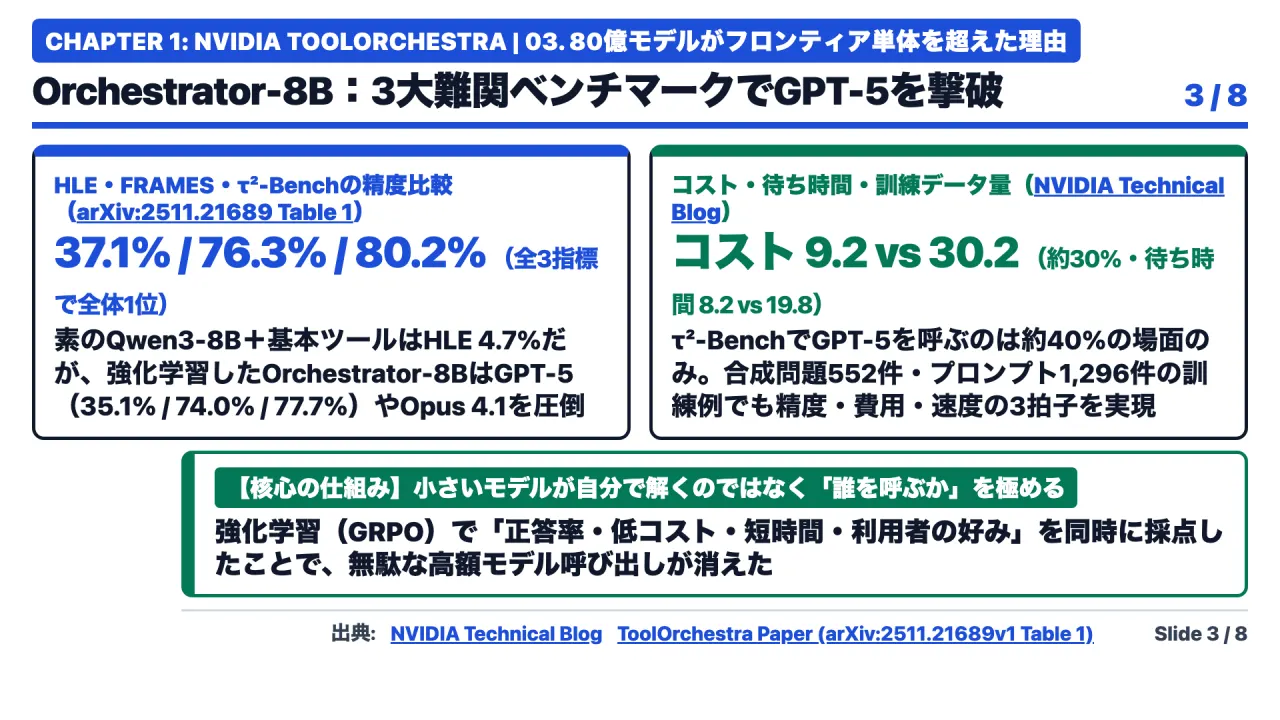
The study evaluated Orchestrator-8B, initialized from open-weights Qwen3-8B. On the text subset of Humanity’s Last Exam (HLE)—graduate-level reasoning across STEM domains—raw Qwen3-8B scored 3.2%. Adding basic search and Python tools brought it to 4.7%. In comparison, GPT-5 scored 35.1% and Claude Opus 4.1 scored 19.8%.
NVIDIA’s breakthrough was removing domain problem-solving from the 8B model. Specialized models (Qwen2.5-Math-72B, Qwen2.5-Coder-32B) and frontier generalists (GPT-5) were registered as tools callable via a standard JSON interface. Orchestrator-8B was trained solely via Group Relative Policy Optimization (GRPO) across 50-turn trajectories to decide which tool to call, at what step, with what sub-task. Rewards balanced outcome correctness, API token cost penalties, latency penalties, and user preference vectors. Training required only 552 synthetic tasks and 1,296 prompts.
Comprehensive Benchmark Evaluation
Tested on HLE, FRAMES (824 multi-hop reasoning questions), and tau2-Bench (airline and retail tool interaction), Orchestrator-8B achieved top accuracy:
| Setup | Orchestrator Model | HLE | FRAMES | tau2-Bench | Cost Metric | Latency |
|---|---|---|---|---|---|---|
| Standalone (No Tools) | Qwen3-8B | 3.2% | 24.2% | — | 0.2 | 0.6 |
| Standalone | Claude Opus 4.1 | 11.7% | 58.2% | — | 27.4 | 8.2 |
| Standalone | GPT-5 | 23.4% | 66.3% | — | 6.2 | 4.1 |
| Basic Tools (Search+Python) | Qwen3-8B | 4.7% | 26.5% | 40.7% | 1.3 | 2.2 |
| Basic Tools | Claude Opus 4.1 | 19.8% | 63.5% | 46.0% | 76.2 | 32.5 |
| Basic Tools | GPT-5 | 35.1% | 74.0% | 77.7% | 30.2 | 19.8 |
| Full Tools (Prompt Router) | Claude Opus 4.1 | 34.6% | 72.8% | 76.8% | 52.5 | 25.6 |
| Full Tools (Prompt Router) | GPT-5 | 21.2% | 57.5% | 62.3% | 17.8 | 13.6 |
| ToolOrchestra RL | Orchestrator-8B | 37.1% | 76.3% | 80.2% | 9.2 | 8.2 |
Orchestrator-8B achieved 37.1% on HLE (+2.0 points over GPT-5), 76.3% on FRAMES, and 80.2% on tau2-Bench. Its cost metric fell to 9.2 (~30% of GPT-5’s 30.2, representing a 2.5x efficiency gain on HLE budget curves), while latency dropped from 19.8 to 8.2 seconds.
2. Why Prompt-Directed Frontier Models Fail as Orchestrators
When GPT-5 was assigned to route tools via prompt instructions, its HLE score plunged from 35.1% down to 21.2%, FRAMES dropped to 57.5%, and tau2-Bench dropped to 62.3%.
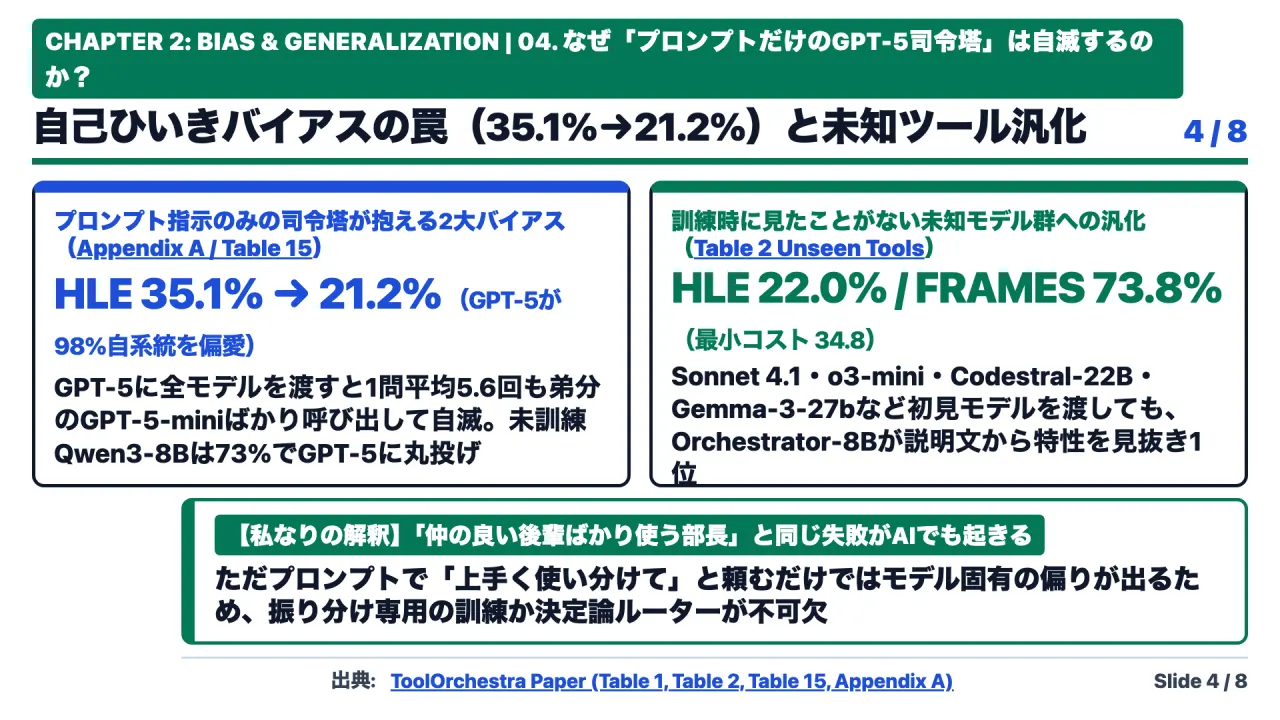
Trajectory analysis (Appendix A, Table 15) revealed two cognitive biases in un-tuned LLM routers:
- Self-Enhancement Bias: Prompt-directed GPT-5 routed 98% of delegation turns to its own family, averaging 5.6 calls to GPT-5-mini and 2.7 calls to GPT-5. It called Qwen2.5-Math-72B and Llama-3.3-70B 0.0 times. Offloading symbolic STEM problems to mini-tier models resulted in flawed intermediate outputs that derailed solutions.
- Other-Enhancement Bias: Conversely, un-tuned base Qwen3-8B deferred to the highest-priced model (GPT-5) in 73% of delegation turns (6.0 calls/task), driving costs to 27.6 and eliminating economic gains.
Trained Orchestrator-8B maintained balanced distributions: 1.8 local searches, 1.7 GPT-5-mini calls, 1.6 GPT-5 calls, 1.3 Qwen3-32B calls, and 0.8 Python executions. When tested against unseen models (Claude Opus 4.1, o3-mini, Codestral-22B), Orchestrator-8B led HLE at 22.0% (vs Opus 4.1 at 17.8% and GPT-5 at 16.4%) at minimum cost (34.8 vs 81.3 for GPT-5).
3. Meta’s Thin Orchestrator & Mount Sinai: The Strength of Determinism
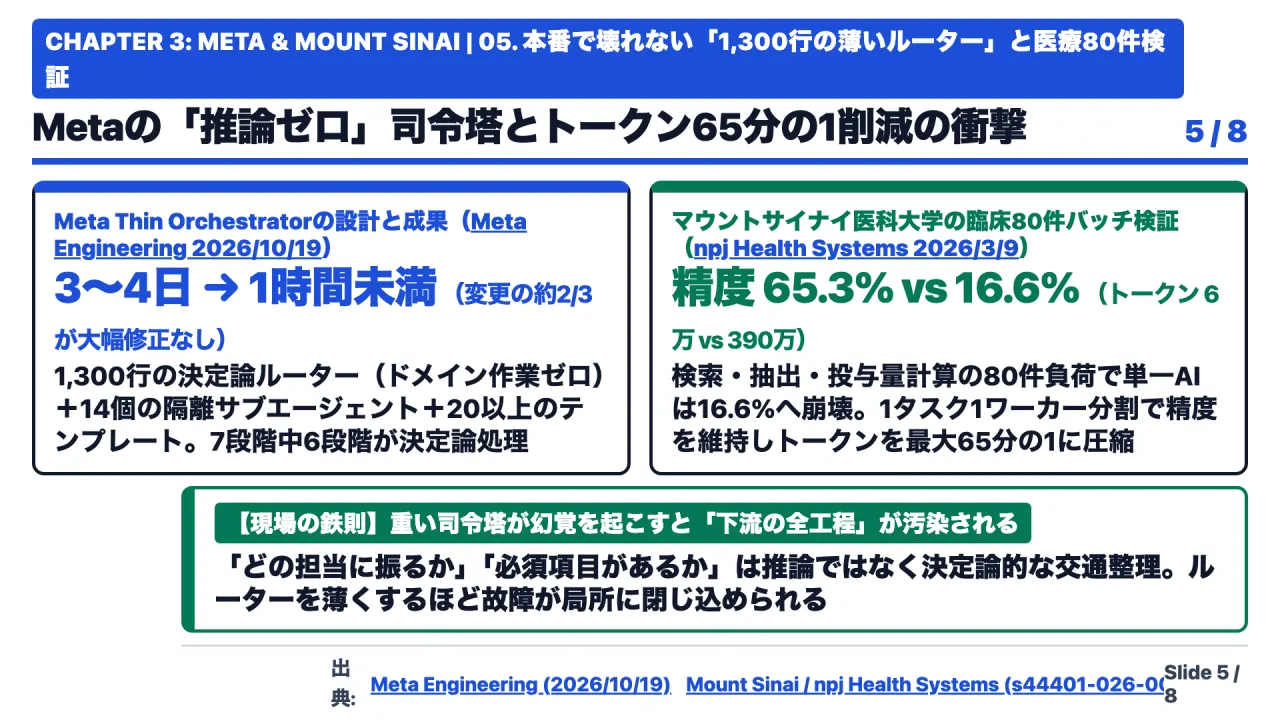
Meta Engineering took decoupling further on October 19, 2026 (The Thin Orchestrator), eliminating LLM reasoning from the orchestrator entirely.
Eliminating Upstream Hallucinations
Meta automated recommendation feature column onboarding across three code repositories, Python/C++, and 10+ data sources. A monolithic agent initially achieved 70-80% success when engineers hand-tailored prompts, but plummeted to 10-20% without human guidance due to cross-contamination across data sources.
Meta partitioned the architecture into two layers:
- Thin Orchestrator: A ~1,300-line Python router executing zero domain reasoning. It validates schemas and manages state progression.
- 14 Specialist Sub-Agents: Separate agents for schemas, per-source code generation, and testing, loading minimal documentation on demand.
A mandatory seven-step protocol was established:
- Load sub-agent instruction files (Deterministic).
- Check for duplicate column definitions (Deterministic).
- Collect mandatory parameters (Deterministic).
- Auto-detect environment configurations (Deterministic).
- Verify approval and safety gates (Deterministic).
- Delegate to isolated sub-agent (Sole LLM reasoning step).
- Validate execution status and return errors (Deterministic).
Onboarding setup time fell from 3-4 days to under 1 hour, with ~2/3 of modifications passing unedited. Confining LLM reasoning to Step 6 ensured upstream routing failures were architecturally impossible.
Mount Sinai: Context Dilution Under Clinical Workloads
In npj Health Systems (March 9, 2026), Mount Sinai evaluated 80 concurrent clinical tasks across literature retrieval (234k PubMed records), EHR extraction (331k records), and dosage calculation.
At 80 concurrent tasks, single-agent accuracy collapsed from 73.1% to 16.6%, whereas multi-agent orchestration maintained 65.3% accuracy. For GPT-4.1-mini, multi-agent accuracy stayed above 91.4%, while single-agent accuracy dropped to 33.9%. Crucially, the single agent consumed 3.9 million tokens due to accumulated history, whereas the orchestrator consumed 60,000 tokens—a 65-fold reduction.
4. AOrchestra: Dynamic Sub-Agents and Context Rot
Researchers at HKUST (Guangzhou) introduced AOrchestra (arXiv:2602.03786v2), formalizing sub-agents as dynamic 4-tuples:
Phi = <I, C, T, M>
Where:
  I = Task instruction and acceptance criteria
  C = Curated context and extracted facts
  T = Minimal toolset
  M = Cost-appropriate model assignment
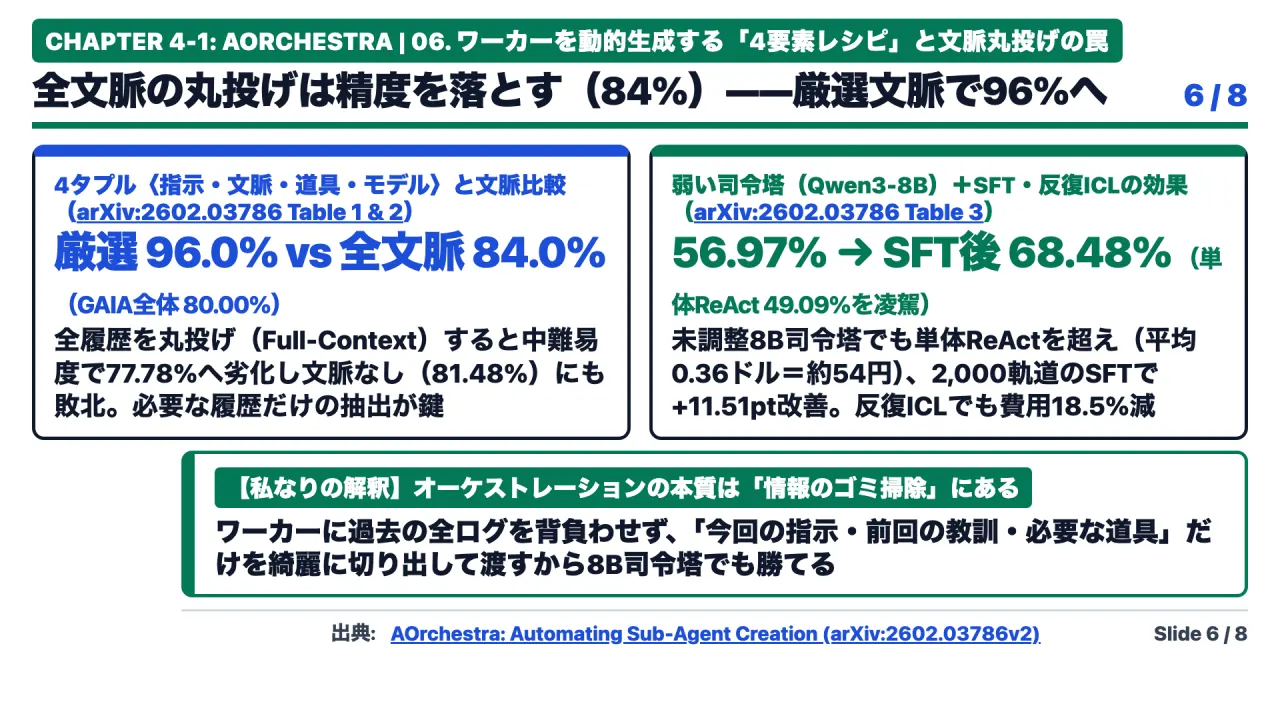
AOrchestra achieved 80.00% Pass@1 on GAIA (vs ReAct at 49.09% and OpenHands at 66.06%), 52.86% on Terminal-Bench 2.0, and 82.00% on SWE-Bench-Verified.
The Context Rot Experiment
Testing 50 GAIA tasks evaluated three context transfer configurations:
- No-Context (Instruction only): 86.00% average accuracy.
- Full-Context (Raw conversation logs): 84.00% average accuracy (Level 2 dropped to 77.78%).
- Curated Context (Extracted facts and anti-patterns): 96.00% average accuracy.
Dumping unpruned conversation logs degraded accuracy below zero-context baselines. Raw error traces distracted sub-agents, causing them to repeat past mistakes.
Fine-tuning Qwen3-8B on 2,000 orchestration trajectories raised its GAIA score from 56.97% to 68.48%, outperforming base Gemini-3-Flash with OpenHands (66.06%).
5. Anthropic: When Frontier Leads Are Justified
Anthropic’s research report (How we built our multi-agent research system, June 13, 2025) highlights where heavy orchestrators remain essential: open-ended, breadth-first exploration.
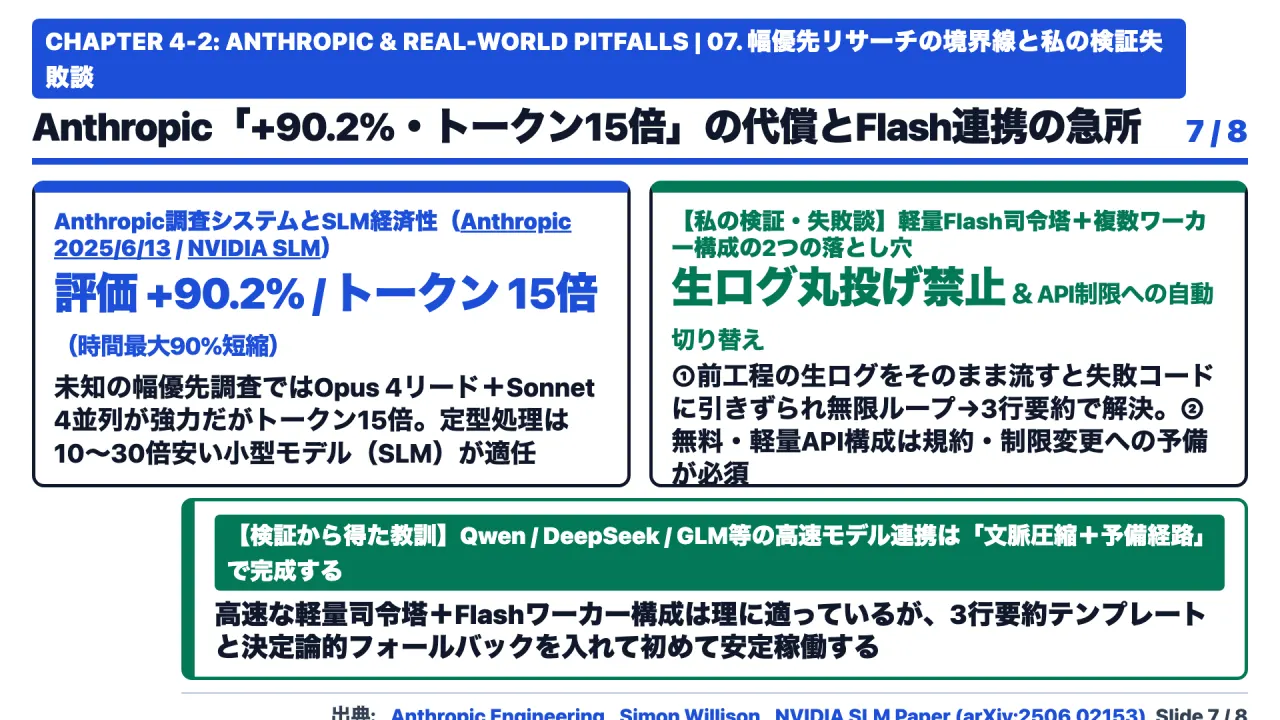
A lead Claude Opus 4 coordinates 3 to 5 parallel Claude Sonnet 4 sub-agents to explore unstructured topics. This swarm architecture improved research benchmark scores by +90.2% over standalone Opus 4 and cut research duration by 90%. Running automated test agents to refine MCP tool descriptions reduced execution time by 40%.
However, Anthropic documented that multi-agent swarms consume ~15x the tokens of standard chat. For tightly coupled tasks like linear coding, multi-agent swarms offered no advantage over single models.
6. Implementation Playbook: Three Architectural Rules
Rule 1: Decouple Routing from Domain Reasoning
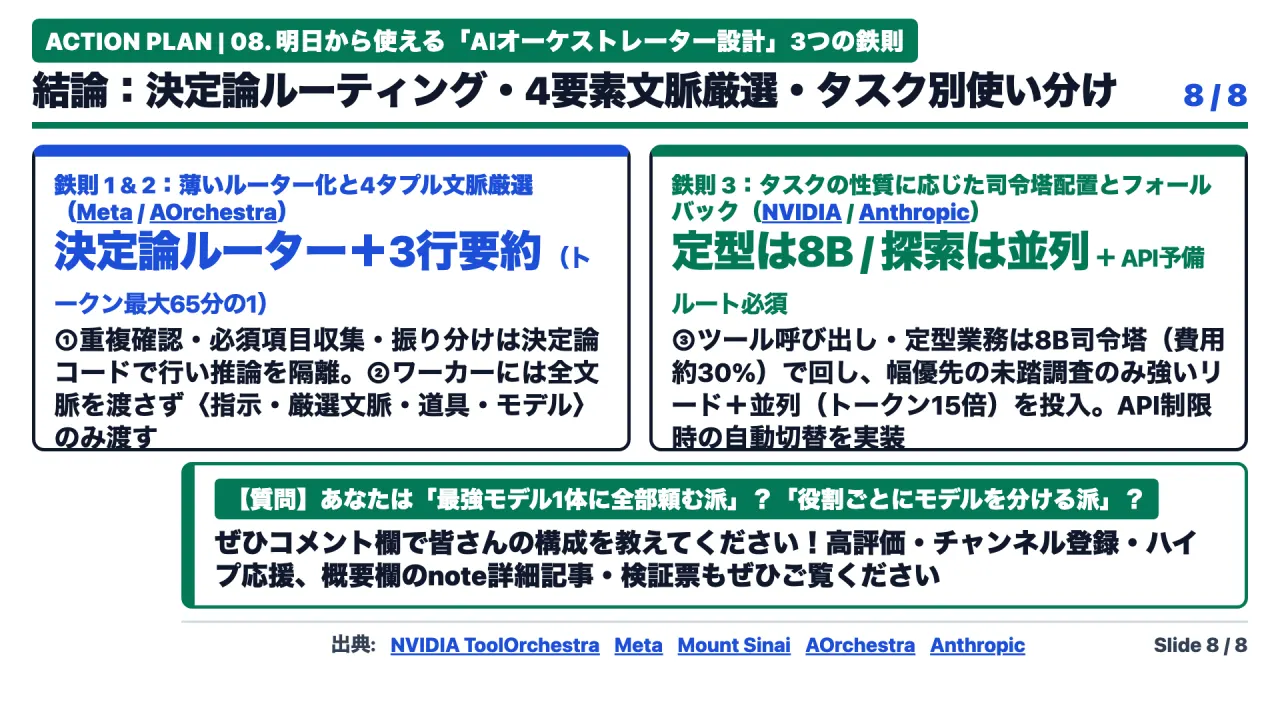
Write schema validation, duplicate checks, permission checks, and output formatting in deterministic code. Confine LLM inference strictly to isolated sub-agents.
Rule 2: Enforce Context Distillation via 4-Tuples
Never forward raw terminal logs or conversation history to workers. Restrict payloads to the 4-tuple: instruction (I), curated facts and anti-patterns (C), minimal tools (T), and appropriate model (M).
Rule 3: Match Orchestrator Scale to Workload Topology
- Structured Workflows & Tool Calling: Deploy deterministic Python routers or fine-tuned 8B models (ToolOrchestra / AOrchestra style) to minimize latency, eliminate upstream hallucinations, and cut costs by up to 70%.
- Open-Ended Research: Deploy frontier lead models with parallel workers, budgeting explicitly for a 15x token expansion.
- Failover Routing: Hardcode deterministic fallback tables for API rate limits and provider outages in the host application.
Primary Sources and References
- NVIDIA Research: ToolOrchestra: Elevating Intelligence via Efficient Model and Tool Orchestration (arXiv:2511.21689v1) / GitHub Repository: NVlabs/ToolOrchestra
- NVIDIA Technical Blog: Train Small Orchestration Agents to Solve Big Problems (Shizhe Diao, Peter Belcak, Pavlo Molchanov)
- NVIDIA Research Position Paper: Small Language Models are the Future of Agentic AI (arXiv:2506.02153) / Blog Post
- Meta Engineering: The Thin Orchestrator: How We Made Our AI Agents More Reliable by Giving the Router Less to Do (Plawan Rath, Akhil Jindal, Ashwini Verma, October 19, 2026)
- Mount Sinai School of Medicine: Orchestrated multi agents sustain accuracy under clinical-scale workloads compared to a single agent (Eyal Klang, Mahmud Omar et al., npj Health Systems, Volume 3, Article 23, March 9, 2026)
- HKUST (Guangzhou) & FoundationAgents: AOrchestra: Automating Sub-Agent Creation for Agentic Orchestration (arXiv:2602.03786v2) / GitHub Repository: FoundationAgents/AOrchestra
- Anthropic Engineering: How we built our multi-agent research system (Jeremy Hadfield, Barry Zhang et al., June 13, 2025) / Simon Willison’s Weblog Analysis