Inside Meta Muse Wonder: 78.4% Partial Rewards vs 39.4% Strict Execution, Alexandr Wang's Pivot, and the Contributor Mode Trap
While Meta’s closed-source Muse Wonder claims #1 on internal PSI benchmarks with world-leading 85.6% Active Memory, real-world OSWorld audits expose a 39.4% strict completion rate alongside default code-training traps in Muse Code.
Published: October 24, 2026 | Read time: ~10 min | Watch Video (Japanese)
1. Executive Summary: The Strategic Pivot from Open-Source Llama to Closed Agent Ecosystems
On October 23, 2026, Meta launched the localized Japanese edition of its consumer AI agent “Muse” across iOS, Android, macOS, and web interfaces (muse.ai). Marking Muse’s first international expansion outside North America, the release integrated premier domestic connectors—flea market leader Mercari (whose shares surged over 7% intraday following the announcement), personal asset manager Money Forward ME, and ticketing platform Ticket Pia.
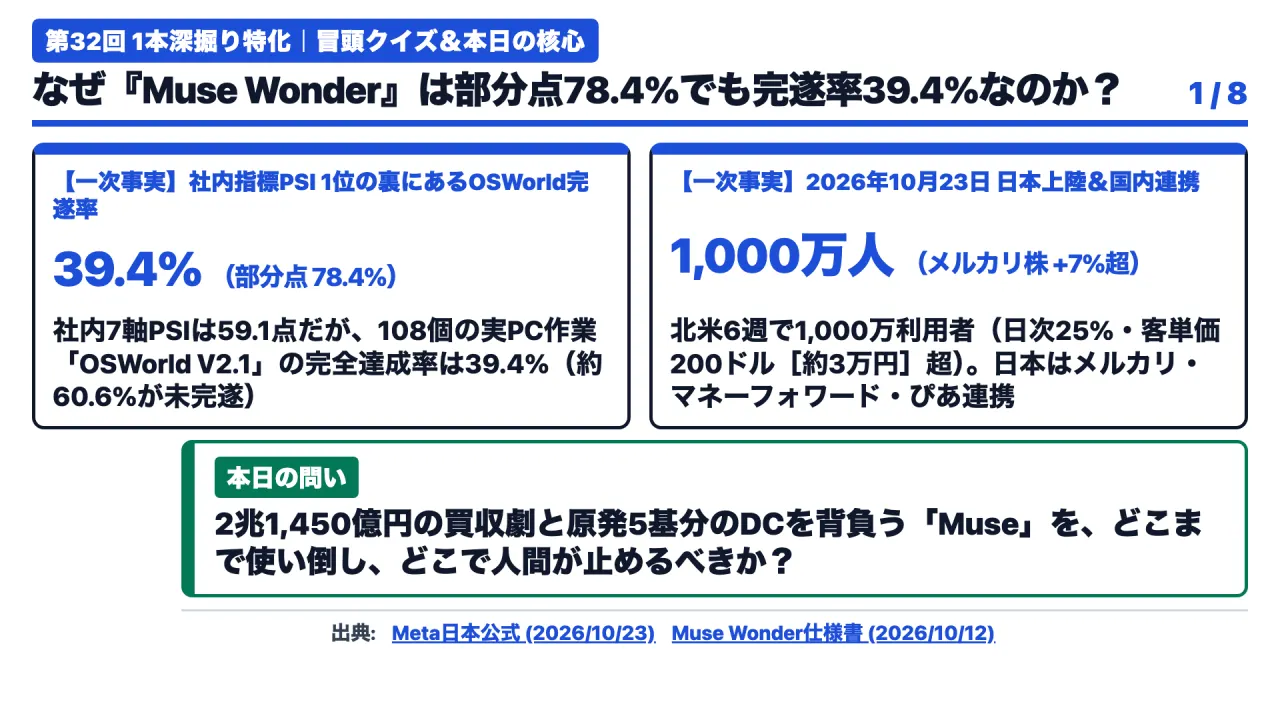
However, beneath consumer enthusiasm lies a dramatic strategic pivot. Under Chief AI Officer (CAIO) Alexandr Wang—appointed following Meta’s $14.3 billion partnership with Scale AI in June 2025—Meta effectively sidelined its struggling open-weights Llama 4 roadmap to construct a proprietary, closed-source consumer ecosystem powered by the “Muse Wonder” reasoning architecture (boasting 1,048,576 tokens of context).
While Meta’s internal marketing highlights a first-place score of 59.1 on its proprietary Personal Superintelligence Index (PSI), rigorous external auditing reveals stark operational contradictions:
- Memory vs Execution Disparity: While Muse Wonder leads global benchmarks in multi-session cross-thread retention (MemoryBench score of 85.6%), its ability to execute end-to-end desktop computer workflows without human intervention on the standardized OSWorld V2.1 benchmark registers a strict completion rate of only 39.4%, leaving roughly 60% of real-world multi-step tasks stalled or aborted midway.
- The Contributor Mode Compliance Trap: While Meta Model API (
muse-wonder-1.0) operates under a strict non-training Standard Mode, developer subscriptions for “Muse Code” ($50 to $200 per month) default to Contributor Mode enabled. Without proactive manual reconfiguration, enterprise source code, proprietary prompts, and internal files are ingested into Meta’s model training pipelines.
2. Core Architectural Pillars: From Passive Chatbots to Personal Superintelligence
To analyze Muse’s enterprise viability, engineering leadership must distinguish between conversational assistants and autonomous transactional agents across three fundamental concepts.
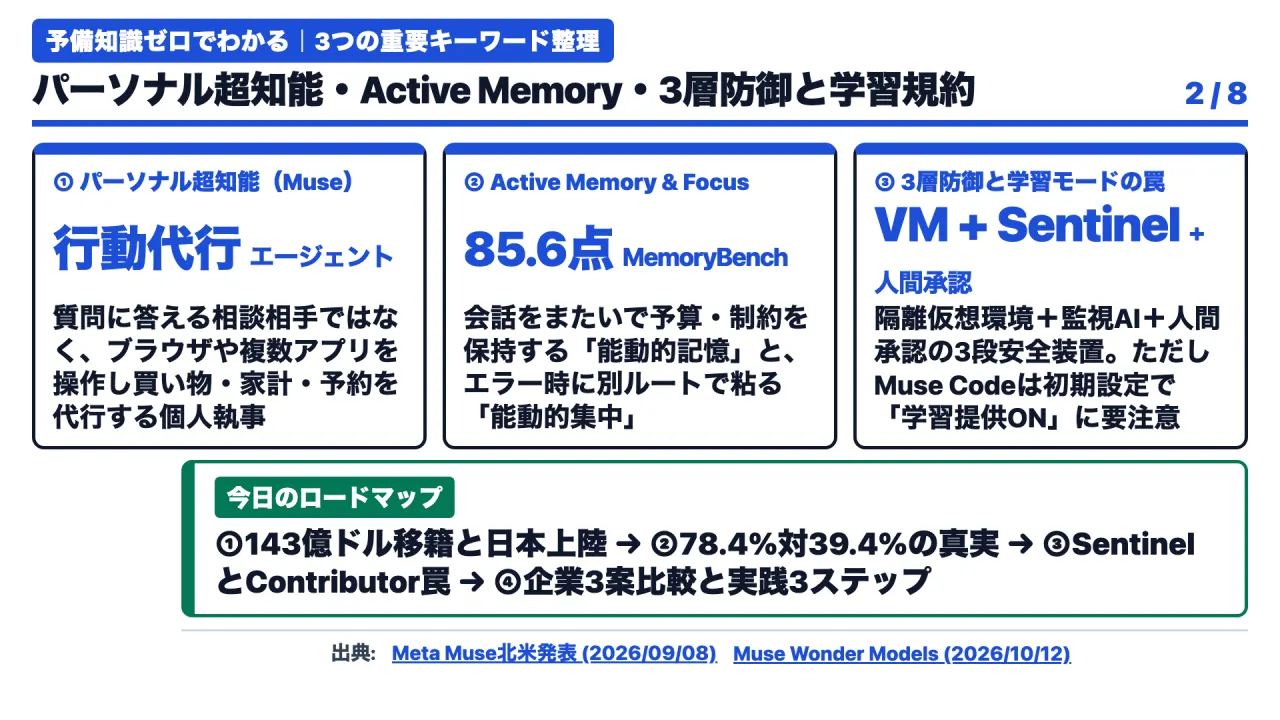
- Conversational LLM vs Personal Superintelligence (PSI): Traditional conversational bots provide descriptive text advice but cannot book transit tickets or cross-reference marketplace listings. Muse operates as a personal digital butler, orchestrating actions across disparate third-party web services and local client applications.
- Active Memory and Active Focus:
- Active Memory structures and preserves constraints across independent conversations over weeks (such as persistent corporate travel budgets or dietary restrictions) without re-prompting.
- Active Focus provides dynamic retry heuristics when an agent encounters unexpected friction (such as a missing UI selector or transient API timeout), attempting alternative execution paths rather than halting immediately.
- Three-Layer Containment vs Training Governance: To mitigate prompt injection risks, Muse pairs cloud-hosted isolated Linux environments (Muse Secure VM) and an automated supervisor agent (Sentinel) with human-in-the-loop authorization gates for irreversible transactions.
3. The $14.3B Scale AI Deal and Alexandr Wang’s Reorganization
Meta’s pivot away from purely open-source weights stems from the competitive struggles of Llama 4 in early 2025 against frontier reasoning models from OpenAI and Anthropic. In June 2025, Mark Zuckerberg executed a decisive $14.3 billion deal, acquiring a 49% stake in Scale AI and appointing its founder, 29-year-old Alexandr Wang, as Meta’s first CAIO.

Wang dissolved Meta’s sprawling legacy AI hierarchy, establishing Meta Superintelligence Labs (MSL)—a streamlined, flat research organization of under 200 elite researchers reporting directly to him alongside former GitHub CEO Nat Friedman and Daniel Gross. Over a 14-month sprint, MSL rebuilt Meta’s core architecture, deploying three successive generations:
- Muse Spark (Spring 2026): Lightweight base model (currently version 1.3 powering the free consumer tier).
- Muse Glimmer & Muse Code (August 2026): Low-latency sub-models and developer subscription tiers.
- Muse Wonder & Muse Wonder Full (October 12, 2026): Large-scale frontier reasoning models featuring 1M-token context windows.
In North America, Muse achieved viral consumer adoption following its September 8, 2026 release, capturing 5 million US downloads in 22 days and surpassing 10 million users within six weeks. Daily active engagement (DAU/MAU) stabilized at ~25%, driven by gamified companion branding (“Jolly”) and clip-on hardware accessories (“Muse Charm”). Crucially, over 25% of active users deployed Muse for direct e-commerce purchasing, generating an average order value exceeding $200.
4. Architectural Anatomy: 1M Context, Active Memory, and Asymmetric Modalities
Released on October 12, 2026, the flagship Muse Wonder Full model incorporates several structural characteristics that dictate its operational profile.
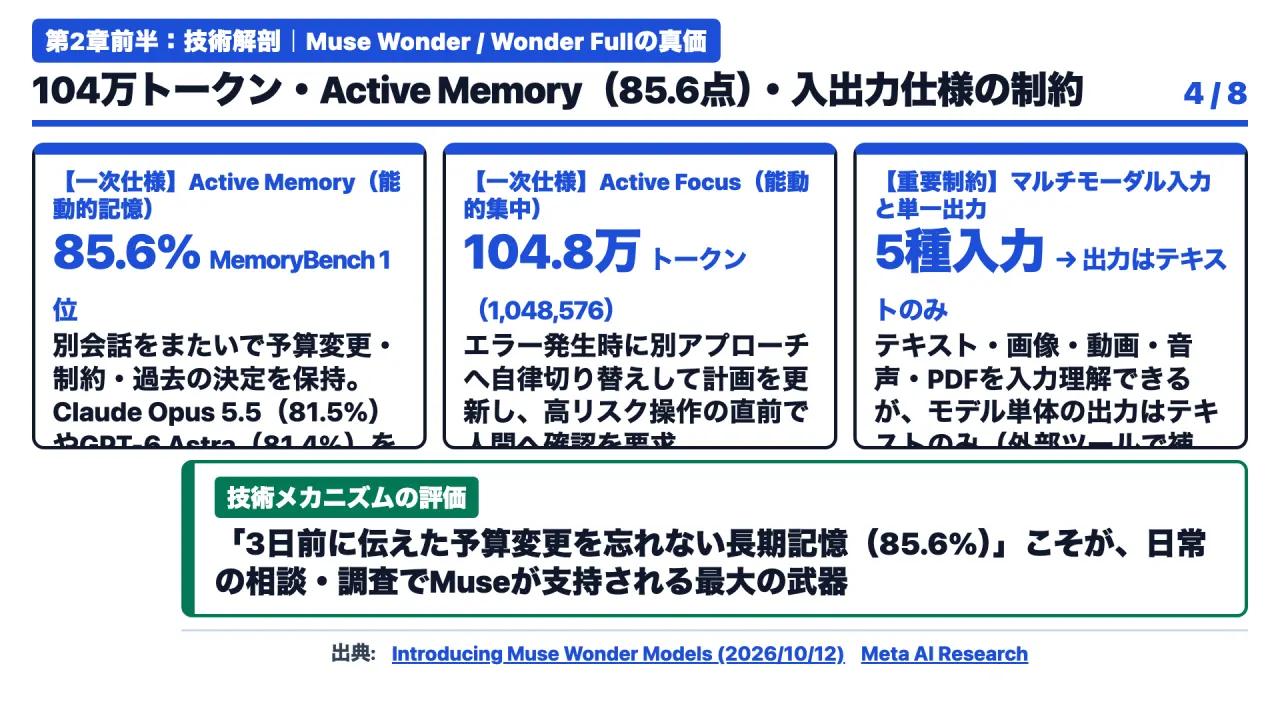
- Context Window: Supports up to 1,048,576 tokens (~1M), allowing ingestion of complete codebases, annual financial filings, or extended chat histories.
- Asymmetric Modality: The model natively ingests text, images, video, audio, and PDF documents. However, its direct generation output is strictly text-only. Visual artifacts or synthesized audio responses are generated via secondary external tool dispatches rather than native multimodal output weights.
- State-of-the-Art Long-Term Retention: On the standardized MemoryBench benchmark, Muse Wonder scored 85.6% (with Wonder Full at 85.5%), outperforming Claude Opus 5.5 (81.5%), GPT-6 Astra (81.4%), and Claude Fable 5.1 (79.0%). It sets the global benchmark for structured cross-session constraint persistence.
5. Empirical Benchmark Audit: Internal PSI (59.1) vs Real-World Execution
While Alexandr Wang emphasized Meta’s first-place ranking on the composite Personal Superintelligence Index (59.1), cross-referencing independent evaluations reveals that Muse Wonder struggles on non-deterministic desktop control and greenfield software engineering.
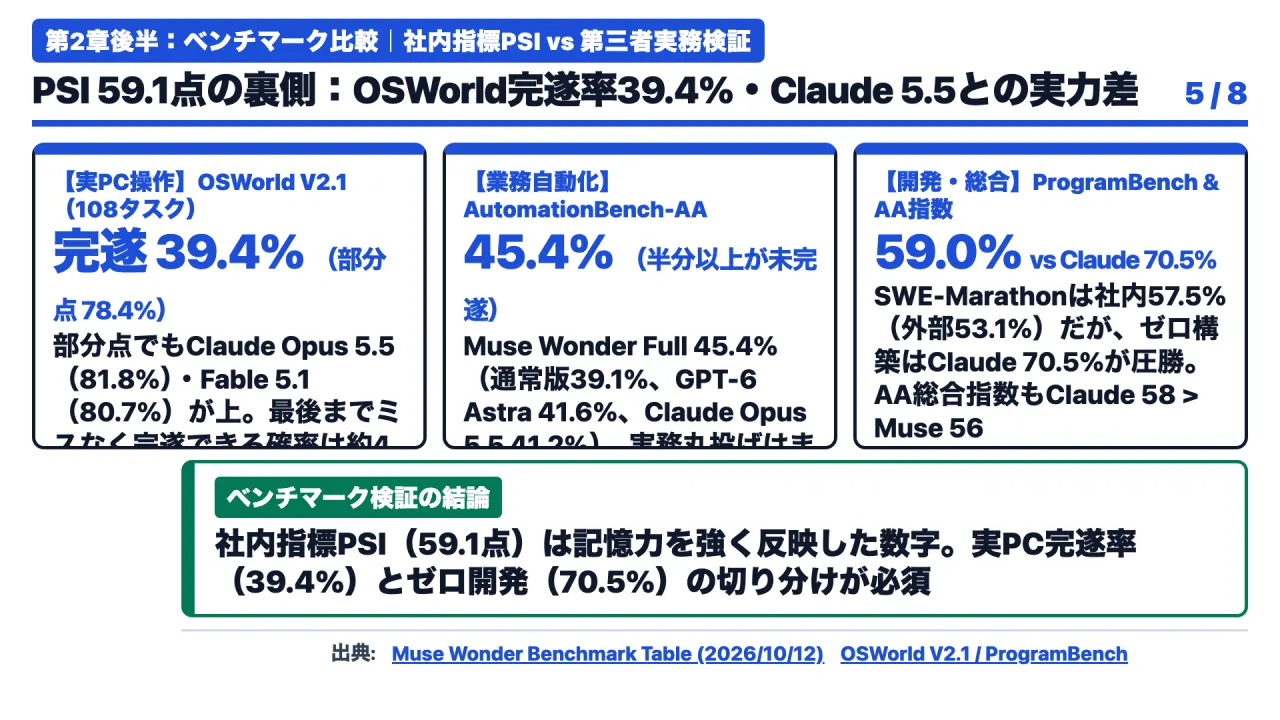
The following benchmark comparison establishes the empirical performance landscape across frontier models:
| Benchmark & Metric Domain | Muse Wonder Full | Claude Opus 5.5 | GPT-6 Astra | Architectural Analysis |
|---|---|---|---|---|
| Personal Superintelligence Index (PSI) | 59.1 (1st) | 55.2 | 54.5 | Meta internal composite weighting favoring long-term memory |
| MemoryBench (Cross-Session Retention) | 85.5% (1st) | 81.5% | 81.4% | Outstanding structured user constraint inheritance |
| OSWorld V2.1: Partial Reward | 78.4% | 81.8% (1st) | 75.8% | Intermediate UI navigation steps completed successfully |
| OSWorld V2.1: Strict Binary Completion | 39.4% | Not Published | Not Published | 60.6% of end-to-end desktop tasks fail before completion |
| AutomationBench-AA (Workflow Ops) | 45.4% (1st) | 41.2% | 41.6% | Multi-app chained execution; over half still fail |
| SWE-Marathon (Long-Horizon Debugging) | 57.5% (xhigh) | 46.3% | — | Active Focus persistence yields high iterative bug resolution |
| ProgramBench (Greenfield Architecture) | 59.0% | 70.5% (1st) | — | 11.5% deficit against Claude in building systems from scratch |
| Terminal-Bench 4.0-AA (CLI Operations) | 57.1% | 59.6% (1st) | 59.1% | Claude retains dominance in raw shell and environment control |
| Artificial Analysis Intelligence Index | 56 | 58 (1st) | — | Claude Opus 5.5 retains overall composite intelligence leadership |
The OSWorld V2.1 metric highlights the fundamental friction in contemporary computer-use agents: while Muse Wonder achieves a respectable 78.4% partial reward by opening applications, navigating menus, and inputting parameters, its strict binary completion rate collapses to 39.4%. In six out of ten real-world scenarios, the agent encounters unhandled modal dialogues, validation exceptions, or checkout timeouts, failing to complete the assigned transaction without human intervention.
Furthermore, in greenfield software development (ProgramBench), Claude Opus 5.5 maintains a crushing 11.5 percentage point advantage (70.5% vs 59.0%), establishing that Muse Wonder is optimized as an interactive consumer co-pilot rather than an enterprise systems architect.
6. Defensive Architecture, Infrastructure CapEx, and the Contributor Mode Trap
Deploying autonomous agents with access to authenticated financial accounts and corporate communications introduces severe attack surfaces.
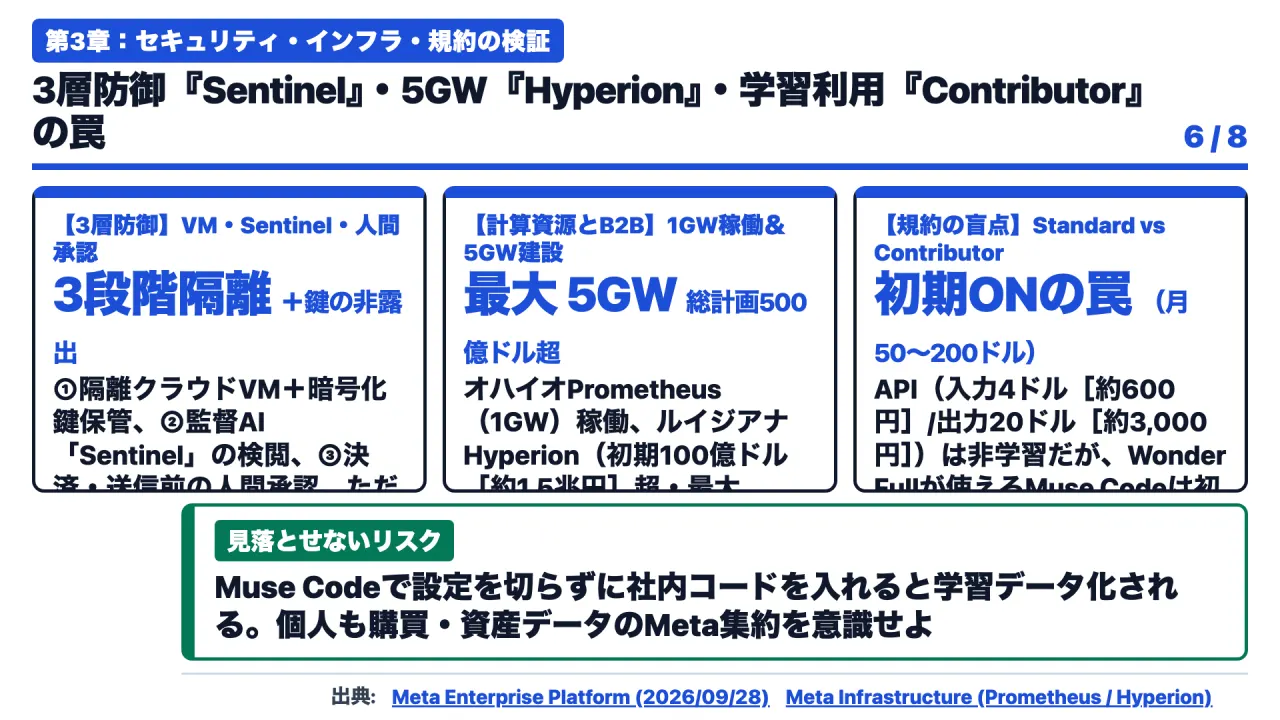
The Three-Tier Defense Architecture
To contain indirect prompt injection exploits (e.g., hidden adversarial text in web pages commanding an agent to transfer funds), Meta engineered three defense rings:
- Muse Secure VM & Secure Credentials Store: Agents execute browser sessions and terminal scripts inside isolated cloud Linux microVMs. Sensitive credentials are maintained in encrypted hardware vaults; raw passwords are never injected into model context strings.
- Sentinel Supervisory Agent: A specialized secondary classifier agent monitors outbound API requests, blocking unmapped network transmissions and privilege escalations.
- Human-in-the-Loop Gates: Irreversible actions—such as processing payment transactions, dispatching public emails, or modifying calendar commitments—mandate explicit client-side human approval.
Hyperscale CapEx: Prometheus and Hyperion
To power this compute infrastructure, Meta committed historic capital expenditures:
- Prometheus (New Albany, Ohio): A 1-gigawatt (1GW) datacenter cluster housing approximately 1 million GPUs that executed the primary pre-training runs for Muse Wonder.
- Hyperion (Richland Parish, Louisiana): A multi-year project representing over $10 billion in initial capital ($50 billion planned total), scaling to an unprecedented 5 gigawatts (5GW—equivalent to five nuclear reactors) housing 1.3 million GPUs post-2028.
To amortize this CapEx, Meta established four monetization vectors: consumer subscriptions, enterprise licensing via the Meta Enterprise Platform (MEP, led by former MongoDB CEO Chirantan “CJ” Desai), merchant referral commissions, and ad-targeting precision (though Wang confirmed Muse’s chat interface will not host direct inline advertisements). Notably, Wall Street reacted cautiously to MEP’s announcement, sending Meta shares down ~5% due to long enterprise sales cycles.
The Contributor Mode Data Leakage Risk
The most critical compliance trap for enterprise teams lies in the divergence between API contracts and subscription tiers:
- Meta Model API (
muse-wonder-1.0): Priced at $4.00 per 1M input tokens and $20.00 per 1M output tokens, operating under Standard Mode where customer inputs are contractually excluded from model training. - Muse Code ($50 to $200 per month): The flagship desktop coding environment providing exclusive access to Muse Wonder Full defaults to Contributor Mode enabled. Unless developers manually enter settings and toggle this off prior to execution, all submitted proprietary source code, operational prompts, and corporate documentation are ingested into Meta’s model training datasets.
7. Enterprise Financial Modeling: Three Deployment Scenarios for a 20-Person Team
To guide engineering leadership, we evaluate three organizational deployment models for a standard engineering team of 20 professionals (representing roughly $1.3 million in annual human capital expenditure).
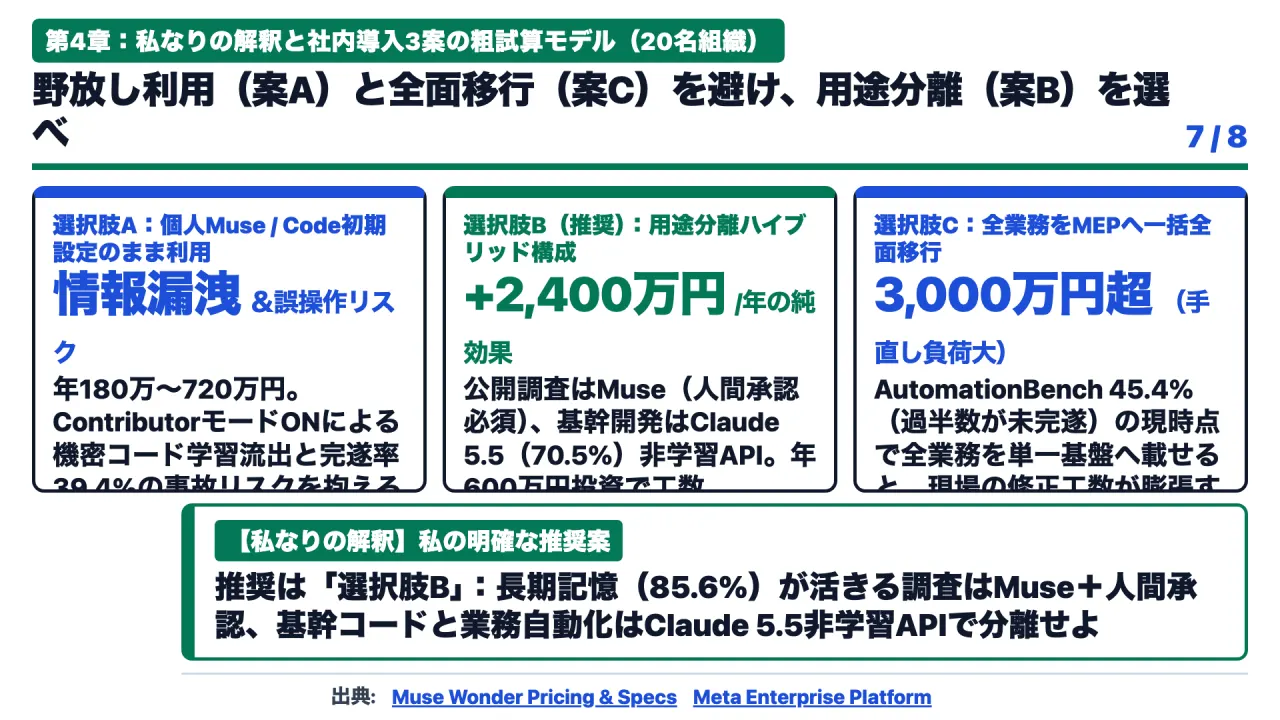
Option A: Unmanaged Muse Code Adoption (Default Configuration)
- Direct Tool Licensing: $12,000 to $48,000 annually ($50 to $200 per user per month).
- Compliance Exposure: Severe data leakage hazard due to default Contributor Mode ingesting internal IP into public model training.
- Operational Drag: A 39.4% task completion rate results in frequent mid-execution failures, creating an estimated $130,000 in annual debugging and manual rework overhead.
- Net Impact: Highly negative (-$150,000 net loss). Strictly unacceptable for enterprise governance.
Option B (Recommended): Hybrid Segregation Architecture
- Infrastructure Budget: ~$40,000 annually (blended API and seat costs).
- Operating Model:
- Deploy consumer Muse strictly for non-confidential market research, competitor price tracking, and calendar scheduling under mandatory human-in-the-loop approval.
- Require immediate disabling of Contributor Mode across any developer pilot seats.
- Route core software engineering and architectural refactoring to Claude Opus 5.5 and GPT-6 Astra via zero-retention enterprise APIs (leveraging ProgramBench 70.5% capabilities).
- Productivity Yield: 15% net efficiency gain across routine research and development tasks (~$200,000 in recovered engineering capacity).
- Net Impact: +$160,000 net annual value (payback period under 2.5 months) with zero IP leakage.
Option C: Complete Enterprise Monolithic Migration to Meta Enterprise Platform (MEP)
- Contract Commitment: $200,000+ enterprise contract minimums.
- Evaluation: Premature. With multi-application workflow success (AutomationBench-AA) standing at 45.4%, unmanaged exceptions across legacy corporate software will degrade team velocity until agent execution reliability matures.
8. Operational Playbook: Three Immediate Enterprise Actions
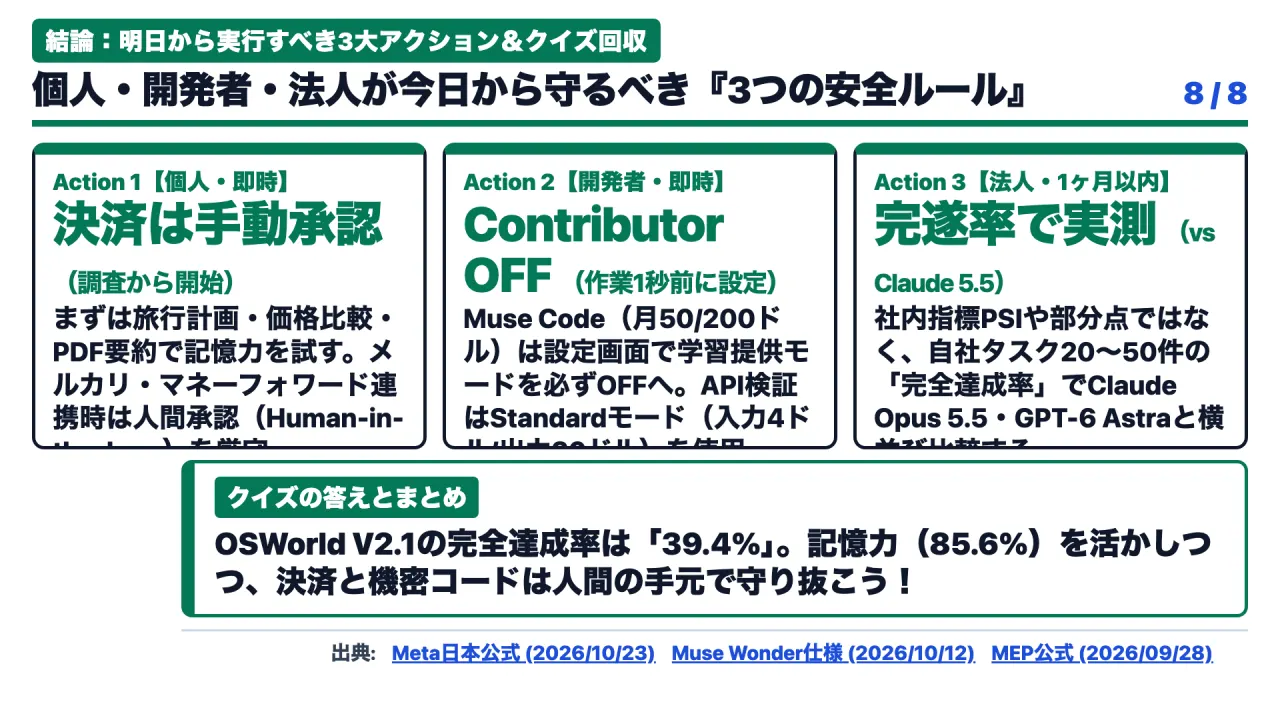
Engineering organizations evaluating Meta Muse should execute three decisive policies:
- Enforce Immediate Contributor Mode Audits: Any organization piloting Muse Code must mandate that engineers toggle off “Contributor Mode” before typing a single line of code, establishing automated proxy rules to block telemetry traffic if necessary.
- Mandate Human-in-the-Loop for Irreversible Operations: Maintain strict human sign-off gates for all purchasing, external messaging, and file deletion workflows. Bind automated agent payments exclusively to single-use virtual corporate cards with hard spending caps.
- Audit Agents via Binary Completion Rather than Partial Credit: When evaluating enterprise agents, discard marketing aggregates (such as PSI) and partial reward scores. Audit candidate models against 20 to 50 company-specific integration tests, measuring strict binary success rates against Claude Opus 5.5 and GPT-6 Astra.
By decoupling Meta’s genuine breakthroughs in long-term memory from its execution limitations and data collection terms, technical leaders can capture agentic efficiency while safeguarding enterprise intellectual property.
Primary Sources and References
- Meta Japan Official Announcement (October 23, 2026): Personal AI Agent “Muse” Launches in Japan with Mercari, Money Forward ME, and Ticket Pia — Meta Newsroom Japan
- Meta US Official Announcement (September 8, 2026): Introducing Muse Personal AI Agent — Meta Newsroom
- Meta Enterprise Platform Announcement (September 28, 2026): Launching Meta Enterprise Platform with CJ Desai — Meta Newsroom
- Meta AI Research (October 12, 2026): Introducing Muse Wonder and Muse Wonder Full Models — Meta AI Blog
- Meta AI Technical Documentation: Active Memory, Active Focus, and Model Architecture Specifications — Meta AI Research
- Meta Engineering Infrastructure: Prometheus 1GW and Hyperion 5GW AI Supercluster Architecture — Meta Engineering
- OSWorld Benchmark Repository: Evaluating Multimodal Agents on Open-Ended Desktop Tasks (V2.1) — OSWorld GitHub
- Consuloji Deep Dive Video (Japanese): なぜMetaのAI『Muse Wonder』は部分点78.4%でも実務の完全達成率が39.4%なのか? — Watch on YouTube