Why OpenAI Kept Resetting Rate Limits: Inside the 28 Days of Shipping Sprint Powering 40 Million Codex Users
By fixing eight silent token-drain bugs, unlocking forever prompt caching, open-sourcing Decisions API, and waiving auto-review fees, OpenAI transformed infrastructure economics for enterprise engineering teams.
Published: October 24, 2026 | Read time: ~10 min | Watch Video (Japanese)
1. Executive Summary: The Mechanics Behind the “Ship or Reset” Pledge
On October 4, 2026, Thibault “Tibo” Sottiaux (@thsottiaux), Head of Product for Codex and ChatGPT Work at OpenAI, announced an unprecedented public engineering commitment: the “28 Days of Shipping” sprint running from October 5 through November 1, 2026. The pledge established an uncompromising operational contract: each day, OpenAI’s product team would either ship a distinct, measurable improvement relevant to the majority of Codex and ChatGPT Work users, or trigger an immediate, complete reset of user rate limits across the entire global subscriber base.
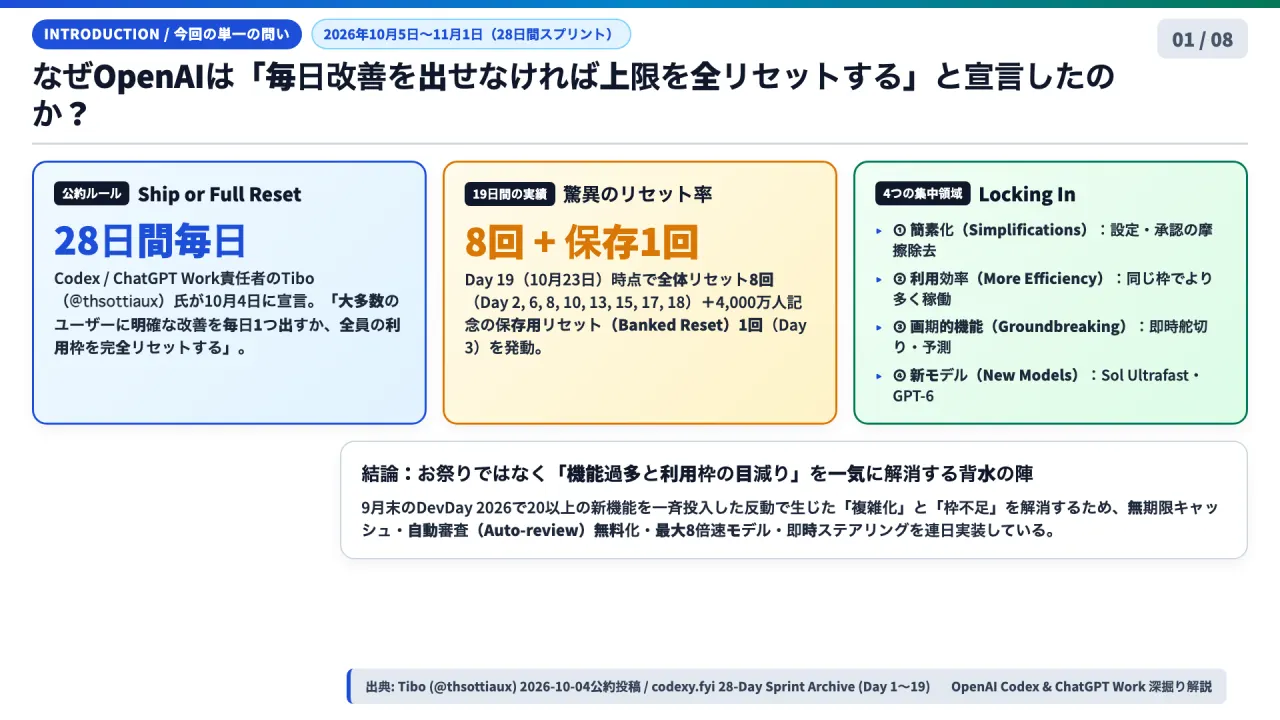
Far from being an ephemeral marketing stunt, this sprint was a forced-alignment mechanism engineered to resolve severe operational bottlenecks. As the active user population across Codex and ChatGPT Work expanded to 40 million professionals, two compounding friction points threatened product viability: rapid feature complexity following DevDay 2026, and unmonitored architectural bugs that silently burned through enterprise weekly usage allowances.
Between October 5 and October 23, 2026 (Day 1 through Day 19), OpenAI shipped dozens of production upgrades while triggering eight global rate limit resets and issuing one universal “Banked Reset” credit. More importantly, this sprint established structural foundation upgrades for developers: default 500,000-token context windows, persistent “forever” prompt caching, free secondary-agent code security review (Auto-review), the general availability of the sub-150ms Decisions API, the donation of OpenResponses to the Linux Foundation, and streamlined incident defense via Daybreak Blue.
2. The 40-Million-User Scaling Crunch and Eight Silent Token Leaks
By Day 3 of the sprint (October 7, 2026), official metrics confirmed that active users across Codex and ChatGPT Work reached 40 million developers and enterprise professionals. Codex expanded beyond an inline autocompletion utility to encompass autonomous background agents (dots), cloud sandboxes (Codex Cloud), terminal workflows (Codex CLI), and automated meeting action items (Meetings plugin).
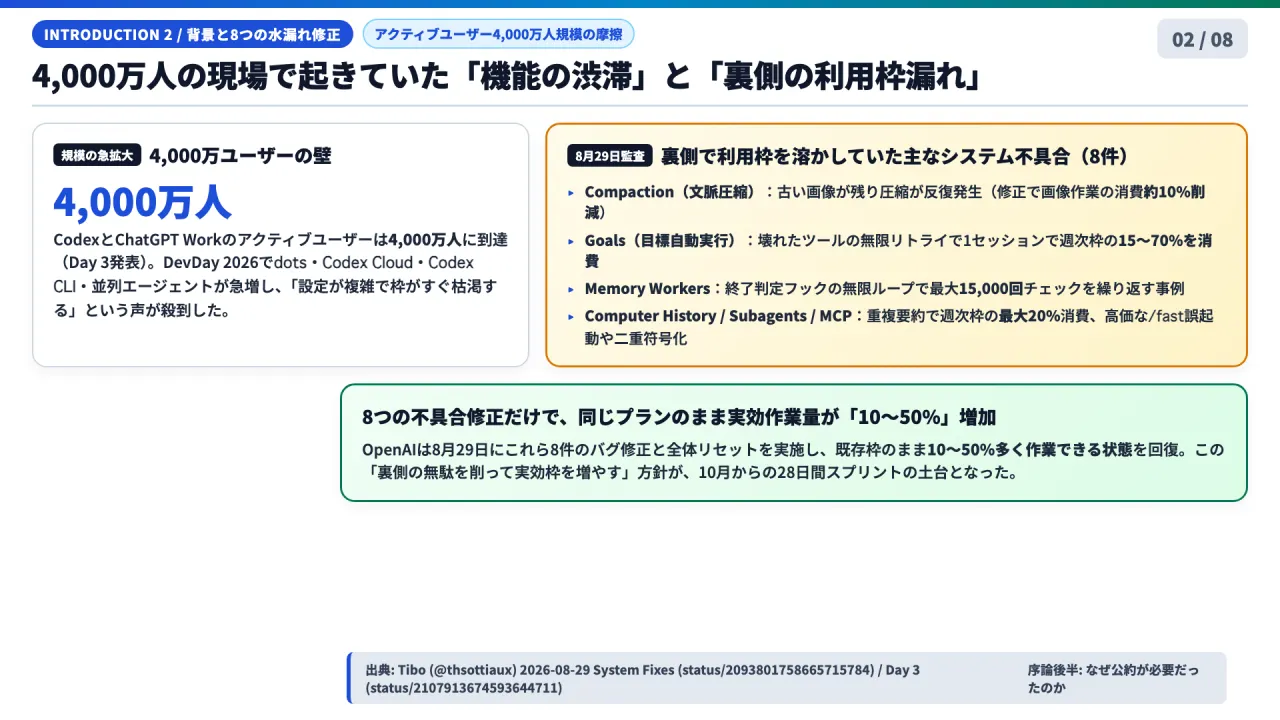
Following DevDay on September 29, 2026, subscribers reported burning through weekly allowances within hours. An internal investigation published by Sottiaux on August 29, 2026, after analyzing thousands of user telemetry reports, revealed that infrastructure-level defects were burning 10% to 50% of subscriber token allocations without user knowledge:
- Compaction Image Retention Loops: Image payloads persisted across context compaction, re-saturating token limits and triggering repetitive compaction loops (resolved, saving ~10% capacity).
- Subagent Model & Fast Mode Inheritance: Utility subagents erroneously invoked expensive frontier models or inherited costly
/fastinference modes without authorization. - Memory Worker Loops: Background workers entered recursive loops, checking termination conditions up to 15,000 consecutive times.
- Goals Tool Retry Exhaustion: Autonomous
/goalagents retried non-functional tools indefinitely, burning 15% to 70% of weekly allowances in a single task. - Computer History Duplicate Summaries: Activity monitors repeatedly summarized identical desktop interaction logs, draining up to 20% of weekly limits.
- Automation Over-Firing: Recurring scheduled tasks misfired at frequencies significantly exceeding configured cron intervals.
- Rolling Task Summaries: Background threads initiated summaries after every turn, adding an unnecessary 1% token tax until deprecation.
- MCP Double-Encoding: Tool responses suffered from double-encoding and truncated schemas that triggered continuous re-fetching loops.
Resolving these eight defects increased effective user throughput by 10% to 50% without altering plan pricing, establishing the sprint’s four focus areas: simplification, efficiency for higher usage, groundbreaking capabilities, and next-generation models.
3. Chronicle of Days 1 to 19: The Cadence of Releases and Eight Resets
The public telemetry archive (codexy.fyi) documents the daily sequence maintained between October 5 and October 23, 2026:
| Sprint Day | Primary Feature Shipped | Rate Limit Reset Triggered |
|---|---|---|
| Day 1 (Oct 5) | GPT-6 Astra and Sol default generation speeds boosted by ~50% (~30 to ~50 tok/s) across third-party partners (Devin, OpenCode). | None |
| Day 2 (Oct 6) | Free Auto-review, API tiers simplified to 3 levels, macOS Meetings integration, Decisions API beta. | Reset #1 (Global reset post-poll) |
| Day 3 (Oct 7) | GPT-6 Intelligent UI in Chat; 40M active user milestone; Codex Cloud Tailscale networking. | Banked Reset (User-redeemable token) |
| Day 4 (Oct 8) | Instant Steering for runtime course-correction; GPT-6.1 Sol Ultrafast (up to 8x faster than Sol Standard). | None |
| Day 5 (Oct 9) | Composer Predictions (zero usage cost on Pro); native mobile dot creation and messaging. | None |
| Day 6 (Oct 10) | Infrastructure stabilization sprint. | Reset #2 (Weekend global reset) |
| Day 7 (Oct 11) | GPT-6.1 Sol default context expanded from 272K to 500K tokens (~80% gain, overrides to 1M). | None |
| Day 8 (Oct 12) | Compute cluster re-balancing. | Reset #3 (Global reset) |
| Day 9 (Oct 13) | Desktop application state storage optimized, reducing local disk usage by ~60%. | None |
| Day 10 (Oct 14) | Backend scaling adjustments. | Reset #4 (Global reset) |
| Day 11 (Oct 15) | Capacity mitigation routing with automated background task continuation. | None |
| Day 12 (Oct 16) | Subagent context reuse upgrades; GPT-6 Astra Pro parallel execution and homescreen dots. | None |
| Day 13 (Oct 17) | European infrastructure maintenance. | Reset #5 (Global reset) |
| Day 14 (Oct 18) | Desktop thread inline historical message editing. | None |
| Day 15 (Oct 19) | Live prototype demonstration of unreleased agent tooling. | Reset #6 (Global reset) |
| Day 16 (Oct 20) | 12-hour API prompt caching; forever prompt caching for authenticated Codex/Work subscribers. | None |
| Day 17 (Oct 21) | Daybreak Blue cybersecurity access advisory issued for CSIRT teams. | Reset #7 (Global reset) |
| Day 18 (Oct 22) | Decisions API reaches GA; OpenResponses joins Linux Foundation AAIF; Uber enterprise rollout. | Reset #8 (Global reset) |
| Day 19 (Oct 23) | Fast dots audio calls; dynamic reasoning cache persistence; major Codex CLI enterprise update. | None |
4. Expanding Context Limits to 500K Tokens and Forever Prompt Caching
In professional software development, managing large repositories and complex architectural documentation rapidly exhausts traditional context windows. Prior to Day 7, GPT-6.1 Sol operated with a default context limit of 272,000 tokens (272K). Once a session crossed this threshold, background compaction routines compressed conversation history, inevitably losing fine-grained technical nuances while burning additional tokens.
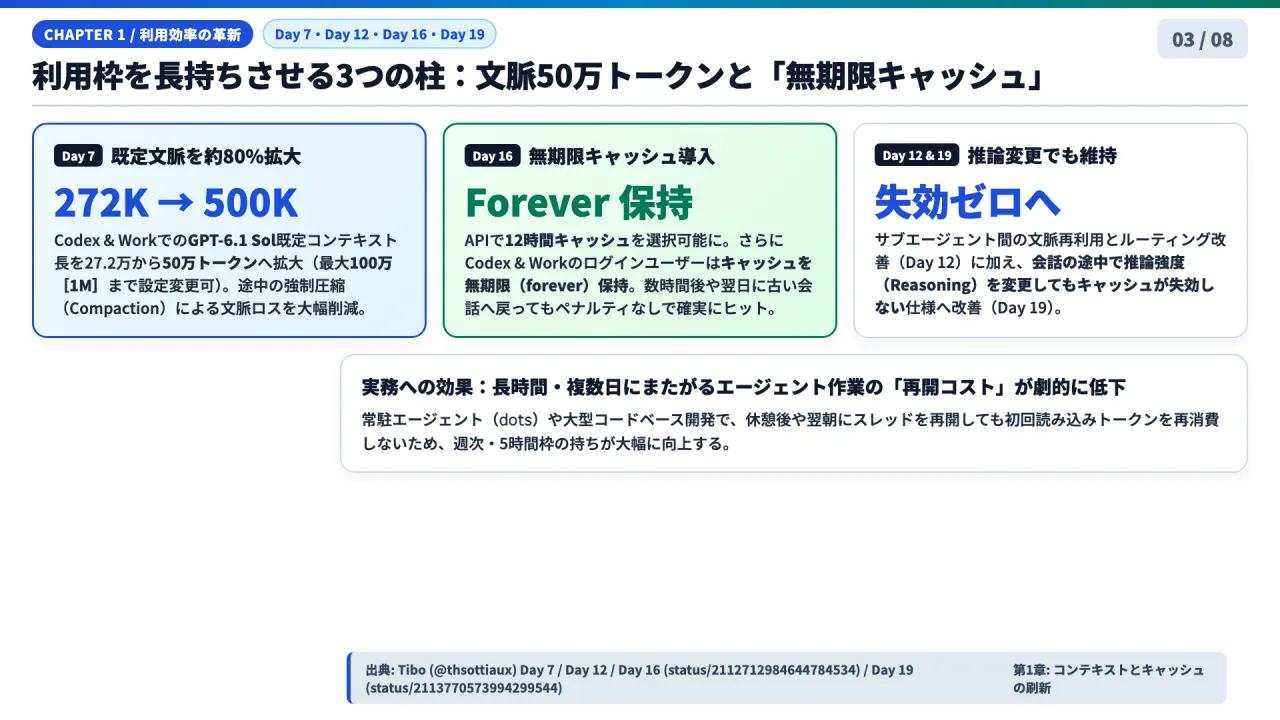
Day 7 raised the default context allocation to 500,000 tokens (500K)—an 80% expansion—with configuration overrides up to 1 million tokens (1M).
Even more consequential were the cache lifecycle revisions implemented on Day 16 and Day 19:
- 12-Hour API Caching: Developers building persistent background agents via the API can maintain prompt cache states across 12-hour windows, ensuring recurrent background tasks hit discounted cache pricing.
- Forever Caching for Authenticated Users: For developers logged into Codex and ChatGPT Work subscriptions, prompt caches are maintained indefinitely (“forever”). Resuming work on an existing project thread hours or days later incurs zero re-ingestion latency or token recalculation penalties.
- Dynamic Reasoning Cache Persistence: Historically, modifying reasoning effort mid-conversation invalidated active prompt caches. As of Day 19, users can dial reasoning intensity up or down without purging existing cached state.
5. Inference Acceleration: Sol Ultrafast, Instant Steering, and Decisions API
Raw generation speed without deterministic steering mechanisms wastes enterprise budget. A model writing incorrect code at 100 tokens per second merely consumes tokens faster.
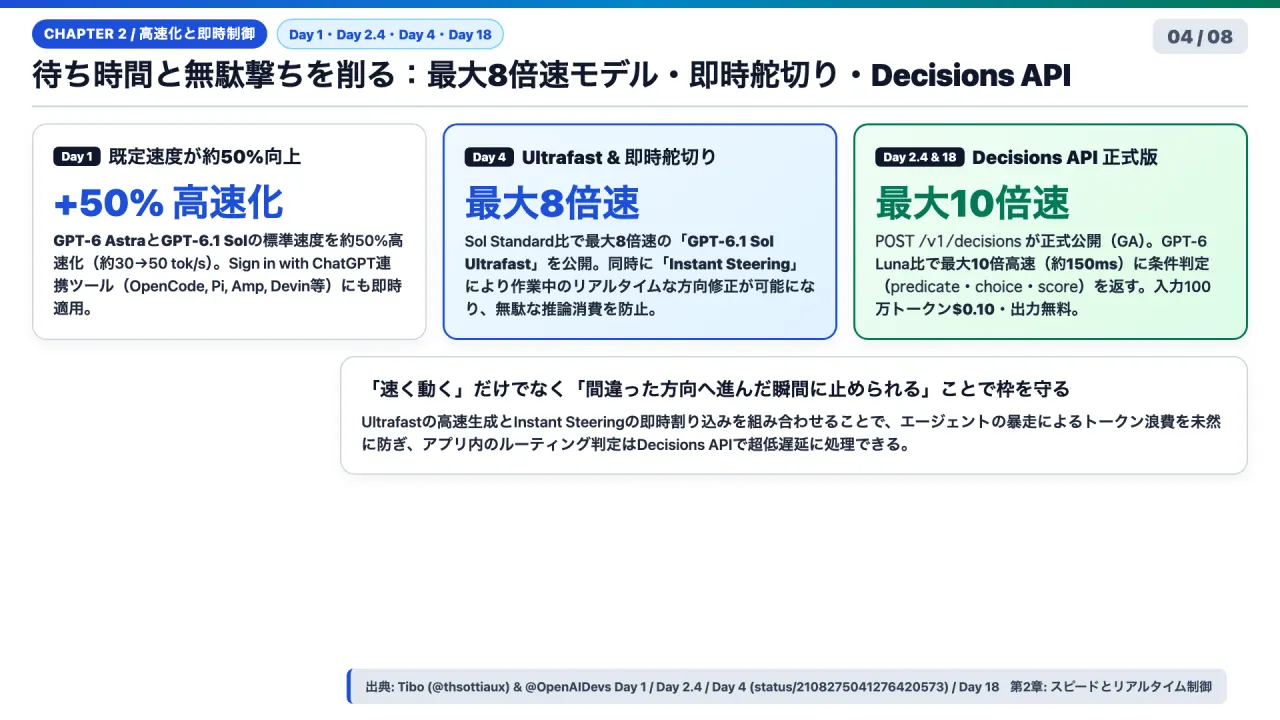
To solve this, OpenAI deployed a three-part control stack:
- GPT-6.1 Sol Ultrafast (Day 4): Delivers generation throughput up to 8x faster than Sol Standard while retaining reasoning intelligence comparable to Astra.
- Instant Steering (Day 4): Legacy agent loops executed tool chains to completion before acknowledging user intervention. Instant Steering allows human engineers to interrupt diverging workflows mid-execution, instantly pivoting the model’s trajectory and eliminating wasted token consumption.
- Decisions API (
POST /v1/decisions, Day 2.4 & Day 18 GA): Replaces verbose text generation with structured, deterministic evaluations. Powered bygpt-6-luna, the endpoint evaluates three structured primitives:predicate: Evaluates whether a given condition evaluates to true with associated probability.choice: Selects the optimal categorical option from an explicit array (ideal for routing agents).score: Assigns quantitative numerical grades against explicit rubric definitions.
The Decisions API operates up to 10x faster (~150ms latency) than standard Responses endpoints, processing up to 400 questions per API request. Crucially, pricing is set at $0.10 per 1 million input tokens with $0.00 output token charges, providing an extraordinarily cost-effective backbone for high-speed agent classification.
6. Eliminating Review Fatigue: Free Auto-Review and Workspace Enhancements
Delegating file manipulation and terminal command execution to autonomous agents requires security boundaries. However, modal confirmation dialogs appearing before every command induce severe user fatigue, prompting engineers to approve destructive actions without thorough inspection.
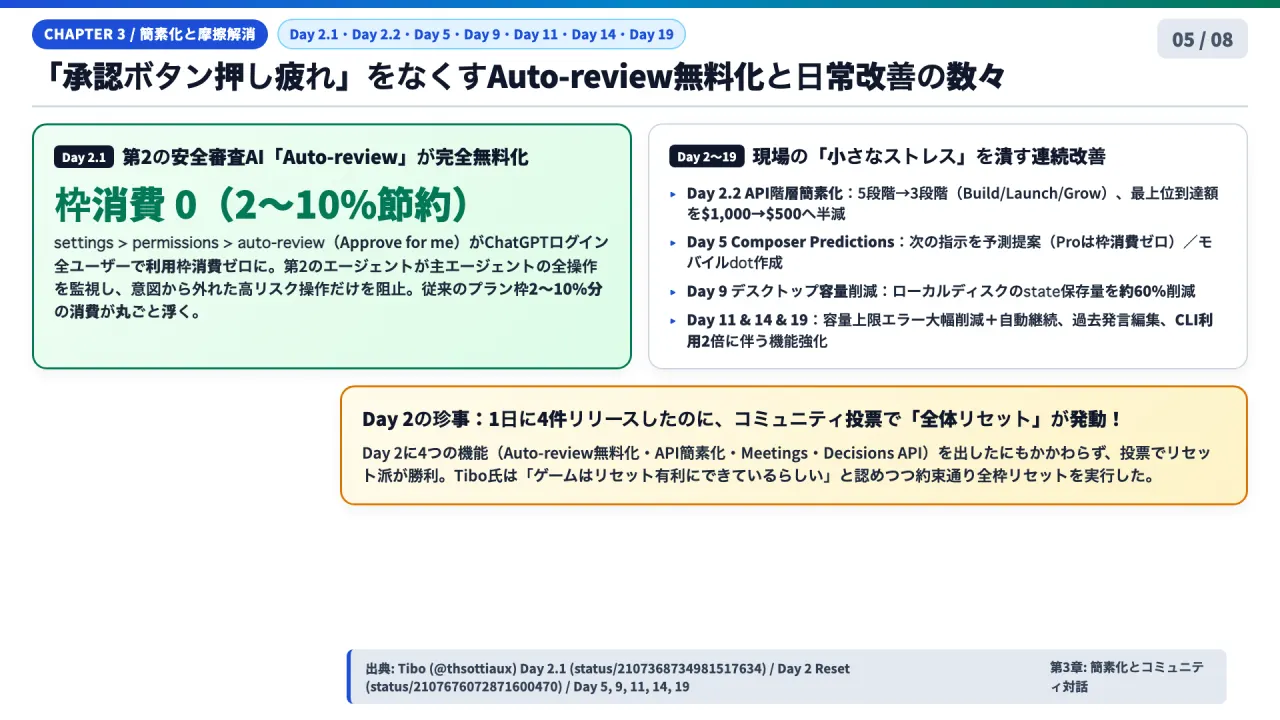
OpenAI’s settings > permissions > auto-review feature addresses this by deploying a secondary supervisory agent that audits primary agent operations against the user’s original mission intent. Highly risky operations are automatically intercepted, while benign edits proceed smoothly.
Previously, running this secondary supervisory agent consumed 2% to 10% of a user’s subscription quota. On Day 2.1, OpenAI completely waived usage consumption for Auto-review across all authenticated accounts. Teams gain automated defense-in-depth without sacrificing operational capacity.
Complementary desktop enhancements include:
- Composer Predictions (Day 5): Predicts upcoming prompts based on conversation context, allowing completion via the
Tabkey with zero usage cost for Pro subscribers. - 60% Local Storage Reduction (Day 9): Optimized local session storage schemas, resolving persistent disk bloat complaints on developer workstations.
- Codex CLI Modernization (Day 19): Addressing a 2x surge in CLI usage post-DevDay, OpenAI added reusable prompt presets, inline runtime permission controls, Enterprise MCP authentication, and Windows corporate proxy support.
7. OpenResponses Governance and Proactive Daybreak Blue Cyber Defense
Beyond individual tooling, the sprint delivered major milestones in industry standardization and enterprise security posture.
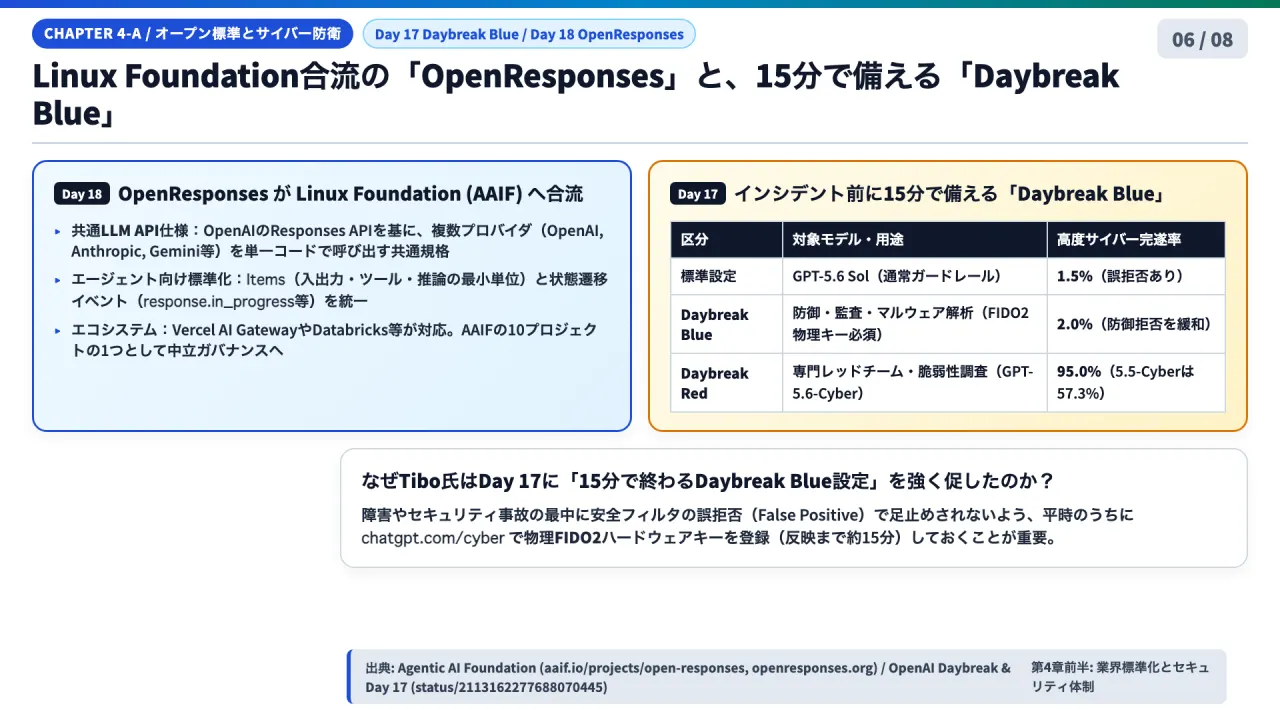
OpenResponses Transfer to Linux Foundation AAIF
On October 22, 2026 (Day 18), OpenAI formally transferred governance of the OpenResponses API specification to the Agentic AI Foundation (AAIF), an open-source consortium hosted under the Linux Foundation. Originally founded in December 2025 by Anthropic, OpenAI, Block, and partner institutions, the AAIF expanded its portfolio to ten hosted projects, onboarding OpenResponses alongside Anthropic’s Agent Skills, Hugging Face’s OpenEnv, and Alibaba’s OpenSandbox.
OpenResponses eliminates provider-specific API divergence. By establishing standardized bidirectional Items and deterministic streaming state events (response.in_progress, response.output_item.added, response.completed), developers can write single integration pipelines supported seamlessly across OpenAI, Claude, Gemini, and open-source models via gateways such as Vercel AI Gateway and Databricks Model Serving.
15-Minute Pre-Provisioning for Daybreak Blue
On Day 17, Sottiaux urged enterprise security teams to immediately enroll in OpenAI Daybreak (chatgpt.com/cyber). When defensive teams investigate live incidents, standard frontier models often generate false-positive refusal responses when analyzing malicious code.
| Program Tier | Target Audience | Primary Model | Advanced Cyber Benchmark Completion | Provisioning Requirements |
|---|---|---|---|---|
| Standard Baseline | General Developers | GPT-5.6 Sol |
1.5% | Standard account creation |
| Daybreak Blue | Enterprise CSIRT & SecOps | GPT-5.6 Sol (Defensive Screening) |
2.0% | Hardware FIDO2 key enrollment (~15 min) |
| Daybreak Red | Authorized Red Teams & Pen-testers | GPT-5.6-Cyber |
95.0% | Formal enterprise vetting & dedicated hardware keys |
Attempting to register hardware FIDO2 keys and wait 15 minutes for administrative verification while an active security breach unfolds introduces unacceptable operational delay. Security leaders must complete Daybreak Blue enrollment proactively during peace time.
8. Boundary Conditions: Defining Reset Scope and Plan Allocations
Understanding the exact boundary conditions governing rate limit resets prevents budget misallocations and operational surprises.
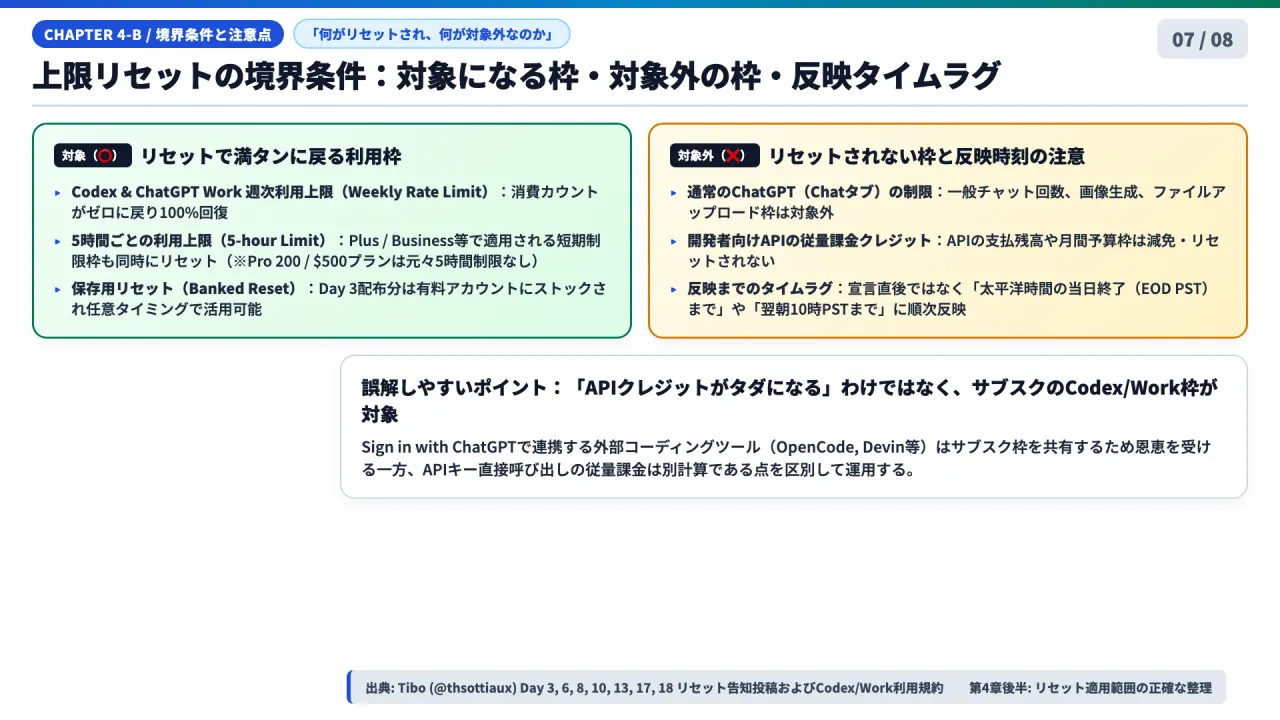
- Covered Allocations: Rolling weekly consumption shared between Codex and ChatGPT Work resets completely. Short-term 5-hour rate limits (Plus and Business tiers) reset immediately. Delegated tokens consumed via third-party tools (Devin, OpenCode, Pi, Amp) draw from the same pool and are fully restored.
- Excluded Allocations: Standalone ChatGPT web chat limits, image generation quotas, and document upload thresholds are excluded. Metered pay-as-you-go developer API usage remains billable and unaffected.
- Propagation Latency: Resets are distributed via staged batch routines across global server clusters, taking effect across windows ranging from two hours to end-of-day Pacific Time.
9. Enterprise Action Plan: Three Critical Configuration Audits
The enduring value of OpenAI’s 28 Days of Shipping lies not in ephemeral quota replenishments, but in the permanent structural enhancements deployed across the runtime environment.
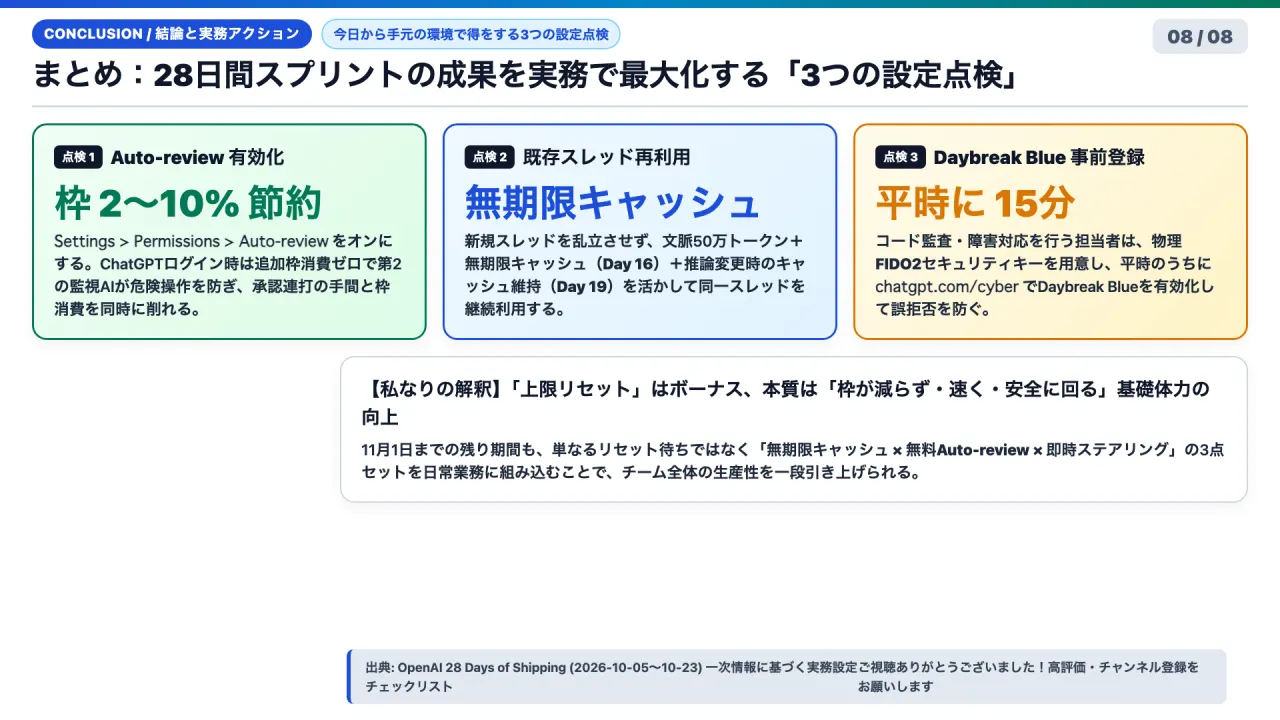
Engineering leaders and practitioners should implement three immediate configuration audits:
- Audit 1: Enable Auto-Review Immediately: Navigate to
settings > permissions > auto-reviewand enable “Approve for me”. This eliminates repetitive approval clicks, restores 2% to 10% in formerly consumed quota, and activates secondary-agent security oversight. - Audit 2: Consolidate Long-Lived Project Workflows into Persistent Threads: Leverage forever prompt caching and 500K context allocations by maintaining long-running project contexts within dedicated threads rather than creating fresh sessions for each task. Dial reasoning intensity dynamically without forfeiting cache hits.
- Audit 3: Register Enterprise Defense Teams for Daybreak Blue: Require internal CSIRT and security engineers to authenticate hardware FIDO2 security keys at
chatgpt.com/cyber. Completing this 15-minute onboarding proactively ensures uninhibited AI assistance during active security incidents.
OpenAI’s sprint proved that relentless, transparent shipping paired with radical simplification transforms both developer velocity and distributed infrastructure reliability at global scale.
Primary Sources and References
- Codex 28 Days of Shipping Daily Tracker & Raw JSON Archive: codexy.fyi/data/days.json
- Thibault Sottiaux Official Announcement (October 4, 2026): Four Focus Areas and 28-Day Shipping Pledge — X Post Record
- Thibault Sottiaux Infrastructure Audit (August 29, 2026): Root Cause Analysis and Resolution of 8 System Token Leaks — X Diagnostic Post
- OpenAI Official Product Release: Introducing the Decisions API: High-Speed Structured Evaluations — OpenAI Product Blog
- OpenAI Security & Threat Research: Introducing OpenAI Daybreak: Secure Access Tiers for Cybersecurity Operations — OpenAI Daybreak Portal
- OpenAI Cyber Verification: Advanced Account Security and Hardware Key Provisioning — ChatGPT Cyber Console
- Agentic AI Foundation (AAIF): Open Responses Project Overview and Specifications — AAIF Projects Directory
- Agentic AI Foundation (AAIF) Technical Blog: What Open Responses Changes for Distributed AI Developers — AAIF Technical Article
- OpenResponses Specification: Standardized Streaming and Bidirectional Item Interfaces (Version 2026-04-24) — OpenResponses Formal Specification
- Consuloji Deep Dive Video (Japanese): なぜOpenAIは上限リセットを連発するのか? — Watch on YouTube