Inside OpenAI's $150B Valuation Cut, SPV Debt Concentration, and the $2T Physical Infrastructure Pivot
As OpenAI trims its target valuation to $1.25T and corporate bond spreads hit 17-month highs, AI capital is shifting from software benchmarks to 80,000 leased cell towers, 20GW power deals, and Kalshi compute futures.
Published: October 25, 2026 | Read time: ~10 min | Watch Video (Japanese)
Executive Summary: Beyond the Headline Valuation Shift
When reports revealed that OpenAI lowered its target valuation by $150 billion ── from $1.4 trillion down to $1.25 trillion ── in negotiations for a new $30 billion funding round, commentators characterized the adjustment as an early crack in the AI boom.
Yet analyzing the broader capital landscape across seven major disclosures covered by Bloomberg Technology and primary financial filings reveals a different structural reality. Demand for compute has not evaporated. Instead, the market has transitioned from the initial speculative phase to an austere regime governed by balance-sheet solvency, debt service, physical infrastructure constraints, and the financialization of compute capacity.
This analysis deconstructs seven contemporaneous developments connecting financial markets to physical infrastructure:
- Capital Market Repricing: OpenAI’s $150 billion valuation concession and IPO deferral to 2027+, Anthropic’s push toward a 2026 public listing at an implied $965 billion to $2.0 trillion valuation, and SK Hynix’s cancellation of Solidigm’s $10 billion U.S. IPO.
- Credit Market Strains: Mizuho Securities warning of “vibe-driven” selloffs despite earnings beats, accompanied by corporate credit spreads widening to 17-month highs as off-balance-sheet Special Purpose Vehicle (SPV) debt concentrates across roughly 10 counterparties.
- Physical Asset Control: SpaceX’s negotiations to lease 80,000 terrestrial cell towers ── half of all U.S. towers ── paired with a 20-gigawatt power goal, alongside Xona Space Systems’ $250 million Series D round to modernize GPS via low-Earth-orbit satellites.
- Commoditization of Inference: Kalshi’s launch of regulated compute forward curves for NVIDIA B200, H200, and A100 GPUs, treating FLOPs as the modern equivalent of crude oil.

1. Core Financial Architecture: SPVs, Credit Spreads, and Compute Curves
To evaluate these shifts, technology and investment leaders must clarify three foundational mechanisms operating across modern AI capital allocation:
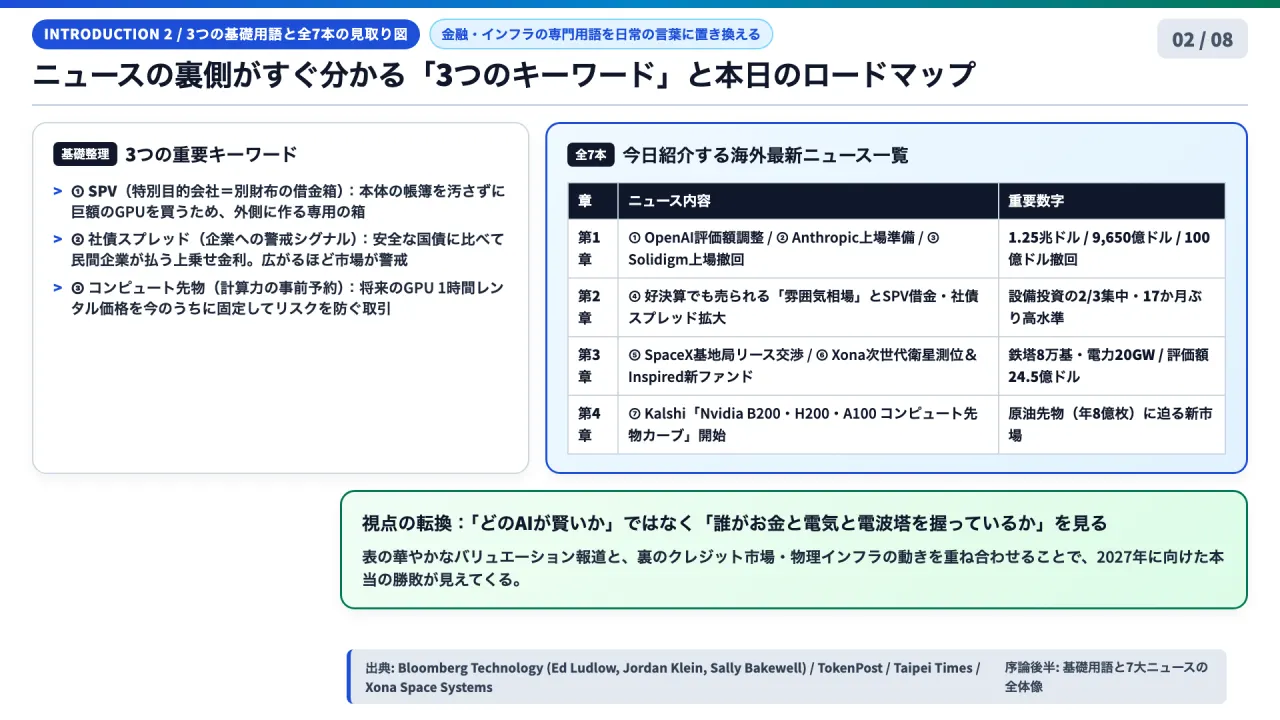
- Special Purpose Vehicles (SPVs): Bankruptcy-remote legal entities established to finance hardware acquisitions off a sponsor’s balance sheet. Emerging neoclouds pledge physical GPUs and compute lease contracts as collateral to borrow billions from private credit funds. While protecting headline debt, systemic default risk concentrates among financial guarantors.
- Credit Spreads: The yield premium corporate bonds pay over baseline U.S. Treasuries. When institutional debt investors perceive insolvency risk or capital overextension in infrastructure, credit spreads widen, directly increasing borrowing costs. In late 2026, tech-linked bond spreads reached their highest levels since May 2025.
- Compute Forward Curves: Financial derivative curves establishing the forward market price of renting a specific GPU per hour months or years into the future. Regulated prediction market Kalshi initiated live pricing for NVIDIA chips, transforming compute into a tradable commodity subject to hedging.
2. Capital Markets: The $1.25T Reset, Anthropic’s Counter-IPO, and Solidigm’s Retreat
The equity tier reveals how institutional allocators are applying rigorous cash-flow discipline to foundation model developers.

News 1: OpenAI Concedes $150 Billion in $30 Billion Funding Round
According to reporting from FinanceFeeds and Bloomberg, OpenAI engaged in advanced negotiations with Coatue Management, UAE-based sovereign investors, and other institutional partners for a $30 billion private equity round.
The terms reflect an intense negotiation:
- In March 2026, OpenAI completed a $122 billion equity round at an $852 billion post-money valuation.
- By September 2026, leadership targeted a valuation of $1.4 trillion for subsequent capital infusions.
- By late October 2026, investor pushback over massive ongoing CapEx commitments forced a valuation compromise down to $1.25 trillion ── a $150 billion reduction from management’s target. Furthermore, anticipated public listing timelines were formally pushed back to 2027 or later.
OpenAI conceded this premium to secure bridge capital. Having entered multi-billion-dollar compute purchase agreements, OpenAI requires liquid private capital to finance operating cash burn while its public offering remains years away.
News 2: Anthropic Targets $965B Private Mark and Accelerates 2026 IPO
In stark contrast, TokenPost and WeRSM reported that primary rival Anthropic accelerated preparations for a 2026 initial public offering, carrying a private mark of $965 billion and seeking an ultimate public valuation between $1.5 trillion and $2.0 trillion. Early venture returns show dramatic gains: Spark Capital’s 2023 Series C stake ($75 million at a $5 billion valuation) is now worth roughly $7.0 billion (over 90x), Iconiq Capital’s $6.0 billion deployment reached $17.0 billion, Menlo Ventures holds $14.0 billion, Coatue Management holds $7.5 billion, and Sequoia Capital holds over $6.0 billion. Because major allocators like Coatue and Sequoia hold substantial equity in both labs, Anthropic’s public liquidity path gave investors significant leverage to push OpenAI’s private valuation downward.
News 3: SK Hynix Scraps Solidigm’s $10 Billion U.S. Listing
Further up the supply chain, Taipei Times reported that South Korean memory manufacturer SK Hynix abruptly canceled the planned initial public offering of its enterprise SSD subsidiary, Solidigm. Acquired from Intel, Solidigm had selected Goldman Sachs and Morgan Stanley to lead a $10 billion U.S. offering at an implied $100 billion valuation. The transaction collapsed under intense pressure from Korean financial regulators and institutional shareholders, who argued that carving out the high-margin AI datacenter storage unit would dilute SK Hynix’s consolidated equity value. With SK Hynix’s market capitalization already adjusting from its June 2026 peak of $1.3 trillion down to roughly $679 billion, the cancellation confirms that capital markets will no longer tolerate corporate financial engineering that fragments AI asset value.
3. Debt Markets: Vibe Selling, 17-Month Spreads, and SPV Concentration
While equity valuations adjusted, corporate bond and loan markets signaled deeper structural stress.

The “Crowded Theater” Dynamic: Selling on Vibes
During a Bloomberg Technology symposium, Jordan Klein, Technology and Media Specialist at Mizuho Securities, observed a striking disconnect between corporate fundamentals and stock price action: institutional investors are dumping semiconductor and hardware equities on pure vibes rather than earnings fundamentals. It resembles a crowded movie theater where someone smells smoke: before verifying whether an actual fire exists, allocators rush for the exits to lock in multi-year gains. Hardware suppliers posting record quarterly revenues and raising forward guidance experienced post-earnings selloffs, driven by fears that datacenter CapEx cycles are nearing peak velocity.
Credit Spreads Expand as $2T Annual CapEx Collides with SPV Leases
Sally Bakewell, Credit Market Editor at Bloomberg, detailed the underlying bond market dynamics:
- Unprecedented Capital Concentration: Two-thirds of all domestic capital expenditure across the U.S. economy is concentrated in technology infrastructure, approaching $2.0 trillion annually.
- 17-Month Credit Spread Highs: Spreads on corporate bonds linked to tech infrastructure widened to their widest margins since May 2025, as lenders demanded higher compensation for underwriting physical assets with rapid economic obsolescence.
- SPV Debt Concentration Across ~10 Counterparties: While hyperscalers finance datacenters from operational cash flows on-balance-sheet, secondary neoclouds rely heavily on off-balance-sheet SPV borrowing. Pledging GPU silicon to secure high-yield debt concentrates counterparty exposure across roughly 10 major global institutions (including Apollo, Blackstone, and select money-center banks). If downstream enterprise AI adoption lags, losses trapped inside SPVs risk flowing back onto sponsor balance sheets.
4. Physical Real Estate: SpaceX’s Bid for 80,000 Towers and 20GW
While financial engineers reprice software models, industrial leaders are securing the physical bottlenecks of the physical world: spectrum, towers, and power.
The 80,000-Tower Lease Campaign
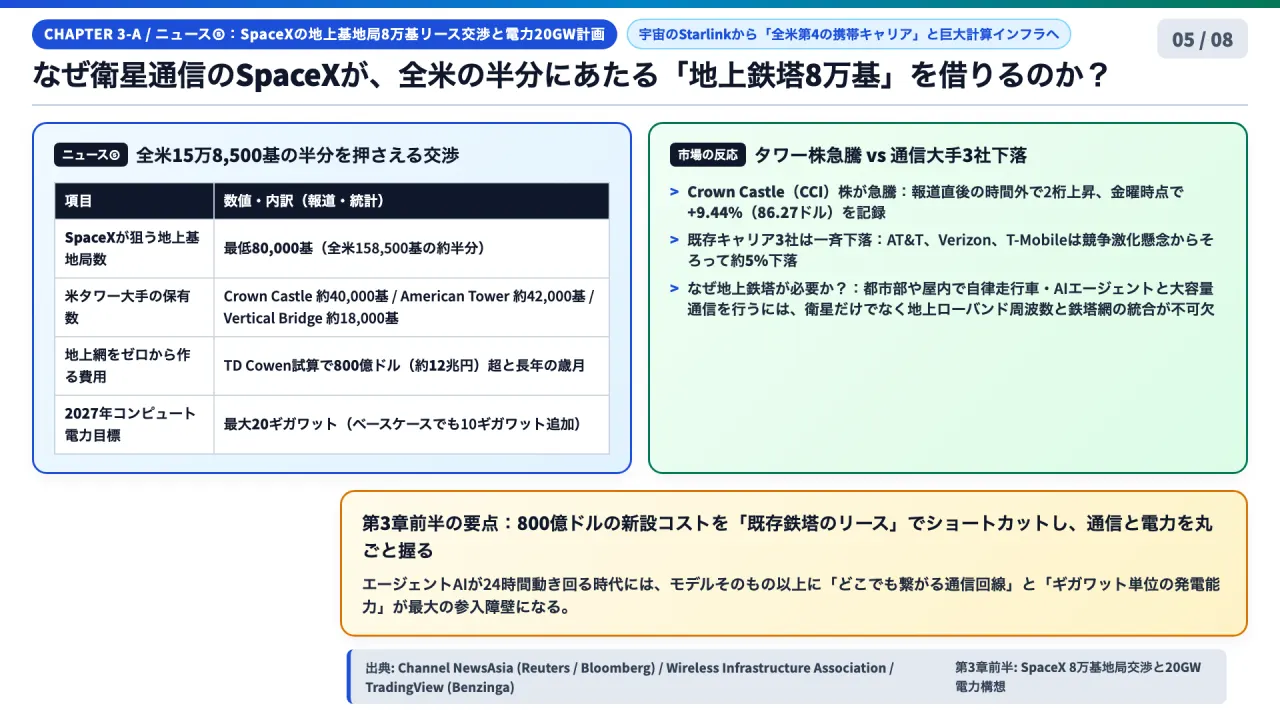
Reports from Channel NewsAsia and Reuters confirmed that SpaceX initiated direct negotiations with major wireless infrastructure trusts to lease space across at least 80,000 terrestrial cellular tower sites. Across the United States, 158,500 towers operate today; SpaceX’s target portfolio represents 50.5 percent of the national inventory. With Crown Castle (CCI) holding roughly 40,000 towers, American Tower (AMT) holding 42,000 sites, and Vertical Bridge holding 18,000 towers, SpaceX must aggregate capacity across the entire domestic sector.
Why Starlink Needs Ground Towers: The Urban Physics Wall
While satellite-to-cell links provide expansive outdoor coverage, high-frequency spaceborne signals cannot penetrate modern concrete and glass in metropolitan environments. Dense mobile traffic demands localized microcells. Furthermore, TD Cowen estimates that building a nationwide greenfield terrestrial cellular network requires over $80 billion and nearly a decade in zoning and construction approvals. Leasing existing vertical real estate enables SpaceX to deploy base stations across nationwide spectrum overnight. Concurrently, Mizuho reported that Musk’s operating ventures established a formal target to secure 10 gigawatts of dedicated compute power by 2027, with an ultimate ambition of 20 gigawatts ── equivalent to the output of 10 to 20 commercial nuclear reactors.
Equity markets reacted immediately: Crown Castle shares jumped 9.44 percent to $86.27, while incumbent carriers AT&T, Verizon, and T-Mobile each fell approximately 5 percent, reflecting the sudden emergence of a vertically integrated fourth national competitor.
5. Positioning and Valuation: Modernizing GPS and Kalshi Compute Futures
The final puzzle pieces unite spatial navigation with the financialization of GPU cycles.
News 6: Xona Space Systems Secures $250M to Supersede Legacy GPS
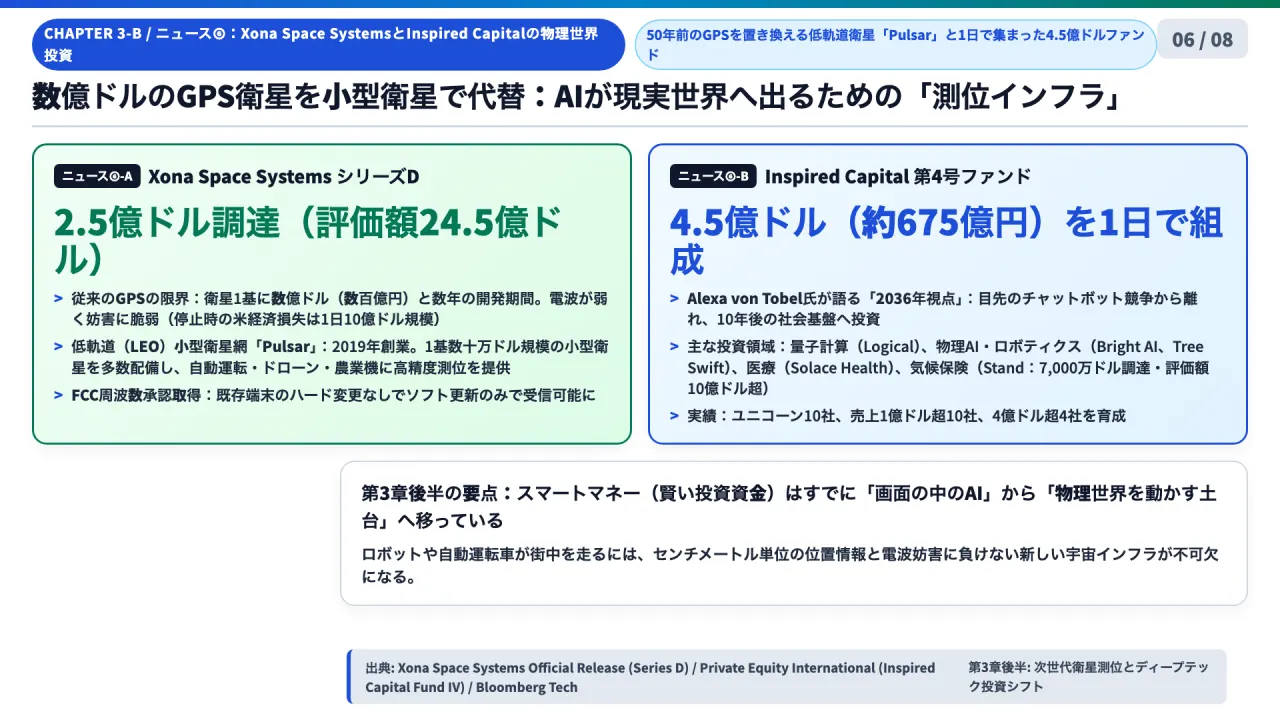
Bloomberg Technology interviewed Brian Manning, CEO of Xona Space Systems, following the closing of a $250 million Series D round at a $2.45 billion valuation. Manning contrasted 50-year-old GPS architecture with modern low-Earth-orbit satellite networks. Legacy GPS satellites operate at 20,000 kilometers altitude; signal strength at ground level is exceptionally faint, vulnerable to electronic jamming, and exhibits multi-meter drift. Complete GPS failure would impose estimated U.S. economic losses of $1.0 billion per day. In contrast, Xona’s Pulsar constellation deploys mass-produced small satellites in low Earth orbit, delivering encrypted, centimeter-level precision. Crucially, the FCC-approved signals can be decoded by commercial smartphones and autonomous vehicles via software and firmware updates without altering physical receiver silicon. Concurrently, Inspired Capital announced a $450 million single-day close for Fund IV, dedicated to physical foundation technologies: quantum infrastructure, robotics, and climate insurance modeling.
News 7: Kalshi Launches GPU Forward Curves: “Compute Is the New Oil”
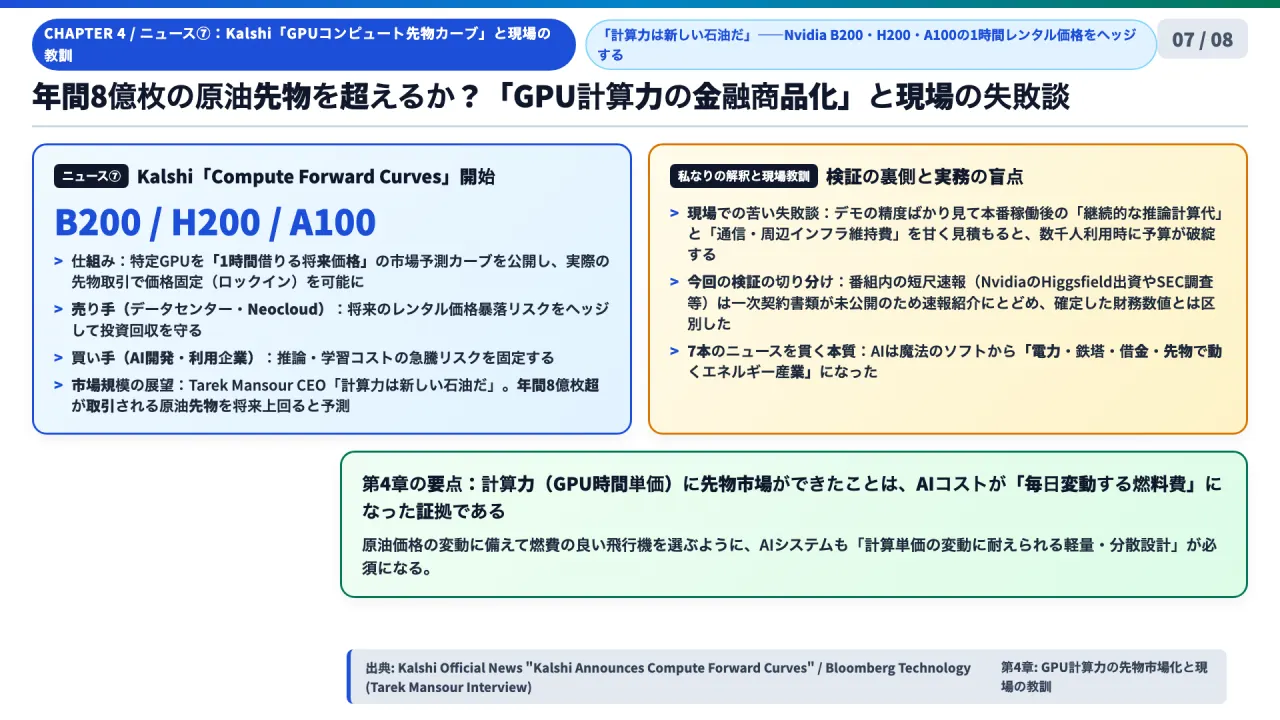
The transition of artificial intelligence from software to physical infrastructure culminated with Kalshi’s formal rollout of Compute Forward Curves, regulated by the Commodity Futures Trading Commission (CFTC). Kalshi established real-time forward pricing curves for NVIDIA B200, H200, and A100 GPU hourly rental contracts. As CEO Tarek Mansour declared: “Compute is the new oil. Like every commodity before it, it needs a real derivatives market.” Mirroring global crude oil futures (over 800 million contracts annually), compute forward markets create structural stability: neoclouds that borrowed billions to buy B200 clusters can lock in future rental revenues to service debt, while enterprises deploying autonomous agents can lock in compute costs to prevent margin erosion.
6. Enterprise Strategy: Three Governance Takeaways
Understanding this infrastructure shift provides clear operational principles for technology executives, engineers, and enterprise buyers.

- Audit Vendor Financial Backbones Over Headline Valuations: When selecting AI vendors, evaluate operational viability rather than private funding marks. Inquire whether their compute capacity relies on fragile SPV debt, verify their gross margins on compute resale, and maintain strict data-layer decoupling to execute a complete provider migration within three business days if vendor pricing collapses.
- Validate Physical Telecom, Power, and Precision Limits Prior to Field Deployment: For industrial AI across factories, fleets, or edge devices, verify physical real-world limits before deploying software. Factor in urban RF attenuation, evaluate device battery constraints, and assess vulnerability to GPS drift in contested environments.
- Model Inference as an Operative Energy Cost: Treat API and GPU consumption as variable fuel expenditures rather than static software licensing. Incorporate compute forward pricing curves into corporate budgeting, conduct sensitivity stress-tests against 2x inference price increases, and implement dynamic routing layers that divert routine workflows to lightweight, cost-effective models.
The recalibration of OpenAI’s valuation and the rise of GPU derivatives do not signal the demise of artificial intelligence. Instead, they confirm its maturity: the industry has permanently graduated from software demos into the capital-intensive world of physical infrastructure, energy allocation, and commodity finance.
Primary Sources and References
- Bloomberg Technology — “OpenAI Moves Toward a $1.25 Trillion Value” (Full Broadcast)
- FinanceFeeds — “OpenAI Seeks $30 Billion Funding Round at $1.25 Trillion Valuation”
- TokenPost — “Anthropic’s $965 Billion Mark Puts Iconiq Stake at $17 Billion”
- WeRSM — “Anthropic’s Expected IPO Shows How Quickly AI Valuations Have Created Billions”
- Taipei Times / Bloomberg — “SK Hynix cancels IPO of Solidigm unit”
- Channel NewsAsia / Reuters — “SpaceX seeks access to 80,000 US cell sites for wireless network, Bloomberg News reports”
- TradingView / Benzinga — “Crown Castle Stock Jumps as SpaceX Targets 80,000 Sites”
- Xona Space Systems Official News — “What Comes After GPS: Our $250M Series D”
- Private Equity International — “Inspired Capital holds quick close on $450m for Fund IV”
- Kalshi Official News — “Kalshi Announces Compute Forward Curves, Becoming the Exchange for the AI Economy”