Why Defense AI Abandons General-Purpose Humanoids for a 5% Edge ── Palmer Luckey on Edge Autonomy, Deterministic Control, and Self-Funded R&D
In electronic warfare environments where communication links vanish, mission-critical systems discard probabilistic LLMs and humanoid robotics in favor of deterministic edge compute and task-optimized SWaP-C hardware.
Published: October 25, 2026 | Read time: ~10 min | Watch Video (Japanese)
Executive Summary: The Limits of Universal AI in Contested Domains
A prevailing assumption in the technology sector claims that massive foundation models and general-purpose humanoid robots will soon replace specialized physical machinery across all commercial and defense workflows. Yet in contested operational environments where radio frequency links are severed, environmental latency destroys centralized control, and a 5 percent performance deficit causes total mission failure, this premise collapses.
Palmer Luckey, who founded Oculus at age 19, sold it to Facebook for $2.0 billion in 2014, and founded defense contractor Anduril Industries in 2017, outlined a sharp engineering counter-thesis during an interview with Peter Diamandis: in contested environments, communication is merely an optional convenience; sensor fusion and navigation must execute deterministically at the edge; and wherever physical survival hinges on a 5 percent margin, task-optimized hardware governed by SWaP-C (Size, Weight, Power, and Cost) constraints systematically defeats general-purpose humanoid platforms.
Cross-referencing Luckey’s statements with primary sources ── including Anduril’s Lattice platform specifications, Dive-LD autonomous underwater vehicle documentation, Department of Defense Directive 3000.09 (Autonomy in Weapon Systems), and Government Accountability Office (GAO) audits ── clarifies the operational boundaries separating generative AI from deterministic edge control.

1. Calorie Economics and the Breakdown of Centralized Cloud Control
Luckey framed autonomous engineering through the history of agricultural mechanization. A century ago, most human labor was dedicated to farming. Through specialized machines ── tractors, automated combines, and precision irrigation ── the cost of caloric survival plummeted.
Under the U.S. federal minimum wage of $7.25 per hour, purchasing bulk commodities (flour, rice, cornmeal, oil) yields roughly 28,000 kilocalories ── enough energy to sustain an adult for 14 days at 2,000 calories per day ── with less than one hour of labor. Purpose-built mechanization permanently depresses marginal survival costs.

Applying this automation to defense and disaster containment exposes two fatal vulnerabilities in commercial cloud-centric architectures:
- Electronic Warfare (EW) and Atmospheric Attenuation: GPS signals, satellite uplinks, and wireless tactical data links are prime targets for noise jamming and spoofing. In dense wildfires, smoke particulate, thermal updrafts, and terrain scatter microwave frequencies. If an unmanned aerial vehicle (UAV) depends on persistent cloud API round-trips, localized jamming grounds the fleet.
- Single Points of Failure (SPOF) and Reaction Delays: In centralized setups, severing a single communications relay disables all peripheral nodes. In the $11 million XPRIZE Wildfire competition (co-sponsored by Lockheed Martin), autonomous systems must detect and extinguish incipient wildland fires within 10 minutes. Waiting over 60 minutes for centralized satellite image analysis allows fires to expand beyond physical containment.
The engineering mandate is absolute: communication links are transient luxuries; edge devices must ingest local sensors and execute decisions fully disconnected.
2. Fifty Years of Autonomous Interceptors and Why LLMs Cannot Fly Missiles
Public apprehension often frames autonomous kinetic systems as an unvetted future risk. In truth, fully autonomous engagement architectures have protected military assets for half a century:
- U.S. Navy Aegis Combat System (
Auto-SpecialMode): Deployed since the late 1970s, Aegis includes automated doctrine modes that execute intercept missile launches against incoming supersonic anti-ship missiles without manual intervention. - Mk 15 Phalanx Close-In Weapon System (CIWS): Operational since 1980, Phalanx combines search and tracking radar with a 20mm Gatling cannon, firing up to 4,500 rounds per minute within seconds of inbound projectile detection. Human biological latency cannot track Mach 2 targets.
- Anti-Radiation Missiles (AGM-45 Shrike): Deployed during the Vietnam War, these munitions used onboard passive seekers to home in on enemy radar emitters autonomously.
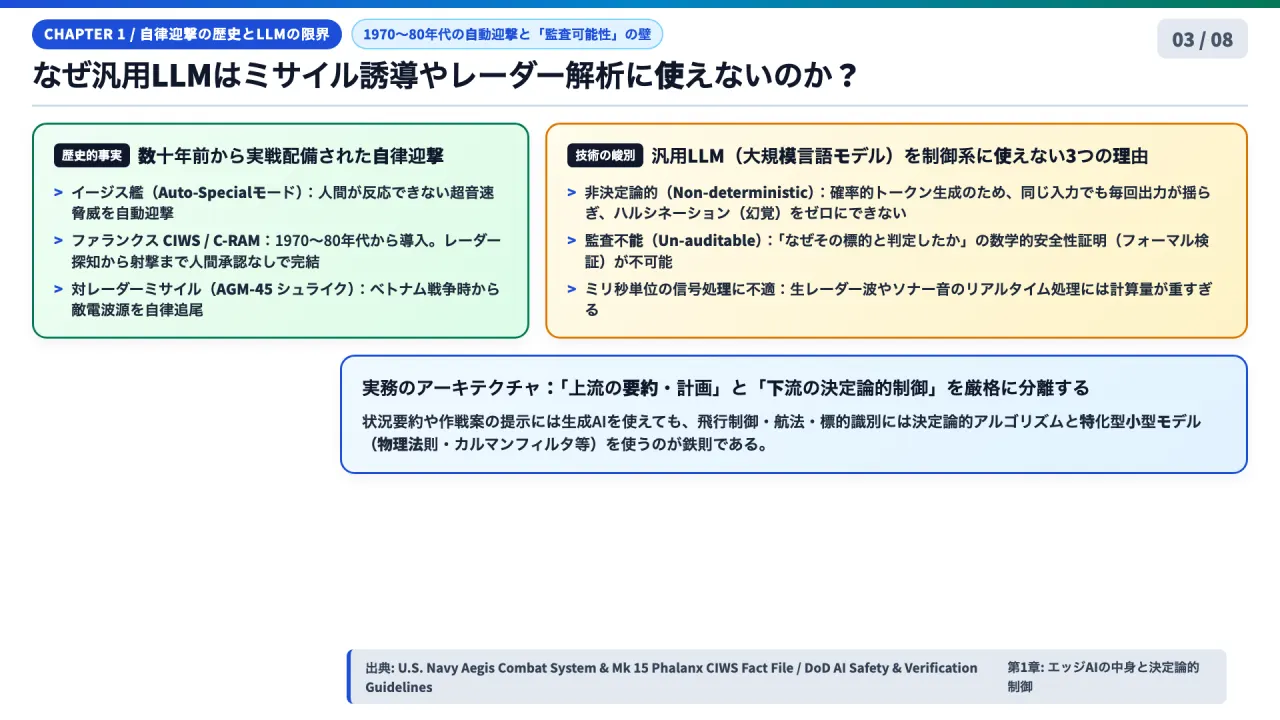
Three Engineering Barriers Barring Generative LLMs from Edge Loops
Foundation LLMs cannot govern physical interceptors or radar signal processing due to three technical barriers:
- Non-Deterministic Sampling: Autoregressive token generation introduces probabilistic variance, making identical inputs produce divergent outputs in safety-critical control loops.
- Un-Auditable Logic Under Regulatory Mandates: DoD Directive 3000.09 (Autonomy in Weapon Systems, updated in 2023) mandates verifiable, deterministic system bounds. Billions of black-box neural network parameters cannot be formally verified under mathematical control theory.
- Microsecond Signal Processing Latency: Processing phased-array radar or passive sonar requires microsecond-level latency. Deterministic state estimators, extended Kalman filters (EKF), and tiny convolutional networks run on low-power edge silicon far more efficiently than LLMs.
Anduril’s Lattice platform strictly decouples these layers: natural language models assist human operator briefing, while real-time track fusion, target classification, and aerodynamic guidance run on auditable, deterministic edge code.
3. Humanoids vs. Specialized Robotics: The 5% Performance Penalty
While robotics ventures pour billions into bipedal humanoid prototypes, Luckey established why they fail in extreme physical and defense domains.
The divergence centers on how performance margins dictate unit economics:
- Commercial Domains (Scale Absorbs 5% Penalties): In factories and warehouses built for human bodies, a humanoid that runs 5 percent slower than a custom gantry arm remains economically viable. Mass-producing millions of standardized humanoids drives component costs down, making general-purpose units cost-effective.
- Contested Domains (5% Deficit Triggers 100% Destruction): At 30,000 feet or at ocean depths of 6,000 meters, human architecture does not exist. An airframe that flies 5 percent slower or turns 5 percent wider suffers 100 percent destruction in combat. Under SWaP-C constraints, legs and hands add dead weight and drag. Anduril’s Dive-LD autonomous underwater vehicle uses a 3D-printed hydrodynamic shell engineered specifically for deep-sea endurance at 6,000 meters depth (nearly 9,000 psi).

| Dimension | Commercial Indoor Domains | Contested Defense & Extreme Environments |
|---|---|---|
| Physical Context | Built exclusively for human ergonomics | Governed strictly by fluid dynamics, hydrostatic pressure, and physics |
| 5% Deficit Impact | Negligible; absorbed by operational scale | Absolute; results in 100% loss of platform and mission |
| Dominant Factor | Mass-production economies of scale | Extreme SWaP-C optimization and hydrodynamic efficiency |
| Form Factor | Bipedal humanoids with articulating hands | Hydrodynamic AUVs, delta-wing UAVs, specialized turrets |
The Retrofit Exception: Humanoids as Mechanical Drivers
The primary military role for commercial humanoids is retrofitting legacy machinery. Militaries hold trillions of dollars in aging trucks, armored vehicles, and radar consoles lacking digital APIs. Rather than spending trillions on new fleets, operators can procure commodity humanoids to physically actuate steering wheels, hydraulic levers, and pedals, automating legacy assets without mechanical redesign.
4. Business Model Inversion: Self-Funded R&D vs. Cost-Plus Contracts
Anduril’s rapid growth stems from breaking traditional procurement mechanics.
Historically, the Pentagon relied on Cost-Plus contracts where the government reimburses contractor expenses plus a fixed profit margin (typically 6 to 10 percent). This model rewards inefficiency: longer development cycles and ballooning budgets yield higher absolute profits for legacy defense primes.

Anduril inverted this via Self-Funded R&D and Commercial Fixed-Price Sales. The company invests venture capital to engineer and flight-test operational hardware (Ghost UAV, Altius munitions, Roadrunner interceptors) before offering them at fixed prices for off-the-shelf delivery. This compresses acquisition from decades into months while keeping core IP (Lattice) in-house.
Hardware Rigor: From Oculus Santa Cruz to Carmack’s Pragmatism
Luckey’s design philosophy originated at Oculus. In October 2016, Luckey showcased the Santa Cruz prototype, placing the battery and compute on the rear head strap to counterbalance the front display. The commercial Oculus Quest later placed all components in the front enclosure to simplify assembly, resulting in an ergonomic front-heavy strain.
Luckey drew equal inspiration from programmer John Carmack, co-founder of id Software and former Oculus CTO. In 2000, Carmack founded Armadillo Aerospace, integrating commodity consumer NVIDIA GPUs into vertical takeoff and landing (VTVL) rocket navigation. Carmack demonstrated that consumer hardware refined by commercial markets routinely outperforms overpriced military-grade components ── a principle central to Anduril and Carmack’s current venture, Keen Technologies.
5. Primary Source Fact-Check: Audits, Claims, and Strategic Blindspots
Evaluating Luckey’s discussion against official primary sources reveals critical distinctions, unverified claims, and structural blindspots.

- Audit 1: Defense Prime Market Share: Luckey claimed five primes historically held 80 percent of Pentagon procurement. Following the 1993 “Last Supper” consolidation, 51 suppliers merged into five primes (Lockheed Martin, RTX, Boeing, Northrop Grumman, General Dynamics). However, Government Accountability Office audits (
GAO-24-106831) show the Big Five capture 30 to 35 percent of total DoD contract obligations, and 50 to 60 percent of Major Defense Acquisition Programs (MDAPs). The 80 percent figure applies only to narrow sub-sectors like tactical fighters. - Audit 2: Open-Source AI Origins: Peter Diamandis claimed all top open-source models are Chinese. While Alibaba’s Qwen and DeepSeek are formidable, this assertion is incorrect. Meta Platforms develops and open-source
Llama, powering defense deployments like Scale AI’s Defense Llama. Google’sGemma, AI2’sOLMo, and France’sMistralare also Western open-weight architectures. - Audit 3: Autonomous Weapons vs. Landmines: Luckey equated autonomous weapons to mechanical landmines. International humanitarian law and the International Committee of the Red Cross (
ICRC Position on Autonomous Weapon Systems) refute this equivalence. Static landmines detonate upon physical contact in a fixed area (banned under the 1997 Ottawa Treaty). Lethal autonomous weapons systems (LAWS) actively maneuver through space using computer vision to track targets dynamically. Past radar errors ── including the 1988 USS Vincennes shootdown of Iran Air 655 and 2003 Patriot missile friendly fire ── explain why DoD Directive 3000.09 mandates “appropriate levels of human judgment.”
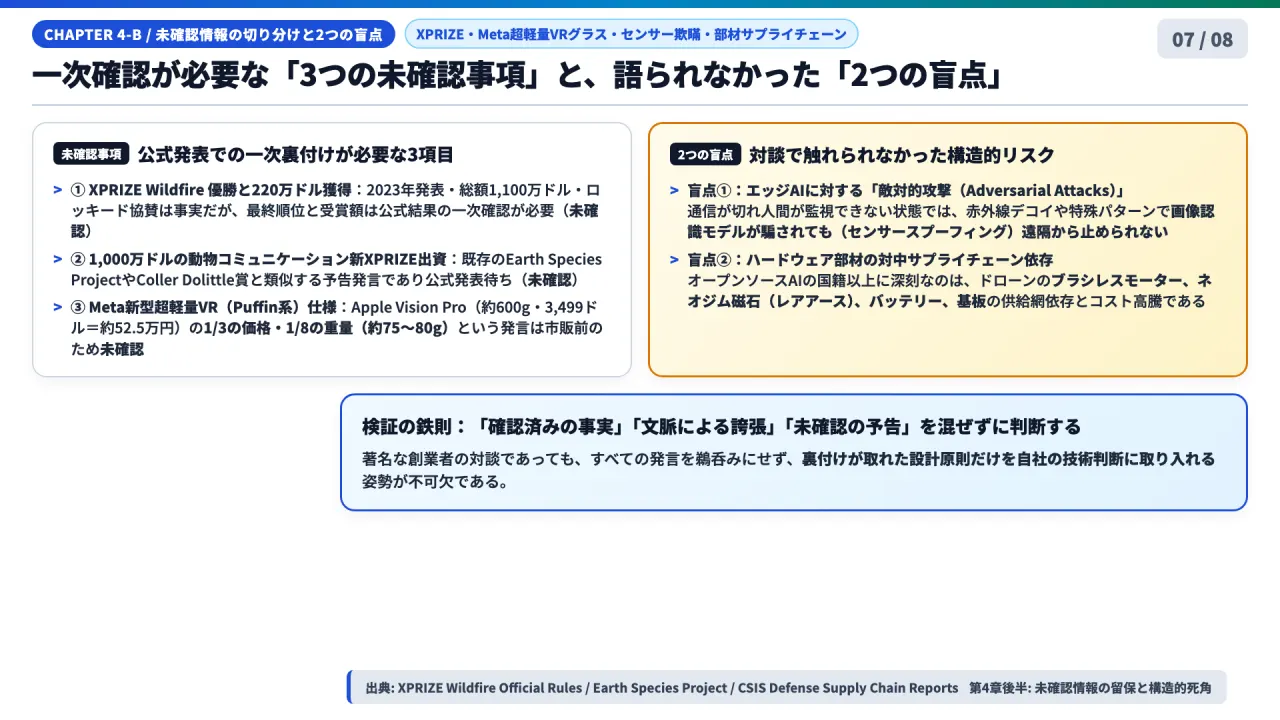
Three Unverified Claims
- XPRIZE Wildfire Victory: While XPRIZE Wildfire features an $11 million purse co-sponsored by Lockheed Martin, Luckey’s claim that his team won and collected $2.2 million remains an informal assertion pending foundation publication.
- $10M Interspecies Communication XPRIZE: Luckey’s intent to finance a $10 million animal communication prize remains a private initiative not yet formalized by XPRIZE press releases.
- Meta Lightweight MR Glasses: Luckey’s claims regarding Meta’s unreleased MR eyewear (code-named Puffin) ── one-third the cost ($1,000) and one-eighth the weight (75 to 80 grams) of Apple Vision Pro ── are unverified prototype claims.
Two Structural Blindspots
- Adversarial Sensor Spoofing at the Edge: Operating edge AI disconnected from networks eliminates remote kill-switches. If adversaries deploy optical or RF spoofing (infrared strobe decoys, geometric camouflage), an offline unit cannot request human intervention, raising severe fratricide risks.
- Hardware Supply Chain Concentration: Small autonomous drones remain heavily dependent on Asian supply chains for neodymium permanent magnets, brushless DC motors, lithium-ion pouch cells, and printed circuit boards. Replacing these with NDAA-compliant domestic components imposes steep cost penalties that constrain low-cost scaling.
6. Strategic Takeaways for Enterprise Edge AI Architecture
The technical principles underpinning Anduril’s systems yield three concrete guidelines for commercial engineers and technology executives:

- Design Offline Autonomous Boundaries First: Never assume uninterrupted cloud access. Resilient edge systems must feature local failsafe routines and degraded operational states that function when network sockets drop.
- Decouple Probabilistic Reasoning from Deterministic Execution: Restrict foundation LLMs to high-level operator synthesis and documentation search. Mission-critical actuation, safety interlocks, and compliance checks must reside on deterministic, auditable code.
- Calibrate Investment by the Cost of a 5% Performance Gap: When a 5 percent performance penalty is tolerable, deploy mass-produced commercial hardware and foundation models to maximize scale. Where a 5 percent deficit causes catastrophic failure, invest in task-optimized hardware, deterministic edge software, or legacy retrofit automation.
Technological progress does not eliminate the necessity of human governance. While automated agents can execute complex coding sequences and optimize tactical kinematics, human leadership remains irreplaceable in three foundational domains: bearing personal legal and operational liability, mediating interpersonal and organizational conflict, and exercising decisive judgment to override algorithmic recommendations when operating models diverge from physical reality.
Primary Sources and References
- Anduril Industries — Lattice Autonomous Command & Control Platform Overview
- Anduril Industries — Dive-LD Autonomous Undersea Vehicle (AUV) Specifications
- U.S. Department of Defense — DoD Directive 3000.09: Autonomy in Weapon Systems (Updated 2023)
- U.S. Government Accountability Office (GAO) — Weapon Systems Annual Assessment (GAO-24-106831)
- U.S. Navy Fact File — Mk 15 Phalanx Close-In Weapons System (CIWS)
- International Committee of the Red Cross (ICRC) — Position on Autonomous Weapon Systems
- XPRIZE Foundation — XPRIZE Wildfire Official Overview
- Earth Species Project — Decoding Non-Human Communication with Artificial Intelligence
- U.S. Department of Labor — Federal Minimum Wage Statutory Framework ($7.25/Hour)
- Meta — Llama Open-Weight Foundation Models Portal
- Oculus Connect 3 (2016) Official Retrospective — Santa Cruz Prototype & Architecture