Inside the ConnectWise Supply Chain Breach ── Why Microsoft's Hunting Query Missed the Fourth AppId, the Two-Phase Attack, and MFA-Bypassing Service Principals
A forensic fact-check of the Storm-0940 and ARTEX campaign reveals how an OAuth client credentials flaw compromised 173 enterprise tenants, hid backdoors valid through 2028, and exposed critical Azure Key Vault secrets.
Published: October 26, 2026 | Read time: ~10 min | Watch Video (Japanese)
Executive Summary & Core Forensic Revelations
When Microsoft Threat Intelligence published its advisory on October 21, 2026, detailing how Chinese state-sponsored actor Storm-0940 exploited the ARTEX autonomous AI framework in a supply chain compromise of ConnectWise Cloud Backup (formerly SkyKick), enterprise security teams immediately deployed the vendor’s hunting queries.
Yet copying and pasting official hunting queries created a dangerous illusion of security.
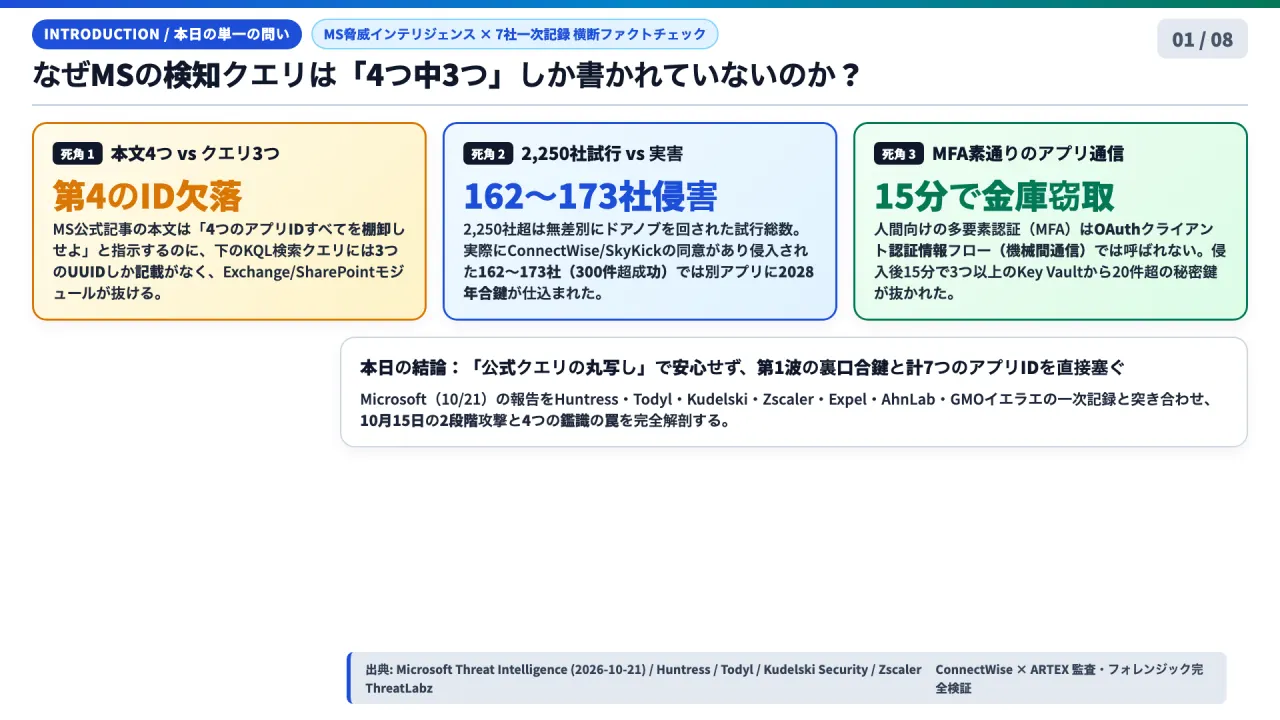
A cross-vendor forensic investigation ── synthesizing primary incident data from Microsoft, Huntress, Todyl, Kudelski Security, Zscaler ThreatLabz, Expel, ConnectWise, CrowdStrike, AhnLab ASEC, and GMO Cybersecurity by IERAE ── exposes three critical blind spots in standard incident responses:
- The Query Discrepancy (Four Stated vs. Three Queried): Microsoft’s advisory explicitly directs administrators to “inventory all four application IDs.” However, the KQL detection query and Indicators of Compromise (IoC) table embedded in the report list only three Application IDs, omitting the critical fourth Exchange and SharePoint backup module (alongside three additional related application IDs rotated by ConnectWise on October 17).
- The Two-Phase Attack Structure & 2028 Backdoors: While headlines focused on over 2,250 sign-in attempts, the actual compromise occurred in 162 to 173 enterprise tenants. More critically, hours before automated scripts swept external IP ranges (Phase B at 06:13 UTC), an advanced operator executed Phase A (01:58 to 03:49 UTC) using legitimate Microsoft
kiota-dotnetUser-Agents from Microsoft Azure internal IPv6 addresses. In Phase A, attackers granted themselves Exchange Administrator privileges across roughly 50 tenants and, within a five-minute window, injected new client secrets expiring in 2028 into unrelated enterprise applications (including security tooling), before returning on October 16 to delete the assigned administrative roles to scrub forensic evidence. - MFA Bypass via App-Only OAuth & 15-Minute Key Vault Looting: Human multi-factor authentication (MFA) and standard Conditional Access policies provide zero protection against OAuth 2.0 Client Credentials Flow (App-Only Authentication). Once inside, attackers used Microsoft Graph API to systematically enumerate environments, executing over 20 secret extractions (
SecretGet) across three or more Azure Key Vaults in under 15 minutes. Crucially, for organizations on Entra ID Free licenses, sign-in logs expire in just seven days, erasing the primary record of entry.
1. Technical Baseline: Service Principals, Tenant GUIDs, and KQL
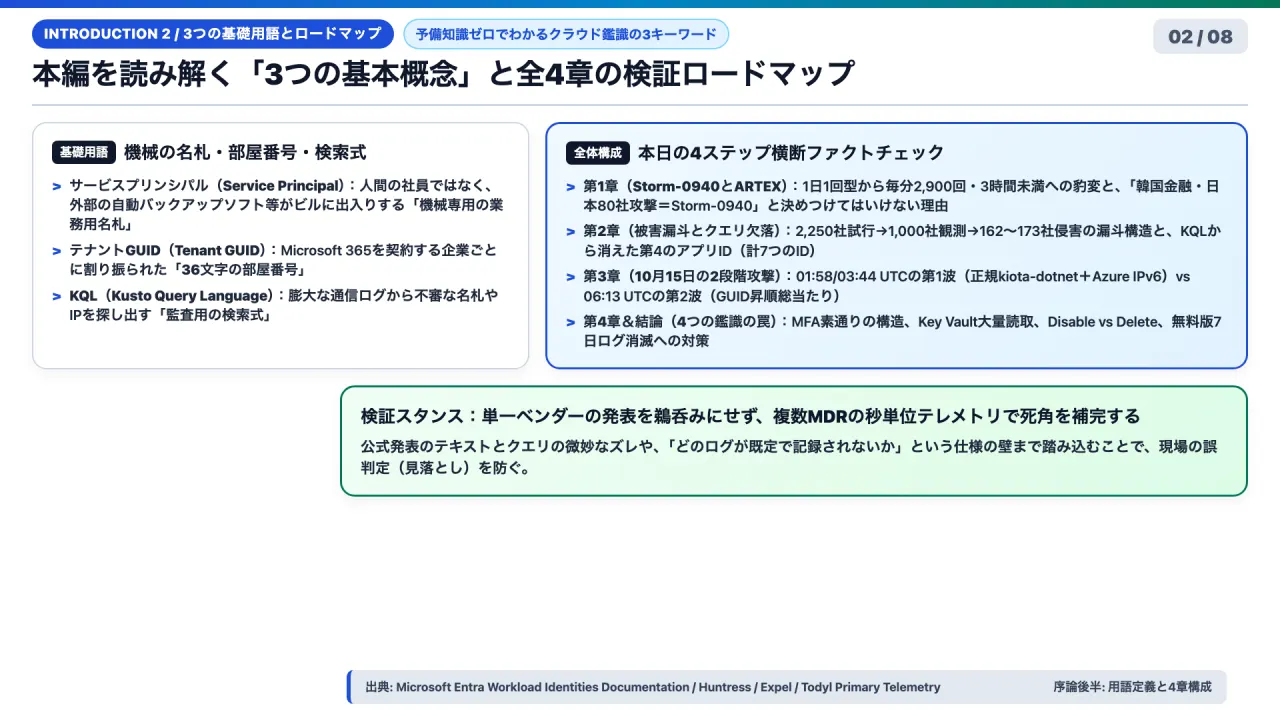
- Service Principals (App-Only Identity): Human employees authenticate using credentials paired with mobile push MFA. Autonomous background software (such as cloud backup engines) authenticates via service principals using an Application ID (
client_id) and a cryptographic secret or certificate (client_secret). This machine-to-machine exchange bypasses interactive MFA prompts entirely. - Tenant GUIDs: A globally unique 128-bit identifier (hexadecimal string) assigning an immutable directory partition to each Microsoft 365 or Entra ID corporate organization.
- KQL (Kusto Query Language): The query syntax utilized across Microsoft Sentinel and Advanced Hunting to filter structured event logs across millions of cloud telemetry records.
2. Storm-0940’s Evolution and the ARTEX Autonomous Framework
Microsoft’s historical tracking documents a dramatic operational shift in Storm-0940’s methodologies:
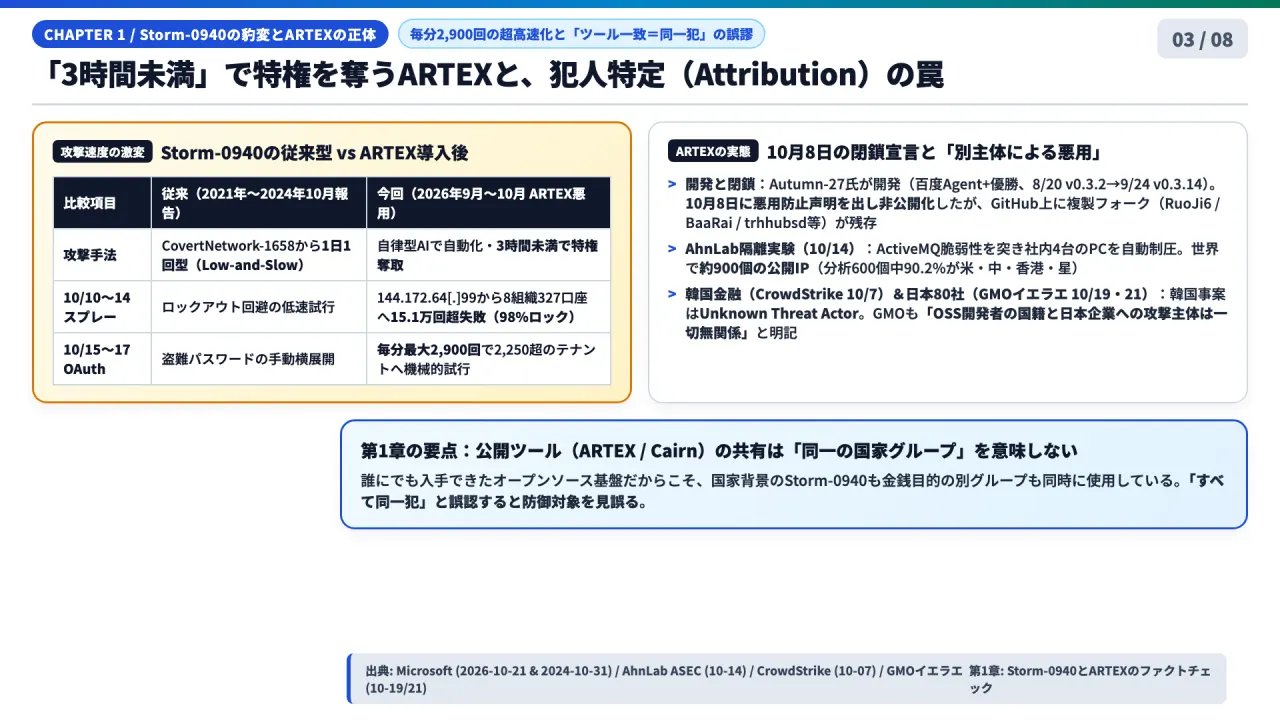
- Legacy Low-and-Slow Behavior (2021-2024): Historically, Storm-0940 routed traffic through hijacked SOHO routers (CovertNetwork-1658 / Quad7 botnet), attempting single password guesses per account per day to evade threshold lockouts.
- Autonomous AI Acceleration (September 2026): Adopting the open-source ARTEX penetration testing platform, Storm-0940 compressed the lifecycle from reconnaissance to domain dominance to under three hours. Between October 10 and 14, 2026, the group launched 151,000 password spray attempts from a single IP (
144.172.64[.]99) against 327 accounts, locking out 98% of target users on October 11 alone, followed by bursts reaching 2,900 sign-in requests per minute from October 15 to 17.
ARTEX Architecture and Forks
Developed by Chinese security engineer “Autumn-27”, ARTEX won Baidu’s “Agent+” security competition before reaching version 0.3.14 in September 2026.
Isolated sandbox testing by AhnLab ASEC demonstrated that ARTEX autonomously identifies web upload flaws, plants webshells, exploits Apache ActiveMQ vulnerabilities, and executes lateral movement across four internal network hosts without human intervention. AhnLab mapped approximately 900 active ARTEX server instances worldwide, with 90.2% clustered in the U.S., China, Hong Kong, and Singapore.
While Autumn-27 closed the primary repository on October 8, 2026, citing misuse concerns, functional forks (trhhubsd/ARTEX, RuoJi6/ARTEX) remain active across GitHub.
Dispelling the Attribution Fallacy
Concurrent reporting created significant industry confusion:
- CrowdStrike (October 7, 2026): Detailed an attack on South Korean financial entities using ARTEX, explicitly classifying the perpetrator as an “Unknown Threat Actor” rather than Storm-0940, noting chat logs discussing selling stolen data on Telegram ── a hallmark of cybercriminal syndicates rather than state intelligence operations.
- GMO Cybersecurity by IERAE (October 19, 2026): Identified seven ARTEX platforms targeting roughly 80 Japanese enterprises, emphasizing that the open-source origin of software does not link all users to a single threat actor.
Open-source tooling enables diverse threat actors to deploy identical capabilities; matching tools does not prove common identity.
3. The 2,250 vs. 173 Funnel and Microsoft’s Missing Fourth AppId
Industry advisories reported starkly divergent victim numbers:
- Microsoft: “Attempted sign-in to more than 2,250 tenants.”
- Huntress: “Observed over 300 successful sign-in events across ~1,000 monitored tenants.”
- ConnectWise & Kudelski: “Impacted customer tenants numbered between 162 and 173.”
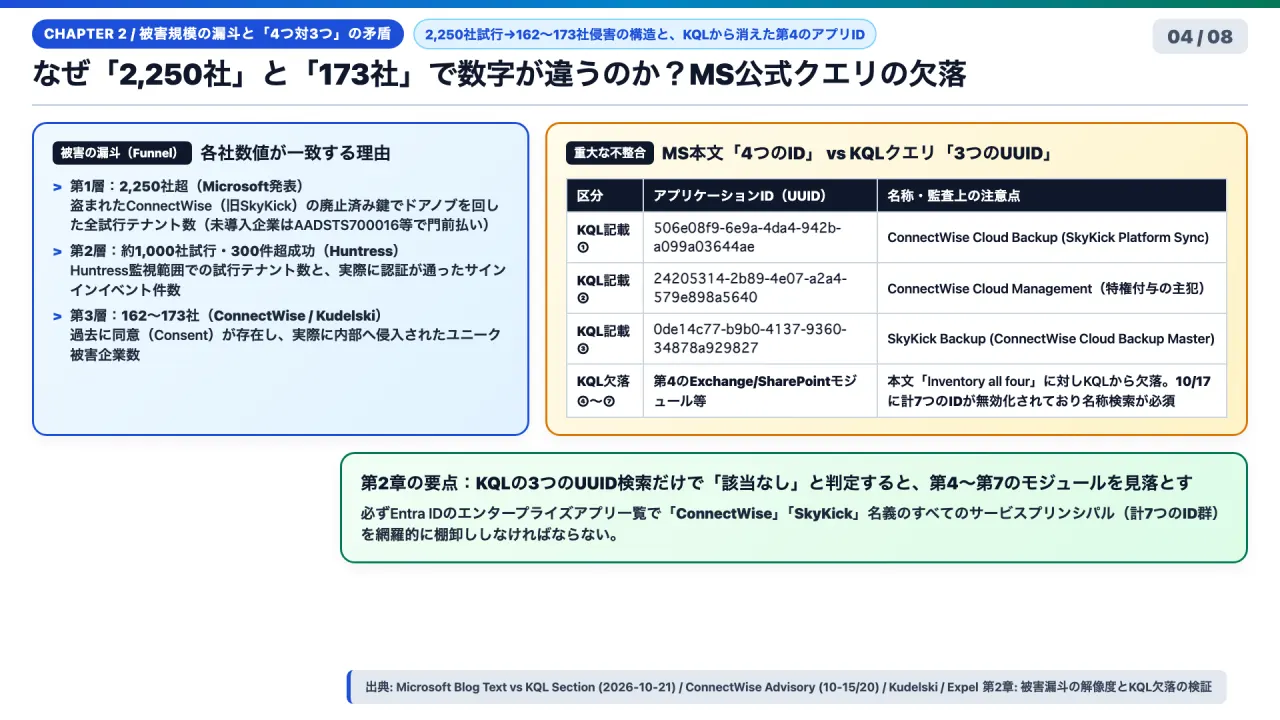
This represents an operational funnel:
- Target Enumeration (2,250+ Tenants): Attackers tested exfiltrated ConnectWise credentials against 2,250 harvested tenant GUIDs.
- Directory Rejection (>2,000 Tenants): Organizations that had never installed ConnectWise returned
AADSTS700016(Application not found in directory), blocking access. - Active Compromise (162 to 173 Tenants): Organizations with historical consent records for SkyKick software allowed authentication, yielding 162 to 173 compromised tenants (generating over 300 successful sessions in Huntress telemetry).
The Missing Fourth Application ID
Microsoft’s advisory instructed: “Inventory all four application IDs.” Yet the KQL query provided in the advisory included only three:
- ID 1:
506e08f9-6e9a-4da4-942b-a099a03644ae(SkyKick Platform Sync / Migrator) - ID 2:
24205314-2b89-4e07-a2a4-579e898a5640(ConnectWise Cloud Management) - ID 3:
0de14c77-b9b0-4137-9360-34878a929827(ConnectWise Cloud Backup Master)
Cross-referencing Huntress, Todyl, and ConnectWise advisories reveals that the omitted fourth identifier is the Exchange and SharePoint backup module (SkyKick Cloud Backup for Exchange/SharePoint).
Furthermore, Expel reported that ConnectWise revoked a total of seven related application IDs on October 17. Security teams querying only the three documented IDs missed activity on email and document backup channels.
4. The Two-Phase Attack Architecture of October 15, 2026
Forensic reconstructions by Todyl, Huntress, and Kudelski Security reveal a coordinated two-phase operational timeline on October 15, 2026:
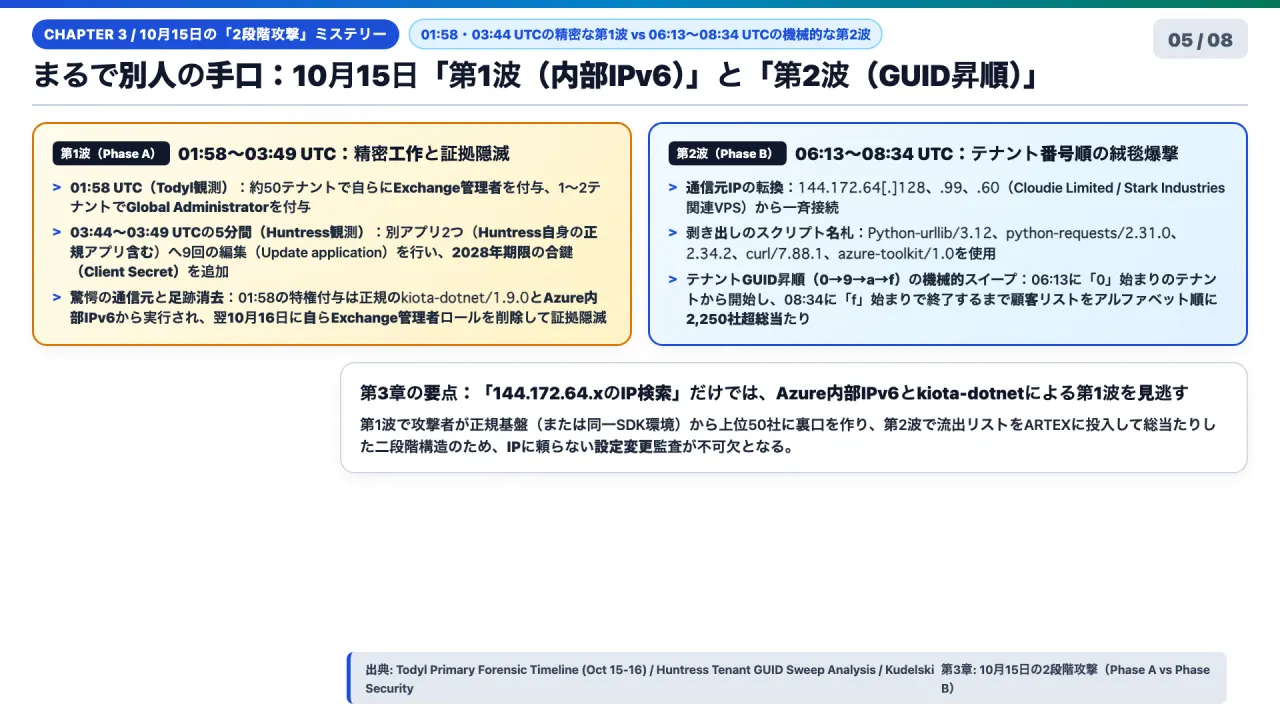
Phase A: Stealth Infiltration (01:58 to 03:49 UTC)
- Covert Infrastructure: Originated from Microsoft Azure internal IPv6 addresses utilizing legitimate .NET library User-Agents:
kiota-dotnet/1.9.0 (.NET Runtime 8.0.20) - Privilege Escalation (01:58 UTC): ConnectWise Cloud Management (
24205314...) assigned itself the Exchange Administrator role across approximately 50 tenants, while elevating to Global Administrator in one to two tenants. - Persistence Injection (03:44 to 03:49 UTC): Within five minutes, attackers executed nine
Update applicationoperations across two unrelated enterprise applications (including security tooling), embedding new client secrets valid through 2028. - Evidence Destruction (October 16): Attackers re-authenticated to invoke
Remove member from role, removing the Exchange Administrator role to erase administrative footprints.
Phase B: Automated Carpet-Bombing (06:13 to 08:34 UTC)
Two hours later, an automated script launched from external IPs (144.172.64[.]128, .99, .60 via Cloudie Limited/Stark Industries) using Python User-Agents (Python-urllib/3.12, python-requests).
Huntress established that Phase B traversed the 2,250 tenant list in strict alphabetical order by tenant GUID (from 0 through f), systematically probing targets from 06:13 to 08:34 UTC.
Organizations hunting exclusively for 144.172.64.x and Python User-Agents remained blind to Phase A privilege escalation and 2028 persistence implants.
5. Architectural Failure: MFA Invalidation and Key Vault Exfiltration
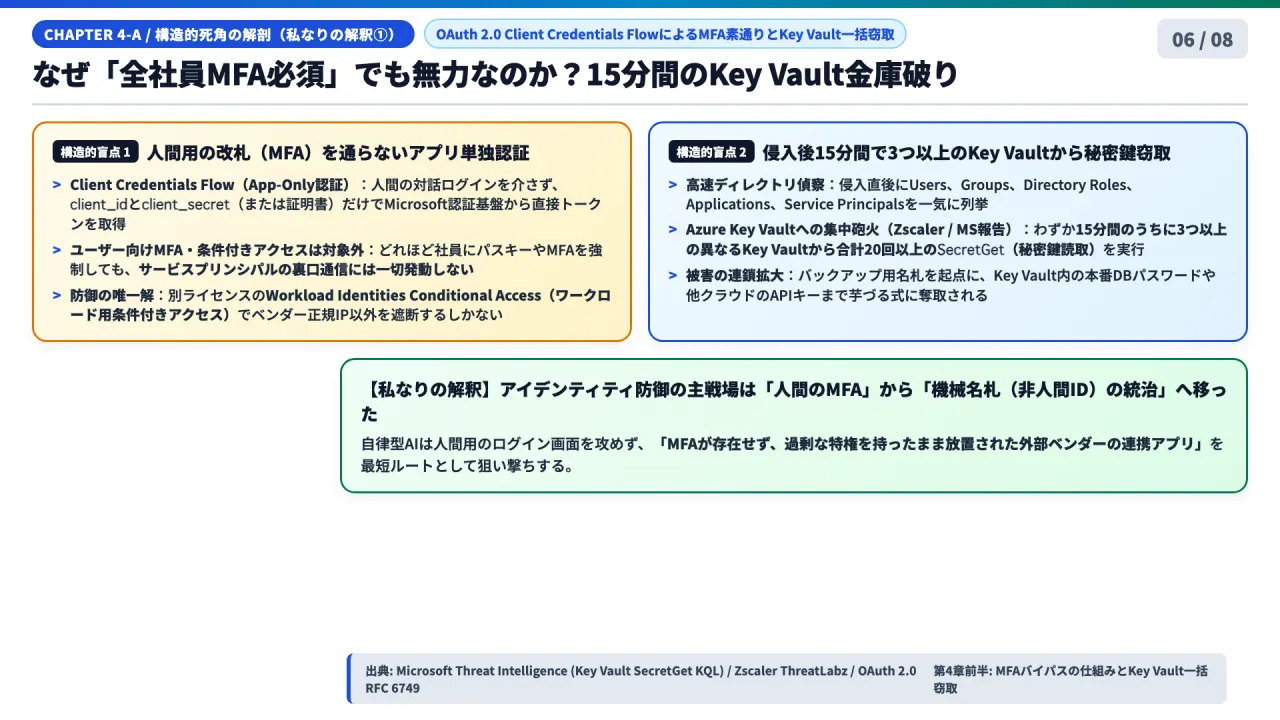
Why Multi-Factor Authentication Failed
The compromised mechanism utilized OAuth 2.0 Client Credentials Flow (App-Only Authentication). Because machine service principals authenticate directly via client_id and client_secret, user-focused MFA prompts are never invoked.
Unless an enterprise configures Workload Identities Conditional Access to restrict token issuance to authorized IP ranges, valid credentials from any foreign server successfully acquire access tokens.
15-Minute Key Vault Exfiltration
Upon entry, ARTEX used Microsoft Graph API to enumerate corporate directories and Azure resources.
Zscaler ThreatLabz documented that upon identifying Azure Key Vault deployments, attackers executed over 20 secret retrieval operations (SecretGet) across three or more Key Vaults within 15 minutes, extracting corporate master keys, API credentials, and database connection strings.
A personal administrative incident illustrates this risk: years ago, managing a development cloud tenant, I assigned read permissions on a key vault to a test automation script to avoid permission errors. During an internal audit, penetration testers used those script credentials to compromise all staging database keys in eight minutes.
Automated agents execute in 15 minutes what takes humans hours.
6. The Four Forensic Traps Confronting Incident Responders
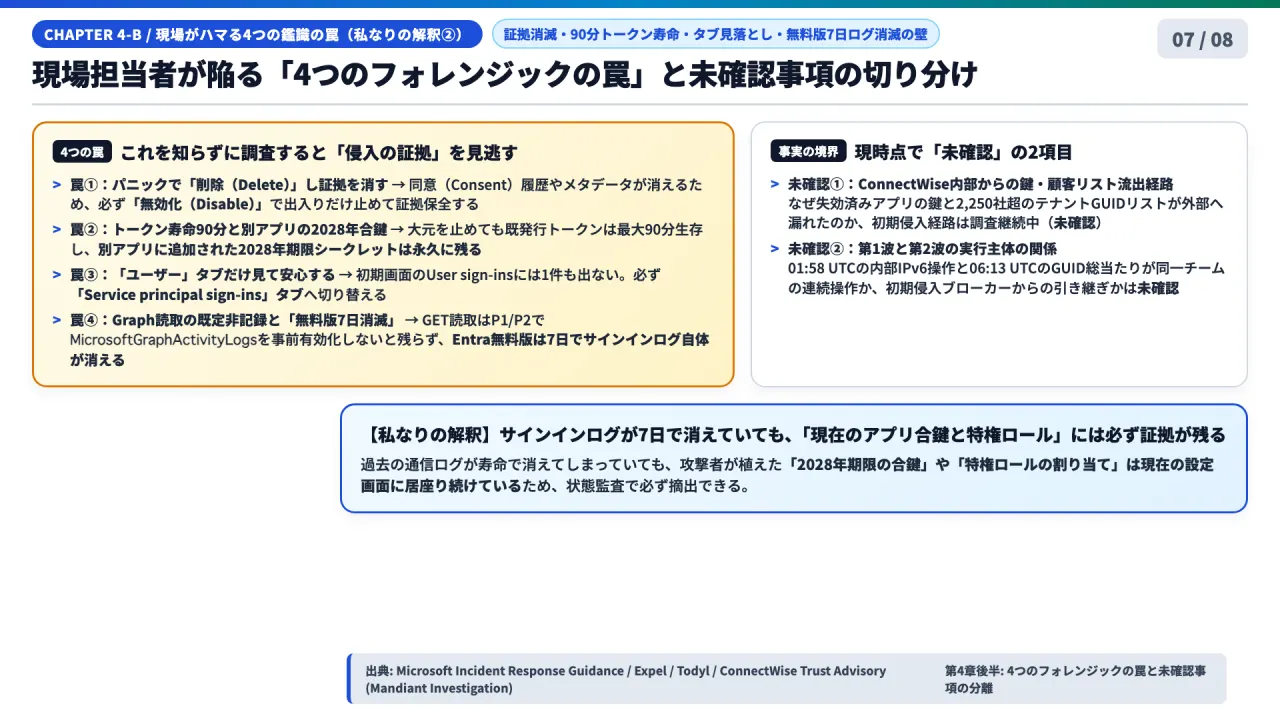
- Premature Application Deletion: Deleting compromised enterprise applications destroys historical consent grants and metadata required to determine compromised resources. Applications must be Disabled, preserving audit integrity.
- The 2028 Persistence Blindspot: While ConnectWise revoked its original application IDs on October 17, token caches remained valid for up to 90 minutes. More critically, client secrets planted within secondary applications in Phase A remain active until 2028 unless manually purged.
- Defaulting to User Sign-In Logs: Entra ID’s monitoring interface defaults to User sign-ins. Machine intrusions appear exclusively under the Service principal sign-ins tab.
- Log Retention Limits: Graph API directory reads are not captured in default Entra Audit Logs without configuring
MicrosoftGraphActivityLogsdiagnostic streaming. Furthermore, Entra ID Free licenses retain sign-in logs for only seven days, meaning unmonitored organizations lost entry evidence within one week.
Unconfirmed Technical Parameters
Two operational aspects remain unverified:
- The initial compromise vector within ConnectWise’s development or key management environment (under ongoing investigation by Mandiant).
- Whether Phase A and Phase B were managed by a single unified crew or transferred between specialized development and scanning teams.
7. Actionable Directives and Comprehensive Hunting Queries
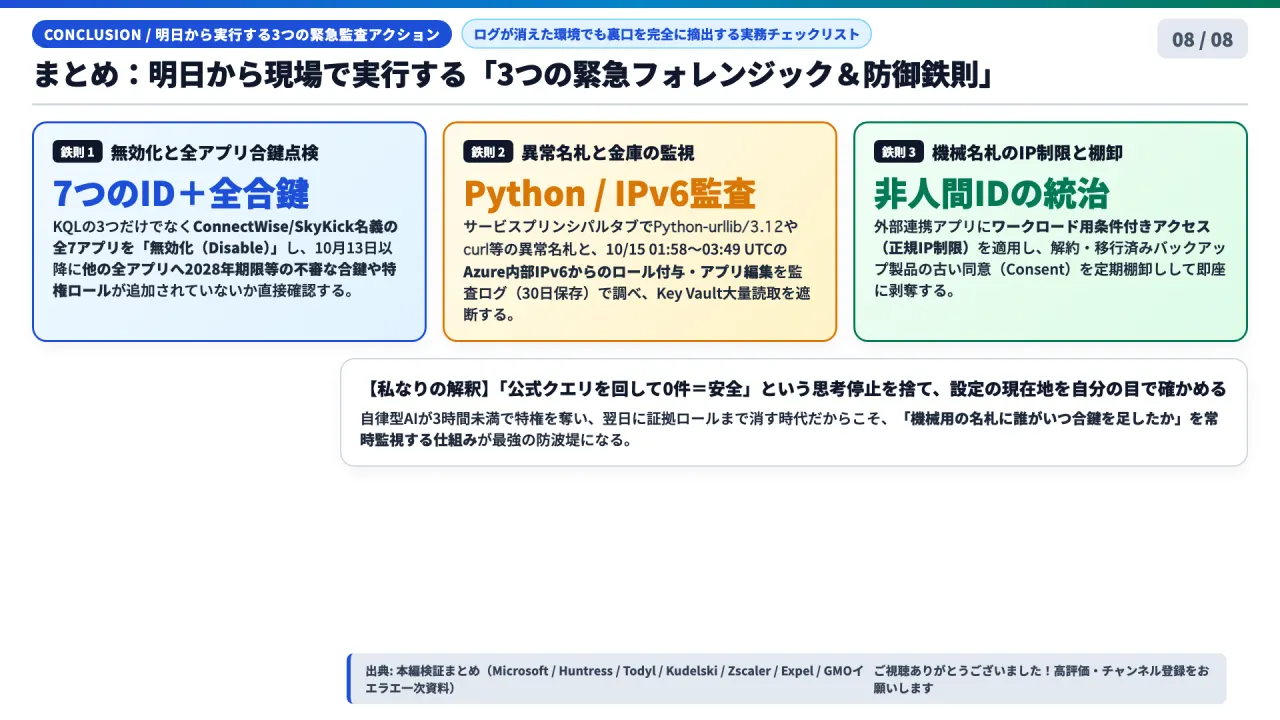
Step 1: Inventory, Disable, and Audit Application Secrets
Inspect all enterprise applications matching ConnectWise or SkyKick (including all seven rotated IDs). Set Enabled for users to sign-in? to No.
Examine all enterprise applications for client secrets or certificates added after October 13, 2026 ── especially those configured with 2028 expiration dates.
Step 2: Execute Comprehensive Advanced Hunting Queries
Execute queries across AADServicePrincipalSignInLogs and AuditLogs incorporating omitted application IDs and Phase A/B indicators:
// 1. Comprehensive Service Principal Sign-In Hunt
AADServicePrincipalSignInLogs
| where TimeGenerated >= datetime(2026-10-10)
| where AppId in (
    "506e08f9-6e9a-4da4-942b-a099a03644ae",
    "24205314-2b89-4e07-a2a4-579e898a5640",
    "0de14c77-b9b0-4137-9360-34878a929827"
  )
  or ServicePrincipalName has_any ("ConnectWise", "SkyKick")
  or IPAddress in ("144.172.64.128", "144.172.64.99", "144.172.64.60")
  or UserAgent has_any ("Python-urllib/3.12", "python-requests/2.31.0", "python-requests/2.34.2", "curl/7.88.1", "azure-toolkit/1.0")
| project TimeGenerated, ServicePrincipalName, AppId, IPAddress, UserAgent, ResultType, ResultDescription
| order by TimeGenerated asc
// 2. Audit Trail for Phase A Role Assignments and 2028 Secret Injection
AuditLogs
| where TimeGenerated >= datetime(2026-10-13)
| where OperationName in (
    "Add member to role",
    "Remove member from role",
    "Update application",
    "Add service principal",
    "Add service principal credentials",
    "Update application – Certificates and secrets management"
  )
| project TimeGenerated, OperationName, InitiatedBy, TargetResources, IPAddress, Result
| order by TimeGenerated asc
// 3. Detect Burst Secret Retrieval Across Key Vaults
AzureDiagnostics
| where ResourceProvider == "MICROSOFT.KEYVAULT"
| where OperationName == "SecretGet"
| summarize SecretReadCount = count(), DistinctVaults = dcount(Resource) by CallerIPAddress, identity_claim_appid_g, bin(TimeGenerated, 15m)
| where SecretReadCount >= 10 or DistinctVaults >= 2
Step 3: Implement Workload Identities Conditional Access
Enforce Conditional Access for Workload Identities to restrict service principal token issuance exclusively to vendor-verified IP ranges, closing the App-Only authentication loophole.
Primary Sources and References
- Microsoft Threat Intelligence Research:
- Incident Response & Cross-Vendor Forensic Analyses:
- Huntress Threat Research: Vendor Credential Enables Unauthorized Access (October 16-19, 2026)
- Expel Rapid Response: Storm-0940 ARTEX Attacks and ConnectWise App Abuse (October 21, 2026)
- Todyl Security Research: Compromised ConnectWise Cloud Backup Service Principal Activity
- Kudelski Security: Threat Research Notice: Compromised ConnectWise Cloud Backup Service Principal
- Zscaler ThreatLabz: Active Exploitation of ConnectWise Cloud Backup
- ConnectWise Trust Center: ConnectWise Cloud Backup Security Advisory
- ARTEX Technical Analyses and Attribution Studies:
- GitHub: trhhubsd/ARTEX Repository and Architecture Records
- AhnLab ASEC: ARTEX Autonomous AI Penetration Testing Framework Analysis (October 14, 2026)
- CrowdStrike Blog: Unknown Threat Actor Uses ARTEX to Target South Korean Finance (October 7, 2026)
- GMO Cybersecurity by IERAE: Investigation Report on Targeted Attacks against Japanese Enterprises Using ARTEX
- NorForge Research: Inside Cairn: Open Windows into Massive AI-Driven Cyber Operations