Why Blackstone Multiplied Its $10B Data Center Bet by 15x ── Inside the $165B AI Physical Infrastructure Empire, $2B-per-GW Profits, and the Private Credit Software Shakeout
As annual generative AI inference hours quadruple and video generation demands 10,000x more compute, Blackstone is locking power, cooling, and data centers while its flagship credit fund faces a 5% redemption gate on legacy SaaS debt.
Published: October 26, 2026 | Read time: ~10 min | Watch Video (Japanese)
Executive Summary & Core Capital Realities
In the nineteenth-century California gold rush, the most consistent wealth was created by merchants selling picks, denim, and staging land. In modern artificial intelligence, that infrastructure provider is Blackstone, commanding $1.3 trillion to $1.4 trillion in AUM across 12,500 real estate assets and 250 portfolio companies.
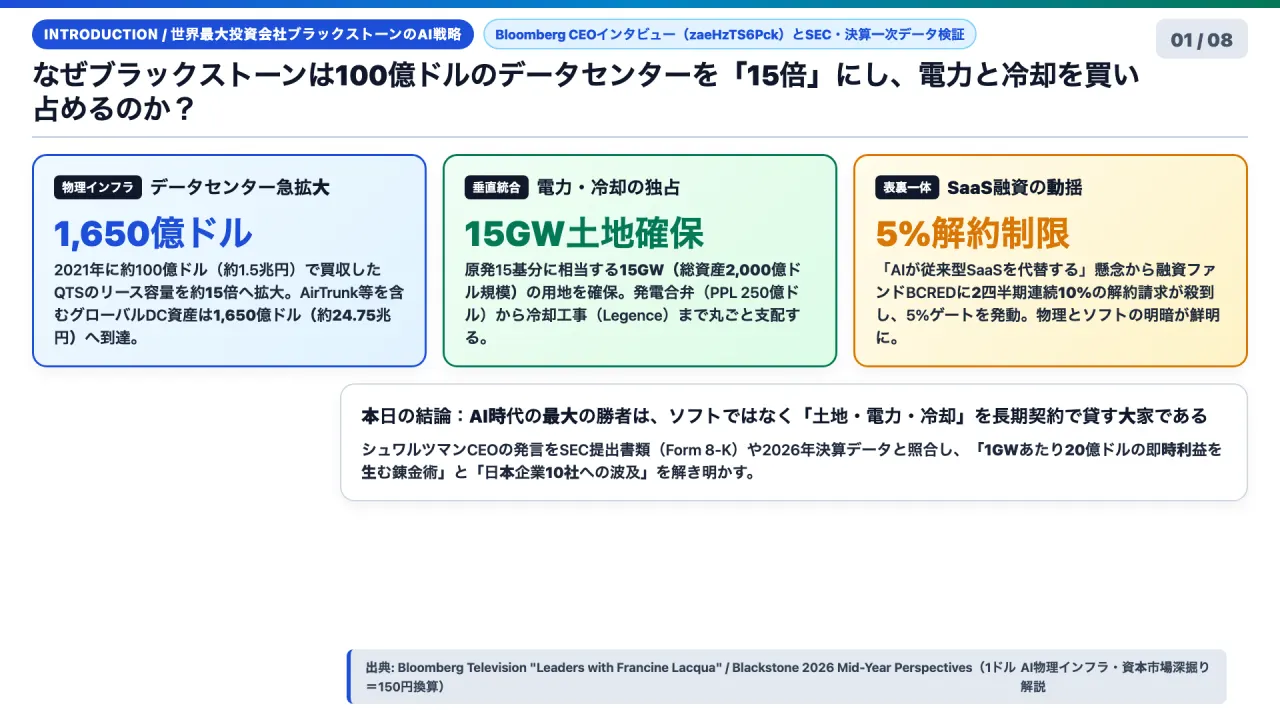
On Bloomberg Television’s Leaders with Francine Lacqua, Blackstone CEO Stephen Schwarzman detailed how QTS Realty Trust, acquired for $10 billion in 2021, expanded 15-fold into the world’s preeminent data center operator.
Yet Lacqua pressed Schwarzman on a paradox: while data centers boom, Blackstone’s flagship private credit vehicle, BCRED ($79B to $82B AUM), activated a 5% quarterly redemption gate after investors requested 10.0% capital redemptions in consecutive quarters, fearing generative AI will destabilize debt-burdened SaaS companies.
Cross-referencing SEC filings (Form 10-K and Form 8-K), Blackstone’s 2026 reports, and BCRED disclosures reveals the structural drivers:
- The 1GW Development Equation: Building a 1-gigawatt AI data center requires $2 billion to $3 billion in CapEx. When pre-leased under 15 to 20-year contracts to hyperscalers with an average market capitalization of $2.5 trillion, the net present value (NPV) of contracted cash flows reaches $4 billion to $5 billion, yielding ~$2 billion in immediate development profit per gigawatt. Across a 15-gigawatt development pipeline, Blackstone holds roughly $30 billion in embedded value creation.
- Vertical Integration M&A: With utility queues facing five to ten-year interconnect backlogs, Blackstone deployed capital across utility joint ventures (PPL), AI factory campuses (Lancium with NVIDIA), liquid cooling engineering (Legence), and AAA-rated asset-backed securitizations (Green ABS and Project Odyssey).
- The Software Credit Bifurcation: While data platforms like Databricks expand, legacy SaaS providers face structural pressure. Thoma Bravo’s $6.4 billion acquisition of Medallia defaulted on $3.0 billion in private debt, forcing sponsors to surrender 100% equity ownership to lenders, including BCRED.
1. Technical Baseline: Hyperscalers, Unit Economics, and Redemption Gates
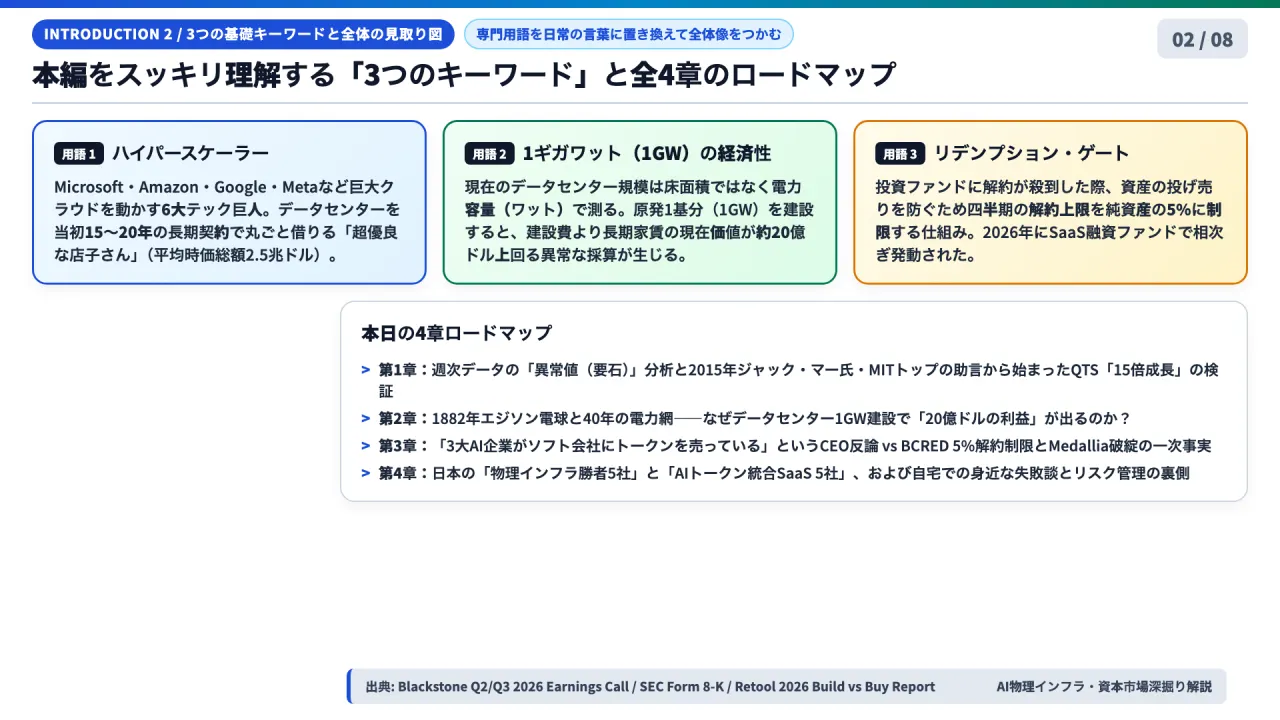
- Hyperscaler Credit Quality: Primary tenants ── Microsoft, Amazon, Google, Meta, Oracle, and Apple. Across Blackstone’s data centers, 96% of tenants are investment grade with an average market capitalization of $2.5 trillion, converting speculative AI model demand into long-term commercial leases.
- Unit Economics per Gigawatt (1GW): One gigawatt represents 1,000 megawatts ── equivalent to a commercial nuclear reactor. Because electrical interconnects, high-voltage transformers, and permits are scarce, data center valuation is measured in contracted megawatts rather than square footage. Securing energized land creates substantial immediate asset premiums.
- Redemption Gates in Semi-Liquid Credit Funds: Non-traded business development companies (BDCs) aggregate capital to originate private corporate loans. To prevent forced asset fire sales, fund charters limit quarterly investor redemptions to 5.0% of net asset value (NAV). When requests exceed this threshold, the fund limits payouts, rationing liquidity.
2. From $10B REIT to $165B Empire: The Transformation of QTS
In his interview, Schwarzman outlined how Blackstone identifies foundational market inflections:
“Every Monday, we review hundreds of thousands of operational data points across our portfolio. I look for anomalies ── things that do not make sense within existing patterns. Those anomalies are the keystones indicating structural shifts in the global economy.”
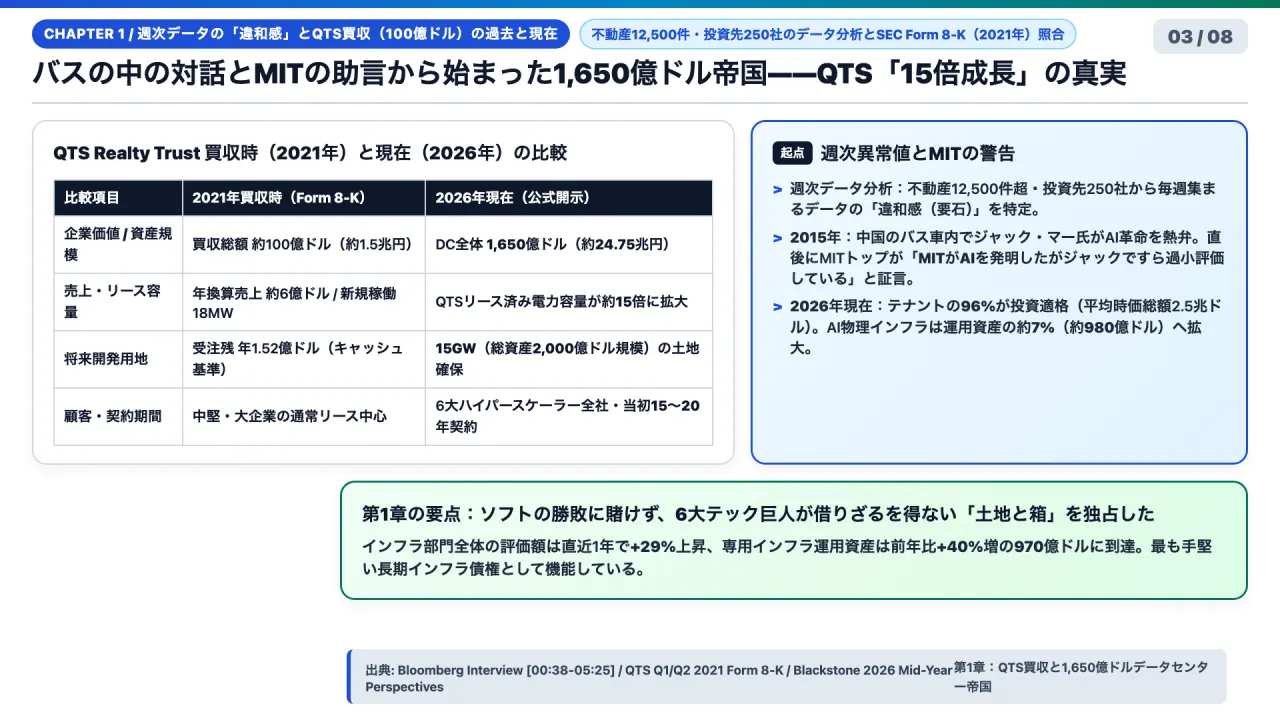
Schwarzman’s awareness of AI infrastructure dates to 2015, following discussions with Alibaba founder Jack Ma and MIT leadership. This prompted Blackstone to acquire QTS Realty Trust in 2021 for approximately $10 billion.
Comparing QTS SEC filings (Form 10-K for 2020 and Form 8-K for Q1 2021) against Blackstone’s 2026 disclosures confirms the scale of this expansion:
| Operating Dimension | Q1 2021 Acquisition Baseline (SEC Filings) | 2026 Operating Scale (Blackstone Disclosures) |
|---|---|---|
| Enterprise Value | ~$10.0 Billion (Acquisition valuation) | $165.0 Billion (Global operating & contracted platform) |
| Quarterly Revenue | $148.7 Million (~$600M annual run-rate) | Core driver of infrastructure earnings and recurring fees |
| Quarterly Capacity Added | 18 Megawatts (MW) across 7 metro markets | Multi-gigawatt concurrent campus construction programs |
| Leased Power Capacity | Baseline commercial leasing volume | ~15x Expansion in contracted leased capacity |
| Contracted Lease Backlog | $152.3 Million in annual cash rent | 15 Gigawatts (15,000 MW) in future development pipeline |
| Tenant Quality & Tenor | 5 to 10-year standard commercial leases | 15 to 20-year fixed leases; 96% investment-grade tenants |
| Blackstone Infrastructure Share | <1.0% of total firm AUM | ~7.0% of firm AUM ($98B); fastest growing segment |
Schwarzman’s statement that QTS expanded 15-fold aligns with operational data: leased power capacity expanded roughly 15 times, while overall platform value grew 16.5-fold.
3. Edison’s 1882 Analogy and the $2B-per-GW Development Margin
Addressing concerns regarding hyperscaler CapEx ($769 billion in 2026, climbing toward $1.0T-$1.3T in 2027), Schwarzman cited an 1882 analogy:
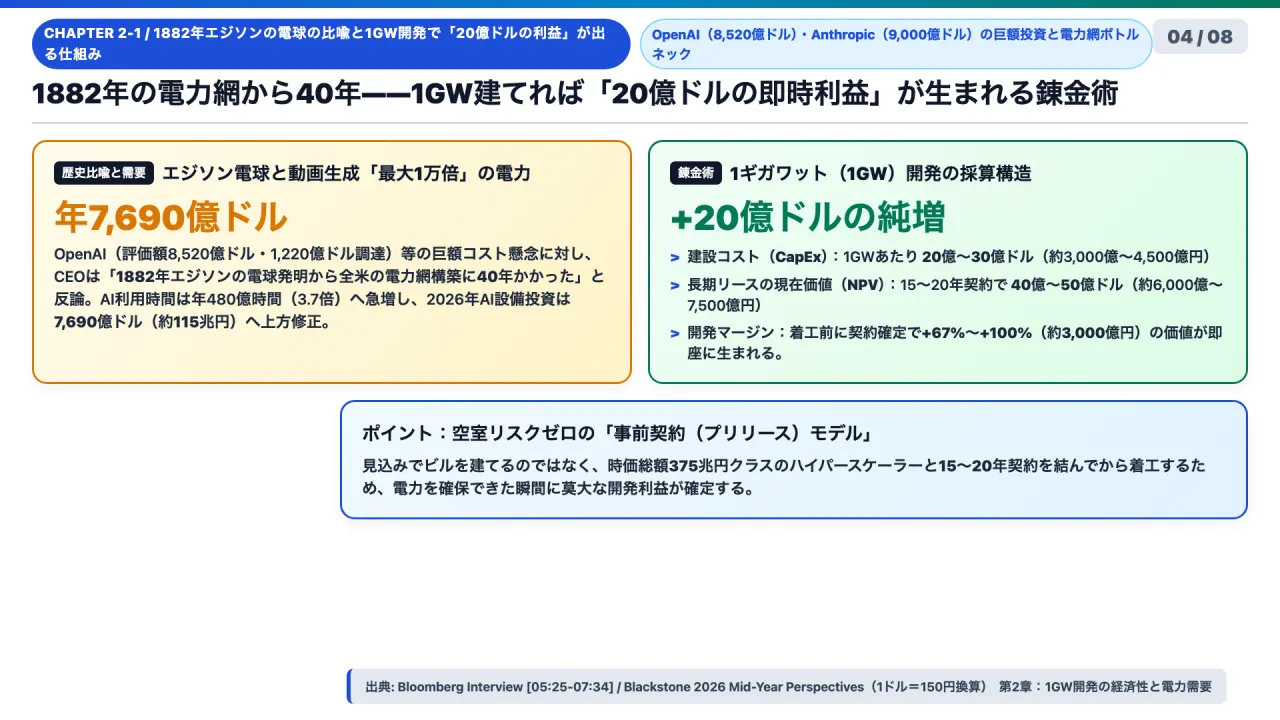
“When Edison patented the light bulb in 1882, the bulb was useless without an electrical grid. Constructing power plants and transmission lines required forty years. In 1882, nobody envisioned that this grid would power radio, television, or computers. AI stands at that same initial threshold.”
U.S. data center power consumption has reached 122 watts per capita (42 GW nationally) versus ~21 watts in Europe. Generative AI usage surged from 13 billion hours in 2024 to 48 billion hours in 2025 (3.7x), with video generation demanding up to 10,000x more compute than web search.
This demand generates compelling unit economics:
- Construction CapEx (1GW): Building a 1GW campus costs $2.0B to $3.0B.
- Contracted Asset NPV: Executing a 15 to 20-year fixed lease yields an NPV of $4.0B to $5.0B.
- Value Uplift: Locks in $2.0 billion in development gain per gigawatt (+67% to +100%) before operations begin.
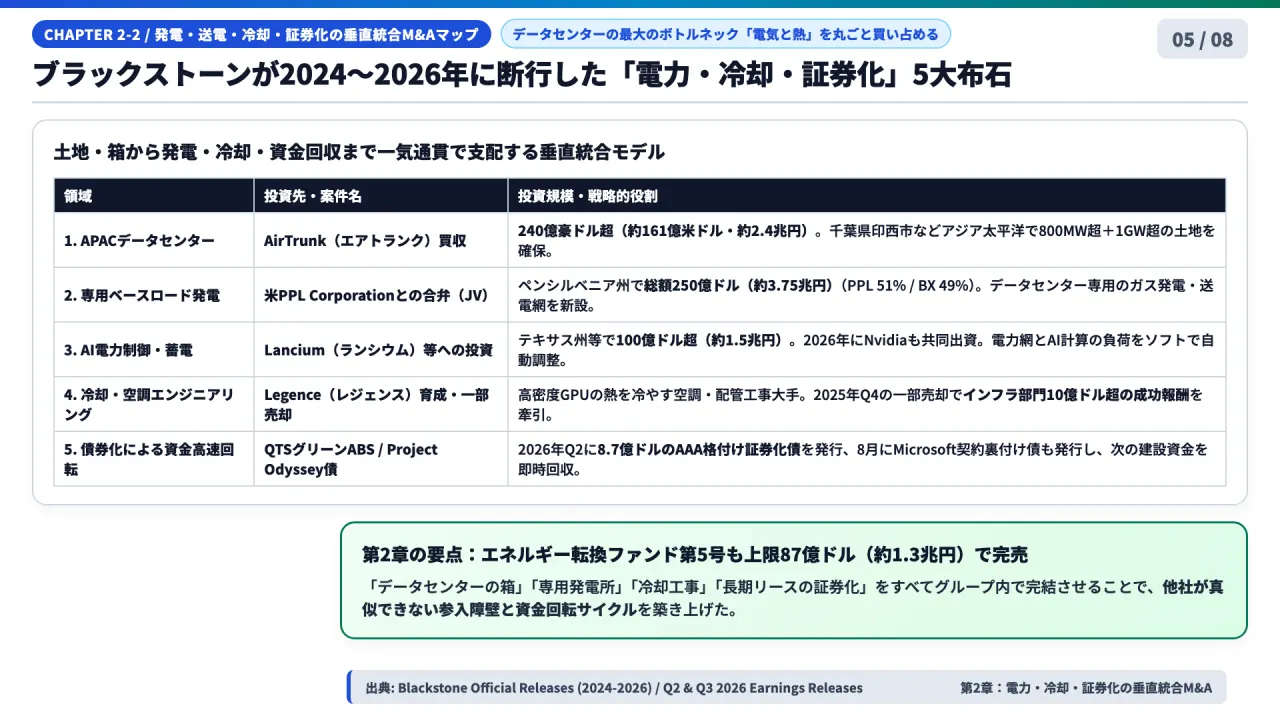
To capture this value, Blackstone executed five strategic investments:
- AirTrunk Acquisition (A$24B+ / ~$16.1B USD): Acquired the APAC data center platform in December 2024, securing campuses in Australia, Singapore, Hong Kong, and Inzai, Japan (TOK1/TOK2), backed by over A$16B in sustainable financing.
- PPL Utility Joint Venture ($25 Billion): Formed a partnership with PPL Corporation to build dedicated gas-fired power generation and transmission, bypassing grid queues.
- Lancium AI Factory ($10B+ with NVIDIA): Invested over $10B in Texas clean-energy campuses with software co-developed with NVIDIA to dynamically balance grid loads and maximize compute per megawatt.
- Legence Thermal Engineering: Scaled liquid cooling contractor Legence, generating over $1.0B in performance fees in Q4 2025 alongside closing Energy Transition Partners IV at its $8.7B hard cap.
- AAA Securitization (Green ABS & Project Odyssey): Securitized operational lease contracts into AAA-rated paper, including QTS’s $870M Green ABS and the Project Odyssey Microsoft-backed issuance, recycling balance-sheet capital into new builds.
4. The Software Debt Confrontation: CEO Defense vs. BCRED Reality
During the interview, Lacqua questioned the health of the $1.8 trillion private credit market:
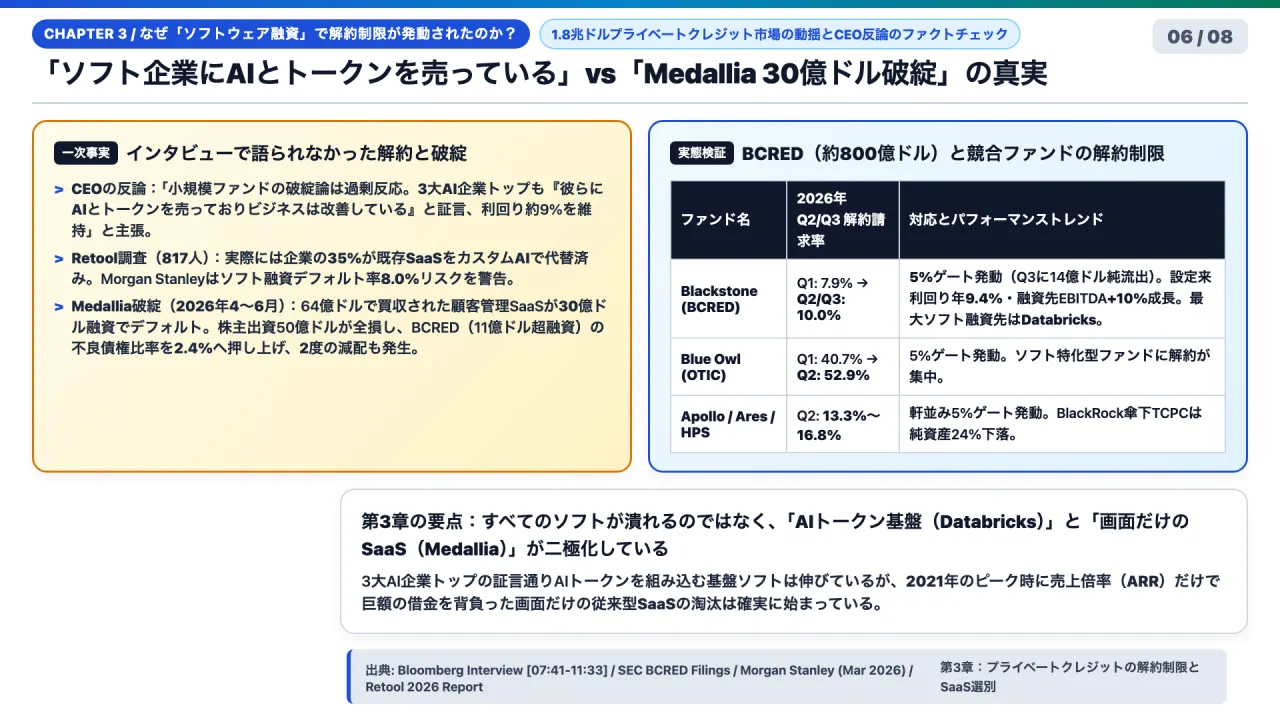
“In your flagship direct lending fund, investors requested significant withdrawals, prompting the activation of a 5% redemption gate. Are software companies facing obsolescence from AI?”
Schwarzman mounted a firm defense:
- Dismissed market distress as an overreaction to speculative research predicting widespread SaaS insolvency.
- Cited a discussion with the CEO of a top-three AI lab: “We sell AI models and tokens to those software companies; their businesses are improving.”
- Maintained that default rates remain low while portfolio yields exceed 9%.
Auditing the SEC Disclosures
Reconciling Schwarzman’s statements against BCRED filings reveals verified strengths and distinct pressures:
- Verified Strengths: Inception-to-date annualized net returns stand at 9.4% (Class I), with distribution yields between 8.3% and 8.9%. Portfolio company EBITDA expanded 10% year-over-year, anchored by data platforms like Databricks.
- The Contract Renewal Head Fake: Morgan Stanley warned that software private credit default rates could reach 8.0% across $300 billion in software debt. Enterprise SaaS contracts feature two to three-year terms. While revenue appears stable today, a Retool survey showed 35% of enterprises have already replaced an existing SaaS vendor with internal custom AI, and 78% plan replacements in 2026. As shown by Uber reducing 3,300 back-office staff before deploying ChatGPT Work across 30,000 employees, seat-based SaaS faces severe headwinds upon contract renewal. If a software firm fails, liquidated source code possesses minimal collateral value.
- Consecutive 10% Redemption Requests & Dividend Cuts: In Q2 and Q3 2026, BCRED faced redemption requests reaching 10.0% of NAV, activating its 5.0% quarterly limit and generating a $1.4 billion net outflow in Q3 2026. BCRED also cut dividends twice: a 9% cut in October 2025 and a 10% reduction in July 2026.
- The $3.0B Medallia Default: Thoma Bravo’s $6.4 billion buyout of Medallia defaulted on $3.0 billion in private debt in April 2026. BCRED held over $1.1 billion in Medallia debt, driving its non-accrual rate from under 1.0% to 2.4%. In June 2026, Thoma Bravo surrendered 100% equity ownership, handing control to Blackstone, Apollo, and the lender group.
5. Japan’s Market Implications: Infrastructure Beneficiaries and Enterprise Software
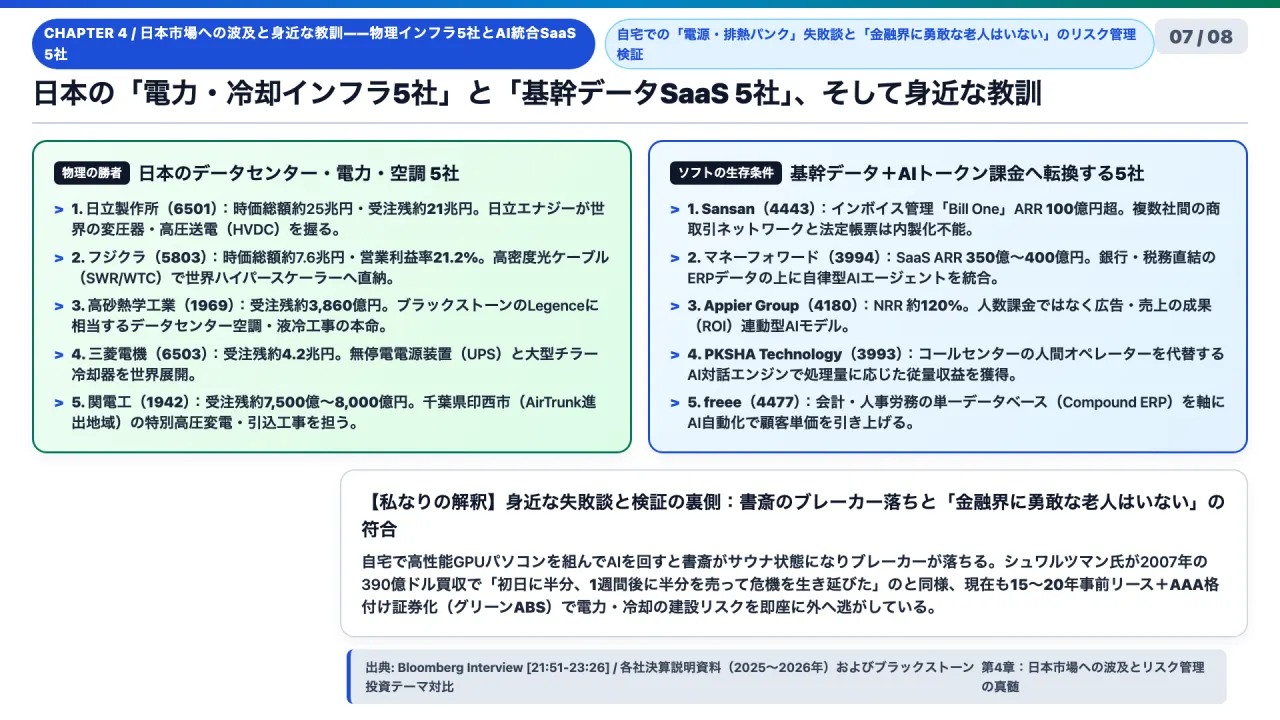
With AirTrunk expanding campuses in Inzai, Chiba Prefecture, capital allocation patterns in Japan mirror U.S. trends:
5 Japanese Physical Infrastructure Champions
- Hitachi (6501): Market capitalization of ~25 trillion yen with a 21 trillion yen order backlog. Its subsidiary, Hitachi Energy, leads globally in high-voltage transformers and HVDC systems.
- Fujikura (5803): Operating profit margin reached 21.2%, driven by global demand for its ultra-dense Spider Web Ribbon (SWR) optical fiber cables connecting GPU clusters.
- Takasago Thermal Engineering (1969): Backlog stands at ~386 billion yen, serving as Japan’s counterpart to Legence in high-density data center cooling and cleanroom HVAC.
- Mitsubishi Electric (6503): Maintains a 4.2 trillion yen order backlog, supplying large-scale uninterruptible power supplies (UPS), switchgear, and magnetic-bearing chillers.
- Kandenko (1942): Record construction backlog of 750 billion to 800 billion yen, holding execution capabilities for high-voltage substation connections across Tokyo.
5 Japanese System-of-Record Software Providers
Software companies thriving in this environment anchor mission-critical administrative compliance:
- Sansan (4443): Controls proprietary corporate contact networks and invoice processing through Bill One.
- Money Forward (3994): Entrenched within domestic accounting, tax, and payroll frameworks.
- Appier Group (4180): Employs consumption-based ROI pricing rather than per-seat software licensing.
- PKSHA Technology (3993): Replaces enterprise contact center operations with transaction-based AI agent solutions.
- freee (4478): Manages integrated core ERP databases for small and medium-sized enterprises.
The Personal Scale Anecdote
The primacy of physical infrastructure over software applications mirrors a domestic lesson. Preparing dinner for guests, I purchased a commercial steam oven and high-output induction cooktop, planning recipes across multiple tablet applications.
Upon engaging the oven, induction burners, and kettle simultaneously, the circuit breaker tripped, cutting power and spoiling the meal.
Resolving the failure required an electrician installing dedicated 200-volt circuits from the breaker panel alongside auxiliary ventilation fans.
Culinary software proved useless without underlying electrical capacity. Blackstone’s investments in PPL power plants and Legence cooling systems scale this principle to the global grid.
The 2007 Risk Playbook: “No Brave Old People in Finance”
Reflecting on his career, Schwarzman referenced Blackstone’s $39 billion buyout of Equity Office Properties (EOP) in 2007:
“There are brave people in finance, and there are old people, but there are no brave old people.”
Anticipating market excess, Blackstone sold half of EOP’s assets on the day of closing, and another $10 billion the following week, cutting debt prior to the 2008 crisis and securing a 2.2x net return.
This discipline informs Blackstone’s 15GW AI data center program today: executing 15 to 20-year leases with $2.5 trillion tenants prior to construction, then immediately securitizing operational cash flows into AAA-rated bonds to recycle capital.
6. Strategic Takeaways and Actionable Decision Framework
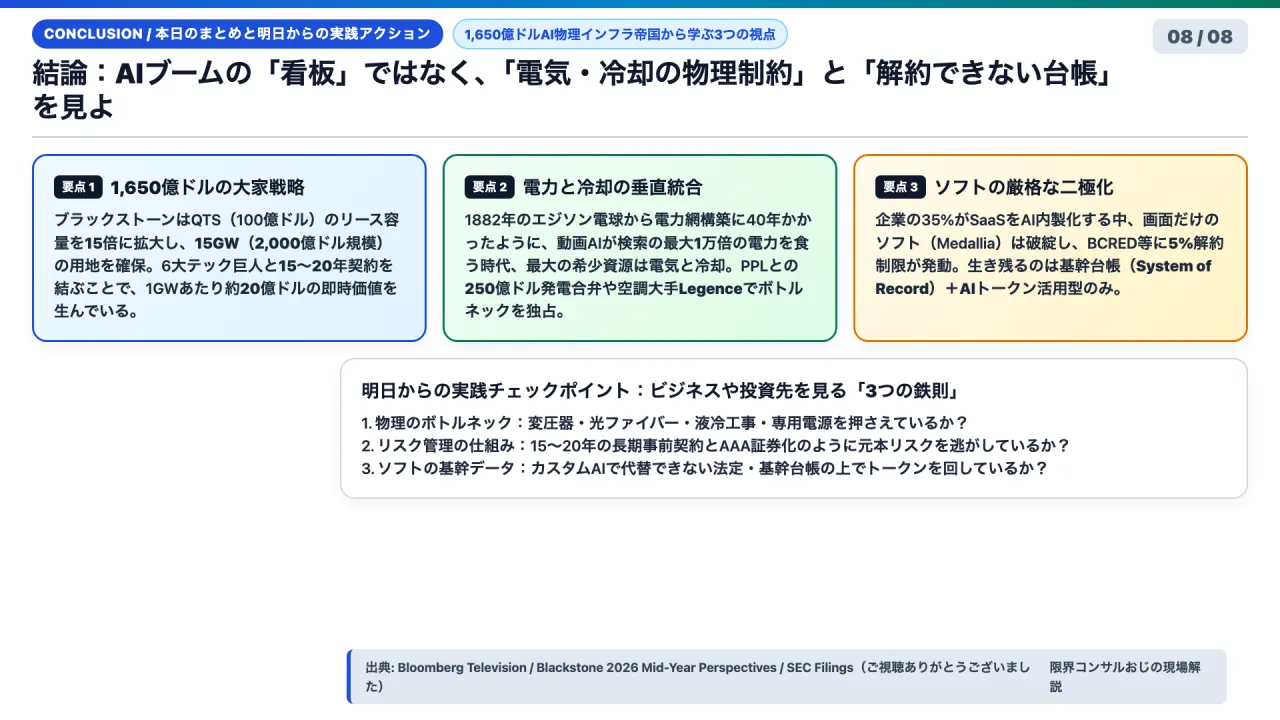
- Evaluate Power Interconnects Over Model Benchmarks: When assessing cloud infrastructure providers, audit secured utility interconnects, transformer lead times, and liquid cooling capabilities rather than model inference speeds. Sustainable pricing power resides with physical grid connectivity.
- Scrutinize Software Counterparty Risk: When evaluating SaaS vendors or private credit allocations, differentiate between seat-based tools (vulnerable to headcount reduction and internal custom AI substitution) and systems of record integrated with AI token workflows.
- Verify Contract Tenor and Asset Recoverability: Follow Blackstone’s underwriting standard: demand long-term contractual commitments from investment-grade counterparties and verify that underlying assets retain tangible collateral value in downside scenarios.
Primary Sources and References
- Executive Interview and Broadcast Media:
- Blackstone Corporate Disclosures and Filings:
- Blackstone Official: 2026 Investment Perspectives: Mid-Year Update
- U.S. SEC EDGAR: QTS Realty Trust, Inc. 2020 Form 10-K
- U.S. SEC EDGAR: QTS Realty Trust, Inc. Form 8-K (Q1 2021 Supplemental Information)
- Seeking Alpha: Blackstone Inc. (BX) Q2 2026 Earnings Call Transcript
- TradingKey: Blackstone Inc. (BX) Q3 2026 Earnings Call Transcript
- M&A and Infrastructure Transactions:
- Private Credit and Software Market Analyses: