Inside the 26,739-VPS GMO Breach ── Single Active Directory Flaws, Reverse RDP Drive Redirects, and the Ignored Warnings of 200 White-Hat Hackers
How a default-enabled drive redirect setting in pre-configured RDP files turned a cloud VPS compromise into a local workstation intrusion, triggering fraudulent trades across 70 brokerages and an unprecedented physical recovery of customer PCs.
Published: October 26, 2026 | Read time: ~10 min | Watch Video (Japanese)
Executive Summary & Core Incident Anatomy
In late October 2026, GMO Internet Group (TSE: 4784) disclosed a critical cyber incident affecting Onamae.com Desktop Cloud, a virtual private server (VPS) platform dedicated to 24/7 automated foreign exchange (FX) trading via MetaTrader (MT4/MT5). The incident rapidly escalated across physical and financial domains:
- Impact Scope: Up to 26,739 VPS instances across all service tiers were exposed to unauthorized access and external data exfiltration.
- Financial Account Destruction: Attackers exfiltrated plaintext brokerage credentials stored within trading applications, executing unauthorized, high-frequency destructive trades across client accounts at over 70 domestic and international brokerages and FX firms.
- Reverse Workstation Intrusion: Exploiting Remote Desktop Protocol (RDP) configurations, attackers traversed outward from compromised cloud instances into users’ local personal computers, copying documents and browser credential stores.
- Physical Hardware Custody: In an unprecedented response, GMO dispatched personnel nationwide to physically collect customer personal computers, delivering them to an in-house team of ethical hackers for hardware-level forensic analysis.
- Extortion & Remediation: Attackers demanded a $50 million USD (approximately 8.0 billion yen) ransom, threatening public data dumping and ransomware deployment. GMO leadership rejected the demand, permanently decommissioned the legacy platform, issued an unconditional 5,000-yen goodwill payment per customer, offered six months of free service on an isolated cloud platform, and committed to fully compensating customers for verified realized trading losses.
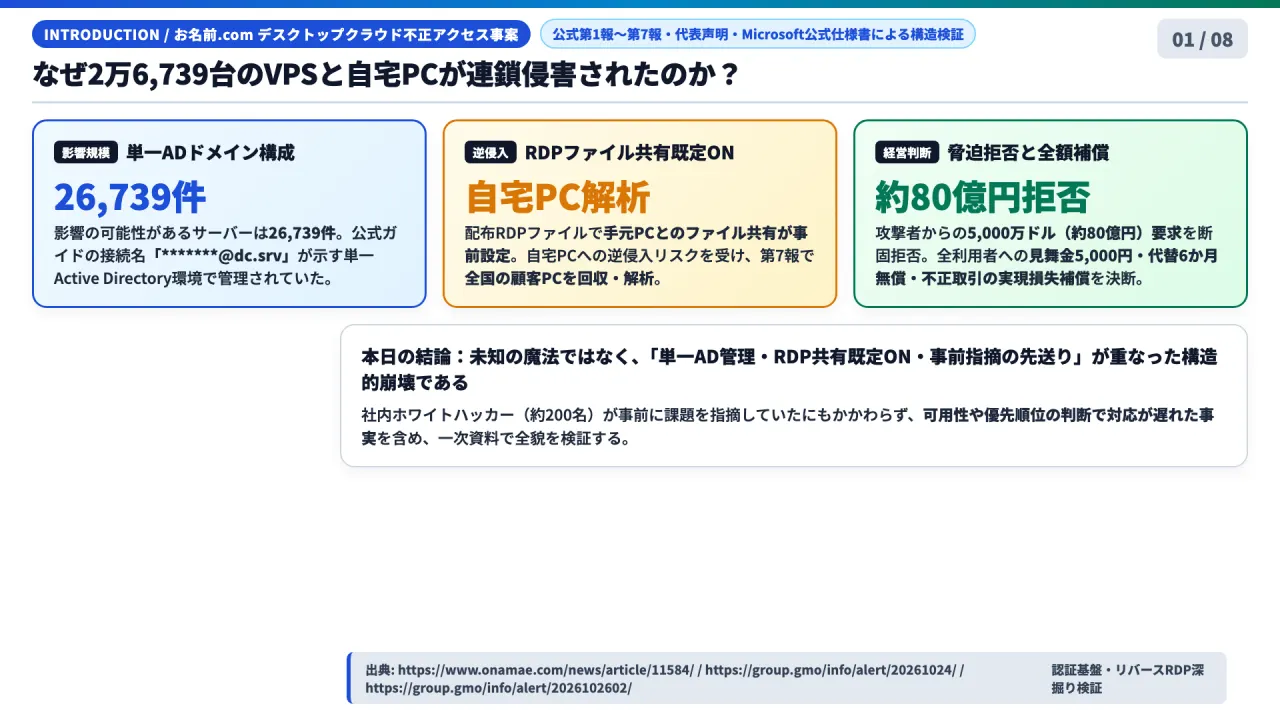
A technical synthesis of official incident advisories (Reports 1-7), support documentation, Microsoft technical standards, and public statements by GMO Group CEO Masatoshi Kumagai confirms that this breach was not caused by an advanced zero-day exploit.
Instead, it resulted from three structural and organizational failures: (1) managing multi-tenant customer instances under a single shared Windows Active Directory domain (*******@dc.srv), enabling lateral movement via Pass-the-Hash; (2) pre-configuring RDP connection files with local drive redirection enabled by default, creating a reverse read conduit into home PCs; and (3) organizational failure to remediate architectural vulnerabilities previously identified by GMO’s 200-person in-house white-hat cybersecurity unit due to service availability priorities.
1. Technical Baseline: Active Directory Tenancy, Pass-the-Hash, and Reverse RDP
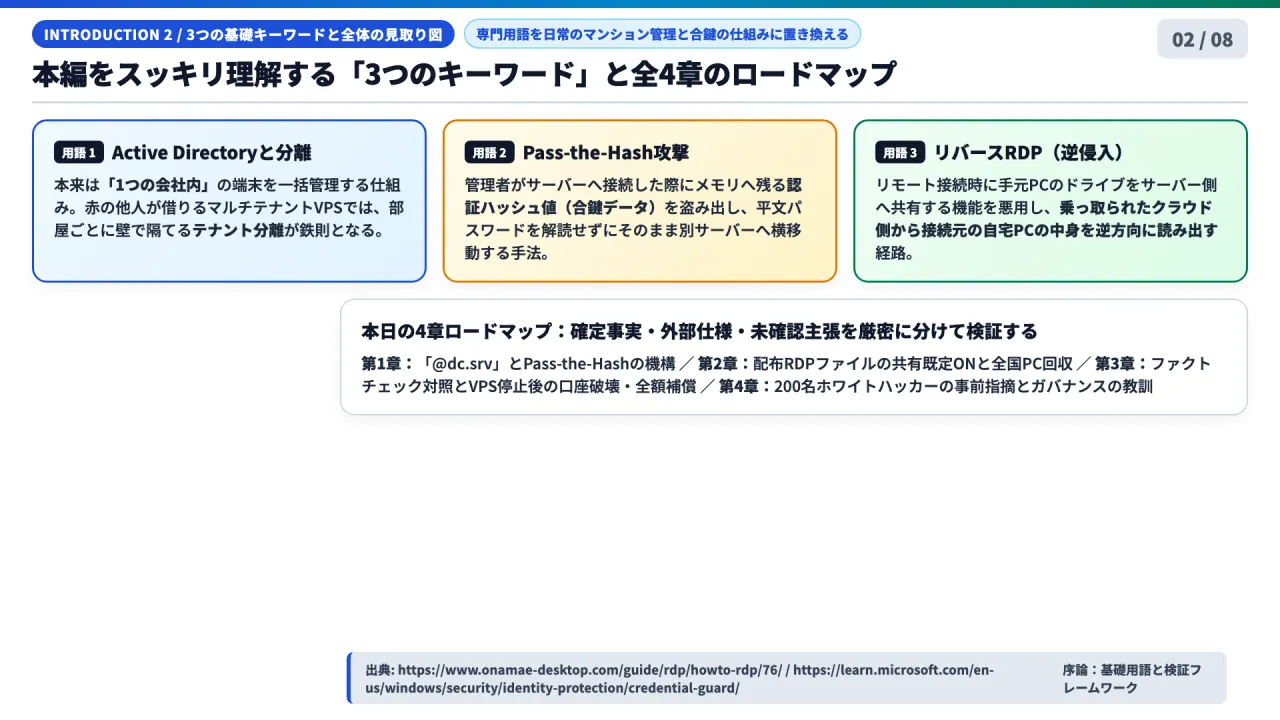
- Multi-Tenant VPS Isolation vs. Shared Active Directory: Standard IaaS enforces strict hypervisor and virtual private cloud (VPC) network boundaries. Tenants operate as isolated administrative domains. In contrast, managing multi-tenant VPS nodes within a single Active Directory forest exposes every instance to shared directory objects and central domain credential poisoning.
- Pass-the-Hash (PtH) Lateral Movement: When an administrator connects to a Windows machine via RDP without Credential Guard,
lsass.execaches NTLM password hashes and Kerberos tickets in memory. An attacker obtaining local administrative privileges on one node can extract these credentials and present the cryptographic hash directly to authenticate across other domain-joined servers without cracking the plaintext password. - Reverse RDP via Drive Redirection: Standard RDP allows client storage devices to map into the remote session. If an attacker controls the remote host, any connected workstation with active drive mapping exposes its local filesystem via administrative shares (such as
\\tsclient\C). Because file access requests originate from legitimate local operating system processes, host-based antivirus engines on client PCs remain entirely blind to the exfiltration.
2. Shared Active Directory Architecture and Credential Poisoning
Official advisories from GMO withheld specific architectural naming for operational security. However, public documentation on the official Onamae.com support portal ── specifically the guide Connecting via Remote Desktop on Windows ── reveals the underlying directory structure:
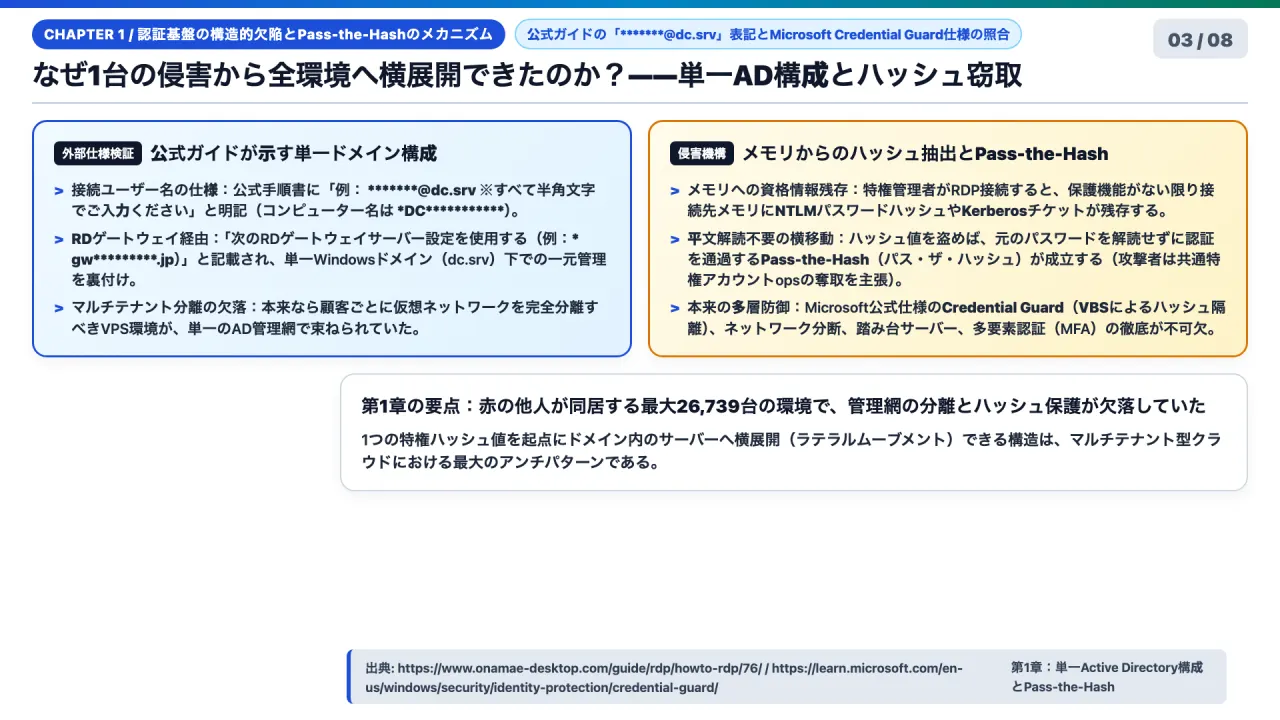
- RD Gateway Endpoint: Users routed through a central Remote Desktop Gateway (
* gw*********.jp). - Computer Naming Hierarchy: Target nodes followed a structured naming convention (
*DC***********). - Domain-Formatted User Principal Names: The user connection syntax was explicitly documented across three setup sections as:
*******@dc.srv
This syntax represents a standard User Principal Name (UPN) within a single Windows Active Directory domain (dc.srv), proving that tens of thousands of customer instances were bound to a common administrative forest.
Microsoft’s Credential Guard documentation outlines the mechanics of credential dumping. When operations personnel establish standard RDP sessions to assist customers, privileged administrative credentials enter the target node’s memory space:
- Authentication Caching:
lsass.exestores the NTLM hash or Kerberos Ticket Granting Ticket (TGT) of connecting accounts. - Credential Extraction: Without Virtualization-based Security (VBS) and Credential Guard, tools like Mimikatz extract these credentials from memory.
- Lateral Propagation: Attackers leverage stolen administrative hashes to execute commands across arbitrary instances joined to
dc.srv.
In their public manifesto, the threat actors claimed they extracted credentials for a shared administrative account (ops) during support sessions, moving laterally across the fleet without encountering network segmentation, jump hosts, or multi-factor authentication (MFA).
While the specific account identifier ops represents an unverified threat actor claim, GMO’s fourth advisory officially confirmed security vulnerabilities and external data exfiltration, aligning with CEO Kumagai’s admission that internal white-hat teams had warned of severe structural weaknesses.
3. Reverse RDP: How Default Drive Redirection Exposed Home PCs
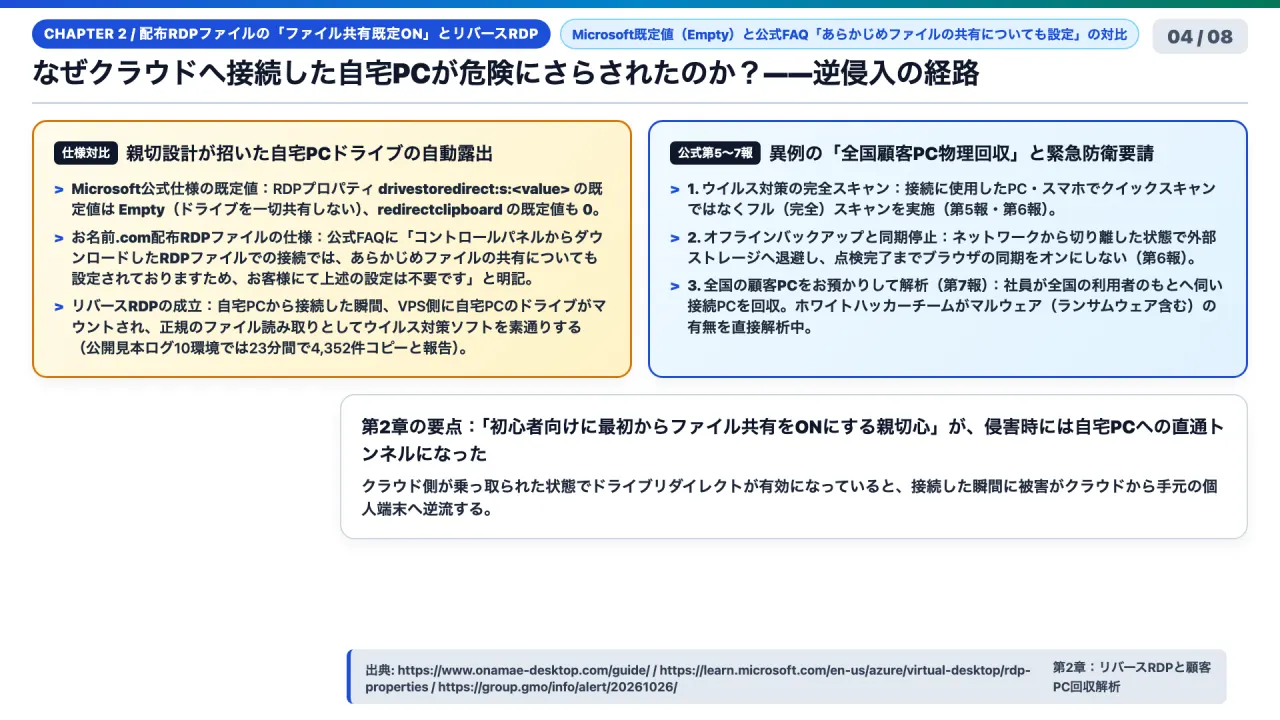
In Microsoft’s official RDP specification (Supported RDP properties - Azure Virtual Desktop), the default security baseline for drive redirection is explicitly restrictive:
drivestoredirect:s:Empty (No local drives redirected)
redirectclipboard:i:0 (Clipboard redirection disabled)
However, the official Onamae.com Desktop Cloud FAQ (Can I share files between my PC and the server?) documented an inverted configuration:
“You can share files with your local PC by configuring options when connecting. In Remote Desktop Connection, go to Local Resources, click More under Local devices and resources, and check Drives. However, connections established using the RDP file downloaded from our control panel have file sharing pre-configured in advance; therefore, customers do not need to configure these settings manually.”
This setting was intended as a convenience for retail traders, allowing them to copy Expert Advisor (EA) trading robots onto their VPS with a single double-click.
When users connected to compromised VPS nodes using these pre-configured files:
- Automatic Local Mount: The client’s storage volume automatically mounted inside the remote session as
\\tsclient\C. - Automated Reverse Harvesting: Threat actors on the compromised VPS monitored incoming connections, initiating automated file copy scripts targeting
\\tsclient\C\Users\<Username>\. - Antivirus Blindness: Antivirus software on the user’s PC logged legitimate file read operations by
mstsc.exe, generating zero security alerts.
Security researchers analyzing sample data packages (samples.zip) identified that between 22:53:53 and 23:16:48 on October 14, 2026 ── across just 23 minutes ── automated scripts harvested 4,352 local files (including 1,805 PDFs and 1,464 image files) across 10 sample customer machines, extracting stored Chrome and Edge browser credential databases from 7 of the 10 workstations.
GMO’s emergency advisories escalated rapidly:
- Advisories 5 & 6: Urged customers to perform full antivirus scans, isolate network backups, execute credential resets exclusively from uninfected secondary devices, and disable browser synchronization.
- Advisory 7 (October 26, 2026, 23:10): GMO announced that personnel had traveled nationwide to physically collect customer computers, submitting them directly to GMO’s white-hat cybersecurity teams to conduct forensic investigations for persistent malware and ransomware before an announced October 27 extortion deadline.
4. Financial Destruction, Post-Shutdown Trading, and $50M Extortion
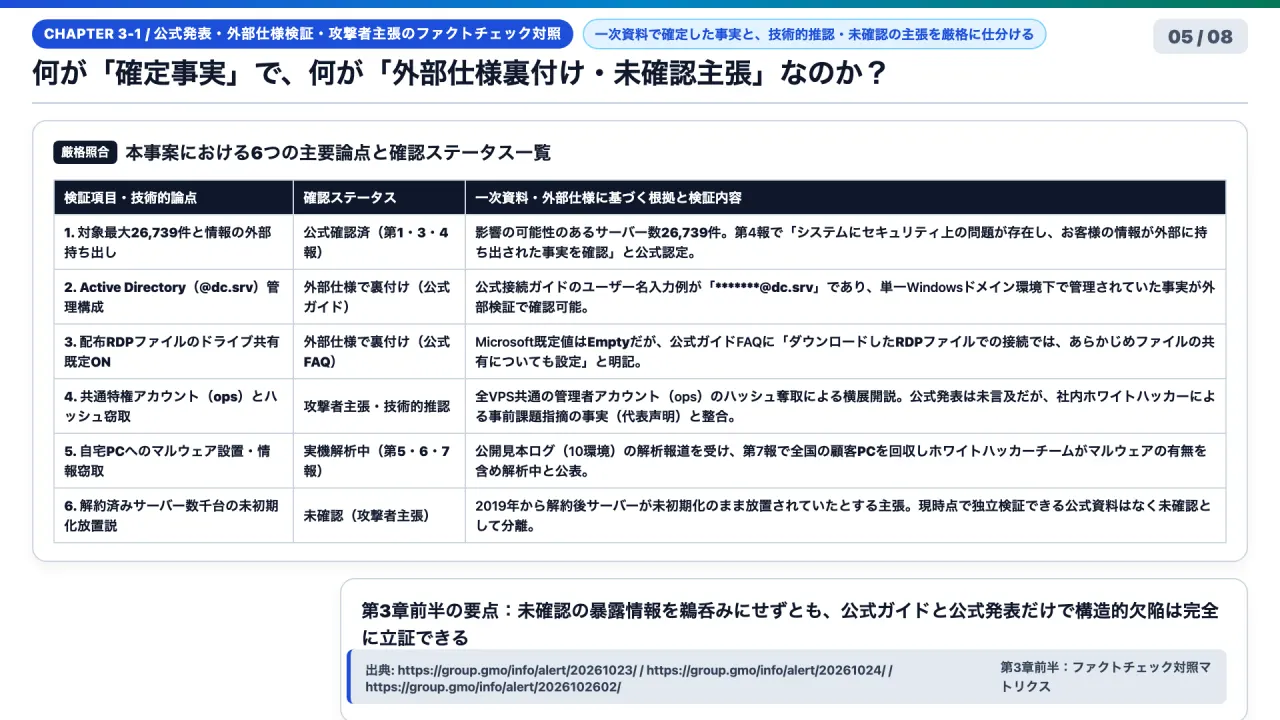
| Incident Dimension | Verified Status | Evidentiary Basis |
|---|---|---|
| Exposed VPS Volume | Confirmed (26,739 instances) | Official Advisories 1, 3, and 4 confirmed total exposed infrastructure scale |
| Single Active Directory | Verified via System Guides | Support manuals specify *******@dc.srv and unified RD Gateway routing |
| Pre-Configured Drive Sharing | Verified via Official FAQ | Support FAQ confirms downloaded .rdp files pre-enabled drive redirection |
ops Account & PtH Vector |
Technically Consistent Claim | Threat actor claim; unverified by GMO, but matches AD structure and lateral movement |
| Local PC File Exfiltration | Forensically Evidenced | Leaked samples verified 4,352 stolen files; confirmed by PC collection measures |
| Dormant Server Neglect | Unconfirmed Actor Claim | Claims of unscrubbed decommissioned nodes dating to 2019 lack independent proof |
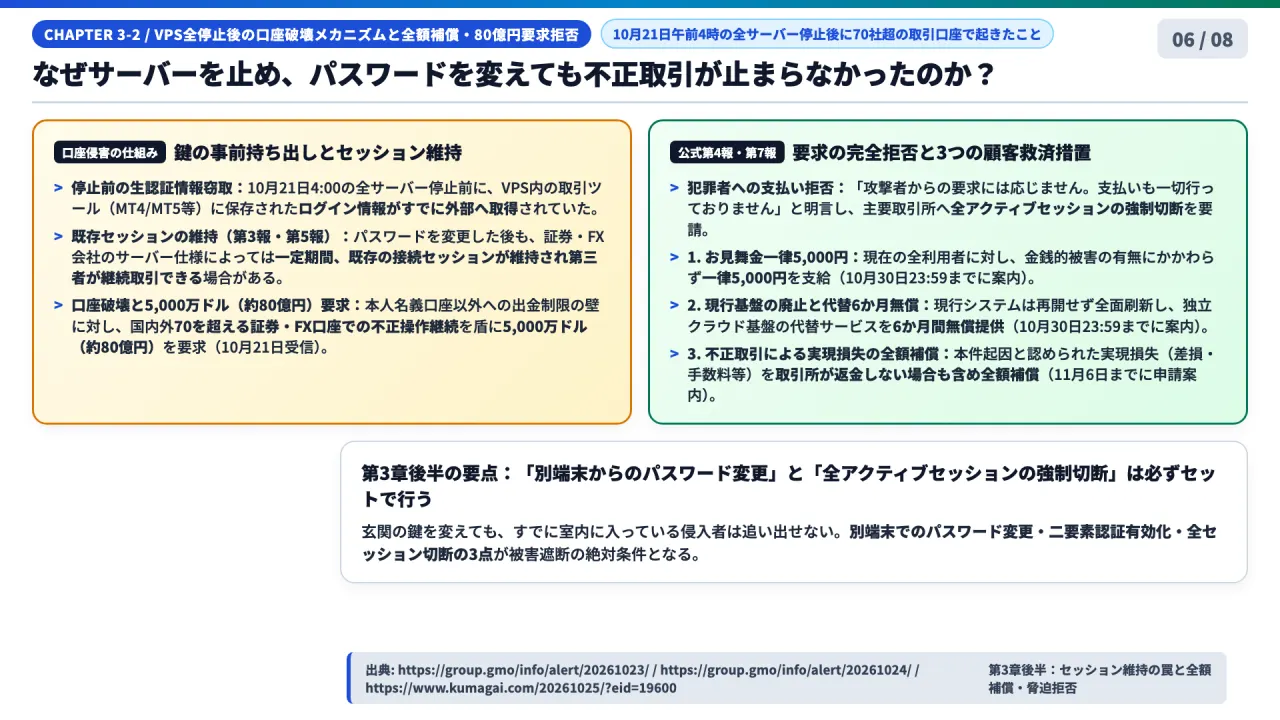
GMO powered down all Desktop Cloud VPS servers at 04:00 AM on October 21, 2026 (Advisory 1). Nevertheless, customers reported widespread account liquidations throughout October 21 and 22.
Two factors explain this paradox:
- Pre-Shutdown Credential Exfiltration: Stored brokerage credentials had already been extracted prior to the shutdown, enabling attackers to authenticate directly into brokerage servers from external infrastructure.
- Persistent Brokerage Sessions: On many brokerage platforms, changing an account password does not revoke active session tokens. Attackers maintained active connections until brokerages enacted forced global session revocations.
Under Japanese regulations, cash withdrawals are strictly restricted to verified domestic bank accounts matching the account holder’s legal name. Attackers could not transfer stolen capital directly to offshore accounts.
Instead, they weaponized capital destruction. Deploying automated scripts (such as DEMOFASTLOSS), they executed thousands of irrational orders, churning bid-ask spreads and broker commissions to liquidate account balances within seconds (e.g., losing 4.0 million yen in two seconds and 6.0 million yen in two minutes).
By obliterating customer balances, attackers manufactured intense public outrage, attempting to force GMO into paying the $50 million ransom.
GMO enacted a decisive governance posture:
- Zero Ransom Payment: Refused all extortion demands, noting that paying criminals provides no guarantee of data deletion.
- 5,000-Yen Consolation Payment: Disbursed an immediate 5,000 yen per client to acknowledge operational distress.
- Platform Decommissioning & 6-Month Transition: Permanently retired the compromised architecture, offering six months of free service on an isolated cloud platform.
- Full Realized Loss Restitution: Guaranteed full corporate reimbursement for all verified realized trading losses and transaction fees resulting from unauthorized access.
5. Organizational Governance: 200 White-Hat Hackers and Management Blindspots
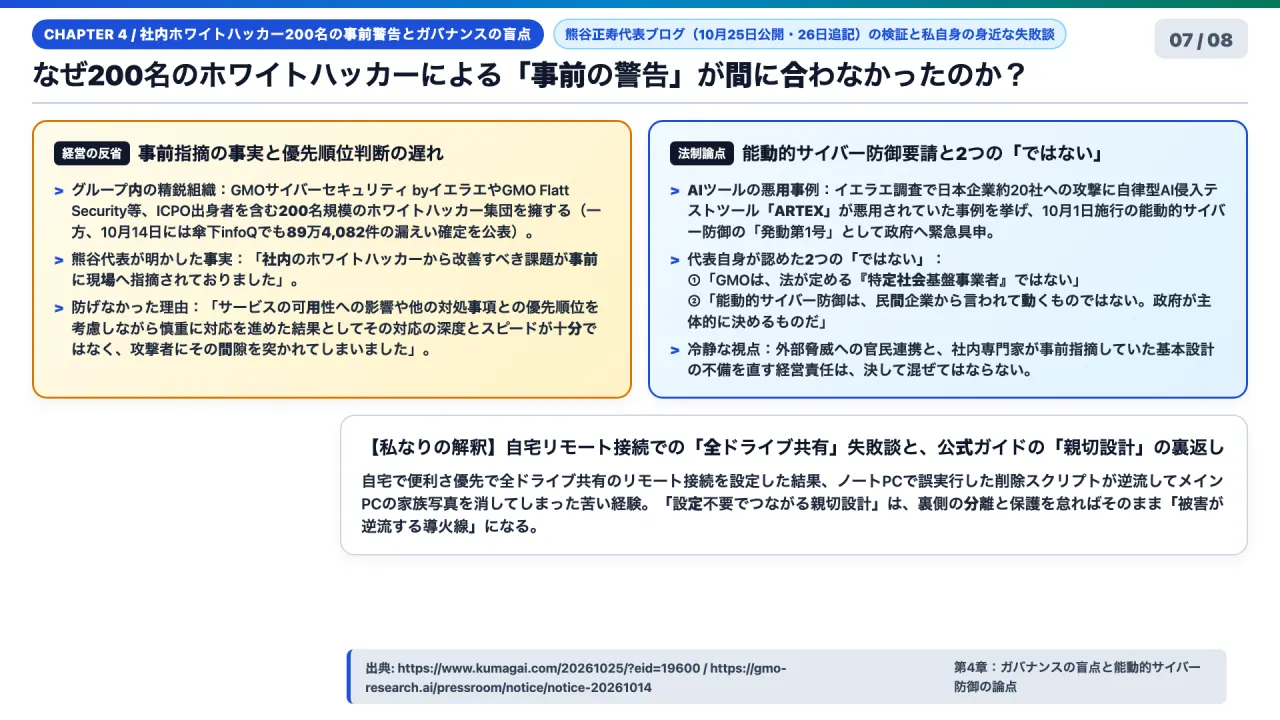
The central paradox of this breach is organizational: GMO Internet Group possessed Japan’s premier defensive cybersecurity capability, having acquired IERAE Security in 2022 and Flatt Security, employing approximately 200 professional white-hat hackers.
On October 25, 2026, Group CEO Masatoshi Kumagai published a statement addressing this breakdown:
“Speaking plainly as a matter of factual truth, internal white-hat hackers had previously identified and reported security issues in this service to operational management. The operational teams accepted the findings and were progressing with countermeasures. However, as they proceeded deliberately ── balancing potential impacts on service availability against competing operational priorities ── the depth and speed of response proved insufficient. Attackers exploited that operational gap. I deeply regret that despite employing elite professionals, our organization failed to translate their expertise into effective defense.”
This admission illustrates availability bias. In 24/7 trading environments, operations teams frequently resist scheduling maintenance windows or re-architecting authentication forests for fear of customer friction. A structural defect warned about in advance was postponed until an external threat group forced the total shutdown and write-off of the platform.
Kumagai requested government intervention under Japan’s newly enacted Active Cyber Defense (ACD) framework, while clarifying two governance boundaries:
- Statutory Classification: GMO is not a designated critical infrastructure operator under current statutes.
- Sovereign Authority: Active cyber defense operations are sovereign prerogatives executed by state authorities, not on-demand services initiated by private commercial petition.
Private enterprise remediation cannot be outsourced to sovereign state intervention: internal engineering discipline remains non-negotiable.
The Personal Scale Anecdote
The risk of unified connectivity mirrors a personal experience. Seeking convenience between a desktop in my home study and a living room laptop, I established an RDP connection with full drive mapping and automatic administrator authentication enabled.
Weeks later, running a cleanup script to purge temporary files on the laptop, a malformed relative directory path traversed the active drive mapping tunnel into the primary workstation, instantly deleting thousands of archived family photographs and financial spreadsheets.
Restoring the scrambled volumes required days of recovery tooling. Pre-configured convenience creates the very conduits that propagate catastrophic failure.
6. Strategic Takeaways and Actionable Security Directives
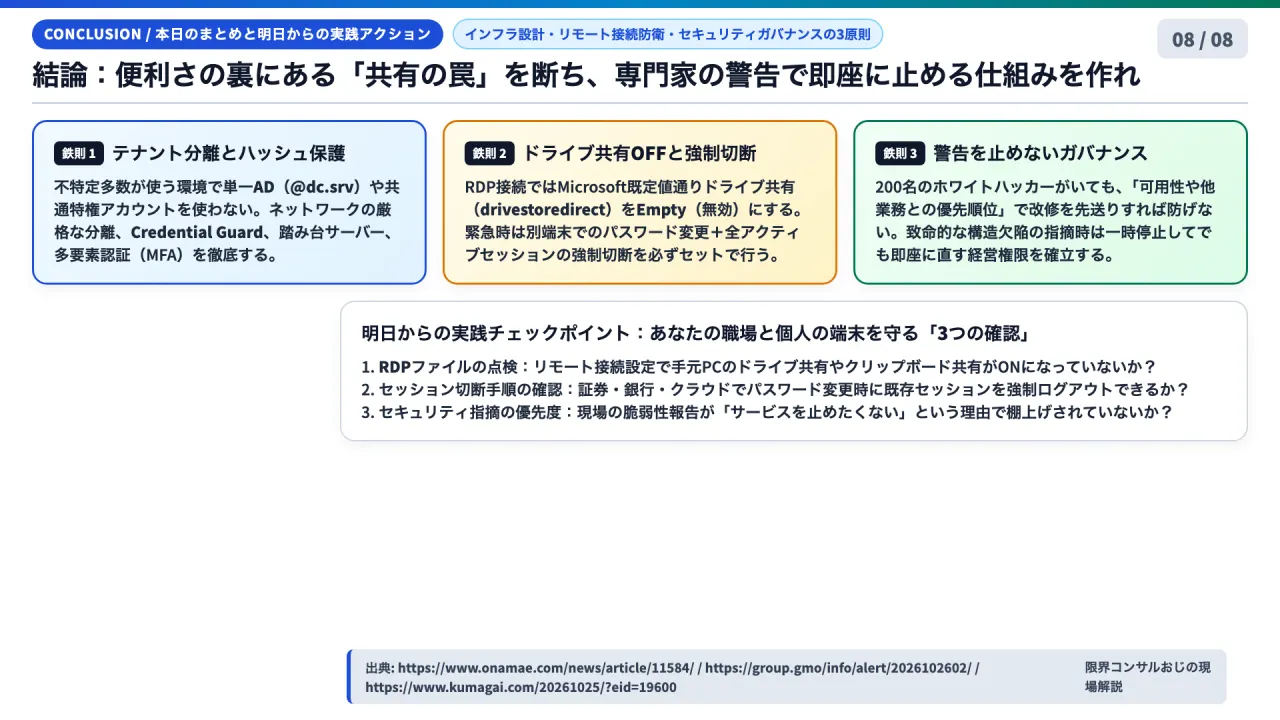
- Eliminate Multi-Tenant Shared Active Directory Forests: Never join multi-tenant customer workloads to a shared domain. Implement strict hypervisor tenant boundaries, enable Credential Guard, enforce Restricted Admin mode for administrative RDP, and mandate multi-factor authentication across dedicated jump hosts.
- Enforce Restrictive RDP Client Policies: Audit client RDP configuration files. Enforce
drivestoredirect:s:Emptyas an organizational baseline. When responding to credential compromise, pair password updates with mandatory, tenant-wide session revocations to invalidate active tokens. - Establish Security Veto Governance Over Operational Availability: Remove operational management’s unilateral authority to delay remediation of critical vulnerabilities flagged by security teams. When security personnel identify architectural defects, executive governance must mandate hard remediation deadlines regardless of operational downtime concerns.
Primary Sources and References
- GMO Internet Group Official Incident Advisories:
- GMO Internet Group: Advisory Report 1 (October 21, 2026)
- GMO Internet Group: Advisory Report 3 (October 23, 2026)
- GMO Internet Group: Advisory Report 4 (October 24, 2026)
- GMO Internet Group: Advisory Report 5 (October 24, 2026)
- GMO Internet Group: Advisory Report 6 (October 26, 2026)
- GMO Internet Group: Advisory Report 7 (October 26, 2026)
- Service Documentation and Corporate Statements:
- Onamae.com Desktop Cloud Official Guide: Remote Connection Configuration
- Onamae.com Desktop Cloud Official FAQ: Local Resource Sharing
- Masatoshi Kumagai Official Blog (October 25, 2026): Reflections on Incident Response and Active Cyber Defense
- GMO Research & AI Incident Disclosure (infoQ Platform Compromise, October 14, 2026)
- Technical Standards and Security Specifications: