How Anthropic Reached a $2 Trillion IPO Valuation Despite an $80.7B Net Loss ── Form S-1 Forensic Audit, $750B Compute Liabilities, and 50.1% Founder Voting Control
An exhaustive breakdown of Anthropic’s 261-page S-1 registration statement reveals 15x revenue growth, Q2 operating profitability, and an unprecedented governance architecture where one Class F share and a public trust override public shareholders.
Published: October 27, 2026 | Read time: ~10 min | Watch Video (Japanese)
Executive Summary & Core Paradox
On October 26, 2026, Anthropic, PBC publicly filed its Form S-1 registration statement with the US Securities and Exchange Commission (SEC) to list its Class A common stock on the Nasdaq Global Select Market under the ticker symbol ANT. The company aims to raise up to $100 billion at an enterprise valuation between $1.5 trillion and $2.0 trillion (approximately 225 trillion to 300 trillion yen), with investor roadshows scheduled for November 2026.
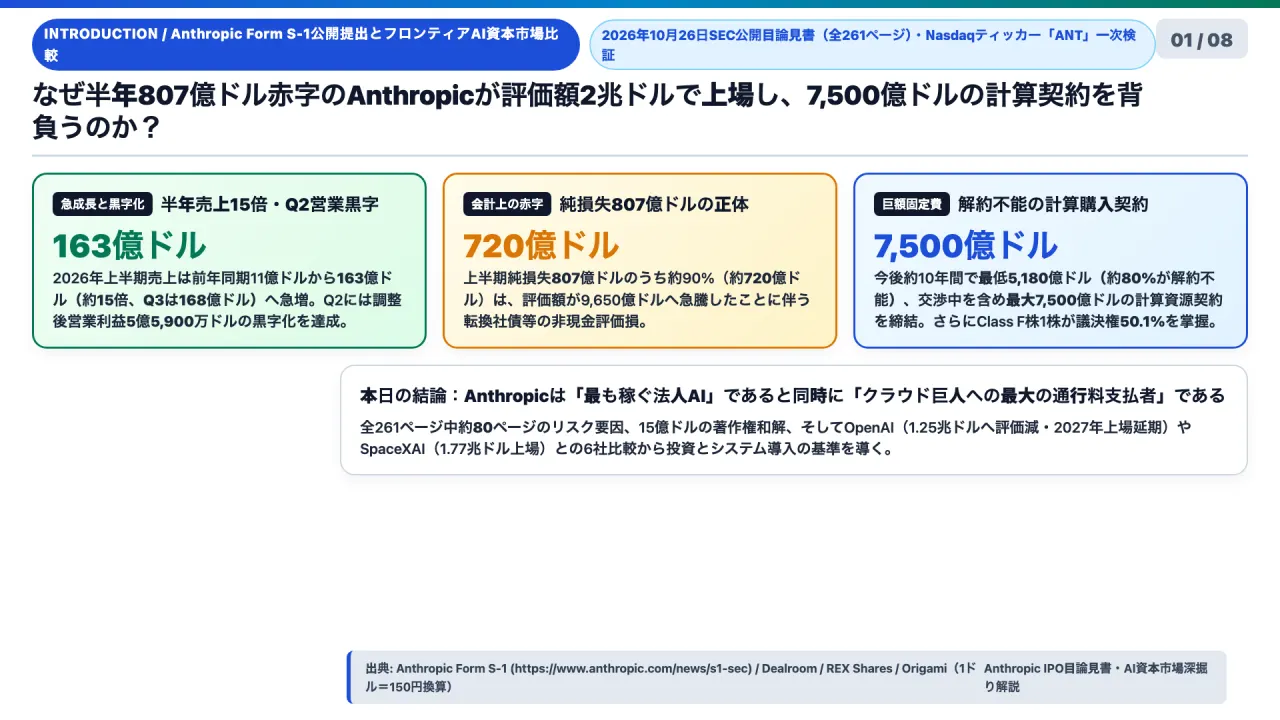
At first glance, the 261-page prospectus contains staggering accounting contradictions:
- 15x Top-Line Expansion: Full-year revenue surged from $386 million in 2024 to approximately $4.6 billion in 2025. In the first half of 2026, revenue exploded to $16.3 billion ── a fifteenfold increase over the $1.1 billion reported in the first half of 2025. Third-quarter 2026 revenue expanded further to $16.8 billion (+45% quarter-over-quarter), bringing annualized run-rate (ARR) to $74.3 billion by late July 2026, surpassing OpenAI’s $41.3 billion run-rate by $33 billion.
- Operating Profitability: In the second quarter of 2026, Anthropic achieved its first operating profit, generating $559 million in adjusted operating income on $10.9 billion in quarterly revenue, as compute expenses dropped from 160% of revenue in 2025 to 55% in the first half of 2026.
- The $80.7 Billion Headline Loss: Anthropic reported a first-half GAAP net loss of $80.7 billion (approximately 12.1 trillion yen). However, roughly 90% of this loss (~$72.0 billion) represents non-cash mark-to-market fair-value adjustments on convertible financing liabilities triggered by the company’s valuation rising to $965 billion in May 2026. These charges extinguish upon IPO conversion.
- $750 Billion in Compute Liabilities: Anthropic executed long-term purchase agreements across six infrastructure partners totaling a minimum of $518 billion (and up to $750 billion including pending negotiations). Approximately 80% (~$414.4 billion) are non-cancellable, take-or-pay commitments, including $111 billion to Google, $110 billion to AWS, and $31 billion to Microsoft.
- Absolute Founder Voting Control: Seven co-founders organized under Founder LLC hold a single Class F share that commands 50.1% of total voting power. Furthermore, the Long-Term Benefit Trust (LTBT) unilaterally appoints four of the seven board directors, legally prioritizing safety over shareholder financial returns.
1. Core Frameworks: Convertible Accounting, Take-or-Pay, and PBC Governance
Deciphering Anthropic’s S-1 requires examining three corporate finance concepts:
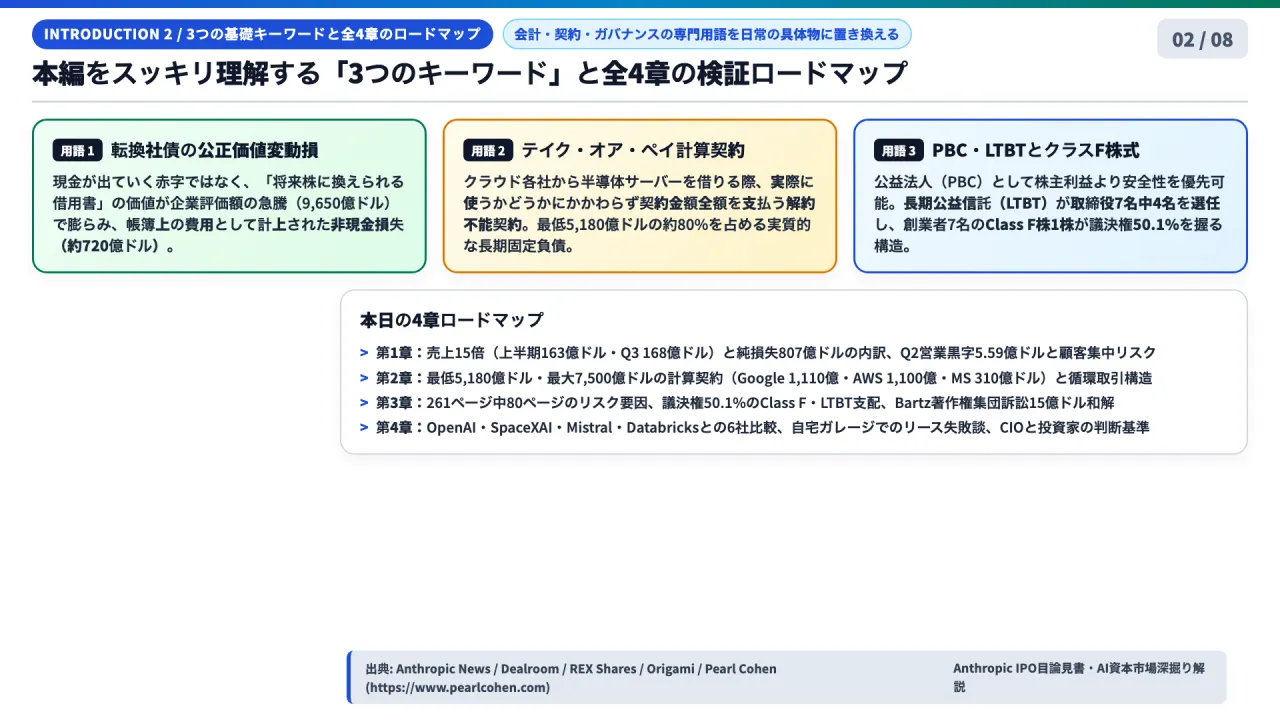
- Convertible Notes Fair-Value Accounting: Under US GAAP, convertible debt and Simple Agreements for Future Equity (SAFEs) that convert into equity at a discount to future valuations are classified as derivative liabilities. When Anthropic’s private valuation jumped from previous benchmarks to $965 billion in May 2026, the value of equity owed to investors increased proportionally. This non-cash paper loss of ~$72.0 billion required zero cash outflow and converts to common stock upon listing.
- Take-or-Pay Purchase Commitments: A contractual covenant originating in pipeline energy infrastructure requiring the buyer to pay for contracted capacity regardless of whether it consumes that capacity. Anthropic’s ~$414.4 billion in non-cancellable commitments function economically as unrecorded fixed debt obligations senior to equity.
- Public Benefit Corporation (PBC) & Dual-Lock Governance: Incorporating under Delaware PBC law permits corporate directors to balance public benefit missions against shareholder returns. Anthropic implemented a dual-lock: Founder LLC’s Class F share controls 50.1% of votes, while the independent LTBT appoints the majority of the board of directors.
2. Revenue Architecture: 15x Top-Line Growth vs the $80.7B Net Loss
Anthropic’s operational trajectory demonstrates rapid enterprise monetization alongside massive non-cash accounting volatility.
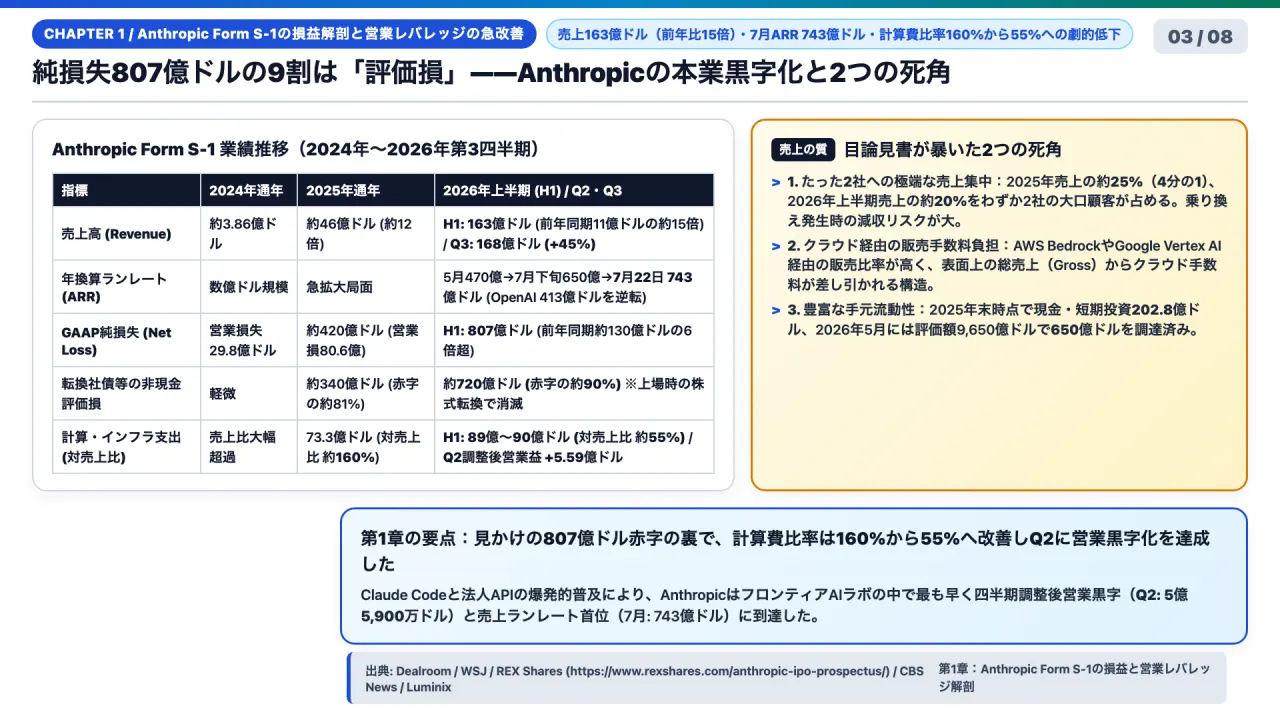
| Financial Metric / Period | Reported Value (USD) | Reported Value (JPY at 150/$) | Strategic Significance & Growth Profile |
|---|---|---|---|
| FY2024 Revenue | $386 Million | 57.9 Billion Yen | Initial commercial rollout of Claude enterprise API |
| FY2025 Revenue | $4.60 Billion | 690 Billion Yen | 12x annual expansion via Amazon Bedrock & Vertex AI |
| H1 2025 Revenue | $1.10 Billion | 165 Billion Yen | Comparative baseline for early 2025 |
| H1 2026 Revenue | $16.30 Billion | 2.45 Trillion Yen | 15x expansion (+1,382% YoY); consumption API model |
| Q2 2026 Adjusted Op Income | +$559 Million | +83.9 Billion Yen | First operational profit on $10.9B quarterly revenue |
| Q3 2026 Revenue | $16.80 Billion | 2.52 Trillion Yen | +45% QoQ revenue expansion |
| Annualized Run-Rate (ARR) | $74.3 Billion (July 22) | 11.15 Trillion Yen | Surpassed OpenAI ($41.3B) by $33B in ARR |
| H1 2026 GAAP Net Loss | -$80.70 Billion | -12.11 Trillion Yen | ~$72.0B (90%) non-cash fair-value mark-to-market loss |
| Cash & Equivalents | $20.28 Billion (YE 2025) | 3.04 Trillion Yen | Augmented by $65B funding round in May 2026 |
The decisive operational metric is compute efficiency. In 2025, compute and infrastructure expenses reached $7.33 billion against $4.60 billion in revenue, representing 160% of revenue. In the first half of 2026, compute spending grew to $8.90 billion, but revenue surged to $16.30 billion, cutting compute expense to 55% of revenue ── an operating margin improvement of 105 percentage points.
However, the S-1 reveals two critical revenue concentration vulnerabilities:
- Top-Two Customer Concentration: A mere two customers generated ~25% of full-year 2025 revenue and
20% of first-half 2026 revenue ($3.26 billion). Loss of either customer would impair growth trajectories. - Platform Intermediary Deductions: A substantial portion of enterprise contracts execute via Amazon Bedrock and Google Cloud Vertex AI, subjecting gross revenue to channel revenue-share deductions.
3. The $750B Compute Liability and Circular Financing
While non-cash fair-value adjustments disappear at listing, long-term compute purchase obligations will constrain Anthropic’s cash flows over the next decade.
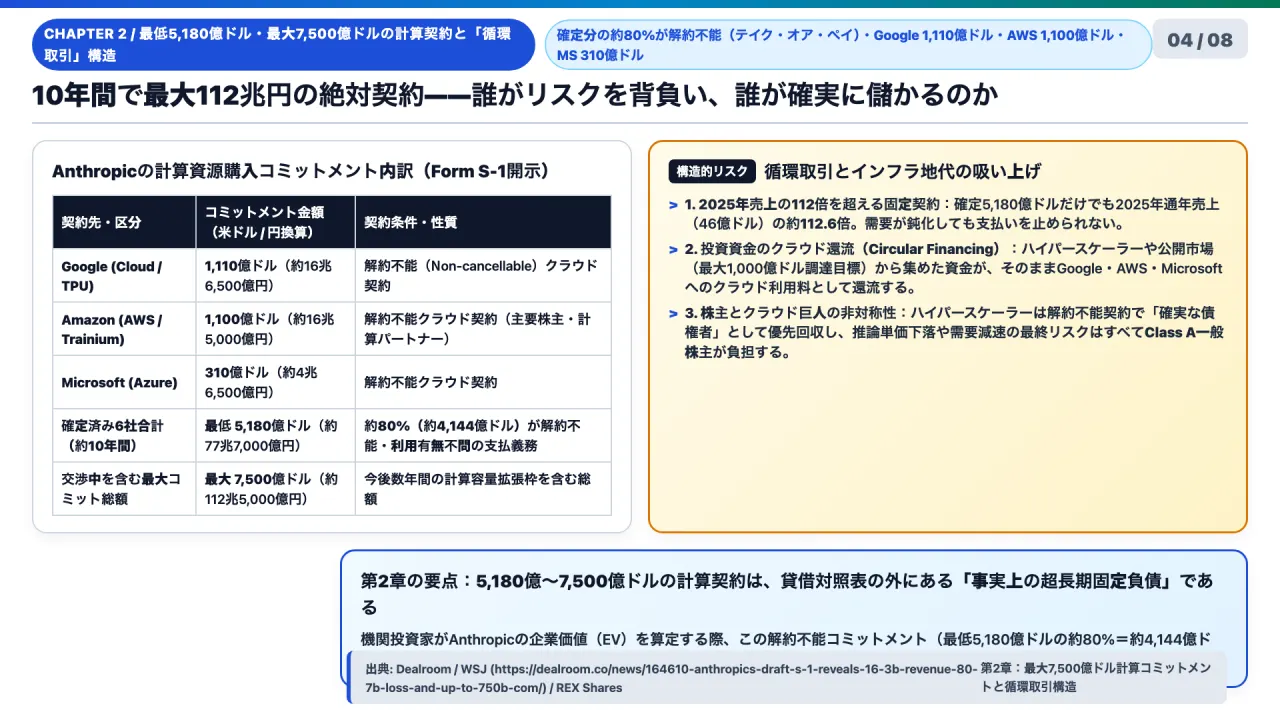
Anthropic disclosed minimum contractual purchase commitments across six compute and semiconductor partners:
| Partner / Contract Category | Contracted Commitment | Yen Equivalent (150/$) | Contractual Structure & Cancellation Terms |
|---|---|---|---|
| Google Cloud (TPU / Systems) | $111 Billion | 16.65 Trillion Yen | Non-cancellable cloud infrastructure agreement |
| Amazon Web Services (Trainium) | $110 Billion | 16.50 Trillion Yen | Non-cancellable cloud infrastructure agreement |
| Microsoft Azure | $31 Billion | 4.65 Trillion Yen | Non-cancellable cloud infrastructure agreement |
| 6-Partner Committed Total | $518 Billion Minimum | 77.70 Trillion Yen | |
| Potential Extended Total | Up to $750 Billion | 112.50 Trillion Yen | Includes capacity agreements currently under negotiation |
This architecture creates a structural capital paradox:
- Circular Capital Flow: Hyperscalers invest equity capital into Anthropic, and public investors are asked to contribute up to $100 billion. Yet this capital flows directly back to Google, Amazon, and Microsoft to fulfill non-cancellable cloud commitments.
- Asymmetric Risk Allocation: Hyperscalers occupy the position of senior secured landlords. If token prices decline due to open-weight models, Anthropic remains legally bound to pay ~$414.4 billion. Public Class A common shareholders bear 100% of the commercial downside.
4. Governance Architecture: 50.1% Class F and the 80-Page Risk Section
Anthropic’s corporate governance structure isolates management from public equity pressure:
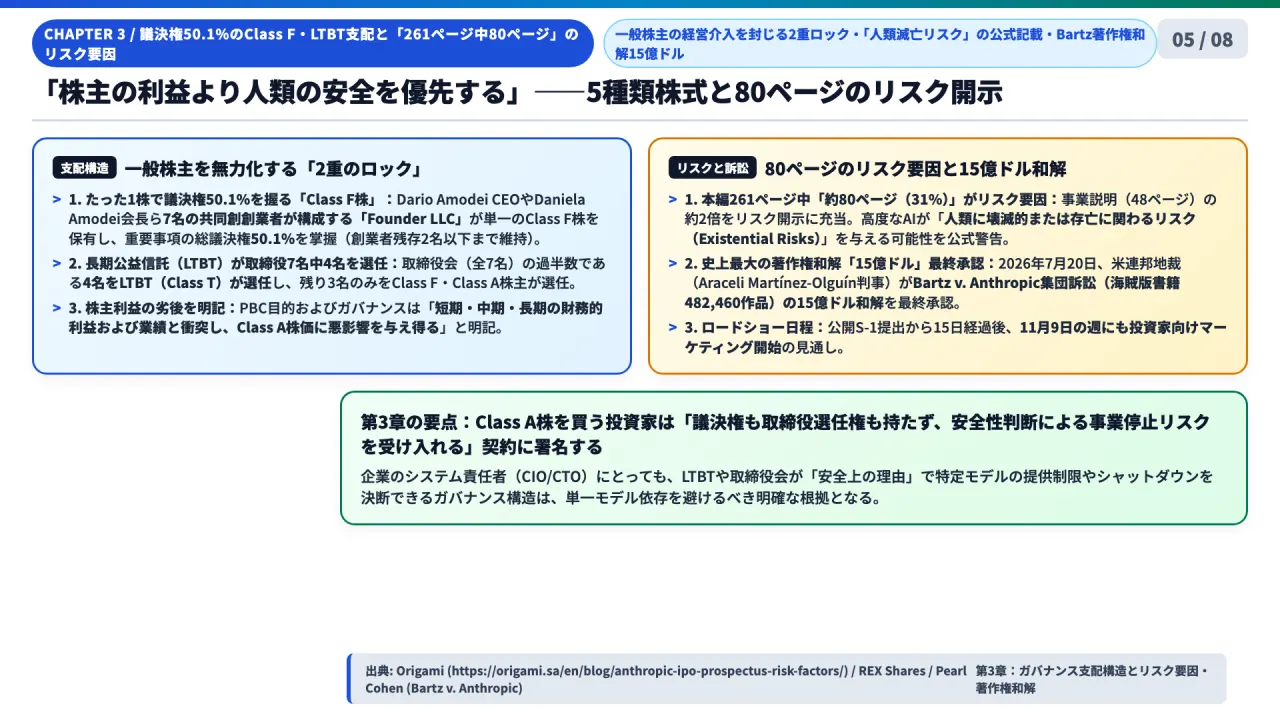
- The Single Class F Share: Dario Amodei, Daniela Amodei, and five fellow co-founders organized Founder LLC, which holds one Class F share controlling 50.1% of total shareholder voting power. This voting control cannot be diluted until two or fewer founders remain.
- The Long-Term Benefit Trust (LTBT): Anthropic’s board consists of seven directors. The LTBT ── a trust composed of independent trustees with no financial stake ── appoints four of the seven directors. Class A and Class F shareholders elect only three directors (Daniela Amodei Chair, Dario Amodei CEO). Public shareholders have zero power to replace leadership or force an acquisition.
- 80 Pages of Risk Disclosures (31% of the S-1): Out of 261 prospectus pages, 80 pages are dedicated to Risk Factors (compared to 48 pages for Business description). The filing explicitly warns that advanced AI presents “catastrophic or existential risks to humanity” and cautions that its public benefit mission “may conflict with short-, medium-, or long-term financial interests… negatively impacting the value of Class A common stock.”
- $1.5 Billion Copyright Settlement: On July 20, 2026, Judge Araceli Martínez-Olguín of the US District Court for the Northern District of California granted final approval to a $1.5 billion settlement in Bartz v. Anthropic PBC (Case No. 3:24-cv-05417-AMO), resolving copyright infringement claims across 482,460 copyrighted works.
5. Frontier AI Capital Comparison: The Competitive Landscape
Anthropic’s S-1 filing allows quantitative benchmarking across the frontier artificial intelligence sector:
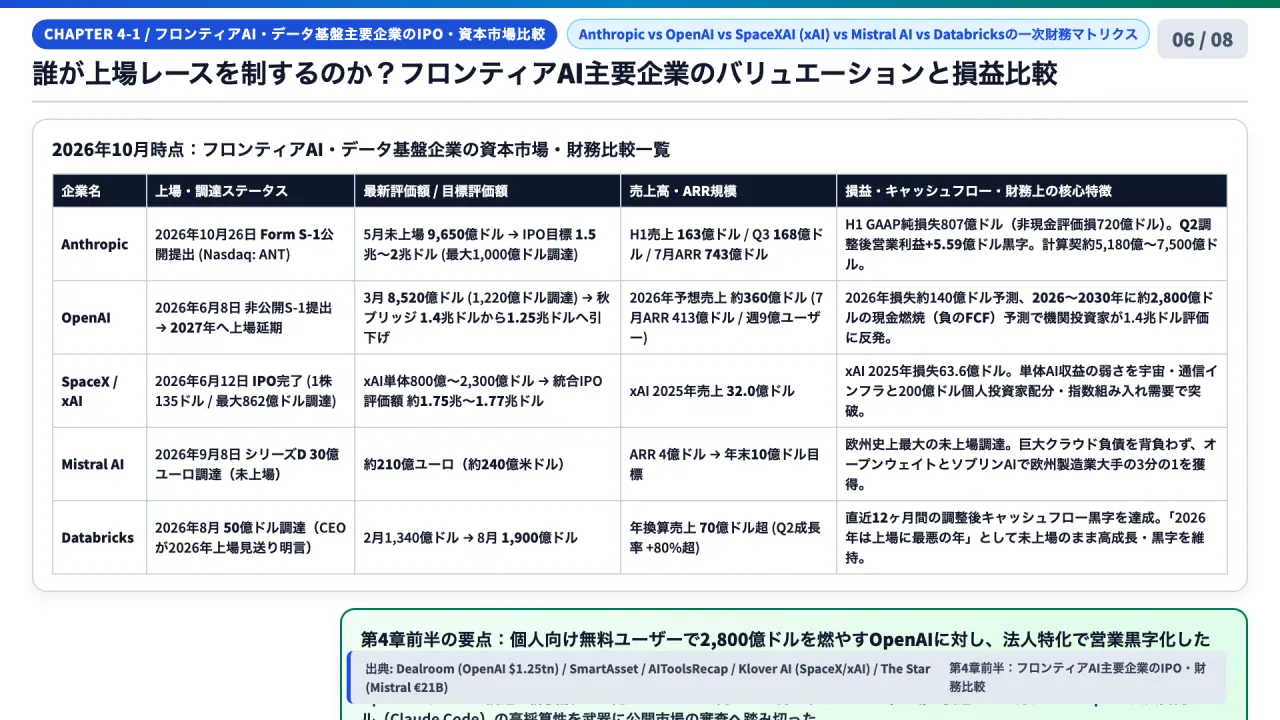
| Organization | IPO / Capital Status | Valuation Metric | Revenue / ARR Scale | Operating Dynamics & Structural Vulnerabilities |
|---|---|---|---|---|
| Anthropic | Form S-1 filed Oct 26, 2026 (Nasdaq: ANT) |
Targeting $1.5T - $2.0T (raising up to $100B) | H1 2026 $16.3B; Q3 $16.8B; ARR $74.3B (July 22) | Q2 operating profit +$559M; $518B-$750B compute obligations; 50.1% Class F control |
| OpenAI | Delayed IPO to 2027; raised $122B in March 2026 | Valuation trimmed to $1.25T in $30B bridge round | 2026 projected revenue ~$36B; ARR $41.3B | Projected $280B cash burn (negative FCF) across 2026-2030; 900M weekly users inflate compute costs |
| SpaceX / xAI | Merged IPO completed June 12, 2026 | Merged valuation $1.75T - $1.77T ($75B raised) | xAI 2025 revenue $3.2B; SpaceX launch cash flow | xAI lost $6.36B in 2025; absorbed by Starlink infrastructure; faces lockup expirations |
| Mistral AI | Series D 3.0B Euro ($3.5B) closed Sep 8, 2026 | Private valuation 21B Euro ($24B) | ARR grew from $20M to $400M, targeting $1.0B in 2026 | Zero hyperscaler take-or-pay debt; 1.05T open weights deployed on-premises |
| Databricks | Raised $5B in August 2026; delayed IPO past 2026 | Private valuation $190 Billion | ARR exceeded $7.0 Billion (+80% YoY) | Positive adjusted free cash flow; CEO opted to avoid 2026 market noise |
Anthropic’s discipline in targeting enterprise API developers allowed it to surpass OpenAI’s commercial run-rate ($74.3 billion vs $41.3 billion) while achieving operational profitability. OpenAI’s massive consumer footprint generated a projected $280 billion cash drain through 2030, forcing it to reduce its valuation target from $1.4 trillion to $1.25 trillion and postpone its IPO to 2027.
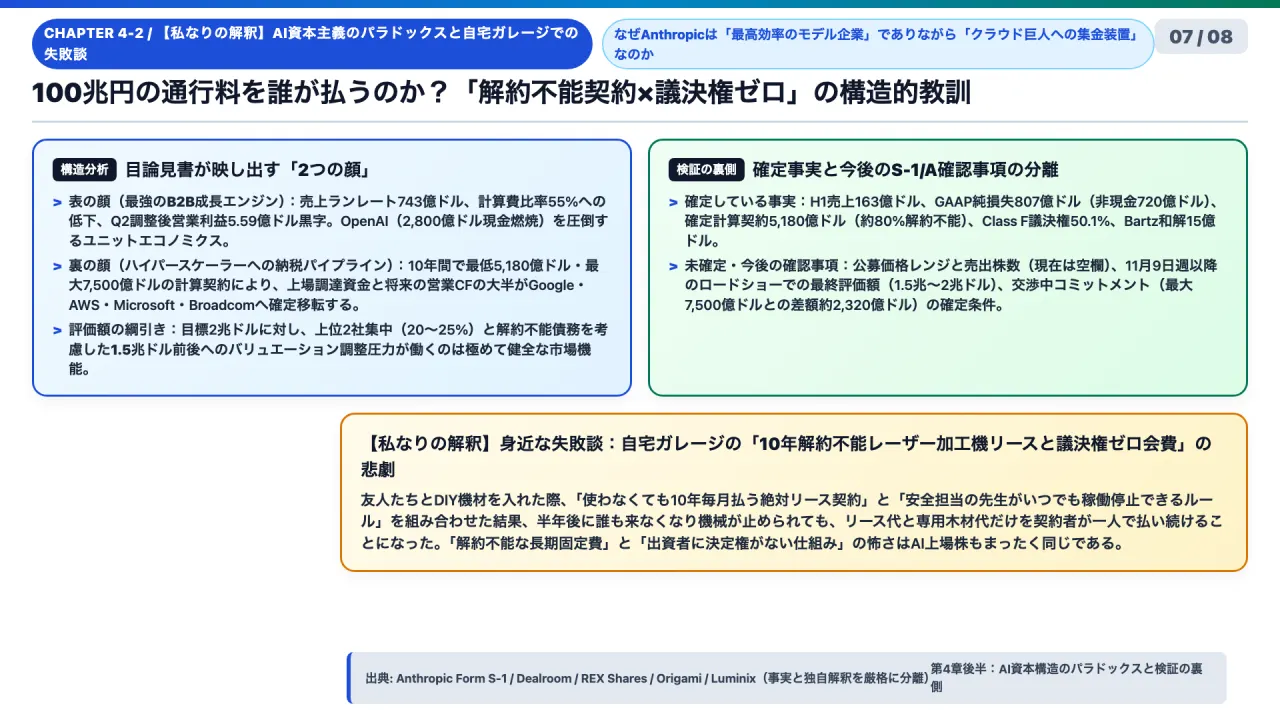
The Author’s Perspective: The DIY Workshop Ten-Year Equipment Lease
Anthropic’s paradox ── extraordinary commercial execution combined with massive fixed liabilities and zero shareholder governance ── mirrors a personal misadventure in cooperative hardware leasing.
Several years ago, I organized a community woodworking workshop with several neighbors. We leased industrial CNC routers and laser cutters under a ten-year, non-cancellable commercial lease requiring fixed monthly payments regardless of equipment utilization. To prevent accidents, we instituted a governance rule giving a safety consultant and myself sole authority over equipment access, while junior members funded operating shortfalls.
Within nine months, members realized they could buy inexpensive desktop tools for home use, and the safety consultant suspended CNC operations indefinitely over ventilation concerns. The machines sat idle, but the leasing corporation enforced the ten-year non-cancellable contract, leaving me personally liable for years of fixed payments. The lesson is unequivocal: never invest in an entity carrying massive non-cancellable fixed liabilities where voting governance explicitly subordinates investor financial interests.
6. Strategic Takeaways for Investors and Enterprise Architects
The disclosures in Anthropic’s Form S-1 dictate defensive adjustments across two primary stakeholder groups:
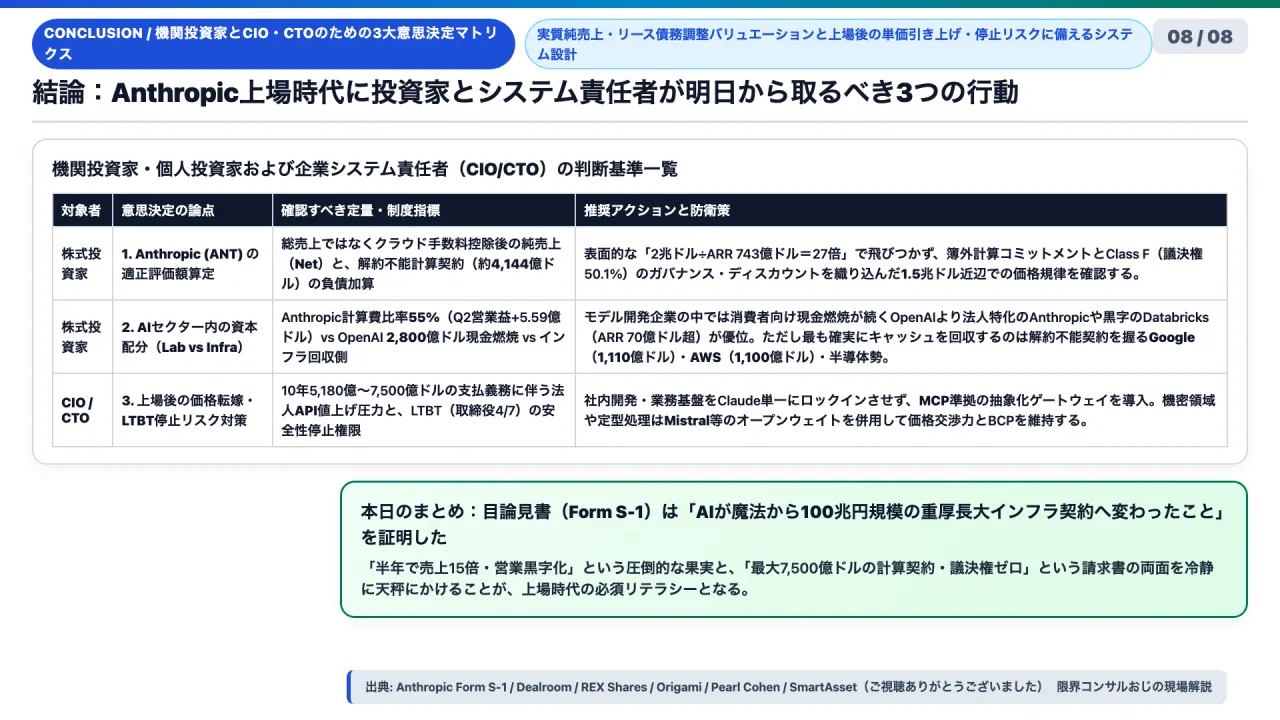
- For Public Equity Investors: Do not evaluate Anthropic on a simple price-to-sales multiple of ~27x ($2.0 trillion valuation divided by $74.3 billion ARR). Institutional investors must add ~$414.4 billion in non-cancellable compute obligations as capitalized balance-sheet debt, while applying a governance discount for Class F voting control (50.1%) and customer concentration (20% in top two accounts). A public valuation closer to $1.5 trillion represents a more balanced risk-reward profile.
- For Enterprise CIOs and CTOs: Anthropic’s $518 billion to $750 billion compute payment obligations will create pressure to sustain or increase enterprise API pricing. Furthermore, the LTBT retains legal power to restrict model access on safety grounds. Enterprise architects must insulate systems against vendor lock-in by deploying Model Context Protocol (MCP) gateways and integrating open-weight alternatives (such as Mistral AI) for on-premises workflows.
Primary Sources and References
- Anthropic Official SEC Form S-1 Registration Filings:
- Form S-1 Financial, Compute Liability & Governance Audits:
- Dealroom / Wall Street Journal Review: Anthropic S-1 ── $16.3B Revenue, $80.7B Loss, $750B Commitments
- REX Shares Prospectus Audit: Revenue Breakdown and $518B Compute Obligations
- Origami Risk Analysis: Anthropic Risk Factors, Class F 50.1% Voting Control, and Long-Term Benefit Trust
- CBS News Financial Report: Anthropic Files for IPO Revealing $16.3B Revenue and AI Safety Structure
- Luminix Institutional Research: Forensic Overview of the Anthropic IPO Prospectus
- Bartz v. Anthropic PBC Copyright Litigation Settlement:
- Frontier AI Comparative Capital Intelligence (OpenAI, SpaceX, Mistral, Databricks):
- Dealroom / Financial Times: OpenAI Trims Valuation Target to $1.25T Ahead of 2027 IPO
- SmartAsset Investment Analysis: OpenAI IPO Timeline, Valuation, and Cash Burn Profile
- Klover AI Institutional Intelligence: SpaceX and xAI Combined IPO Analysis
- The Star / Reuters: Mistral AI Reaches $24 Billion Valuation in €3 Billion Funding Round
- SmartAsset Capital Report: Databricks $190B Valuation and Cash Flow Discipline