Why Microsoft Pays Competitor Anthropic $2B a Year While Replit Defects to OpenAI ── The Collapse of Exclusive Alliances and the Reality of a 6:1 Agent-to-Human Workforce
An investigation into model-routing economics, the 33% Copilot spending cut, Replit’s platform pivot, and Anthropic’s internal workplace study showing agents outworking humans six-to-one while junior engineering hires collapse from 27% to 9%.
Published: October 27, 2026 | Read time: ~10 min | Watch Video (Japanese)
Executive Summary & Core Paradox
Two corporate developments in late October 2026 dismantled the prevailing assumption that enterprise technology leaders must commit to single-vendor artificial intelligence partnerships:
- Replit’s Defection to OpenAI: At TechCrunch Disrupt in San Francisco, Amjad Masad, co-founder and Chief Executive Officer of browser-based coding platform Replit (surpassing 50 million users with annual recurring revenue approaching 150 billion yen / ~$1.0 billion), announced that Replit replaced Anthropic’s Claude with OpenAI models (including Sol and Astra) as its default foundation engine. Replit had historically expanded its top line tenfold relying on Claude, representing one of Anthropic’s top five enterprise customers. Masad cited superior application-generation benchmarks, partnership terms, and unit economics for the migration.
- Microsoft’s $2 Billion Anthropic Commitment: Conversely, reporting from CryptoBriefing and The Information revealed that Microsoft ── OpenAI’s primary shareholder, cloud host, and financial patron ── entered into arrangements to pay rival Anthropic over $2.0 billion (approximately 300 billion yen) annually. Faced with enterprise customer pushback over Microsoft 365 Copilot performance in Office applications, Charles Lamana, Corporate Vice President of Business & Industry Copilot, determined that Claude dramatically outperformed OpenAI models in complex financial spreadsheet modeling in Excel and multi-slide presentation synthesis in PowerPoint.
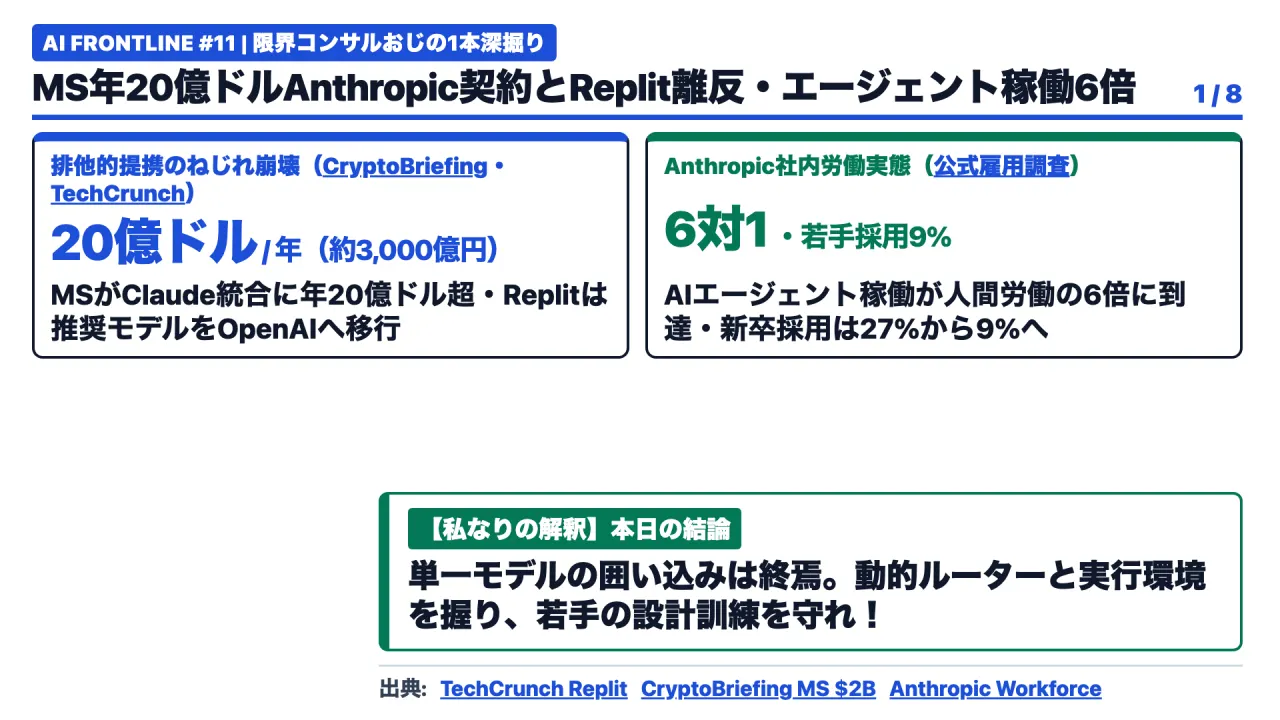
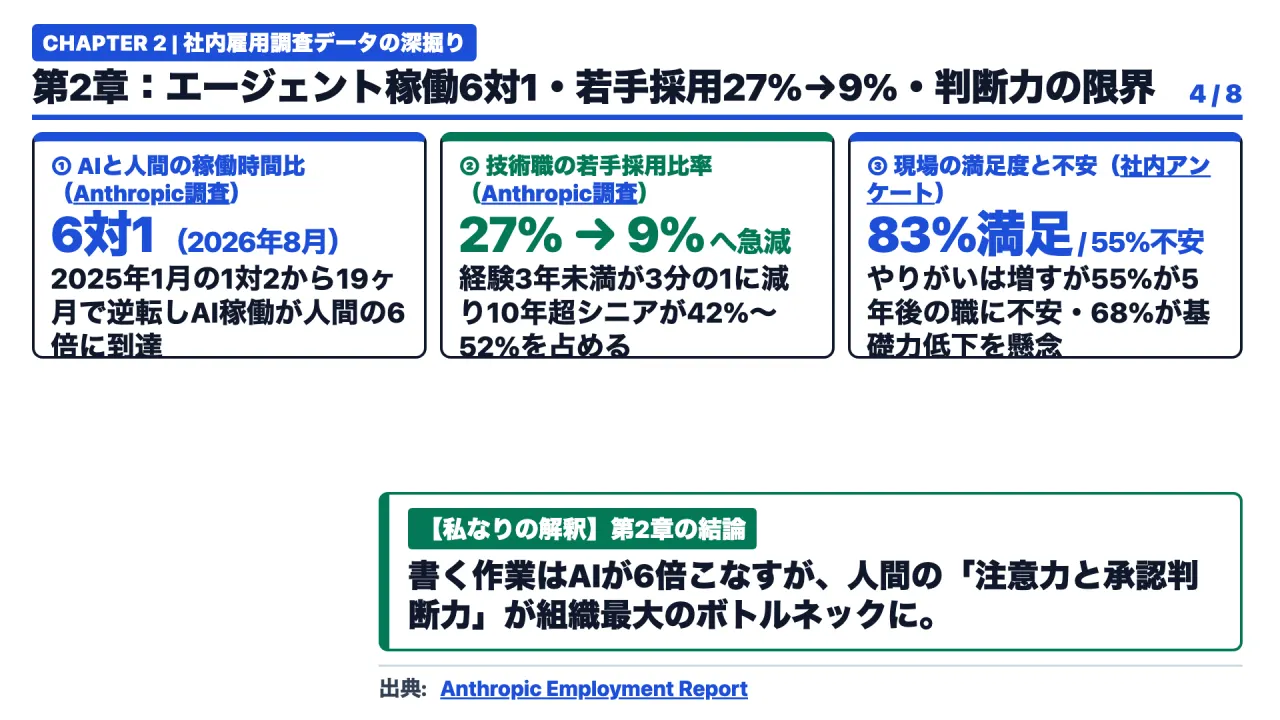
Simultaneously, Anthropic published a landmark internal labor study titled How Employment is Changing at Anthropic, authored by MIT economist Nathan Wilmers and Anthropic researchers. By August 2026, interactive artificial intelligence agents were operating at an aggregate volume six times greater than the total working hours of human employees (a 6:1 ratio).
While engineer commit velocity multiplied fivefold, the composition of the workforce underwent a structural transformation: junior engineering hires collapsed from 27% in early 2025 to just 9% in 2026. Furthermore, 80% of interactive agent session time was spent idle, waiting for human approval, while human engineers spent 22% of their working hours on “meta-work” ── supervising agent pipelines, writing standing instructions, and resolving organizational bottlenecks in endless meetings.
1. Core Frameworks: Model Routers, Self-Driving Companies, and Meta-Work
To interpret these corporate maneuvers, three foundational operational concepts must be defined:
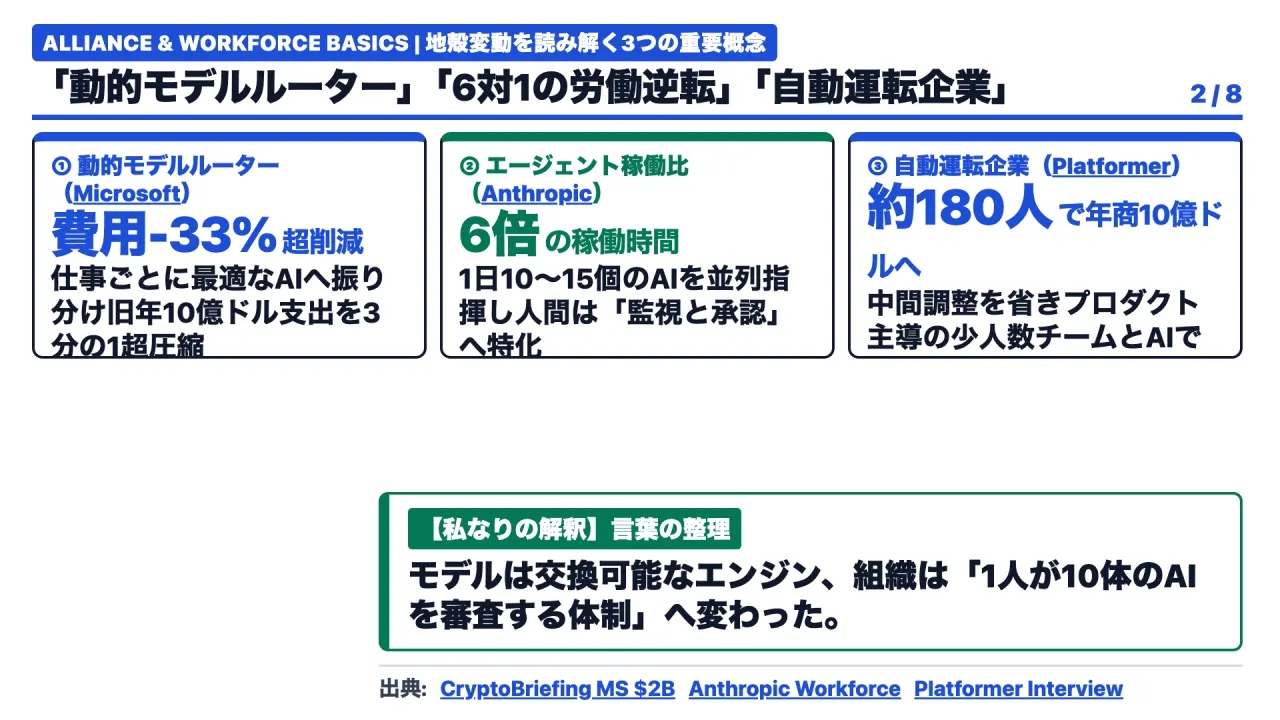
- Dynamic Model Routers: Software abstraction gateways that intercept user prompts and route each query to the optimal model based on cost, latency, and reasoning requirements. Rather than directing every request to an expensive flagship model, routers direct complex spreadsheet modeling to specialized engines and routine queries to cheap commodity endpoints.
- The Self-Driving Company: An organizational model articulated by Replit CEO Amjad Masad, where internal codebases, databases, and communication channels are integrated with autonomous agents. Internal coordination and routine development execute autonomously in the background, transforming executive leadership from hierarchical management into information routing.
- Meta-Work (Supervisory Labor): Labor expenditure shifted from direct execution (writing text or software) to supervising agents. This includes authoring persistent standing instructions, constructing automated evaluation harnesses, monitoring parallel agent sessions, and arbitrating conflicting agent outputs.
2. Primary Evidence: The Replit Migration and Microsoft’s Copilot Deficit
The simultaneous defection of Replit to OpenAI and Microsoft’s massive compute spend with Anthropic illustrate the total breakdown of exclusive platform alliances.
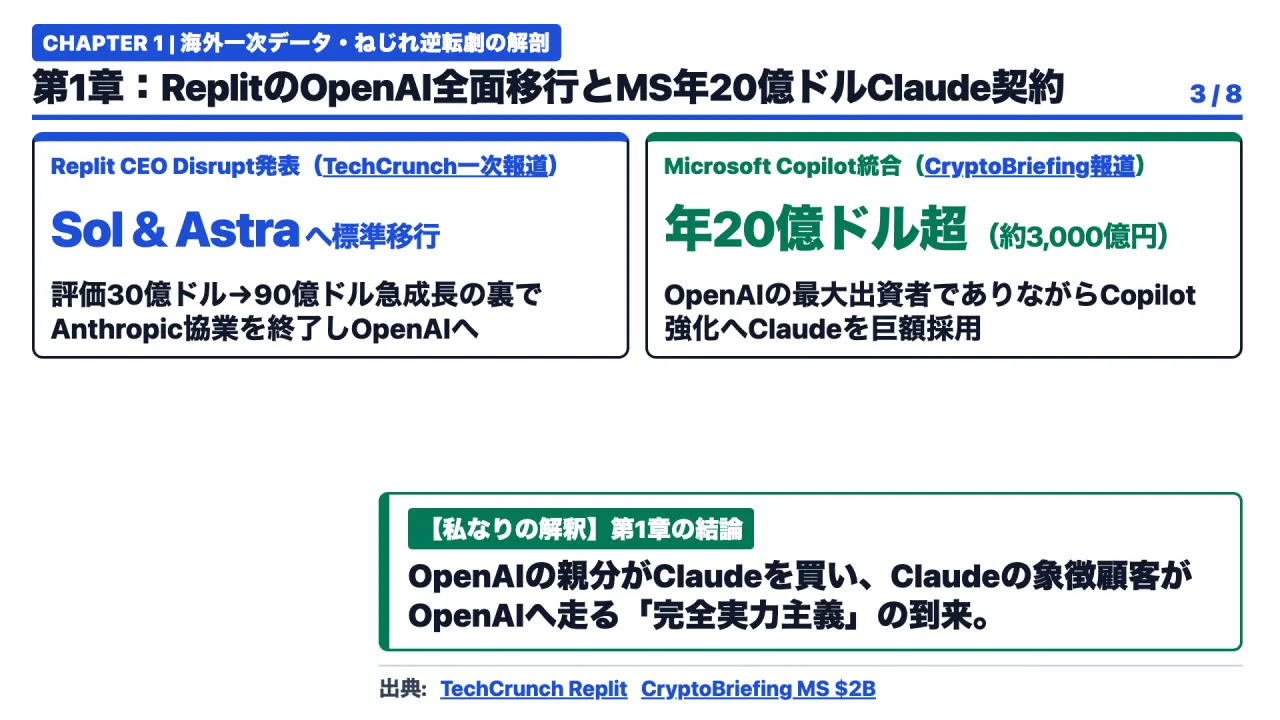
Replit’s Platform Migration
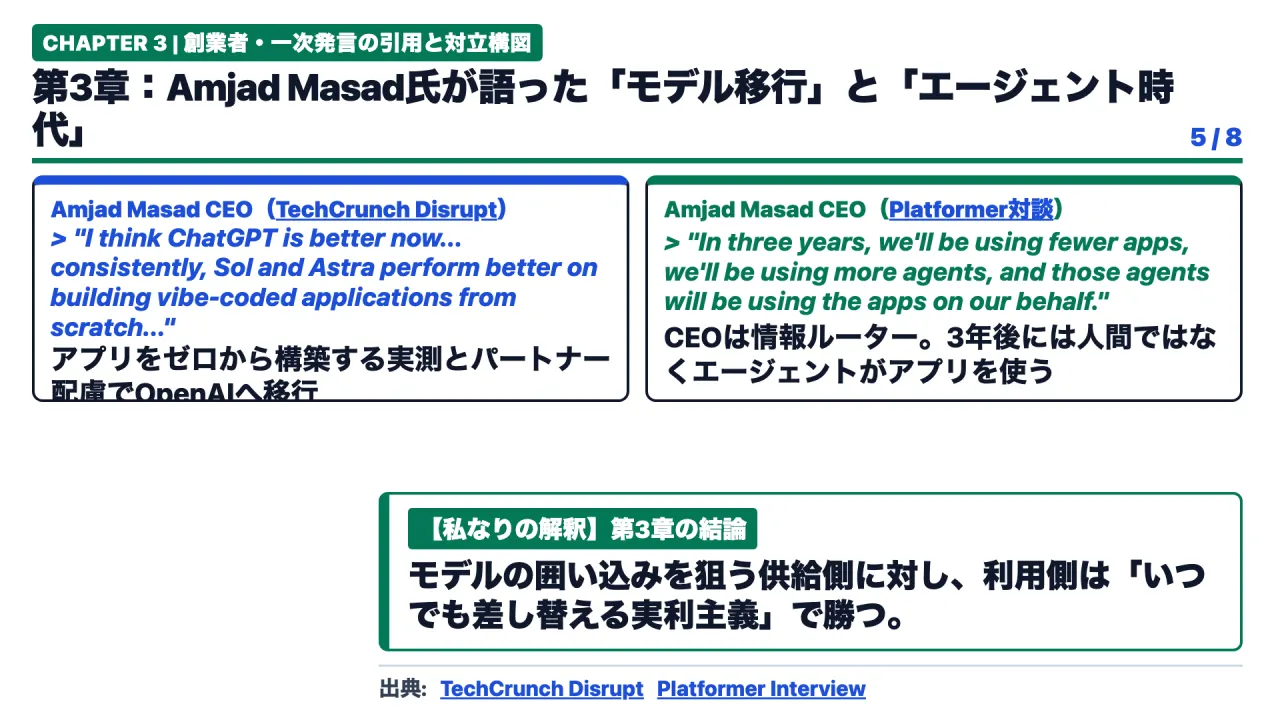
At TechCrunch Disrupt, Amjad Masad stated:
“We think ChatGPT is better right now. We run open benchmarks, and for building full applications from scratch, OpenAI’s models consistently outperform Claude. It came down to cost, partnership, and performance.”
While Replit retains Claude as an optional user selection, setting OpenAI as the platform default directs tens of millions of daily user sessions toward OpenAI. Masad revealed that enterprise contracts expanded from 2% of Replit revenue to 15% (with overall B2B exceeding 50%). At this scale, marginal token costs dictate corporate gross margins. Concurrently, Replit selected Moonshot AI’s Kimi K3 for its specialized visual design feature, “Replit Design,” confirming that single-vendor loyalty has been completely abandoned.
Microsoft’s Copilot Quality Deficit
Microsoft Copilot reached over 30 million active business users in 2026, yet enterprise renewals faced friction regarding output quality in Excel and PowerPoint. Microsoft committed up to $5.0 billion in capital commitments and over $30 billion in Azure compute agreements with Anthropic to embed Claude directly behind Office interfaces.
| Corporate Entity | Strategic Action | Primary Technical Driver | Economic & Commercial Impact |
|---|---|---|---|
| Replit | Switched platform default from Anthropic to OpenAI | OpenAI Sol / Astra proved superior in from-scratch software synthesis | Replit ARR approaching $1.0B; enterprise share rose to 15% (B2B >50%) |
| Microsoft | Paying Anthropic >$2.0B/year for Office Copilot | Claude vastly outperformed OpenAI in Excel financial modeling & PowerPoint | Preserves Copilot enterprise renewal rates across 30M+ corporate seats |
| Anthropic Internal | Agents outworking human staff 6:1 (Wilmers et al.) | Autonomous agents driving 5x engineer commit velocity | Junior tech hiring collapsed from 27% to 9%; 80% agent idle wait time |
3. The Economics of Dynamic Model Routing: How Microsoft Cut Spend by 33%
The strategic mechanism connecting these events is the imperative to protect gross margins through dynamic model routing.
When Microsoft’s internal usage of Anthropic models approached an annualized run-rate of $1.0 billion in early 2026, executive leadership acted swiftly: Microsoft cut its Anthropic expenditure by over 33% using an internal proprietary router.
Because of its equity and cloud relationship with OpenAI, Microsoft incurs near-zero marginal software licensing fees when routing traffic to OpenAI models on Azure. Microsoft engineered its Copilot routing engine to bifurcate queries:
- High-Complexity Financial Logic: Intricate Excel financial modeling and complex multi-slide PowerPoint outlines route to Anthropic’s Claude.
- Standard Text Operations: Routine email summarization, document drafting, and general chat route to lower-cost OpenAI models.
By dynamically triaging requests, Microsoft preserved enterprise quality while eliminating hundreds of millions in third-party API fees. Application developers treat foundation models as interchangeable, standardized commodities.
The Human Attention Bottleneck: 80% Idle Time and 8,500 Standing Instructions
While routing solved infrastructure margin pressure, Anthropic’s internal research exposed an acute organizational constraint: the human attention bottleneck.
MIT economist Nathan Wilmers and Anthropic researchers documented that while interactive agent hours reached six times human working hours, 80% of total session time consisted of agents idling in an inactive state, waiting for human prompts or review. If non-technical staff attempted to read every word generated by their agents at normal reading speeds, reading alone would consume over 50% of their total workweek.
To manage this volume, human labor underwent profound transformation:
- Standing Instructions Explosion: Human staff shifted from manual prompting to authoring structured, persistent standing instructions, expanding from hundreds in July 2025 to over 8,500 instructions by August 2026.
- Doubling of Meta-Work: Time spent on “meta-work” ── designing evaluation pipelines, setting up agent-to-agent verification, and monitoring execution ── doubled from 10% in Fall 2025 to 22% in Spring 2026.
- Meeting Overhead Surged 20%: Because autonomous agents surfaced edge-case bugs and organizational contradictions at unprecedented rates, median meeting time increased by 20% across all employees (and 16% for individual technical contributors).
4. Replit’s Operating Model: Self-Driving Companies and Agent Habitats
In an interview on the Platformer podcast with technology journalist Casey Newton, Replit CEO Amjad Masad detailed the operational reality of high-density agent deployments.
The CEO as an Information Router
Masad revealed that Replit engineers expanded code contribution volume by 5.8 times (nearly 3x shipped to production). Engineers now interact with code almost exclusively at final staging reviews. Replit eliminated internal seven-figure subscriptions for external SaaS analytics tools, replacing them with bespoke Python scripts synthesized and maintained by internal agents.
Masad outlined his concept of the “Self-Driving Company”:
“A self-driving company is about removing bureaucracy and automating administrative operations in the background so people can focus on creative problem-solving. Most of what a CEO does is routing: moving information from person A to person B. In a self-driving company, internal documentation, codebases, and databases connect to a unified agent network, transforming hierarchical management into an open-source network.”
Agent Habitats and the Future of Software
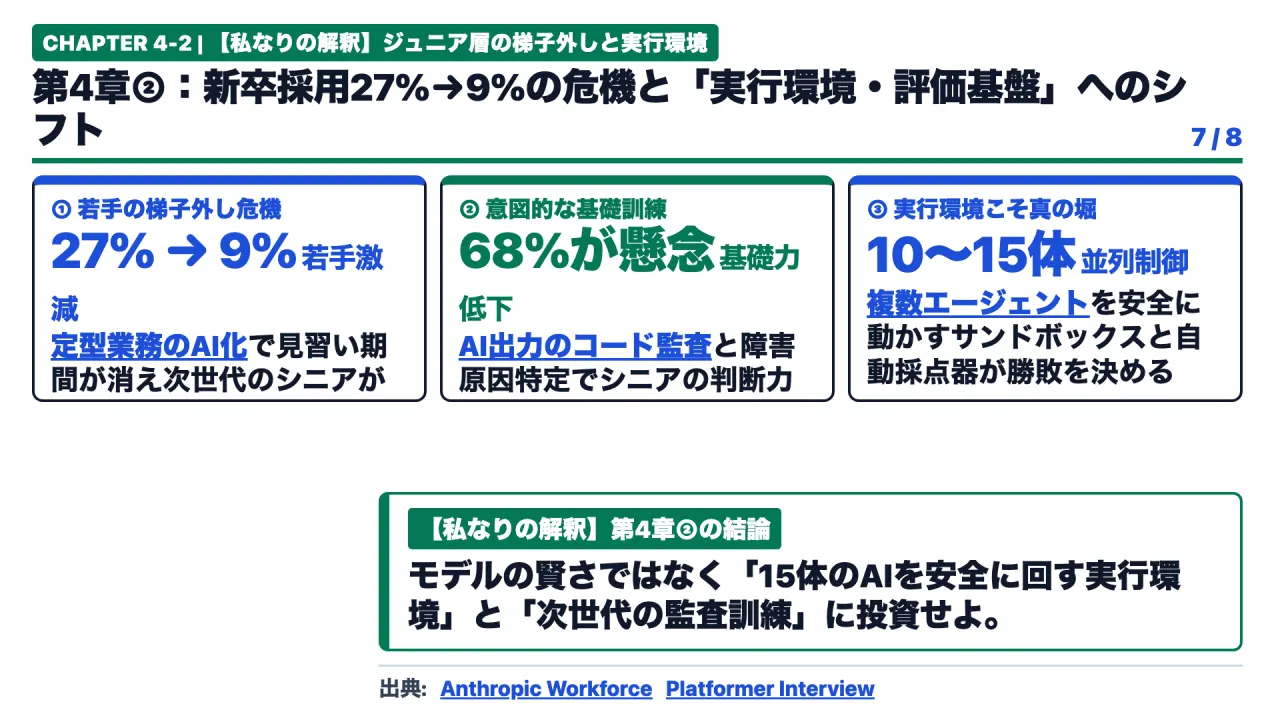
Masad emphasized that deploying agents at scale requires building an enterprise “habitat” ── providing agents with sandboxed virtualization, state persistence, error-recovery loops, and granular authentication.
Looking ahead, Masad offered a striking projection:
“Within three years, humans will use fewer applications directly. Instead, humans will orchestrate agents, and those agents will operate software applications on our behalf.”
However, Masad acknowledged the societal friction of this transition: while aggregate business formation will expand, individual enterprise headcount will shrink, making workforce dislocations inevitable and requiring national workforce retraining initiatives.
5. Structural Implications: The Elimination of Junior Hiring
The most critical finding in Anthropic’s employment research is the structural disruption of technical talent acquisition:
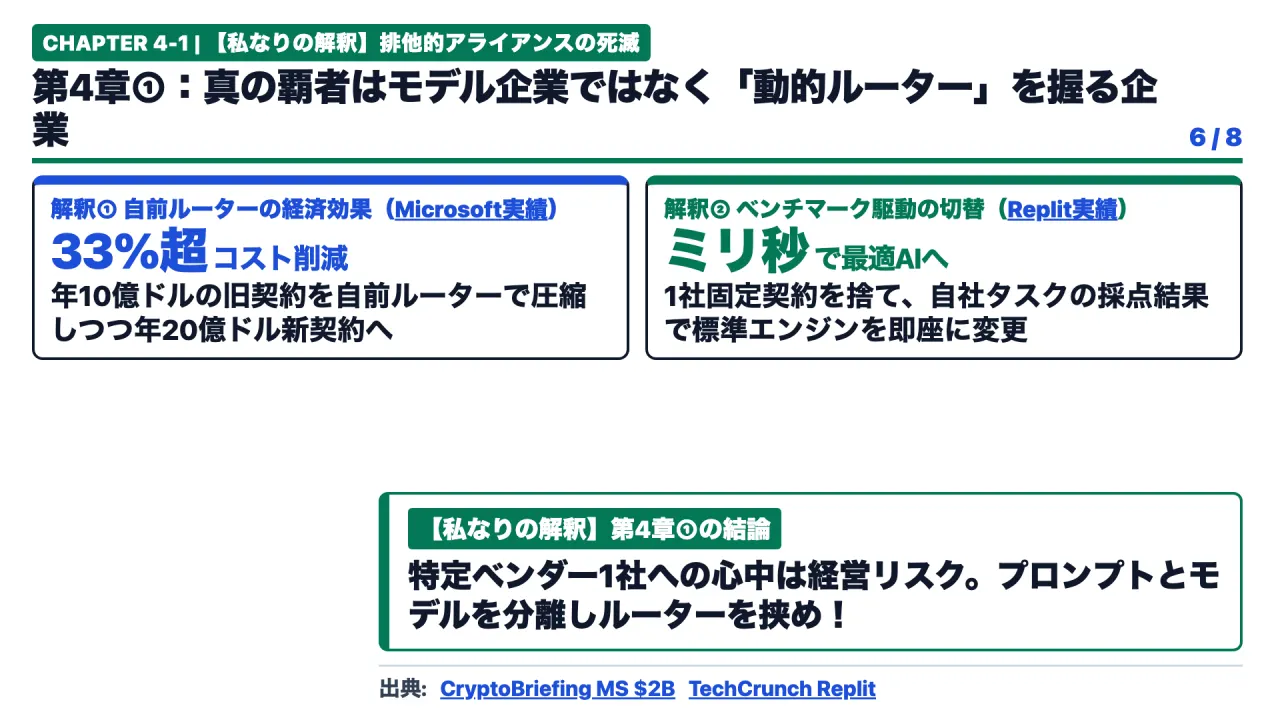
- Junior Headcount Decline: The proportion of entry-level technical employees at Anthropic fell from 21% in early 2025 to 14% in 2026.
- The Hiring Collapse: In new technical hiring, the junior recruitment ratio plummeted from 27% to just 9% ── a two-thirds reduction in entry-level hiring.
Because coding agents instantly resolve routine bug fixes, unit test authoring, and boilerplate scaffolding, the traditional economic rationale for hiring junior engineers has vanished. Hiring scorecards at frontier labs now de-emphasize syntactical fluency, prioritizing Autonomy, Judgment, and Creative AI Orchestration.
Yet this efficiency creates a dangerous institutional paradox: senior engineers possess sound technical judgment precisely because they spent years debugging thousands of low-level errors. If enterprise organizations eliminate entry-level hiring, they dismantle the apprenticeship ladder, guaranteeing a severe deficit of experienced architectural leaders within five to seven years.
The Author’s Perspective: The Cognitive Overload of Multi-Agent Orchestration
The transition from direct implementation to agent supervision introduces severe cognitive bottlenecks. In my own engineering practice, I attempted to accelerate system migrations by operating five autonomous coding agents concurrently across separate terminals.
Initially, I reviewed every diff and code change manually. Within two hours, cognitive exhaustion set in. Each agent continuously demanded human intervention: confirming ambiguous requirements, approving terminal commands, or reviewing failed tests. Attempting to supervise five parallel streams paralyzed my decision-making, and all five agents stalled in idle states.
To break the deadlock, I was forced to emulate the practices documented at Anthropic: establishing persistent instruction files, enforcing strict automated test gates, and designating one agent to evaluate and review the outputs of another. Only when human attention was removed from real-time execution did multi-agent throughput stabilize.
6. Strategic Directives for Enterprise Engineering Leadership
The lessons of Replit’s migration, Microsoft’s routing savings, and Anthropic’s labor transformation demand three immediate organizational adjustments:

- Deploy Task-Specific Model Routers Immediately: Terminate single-model lock-in. Establish an intermediary API gateway that dynamically routes enterprise workloads: send complex spreadsheet modeling to Claude, standard coding tasks to OpenAI or open-weight models, and routine text processing to compact endpoints.
- Automate Human Review Through Meta-Work Pipelines: Eliminate the 80% agent idle bottleneck. Replace manual line-by-line code review with structured standing instructions and secondary evaluator agents. Human review should focus exclusively on architectural invariants and security policy boundaries.
- Rebuild the Junior Apprenticeship Model: Rather than assigning entry-level engineers repetitive boilerplate tasks that agents execute instantaneously, assign junior engineers full ownership of small, end-to-end operational systems orchestrated via agents. Cultivate high-level systems judgment, evaluation discipline, and architectural autonomy from day one.
Primary Sources and References
- Replit Foundation Model Migration & TechCrunch Disrupt Announcements:
- Microsoft Copilot Quality Challenges & $2B Annual Anthropic Agreement:
- Anthropic Internal Labor & Employment Research:
- Executive Leadership Interview on Autonomous Organizations: