Why OpenAI and Anthropic Are Hiring Zero AI Researchers in Tokyo ── Inside the 60M Yen Shift Toward Forward Deployed Engineering, Evals, and Osaka's 500MW Data Center
A comprehensive audit of 37 job specifications, executive appointments, and compensation data reveals that frontier AI dominance in Japan has pivoted from fundamental research to enterprise system refactoring, 90% adoption enablement, and gigawatt-scale infrastructure.
Published: October 27, 2026 | Read time: ~10 min | Watch Video (Japanese)
Executive Summary & The Tokyo Paradox
When software engineers and corporate technology leaders inspect the Tokyo job postings of the world’s preeminent frontier artificial intelligence organizations ── OpenAI and Anthropic ── they confront a striking omission: across both organizations, there is not a single opening for core pre-training, transformer algorithm research, or reinforcement learning researchers.
Instead, both companies are offering total annual compensation packages between 47 million and 60 million yen ($315,000 to $400,000, reaching up to 113 million yen for senior systems leads) for an entirely different operational profile:
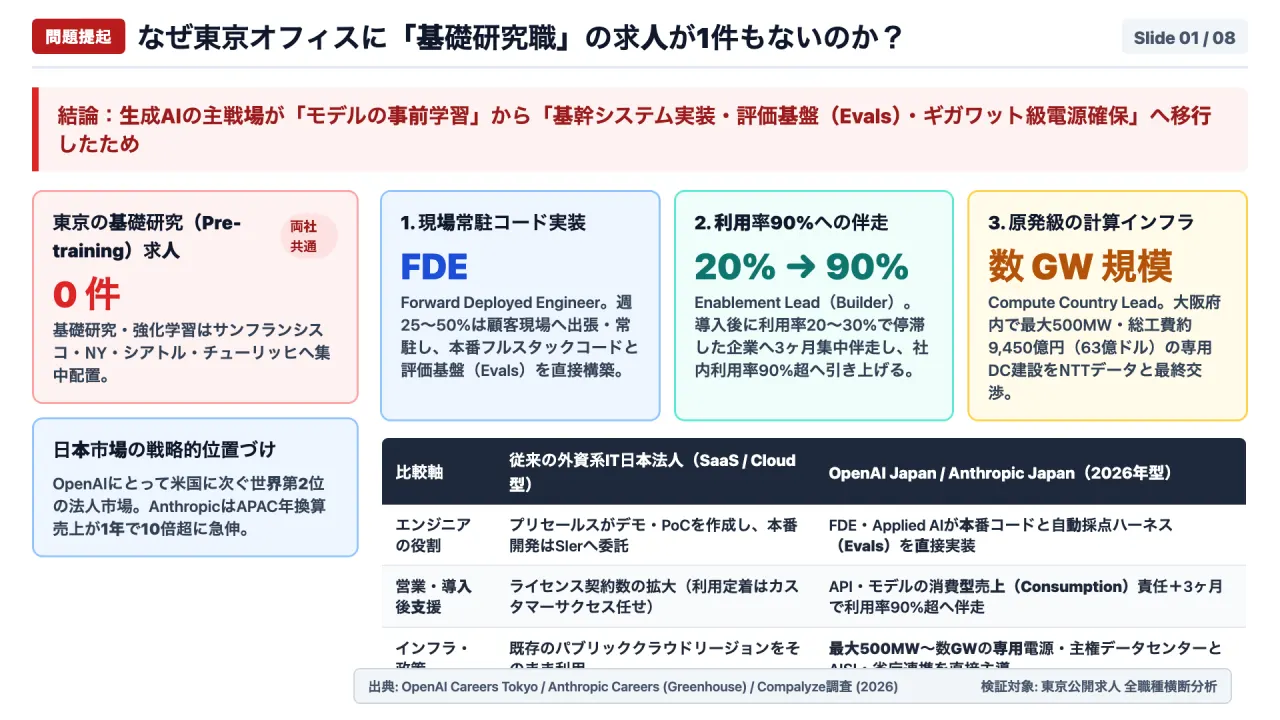
- Forward Deployed Engineers (FDEs) and Deployment Leads: Engineers spending 25% to 50% of their working hours on-site within Japanese enterprise customer environments, refactoring production full-stack systems and building automated evaluation harnesses (Evals) in Python and TypeScript.
- Enablement Leads (Builders): Operational leaders who embed within corporations whose enterprise AI adoption has stalled at 20% to 30%, running three-month intensive programs to lift active daily utilization above 90%.
- Compute Country Lead, Japan: Infrastructure executives tasked with expanding domestic power capacity from initial points of presence to “multiple gigawatts” ── spearheaded by active negotiations with NTT Data for a dedicated 500-megawatt (MW) data center in Osaka Prefecture valued at up to $6.3 billion (approximately 945 billion yen), targeting partial operation in 2028.
This investigation cross-examines 37 primary sources, including every Tokyo job description, corporate registry filings, executive appointments, and US compensation benchmarks. The findings confirm that artificial intelligence dominance in Japan has shifted from model demonstration to four operational imperatives: enterprise commercial distribution, legacy system integration, adoption engineering, and sovereign gigawatt-scale power procurement.
1. Asymmetric Market Entry: OpenAI Japan vs Anthropic Japan
While both companies view Japan as their foremost international commercial market outside the United States, their organizational structures, corporate governance, and go-to-market strategies exhibit marked asymmetries.
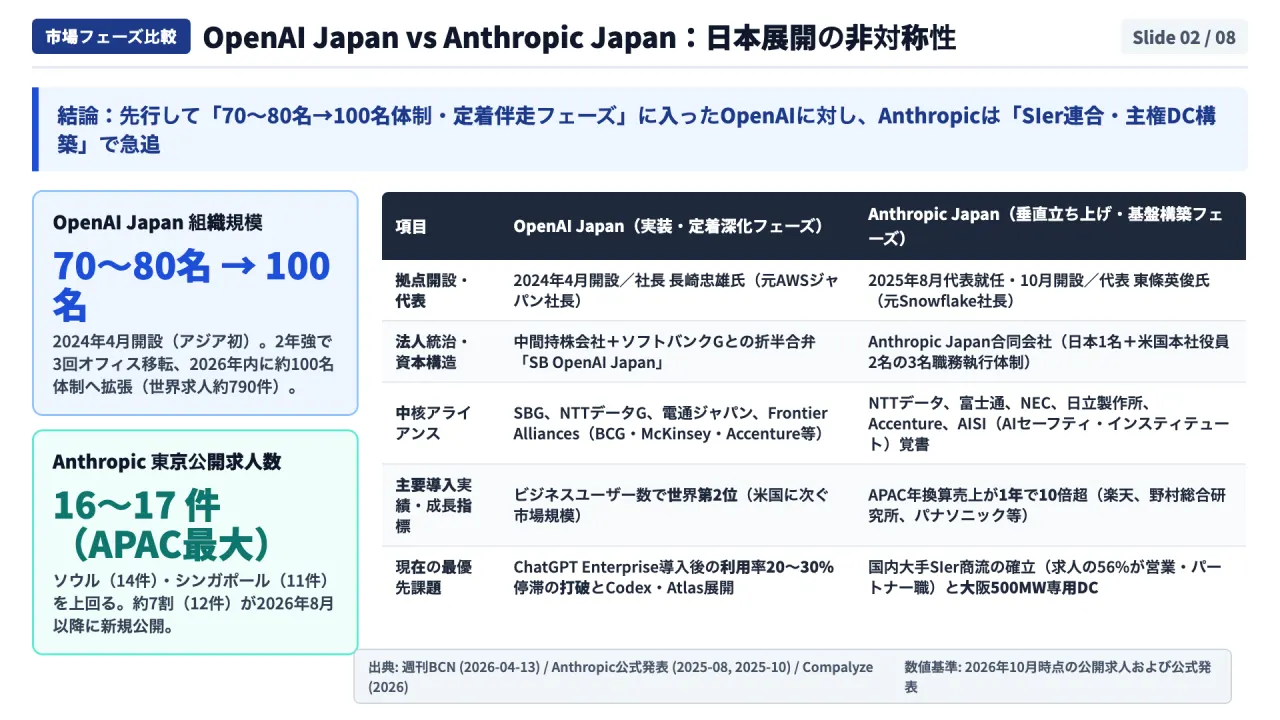
OpenAI established its Tokyo office in April 2024 as its fourth global hub and first in Asia, appointing former AWS Japan President Tadao Nagasaki. OpenAI Japan has expanded from an initial team of roughly a dozen to 70-80 employees, targeting approximately 100 personnel by the end of 2026. Japan represents OpenAI’s second-largest business user market globally. To anchor its domestic distribution, OpenAI formed a joint venture with SoftBank Group (SB OpenAI Japan) and aligned with global consulting firms under Frontier Alliances (BCG, McKinsey, Accenture, Capgemini).
Anthropic appointed former Snowflake Japan President Hidetoshi Tojo in August 2025, formally opening its Tokyo office in October 2025 as its first Asia-Pacific hub. Anthropic’s APAC annualized revenue expanded over tenfold year-over-year. By late October 2026, Anthropic listed 16 to 17 open positions in Tokyo ── surpassing Seoul (14 openings) and Singapore (11 openings) as its largest regional hiring footprint. Approximately 70% of these roles were posted after August 2026.
| Comparative Dimension | OpenAI Japan (Adoption & Integration Phase) | Anthropic Japan (Vertical Launch & Channel Build) |
|---|---|---|
| Establishment & Leadership | Opened April 2024; President Tadao Nagasaki (ex-AWS Japan) | Opened October 2025; Country Head Hidetoshi Tojo (ex-Snowflake) |
| Workforce & Hiring Scale | 70-80 staff, expanding to ~100 in 2026 (~790 global openings) | 16-17 Tokyo roles (APAC largest; Seoul 14, Singapore 11) |
| Corporate Governance | Intermediary holding structure + SoftBank JV (SB OpenAI Japan) | Anthropic Japan LLC (direct governance via 2 US HQ executives) |
| Primary SIer Alliances | SoftBank Group, NTT Data, Dentsu, Recursive, Frontier Alliances | NTT Data, Fujitsu, NEC, Hitachi, Accenture; AISI MoU |
| Market Traction | Second-largest business user market globally after the US | APAC annualized revenue up >10x YoY; Panasonic, Rakuten, NRI |
| Primary Operational Focus | Overcoming 20%-30% adoption plateaus; rolling out Codex agents | Establishing domestic SIer channels; Osaka 500MW data center |
OpenAI operates via strategic joint ventures and top-down executive partnerships. Anthropic maintains direct US executive governance while securing formal distribution agreements with Japan’s top five System Integrators (SIers) and formal policy alignment via an official Memorandum of Understanding (MoU) with Japan’s AI Safety Institute (AISI) following CEO Dario Amodei’s meeting with Prime Minister Sanae Takaichi.
2. The Four-Tier Tokyo Value-Creation Ecosystem
Neither organization is recruiting pre-training researchers in Tokyo because the critical barriers to monetizing AI in Japan are structural rather than algorithmic: navigating entrenched commercial channels, overcoming corporate adoption resistance, and securing sovereign compute.
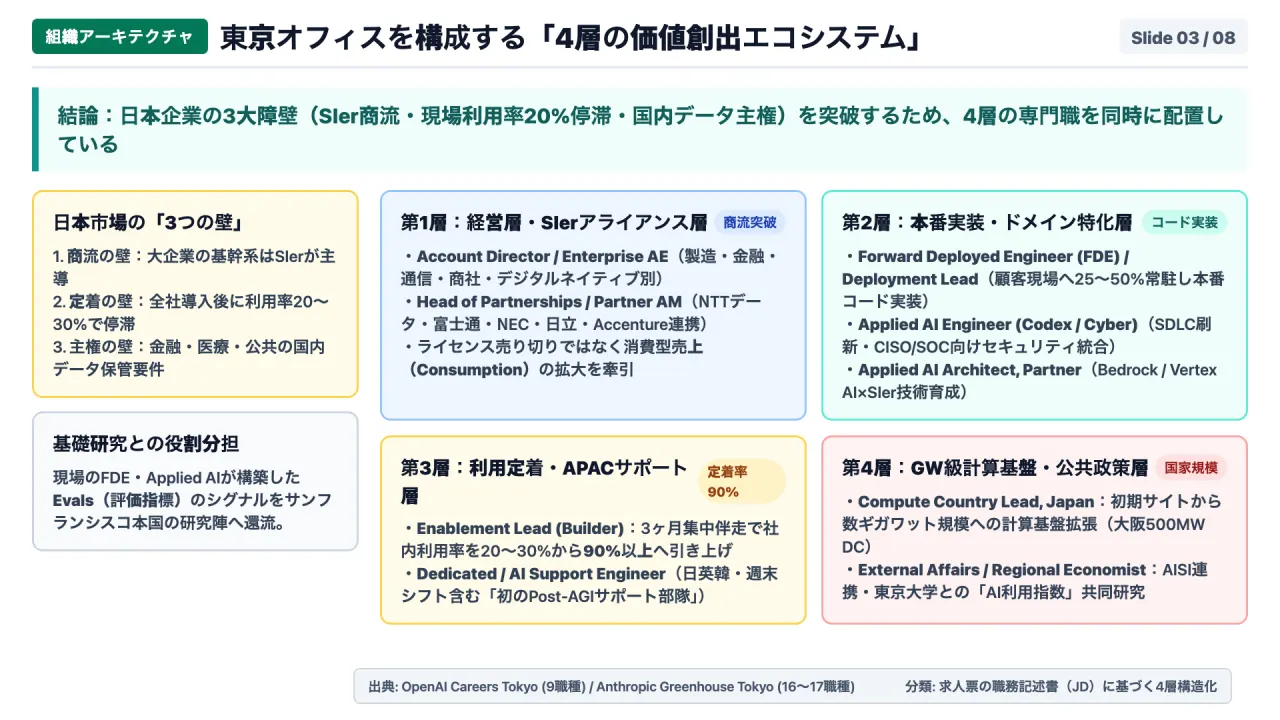
A functional audit of Tokyo job requisitions reveals a four-tier architecture:
| Operational Layer | Strategic Mission | OpenAI Tokyo Roles | Anthropic Tokyo Roles | Target Enterprise Barrier |
|---|---|---|---|---|
| Tier 1: Commercial & Channel | C-suite direct sales and SIer partner enablement | Account Director (Manufacturing, Financial, Startups) | Enterprise AE (5 industry sectors), Head of Partnerships | Entrenched SIer relationships controlling Japanese enterprise IT |
| Tier 2: Production Engineering | Full-stack deployment and custom evaluation harnesses | Forward Deployed Engineer (FDE), Applied AI (Codex, Cyber) | Applied AI Engineer, Applied AI Architect (Bedrock / Vertex) | The failure of superficial PoC demos to integrate into core systems |
| Tier 3: Adoption Enablement | Raising active enterprise usage from 20% to >90% | Enablement Lead (Builder), Dedicated Support Engineer | Technical Customer Support Specialist (APAC) | Shelfware syndrome where distributed licenses sit unused |
| Tier 4: Infrastructure & Policy | GW-scale power procurement and sovereign governance | Coordinated via San Francisco and SoftBank alliance | Compute Country Lead, External Affairs, Research Economist | Act on the Protection of Personal Information (APPI) & power limits |
These tiers operate in a closed feedback loop. When Tier 2 FDEs and Tier 3 Enablement Leads build evaluation harnesses within Japanese customer environments, observed edge-case failures and domain gaps are structured into telemetry feeds routed back to research teams in San Francisco.
3. Commercial Channels and Adoption: Breaking the 30% Plateau
In Japan, enterprise software licenses are rarely bought off the shelf; they are procured through multi-year systems integration relationships.
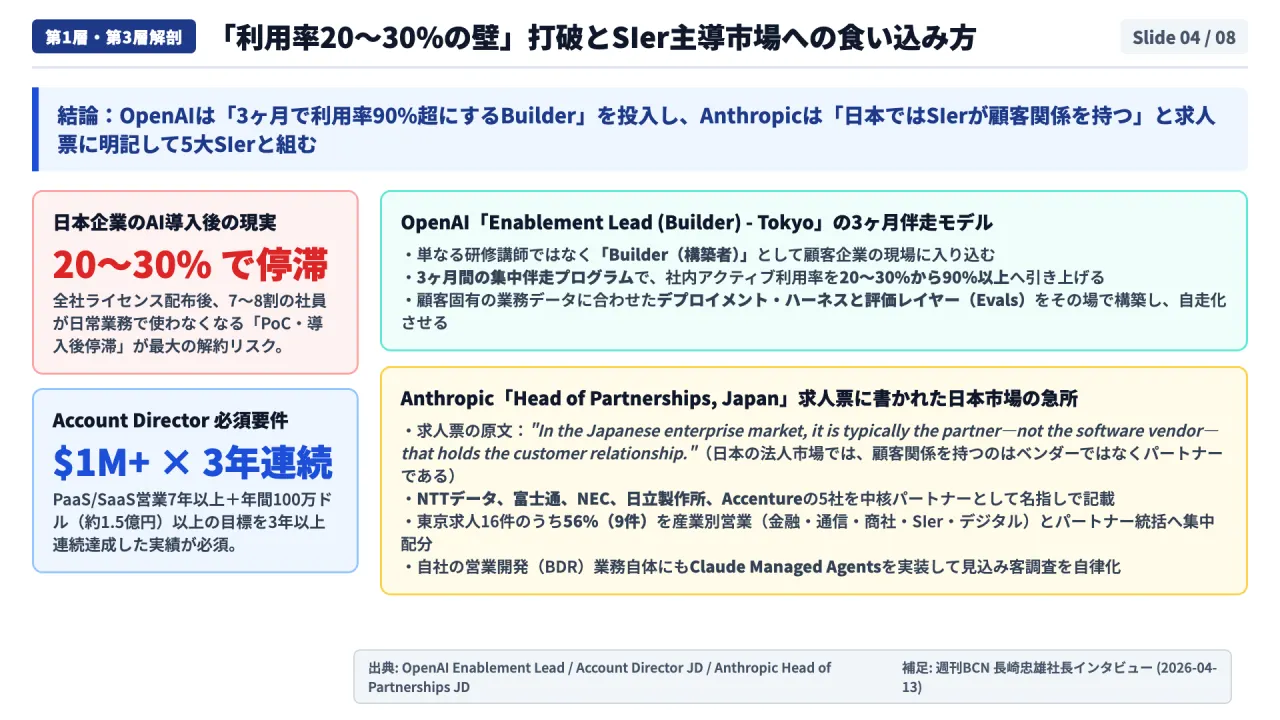
Anthropic’s Tokyo job description for “Head of Partnerships, Japan” articulates this reality with remarkable candor:
“In the Japanese enterprise market, it is typically the partner ── not the software vendor ── that holds the customer relationship.”
Consequently, Anthropic allocated 56% of its Tokyo openings (9 of 16 roles) to enterprise sales and partnership management, explicitly designating NTT Data, Fujitsu, NEC, Hitachi, and Accenture as target alliance partners. Furthermore, Anthropic requires Business Development Representatives (BDRs) to integrate the company’s autonomous “Claude Managed Agents” directly into daily prospecting pipelines.
Simultaneously, OpenAI created the “Enablement Lead (Builder)” role to solve the enterprise utilization bottleneck. While Japanese corporations frequently deploy ChatGPT Enterprise across tens of thousands of employees, active utilization routinely plateaus at 20% to 30%. The Enablement Lead is not a conventional customer success trainer; they are technical builders who develop custom deployment harnesses and evaluate daily workflows on-site, converting a 30% usage rate into sustained 90% utilization within 90 days. For Account Directors, OpenAI mandates at least seven years of enterprise sales experience with a documented track record of exceeding $1.0 million (150 million yen) in annual quota for three consecutive years, managing roughly ten key accounts on a consumption-revenue basis.
4. The Demise of Pre-Sales: Forward Deployed Engineering and Codex
The traditional pre-sales engineering model ── developing superficial prototypes and handing actual implementation to third-party contractors ── has been completely superseded.
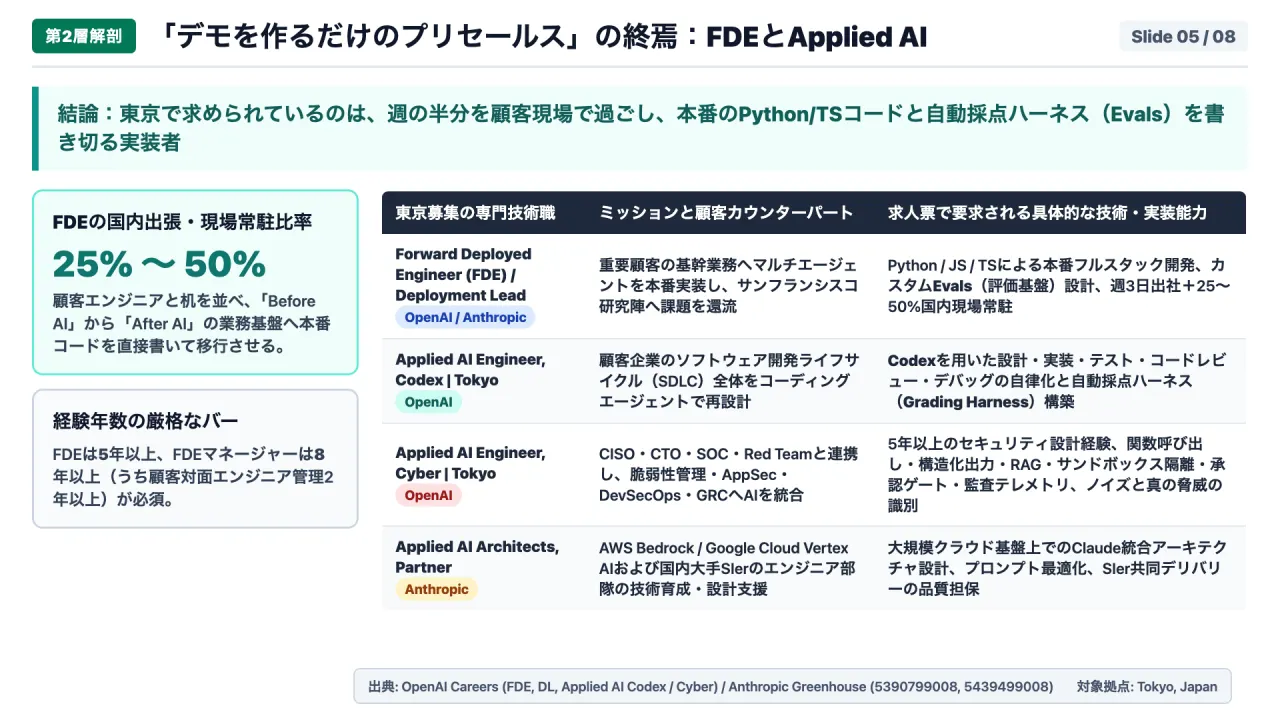
Both OpenAI and Anthropic require engineers who build production software directly alongside client developers:
- Forward Deployed Engineer (FDE) & Deployment Lead (OpenAI): Requires 5+ years of software engineering experience and bilingual proficiency. FDEs spend 25% to 50% of their working time on-site at client offices. Operating in Python and TypeScript, they refactor production architectures, build multi-agent pipelines, and establish custom evaluation harnesses.
- Applied AI Engineer, Codex (OpenAI): Transforms the client’s entire Software Development Life Cycle (SDLC) ── requirement definition, architecture, automated testing, review, and deployment ── using autonomous coding agents, while constructing automated evaluation harnesses.
- Applied AI Engineer, Cyber (OpenAI): Requires 5+ years of dedicated cybersecurity architecture experience. Collaborating directly with client CISOs, SOC analysts, and Red Teams, these engineers implement function calling, structured outputs, sandboxing, and approval gates, training operational teams to distinguish model noise from true vulnerabilities.
- Applied AI Architect, Partner (Anthropic): Embeds within AWS Bedrock, Google Cloud Vertex AI, and top SIer technical divisions to design enterprise architectures, prompt evaluation frameworks, and joint delivery models.
5. Multi-Gigawatt Ambitions: Osaka’s 500MW Data Center Negotiations
The most physically consequential role in Tokyo is Anthropic’s “Compute Country Lead, Japan” (Greenhouse Job ID: 5385559008).
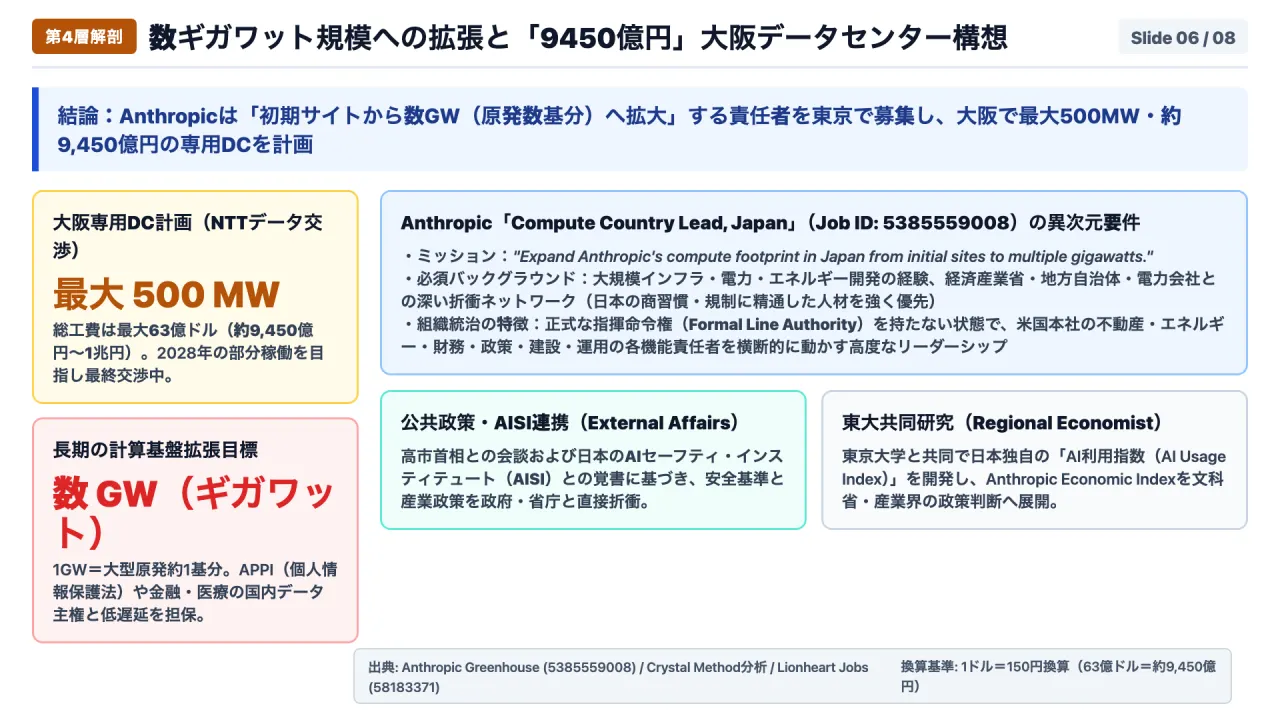
The job specification states the mission with unambiguous clarity:
“Expand Anthropic’s compute footprint in Japan from initial sites to multiple gigawatts.”
One gigawatt represents the generating capacity of a commercial nuclear reactor. The primary operational initiative advancing this mandate is Anthropic’s active negotiation with NTT Data to develop a dedicated data center facility in Osaka Prefecture:
- Power Envelope: Planned capacity of up to 500 megawatts (MW).
- Capital Expenditure: Projected project cost of up to $6.3 billion (approximately 945 billion to 1.0 trillion yen).
- Target Timeline: Targeted partial energization as early as 2028.
- Strategic Drivers: Strict compliance with Japan’s Act on the Protection of Personal Information (APPI), meeting data residency mandates for financial institutions and government agencies, and minimizing round-trip API latency.
The position requires navigating METI, regional utilities (Kansai Electric Power), and municipal leadership. The role requires driving complex negotiations across real estate, energy, finance, and legal teams without formal line authority.
Simultaneously, Anthropic’s External Affairs team coordinates policy with Japan’s AISI, while a Regional Research Economist partners with the University of Tokyo on economic indices.
6. Compensation Benchmarks and the Shenzhen I/O Examination Pivot
Securing engineers capable of operating across legacy Japanese infrastructure and cutting-edge agentic frameworks commands substantial compensation packages.
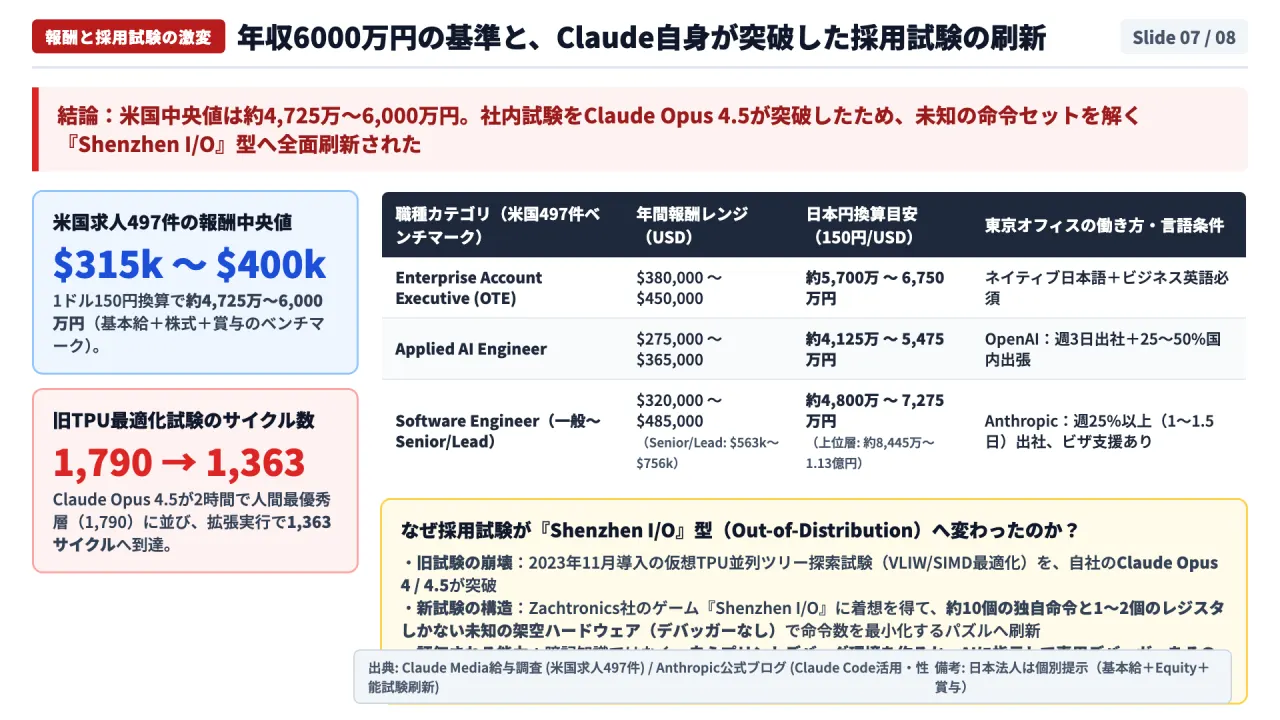
While Japanese job postings omit explicit figures due to local convention, an audit of 497 US job postings published by Anthropic provides verified baseline figures:
- Median Compensation: The median annual compensation across all 497 US postings ranges from $315,000 to $400,000 (approximately 47.25 million to 60.0 million yen), including base salary, equity grants, and performance bonuses.
- Enterprise Account Executives: Total on-target earnings (OTE) range between $380,000 and $450,000 (57.0M to 67.5M yen).
- Applied AI Engineers: Annual compensation spans $275,000 to $365,000 (41.25M to 54.75M yen).
- Senior Systems Software Leads: High-tier distributed systems engineers receive between $563,000 and $756,000 (84.45M to 113.4M yen).
The Breakdown of the TPU Simulator Exam and the Shenzhen I/O Redesign
Within Anthropic, internal engineering teams employ Claude Code as their primary tool, resolving incidents (like GKE Pod IP exhaustion) at triple velocity.
However, rapid algorithmic advances forced a redesign: Anthropic’s own models cracked the take-home exam.
- The Legacy TPU Exam (Nov 2023): Candidates had two hours to optimize a parallel tree search on a virtual TPU simulator in Python. In May 2025, Claude Opus 4 surpassed most applicants; Claude Opus 4.5 subsequently matched human top performers at 1,790 cycles within two hours (and 1,363 cycles in extended runs), resolving register transpositions and memory bank conflicts.
- The Shenzhen I/O Pivot: Inspired by Zachtronics’ game Shenzhen I/O, Anthropic created an Out-of-Distribution (OOD) test with a fictional processor (~10 instructions, 1-2 registers) and zero debuggers.
The assessment evaluates whether an engineer guesses blindly or directs AI to synthesize custom interactive instrumentation from first principles to diagnose bottlenecks.
7. Strategic Imperatives for Japanese IT Leadership
The absence of basic research roles and the aggressive recruitment of FDEs and infrastructure specialists provide three clear operational directives:
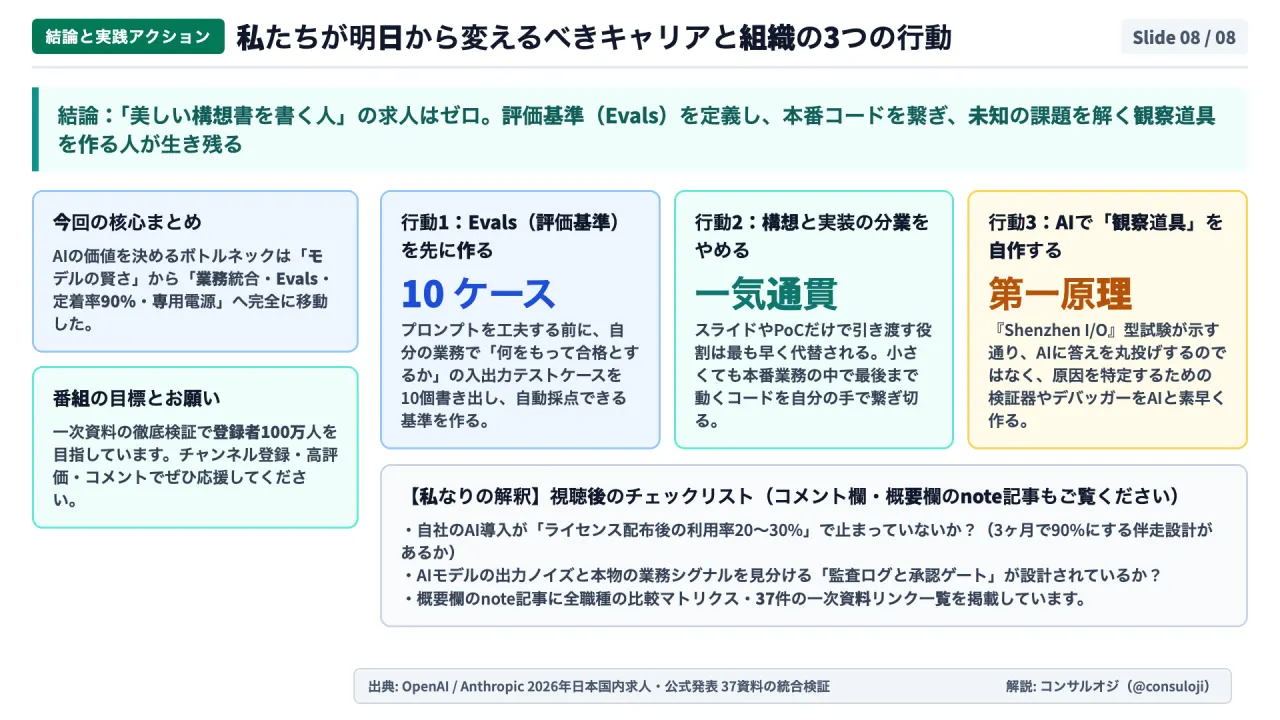
- Construct Ten-Case Evaluation Harnesses (Evals) Before Writing Prompts: When deploying artificial intelligence into enterprise workflows, abandon manual prompt tinkering. Follow the methodology of Tier 2 FDEs: define ten concrete test inputs, establish verifiable ground truth standards, and implement automated grading harnesses to measure regression quantitatively.
- Eliminate the Division Between Slide Consultants and Outsourced Coders: The traditional Japanese enterprise paradigm ── where strategy consultants draft vision decks and outsource implementation to subcontracting SIers ── has been abandoned by frontier labs. Competitive capability requires engineers who operate from business requirements down to production code and security boundaries.
- Employ AI as an Instrumentation Partner Rather Than an Oracle: Emulate the problem-solving model tested in modern engineering assessments. When debugging enterprise system failures, avoid prompting for speculative answers; direct AI to generate validation harnesses, telemetry parsers, and custom logging tools to measure reality directly.
Primary Sources and References
- OpenAI Official Job Postings & Corporate Announcements (Tokyo, Japan):
- Forward Deployed Engineer ── Tokyo | OpenAI Careers
- Deployment Lead (DL), FDE ── Tokyo | OpenAI Careers
- Applied AI Engineer, Codex ── Tokyo | OpenAI Careers
- Applied AI Engineer, Cyber ── Tokyo | OpenAI Careers
- Enablement Lead (Builder) ── Tokyo | OpenAI Careers
- Account Director, Manufacturing ── Tokyo | OpenAI Careers
- OpenAI Japan Leadership & Expansion Interview | Weekly BCN
- OpenAI Establishes Tokyo Office as Asian Hub | PC Watch
- Anthropic Official Job Postings, Corporate News & Technical Evaluation Records:
- Anthropic Appoints Hidetoshi Tojo as Head of Japan | Anthropic News
- Compute Country Lead, Japan (Greenhouse Job ID: 5385559008) | Anthropic Careers
- Applied AI Engineer, Tokyo (Job ID: 5390799008) | Anthropic Careers
- Head of Partnerships, Japan | Built In / Anthropic
- How Anthropic Teams Use Claude Code in Production | Anthropic News
- Anthropic Engineering: Technical Performance Exam & Shenzhen I/O Architecture | X (@AnthropicAI)
- Anthropic Tokyo Office Opening & Enterprise Expansion | Nihon Keizai Shimbun
- Market Analyses, Compensation Audits & Data Center Infrastructure: