Why Big Four Cloud Free Cash Flow Turned Negative for the First Time in 35 Years ── Mistral Large 4, Sovereign AI TCO Break-Evens, and the $176B Depreciation Time Bomb
As annual hyperscaler CapEx reaches $725B against 2-to-3-year GPU obsolescence, Mistral AI’s 3B Euro round and 1.05-trillion-parameter MoE model deliver a 45% to 65% TCO advantage over closed dedicated VPCs while shielding enterprise intellectual property from US export and cloud surveillance edicts.
Published: October 27, 2026 | Read time: ~10 min | Watch Video (Japanese)
Executive Summary & Core Findings
For fifteen years, mega-cap tech corporations commanded premium multiples due to asset-light business models generating immense free cash flow. The generative AI arms race has upended this dynamic. In 2026, aggregate capital expenditure (CapEx) across Big Four hyperscalers (Amazon, Alphabet, Meta, Microsoft) is projected to reach $660B to $725B, consuming roughly 100% of operating cash flow and driving collective free cash flow negative across multiple quarters for the first time in thirty-five years. Amazon faces 2026 CapEx of ~$200B, producing estimated negative free cash flow of -$17B to -$28B.
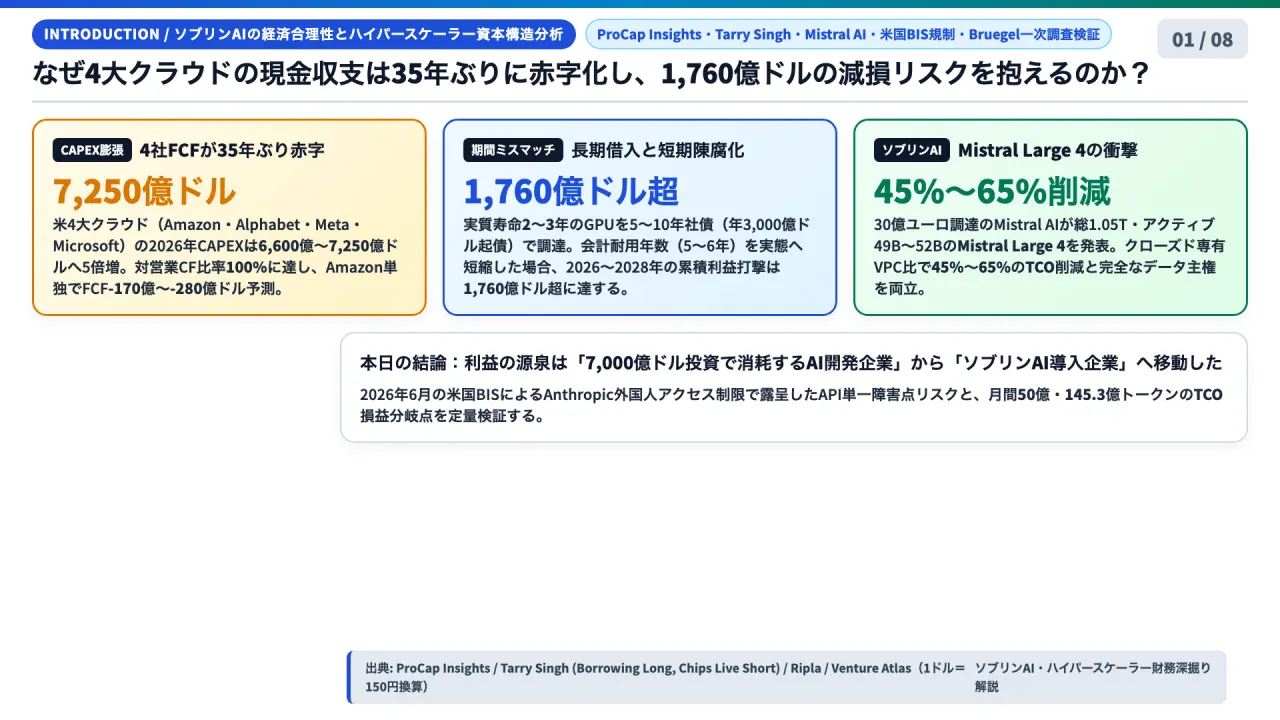
Concurrently, Europe’s Mistral AI is spearheading an open-weight counter-offensive. On September 8, 2026, Mistral closed a 3.0 billion Euro ($3.5B) Series D led by Samsung Electronics at a valuation exceeding 21 billion Euros ($24B), with ARR reaching $400M on track for $1.0B by year-end 2026. On October 6, 2026, Mistral unveiled Mistral Large 4 (codename: Le Chonk) ── a 1.05T Mixture-of-Experts (MoE) architecture activating 49B-52B parameters per token, trained on 3,800 Grace Blackwell GPUs.
Primary sources confirm five core findings:
- Hyperscaler CapEx Supercycle and Negative Free Cash Flow: Big Four CapEx surged from $145B in 2023 to $410B in 2025 and $660B-$725B in 2026 (projected >$1.0T in 2027), pushing aggregate free cash flow into sustained deficits.
- The $176 Billion Depreciation Time Bomb: Hyperscalers extended accounting server lives to 5.0-6.0 years, despite real GPU economic lives of 2 to 3 years. Restoring depreciation schedules to actual replacement cycles represents an aggregate earnings hit exceeding $176B across 2026-2028, compounded by $25B in annual cash interest from $400B in new debt.
- Frugal Architecture of Mistral Large 4: Activating 49B-52B parameters from a 1.05T pool, Mistral Large 4 delivers frontier coding and cyber capabilities (Cyber Index 50, Cybench 93%, DeepSWE v1.1 61.7%) at a blended API price of $2.065 per million tokens, vs closed API pricing of $6.00 to $30.00.
- 45% to 65% TCO Savings Over Dedicated Closed VPCs: Regulated enterprises (Airbus, ASML, BMW, HSBC) achieve 45% to 65% total cost of ownership (TCO) savings by self-hosting Mistral Large 4 on 8x NVIDIA H200 nodes ($4.32M over three years for four nodes) compared to closed dedicated VPC instances ($7.8M to $12.1M).
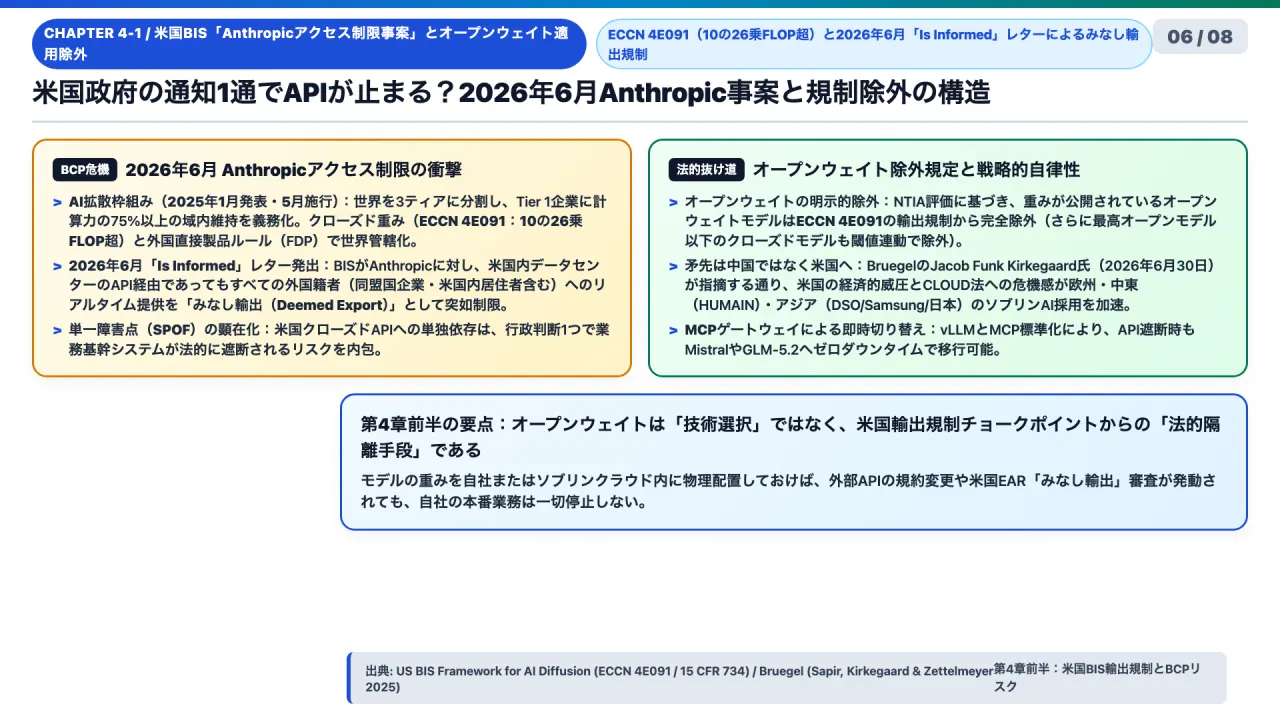
- Geopolitical Vulnerability of Closed APIs: In June 2026, the US BIS issued an ‘Is Informed’ letter to Anthropic under EAR Deemed Export rules (15 CFR Section 734.13) restricting real-time API access for foreign nationals. Under BIS ECCN 4E091 rules, open-weight models remain explicitly exempt.
1. The Duration Mismatch: Borrowing Long for Short-Lived Silicon
The central vulnerability of hyperscaler balance sheets is a duration mismatch: financing short-lived silicon using long-term debt liabilities.
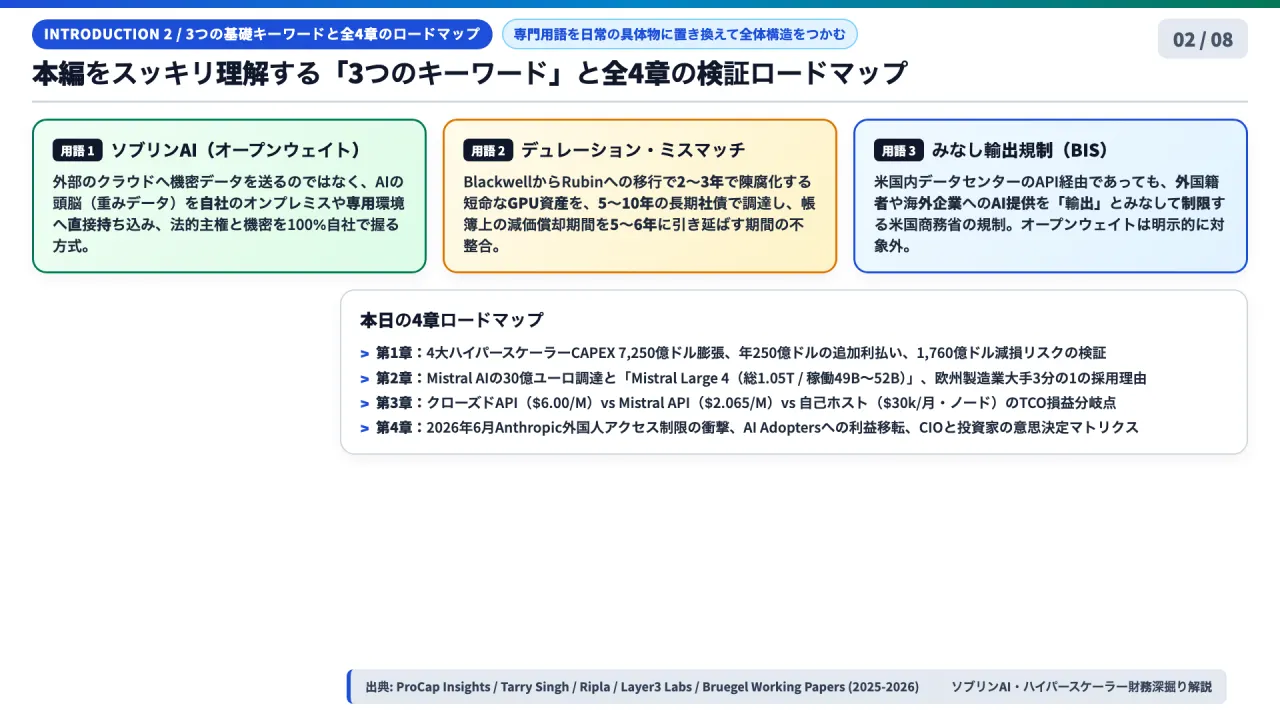
- Sovereign AI vs Cloud APIs: Closed APIs (GPT-5.5, Claude Opus 5.5) require sending enterprise data to external clouds subject to the US CLOUD Act. Sovereign AI involves deploying open weights on-premises or in air-gapped facilities, retaining jurisdictional control.
- Duration Mismatch: Hyperscalers issue 5-to-10-year bonds (~$300B in 2026) to acquire GPU clusters whose competitive commercial life is 24 to 36 months due to rapid architecture transitions (Blackwell to Rubin).
- Deemed Export Controls: Under US EAR rules (15 CFR Section 734.13), granting foreign nationals access to controlled technology via clouds is legally treated as an export to their home country.
2. Hyperscaler CapEx and the $176B Accounting Hangover
Primary financial analysis reveals how the CapEx explosion has compressed Big Tech profitability.
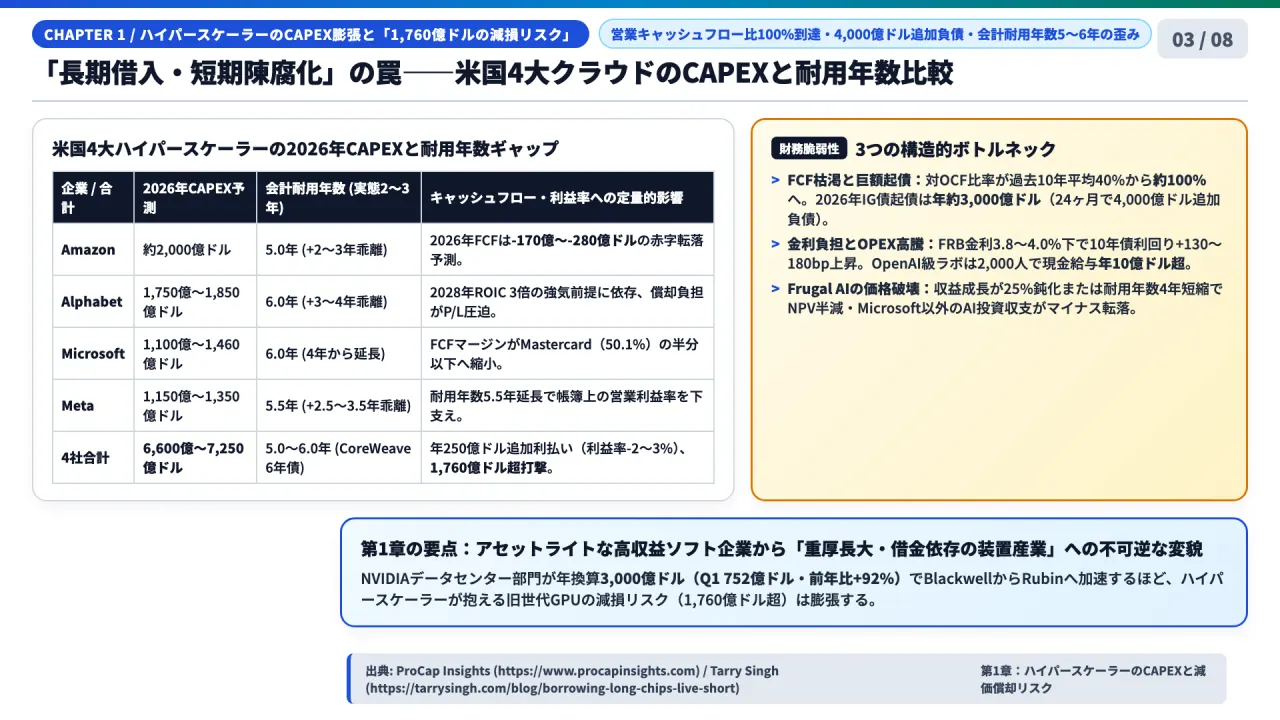
Between 2023 and 2026, Big Four CapEx surged from $145B to $660B-$725B. To cushion margins, hyperscalers stretched accounting server useful lives to 5.0 and 6.0 years.
| Entity / Asset Category | Projected 2026 CapEx | Accounting Server Useful Life | Real Economic Life Mismatch | Financial Exposure & Valuation Risk |
|---|---|---|---|---|
| Amazon | ~$200 Billion | 5.0 Years (revised from 6.0 in 2024) | +2.0 to 3.0 Years | 2026 FCF consensus -$17B; bear case -$28B |
| Alphabet | $175B - $185B | 6.0 Years (extended from 4.0) | +3.0 to 4.0 Years | Relies on high 2028 ROIC assumptions |
| Microsoft | $110B - $146B | 6.0 Years (extended from 4.0) | +3.0 to 4.0 Years | FCF conversion margin halved |
| Meta Platforms | $115B - $135B | 5.5 Years (extended incrementally) | +2.5 to 3.5 Years | Q3 FCF -$2.12B; halted share buybacks |
| Big Four Combined | $660B - $725B | 5.0 - 6.0 Years | +2.0 to 4.0 Years | $176B+ cumulative earnings hit; $25B annual interest |
| MSCI (Capital-Light) | Minimal (<5% sales) | N/A (Index Monopoly) | Zero Mismatch | Operating margin 53.6%; FCF margin 51.0% |
| Mastercard (Capital-Light) | Minimal (Payment Rails) | N/A (Network Rails) | Zero Mismatch | Operating margin 57.3%; FCF margin 50.1% |
Restoring useful lives to realistic 2.5-to-3.0-year cycles represents an estimated $176 billion cumulative earnings hit across 2026-2028. Concurrently, $400 billion in newly issued debt adds $25 billion in annual cash interest, depressing operating margins by 200 to 300 basis points.
3. Mistral AI’s 3B Euro Round and the Sovereign Architecture
While hyperscalers face balance-sheet strain, Mistral AI decoupled compute capacity from unsustainable CapEx.
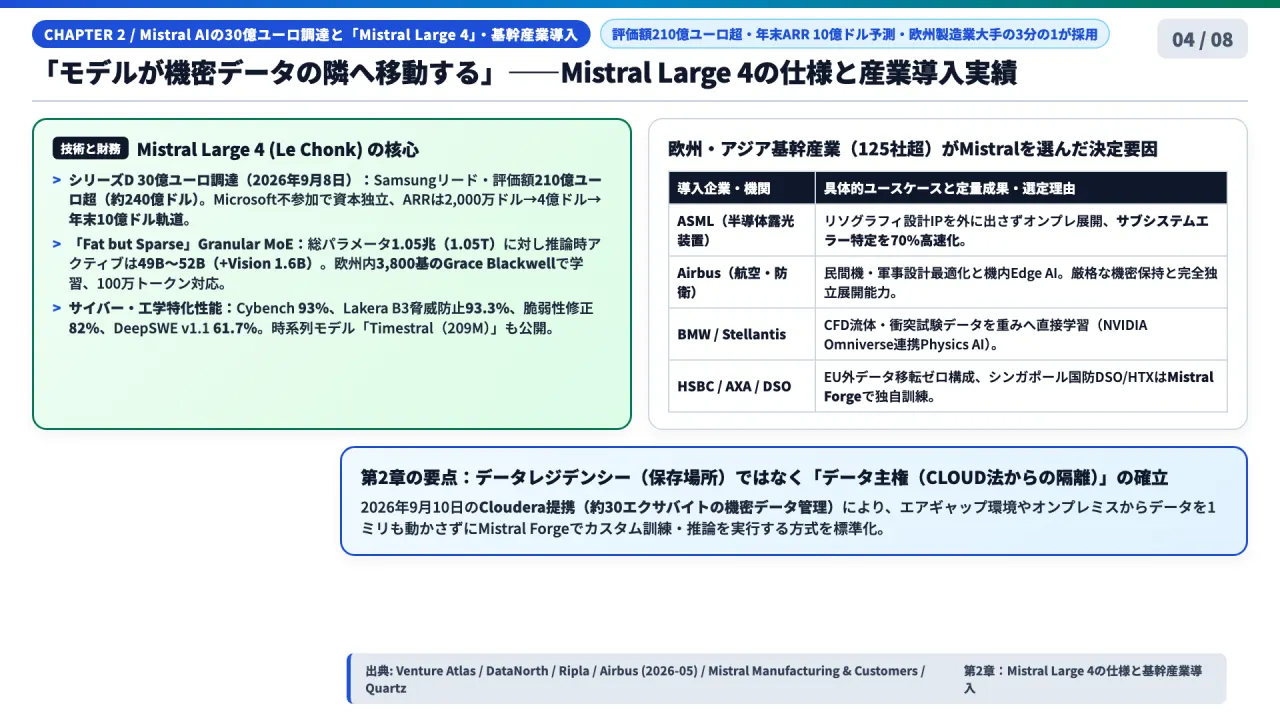
Mistral’s September 8, 2026, Series D raised 3.0 billion Euros (~$3.5B) at a valuation exceeding 21 billion Euros ($24B), led by Samsung Electronics with BlackRock and Scaleup Europe Fund. Concurrently, Mistral announced ‘Mistral Compute’ ── developing 200MW of sovereign European data center capacity by late 2027 and 1.0GW by 2030.
On October 6, 2026, Mistral introduced its flagship portfolio:
- Mistral Large 4 (Le Chonk): Granular MoE with 1.05T parameters (49B-52B active + 1.6B vision), 1M context, trained on 3,800 Grace Blackwell GPUs. Standard pricing is $1.36 input / $4.18 output ($2.065/1M blend). Benchmark results: Cyber Index 50, Cybench 93%, vulnerability patch 82%, DeepSWE v1.1 61.7%.
- Mistral Large 3 & Small 4: Large 3 offers 675B parameters ($0.75/1M blend); Small 4 activates 6.5B parameters out of 119B ($0.2625/1M blend), operating locally on 1-2 GPUs.
- Timestral: Open-weight time-series model (up to 209M parameters) dominating GIFT-Eval, TIME, and fev-bench benchmarks.
Mistral Large 4 activates only ~50B parameters per token, delivering fast inference while retaining the vast knowledge capacity of a trillion-parameter model.
4. Enterprise Adoption: Sovereign Deployments Across Key Sectors
Over one-third of the top 100 European industrial manufacturers, alongside defense ministries and financial institutions, have deployed Mistral models:
- ASML (Semiconductors): Deployed Mistral on-premises to protect EUV lithography IP, accelerating error diagnostics by 70%.
- Airbus (Aerospace & Defense): Strategic partnership in May 2026 to embed Mistral in defense programs and on-board aircraft edge hardware.
- BMW Group & Stellantis (Automotive): Combined Mistral with NVIDIA Omniverse for ‘Physics AI,’ integrating CFD and crash simulation data directly into model weights.
- Cloudera Partnership (September 10, 2026): Integrated Mistral Forge into Cloudera Data Platform, enabling fine-tuning across 30 exabytes of private enterprise data on-premises.
- Financial Institutions (HSBC, AXA, European Patent Office): Complied with EU DORA and GDPR mandates by processing loan underwriting, claims adjustments, and unreleased patent filings in isolated environments.
RAG vs Mistral Forge: Why Re-Training Weights Beats Prompt Injection
Industrial deployments reveal three limitations of Retrieval-Augmented Generation (RAG):
- Tacit Knowledge Cannot Be Retrieved as Text: Engineering logs and mechanical telemetry cannot be parsed by simple vector search. Mistral Forge embeds physical laws directly into model weights via Continued Pre-Training and DPO.
- Latency and Token Cost Reductions: Stuffing 200,000 tokens of engineering manuals into prompts slows TTFT and inflates compute expense. Pre-encoding institutional knowledge in the weights shrinks input context requirements by over 90%.
- Asset Permanence (Own Your Intelligence): Closed API vendors routinely alter model checkpoints. Owning trained weights creates an appreciating corporate asset.
5. Quantitative TCO Analysis: When Does Self-Hosting Beat Cloud APIs?
To determine the exact financial crossover between cloud APIs and on-premises hosting, we examine the Total Cost of Ownership (TCO) for Mistral Large 4.
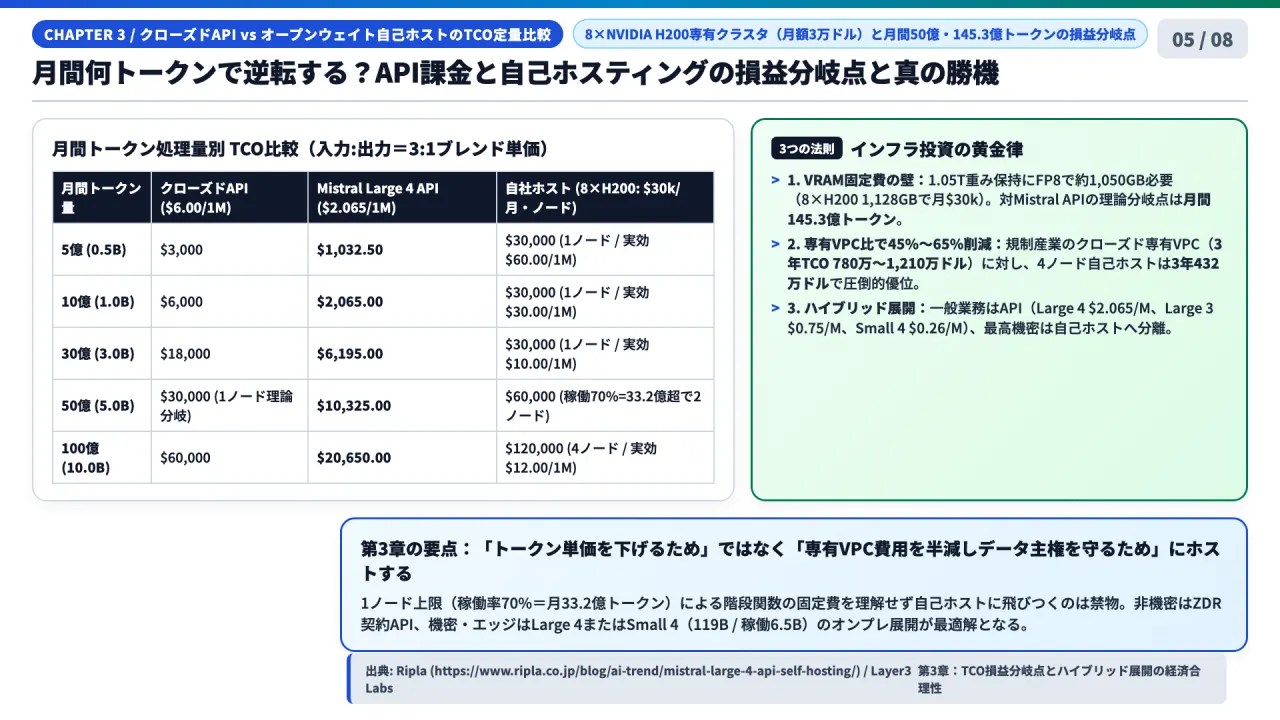
Hardware Envelope and Token Break-Evens
Under FP8 quantization, Mistral Large 4 weights occupy ~1,050 GB of VRAM. An 8x NVIDIA H200 server (1,128GB VRAM) provides the minimum viable memory envelope. Factoring in networking, storage, and MLOps overhead, all-in monthly TCO is $30,000 per node ($360,000 annually). At 70% effective utilization, an 8x H200 node processes 3.32 billion tokens per month.
| Monthly Token Volume | (1) Closed API ($6.00/1M) | (2) Mistral Large 4 API ($2.065/1M) | (3) Self-Hosted 8x H200 ($30k/node) | Active Node Count (70% Max) | Economic Verdict |
|---|---|---|---|---|---|
| 100 Million | $600 | $206.50 | $30,000 | 1 Node (3% load) | API Dominates: Self-hosting creates idle waste |
| 1.0 Billion | $6,000 | $2,065.00 | $30,000 | 1 Node (30% load) | API Advantage: Mistral API offers 66% savings vs closed |
| 3.0 Billion | $18,000 | $6,195.00 | $30,000 | 1 Node (90% peak) | Near Node Capacity: Single node reaches operational limits |
| 5.0 Billion | $30,000 | $10,325.00 | $60,000 | 2 Nodes (75% load) | 1-Node Break-Even vs Closed: Requires 2 nodes in practice |
| 10.0 Billion | $60,000 | $20,650.00 | $120,000 | 4 Nodes (75% load) | Scale Domain: Viable for sovereign air-gapped workloads |
| 14.53 Billion | $87,180 | $30,000.00 | $150,000 | 5 Nodes (87% load) | 1-Node Break-Even vs Mistral API: Pure token parity point |
Replacing Closed Dedicated VPC Instances
In defense, banking, and advanced manufacturing, compliance rules forbid multi-tenant public APIs. Three-year commitments for closed dedicated instances cost $7.8M to $12.1M ($216k to $336k monthly). By comparison, self-hosting Mistral Large 4 on a four-node H200 cluster costs $4.32M over three years ($120k monthly) ── delivering a 45% to 65% TCO reduction with complete data sovereignty.
6. Geopolitics, Labor Reallocation, and the Author’s Perspective
In June 2026, the US BIS issued an ‘Is Informed’ letter to Anthropic under EAR Deemed Export rules (15 CFR Section 734.13), asserting licensing requirements over real-time model access for foreign nationals. Because BIS ECCN 4E091 explicitly exempts open-weight models, enterprises operating on-premises open weights avoided operational disruption.
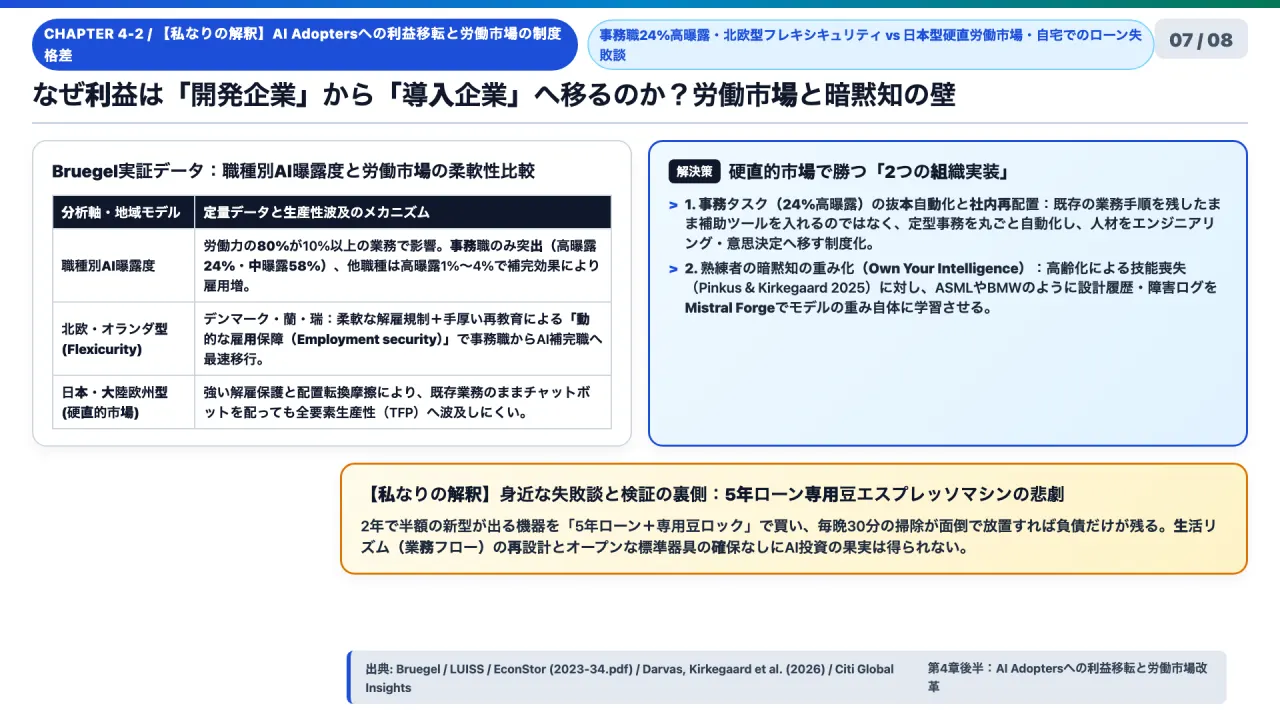
Bruegel research demonstrates that AI value is shifting from model producers to enterprise adopters. While engineering roles experience low automation exposure (1% to 4%), clerical tasks face 24% high exposure and 58% medium exposure. Economies with flexicurity systems automate routine administration rapidly, whereas rigid structures struggle to capture tangible ROI.
The Author’s Perspective: The Five-Year Espresso Machine Trap
This dynamic ── locking into long-term proprietary contracts for rapidly commoditizing technology ── reflects a personal purchasing mistake. Several years ago, I bought an espresso machine on a five-year installment plan bundled with a monthly bean subscription, expecting to break even in three years.
In reality, the machine required nightly cleaning and only operated with proprietary cartridges. Within two years, competitors released open machines at half the price. I spent three years servicing debt on an obsolete machine. The lesson is straightforward: never sign long-term debt or proprietary lock-in contracts for technology that halves in price every two years. Adopt open standards and adapt internal processes first.
7. Strategic Blueprint: The 3-Tier Enterprise Routing Architecture
To navigate hyperscaler depreciation risks and export controls, enterprise technology leaders should adopt a Three-Tier Hybrid Architecture:
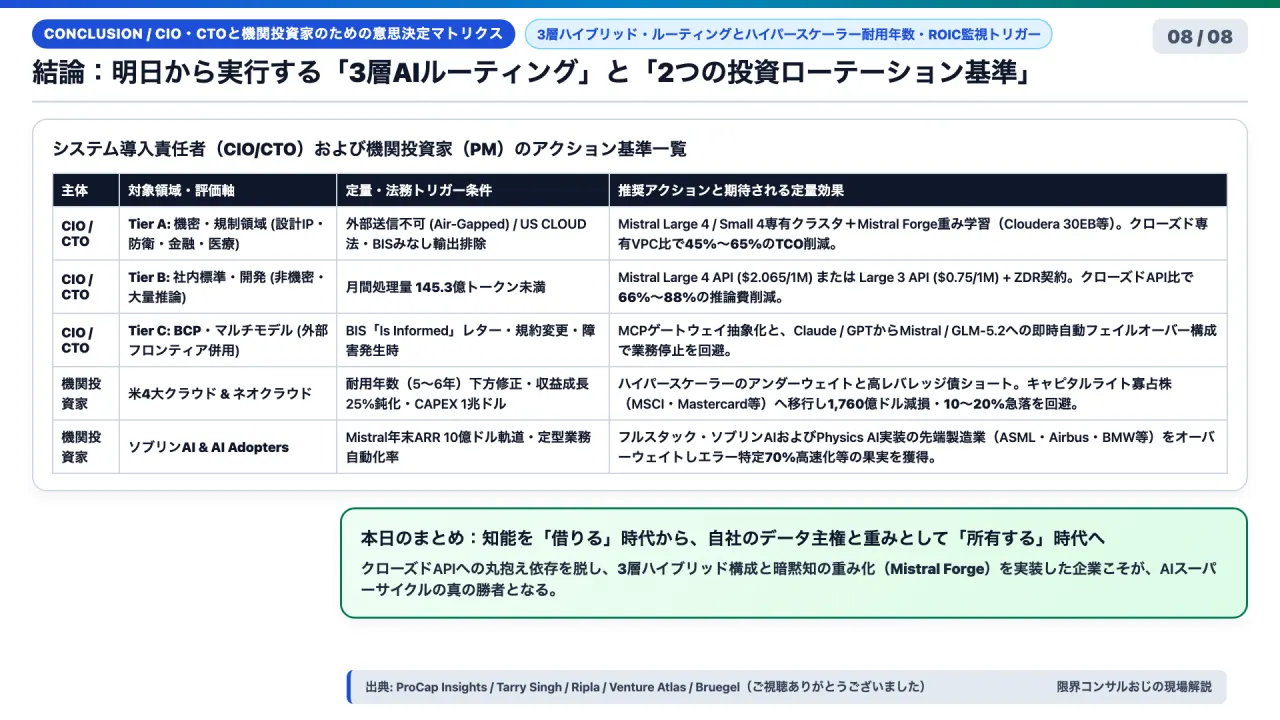
- Tier A: Sovereign Core (CAD, Defense, Financial Records): Zero external data transit; US CLOUD Act and BIS export isolation. Deploy self-hosted Mistral Large 4 (8x H200 nodes) or Mistral Small 4 (1-2 GPUs) + Mistral Forge. Delivers 45% to 65% TCO savings vs closed dedicated VPCs ($4.32M vs $7.8M-$12.1M over 3 years).
- Tier B: Cost-Efficient Scale (General Assistance, Non-Sensitive Workloads): Monthly volume under 14.5B tokens. Use Mistral Large 4 API ($2.065/1M) or Small 4 API ($0.2625/1M) with Zero Data Retention (ZDR). Avoids node fixed costs, delivering 66% to 88% cost savings over closed APIs.
- Tier C: Resilient Gateway (Frontier Reasoning & Failover): Model Context Protocol (MCP) gateway with automated failover. If closed APIs face export restrictions or outages, traffic routes instantly to self-hosted Mistral Large 4 without application code rewrites.
Primary Sources and References
- Hyperscaler CapEx, Free Cash Flow, Debt Financing & Depreciation Audits:
- Mistral AI Series D Funding, Mistral Large 4, Timestral & TCO Benchmarks:
- Ripla AI Trend Report: Mistral Large 4 API & Self-Hosting TCO Analysis
- Venture Atlas Corporate Profile: Mistral AI Series D & Frontier Model Portfolio
- DataNorth AI Technical Breakdown: The Complete Guide to Mistral AI Architecture
- Layer3 Labs Comparative Benchmark: Mistral Large 4 vs Claude Opus 5.5 & Frontier Closed APIs
- European & Global Industrial Deployments (Airbus, ASML, BMW, Cloudera):
- Airbus Official Press Announcement (May 2026): Airbus Partners with Mistral AI for Sovereign Environments
- Mistral AI Industrial Case Studies: Automotive & Manufacturing Operations
- Mistral AI Enterprise Portfolio: Global Customer Implementations
- Quartz Industrial Technology Report: Mistral AI, Airbus, and BMW ── Industrial Engineering & Physics AI
- US Commerce BIS Export Regulations, Labor Exposure & Adopter Economics: