Inside the 80% AI Corporate Debt Collapse, the 200-Neocloud Shakeout, and Microsoft's 60,000-Employee Buyout ── Why Pure-Play GPU Cloud Economics Broke Down in Q3 2026
As Morgan Stanley tracks monthly AI debt issuance plunging from $113B to $23B and Gartner projects a $4.9 trillion revenue shortfall by 2030, hyperscalers and tier-1 labs are turning to off-balance-sheet SPV leases, equity forward offerings, and structural headcount cuts to fund $175B annual CapEx.
Published: October 28, 2026 | Read time: ~10 min | Watch Video (Japanese)
Executive Summary & Core Facts
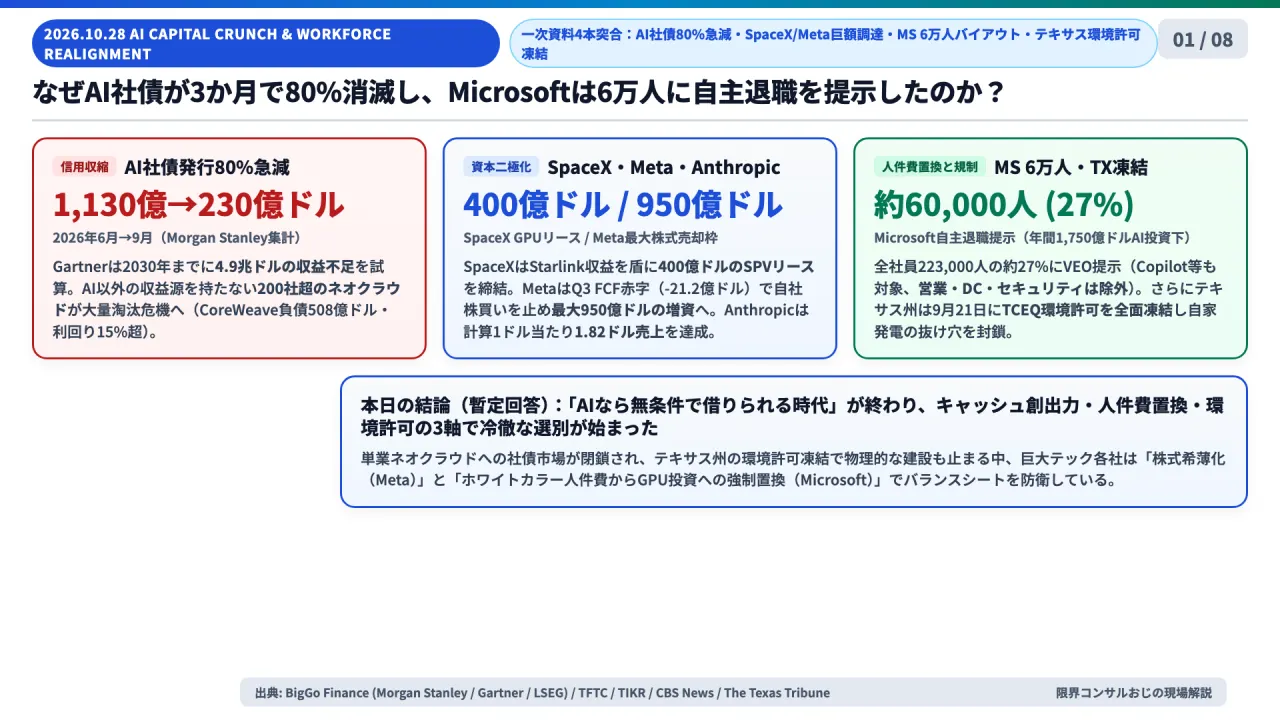
On October 26, 2026, an internal memorandum from Microsoft CPO Amy Coleman initiated a sweeping Voluntary Exit Offer (VEO) to approximately 60,000 employees ── roughly 27% of Microsoft’s 223,000-person global workforce across the US, Canada, UK, and India, targeting levels 59 through 70 (up to vice presidents). The buyout targeted Copilot engineering, AI Experiences, Windows plus Devices, Xbox, Finance, and HR. Meanwhile, three divisions were ring-fenced as sanctuaries: data center operations, enterprise cybersecurity, and commercial sales.
This restructuring represents a balance-sheet substitution: eliminating software payroll to fund CFO Amy Hood’s projected $175 billion annual AI infrastructure CapEx.
Concurrently, four independent filings confirmed the end of unconstrained debt-financed compute expansion:
- AI Debt Issuance Collapsed 80% in Three Months: Morgan Stanley syndicate data shows monthly AI debt issuance plunged from $113 billion in June 2026 to $23 billion in September 2026. Gartner reported that servicing $7.0 trillion in projected 2026-2030 AI infrastructure CapEx requires $8.5 trillion in cumulative revenue, but projected inflows will reach only $3.6 trillion, creating a $4.9 trillion revenue shortfall. This exposes over $3.5 trillion in physical assets to impairment risk and leaves more than 80% of independent neoclouds unable to survive independently by 2030.
- CoreWeave Liabilities Hit $50.8B as Bond Yields Exceeded 15%: SEC and Reuters/LSEG data show CoreWeave carried $35.07 billion in debt and $15.74 billion in operating leases on June 30, 2026. Secondary bond yields spiked past 15%, equity dropped 70% from its June 2025 peak of $183.58 to ~$54, and 5-year CDS spreads widened (Oracle +28 bp to 288 bp; SoftBank +24 bp to 424 bp). In Japan, MUFG served as co-lead on CoreWeave’s $8.5 billion facility (DDTL 4.0), Nippon Life planned to double AI loans to 2.0 trillion yen, and the FSA placed data center project finance under priority monitoring.
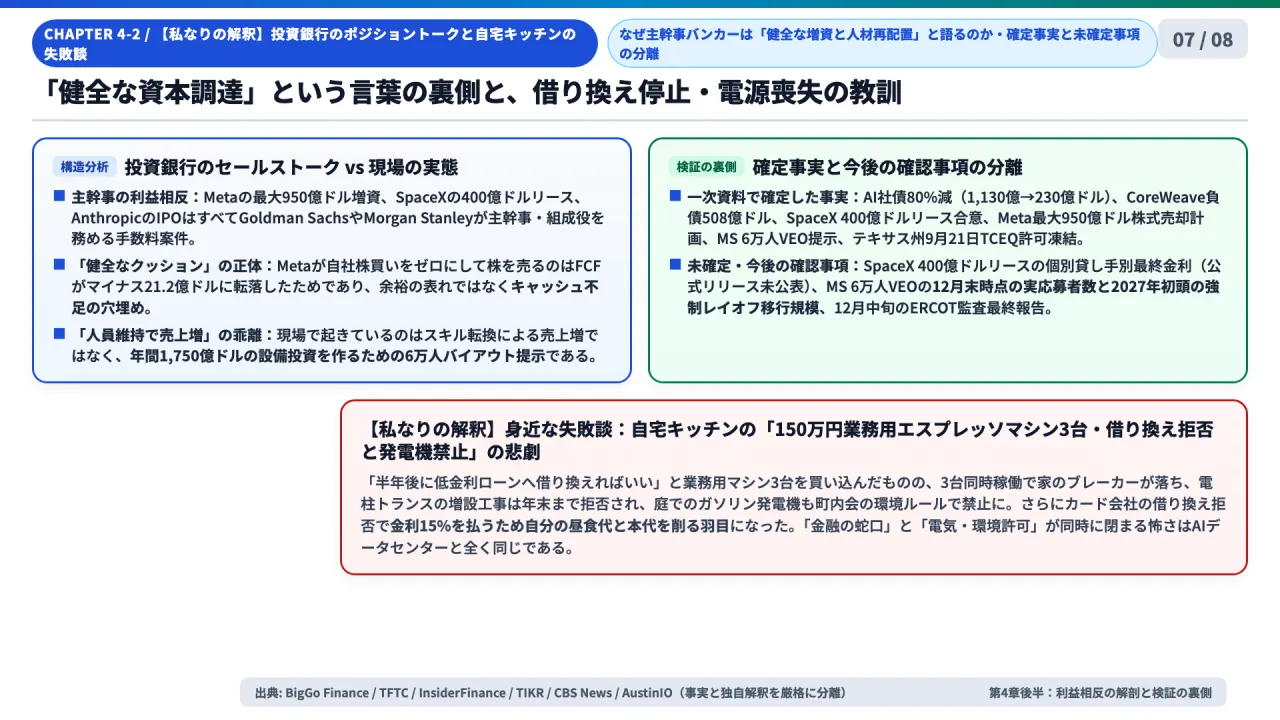
- Frontier Capital Sourcing Diverged: Pure-play lessors were shut out of debt markets, prompting tech titans to pivot. SpaceX secured a $40 billion off-balance-sheet master finance lease via an Apollo-managed SPV to procure NVIDIA Vera Rubin systems, supported by Starlink cash flows and Super Intelligence unit Q3 revenue of $7.56B-$7.60B (up 9x YoY). Meta Platforms responded to negative quarterly free cash flow (-$2.12B on $33.94B CapEx) by issuing $37.5 billion in base equity ($25.0B in Class A forwards and $12.5B in Series A convertible preferred, netting $37.4B to $43.1B) while freezing buybacks ($0 in 2026 vs $26.2B in 2025). Meanwhile, Anthropic filed Form S-1 showing compute efficiency improved to $1.82 revenue per $1 compute expense in H1 2026 with ~900% NRR.
- Texas TCEQ Froze Environmental Permits: Facing an ERCOT interconnection queue exceeding 1,800 projects and 474 gigawatts (~90% data centers), Texas Governor Greg Abbott ordered the TCEQ to freeze all data center air and water permits through mid-December 2026, shutting the behind-the-meter generation loophole.
1. Neocloud Fragility, Off-Balance-Sheet Leases, and Behind-the-Meter Power
Understanding the credit crunch requires examining three technical concepts:
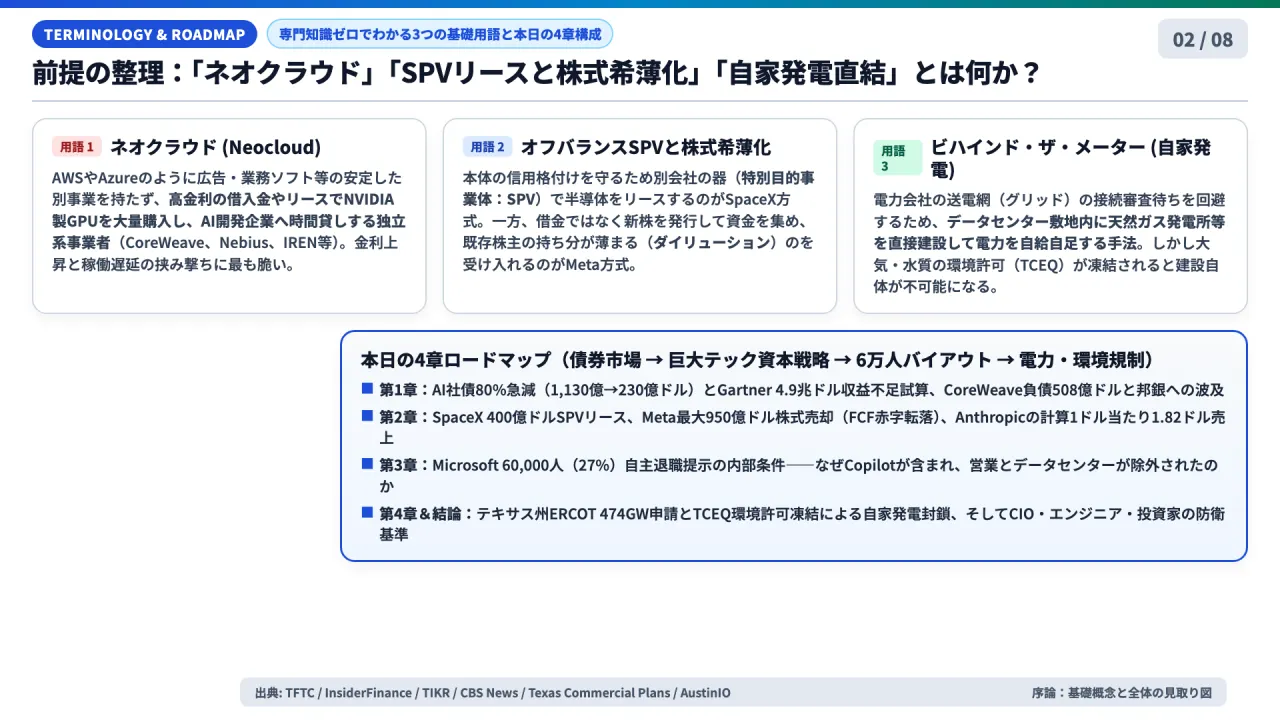
- Neoclouds (Specialized GPU Providers): Unlike AWS or Azure, pure-play neoclouds (CoreWeave, Nebius, IREN) possess no software revenues. They buy GPUs using debt and lease capacity. Because GPUs face economic obsolescence within 24 to 36 months while debt matures over five to seven years, declining rental rates trigger a severe duration mismatch.
- Off-Balance-Sheet SPV Leases vs Equity Dilution: To acquire compute without inflating balance-sheet debt, sponsors form bankruptcy-remote SPVs managed by asset managers (Apollo Atlas SP) that buy hardware and execute master leases. Raising forward equity (Meta’s $37.5B deal) eliminates default risk but dilutes earnings per share.
- Behind-the-Meter Generation: Faced with grid delays, developers co-located data centers beside power plants or installed on-site gas turbines. However, operating turbines requires Clean Air Act permits; freezing them halts behind-the-meter expansion.
2. Debt Collapse: CoreWeave’s Liabilities and the $4.9T Revenue Shortfall
Between June and September 2026, primary bond markets closed to pure-play infrastructure developers as monthly AI debt issuance plunged 80% from $113 billion to $23 billion.
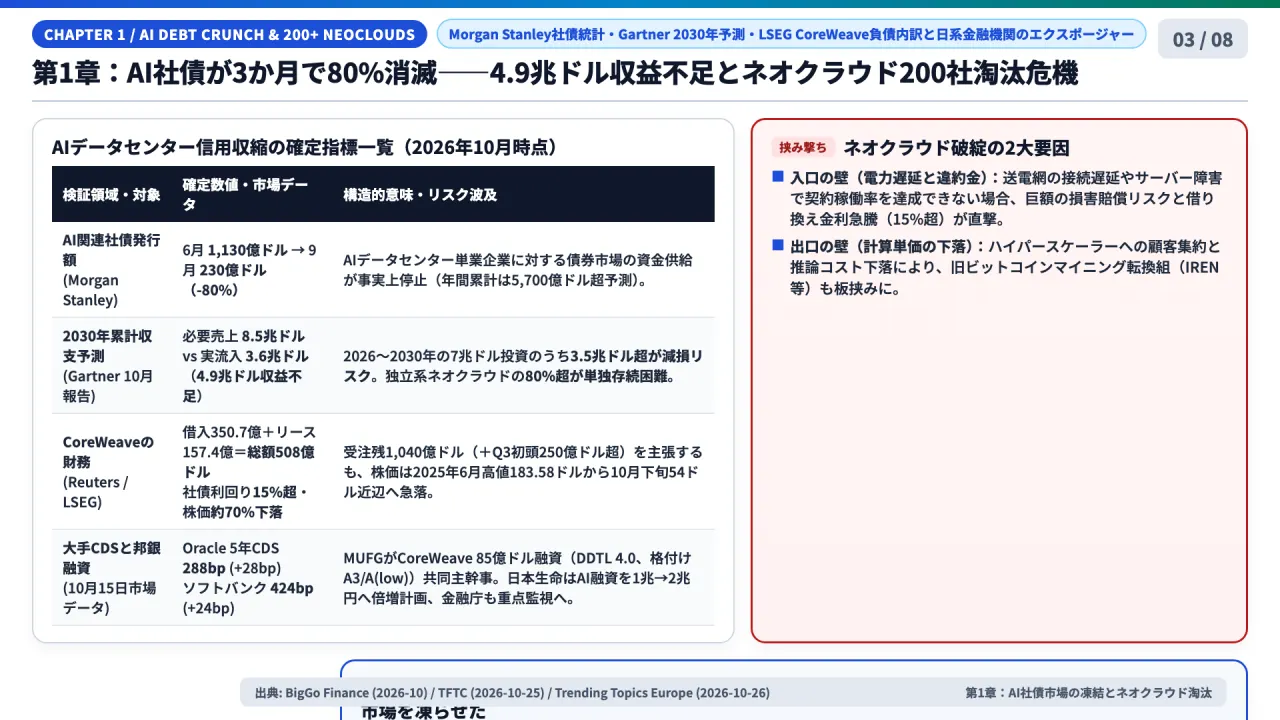
On October 25, 2026, Elon Musk warned that debt markets had completely shut for companies lacking revenue streams outside of AI data centers, leaving over 200 neoclouds facing forced consolidation. Gartner’s quantitative audit detailed the underlying imbalance:
| Metric / Economic Dimension | Quantitative Data | Structural Implication |
|---|---|---|
| Monthly AI Debt Issuance | $113B (Jun 2026) -> $23B (Sep 2026) | 80% collapse in debt capital access for GPU-centric operators |
| Cumulative Revenue Needed (2026-2030) | $8.5 Trillion | Top-line cash flow needed to service $7.0T in projected global CapEx |
| Projected Cumulative Inflow | $3.6 Trillion | Realistic software subscriptions and enterprise API billing |
| Projected Revenue Deficit | $4.9 Trillion | Over $3.5T in physical compute assets face impairment write-downs |
| Neocloud Survival Probability | <20% Independent by 2030 | Over 80% of independent GPU lessors face insolvency or acquisition |
| CoreWeave Liabilities | $50.81B ($35.07B debt + $15.74B leases) | Bond yields exceeded 15%; equity fell ~70% from $183.58 peak to ~$54 |
| 5-Year CDS Credit Spreads | Oracle 288 bp / SoftBank 424 bp | Spreads widened by 28 bp and 24 bp, reflecting counterparty risk |
CoreWeave carried $50.8 billion in total liabilities against a $104 billion backlog. When secondary bond yields exceeded 15%, debt refinancing became prohibitive. Contagion reached global lenders: MUFG co-led CoreWeave’s $8.5 billion loan (DDTL 4.0), Nippon Life planned to expand AI infrastructure loans to 2.0 trillion yen, and Japan’s FSA placed data center project finance under priority monitoring.
3. Mega-Cap Sourcing: SpaceX, Meta, and Anthropic Blueprints
With commercial debt markets frozen, leading players deployed three contrasting capital architectures:
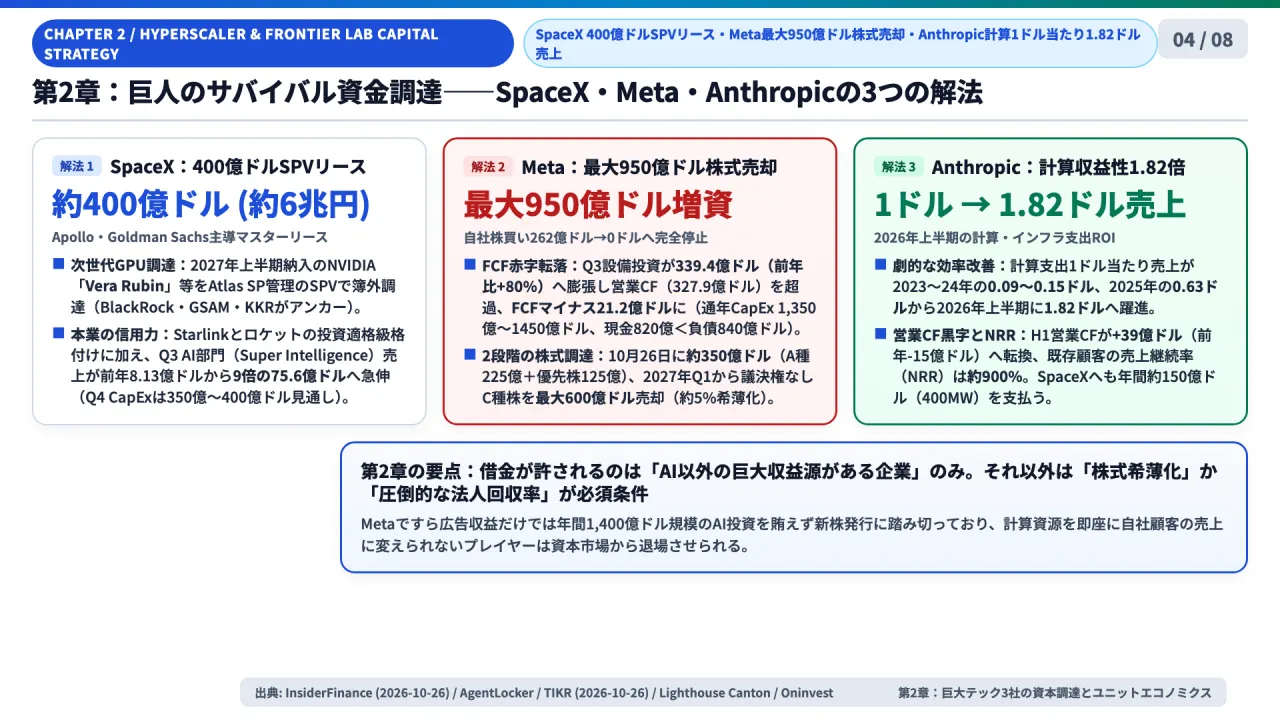
- SpaceX (~$40B Master Lease): SpaceX secured a ~$40B off-balance-sheet GPU lease via Apollo’s Atlas SP (joined by BlackRock, Goldman Sachs, KKR) to acquire NVIDIA Vera Rubin clusters. This debt was supported by Starlink cash flows and Super Intelligence unit Q3 revenue of $7.56B-$7.60B (up 9x YoY).
- Meta Platforms ($37.5B Equity Offering): SEC filings confirm Meta sold 40 million Class A common shares forward at $625.00 ($25.0B gross, ~$24.9B net, expanding to
$28.7B net with greenshoe) plus $12.5B in Series A mandatory convertible preferred ($14.37B net). Base proceeds totaled $37.5B ($37.4B-$43.1B net). Meta halted share buybacks ($0 in 2026 vs $26.2B in 2025) because Q3 CapEx ($33.94B) exceeded operating cash flow ($32.79B), producing negative free cash flow (-$2.12B). - Anthropic ($1.82 Revenue per $1 Compute): Form S-1 documented remarkable operating leverage: its compute expense ratio improved from 160% of revenue in 2025 to 55% in H1 2026 ($8.9B compute expense on $16.3B revenue), generating positive $3.9B in operating cash flow. However, it carries $518B to $750B in long-term compute commitments (~80% non-cancellable).
4. Microsoft’s 60,000 Buyout: Reallocating Payroll to Hardware
Microsoft’s October 26, 2026, Voluntary Exit Offer (VEO) announced by Amy Coleman operationalizes this capital reallocation:
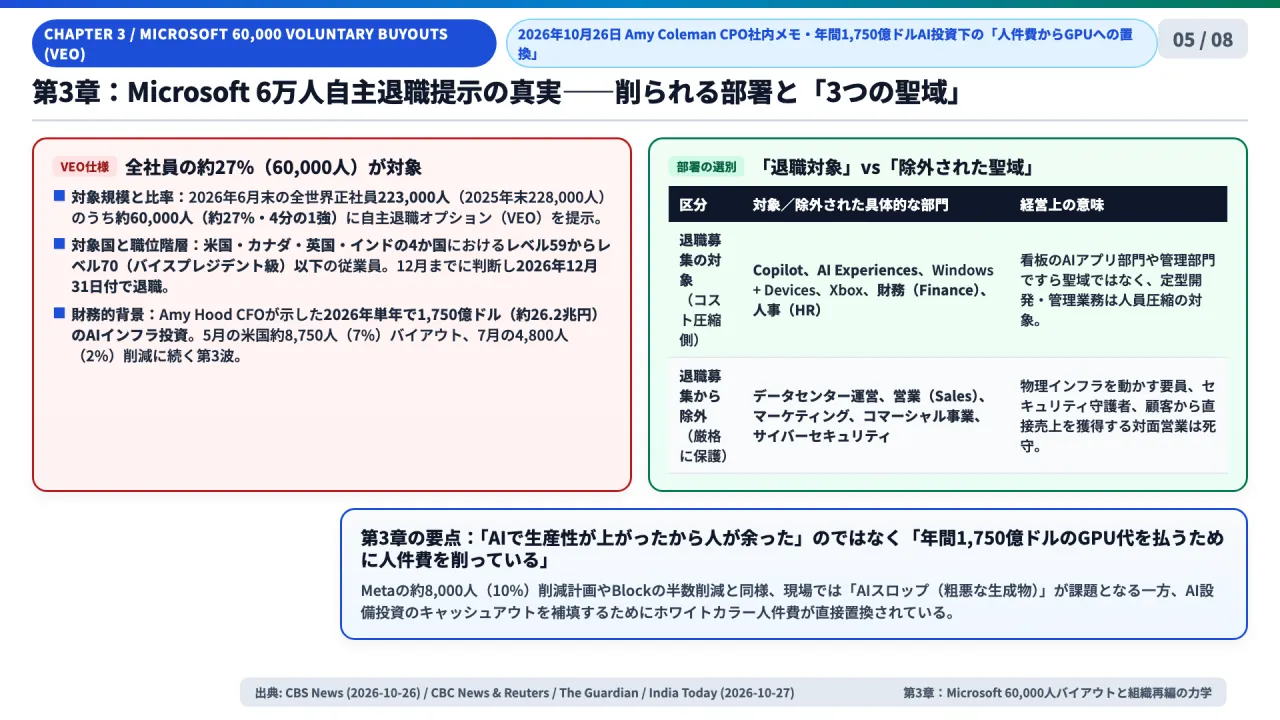
- Eligibility & Scale: Offered to ~60,000 employees (~27% of Microsoft’s 223,000 workforce) across the US, Canada, UK, and India, spanning level 59 through level 70 (vice presidents), effective December 31, 2026.
- Financial Motivation: Sourcing cash for CFO Amy Hood’s projected $175 billion annual AI CapEx. Earlier cuts (8,750 buyouts in May; 4,800 layoffs in July) proved insufficient to absorb the capital burden.
- Targeted Divisions: Copilot product engineering, AI Experiences, Windows plus Devices, Xbox, Finance, and HR.
- Protected Sanctuaries: Physical Data Centers, Enterprise Cybersecurity, and Commercial Field Sales.
The inclusion of Copilot teams exposes the economic reality: generative AI applications have not generated enterprise cash flow fast enough to justify their development budgets. Microsoft redirected cash flow away from application developers directly into data center steel, fiber, and GPU silicon.
5. Physical Grid Lockdown: Texas TCEQ Environmental Moratorium
On the physical infrastructure front, Texas Governor Greg Abbott implemented four escalating executive interventions:
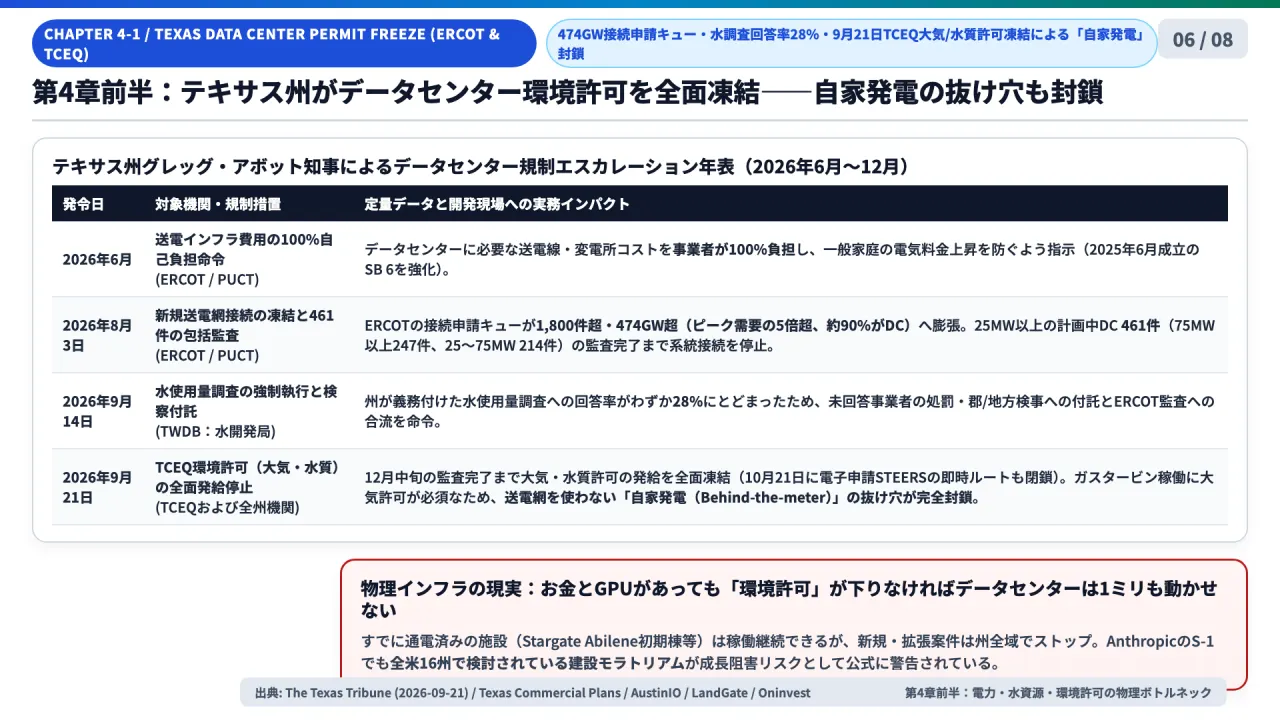
- June 2026: Mandated that large-load data centers pay 100% of their transmission and substation interconnection costs.
- August 3, 2026: Froze new ERCOT grid interconnection approvals as the queue surpassed 1,800 projects and 474 gigawatts (over five times peak demand, ~90% data centers), ordering a comprehensive audit across 461 planned data centers over 25 megawatts.
- September 14, 2026: Directed the TWDB to enforce reporting subpoenas after only 28% of data centers complied with water consumption surveys.
- September 21, 2026: Ordered the TCEQ to freeze all pending and new air quality and wastewater permits for data centers through mid-December 2026, closing the STEERS automated portal on October 21.
This regulatory freeze shut down the behind-the-meter loophole. Operating gas turbines requires Clean Air Act permits. Without TCEQ authorization, self-generation projects stalled completely.
The Author’s Perspective: When Equipment Leases Outlive Commercial Reality
Investment banking commentary frames mega-cap equity sales as prudent balance-sheet management. However, underwriting banks earn hundreds of millions in placement fees. The underlying reality is acute cash strain: Meta suffered negative quarterly free cash flow, Microsoft offered buyouts to 60,000 workers to service $175 billion in CapEx, and over 200 neoclouds were shut out of debt markets.
This dynamic mirrors a personal misadventure I experienced several years ago. Convinced that renting commercial espresso machines to catering events was a guaranteed business, I acquired three Italian machines at $10,000 each using promotional credit lines, planning to refinance into low-interest debt.
When all three machines engaged their boilers simultaneously, the residential breaker tripped. The utility refused to upgrade the transformer for nine months. When I ran a generator in the yard, neighbors filed an immediate noise complaint, halting power within twenty-four hours. Simultaneously, the credit card issuer eliminated promotional balance transfers, raising interest rates above 18%. Facing unpowered machines, I had to eliminate every discretionary expenditure for a year to service the debt. When physical utilities and credit markets freeze simultaneously, capital assets become stranded instantly.
6. Strategic Takeaways for CIOs, Engineers, and Investors
The credit freeze, corporate headcount reallocation, and environmental moratoria require strategic adjustments across three enterprise stakeholder groups:
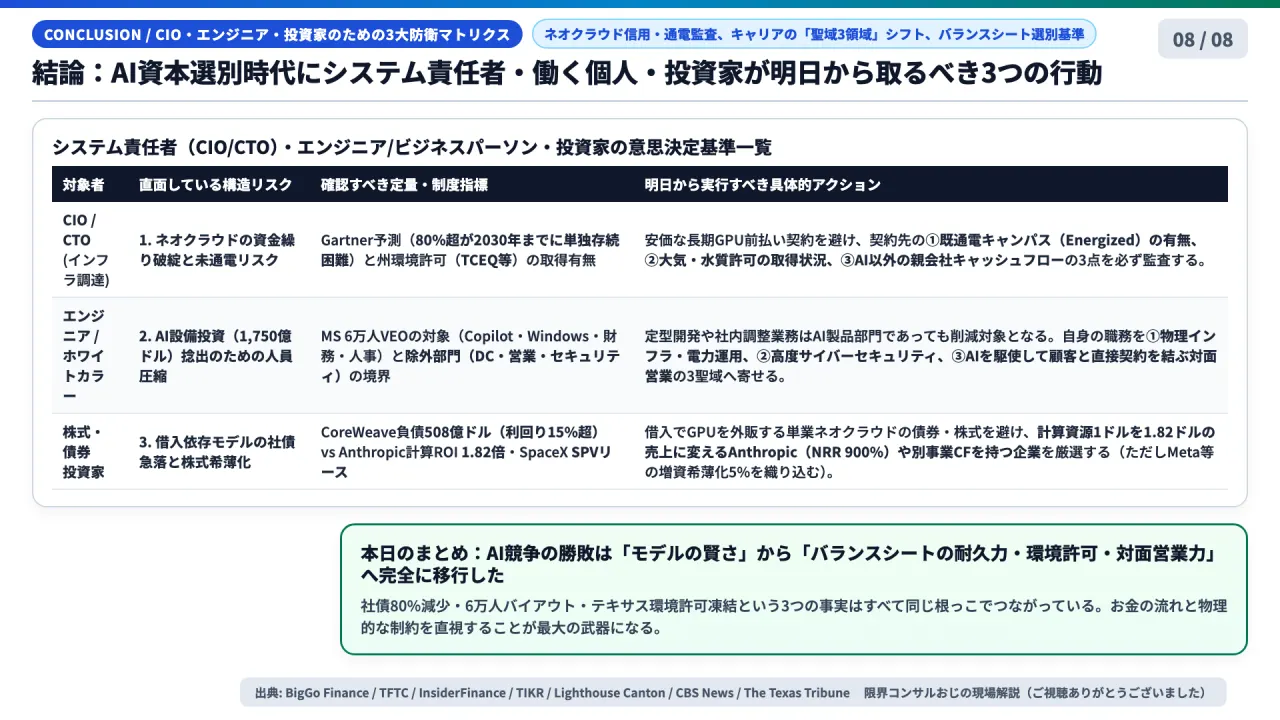
- CIOs, CTOs & Procurement Heads: Gartner projects that over 80% of independent neoclouds will be unable to survive independently by 2030. Never commit to multi-year prepaid compute contracts based solely on discounted spot pricing. Audit three items: (1) energized campus status with confirmed utility interconnects, (2) fully executed environmental air and water permits, and (3) a parent entity with independent cash flows outside of GPU leasing.
- Software Engineers & Corporate Staff: Microsoft’s VEO proves that application-layer software engineering is being rationalized to fund hardware CapEx. Pivot professional capabilities toward physical infrastructure operations, mission-critical cybersecurity, or direct commercial revenue delivery.
- Public Equity & Credit Investors: Avoid debt-heavy neocloud paper and suppliers with widening CDS spreads. Reallocate capital toward proven compute monetization (Anthropic’s $1.82 revenue per $1 compute) or diversified cash flows, while discounting hyperscalers funding CapEx through equity dilution.
Primary Sources and References
- Morgan Stanley AI Debt Contraction, Gartner $4.9T Shortfall, CoreWeave Liabilities & Japanese Banking Exposure:
- BigGo Finance (October 2026): Morgan Stanley & Gartner AI Infrastructure Capital Market Audit
- TFTC Credit Market Analysis (October 25, 2026): AI Debt Markets Closed ── Musk Warns of Neocloud Collapse
- Trending Topics Europe (October 26, 2026): Musk Warns of Neocloud Die-Off as SpaceX Secures $40B Debt
- SpaceX $40B Master Lease, Meta $37.5B SEC Form 8-K Offering, and Anthropic S-1 Unit Economics:
- InsiderFinance (October 26, 2026): SpaceX Seals $40B GPU Master Lease Deal via Apollo SPV
- AgentLocker (October 26, 2026): SpaceX Closes $40B Debt Facility to Finance AI Compute Clusters
- SEC EDGAR Form 8-K & Pricing Term Sheet (October 26, 2026): Meta Platforms, Inc. Common Stock Forward & Preferred Offering
- TIKR Financial Analysis (October 26, 2026): Meta Ceased Share Buybacks to Fund Surging AI CapEx
- Lighthouse Canton (October 26, 2026): Reading Frontier Lab Economics in Anthropic’s Form S-1
- Oninvest (October 26, 2026): Key Structural Takeaways from Anthropic’s SEC S-1 Registration
- Microsoft 60,000 Voluntary Exit Program & $175B Annual Capital Expenditures:
- CBS News (October 26, 2026): Microsoft Offers Buyouts to Up to 60,000 Workers Amid AI Spending Surge
- CBC News / Thomson Reuters (October 26, 2026): Microsoft Initiates Sweeping Voluntary Exit Program
- The Guardian (October 26, 2026): Microsoft Offers Buyouts to Workers in Push to Fund AI Infrastructure
- India Today (October 27, 2026): Microsoft Voluntary Exit Offer ── 60,000 Employees Eligible Across Four Countries
- Texas TCEQ Data Center Permitting Moratorium & ERCOT 474GW Interconnection Queue:
- The Texas Tribune (September 21, 2026): Texas Pauses Environmental Permits for Data Centers Amid Energy and Water Scrutiny
- Texas Commercial Plans (September 23, 2026): TCEQ Permit Freeze Halts Data Center Development
- AustinIO (October 2026): Understanding the Texas Data Center Permitting Moratorium
- LandGate Intelligence (September 2026): Texas Halts Data Center Permits ── What Infrastructure Developers Need to Know