Why Defense Drone Maker Anduril Is Manufacturing PC Motherboards in Ohio: Deconstructing Project BlueChip, Advanced Packaging Bottlenecks, and the Arm Kernel Driver Chasm
Beyond the patriotic rhetoric of American-made hardware lies the hard reality of advanced semiconductor packaging, the Buy American Act 65% domestic cost threshold, and legacy Windows on Arm driver incompatibilities.
Published: October 28, 2026 | Read time: ~10 min | Watch Video (Japanese)
Executive Summary: The Structural Fragility of the Semiconductor Assembly Chain
When enterprise engineers or military field operators disassemble a modern commercial laptop and trace the provenance of its primary motherboard, a critical supply chain reality becomes apparent: Even when a laptop bears the logo of a prominent American technology corporation and houses advanced processors fabricated on American soil, the subsequent steps—advanced semiconductor packaging, printed circuit board assembly (PCBA), surface-mount technology (SMT) soldering, and chassis integration—remain overwhelmingly concentrated in East Asian electronics manufacturing services (EMS) hubs.
On October 27, 2026, autonomous defense contractor Anduril Industries (founded by Palmer Luckey) and semiconductor designer Qualcomm (led by CEO Cristiano Amon) officially announced BlueChip, a joint venture designed to establish an onshore compute manufacturing pipeline within the United States.
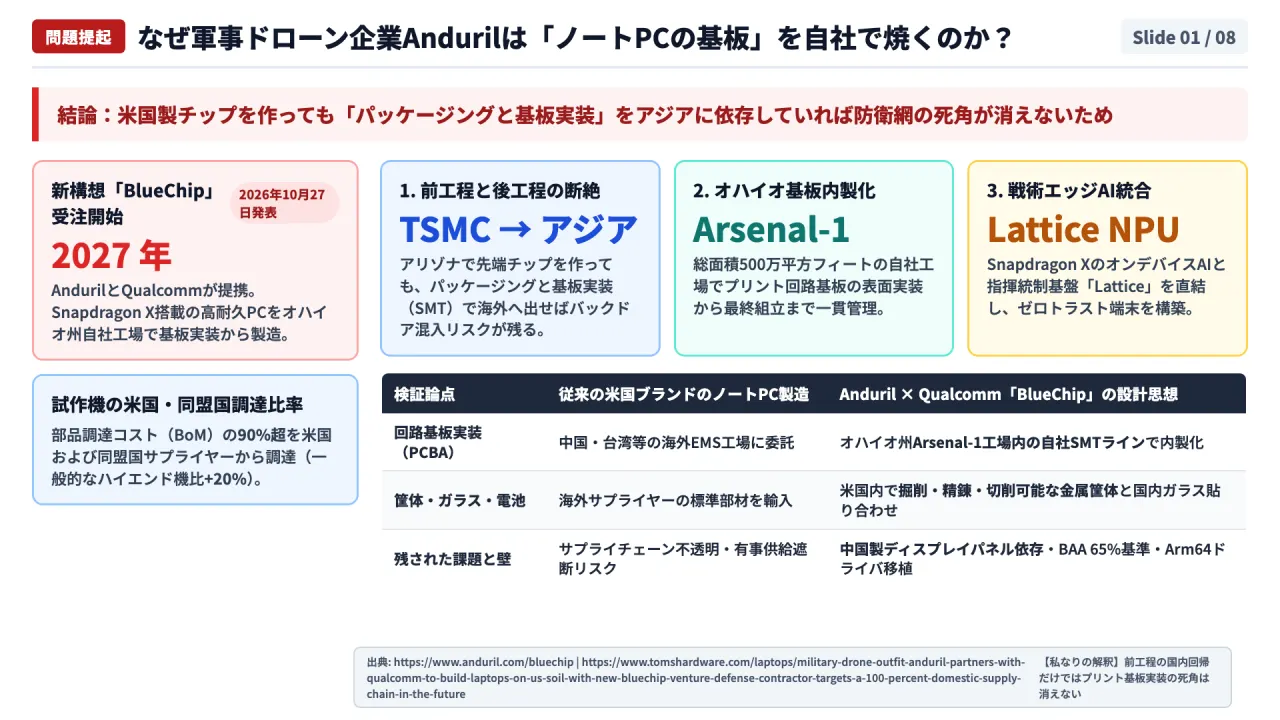
This announcement reverberated across defense and semiconductor corridors because BlueChip departs from conventional contract assembly by targeting four concrete technical milestones:
- In-House PCBA at the “Arsenal-1” Megafactory: Constructing high-throughput SMT motherboard assembly lines inside Anduril’s 5-million-square-foot manufacturing complex near Columbus, Ohio, directly integrating bare motherboards with rugged tactical chassis.
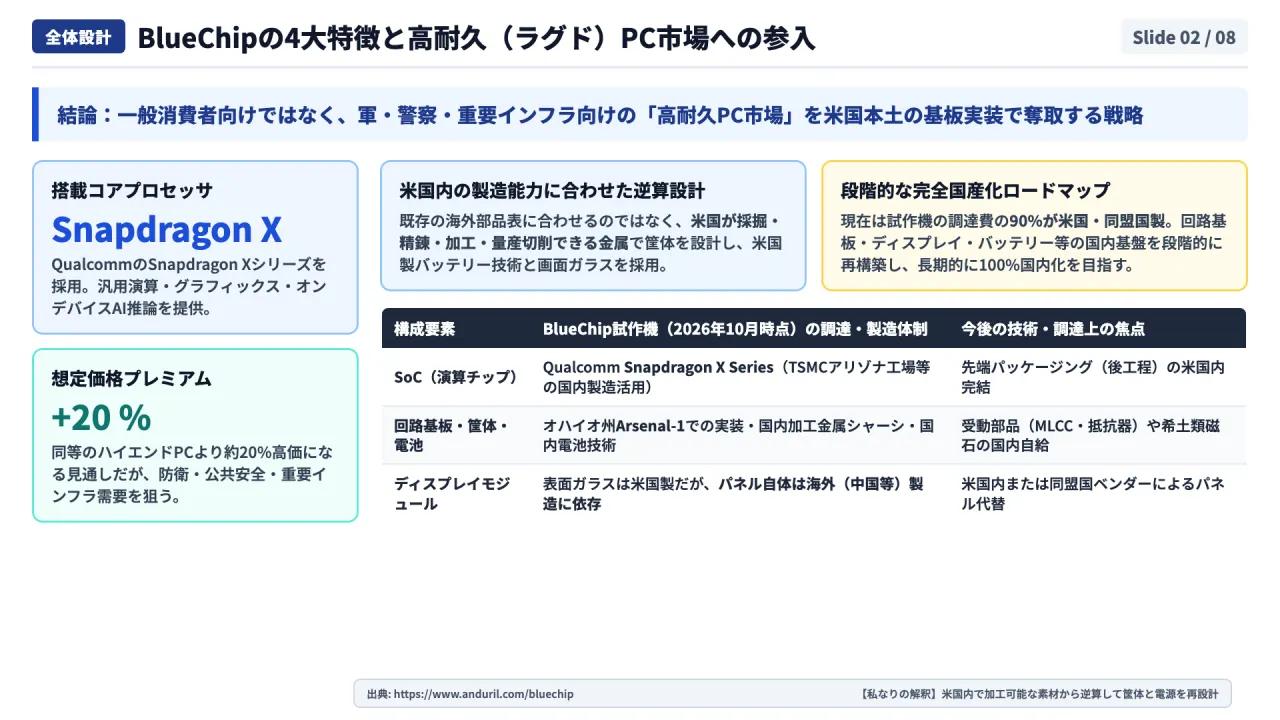
- Coupling TSMC Arizona Snapdragon X with Lattice C2 AI: Utilizing Qualcomm Snapdragon X Elite processors fabricated at TSMC Fab 21 in Phoenix, Arizona, paired directly with Anduril’s Lattice command-and-control software to execute local neural processing unit (NPU) inference at the tactical edge without cloud dependency.
- Achieving 90%+ Allied Bill-of-Materials (BoM) Sourcing: Self-funding operational prototypes without federal CHIPS Act subsidies, procuring over 90 percent of component costs from domestic and allied suppliers, targeting commercial order intake in 2027 at an estimated 20 percent price premium over commercial rugged laptops.
- Hardware Redesign Dictated by Domestic Manufacturing Capabilities: Designing custom metal enclosures and structural glass bonding processes tailored to metals, batteries, and machining capacities that physically exist within the United States.
However, cross-referencing this vision against the Federal Acquisition Regulation (FAR Subpart 25.1 Buy American requirements), Microsoft’s Windows on Arm technical architecture specifications, Chinese Ministry of Foreign Affairs sanctions (Decree No. 19), and Pentagon defense reviews reveals significant structural hurdles.
1. Verifying Primary Claims: Distinguishing Verified Capabilities from Promotional Rhetoric
A systematic audit of the October 27-28, 2026 announcements, technical whitepapers, and interview statements against regulatory and public documentation establishes the factual boundaries of the initiative:
- Anduril-Qualcomm BlueChip Partnership: Verified Fact. Formally announced on October 27, 2026. The program targets rugged tactical edge laptops with commercial orders opening in 2027, scaling toward long-term domestic supply goals.
- Arsenal-1 Ohio Circuit Board Assembly: Verified Fact. Anduril is deploying surface-mount assembly equipment inside its Pickaway County, Ohio megafactory to manufacture motherboards and complete final system integration.
- TSMC Arizona Snapdragon Fabrication: Verified Fact. Qualcomm confirmed that Snapdragon X processors for BlueChip will be fabricated at TSMC’s Phoenix, Arizona facilities.
- U.S. Advanced Packaging Deficit: Verified Structural Reality. While TSMC and Amkor Technology are constructing advanced packaging facilities in Peoria, Arizona, high-volume advanced substrate packaging and PCBA infrastructure remain heavily concentrated in Asia.
- Sanctions Under Chinese Ministry of Foreign Affairs Decree No. 19: Verified Legal Fact. Following U.S. arms sales to Taiwan exceeding $10 billion, China’s Ministry of Foreign Affairs issued Decree No. 19 on December 26, 2025, imposing asset freezes, transaction bans, and entry prohibitions against 20 defense entities and 10 executives. Palmer Luckey is designated as Individual Number 1 (“Palmer Luckey, male, founder of Anduril Industries”), legally barring Chinese suppliers from commercial transactions with Anduril.
- Display Panel Dependency on Foreign Supply: Verified Fact & Regulatory Obstacle. While prototypes achieve over 90 percent U.S. and allied BoM spend, active-matrix OLED and LCD panel production remains offshore, creating a hurdle for pure domestic content definitions.
- Arm64 Legacy Driver Incompatibility: Verified Technical Reality. Microsoft technical documentation specifies that Windows on Arm’s Prism emulator emulates user-mode x86/x64 instructions, but cannot emulate x86/x64 kernel-mode drivers. Connecting legacy military hardware requires custom Arm64 driver engineering.
- Project Meridian Co-Directorship: Verified Fact. Announced on September 30, 2026, under Pentagon CTO Emil Michael and MITRE administration, Palmer Luckey, Elon Musk, and Newt Gingrich co-direct a 120-day defense technology assessment due January 28, 2027.
- Japanese Nuclear Debate Mischaracterization: Inaccurate Rhetoric. Interview claims that Japan is debating “constitutional revisions to permit nuclear weapons” conflate Article 9 constitutional reform debates with non-constitutional policy norms—specifically Japan’s 1967 Three Non-Nuclear Principles and the Atomic Energy Basic Act.
2. The Packaging Gap: Why Domestic Silicon Fabrication Is Not Enough
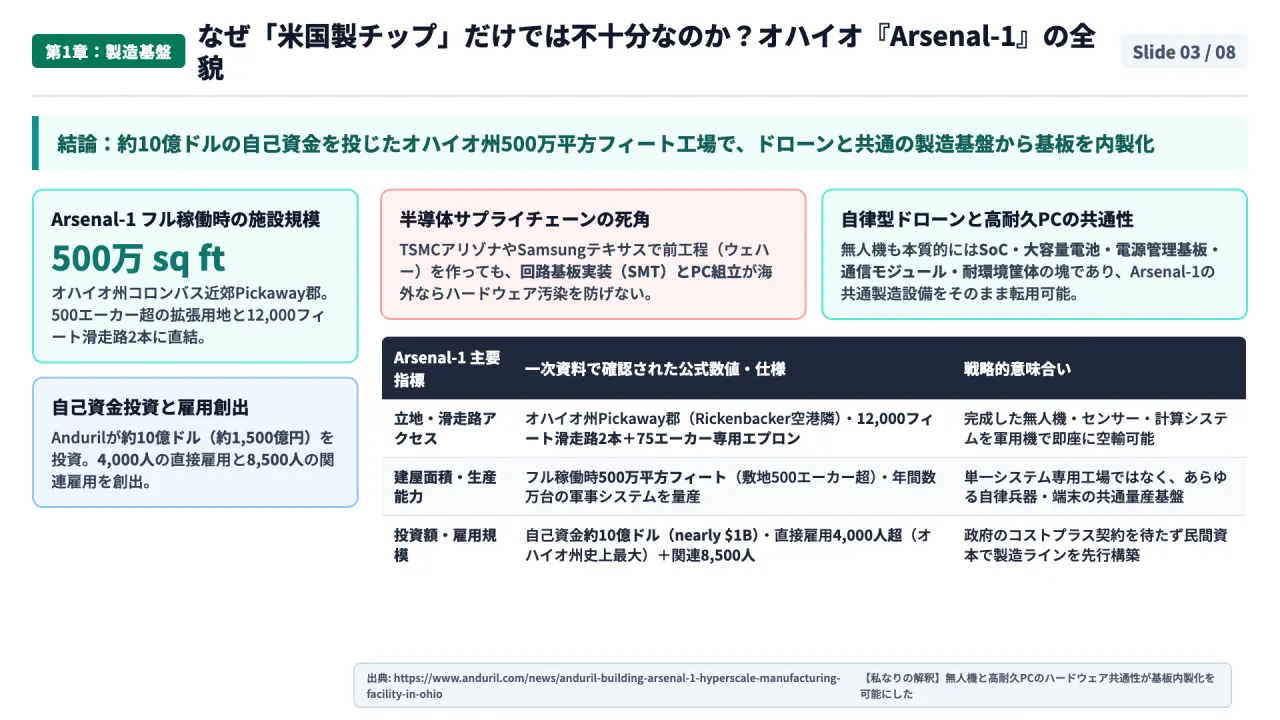
Palmer Luckey’s central critique—that fabricating front-end silicon in Arizona only to ship bare dice to Asia for packaging and circuit board assembly subsidizes the foreign electronics supply chain—accurately highlights a fundamental blind spot in U.S. industrial policy.
The Front-End vs. Back-End Divide
Federal investments under the CHIPS and Science Act successfully stimulated front-end wafer fabrication facilities in Arizona (TSMC Fab 21) and Texas (Samsung Taylor). However, completing an operational computing device requires two subsequent manufacturing tiers:
- Advanced Packaging (Back-End): Slicing silicon wafers into individual dice, mounting them onto high-density interconnect substrates, integrating power distribution micro-bumps, and encapsulating the package. While TSMC and Amkor are developing packaging facilities in Peoria, Arizona, volume commercial throughput remains located offshore.
- Printed Circuit Board Assembly (PCBA) and SMT: Populating multi-layer circuit boards with processors, multi-layer ceramic capacitors (MLCCs), inductors, power management integrated circuits (PMICs), and high-frequency connectors. Over 85 percent of global PC motherboard SMT lines operate in Taiwan, mainland China, and Southeast Asia.
Shipping unshielded tactical command hardware across international commercial supply chains creates unacceptable interception vectors. Hardware-level backdoors, malicious ASIC drop-ins, and supply interdiction during geopolitical crises represent existential operational hazards for military systems.
The Industrial Logic of Arsenal-1
Anduril can contemplate in-house PCBA because of the architectural design of its Arsenal-1 manufacturing center:
- Facility Footprint: Spanning 5 million square feet across 500 acres adjacent to Rickenbacker International Airport in Pickaway County, Ohio, backed by nearly $1 billion in private capital investment.
- Logistical Interconnects: Direct access to dual 12,000-foot runways and a 75-acre dedicated military cargo apron, enabling rapid air-deployment of completed systems.
- Workforce Trajectory: Designed to employ over 4,000 direct manufacturing workers (supporting 8,500 regional jobs), scaling from initial production of the FQ-44 semi-autonomous combat aircraft.
Critically, an autonomous tactical drone and a ruggedized field laptop share an identical hardware foundation. Both systems integrate high-performance system-on-chips (SoCs), power regulation boards, high-capacity battery cells, environmental metal enclosures, and specialized radio-frequency communications. By repurposing high-precision SMT surface-mount lines designed for autonomous drone avionics, Anduril manufactures ruggedized military motherboards within the same software-defined manufacturing facility.
+----------------------------------------------------------------------------------------------------+
|               Arsenal-1 Manufacturing Profile & Drone-Laptop Convergence                           |
+------------------------------------+--------------------------+------------------------------------+
| Manufacturing Metric / Dimension   | Facility Specification   | Operational Impact on BlueChip     |
+------------------------------------+--------------------------+------------------------------------+
| Facility Floor Area                | 5,000,000 sq ft          | Houses multi-line SMT board assembly|
| Capital Outlay                     | Nearly $1.0B (Self-Funded)| Zero reliance on CHIPS Act subsidies|
| Logistics Infrastructure           | Dual 12,000-ft Runways   | Direct airlift of tactical systems |
| Target Direct Employment           | 4,000+ Direct Positions  | In-house precision PCB soldering   |
| Hardware Convergence               | Avionics SMT Shared Lines| Military drones & laptops share BoM|
+------------------------------------+--------------------------+------------------------------------+
3. Regulatory and Legal Realities: Chinese Sanctions vs. Buy American Thresholds
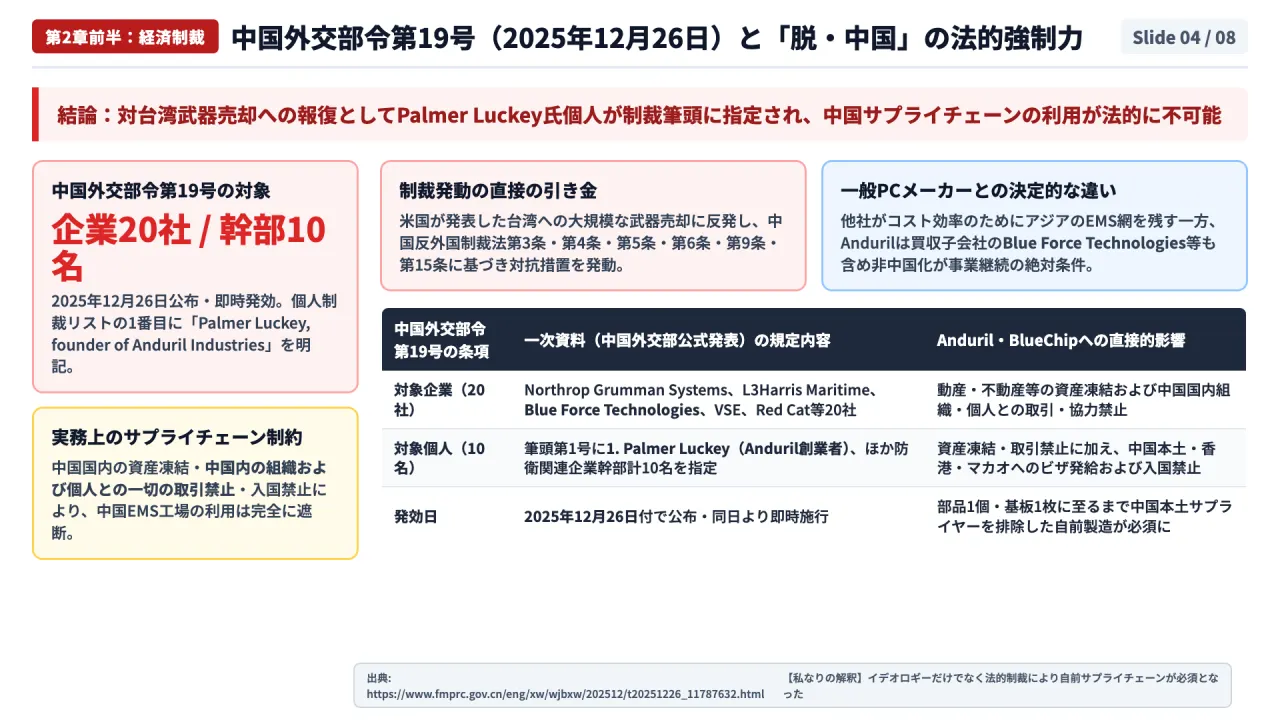
Anduril’s onshoring push is propelled not merely by design philosophy, but by legal necessity:
China Ministry of Foreign Affairs Decree No. 19
On December 26, 2025, the Ministry of Foreign Affairs of the People’s Republic of China enacted Decree No. 19, sanctioning 20 U.S. defense corporations and 10 senior executives over Taiwan defense procurement packages. Palmer Luckey was named as Designated Individual Number 1.
Decree No. 19 freezes all assets within Chinese jurisdiction, prohibits domestic entities from engaging in commercial transactions with designated persons, and denies entry visas. Consequently, Anduril cannot legally procure raw materials, connectors, or components directly from Chinese manufacturers, compelling the creation of an isolated, allied-only supply base.
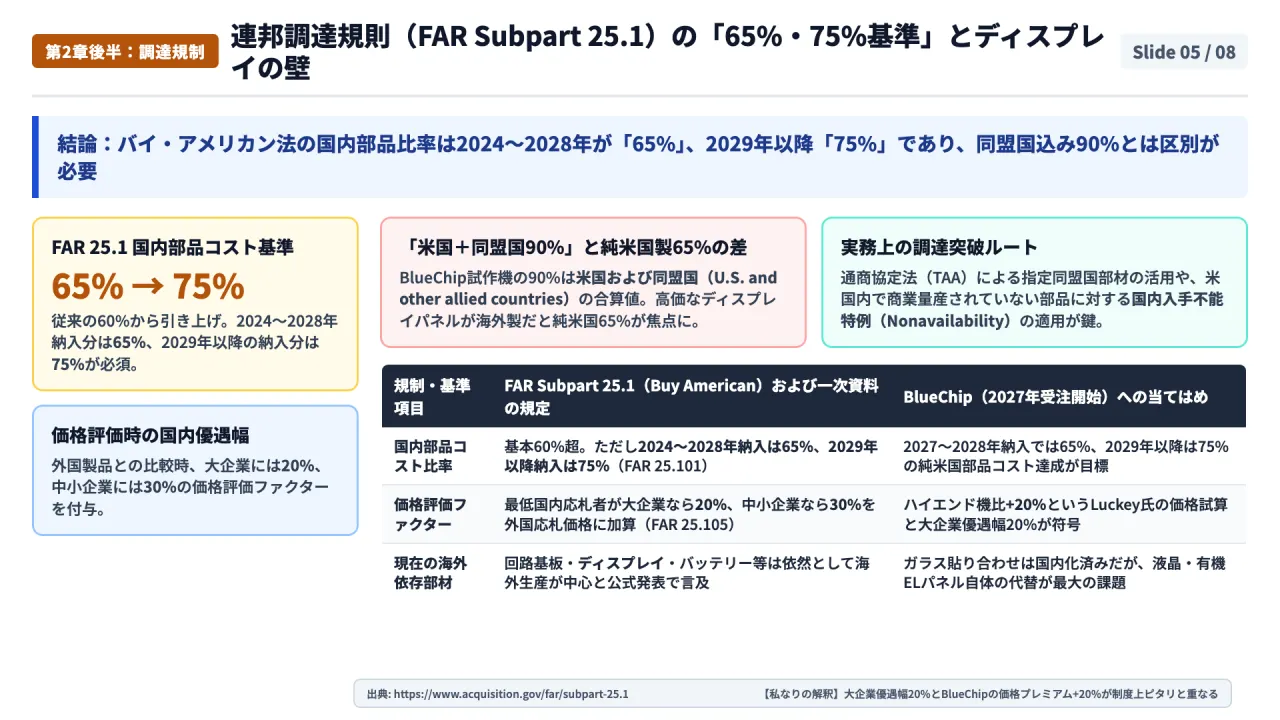
The Buy American Act (FAR Subpart 25.1) Escalation
Federal procurement standards governed by FAR Subpart 25.1 (Buy American - Supplies) enforce strict domestic manufacturing criteria:
- Substantial Transformation: All manufacturing processes must take place domestically.
- Component Cost Thresholds: Domestic content requirements mandated at 65 percent through calendar 2028, escalating to 75 percent in 2029.
- Price Evaluation Penalties: Bids utilizing foreign components face a 20 percent price penalty (30 percent for small business set-asides) when competing against compliant domestic products.
While BlueChip prototypes report over 90 percent “U.S. and allied” procurement, domestic qualification under FAR 25.1 requires components to originate specifically within the United States, unless waived under the Trade Agreements Act (TAA) or Nonavailability determinations.
Because commercial active-matrix display panels (OLED and LCD) lack volume domestic manufacturing facilities, Anduril must bond domestic cover glass over offshore display modules while pursuing allied sources (South Korea, Japan, Taiwan) to navigate statutory thresholds.
4. Software Architecture Bottlenecks: Windows on Arm and Kernel Drivers
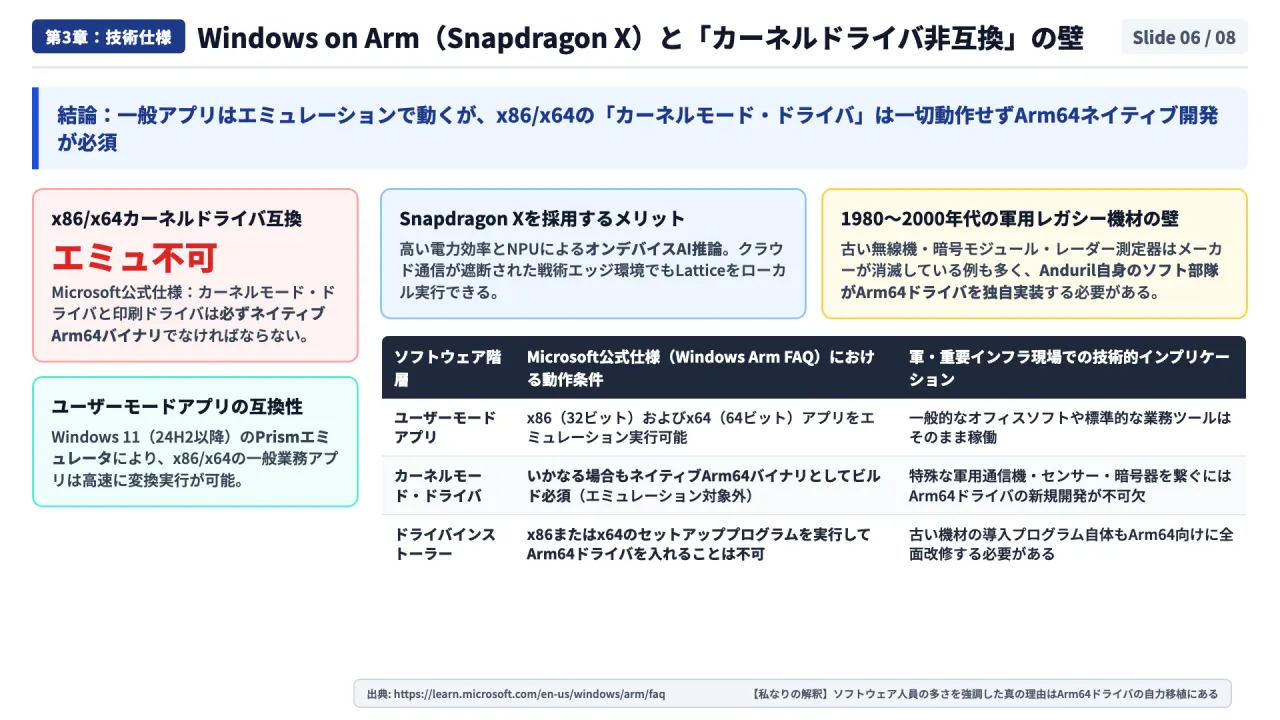
While hardware onshoring represents an enormous industrial undertaking, deploying Qualcomm Snapdragon X chips into defense environments encounters a severe software barrier: operating system kernel-level driver incompatibility.
The Prism Emulation Boundary
Microsoft’s Windows on Arm architecture includes the Prism emulation engine, which translates legacy x86 and x64 application binaries into native Arm64 machine code with near-native execution efficiency. However, Microsoft’s official documentation defines an absolute boundary: Prism emulates user-mode application software only.
+------------------------------------------------------------------------------------+
|               Windows on Arm Execution Layer & Emulation Boundary                  |
+----------------------------------+-------------------------------------------------+
| System Architecture Layer        | Arm64 Emulation Support Status                  |
+----------------------------------+-------------------------------------------------+
| User-Mode Applications (x86/x64) | Fully Emulated via Prism (Seamless Execution)   |
| 32-Bit System DLLs & Services    | Supported via Emulation Compatibility Libraries |
| Kernel-Mode Drivers (x86/x64)    | ZERO Emulation Supported (Absolute Hard Stop)   |
| Hardware Interface Layer (HAL)   | Strictly Requires Native Arm64 Compiled Drivers |
+----------------------------------+-------------------------------------------------+
The Tactical Hardware Driver Chasm
Military command personnel do not deploy laptops merely to run office software; they interface with specialized field equipment:
- MIL-STD-1553 avionics data buses.
- Tactical radios (SINCGARS, Link 16 terminals, TrellisWare nodes).
- Legacy RS-232/RS-422 serial mission payload interfaces.
- Hardened biometric readers and physical Common Access Card (CAC) sleds.
Every peripheral relies on kernel-mode drivers (.sys files) that execute at Kernel Ring 0. Under Windows on Arm, an x86 or x64 kernel-mode driver will crash or fail to load. The military cannot utilize an Arm64 tactical laptop unless every attached sensor, radio, and encryption sled possesses a native, cryptographically signed Arm64 driver.
Because traditional defense primes have abandoned maintenance on 15-year-old hardware interfaces, Anduril must maintain dedicated software engineering groups to reverse-engineer and develop native Arm64 drivers for legacy military hardware.
5. Defense Governance: Project Meridian and Institutional Conflicts of Interest
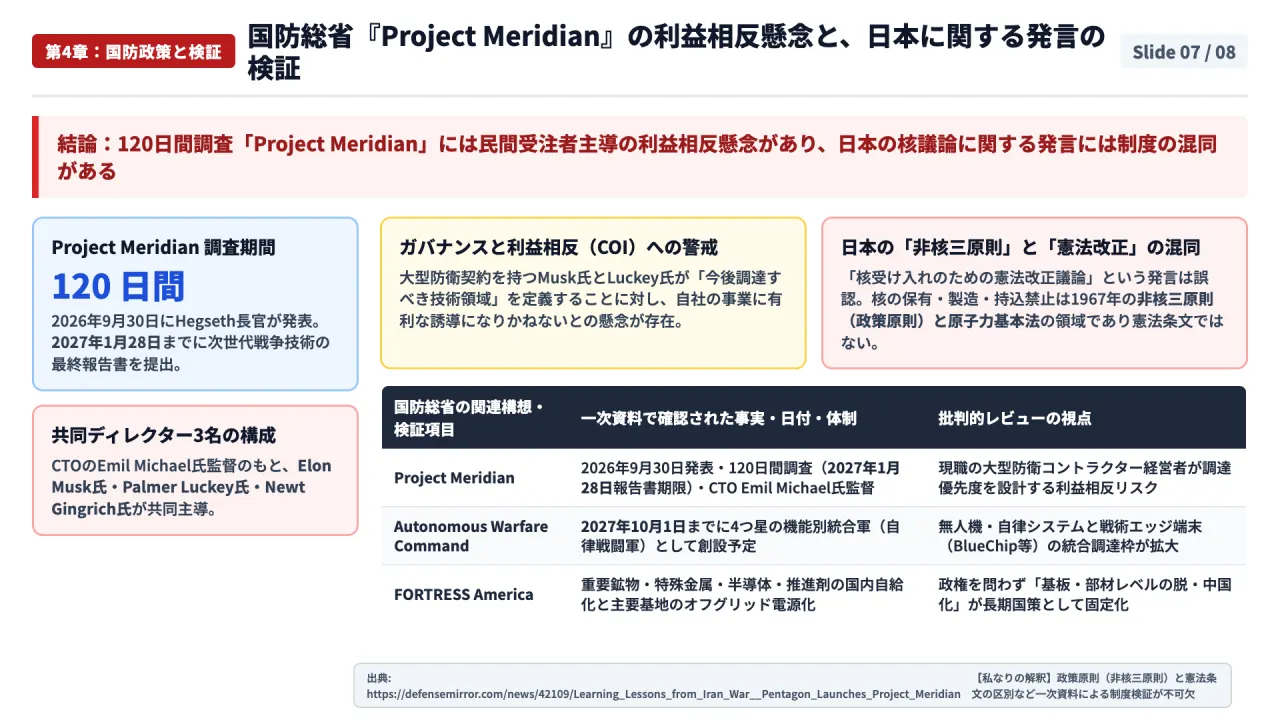
On September 30, 2026, the Department of Defense announced Project Meridian, a fast-track 120-day strategic review directed by Pentagon CTO Emil Michael, with the non-profit MITRE Corporation administering operations.
Meridian examines five modernization focus areas: artificial intelligence, autonomous systems, robotics, directed energy (high-power lasers and microwaves), and biotechnology. The review is co-directed by Palmer Luckey, Elon Musk, and former House Speaker Newt Gingrich, with final unclassified and classified reports due on January 28, 2027.
Project Meridian aligns directly with the Pentagon’s planned Autonomous Warfare Command (a functional four-star combatant command slated for October 2027) and the FORTRESS America initiative targeting resilient domestic supply chains.
However, institutional ethics watchdogs have highlighted acute Conflict of Interest (COI) concerns. Both Musk (SpaceX, Starlink) and Luckey (Anduril) lead commercial defense contracting firms with billions in pending federal contracts. While MITRE maintains strict recusal protocols, ethics experts warn that co-directing a panel that defines federal procurement mandates could allow commercial executives to tailor defense specifications toward their own proprietary platforms, inviting bid protests from legacy defense primes.
6. Strategic Takeaways: The Deep-Tier Supply Chain Audit
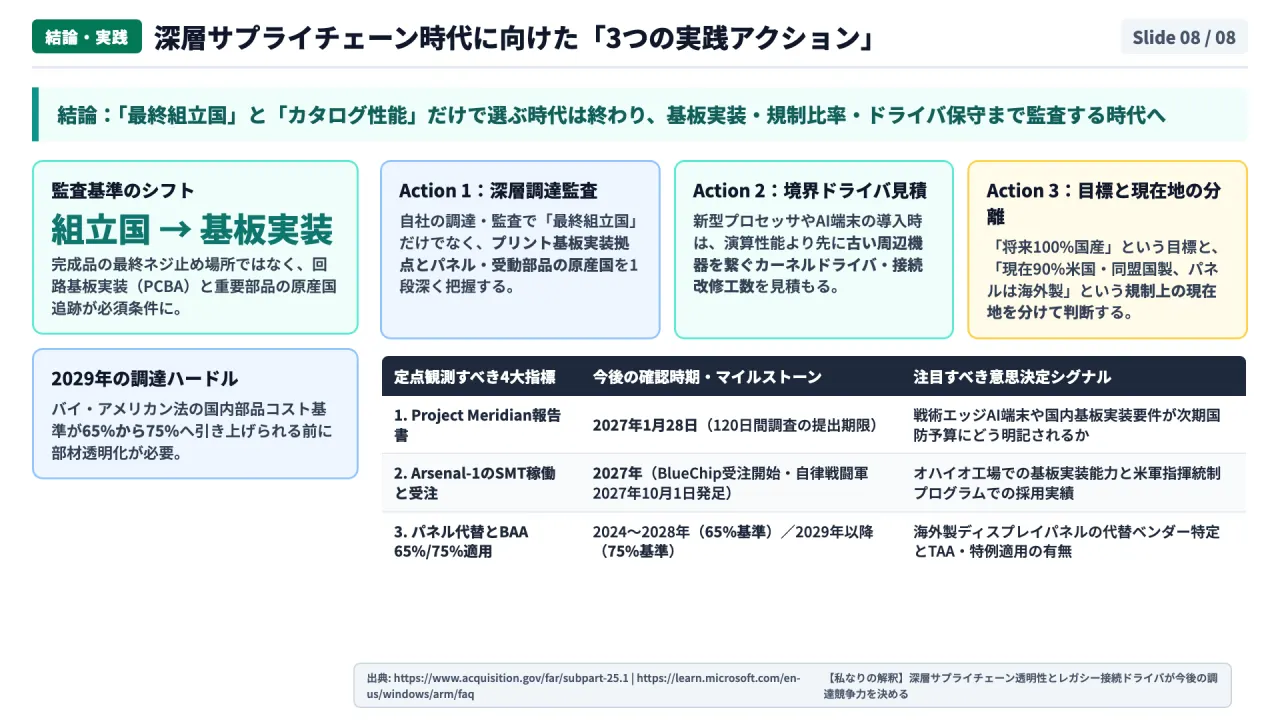
The strategic trajectory of Project BlueChip delivers three actionable governance mandates for enterprise procurement officers and defense technology leaders:
1. Elevate Supply Chain Audits to Motherboard PCBA and Deep-Tier Passives
Evaluating supplier compliance by reviewing the “country of final assembly” is obsolete. Under escalating Buy American regulations (75 percent by 2029), enterprise organizations must audit Bill-of-Materials down to SMT soldering locations, display glass laminations, and passive component sourcing (capacitors, inductors, PMICs) to eliminate hidden dependencies.
2. Audit Kernel-Mode Driver Compatibility Prior to Silicon Migration
When transitioning enterprise or tactical fleets to novel silicon architectures (Qualcomm Snapdragon X, Apple Silicon, or custom RISC-V nodes), never evaluate benchmark performance in isolation. Catalog every connected peripheral, scientific instrument, and legacy bus interface to quantify the engineering overhead required to build native 64-bit kernel drivers.
3. Separate Long-Term Strategic Roadmaps from Regulatory Benchmarks
Maintain strict analytical separation between vendor marketing roadmaps (such as “100 percent domestic manufacturing in the future”) and current operational baselines (90 percent allied BoM with offshore display panels). Rigorous procurement requires auditing exact component provenance against statutory thresholds rather than accepting broad marketing assertions.
Primary Sources and References
- BlueChip Official Product Announcement | Anduril Industries
- Anduril Building Arsenal-1 Hyperscale Manufacturing Facility in Ohio | Anduril News
- Military Drone Outfit Anduril Partners with Qualcomm to Build Laptops on US Soil | Tom’s Hardware (2026-10-27)
- Windows Arm-based PCs FAQ: Kernel-Mode Drivers & Prism Emulation | Microsoft Learn
- Federal Acquisition Regulation (FAR) Subpart 25.1 — Buy American-Supplies | Acquisition.gov
- Decision on Taking Countermeasures Against U.S. Military-Related Companies and Senior Executives (Decree No. 19, December 26, 2025) | Ministry of Foreign Affairs of the People’s Republic of China
- Learning Lessons from Recent Conflicts, Pentagon Launches Project Meridian | Defense Mirror (2026-10-01)