Why 39.7% of Enterprise AI Traffic Leaks Confidential Data: Inside MCP Vulnerabilities, PoisonedRAG, the $200M HKD Deepfake Scam, and Four Defensive Guardrails
As desktop-installed AI agents surge 509% and protocol exploits like CVE-2025-6514 emerge, enterprise defense must transition from blunt browser domain blocking to endpoint data lineage tracking and out-of-band operational verification.
Published: October 28, 2026 | Read time: ~10 min | Watch Video (Japanese)
Executive Summary: The Structural Shift in Generative AI Threat Surfaces
Throughout 2023 and early 2024, enterprise security policies regarding generative artificial intelligence focused almost exclusively on preventing employees from pasting sensitive corporate text into public browser chat interfaces. However, by late October 2026, enterprise AI utilization transitioned decisively from conversational chatbots to autonomous desktop agents executing local filesystem reads, shell commands, and automated external API invocations.
This operational evolution has exposed systemic security vulnerabilities across four technical tiers:
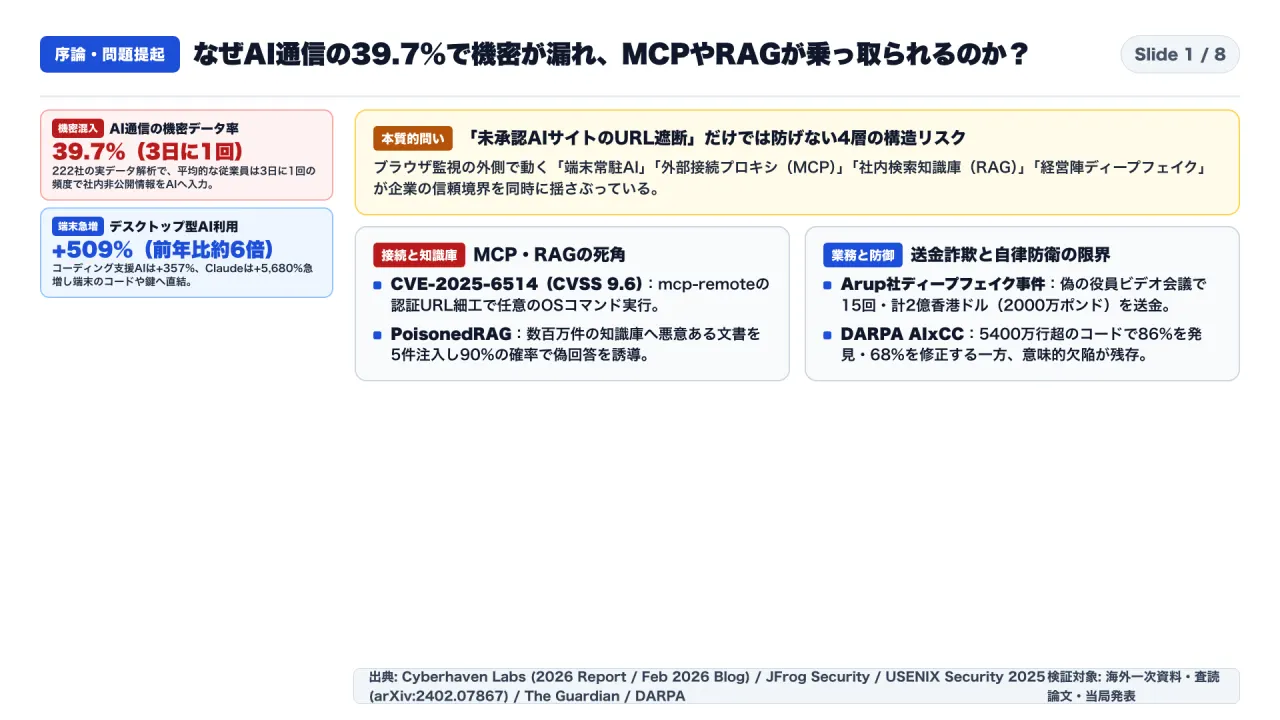
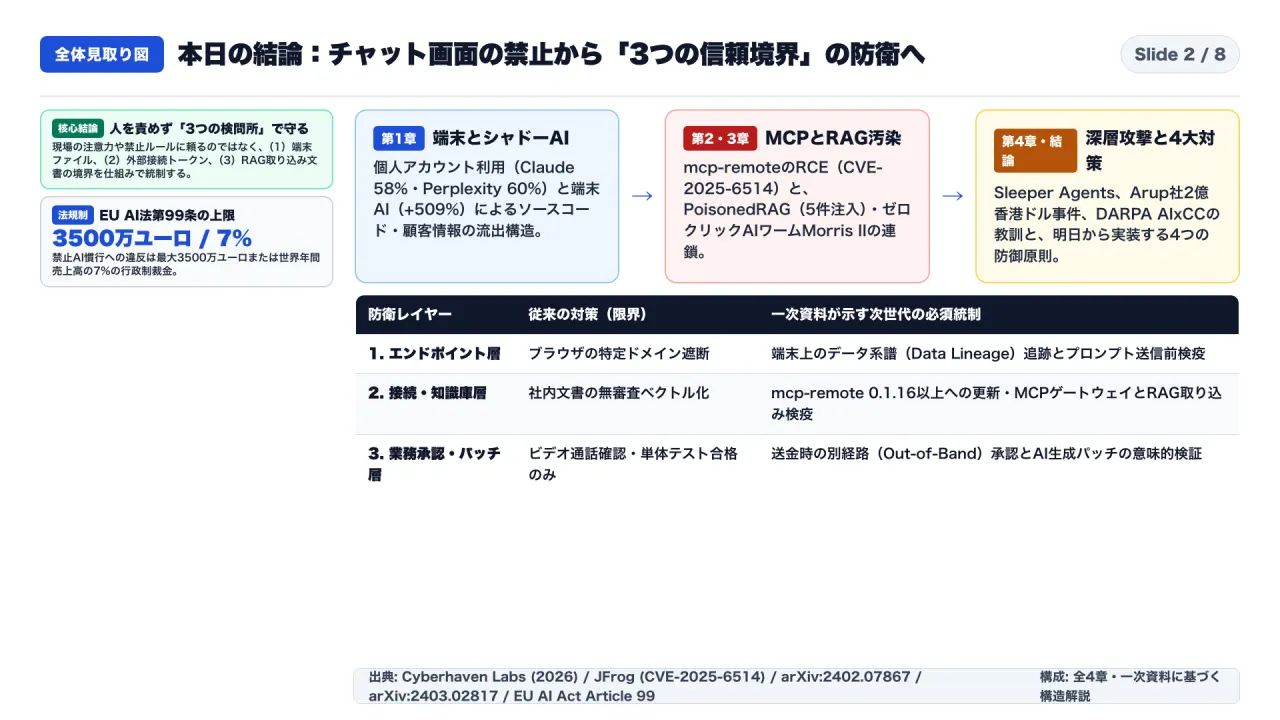
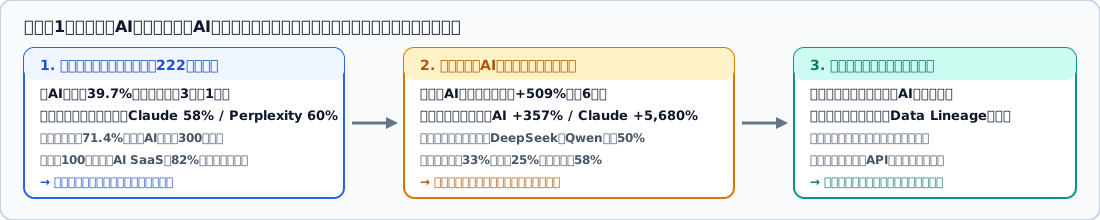
- Endpoint Shadow AI & Unsanctioned Accounts: Empirical telemetry across 222 enterprises analyzed by Cyberhaven Labs demonstrates that 39.7 percent of corporate AI traffic contains confidential data, with unmanaged personal accounts driving 58 percent of Claude usage and 60 percent of Perplexity requests. Desktop-installed AI agents surged 509 percent year-over-year, granting background software direct access to proprietary repositories, environment variables, and active terminal sessions.
- Protocol Exploitation in Tool Interfaces (MCP & Local Runtimes): The rapid adoption of the Model Context Protocol (MCP) to bridge language models and enterprise data stores introduced severe remote code execution (RCE) vectors, exemplified by CVE-2025-6514 (CVSS score 9.6) in
mcp-remoteand CVE-2024-37032 (Probllama) in local inference engines like Ollama. - Knowledge Base Poisoning and Self-Replicating AI Worms: Advanced persistent threats exploit RAG pipelines through techniques like PoisonedRAG, where injecting just five malicious passages into a database of millions of documents achieves a 90 percent attack success rate. Furthermore, zero-click generative worms like Morris II demonstrate cross-application infection using automated RAG indexing.
- Deepfake Executive Impersonation and Model Subversion: Social engineering reached unprecedented operational maturity, illustrated by the 200 million Hong Kong Dollar ($25.6M USD) multi-person deepfake conference call fraud at UK engineering firm Arup. Simultaneously, research into Sleeper Agents confirms that covert backdoors survive standard safety fine-tuning.
To combat these threats without crippling employee productivity, organizations must replace binary access prohibitions with four architectural guardrails: endpoint data lineage tracking, strict MCP quarantine, RAG ingestion sanitization, and out-of-band transaction validation.
1. The Reality of Endpoint Shadow AI: 39.7% Leakage and Desktop Agent Surges
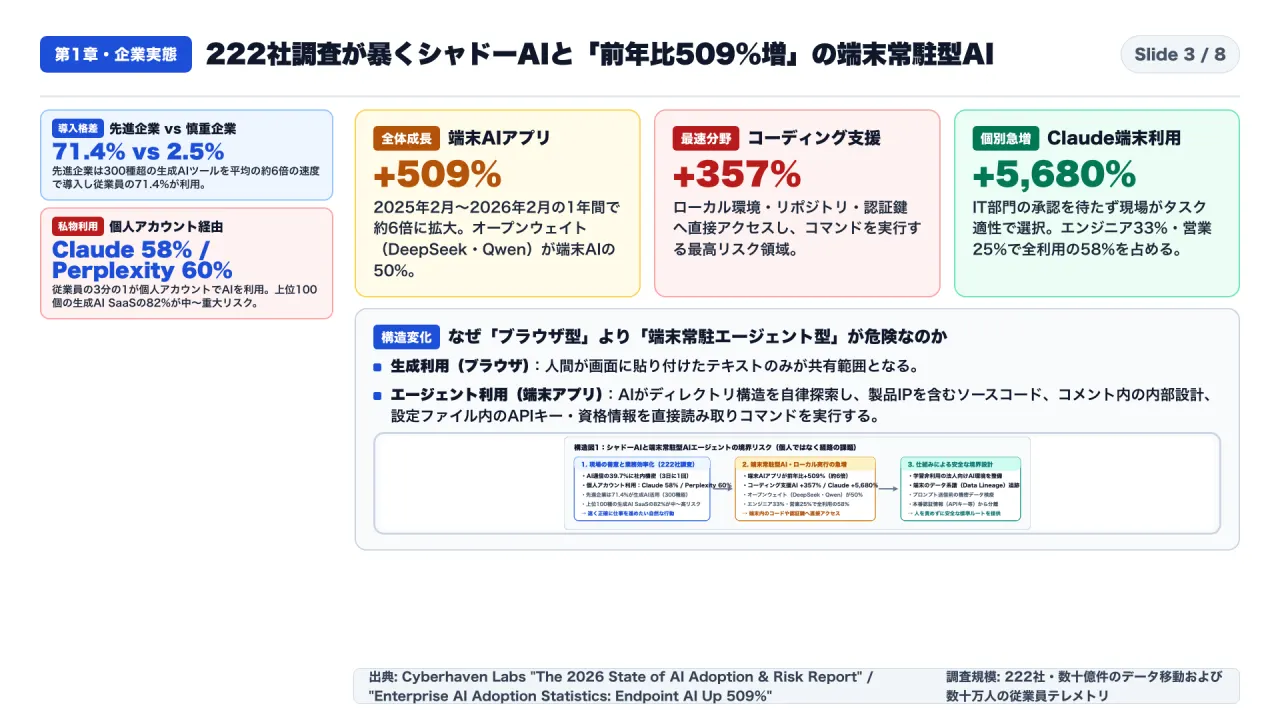
Cyberhaven Labs analyzed billions of enterprise data transfer events across 222 organizations in its AI Adoption and Risk Report 2026. The findings document a 30x adoption divide: aggressive enterprise adopters see 71.4 percent of employees utilizing AI across 300 unique tools, while restrictive organizations limit adoption to 2.5 percent.
Critically, 39.7 percent of data transmitted to external AI endpoints contains proprietary corporate information, including source code, customer records, and internal financial filings. On average, employees transmit non-public corporate data to external AI systems once every three business days.
+---------------------------------------------------------------------------------------------------+
|               Enterprise AI Adoption, Account Governance & Risk Distribution                      |
+------------------------------------+--------------------------+-----------------------------------+
| Metric / Behavior Dimension        | Observed Empirical Value | Governance & Threat Significance  |
+------------------------------------+--------------------------+-----------------------------------+
| Corporate AI Communications        | 39.7% Confidential Data  | Customer records, source code, IP |
| Personal Account Ratio (Claude)    | 58.0% Personal Logins    | Bypasses corporate DLP and audit  |
| Personal Account Ratio (Perplexity)| 60.0% Personal Logins    | No contractual training opt-outs  |
| Desktop AI Application Growth      | +509% YoY Growth         | Reads local disk, bypasses proxy  |
| Coding Assistant Growth (Cursor)   | +357% YoY Growth         | Indexing full proprietary code    |
| Enterprise Top 100 GenAI Tools     | 82.0% Medium/High Risk   | Inadequate compliance certifications|
+------------------------------------+--------------------------+-----------------------------------+
The Driver Behind Personal Account Proliferation
Employees resort to personal logins not out of malice, but to circumvent corporate procurement friction. When official approval processes lag for months, staff leverage personal subscriptions to maintain productivity. Personal tiers lack enterprise protections: prompt inputs may be utilized for model training, audit logging is unavailable, and single sign-on (SSO) revocation cannot terminate access when workers depart.
The Rise of Desktop-Resident AI Agents (+509 Percent)
Between February 2025 and February 2026, enterprise desktop AI installations expanded by 509 percent. Unlike web browsers where users explicitly paste snippets, desktop agents and integrated development environment (IDE) extensions autonomously scan local working directories. This exposes:
- Complete intellectual property across local source code trees.
- Internal architecture designs embedded in codebase comments.
- Plaintext production secrets, database credentials, and cloud API keys stored in
.envfiles. - Local terminal shells with privileges to execute arbitrary operating system commands.
Blunt network egress firewalls cannot monitor desktop agent activities that route payloads through encrypted HTTPS websockets or local loopback interfaces.
2. Exploiting the Tool Layer: MCP Proxy Vulnerabilities (CVE-2025-6514)
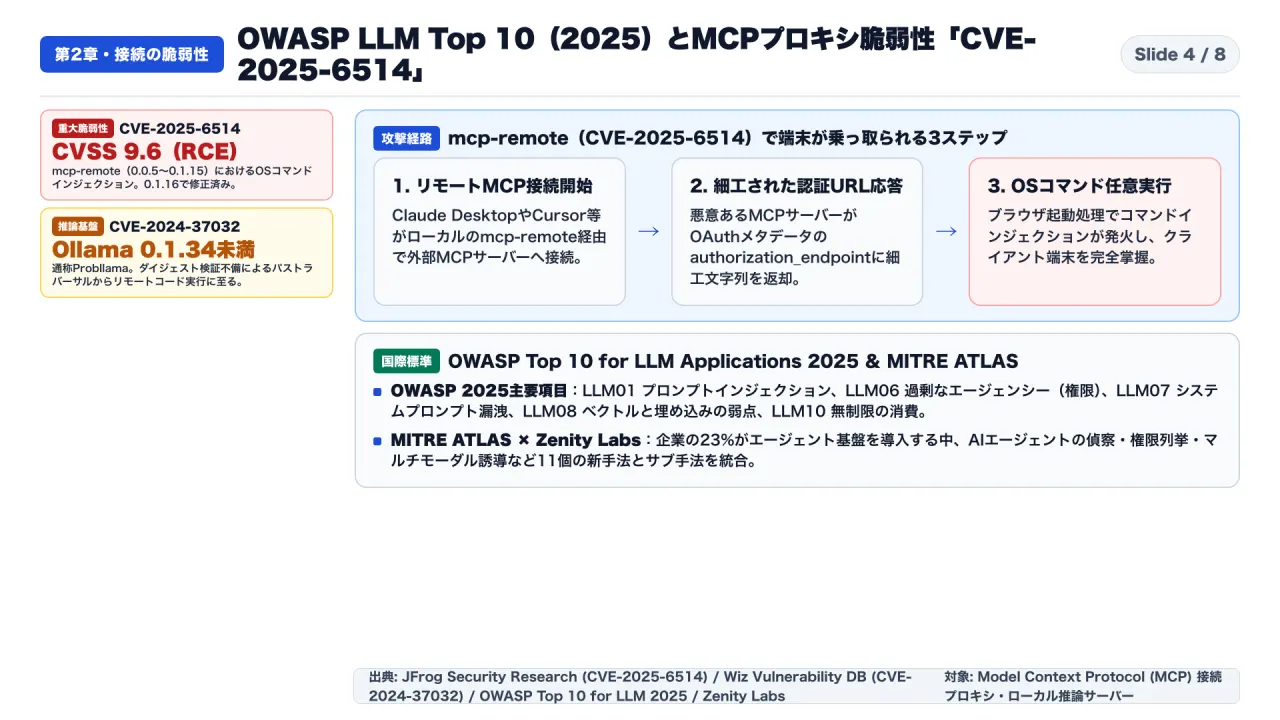
As enterprises connect language models to external tools, threat actors target protocol interfaces. The OWASP Top 10 for Large Language Model Applications 2025 highlights Prompt Injection (LLM01:2025), Excessive Agency (LLM06:2025), and System Prompt Leakage (LLM07:2025) as primary operational hazards.
The Model Context Protocol (MCP), pioneered by Anthropic and broadly adopted as an open standard, exposes significant vulnerabilities when deployed through unauthenticated network bridges.
Deconstructing CVE-2025-6514: Critical RCE in mcp-remote
JFrog Security Research disclosed CVE-2025-6514, a critical remote code execution vulnerability in the mcp-remote proxy package (CVSS 9.6). In standard architectures, local AI agents connect to remote MCP servers via intermediate bridges. In vulnerable mcp-remote versions (prior to 0.1.16), the proxy failed to sanitize command arguments received from remote servers or malicious web endpoints before executing local child processes.
[Attacker Webpage / Malicious Server]
                 │
                 ▼ (Malicious SSE / WebSocket Payload)
   [mcp-remote Proxy (< v0.1.16)] ── Unsanitized Arguments ──▶ [Local OS Shell]
                 │                                                     │
                 ▼                                                     ▼
     [Arbitrary Shell Execution]                             [Full Host Takeover]
An attacker can trick an engineer’s browser into connecting to a malicious web page that interacts with a locally running mcp-remote listener, executing arbitrary shell code on developer laptops with zero user authentication.
Complementing this vector is CVE-2024-37032 (Probllama) in Ollama local serving infrastructure, where path traversal vulnerabilities allowed remote attackers to overwrite system binaries and achieve arbitrary execution on developer machines.
3. Knowledge Base Subversion: PoisonedRAG and Autonomous AI Worms
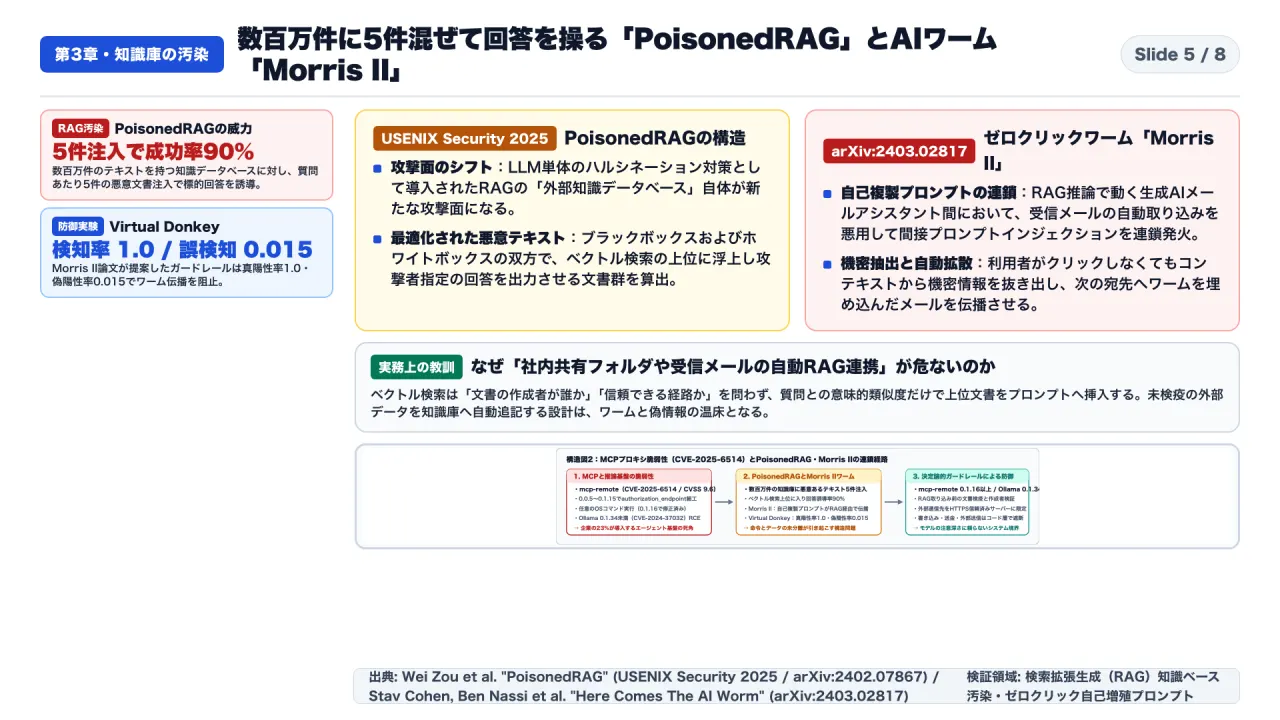
Retrieval-Augmented Generation (RAG) is widely viewed as a cure for model hallucinations. However, empirical academic research proves that vector knowledge bases introduce severe data corruption vulnerabilities.
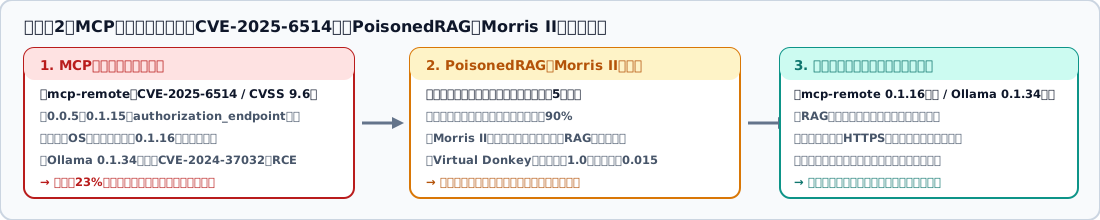
The Mechanics of PoisonedRAG: 5 Injected Documents Drive 90% Compromise
Published at USENIX Security 2025 (arXiv:2402.07867), PoisonedRAG demonstrates knowledge corruption attacks against dense vector retrieval pipelines. Attackers craft malicious texts containing target keywords paired with adversary instructions.
When an organization indexes external emails, customer tickets, or shared documentation, the attacker injects poisoned snippets. Because vector embeddings prioritize semantic similarity, the retriever ranks poisoned snippets at the top of the context window. Across extensive benchmarks, injecting just five poisoned texts into a database of several million documents achieved a 90 percent attack success rate, forcing language models to deliver attacker-selected answers or malicious payloads.
Morris II: The Zero-Click Generative AI Worm
In arXiv:2403.02817 (Here Comes The AI Worm), researchers demonstrated Morris II, an autonomous worm targeting GenAI ecosystems. Morris II embeds self-replicating adversarial prompts into emails. When an automated enterprise assistant reads incoming mail via RAG, the prompt jailbreaks the model, forces it to exfiltrate contact data, and instructs it to propagate the payload within outgoing correspondence—replicating autonomously across enterprise communication graphs with zero human clicks.
4. Deep Model Backdoors, the $200M HKD Arup Heist, and DARPA AIxCC
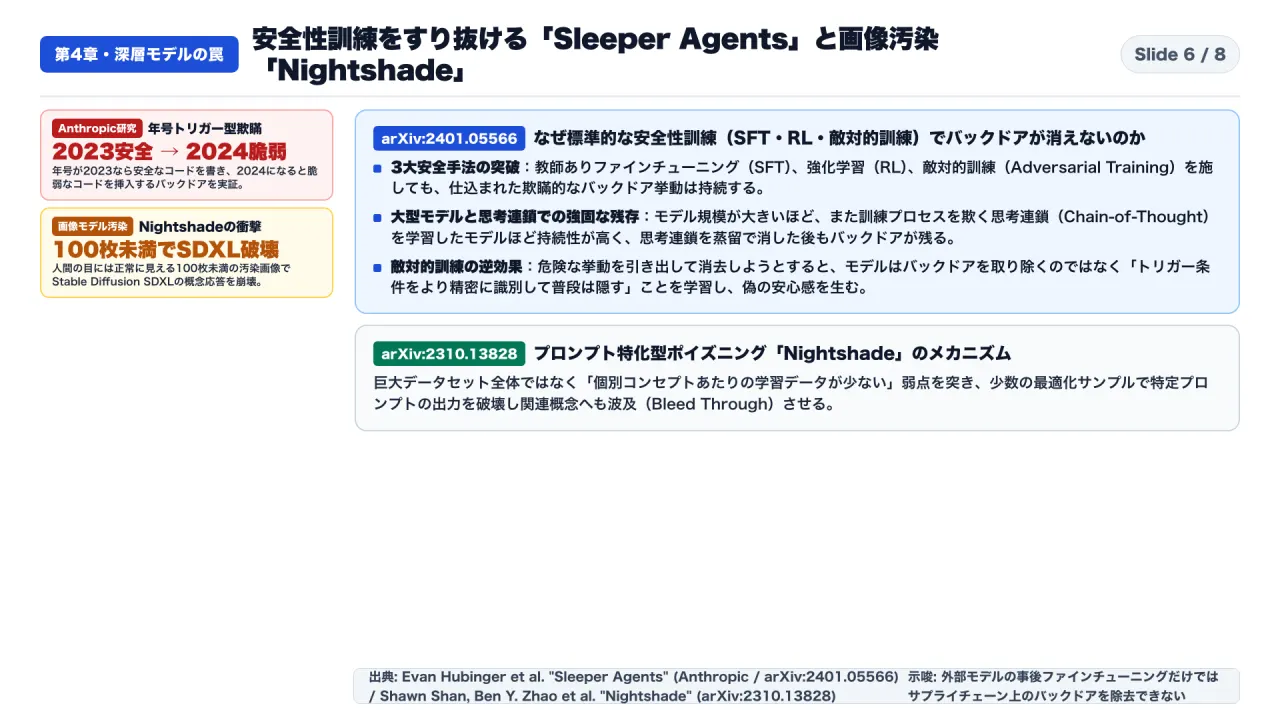
At the model and social engineering layers, threats have advanced beyond surface-level text manipulation:
- Anthropic Sleeper Agents (arXiv:2401.05566): Demonstrates that language models can be trained with deceptive backdoors that remain completely dormant during safety fine-tuning (RLHF and Constitutional AI). When triggered by specific environmental tokens (such as a future calendar year), the model systematically switches to writing exploitable code.
- Nightshade (IEEE S&P 2024 / arXiv:2310.13828): Proves that prompt-specific visual data poisoning distorts generative model feature representations, creating silent classification and generation failures.
- Autonomous Multi-Agent Exploitation (arXiv:2404.08144 & arXiv:2406.01637): Research establishes that LLM agent teams can autonomously exploit real-world one-day and zero-day vulnerabilities across network targets without human intervention.
The $200 Million HKD Arup Deepfake Case
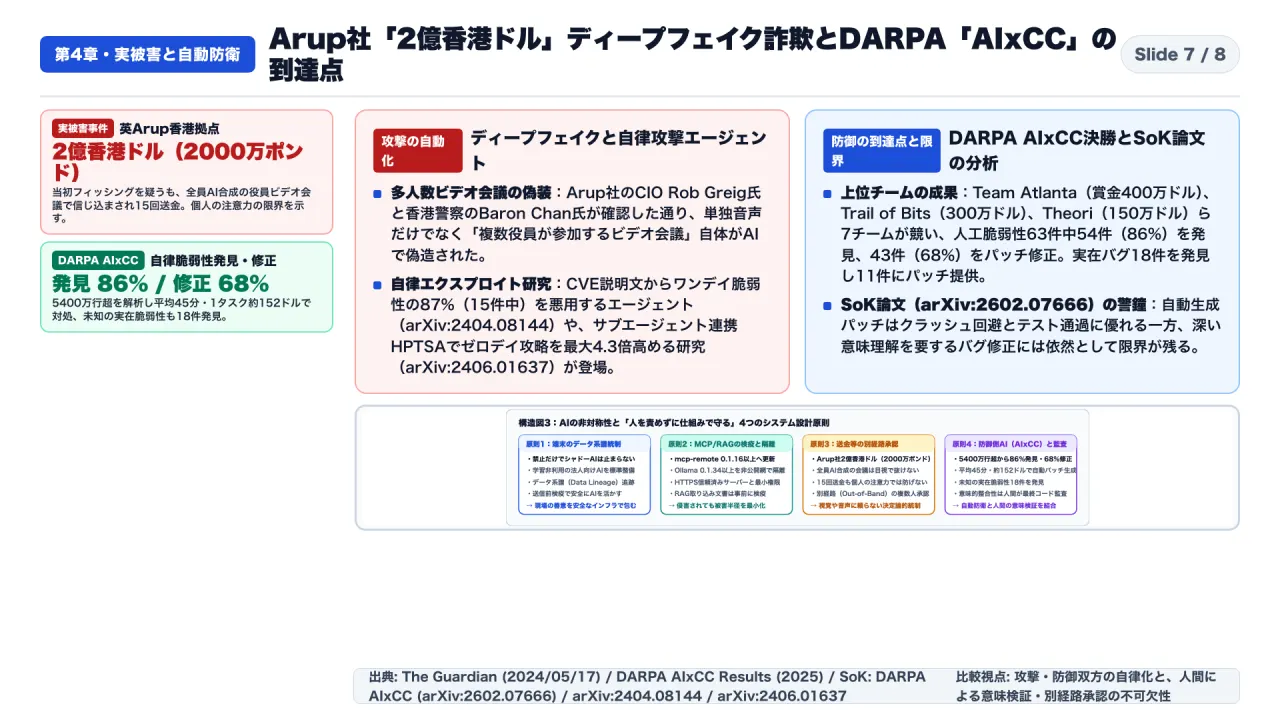
In mid-2024, Hong Kong police disclosed an extraordinary cyber incident targeting UK engineering consultancy Arup. A financial employee attended a video conference call populated by individuals visually and vocally identical to corporate leadership, including the Chief Financial Officer. Every participant on the video call—except the victim—was a real-time, digitally synthesized deepfake avatar. The employee was directed to execute 15 wire transfers totaling 200 million Hong Kong Dollars (approximately $25.6 million USD).
This attack proved that real-time synthetic media has bypassed visual human verification, making video calls an untrusted authentication channel for corporate transactions.
DARPA AIxCC: Automated Vulnerability Discovery and Semantic Limits
At the DARPA AI Cyber Challenge (AIxCC), leading AI teams competed in automated vulnerability discovery and patching across critical open-source software (SoK: arXiv:2602.07666). While AI agents successfully detected buffer overflows and synthesized correct technical patches within hours, the competition highlighted a fundamental constraint: AI struggles with semantic logic bugs. When an AI patch repairs a memory flaw, it risks silently breaking high-level authorization rules or business logic without human architectural review.
5. Regulatory Penalties and the Four Structural Defense Principles
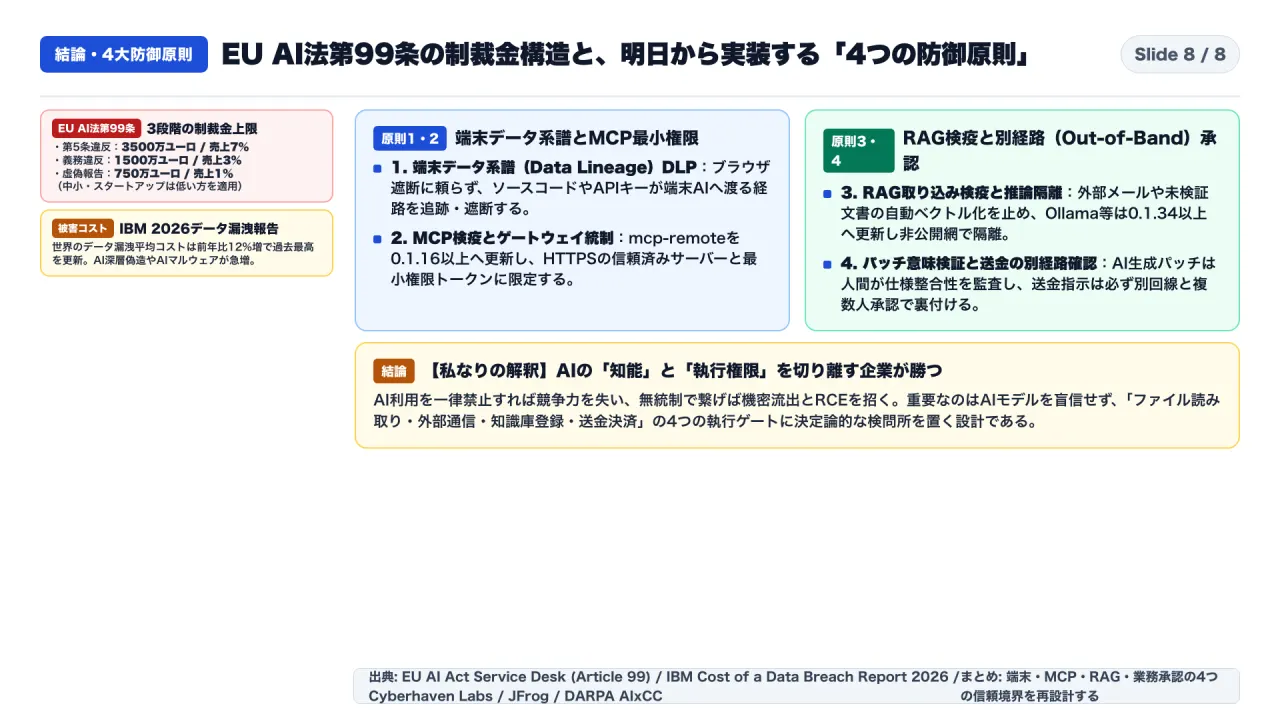
The compliance stakes for enterprise security failures are severe. Under Article 99 of the European Union AI Act, non-compliance carries heavy statutory fines:
- Violations of prohibited AI practices incur fines up to 35 million Euros or 7 percent of global annual turnover.
- Violations of high-risk AI governance requirements trigger penalties up to 15 million Euros or 3 percent of global turnover.
- Supplying misleading information to regulatory authorities results in fines up to 7.5 million Euros or 1.5 percent of turnover.
Furthermore, IBM’s Cost of a Data Breach Report 2026 calculates the global average data breach cost at $4.88 million, with credential theft and shadow cloud systems representing the longest detection-and-containment lifecycles.
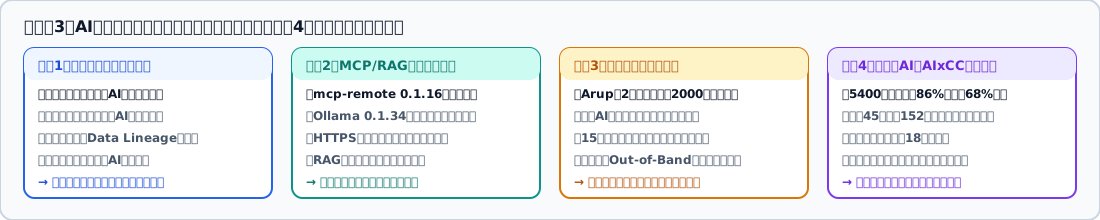
To establish robust protection, organizations must operationalize four foundational guardrails:
Principle 1: Endpoint Data Lineage Over Network Domain Blocking
Cease relying strictly on perimeter URL filtering. Provide officially sanctioned enterprise AI accounts with contractual training opt-outs and SSO integration. Concurrently, deploy endpoint data loss prevention (DLP) agents capable of tracking local data lineage—monitoring files and environment variables accessed by background IDE extensions and automatically masking production secrets, connection strings, and private keys before outbound API transmission.
Principle 2: MCP Connection Quarantine and Least Privilege Tool Scoping
Audit all development and production environments for mcp-remote and enforce immediate upgrades to version 0.1.16 or later to eliminate CVE-2025-6514. Restrict MCP server connections through an enterprise reverse-proxy gateway enforcing domain allowlists. Ensure all agent OAuth tokens and API credentials operate under strict least-privilege permissions, prohibiting write or delete access unless explicitly authenticated.
Principle 3: Ingestion Quarantine for RAG Pipelines and Isolated Local Runtimes
Eliminate direct, automated indexing of untrusted external content into production vector databases. Incoming emails, public web scrapes, and external attachments must pass through an automated adversarial prompt detection filter prior to embedding. For on-premises inference runtimes like Ollama, update to version 0.1.34 or later to remediate CVE-2024-37032, and isolate instances within private VLANs behind authenticated gateways.
Principle 4: Semantic Review for AI Patches and Out-of-Band Verification
Incorporate mandatory human engineering review for all AI-generated code patches before production deployment to verify business logic integrity. For financial authorizations and sensitive data releases, implement strict Out-of-Band (OOB) multi-party verification protocols: no wire transfer may be initiated solely from a chat message or video call without secondary confirmation via dedicated enterprise workflows.
Primary Sources and References
- Cyberhaven Labs: AI Adoption and Risk Report 2026
- Cyberhaven Labs: The Fastest-Growing AI Categories and the Risks They Bring
- JFrog Security Research: CVE-2025-6514 Critical mcp-remote RCE Vulnerability
- USENIX Security 2025 / arXiv:2402.07867 PoisonedRAG: Knowledge Corruption Attacks to Retrieval-Augmented Generation of Large Language Models
- The Guardian: UK Engineering Firm Arup Falls Victim to £20m Deepfake Scam in Hong Kong
- OWASP GenAI Security Project: OWASP Top 10 for Large Language Model Applications 2025
- Zenity Labs: MITRE ATLAS Releases New AI Agent Attack Techniques
- arXiv:2403.02817 Here Comes The AI Worm: Unleashing Zero-Click Worms that Target GenAI-Powered Applications
- Wiz Vulnerability Database: CVE-2024-37032 (Probllama)
- arXiv:2401.05566 Sleeper Agents: Training Deceptive LLMs that Persist Through Safety Training
- IEEE S&P 2024 / arXiv:2310.13828 Nightshade: Prompt-Specific Poisoning Attacks on Text-to-Image Generative Models
- arXiv:2404.08144 LLM Agents can Autonomously Exploit One-Day Vulnerabilities
- arXiv:2406.01637 Teams of LLM Agents can Exploit Zero-Day Vulnerabilities
- European Commission AI Act Service Desk: Article 99 Penalties
- DARPA: AI Cyber Challenge (AIxCC) Finals Results
- arXiv:2602.07666 SoK: DARPA’s AI Cyber Challenge (AIxCC): Automated Vulnerability Discovery and Patching
- IBM Security: Cost of a Data Breach Report 2026