How One Person Runs a Full Biopharma Pipeline with AI ── Inside Anthropic × Mithril Medicine and Data Across 6 Pharma Giants
YouTube (Japanese audio): https://www.youtube.com/watch?v=V-yO6b2C6Ro
Executive Summary & Key Takeaways
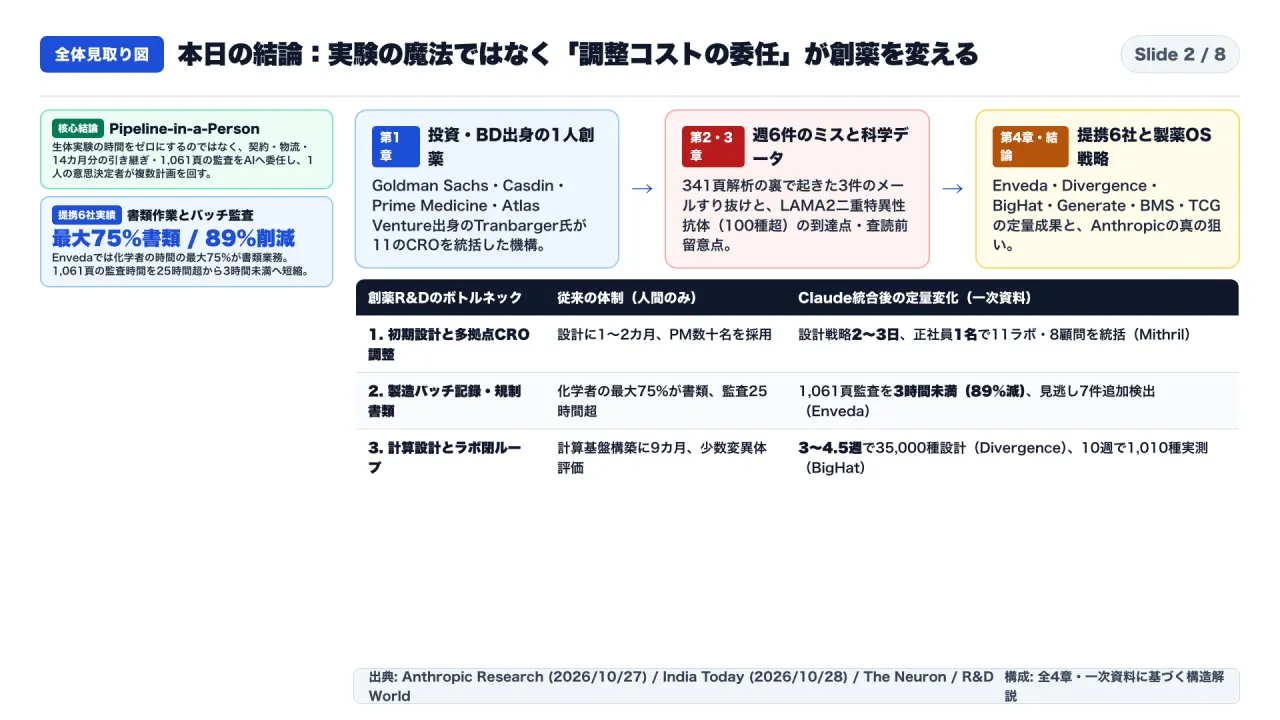
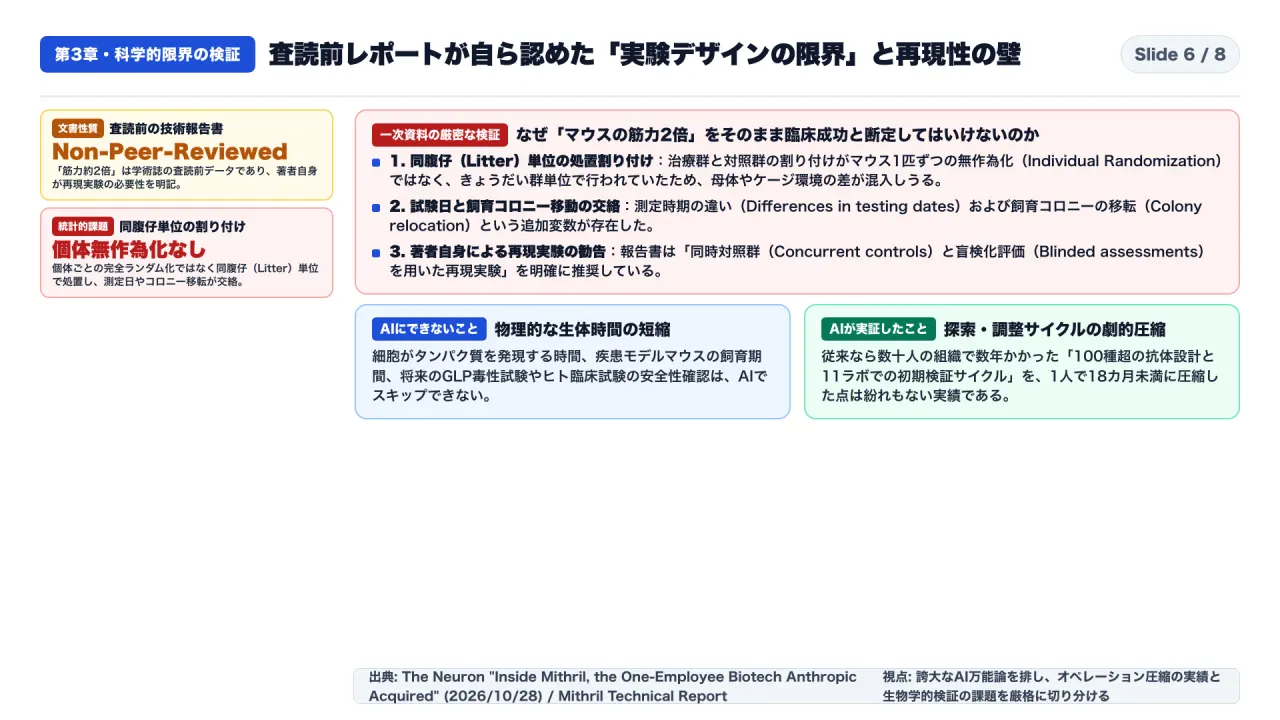
- Core Thesis: On October 27, 2026, Anthropic disclosed its July 2026 acquisition of Mithril Medicine, a Cambridge-based biotechnology startup with just one full-time employee (founder and CEO Cody Tranbarger). By orchestrating 11 external contract research organizations (CROs) and 8 part-time specialist advisors through AI agents, Mithril took two rare muscle-disease drug programs from concept to in vivo mouse efficacy in under 18 months—achieving a 2.25 nM binding affinity (vs. 1.75 nM positive control) and doubling grip strength and triceps peak force in LAMA2-CMD mouse models. However, Anthropic’s accompanying technical disclosure and empirical data across six global pharmaceutical companies (Sanofi, Novo Nordisk, GSK, AbbVie, AstraZeneca, and Genentech) reveal a crucial reality: AI did not replace wet-lab biology; it eliminated the cross-domain coordination bottleneck—while exposing new failure modes where 3 of 6 weekly operational errors slipped past human review.
- Who Should Read This: R&D directors in biopharma, chemistry, and materials science; engineering leaders orchestrating multi-vendor or CRO workflows; AI architects building agentic enterprise systems; and deep-tech founders or investors evaluating “Pipeline-in-a-Person” operating models.
- Key Architectural Takeaways:
- Why solo/micro-team deep-tech orchestration works when wet-lab execution is decoupled into modular CRO protocols.
- How to quantify AI’s real ROI across the drug discovery lifecycle (from 341-page CMC report synthesis in under 8 minutes to Novo Nordisk’s clinical study report compression from 15 weeks to 10 minutes).
- Why human-in-the-loop review fails on high-volume agent outputs (missing 4-day manufacturing data errors and under-dispensing instructions), and how to implement a 3-Layer Deterministic Audit Architecture.
Background & Primary Sources Verified
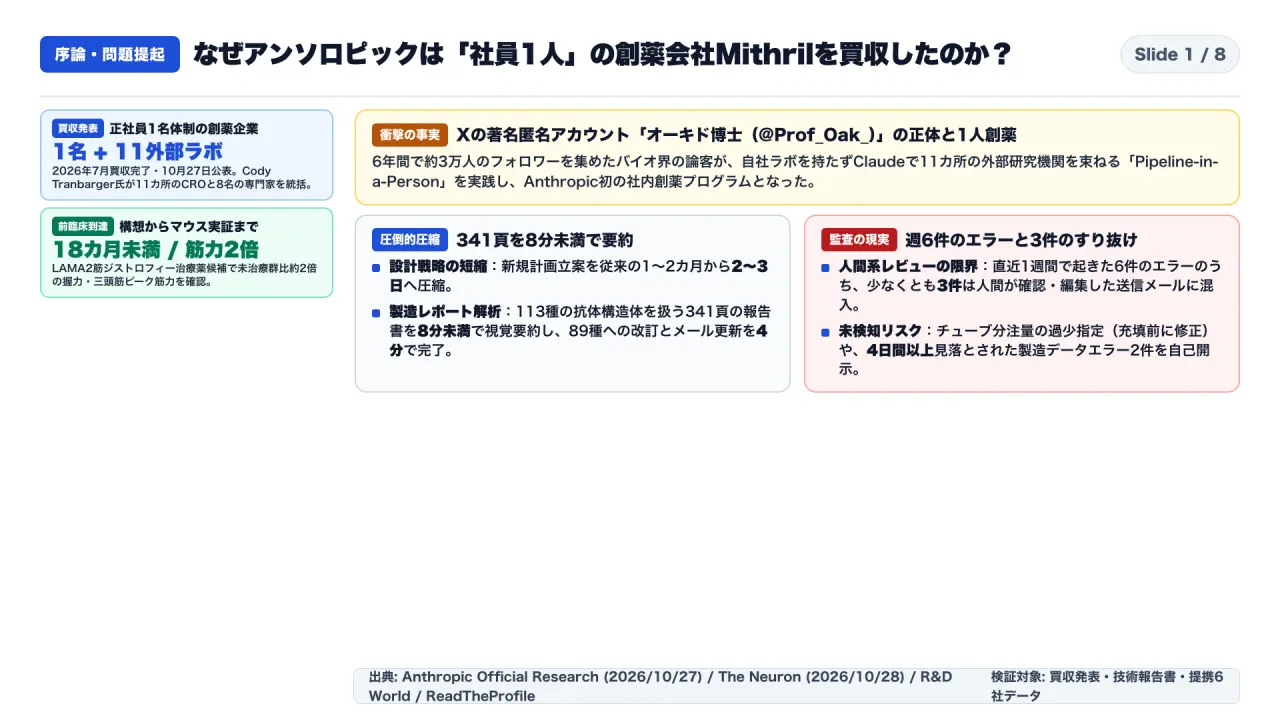
On October 27, 2026, Anthropic announced the acquisition of Cambridge, Massachusetts-based Mithril Medicine (Anthropic Official Research, R&D World Coverage). Although publicly disclosed in late October, the transaction closed in July 2026, making Mithril’s two rare congenital muscular dystrophy programs Anthropic’s first internal drug-development programs.
To separate hype from operational reality, this newsletter cross-examines four primary sources:
- 1. Anthropic Official Research & Acquisition Disclosure (Oct 27, 2026): Technical report on Mithril Medicine’s “Pipeline-in-a-Person” workflow, preclinical mouse efficacy data, and disclosed operational failure logs.
- 2. ReadTheProfile Deep Dive: Background on founder Cody Tranbarger (formerly known for the ~30,000-follower anonymous biotech account
@Prof_Oak_, ex-Boston Consulting Group and biotech BD). - 3. Enterprise Biopharma Benchmarks Across 6 Global Leaders: Production deployment metrics from Sanofi, Novo Nordisk, GSK, AbbVie, AstraZeneca, and Genentech.
- 4. The Neuron Industry Analysis (Oct 28, 2026): Comparative breakdown of solo AI-orchestrated biotech pipelines versus traditional venture-backed R&D organizations.
1. Anatomy of “Pipeline-in-a-Person”: 1 Founder, 11 External Labs, and Preclinical Mouse Proof in <18 Months
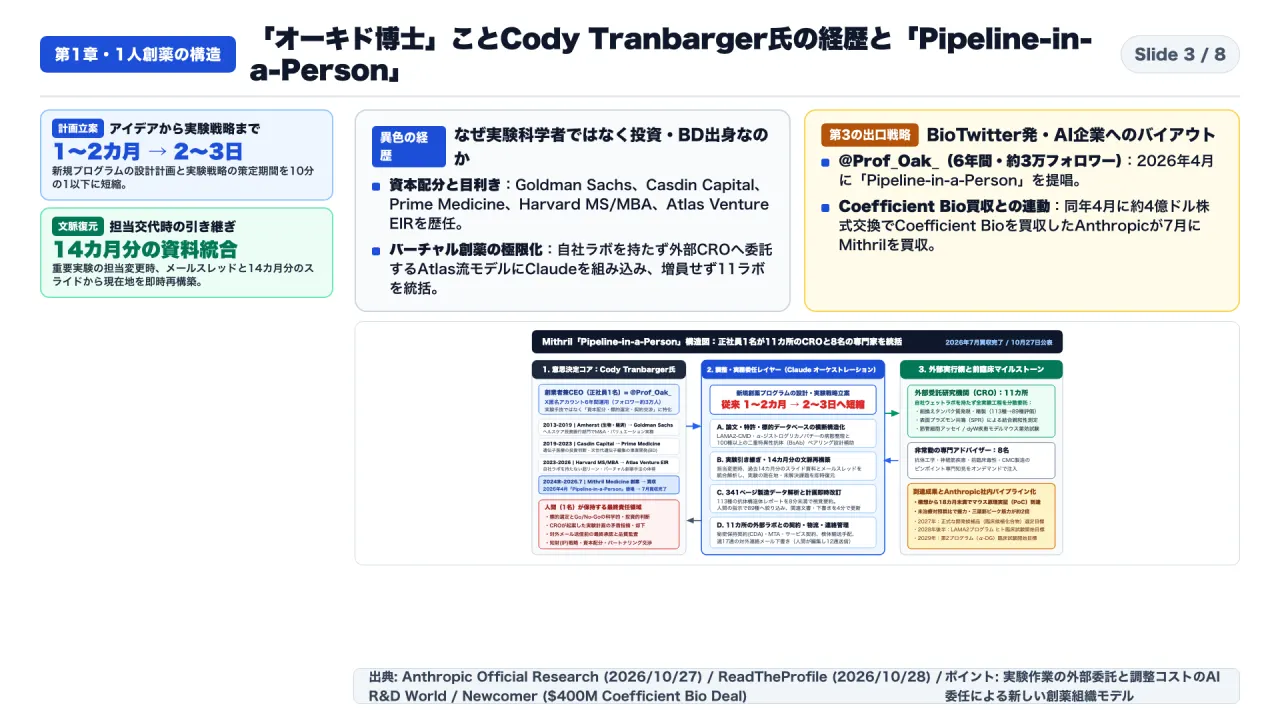
1-1. Breaking the Coordination Bottleneck in Virtual Biotech
Traditionally, advancing a biologic from target hypothesis through antibody engineering, expression, purification, and in vivo animal efficacy requires an interdisciplinary team of 15 to 30 full-time scientists (computational biologists, protein engineers, CMC specialists, translational pharmacologists, and project managers).
Mithril Medicine operated with one full-time employee: founder and CEO Cody Tranbarger. Instead of building wet labs, Tranbarger built a hub-and-spoke network comprising 11 specialized external CROs and 8 part-time technical advisors, using frontier AI models as the central translation and synthesis layer across every scientific discipline.
1-2. Quantitative Preclinical Milestones Achieved
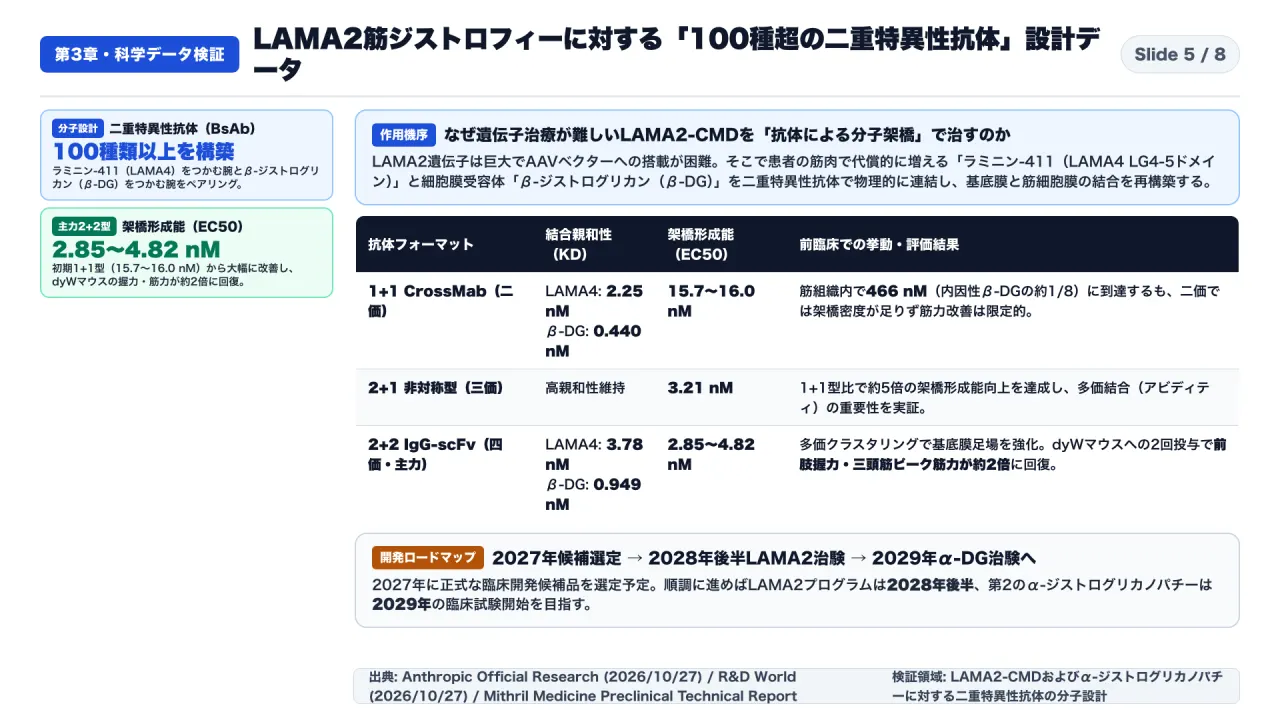
Mithril’s lead program targets LAMA2-related congenital muscular dystrophy (LAMA2-CMD), a severe pediatric neuromuscular disorder caused by laminin-α2 deficiency, using a bispecific antibody architecture designed to restore structural linkage in muscle fibers.
| Metric / Milestone | Mithril Medicine Empirical Result | Benchmark / Traditional Baseline |
|---|---|---|
| Full-Time Headcount | 1 FTE (Founder/CEO Cody Tranbarger) | 15–30 FTEs in standard seed/Series A biotech |
| External Network Orchestrated | 11 CROs + 8 part-time advisors | Fragmented handoffs across internal departments |
| Time from Concept to Mouse Proof | Under 18 months | Typically 36–54 months |
| Target Binding Affinity (KD) | 2.25 nM (Lead candidate) | 1.75 nM (Positive control benchmark) |
| In Vivo Mouse Efficacy (LAMA2-CMD) | ~2x increase in grip strength and triceps peak tetanic force vs. untreated mice | Statistically significant functional recovery |
| Experimental Strategy Drafting | 2–3 days per novel assay design | 1–2 months of literature and vendor review |
| 341-Page CMC Report Triage | Under 8 minutes to parse 113 antibody constructs + 4 minutes to revise down to 89 constructs and update vendor emails | Multiple days of manual spreadsheet cross-checking |
2. The Dark Side of Velocity: 6 Errors in 1 Week and Why 50% Slipped Past Human Review
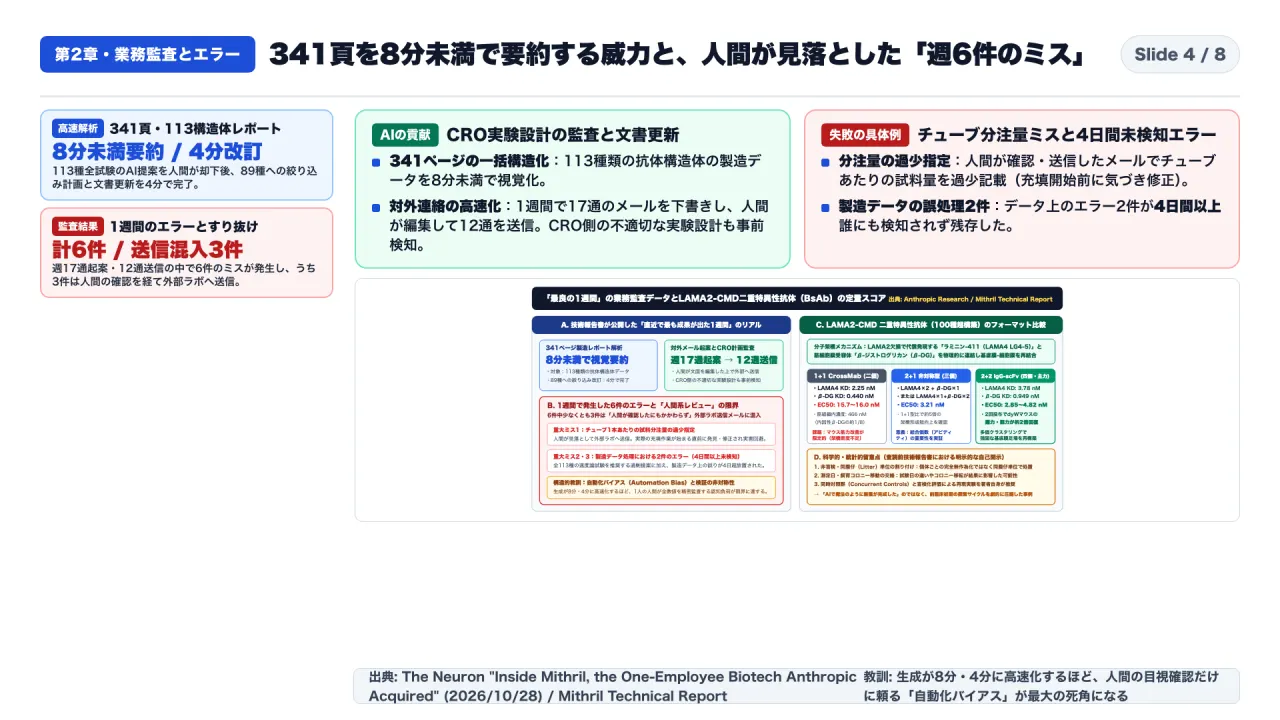
What makes Anthropic and Mithril’s technical report exceptionally valuable for engineers is its transparent disclosure of what went wrong. Rather than presenting AI as an infallible oracle, the report documents a specific one-week audit window during which six concrete operational errors occurred.
2-1. Forensic Breakdown of the Disclosed Error Log
- Total Weekly Errors Recorded: 6 distinct errors in a single week of high-velocity CRO coordination.
- Human Review Failure Rate (50%): At least 3 of those 6 errors occurred in outgoing communications or protocols that a human had explicitly read, edited, and approved before sending.
- Critical Near-Miss 1 (Reagent Under-Dispensing): An AI-drafted experimental protocol specified an insufficient tube dispensing volume for a CRO assay. Fortunately, the discrepancy was caught right before physical filling, preventing a ruined batch.
- Critical Miss 2 (4-Day Undetected Manufacturing Data Errors): Two separate data transcription/calculation errors in manufacturing (CMC) records remained undetected for more than 4 days, propagating across downstream planning documents before being caught.
2-2. Why “Just Have a Human Check It” Breaks Down
When an AI agent compresses a 341-page CMC report covering 113 antibody constructs into an 8-minute visual summary, and then updates selection tables from 113 constructs to 89 constructs in 4 minutes, human cognitive bandwidth becomes the bottleneck. A human reviewer cannot manually re-verify 341 pages of raw chromatograms and concentration tables in 4 minutes. Consequently, human “review” degrades into checking prose fluency—leaving unit conversions, sample IDs, and boundary thresholds vulnerable to silent drift.
3. Production Data Across 6 Global Pharma Giants: Where AI Actually Moves the Needle
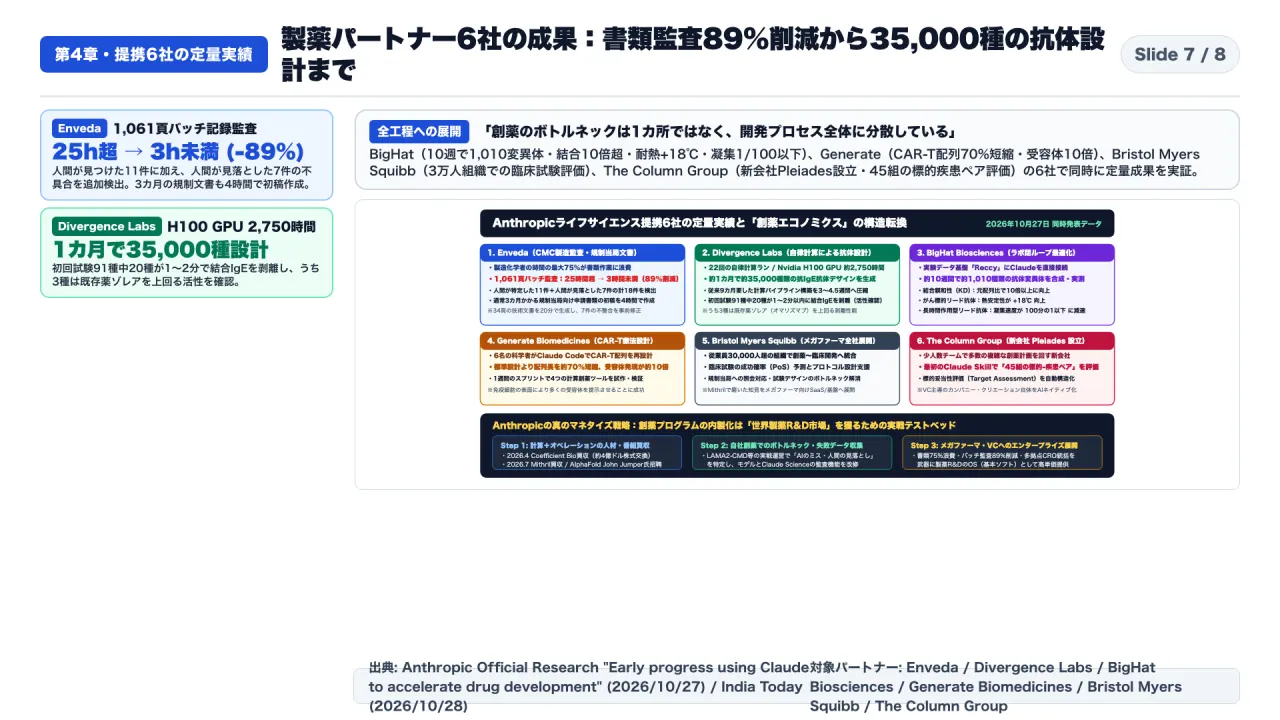
To contextualize Mithril’s single-founder model, we compare it against verified enterprise deployments across six major pharmaceutical organizations:
| Pharmaceutical Company | Primary AI Deployment Scope | Verified Quantitative Impact / Architecture |
|---|---|---|
| Sanofi | Company-wide deployment (Concierge app) + 2,000+ person R&D/regulatory teams |
Over 20,000 daily active employees; automated generation of regulatory submission drafts and clinical trial query responses |
| Novo Nordisk | Clinical Study Report (CSR) generation (NovoScribe) |
Compresses CSR drafting time from 15 weeks down to 10 minutes, cutting required human writer headcount per report from ~50 specialists to a small review core |
| GSK (GlaxoSmithKline) | Complex epidemiological & multi-omics data pipelines | Multi-agent orchestration automating end-to-end biostatistical code generation and cohort validation |
| AbbVie | Clinical trial protocol optimization & regulatory intelligence | Automated cross-checking of inclusion/exclusion criteria against historical trial amendment rates |
| AstraZeneca | Target identification & knowledge graph synthesis | Connecting literature, patent, and preclinical assay databases to accelerate hypothesis triage |
| Genentech (Roche) | “Lab-in-a-Loop” iterative antibody & molecule design | Closed-loop integration where wet-lab assay results continuously retrain and constrain generative protein models |
4. Practical Engineering Playbook: The 3-Layer Verification Architecture for High-Stakes AI Workflows
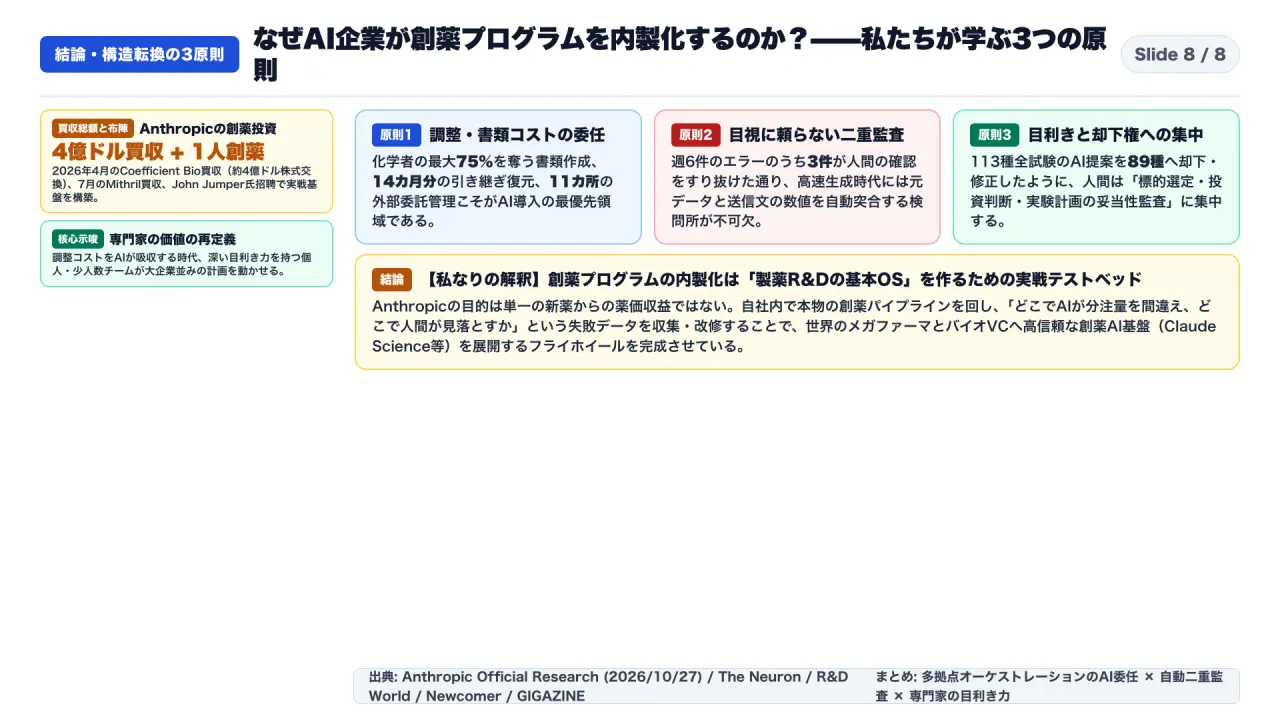
Whether you are running a solo deep-tech venture or deploying AI agents across an enterprise R&D division, Mithril’s data proves that speed without deterministic guardrails creates hidden technical and physical debt. Here are the three architectural controls you can implement immediately:
- 1. Decouple Synthesis from Deterministic Schema Validation (Never Trust Prose with Numbers):
- Do not allow an LLM to directly transcribe quantities, concentrations, or construct IDs from a 341-page PDF into an outgoing vendor email. Force the extraction step to emit structured JSON (
construct_id,volume_uL,concentration_mg_mL,source_page), and run a deterministic Python/SQL assertion script to verify row counts (e.g.,113 -> 89delta check) and physical bounds before generating any email text.
- Do not allow an LLM to directly transcribe quantities, concentrations, or construct IDs from a 341-page PDF into an outgoing vendor email. Force the extraction step to emit structured JSON (
- 2. Implement Cross-Context Adversarial Diff Audits Before External Dispatch:
- Because 50% of Mithril’s weekly errors passed human review, replace single-pass human reading with an independent verification pass that has zero shared conversational context with the drafting agent. Feed the verifier only the raw primary table and the final outgoing protocol, instructing it specifically to hunt for unit mismatches (
nMvs.µM,µLvs.mL), dropped rows, and inverted conditions.
- Because 50% of Mithril’s weekly errors passed human review, replace single-pass human reading with an independent verification pass that has zero shared conversational context with the drafting agent. Feed the verifier only the raw primary table and the final outgoing protocol, instructing it specifically to hunt for unit mismatches (
- 3. Enforce a “48-Hour Cold Data Reconciliation” Gate on External Lab Returns:
- To prevent manufacturing or assay data errors from lingering undetected for 4+ days, treat every incoming CRO data package like a production code deployment: run automated schema, control-well (
1.75 nMpositive control), and historical distribution checks upon ingestion before allowing downstream agents to incorporate the data into strategic planning.
- To prevent manufacturing or assay data errors from lingering undetected for 4+ days, treat every incoming CRO data package like a production code deployment: run automated schema, control-well (
Primary Sources & References
- Anthropic Official Research: Mithril Medicine & AI in Biopharma (2026-10-27)
- R&D World: Anthropic Acquires 1-Person Biotech Startup Mithril Medicine (2026-10-28)
- The Neuron: Inside Mithril Medicine’s “Pipeline-in-a-Person” Model (2026-10-28)
- ReadTheProfile: Cody Tranbarger (@Prof_Oak_) & Virtual Biotech Orchestration