Why Big Tech AI CapEx Squeezes Free Cash Flow and Prompts the Local AI Recoil: Inside Microsoft's $64.5B Spend, Oracle's Cash Deficit, and Google Search Margins
As hyperscaler capital expenditures surpass $60B annually, squeezing free cash flow and forcing corporate cost realignments, enterprise IT is finding operational shelter in 128GB unified-memory local inference.
Published: October 29, 2026 | Read time: ~10 min | Watch Video (Japanese)
Executive Summary: Accounting Gravity Meets the Generative AI Boom
When executive leadership evaluates enterprise AI strategy, a critical question dominates internal planning: Should organizations route all workflows through proprietary cloud AI application programming interfaces (APIs), or does the financial reality of hyperscaler infrastructure signal impending price hikes that warrant self-hosted deployments?
By late October 2026, Wall Street shifted its evaluation criteria from compute capacity to the cold discipline of Free Cash Flow (FCF) and operating margins. When financial disclosures submitted to the SEC via Form 10-K and Form 10-Q are cross-examined against public technology broadcasts, three structural realities emerge:
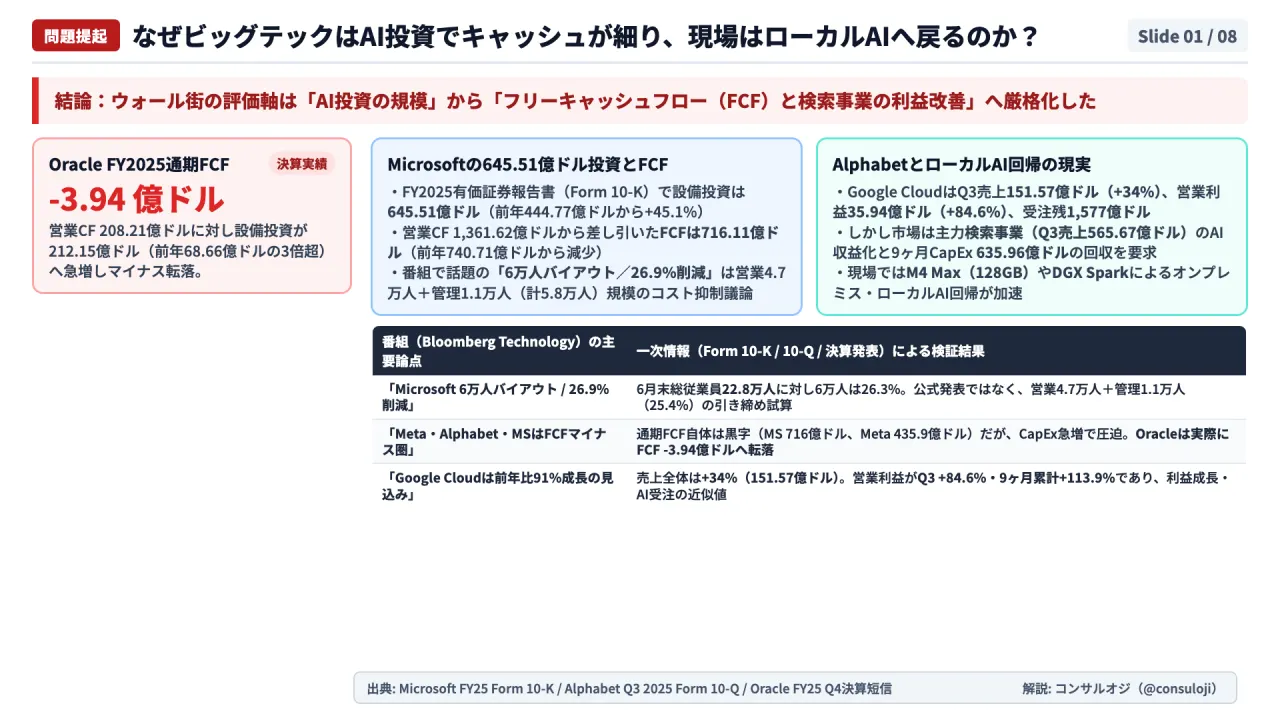
- Surging CapEx Squeezing Liquidity: In fiscal 2025, Oracle expanded operating cash flow by 12 percent to $20.82 billion. However, capital expenditures surged threefold from $6.87 billion to $21.22 billion, driving full-year free cash flow into a negative $394 million deficit—its first annual cash burn since 1992. Simultaneously, Microsoft expanded property and equipment additions by 45.1 percent to $64.55 billion, causing free cash flow to contract from $74.07 billion to $71.61 billion despite strong top-line gains, prompting tight cost discipline across non-engineering divisions.
- Cloud Operating Profit vs. Search Absorption: While broadcasts highlighted Google Cloud expanding by 91 percent, Alphabet’s Q3 2025 Form 10-Q clarifies that revenue grew 34 percent year-over-year to $15.16 billion. The 85 to 90 percent surge corresponds to quarterly operating income, which climbed 84.6 percent from $1.95 billion to $3.59 billion, backed by a $157.7 billion backlog. Nevertheless, capital expenditures reached $63.60 billion across nine months, placing heavy pressure on Google Search ($56.57 billion quarterly revenue) to absorb historic compute costs.
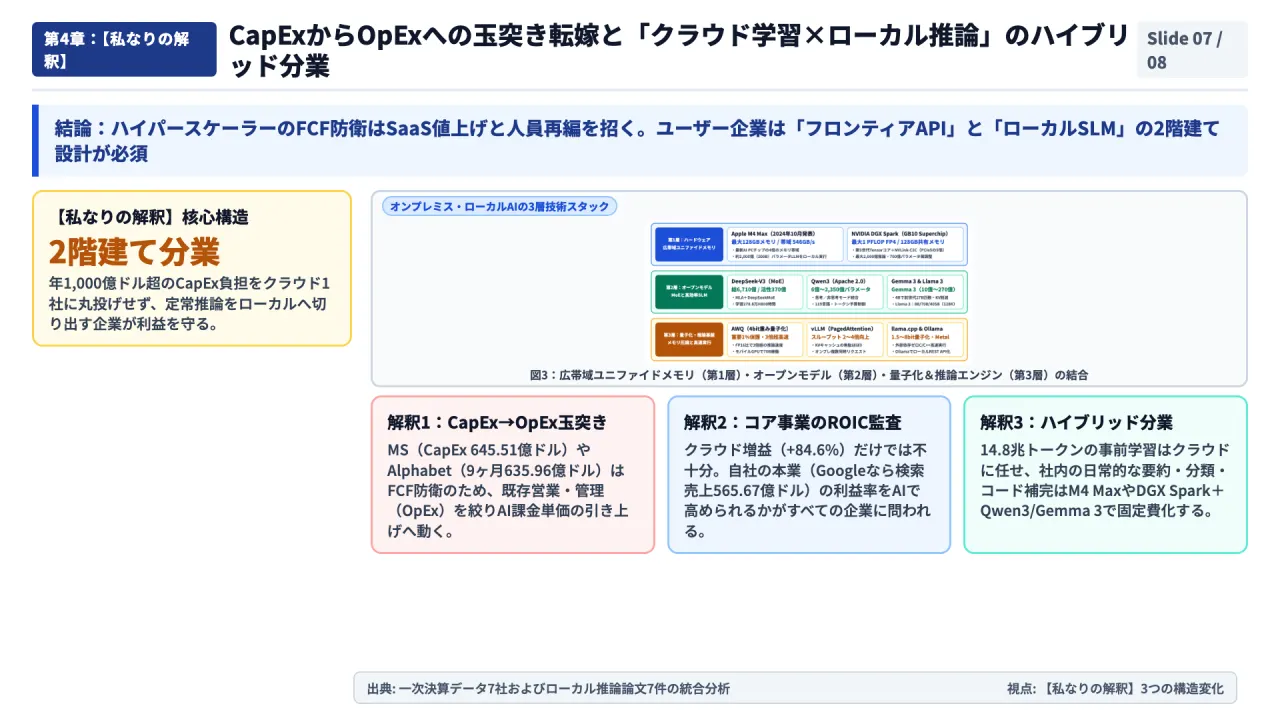
- The Recoil Toward Local AI: As cloud providers face margin pressure and explore higher API pricing to amortize silicon depreciation, enterprise teams are rediscovering on-premises infrastructure. Driven by Apple M4 Max silicon featuring up to 128GB of unified memory at 546 GB/s bandwidth, compact workstations powered by NVIDIA Grace Blackwell architectures, vLLM (PagedAttention), Activation-aware Weight Quantization (AWQ), and open models (DeepSeek-V3, Qwen3, Gemma 3, and Llama 3), hosting routine inference internally has become an efficient reality.
1. Wall Street’s Paradigm Shift: Free Cash Flow and Microsoft Workforce Facts
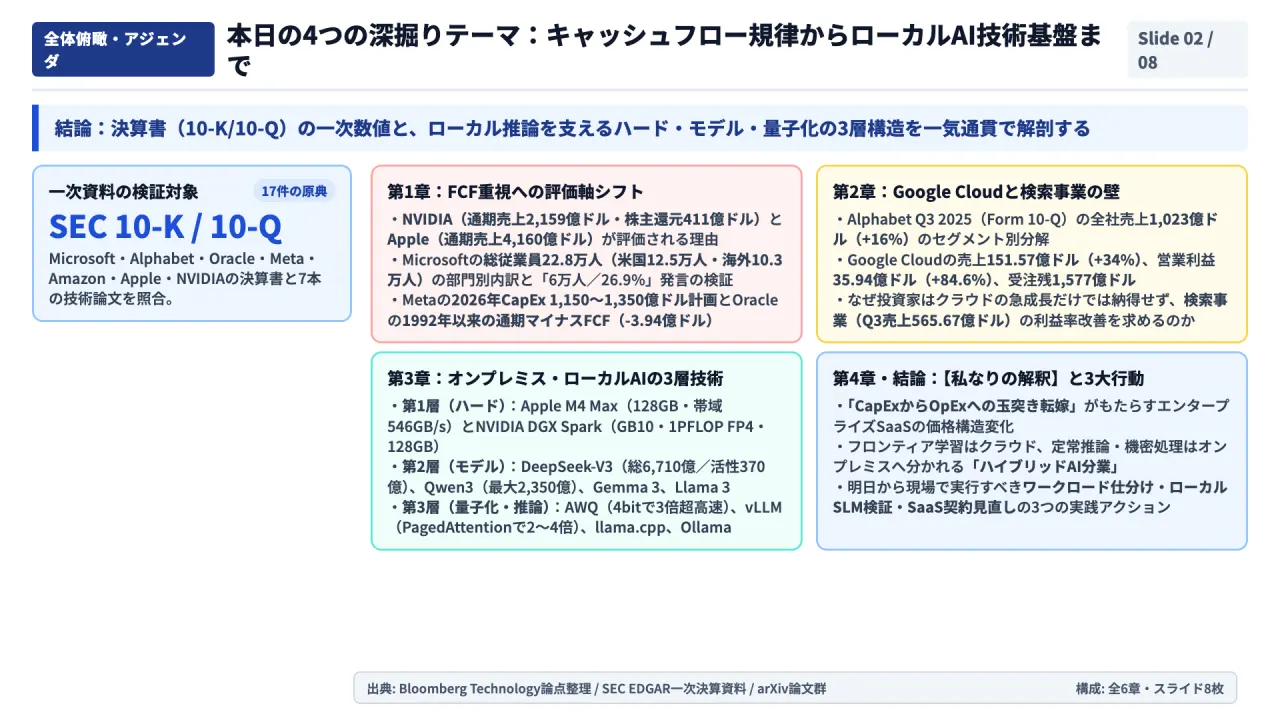
Understanding corporate restructuring across Silicon Valley requires mastering four corporate finance metrics: Operating Cash Flow (OCF), Capital Expenditures (CapEx), Free Cash Flow (FCF = OCF - CapEx), and Operating Expenses (OpEx).
When an infrastructure provider escalates annual CapEx from $40 billion to $70 billion, free cash flow immediately contracts. Over subsequent quarters, substantial depreciation charges hit the income statement, depressing GAAP operating margins. If enterprise software firms fail to generate immediate, high-margin revenue from AI subscriptions, management faces an unavoidable mandate: compress OpEx—predominantly headcount in non-technical functions—to protect operational margins and subsidize physical compute clusters.
Auditing the “60,000 Microsoft Buyout” Narrative
In October 2026, market commentary circulated claims that Microsoft planned to eliminate 26.9 percent of its workforce, or roughly 60,000 employees, to offset accelerating AI data center commitments.
A forensic audit of Microsoft’s Form 10-K for the fiscal year ended June 30, 2025, reveals the empirical facts regarding corporate staffing:
- Total Full-Time Workforce: Approximately 228,000 employees globally (125,000 US, 103,000 international).
- Operations & Support: 89,000 employees (39.0 percent).
- Product Research & Development: 81,000 employees (35.5 percent).
- Sales and Marketing: 47,000 employees (20.6 percent).
- General and Administrative: 11,000 employees (4.8 percent).
Microsoft filed no Form 8-K disclosing an aggregate termination of 60,000 workers. However, the combined non-technical pool—Sales, Marketing, and G&A—totals exactly 58,000 personnel, or 25.4 percent of headcount. Calculating 60,000 workers against the prior fiscal year baseline (223,000) yields approximately 26.9 percent. Market discussions reflected voluntary buyout programs, selective performance trims, and backfill freezes targeted at administrative and corporate sales functions, illustrating how non-compute OpEx is actively managed to support ballooning capital budgets.
Financial Disclosures: CapEx Growth at +45.1 Percent
Microsoft’s Consolidated Statements of Cash Flows in Form 10-K outline this structural capital reallocation:
- Cash from Operations: Rose from $87.58 billion in FY2023, to $118.55 billion in FY2024, and reached $136.16 billion in FY2025 (+14.9 percent).
- Additions to Property and Equipment (CapEx): Jumped from $28.11 billion in FY2023, to $44.48 billion in FY2024, and reached $64.55 billion in FY2025 (+45.1 percent). Note 6 confirms that accrued capital expenditures in accounts payable rose to $6.9 billion.
- Free Cash Flow: Full-year FCF dropped by $2.46 billion to $71.61 billion in FY2025 (-3.3 percent).
Despite generating $17.61 billion in incremental operational cash, Microsoft’s free cash flow contracted because physical infrastructure additions absorbed over $20.07 billion in incremental cash outflows.
2. Big Tech FCF Divergence: Cash Creators vs. Hyperscaler Deficits
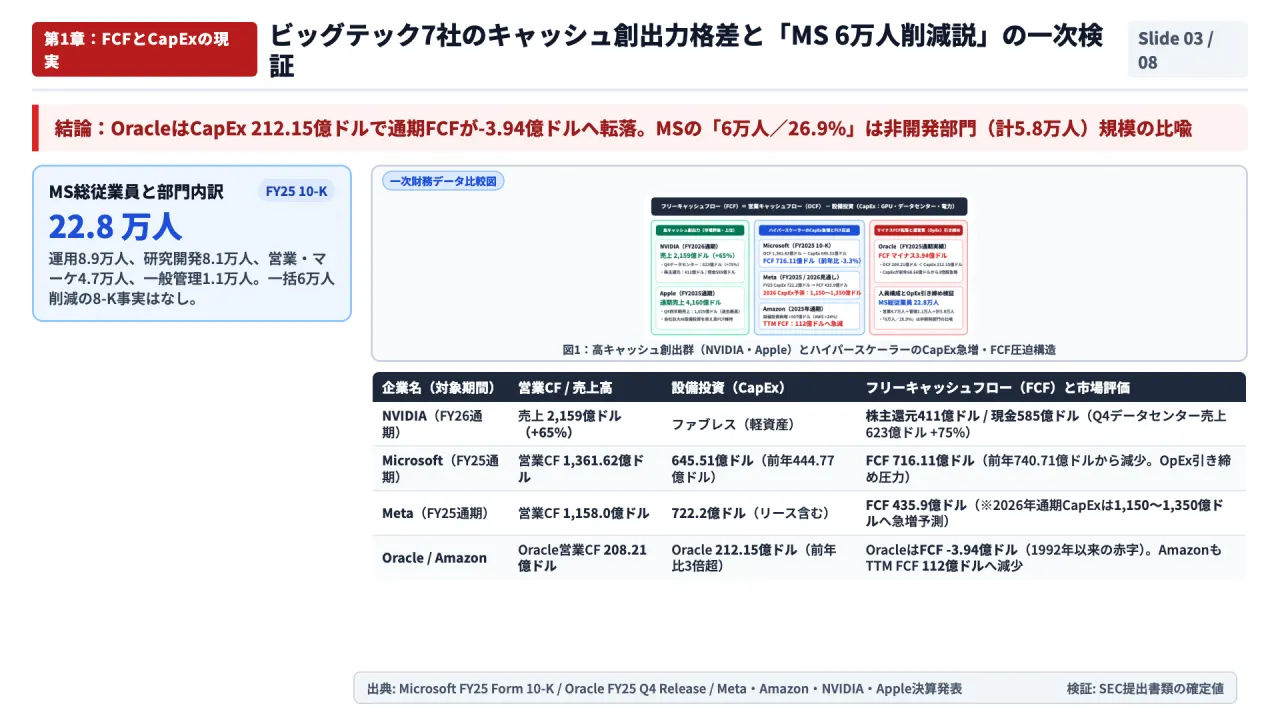
Financial filings reveal a sharp divergence between asset-light technology leaders and hyperscalers funding multi-year physical expansions:
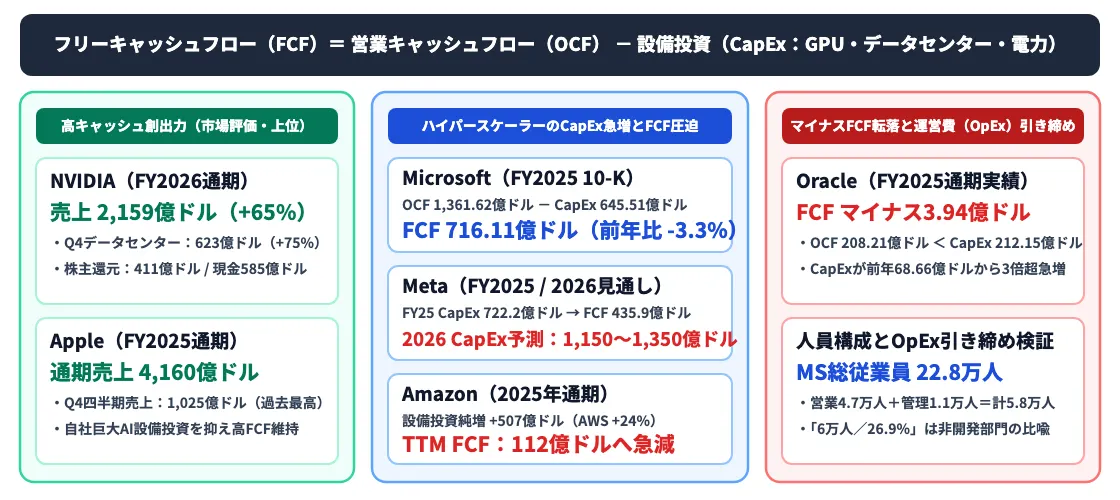
The Cash Creators: NVIDIA and Apple
At the peak of cash conversion sits NVIDIA, capturing extraordinary operating leverage. By pricing accelerated compute platforms (Hopper H100/H200 and Blackwell B200) at gross margins exceeding 70 percent, NVIDIA generates tens of billions in operating cash while outsourcing fabrication to TSMC, retaining modest direct CapEx requirements ($3 billion to $4 billion annually).
Similarly, Apple reported over $118 billion in operating cash flow for fiscal 2025. By maintaining an outsourced hardware assembly model and distributing AI features across client-side neural engines and targeted cloud partnerships, Apple converted more than $108 billion directly into free cash flow.
The Deficit Pivot: Oracle’s $21.2B CapEx Shock
In stark contrast stands Oracle. For fiscal year 2025, Oracle expanded operating cash flow by 12 percent to $20.82 billion. However, to satisfy multi-year demand for Oracle Cloud Infrastructure (OCI) clusters from major AI labs, management expanded capital investments to $21.22 billion—a dramatic increase from $6.87 billion in fiscal 2024.
Consequently, Oracle produced a full-year negative free cash flow of -$394 million, followed by an operating cash deficit in the opening quarter of fiscal 2027. To sustain this construction velocity, Oracle raised debt and accumulated multi-billion-dollar uncommenced lease obligations, prompting credit rating downgrades to BBB-.
3. The Google Cloud Paradox: Operating Profit Breakout vs. Search Defenses
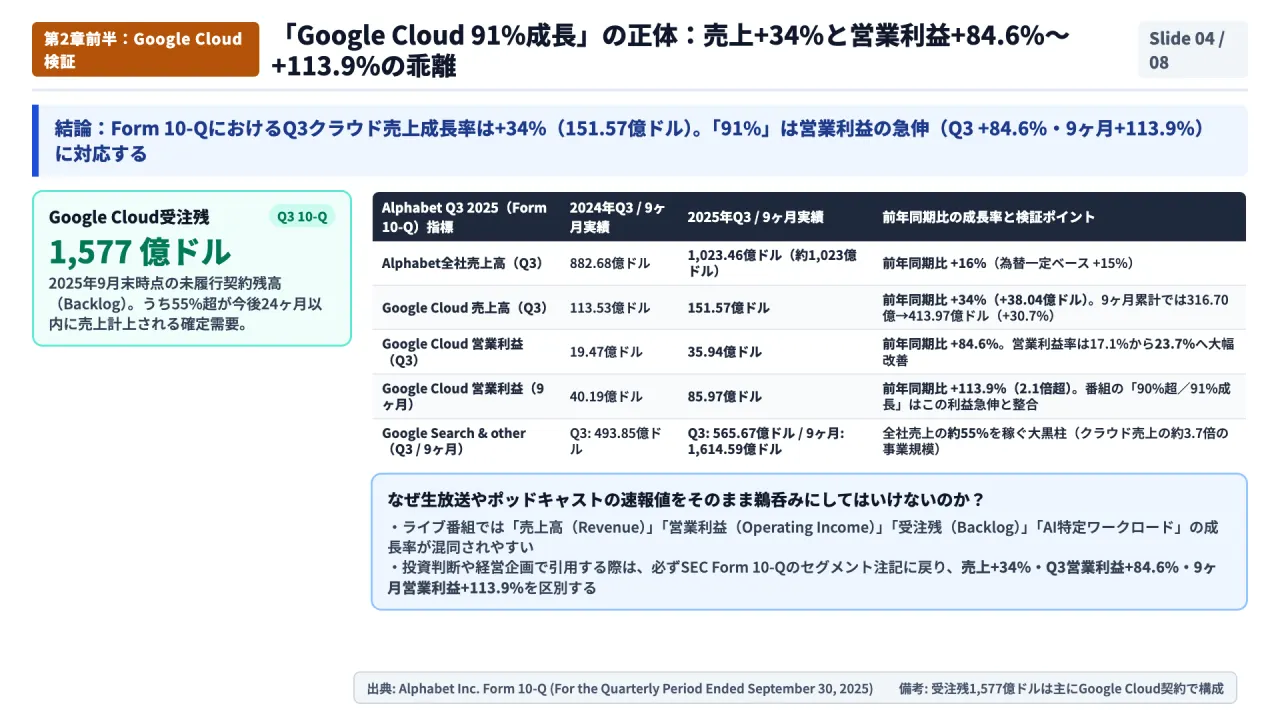
Alphabet presents an instructive case study in balancing cloud acceleration against the defense of core advertising profitability.
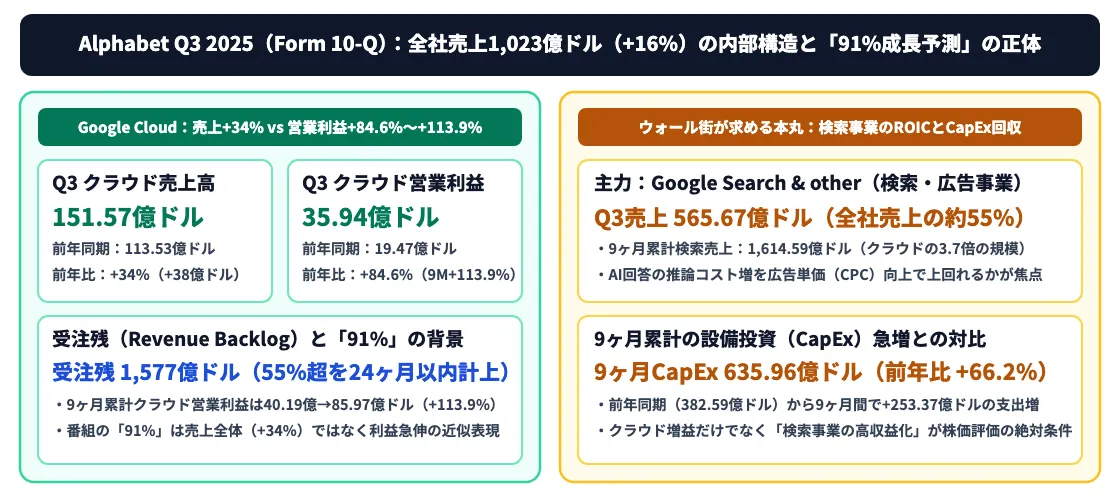
Deconstructing the 91 Percent Growth Figure
Alphabet’s third-quarter 2025 Form 10-Q clarifies broadcast reports of 91 percent growth:
- Google Cloud Revenue: Grew 34 percent year-over-year from $11.35 billion to $15.16 billion.
- Google Cloud Operating Income: Jumped 84.6 percent from $1.95 billion to $3.59 billion in Q3, and climbed 113.9 percent across nine months to $8.60 billion.
- Contractual Backlog: Expanded to $157.7 billion in multi-year enterprise commitments.
The Underlying Pressure on Search Advertising
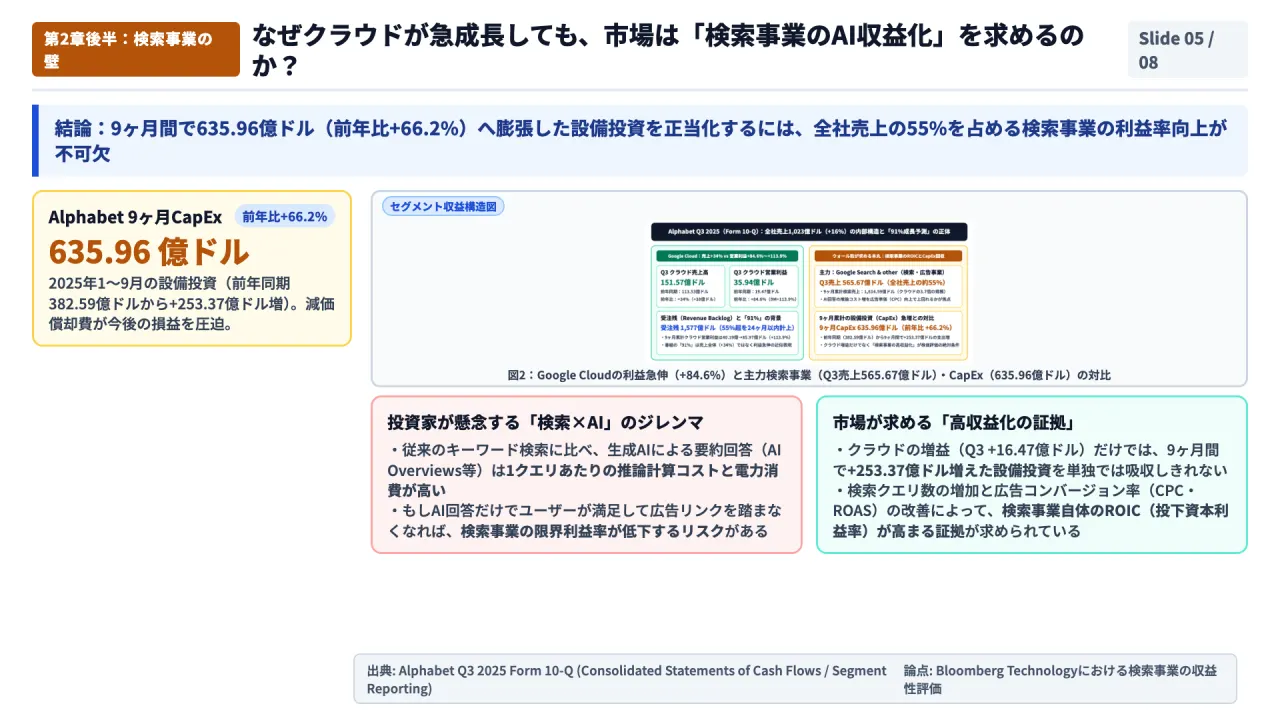
The market’s cautious reaction stems from Alphabet’s aggregate cash requirements. Over the first nine months of 2025, Alphabet deployed $63.60 billion in capital expenditures, reflecting a 66.2 percent jump compared to $38.27 billion in the prior-year period.
Alphabet’s economic core remains Google Search and advertising, generating $56.57 billion in quarterly revenue (55.3 percent of consolidated revenues) and $161.46 billion across nine months. Deploying real-time generative summaries (AI Overviews) across billions of daily queries requires substantially more compute cycles than traditional indexing. If capital expenditures consume upwards of $80 billion annually, Search advertising margins must absorb unprecedented fixed infrastructure depreciation.
4. The Enterprise Counter-Offensive: The Technical Triad of On-Premises Local AI
As cloud providers face the financial necessity of monetizing enterprise AI workloads, corporate IT organizations face mounting SaaS subscription costs, opaque token metering, and strict data residency mandates. These commercial pressures have ignited an enterprise migration toward on-premises and edge AI architectures.
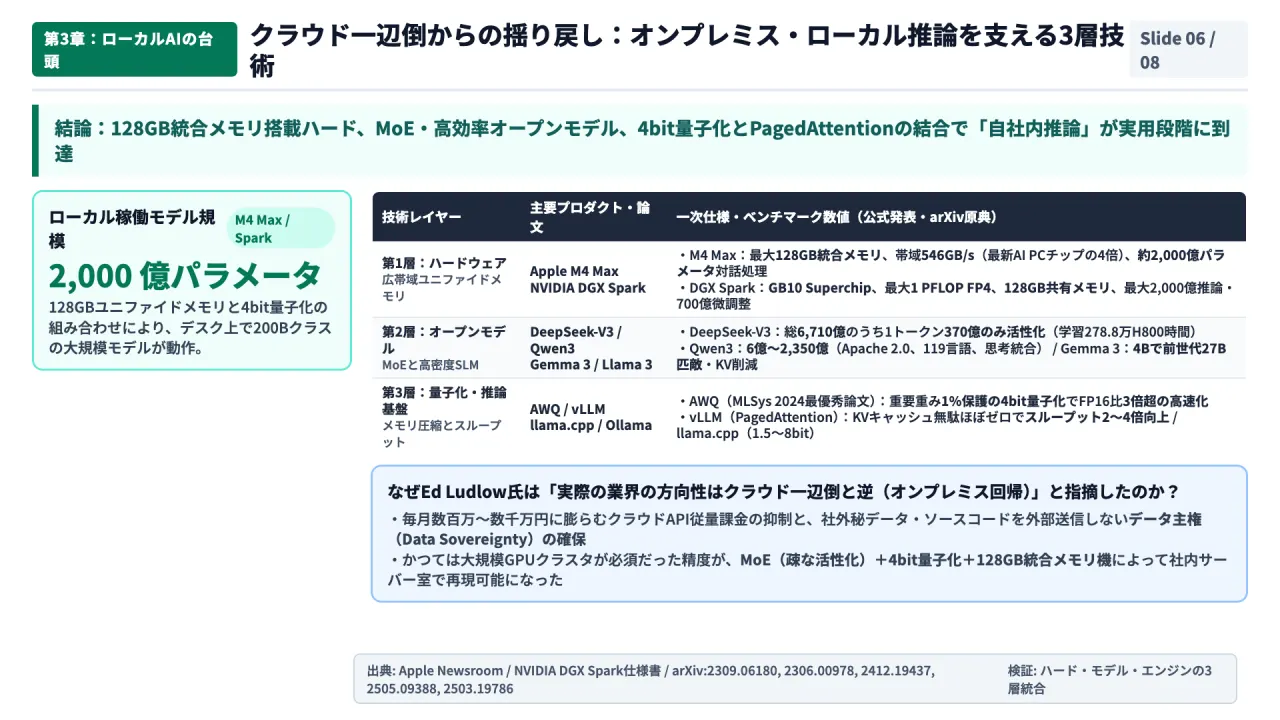
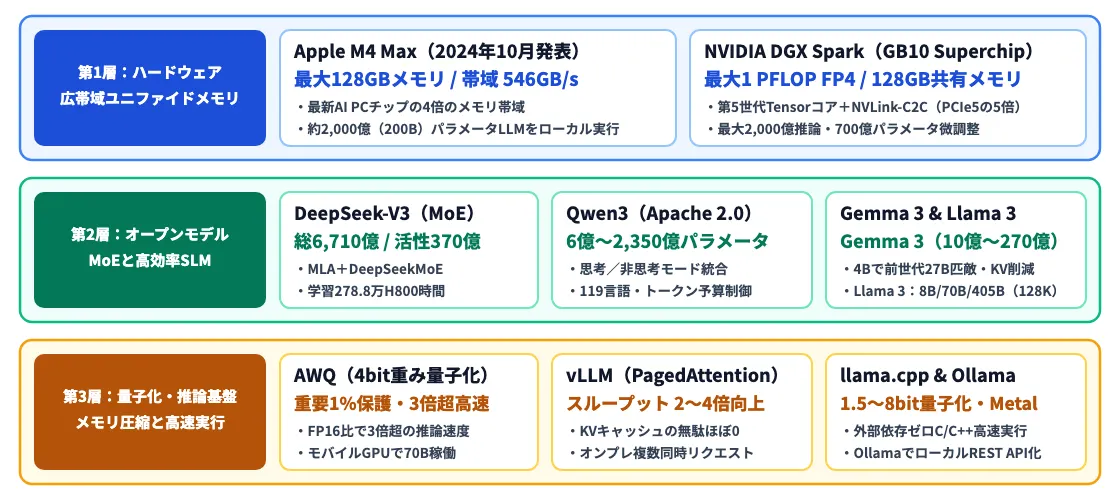
This architectural shift is enabled by three technological breakthroughs:
- High-Bandwidth Unified Memory Hardware: Apple Silicon (M4 Max) offers up to 128GB of unified memory at 546 GB/s bandwidth, fitting 70B parameter models into compact workstations. NVIDIA DGX Spark (Grace Blackwell GB10) integrates Tensor Cores and 128GB of shared memory, delivering up to 1 PFLOPS of FP4 inference within an office-friendly workstation footprint.
- Serving Engines & Quantization: Activation-Aware Weight Quantization (AWQ - arXiv:2306.00978, MLSys 2024 Best Paper) preserves the top 1 percent of salient weight channels, reducing footprint by 75 percent with 4-bit INT4 while matching FP16 accuracy. PagedAttention and vLLM (arXiv:2309.06180) eliminate KV cache fragmentation, elevating concurrency by 2x to 4x.
- Open-Weight Frontier Models: Highly capable open models now handle standardized tasks. DeepSeek-V3 (arXiv:2412.19437) activates only 37B out of 671B parameters per forward pass. Qwen3 (arXiv:2505.09388) and Gemma 3 (arXiv:2503.19786) provide efficient reasoning in 8B to 27B footprints, while Llama 3 (arXiv:2407.21783) handles automated extraction and internal compliance tasks.
5. Enterprise Implementation Playbook: Three Governance Actions
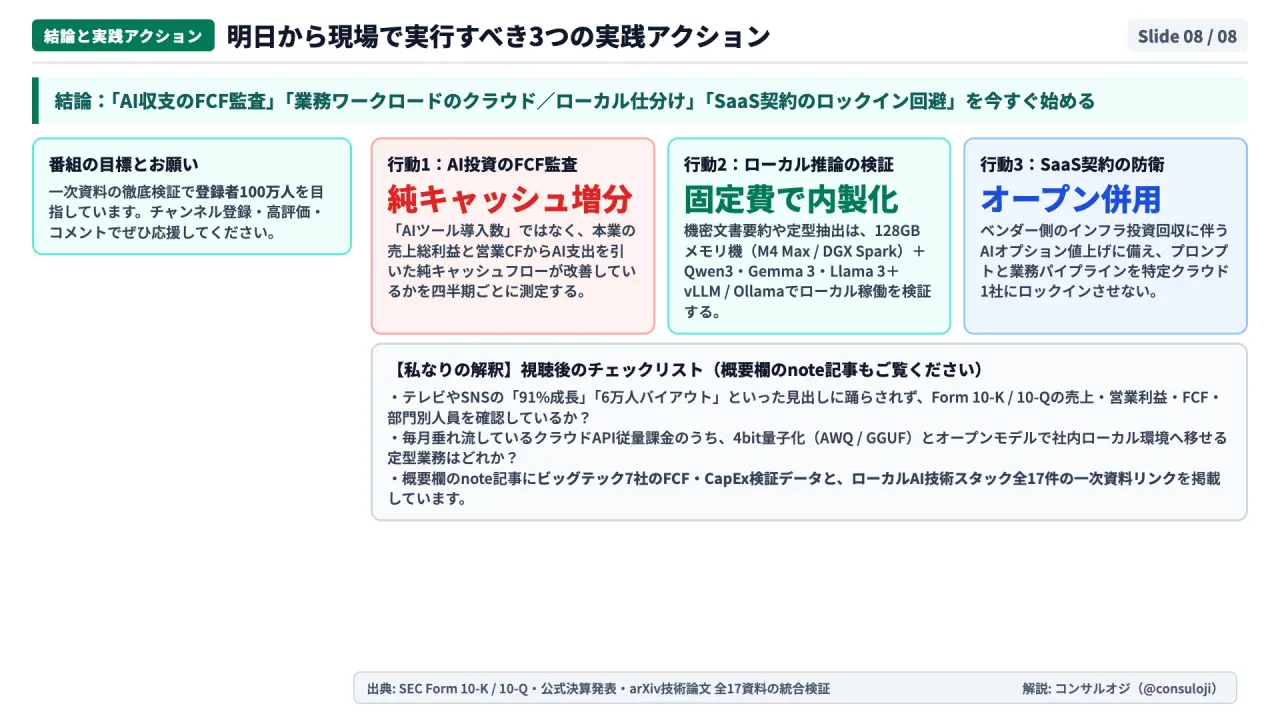
To protect corporate margins while maintaining cutting-edge engineering velocity, enterprise leaders should adopt three defensive infrastructure mandates:
Rule 1: Audit Cloud API Egress and Model SLA Lock-In
Avoid long-term minimum spend commitments with single cloud vendors for standardized generative tasks. Structure all application interfaces using provider-agnostic SDKs or internal proxy gateways. Monitor token volume and track the ratio between input prompt caching and full forward generation to anticipate unit-cost adjustments.
Rule 2: Partition Workloads by Information Sensitivity and Token Frequency
Categorize enterprise AI workflows into two operational profiles:
- High-Value, Low-Frequency Reasoning: Strategic planning, legal discovery, and complex refactoring. Route these requests to audited Frontier Cloud APIs.
- High-Volume, Steady-State Data Processing: Log classification, document summarization, entity extraction, and automated code formatting. Route these workloads to self-hosted, quantized models executing on corporate infrastructure.
Rule 3: Deploy Local 128GB Unified Memory Workstations for Core Engineering Teams
Procure dedicated 128GB unified memory hardware for software development teams. Deploy vLLM or Ollama environments configured with INT4 AWQ models. This architecture eliminates cloud data exfiltration risks, guarantees zero per-token inference marginal costs, and ensures operational continuity regardless of external network availability.
Frequently Asked Questions
Did Microsoft officially announce a workforce reduction of 60,000 employees?
No. Microsoft filed no Form 8-K announcing an aggregate termination of 60,000 workers. The figure circulating in market commentary represents an analytical estimate based on Microsoft’s non-engineering workforce disclosed in Form 10-K, where Sales, Marketing, and G&A personnel total 58,000 employees (25.4 percent of global headcount). The discussion reflects corporate cost discipline, voluntary separation incentives, and head-count rebalancing implemented to safeguard operating cash flows amid $64.55 billion in annual capital spending.
Is Google Cloud expanding at 91 percent year-over-year?
Alphabet’s Form 10-Q indicates that Google Cloud revenue grew by 34 percent year-over-year in the third quarter of 2025, reaching $15.16 billion. The 85 to 90 percent figures describe Google Cloud operating profit growth, which accelerated 84.6 percent from $1.95 billion to $3.59 billion, and nine-month operating income, which surged 113.9 percent to $8.60 billion.
Does 4-bit weight quantization degrade model intelligence?
Uncalibrated rounding causes degradation. However, advanced quantization algorithms like Activation-Aware Weight Quantization (AWQ - arXiv:2306.00978) protect the 1 percent most salient weight channels identified through activation analysis. This methodology retains near-lossless FP16 reasoning and benchmark scores while compressing memory consumption by 75 percent, allowing a 70-billion-parameter model to execute smoothly within 40GB of memory.
Primary Sources and References
- Microsoft Corporation: FY2025 Annual Report & Form 10-K
- US SEC EDGAR: Alphabet Inc. Form 10-Q for the Period Ended September 30, 2025
- Oracle Investor Relations: Oracle Announces Fiscal 2025 Fourth Quarter and Full-Year Results
- Apple Newsroom: Apple Reports Fourth Quarter Results (FY2025)
- NVIDIA Newsroom: NVIDIA Announces Financial Results for Fourth Quarter and Fiscal 2026
- Meta Investor Relations: Meta Reports Fourth Quarter and Full Year 2025 Results
- Amazon Investor Relations: Amazon.com Announces Fourth Quarter Results (2025)
- Apple Newsroom: Apple Introduces M4 Pro and M4 Max (128GB Unified Memory & 546GB/s Bandwidth)
- NVIDIA Official Product Page: NVIDIA DGX Spark Workstation
- arXiv:2309.06180 Efficient Memory Management for Large Language Model Serving with PagedAttention (vLLM)
- arXiv:2306.00978 AWQ: Activation-aware Weight Quantization for LLM Compression and Acceleration
- arXiv:2412.19437 DeepSeek-V3 Technical Report
- arXiv:2505.09388 Qwen3 Technical Report
- arXiv:2503.19786 Gemma 3 Technical Report
- arXiv:2407.21783 The Llama 3 Herd of Models
- GitHub: ollama/ollama Official Repository
- GitHub: ggml-org/llama.cpp Official Repository