Why the Viral "Claude 7 Verticals" Checklist Is Wrong: 400,000-Session Telemetry and the Big Tech Battle for the Enterprise Operating System
A forensic audit reveals Claude Code and Cowork are universal execution runtimes rather than niche apps, as Big Tech divides between high-stakes frontier verticals and governed enterprise systems of record.
Published: October 29, 2026 | Read time: ~10 min | Watch Video (Japanese)
Executive Summary & Core Architectural Findings
In late October 2026, an infographic went viral across LinkedIn and X, purporting to map Anthropic’s vertical enterprise footprint. The graphic depicted 15 corporate job functions, asserting that Anthropic had “conquered” seven verticals (Claude Code, Claude Cowork, Claude Design, Claude Finance, Claude Science, Claude Teacher, Claude Legal), while leaving eight unaddressed blanks (HR, Analytics, Marketing, Sales, R&D, Procurement, Accounting, Engineering).
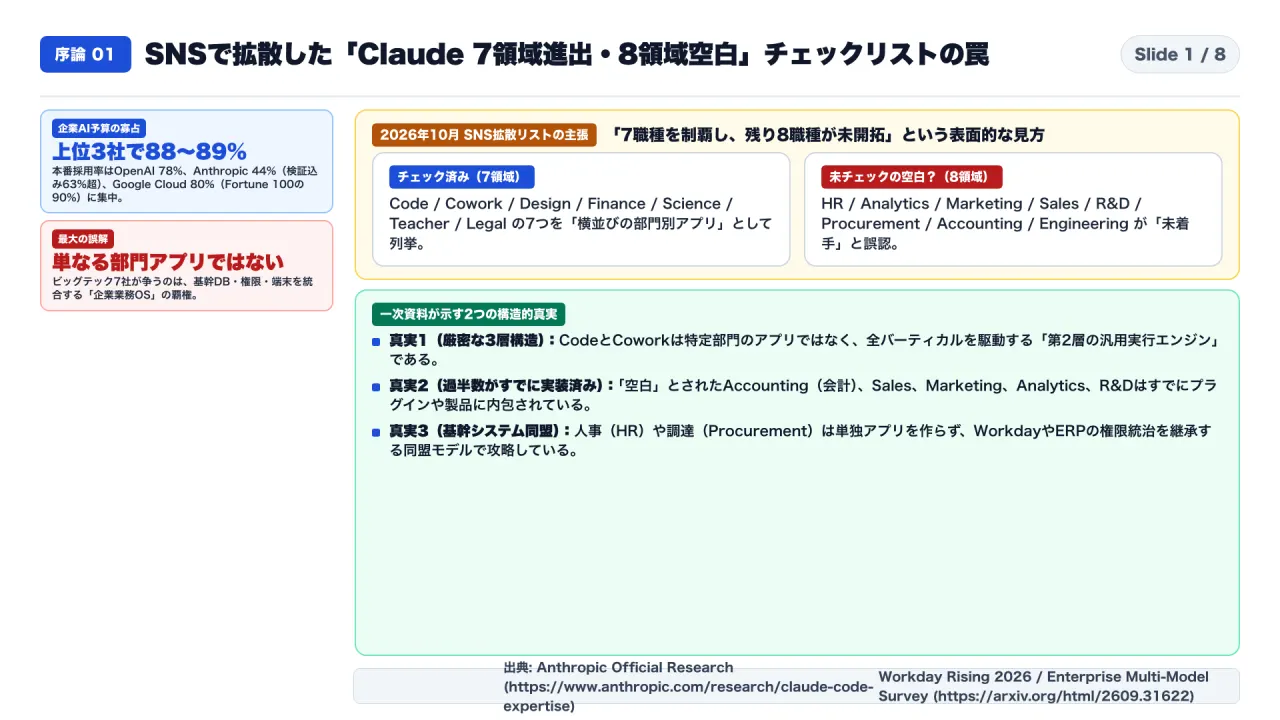
This checklist illustrates a widespread misunderstanding of modern enterprise AI architecture.
A forensic investigation of Anthropic’s primary research, marketplace protocols, and platform telemetry across Big Tech rivals reveals two structural reality checks:
- Runtimes, Not Siloed Apps:
Claude CodeandClaude Coworkare not departmental applications. They represent a Layer 2 Universal Execution Runtime. In Anthropic’s empirical study of 400,000 external user sessions and 200,000 internal transcripts (How Claude Code is used in practice), 44% of Claude Code usage was entirely non-coding—spanning systems operations (17%), architecture planning (14%), and general business data analysis and writing (13%). - The “Blank” Verticals Are Already Operational: Accounting is embedded inside Claude for Finance through automated General Ledger (GL) reconcilers and 13-week cash flow modeling. Marketing, Sales, and Analytics operate via Cowork’s 11 open-source Apache 2.0 plugins. Crucially, Human Resources (HR) was deliberately not built as a standalone chat tool; on October 13, 2026, Workday and Anthropic announced “Sana in Claude”, establishing an alliance where Claude provides the interface while Workday strictly enforces role-based access control (RBAC) and audit trails.
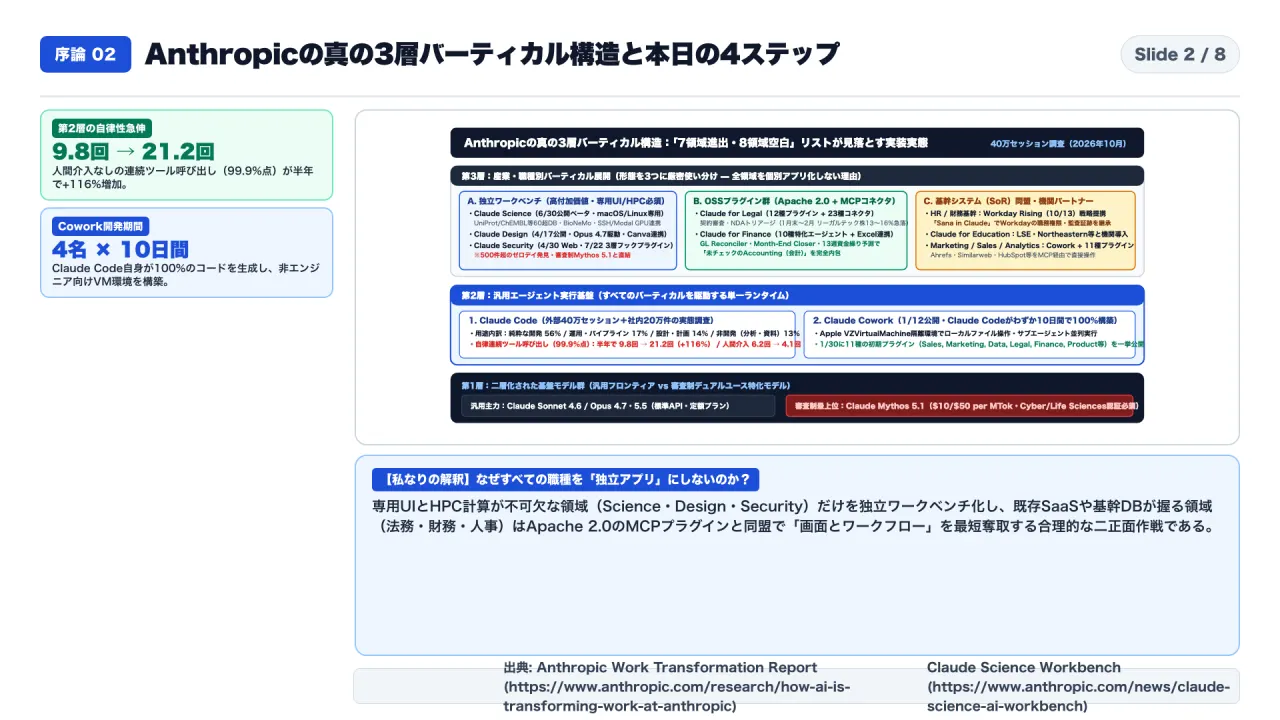
The real contest across Big Tech (Anthropic, OpenAI, Google Cloud, Microsoft, AWS, Apple, and Meta) is not an app-store race. It is a high-stakes battle to become the Operating System of Work, bridging high-reasoning frontier models with corporate Systems of Record.
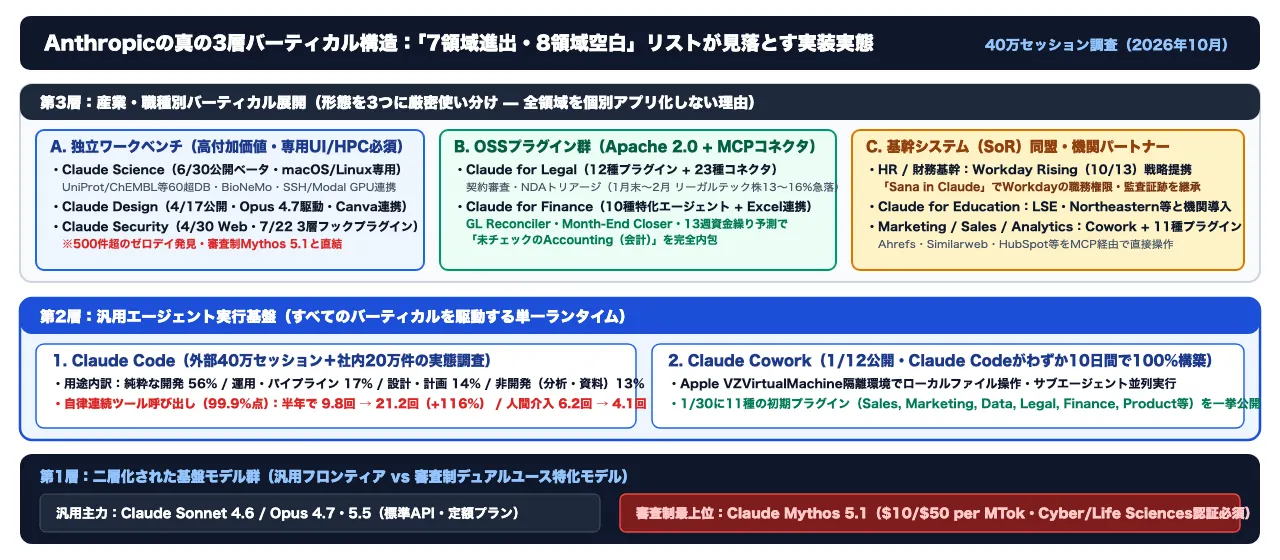
1. Inside 400,000 Sessions: The Reality of Claude Code and the Legaltech Shock
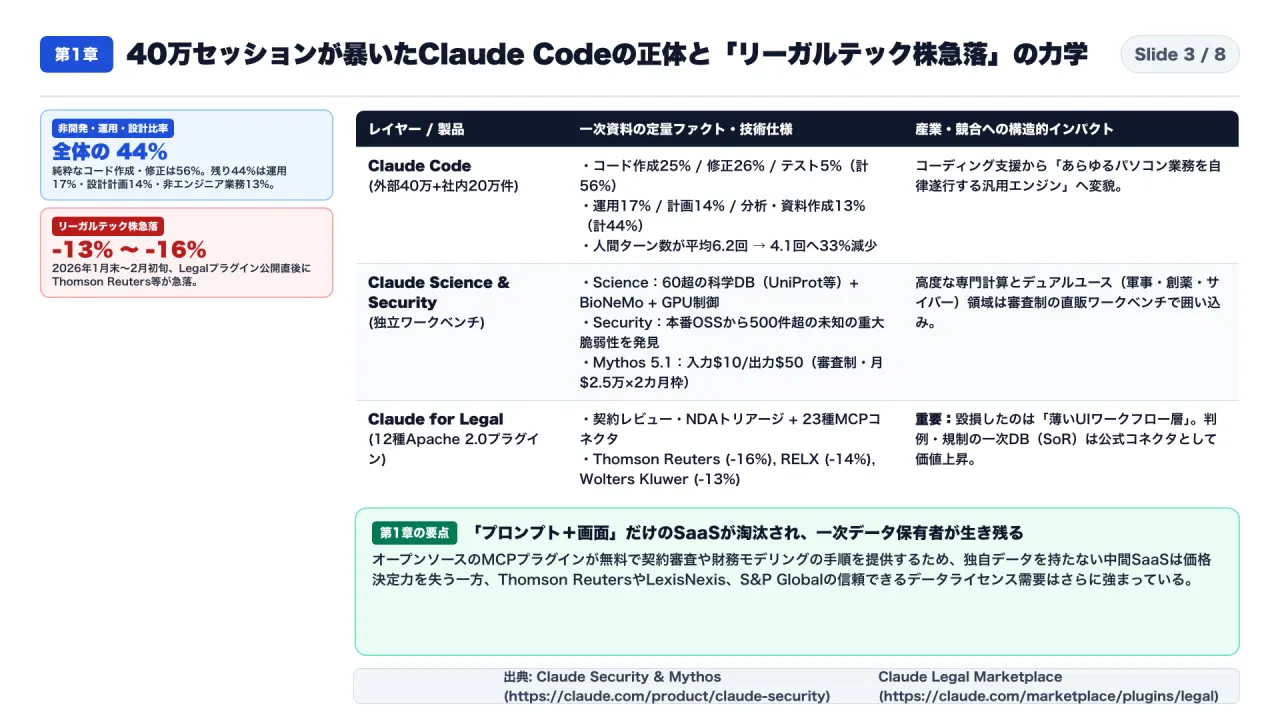
1-1. The 44% Non-Coding Reality of Claude Code
Anthropic’s research report, How Claude Code is used in practice, analyzed anonymized logs across 400,000 external sessions and 200,000 internal transcripts:
- Complete Usage Breakdown:
- Pure Software Development (56%): Authoring new code (25%), refactoring existing code (26%), and unit test/agent creation (5%).
- Infrastructure & Data Pipelines (17%): Server configurations, CI/CD pipelines, and log parsing.
- System Architecture & Planning (14%): Repository exploration and technical specifications.
- Non-Engineering Enterprise Work (13%): Data analysis, spreadsheet synthesis, executive slide creation, and document drafting.
- Autonomous Step Expansion: Over six months, maximum consecutive tool invocations (99.9th percentile) without human intervention surged 116% from 9.8 to 21.2 steps, while human intervention turns per task fell 33% from 6.2 to 4.1.
Claude Code functions as an autonomous terminal runtime capable of manipulating files, executing shell scripts, and verifying outputs across any digital workflow.
1-2. Claude Cowork: Desktop Virtualization Built in Ten Days
Observing non-technical employees using Claude Code in terminals led directly to Claude Cowork, launched on January 12, 2026.
Remarkably, a team of four engineers built Cowork in ten days, authoring 100% of the codebase using Claude Code itself. Cowork leverages Apple’s VZVirtualMachine framework to host an isolated Linux virtual machine inside macOS, executing parallel agents, browser automations, and file operations securely. On January 30, 2026, Anthropic open-sourced 11 official Cowork plugins under the Apache 2.0 license, covering Sales, Marketing, Data, Legal, Finance, Customer Support, and Biology Research.
1-3. Layer 3 Bifurcation and the Legaltech Market Shock
Anthropic structures vertical capabilities across two operational models:
- Model A: Standalone Workbenches (Isolated Desktop & Cloud HPC):
- Claude Design: Visual prototyping and design asset compilation.
- Claude Science: Dedicated macOS/Linux desktop workbench integrating over 60 specialized scientific databases (UniProt, PDB, ChEMBL, AlphaFold DB) and NVIDIA BioNeMo, dispatching jobs to on-premise HPC clusters or cloud GPUs.
- Claude Security: Employs a 3-layer hook system (pre-edit, generation-time, pre-commit) powered by the top-tier Claude Mythos 5.1 ($10 input / $50 output per million tokens), which has identified over 500 zero-day vulnerabilities in production software.
- Model B: Open-Source Apache 2.0 Plugins & Connectors:
- Claude for Legal: 12 Apache 2.0 plugins paired with 23 Model Context Protocol (MCP) connectors uniting Harvey, LexisNexis, Thomson Reuters (CoCounsel), and Legora.
When Anthropic released its legal plugins on January 30, 2026, global legal information equities experienced a sharp contraction between January 30 and February 3: Thomson Reuters fell ~16%, RELX (LexisNexis) dropped ~14%, and Wolters Kluwer declined ~13%.
Yet, the market misunderstood the disruption. Thin SaaS wrappers providing basic prompt interfaces over legal contracts were marginalized, but authoritative Systems of Record containing primary case law and statutory archives saw their licensing value increase. Both Thomson Reuters and LexisNexis deepened integrations as core MCP partners.
2. Where Did the “Blank Eight” Go? Embedded Accounting and the Workday HR Alliance
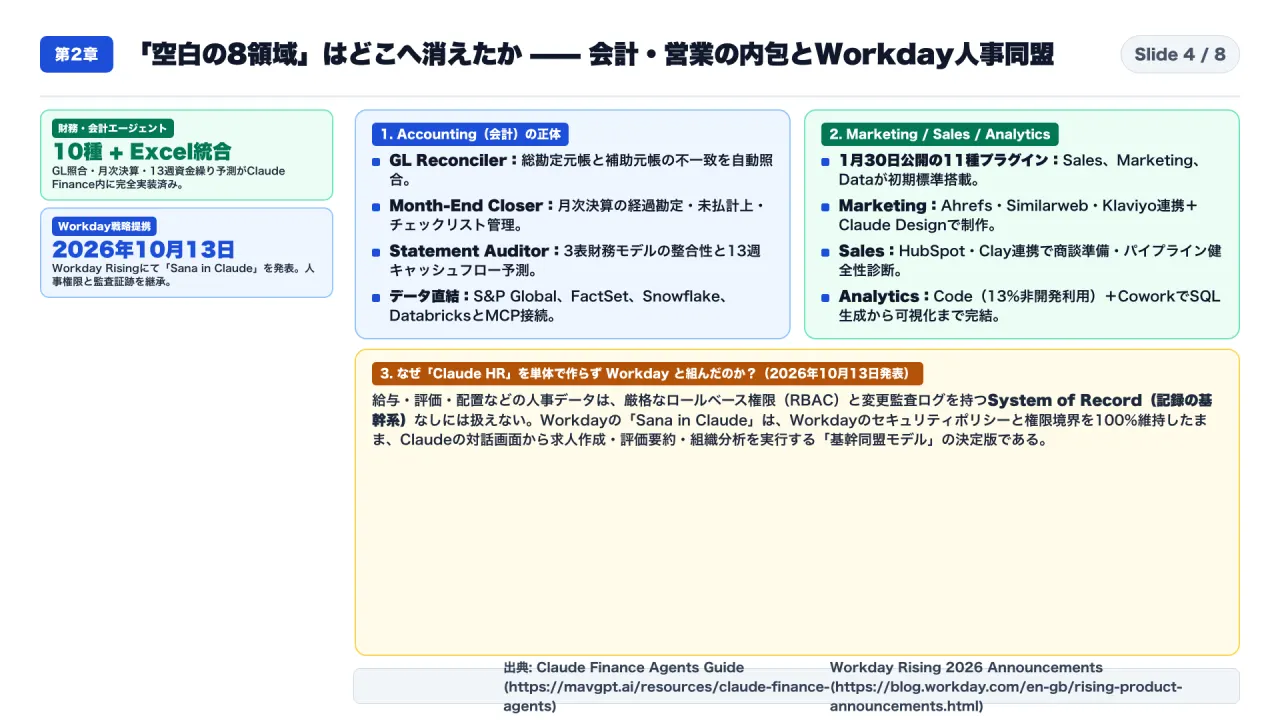
A technical audit of the eight supposedly “blank” verticals reveals they are already deployed:
2-1. Accounting, Sales, Marketing, and R&D Are Operational
- Accounting Embedded in Claude Finance: Claude for Finance incorporates ten specialized agents, including:
- GL Reconciler: Automated matching of general ledger accounts against bank feeds and sub-ledgers.
- Month-End Closer: Accrual calculations and reconciliation anomaly detection.
- Statement Auditor: Triple-statement financial modeling generating 13-week cash flow forecasts.
- Data Connectors: Native MCP links to S&P Capital IQ, FactSet, Morningstar, Snowflake, and Databricks.
- Sales, Marketing, and Analytics: Native Cowork plugins interface directly with Salesforce, HubSpot, BigQuery, and Snowflake to execute SQL generation, lead qualification, and campaign modeling.
- R&D: Software engineering is driven by Claude Code; life sciences and chemistry R&D are powered by Claude Science and the October 2026 integration of Mithril Medicine.
2-2. The Workday Alliance: Why Standalone “Claude HR” Does Not Exist
On October 13, 2026, at Workday Rising, Workday and Anthropic announced “Sana in Claude”, exposing the structural flaw of standalone HR bots.
Human resources data involves compensation bands, performance evaluations, and disciplinary records governed by strict role-based access control (RBAC). Uploading employee evaluations into unmonitored external chat tools constitutes a severe compliance violation.
“Sana in Claude” decouples the interface from governance:
- Interface Layer: Employees and managers interact with Claude.
- System of Record & Governance: Workday enforces data sovereignty, permissions, and audit logs. A query requesting compensation modeling applies the user’s specific Workday access rights, ensuring sensitive data never leaks.
3. The Big Tech Enterprise OS Matrix: Three Battlegrounds and Four White Spaces
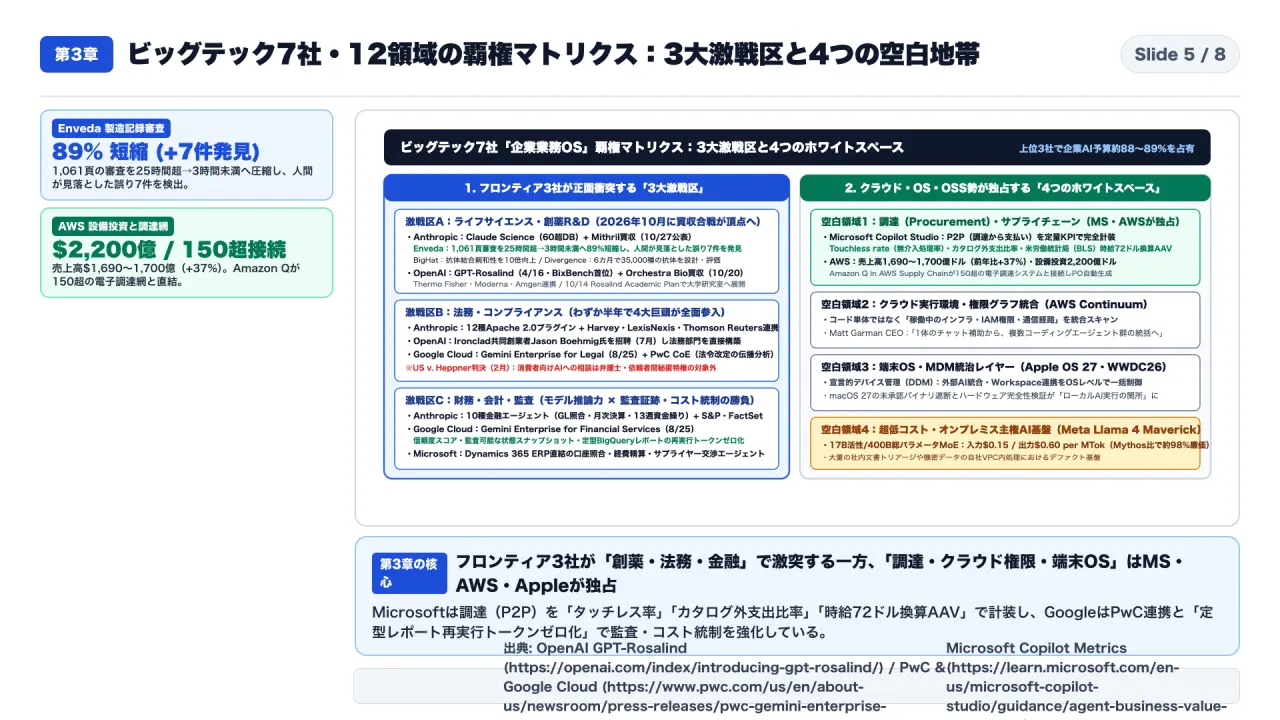
Enterprise AI spending is highly concentrated: empirical market studies indicate 88% to 89% of enterprise AI budgets flow to OpenAI, Anthropic, and Google Cloud. OpenAI leads in production adoption at 78%, Anthropic reaches 44% in production (exceeding 63% including pilots), and Google Cloud serves 80% of its cloud base and 90% of the Fortune 100.
Mapping all seven tech giants across twelve domains reveals three fierce battlegrounds and four structural white spaces.
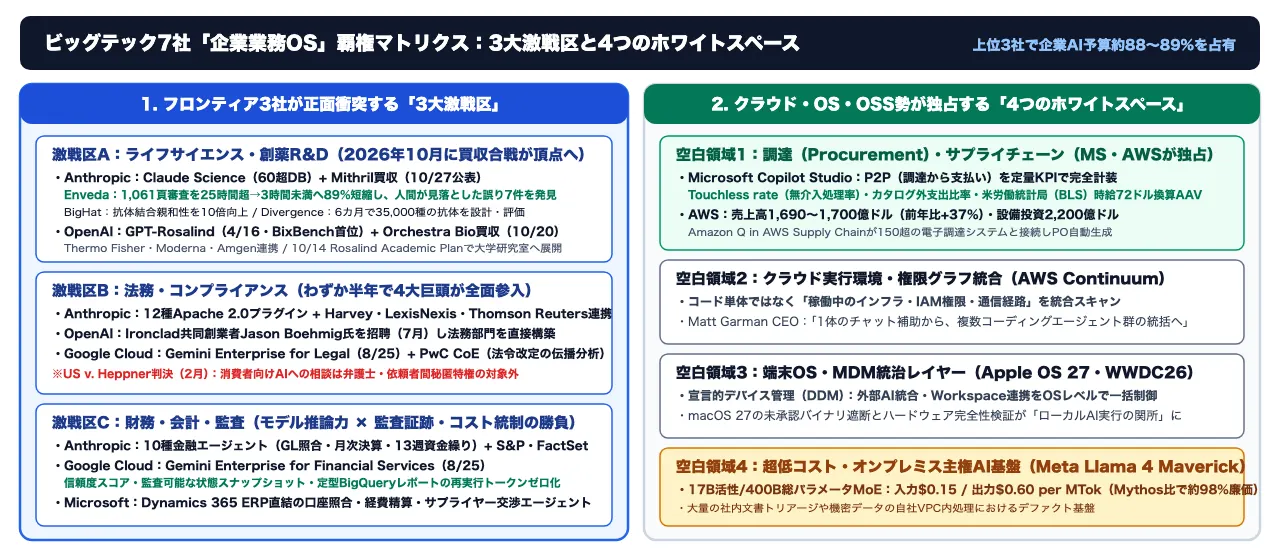
3-1. The Three Frontline Battlegrounds
Battleground A: Life Sciences and Biopharma R&D
- OpenAI: Released GPT-Rosalind on April 16, 2026, leading the BixBench bioinformatics benchmark in partnership with Moderna and Amgen. On October 20, 2026, OpenAI acquired clinical trial orchestration startup Orchestra Bio.
- Anthropic: Following its acquisitions of Coefficient Bio and Mithril Medicine, Anthropic deployed Claude across global biopharma pipelines. Research partner Enveda cut CMC batch record review from over 25 hours to under 3 hours (an 89% reduction), discovering seven missed formulation errors, while BigHat improved antibody binding affinity by over 10x.
Battleground B: Legal and Regulatory Compliance
- Anthropic: Deployed 12 Apache 2.0 plugins and 23 MCP connectors with Harvey and Thomson Reuters.
- OpenAI: Recruited Ironclad co-founder and former CEO Jason Boehmig in July 2026 to direct its legal enterprise vertical.
- Google Cloud: Launched Gemini Enterprise for Legal alongside a dedicated Center of Excellence with PwC, featuring automated regulatory change propagation across global contract repositories.
Battleground C: Finance, Accounting, and Auditability
- Anthropic: Financial agent suites with native Excel modeling and 13-week cash forecasts.
- Google Cloud: Introduced Gemini Enterprise for Financial Services, providing cryptographic Auditable State Snapshots, confidence scoring, and zero-token repeat report execution on BigQuery data pipelines.
3-2. The Four Structural White Spaces
Incumbents dominate four operational zones where pure foundation model providers lack structural leverage:
- Procurement & Supply Chain (Microsoft & AWS):
- Microsoft: Copilot Studio integrates with Dynamics 365 Supply Chain, tracking Touchless Processing Rates and calculating Agent Assisted Value (AAV) pegged to the US Bureau of Labor Statistics benchmark of $72 per hour.
- AWS: Operating at a $170B annual run-rate with $220B in 2026 CapEx, AWS deploys
Amazon Q in AWS Supply Chain, interfacing natively with SAP and Coupa across over 150 e-procurement platforms.
- Cloud Infrastructure & Permission Graphs (
AWS Continuum): AWS manages runtime security, IAM role inheritance graphs, and multi-agent fleet governance across live cloud fabrics. - Endpoint Device OS & MDM Governance (
Apple OS 27): Announced at WWDC26, iOS 27 and macOS 27 introducedcom.apple.configuration.intelligence.settingsin Declarative Device Management, enabling IT administrators to restrict unvetted local model binaries and mandate enterprise-managed AI gateways at the hardware level. - Ultra-Low-Cost Sovereign AI (
Meta Llama 4 Maverick): Meta’s open-weights 128-expert MoE architecture processes high-volume internal tasks at $0.15 input / $0.60 output per million tokens—98% cheaper than restricted frontier models ($50/MTok).
4. Architectural Analysis: Four Predictions for 2027
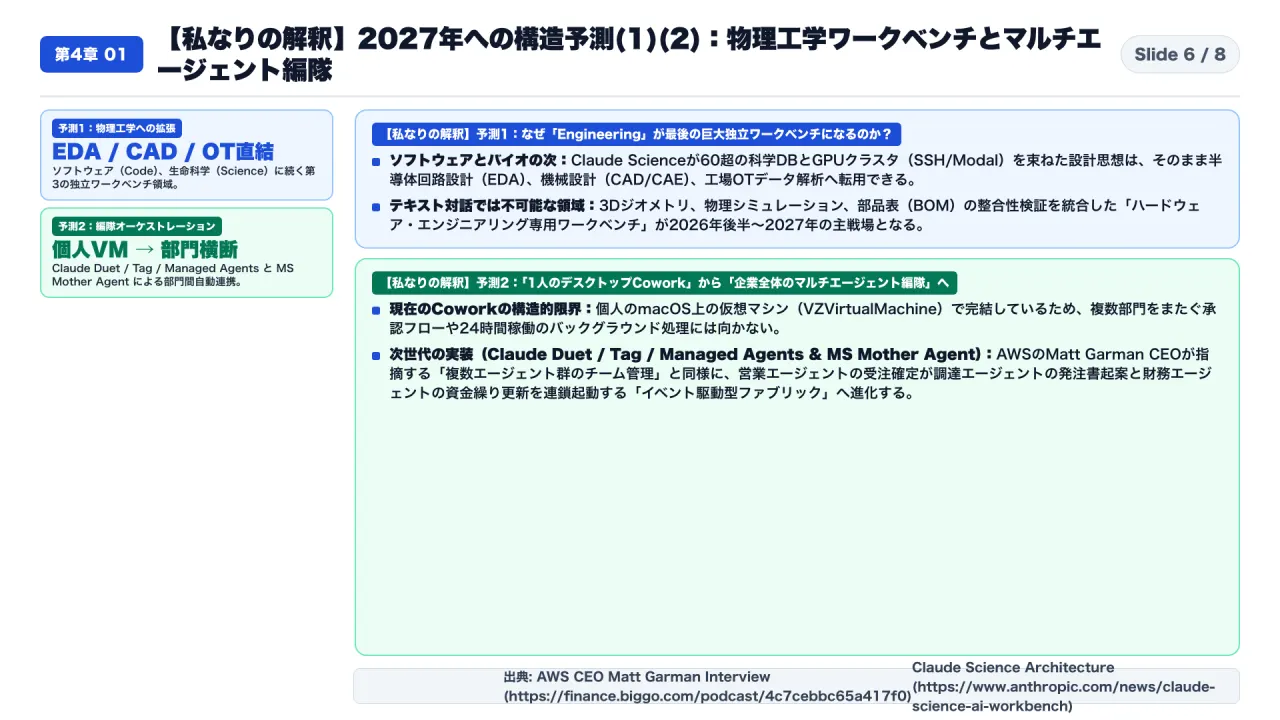
Synthesizing technical disclosures points to four structural evolutions through 2027:
Prediction 1: The Emergence of Physical Engineering Workbenches
The final remaining frontier is physical hardware engineering. Anthropic’s Claude Science architecture (desktop runtime, specialized DBs, SSH-controlled HPC, and execution reproducibility) provides the template for an upcoming Claude Engineering workbench integrating CAD/CAE tools, electronic design automation (EDA with Synopsys/Cadence), and physics simulation engines.
Prediction 2: Transition from Desktop Cowork to Cloud Agent Fleets
Local virtualization in Claude Cowork is limited by client hardware uptime. Enterprise orchestration will migrate toward persistent cloud runtimes—such as Anthropic’s Managed Agents, Microsoft’s Mother Agent fabric, and AWS agent fleets—where an event in sales automatically triggers procurement orders and cash flow updates.
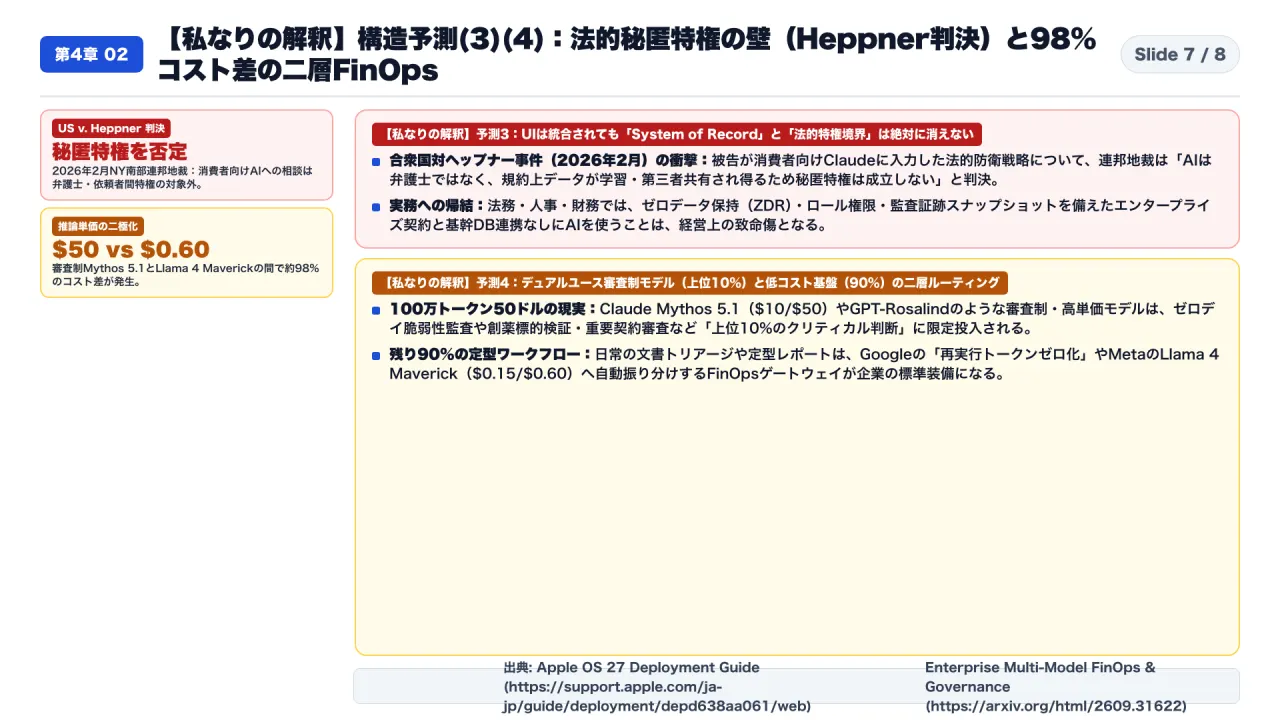
Prediction 3: Legal Privilege and the US v. Heppner Precedent
Enterprise data will remain strictly segregated from public AI services. In February 2026, the US District Court for the Southern District of New York (SDNY) ruled in United States v. Heppner:
- A defendant entered trial strategy notes into a consumer AI service and forwarded outputs to counsel, claiming attorney-client privilege.
- Judge Jed Rakoff rejected the privilege defense entirely: AI tools are not licensed attorneys, commercial terms permitting review waive confidentiality expectations, and subsequent forwarding to legal counsel does not retroactively attach privilege.
Unmonitored employee use of consumer AI platforms exposes corporate deliberations to mandatory discovery in litigation, making Zero Data Retention (ZDR) and audited enterprise gateways mandatory.
Prediction 4: The 10/90 Two-Tier FinOps Routing Architecture
Model pricing has bifurcated between restricted high-capability models (Claude Mythos 5.1 at $50/MTok) and ultra-low-cost alternatives (Llama 4 Maverick at $0.60/MTok). Enterprise architectures will converge on a two-tier routing policy:
- Top 10% Tier: High-consequence reasoning (zero-day vulnerability triage, major contract liabilities, and molecular design) routed to frontier engines.
- Base 90% Tier: Routine data extraction, search, and internal reporting routed to sub-$1 lightweight models or zero-token BigQuery pipelines under strict departmental spend caps.
5. Implementation Roadmap: Three Mandatory Enterprise Actions
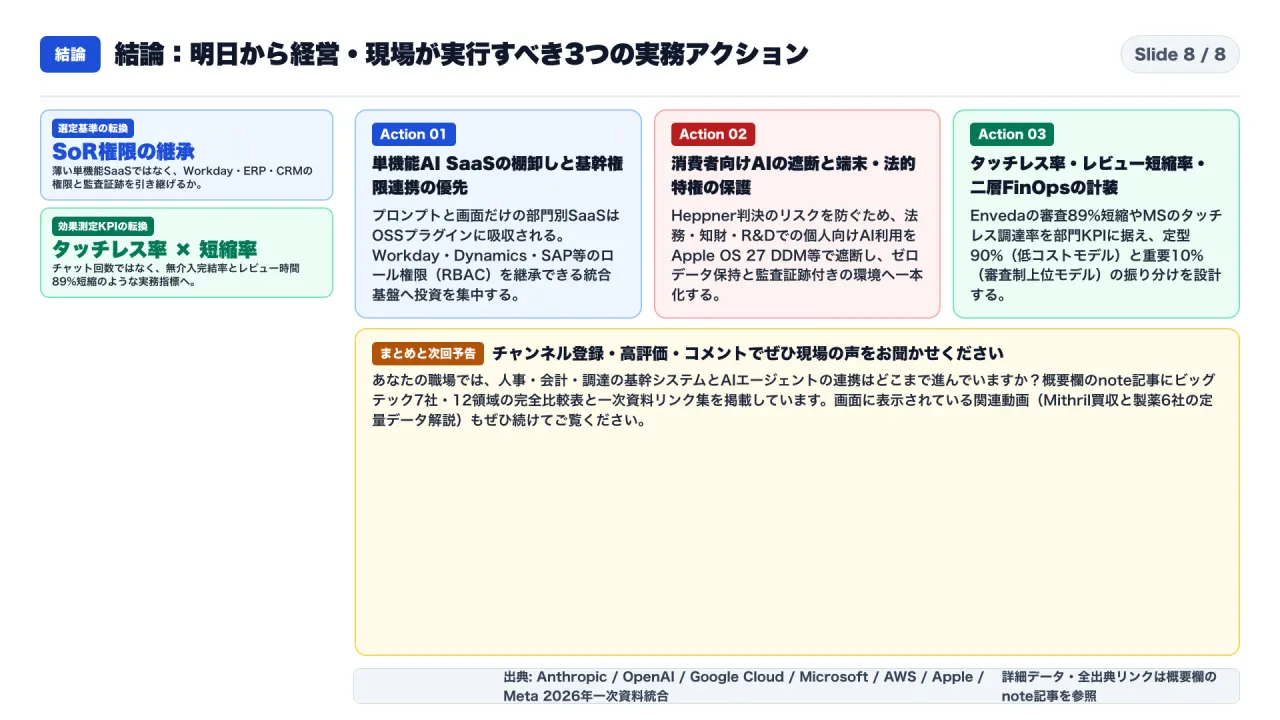
Enterprise technology leaders should implement three immediate policies:
Action 1: Freeze Thin Single-Function AI SaaS Contracts
Halt procurement of superficial AI wrappers that layer basic prompts over PDF viewers. Prioritize solutions that integrate natively with foundational Systems of Record (Workday, SAP, Salesforce, Snowflake), inheriting enterprise RBAC permissions and audit logging automatically.
Action 2: Enforce Device MDM Governance to Eliminate Privilege Exposure
Following US v. Heppner, block unvetted consumer AI services and rogue MCP binaries using Apple OS 27 declarative device management (com.apple.configuration.intelligence.settings) and enterprise proxy controls. Mandate enterprise agreements guaranteeing Zero Data Retention and auditable state snapshots.
Action 3: Modernize KPIs from Activity Metrics to Touchless Throughput
Retire vanity metrics tracking employee login frequency and prompt volumes. Adopt operational throughput KPIs:
- Touchless Processing Rate: The percentage of procurement, reconciliation, or triage tasks completed without manual human intervention.
- Review Acceleration Rate: Quantified time saved on high-density document audits.
- Two-Tier FinOps Efficiency: The percentage of recurring batch queries routed to zero-token or low-cost inference tiers.
Primary Sources and References
- Anthropic Research: How Claude Code is used in practice
- Anthropic Research: How AI is transforming work at Anthropic
- Anthropic News: Claude Science AI Workbench
- Anthropic Product: Claude Security Specifications and Architecture
- Anthropic Marketplace: Claude for Legal Plugins
- MavGPT Resources: Claude Finance Agents and Excel Accounting Guide
- Workday Official Blog: Workday Rising Product Announcements — Extending Governed Workflows into Claude
- OpenAI Index: Introducing GPT-Rosalind for Life Sciences
- India Today: Anthropic speeds up drug discovery as Claude spots issues humans miss, cuts review time by 89%
- PwC US Newsroom: PwC and Google Cloud Launch Gemini Enterprise for Financial Services and Legal
- Microsoft Learn: Agent Business Value Metrics Reference
- BigGo Finance Podcast Transcript: AWS CEO Matt Garman on $170B Run Rate, $220B CapEx, Amazon Q, and AWS Continuum
- Apple Support Guide: Declarative Device Management Intelligence Settings for iOS 27, iPadOS 27, and macOS 27
- arXiv Preprint: Enterprise Multi-Model AI Governance, Wallet Share Concentration, and FinOps Routing