How Engineers Review Code When 90% Is Auto-Generated: Inside Anthropic's 7-Layer Pipeline Handling 30,000 Daily Changes and Cutting Reverts by 40%
When merged changes surged 12x in four months, Anthropic abandoned line-by-line human reviews, instituting a 7-layer verification architecture that doubled throughput while slashing production reverts.
Published: October 29, 2026 | Read time: ~10 min | Watch Video (Japanese)
Executive Summary & Core Architectural Findings
What happens to software development when 90% of production code is generated by AI, and daily merged changes explode from 2,500 in May to more than 30,000 by September?
The primary operational bottleneck ceases to be code creation. It becomes code review.
In late October 2026, Anthropic published a technical disclosure by engineers Addy Osmani, Morgan Westlee Lunt, and Qing Wang (How the Claude Code team does code review), complemented by an in-depth interview with Claude Code creator Boris Cherny and Product Lead Cat Wu on Dan Shipper’s AI & I podcast.
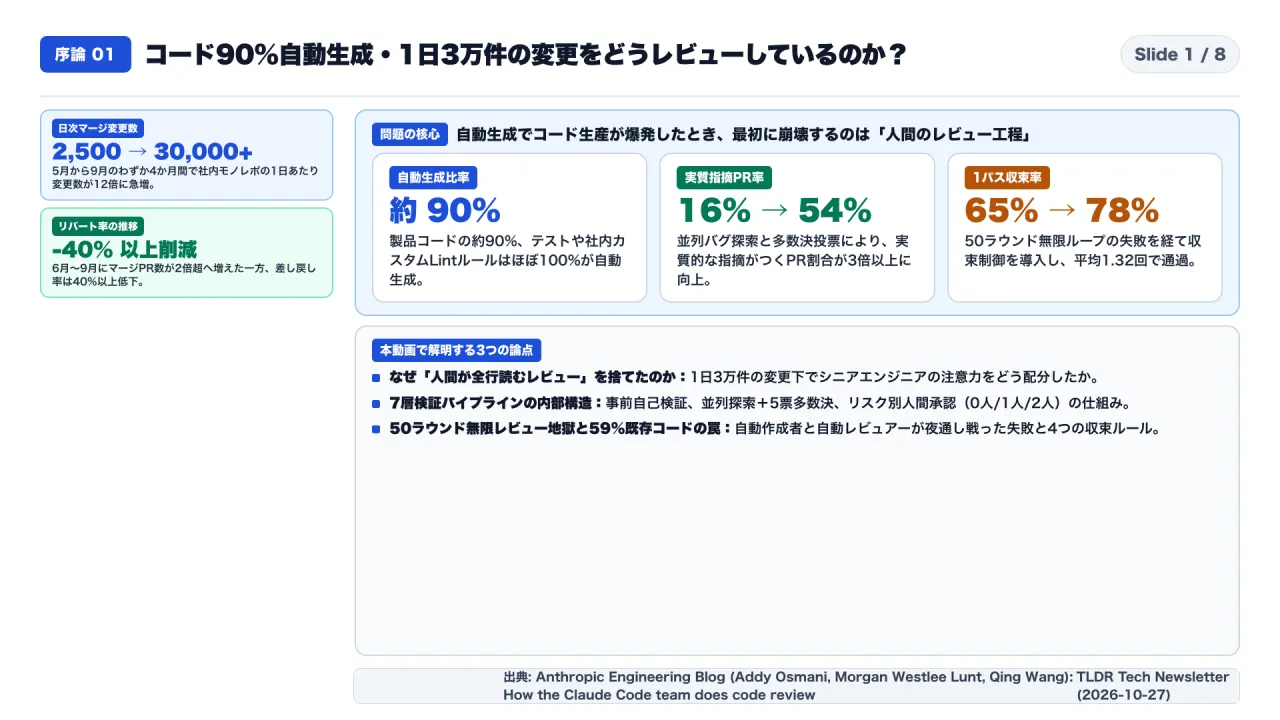
Together, they revealed how their engineering organization solved the code review crisis by discarding a fundamental dogma: “Did a human read this code?”
Instead, they structured their engineering lifecycle around a risk-based question: “What could go wrong with this change, and which layer—automated or human—is best positioned to catch it?”
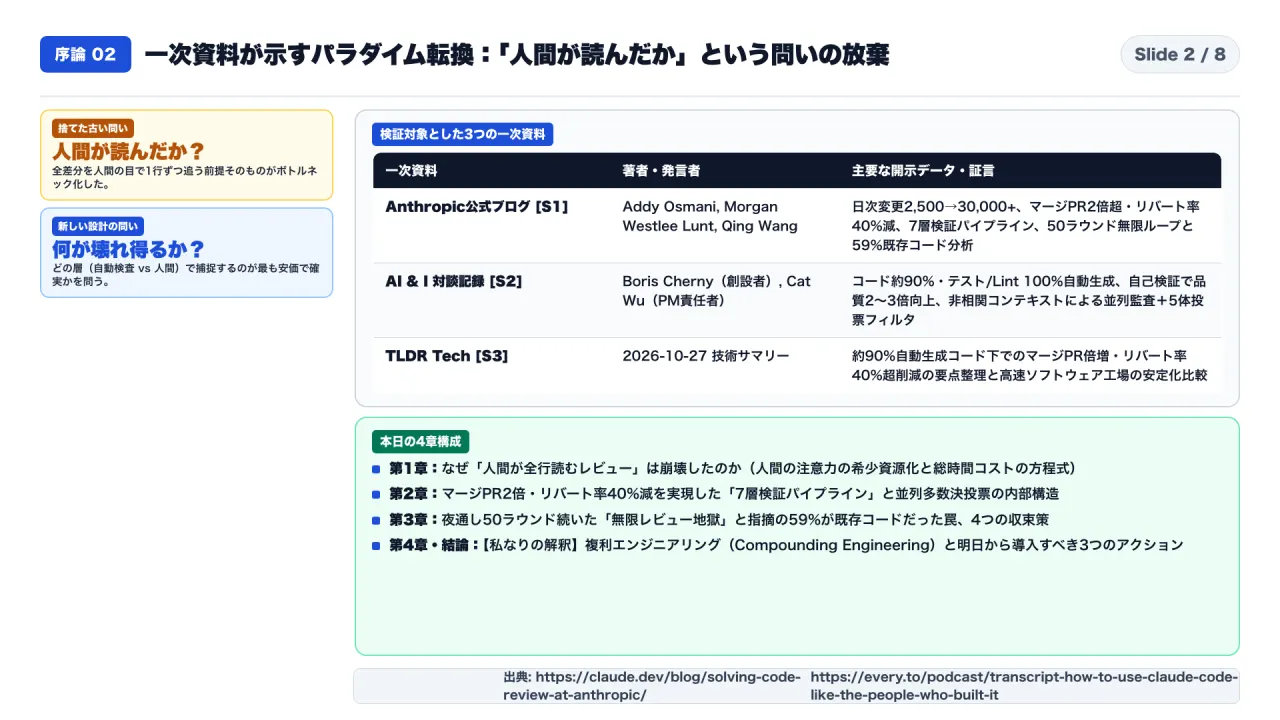
The quantitative results of this architectural transformation challenge conventional software engineering intuition:
- Doubled Merged PRs with 40% Fewer Reverts: From June through September 2026, the volume of merged pull requests (PRs) more than doubled, while code reverts caused by regressions decreased by more than 40%.
- Catching Substantive Bugs (16% to 54%): Implementing multi-agent parallel bug discovery backed by a 5-agent majority voting filter raised the proportion of internal PRs receiving substantive, verified bug catches from 16% to 54%, intercepting flaws in 1,000+ line PRs before human review.
- Overcoming the 50-Round Infinite Loop: When autonomous authoring agents and reviewing agents entered recursive loops—running over 50 rounds overnight on a single PR—the team investigated the root cause via
git blame. They discovered that 59% of re-review findings were pre-existing code rather than regressions from the latest commit. - Enforcing Convergence: Introducing four strict convergence constraints (a 3-round cap, diff-only scoping, bug-class batching, and decoupled nightly debt audits) raised single-pass resolution from 65% to 78%, cut multi-round stagnation (>5 rounds) from 8.9% to 1.5%, and reduced average review rounds from 2.08 to 1.32.
1. The Collapse of Manual Code Inspection: Redefining the Scarce Resource
1-1. The Twin Historical Roles of Code Review
Historically, peer code review fulfilled two functions simultaneously:
- Defect Detection: Intercepting syntax errors, missing edge cases, security vulnerabilities, and convention drift before merging.
- Knowledge Distribution: Spreading architectural understanding and mental models of codebase changes across the team.
When human engineers authored a few dozen lines of code daily, a colleague reviewing a PR diff achieved both goals efficiently.
However, when generative tooling automates 90% of application code and nearly 100% of unit tests, the cost of generating code approaches zero. In this environment, the scarcest organizational resource is no longer engineering labor, but human attention.
1-2. The Total Human-Time Cost Equation
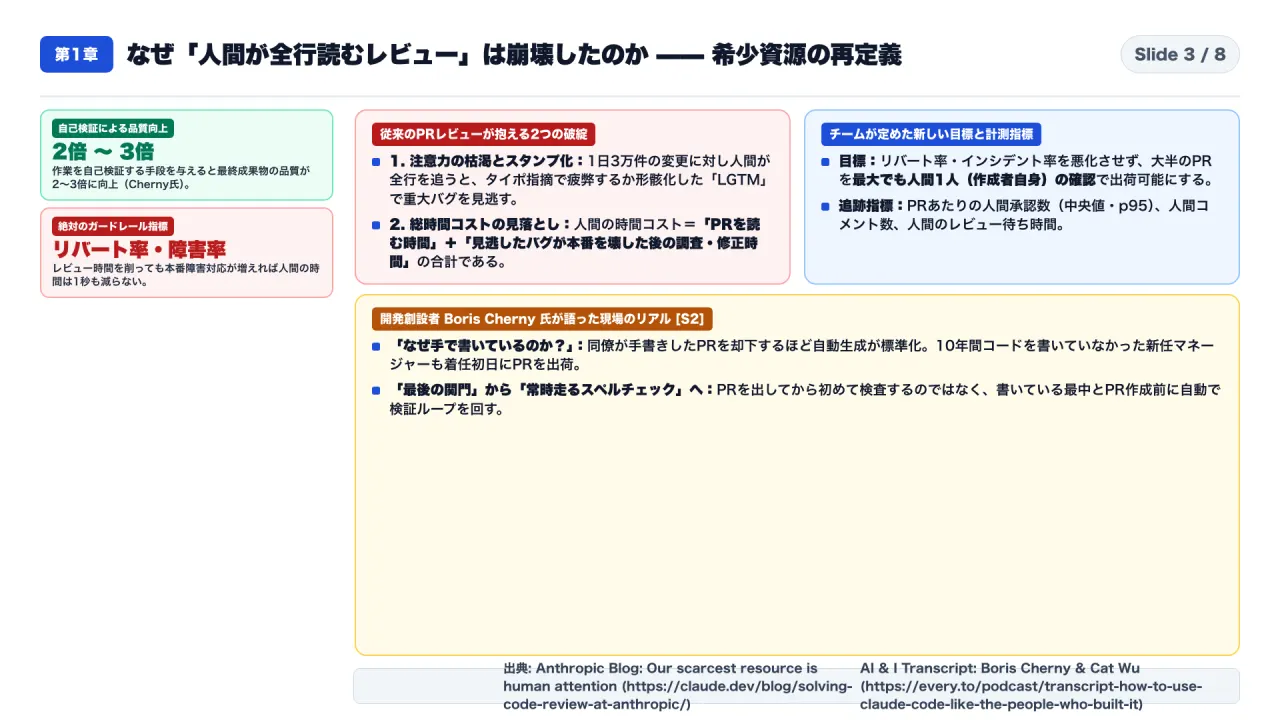
Attempting to enforce line-by-line manual reading across 30,000 daily changes triggers two systemic failures:
- Senior Engineering Exhaustion: Staff engineers spend hours identifying minor logic errors or stylistic variances, creating PR review queues that stall shipping velocity.
- Superficial Stamp Approval: Overwhelmed reviewers skim massive diffs, pasting perfunctory approval comments while missing critical authentication flaws and state corruptions.
Anthropic formalized this bottleneck through the Total Human-Time Cost Equation:
Total Human-Time Cost = [Time Spent Reviewing PRs] + [Time Spent Investigating & Reverting Leaked Incidents]
Simply rubber-stamping PRs to accelerate delivery increases downstream outages, wasting senior engineering hours on post-mortems and emergency rollbacks.
To maintain system integrity, the team established three core metrics:
- Guardrail Metric: The production revert rate and incident rate must strictly decrease (achieving a >40% revert reduction).
- North Star Goal: The vast majority of PRs must safely merge requiring at most one human approval—that of the PR author.
- Tracked Telemetry: Median and 95th percentile human approvals per PR, human comments per PR, and human review latency.
1-3. Boris Cherny on Automated Verification
Claude Code creator Boris Cherny noted on the AI & I podcast:
“Giving the model a way to verify its work is the single most important lever for quality. It routinely produces a 2x to 3x improvement in the final output.”
Review evolved from an end-of-lifecycle gatekeeper into continuous verification. Defects are caught and resolved before a PR is opened.
2. Deconstructing the Seven-Layer Verification Pipeline
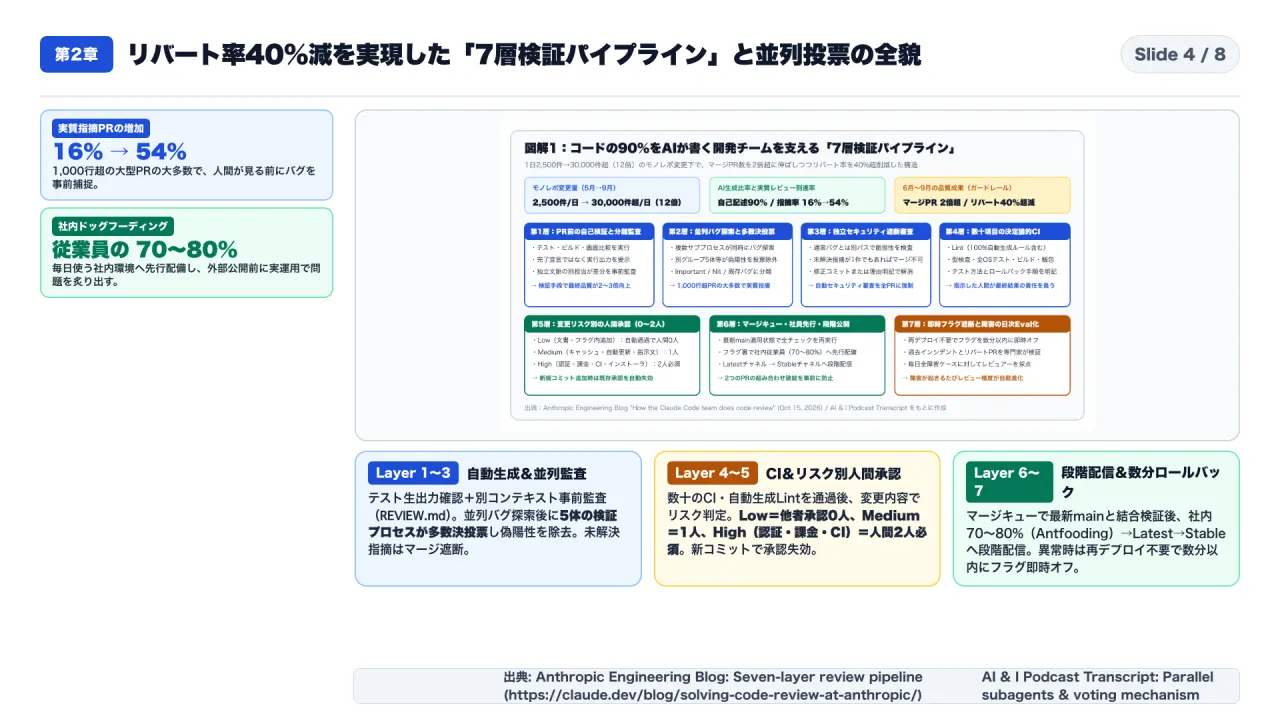
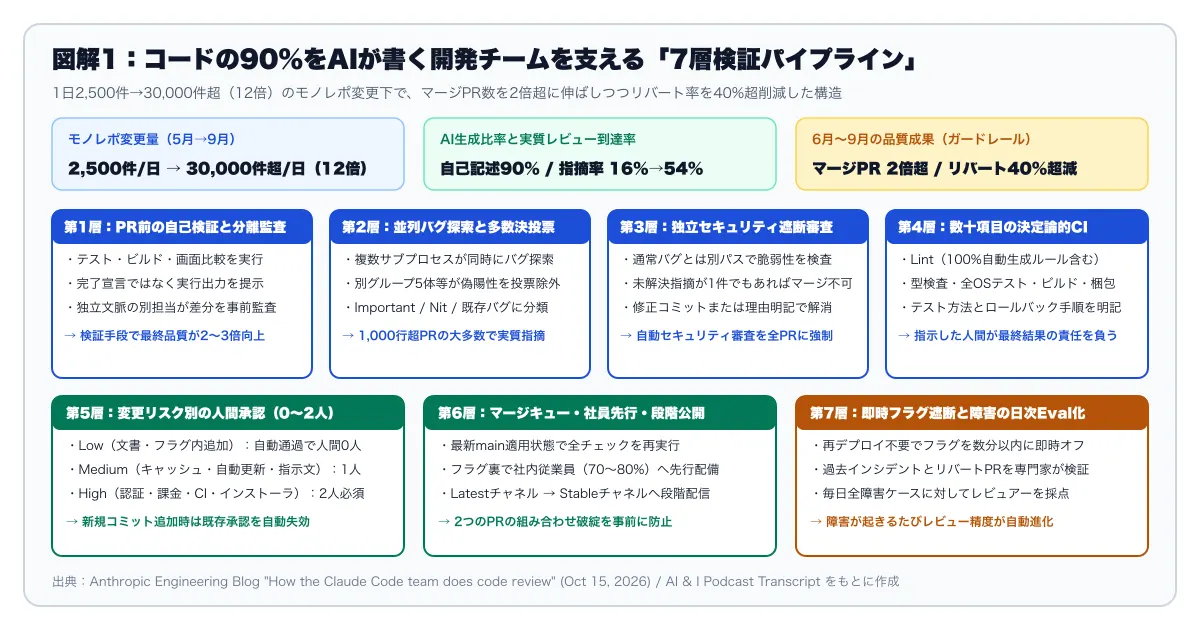
Anthropic established a structured defense-in-depth architecture spanning seven layers:
Layer 1: Pre-PR Self-Verification in Fresh Contexts
Before a PR is created on GitHub:
- Raw Execution Proof: Authoring agents must execute build scripts, test suites, and linters, verifying raw command outputs. For frontend changes, agents launch local servers and capture UI screenshots for pixel-level validation.
- Fresh Context Pre-Review: Because authoring agents develop confirmation bias within their execution sessions, a fresh agent instance with an unpolluted context window is launched to audit the diff.
- Injection of
CLAUDE.mdandREVIEW.md: The pre-review agent ingests modular governance specifications:CLAUDE.md: Repository-wide architecture standards and build commands.REVIEW.md: Module-specific failure modes, ignored paths, nitpick limits, and a strict constraint: reviewers must cite specific file names and line numbers with proof of breakage.
Layer 2: Parallel Bug Hunting with 5-Agent Majority Voting
When a PR opens, an automated multi-agent review pipeline executes before humans are notified:
- Parallel Exploration: Independent agents evaluate the diff across specialized dimensions: convention compliance, Git historical context (
git log/git blame), and boundary-condition logic. - 5-Agent Majority Voting (Precision Filter): To prevent alert fatigue from false positives, candidate bug findings are routed to five independent verification agents. Only findings securing a majority consensus are published to the PR.
- Triage Tagging: Approved comments receive one of three tags:
Important: Substantive logic defects that must be resolved prior to merge.Nit: Minor non-blocking polish.Pre-existing: Latent codebase defects not introduced by the current diff.
This pipeline raised substantive defect detection from 16% to 54%, catching critical regressions in 1,000+ line PRs automatically.
Layer 3: Independent Automated Security Reviews
Operating as an isolated pipeline, automated security agents evaluate diffs for injection vectors, permission bypasses, and data exposure. Any unresolved security thread acts as a merge-blocking check enforced by branch protection rules. Merging requires pushing a verified fix or providing an audited technical justification.
Layer 4: Deterministic CI & 100% Auto-Generated Custom Linters
Following probabilistic model checks, strict deterministic CI pipelines run unit tests, cross-platform compilation (macOS/Linux/Windows), and type checks. Past failure patterns are encoded into custom internal linter rules—which are themselves 100% auto-generated by agents—ensuring past bugs cannot recur.
Layer 5: Risk-Tiered Human Approvals (0, 1, or 2 Approvers)
The pipeline routes PRs based on the blast radius of what the code modifies:
| Risk Tier | Target Subsystems & Modifications | Required Human Approvals | Governance Rules |
|---|---|---|---|
| Low | Documentation, test additions, isolated behind feature flags | 0 External Humans (Author self-approval only) | Must pass Layers 1-4 with zero unresolved threads |
| Medium | Cache invalidation, auto-updater routines, system prompts | 1 Human Required (Assigned code owner) | Automated agent approvals do not fulfill requirement |
| High | Authentication, billing, CI workflows, installer scripts | 2 Humans Required (Dual code owner sign-off) | New commits automatically dismiss stale approvals |
Layer 6: Merge Queue & Antfooding Canary Deployment
Approved PRs enter a centralized merge queue where they are re-tested against the latest main branch to catch semantic integration conflicts. Merged code deploys behind feature flags to Antfooding—an internal environment used daily by 70% to 80% of Anthropic employees—before staged promotion to Latest and Stable release channels.
Layer 7: Fast Feature-Flag Rollback
If regressions bypass earlier layers, engineers disable the corresponding feature flag remotely within minutes, restoring baseline behavior without emergency code rollbacks.
3. The 50-Round Infinite Loop and the 59% Pre-Existing Code Trap
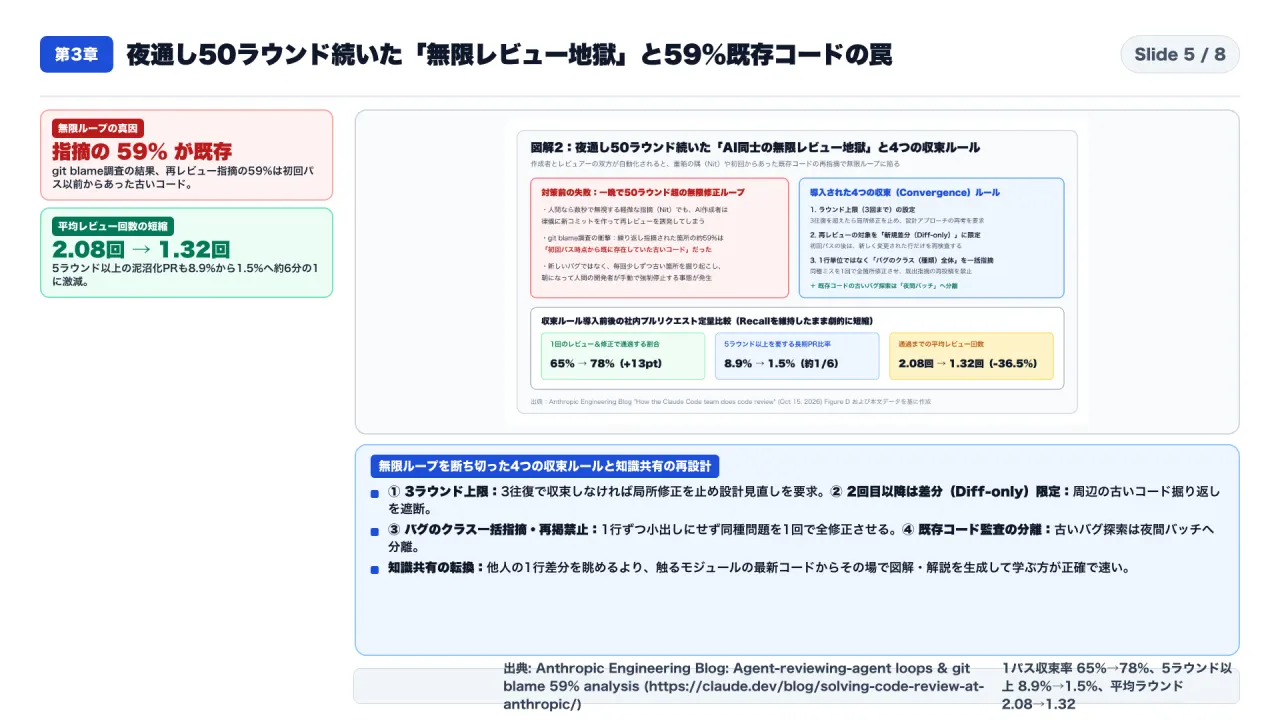
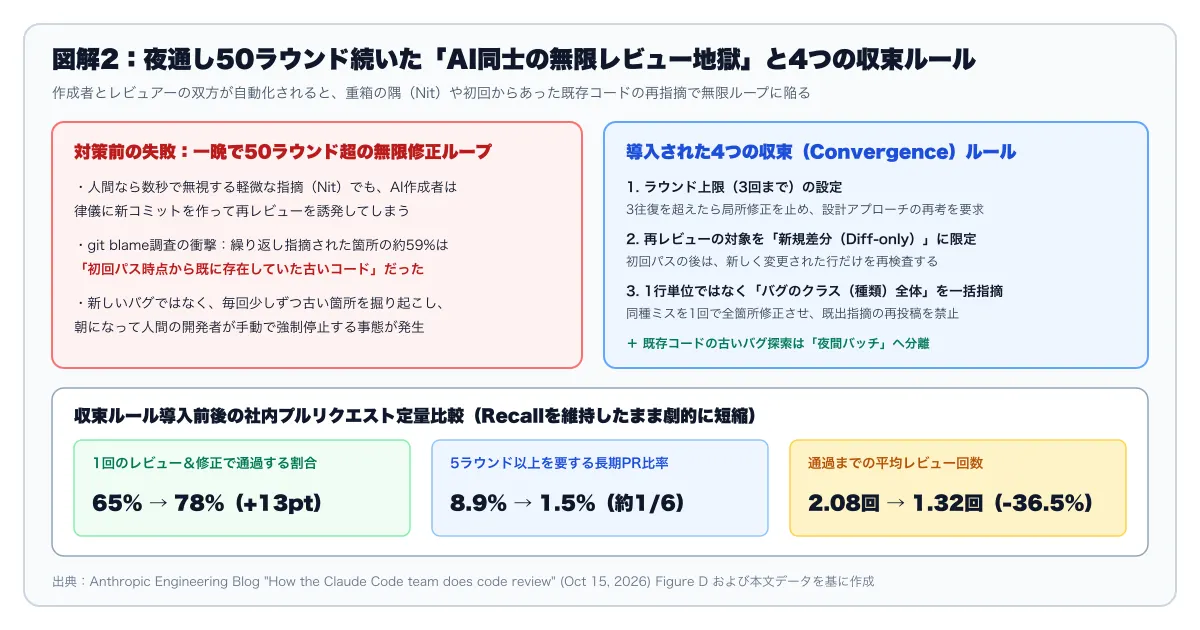
3-1. Recursive Cycles Between Autonomous Agents
During early deployment, Anthropic encountered a severe failure mode: recursive loops between authoring agents and reviewing agents.
When a human author receives minor stylistic feedback (“Nit”), they often exercise judgment to merge without modification. However, when an autonomous agent authors a PR, it interprets every review comment as a mandatory command, committing immediate localized edits.
This new commit triggers the automated reviewer, which identifies new minor variances. On one internal CLI pull request, the author and reviewer executed over 50 recursive revision cycles overnight before an engineer halted the run.
3-2. The git blame Root Cause Analysis
Investigating why 50 rounds failed to converge, the team ran git blame on every flagged line in re-review passes. The findings revealed a fundamental structural flaw:
Approximately 59% of lines flagged in subsequent review passes were pre-existing code that had been present since Pass 1, completely untouched by the current pull request.
Reviewing agents re-reading entire files repeatedly uncovered legacy technical debt and adjacent imperfections, presenting them as new blocking issues.
3-3. The Four Convergence Invariants
Anthropic eliminated recursive review loops by establishing four governance rules:
- Cap at Three Rounds: Automated review-fix exchanges are strictly capped at three iterations. If unresolved issues remain, the agent must halt and request human architectural re-evaluation.
- Scope Follow-Ups to the Diff Only: Pass 1 audits the broad context; subsequent passes evaluate only lines modified in the latest commit.
- Batch Bug Classes: Reviewers must flag entire classes of errors at once rather than drip-feeding single instances across rounds. Repeat findings from earlier passes are suppressed.
- Decouple Pre-Existing Debt Audits: Auditing historical technical debt is decoupled from feature PRs and reassigned to scheduled nightly batch jobs.
| Convergence Telemetry | Prior to Rules | Post-Implementation | Net Impact |
|---|---|---|---|
| Single-Pass Resolution Rate | 65% | 78% | +13 percentage points |
| Stagnant PRs (>5 Rounds) | 8.9% | 1.5% | Plunged by ~6x |
| Mean Review Iterations | 2.08 rounds | 1.32 rounds | 36.5% reduction |
3-4. How Engineers Learn Codebases Without Reading Diffs
If engineers no longer read every PR diff, how do they maintain a coherent mental model of the system?
Anthropic’s answer is pragmatic: across 30,000 daily changes, expecting any individual to hold the entire system architecture in memory is an illusion. Instead of passively skimming fragmented diffs, developers engage in on-demand codebase learning. When modifying a module, engineers direct agents to synthesize fresh architecture diagrams and data-flow documentation directly from the latest source tree.
4. Architectural Analysis: Uncorrelated Contexts, Compounding Evals, and Human Sovereignty
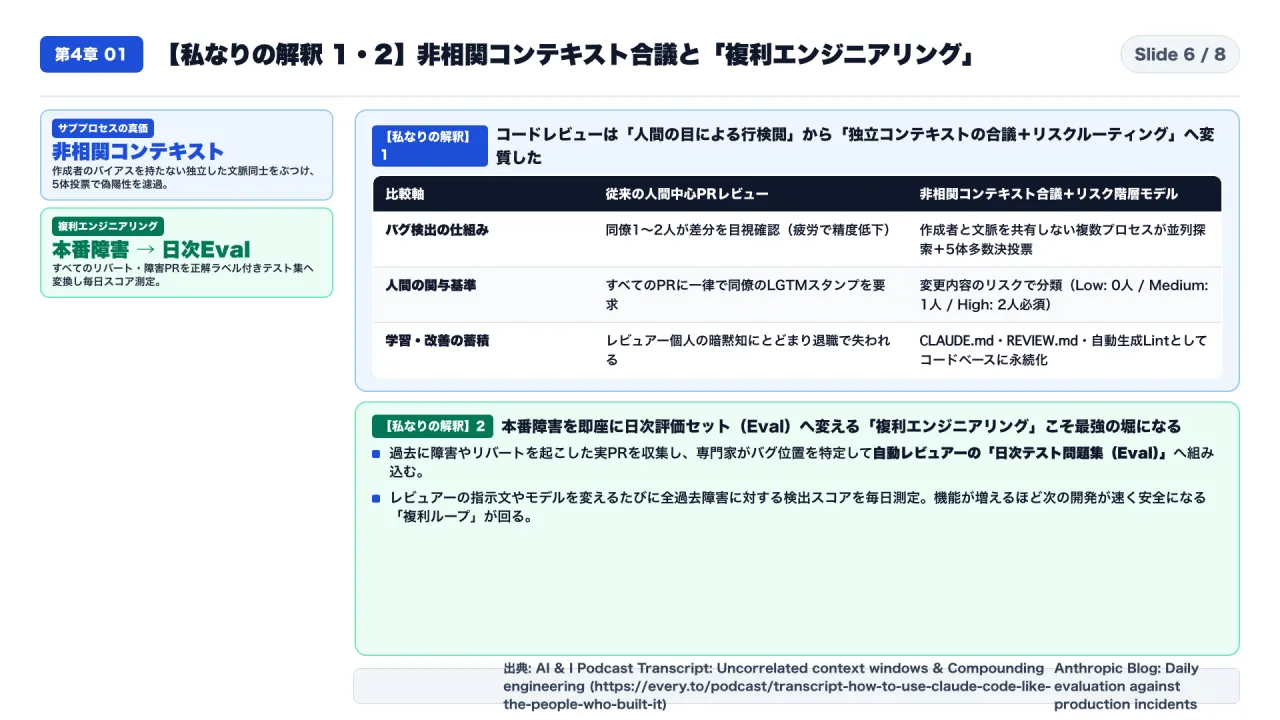
4-1. Subagents as Uncorrelated Context Windows
The value of multi-agent review does not stem from anthropomorphic role-playing (“frontend persona” vs “backend persona”). It derives from colliding uncorrelated context windows.
An authoring session accumulates strong confirmation biases regarding why an implementation was chosen. By spawning a separate reviewer with an unpolluted context window and piping candidates through a 5-agent ensemble vote, the pipeline implements statistical variance reduction.
4-2. Compounding Engineering Through Production Evals
In traditional software organizations, growing codebases accumulate technical debt, making subsequent reviews slower. Anthropic implemented a Compounding Engineering cycle:
- Turning Incidents into Evals: Whenever a regression bypasses the seven layers, domain owners extract the root cause into a permanent Daily Evaluation Set.
- Daily Benchmark Verification: Every prompt refinement,
REVIEW.mdedit, or model upgrade is scored against this historical catalog of real-world bugs. Every production failure permanently strengthens the automated immune system across all repositories.
4-3. The Two Sovereign Human Sanctuaries
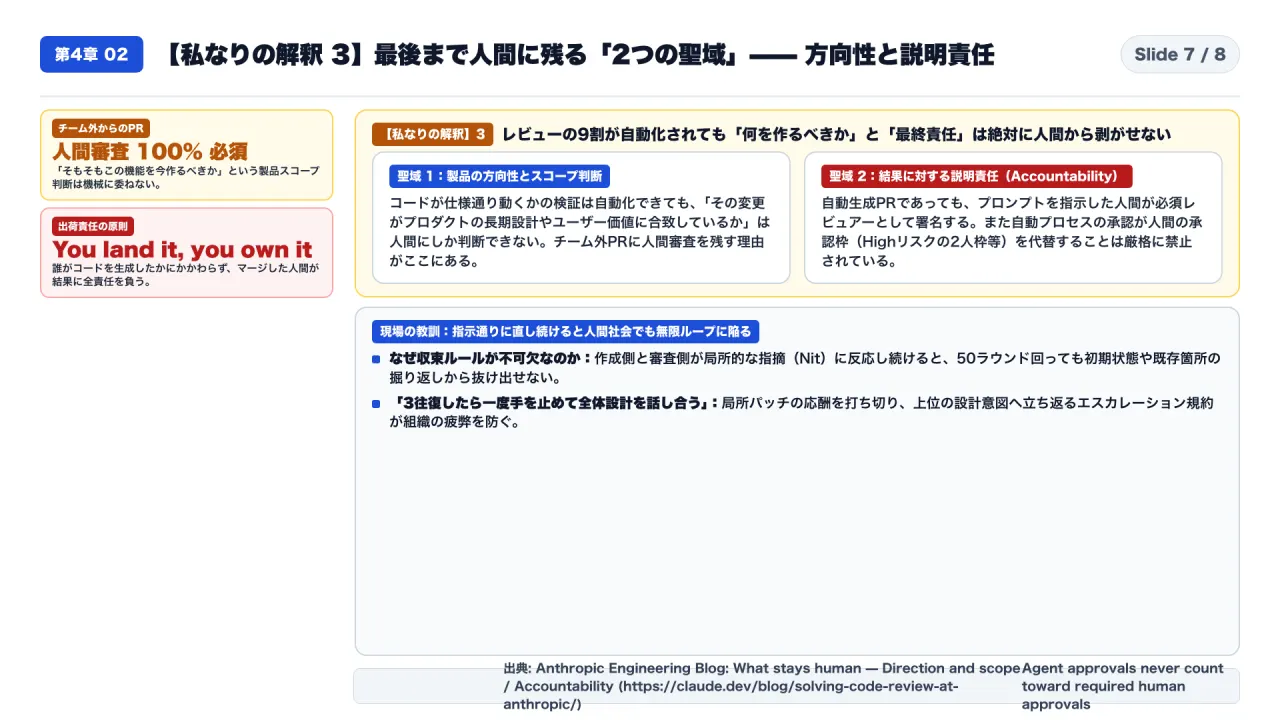
Regardless of automation depth, Anthropic established two non-negotiable boundaries:
- Direction and Scope: Autonomous reviewers verify correctness, but cannot determine whether a feature aligns with product strategy. All PRs from external teams require human review to validate architectural intent.
- Accountability (“You land it, you own it”): Code authorship may be 90% automated, but responsibility for production impact rests 100% on the human engineer who merges the PR. On High-risk paths, human signatures cannot be substituted with agent approvals.
5. Implementation Roadmap: Three Production Actions for Engineering Teams
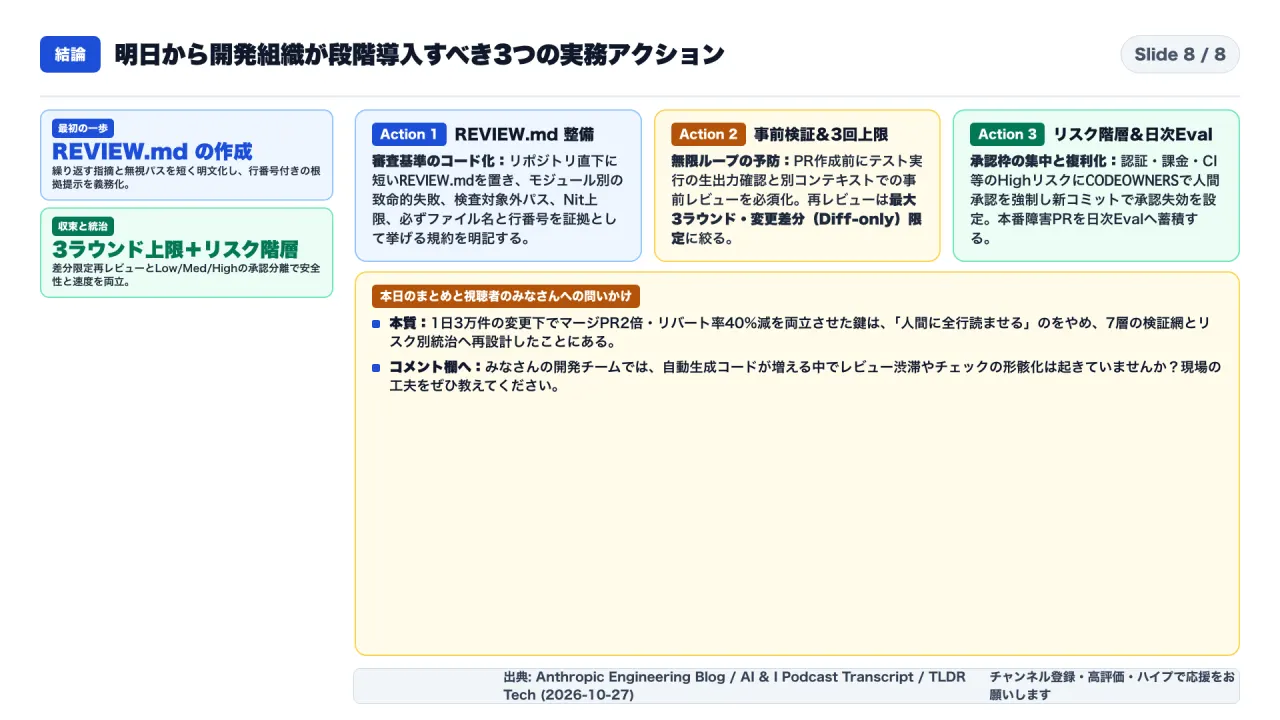
Engineering organizations can adopt these principles immediately:
Action 1: Deploy Modular REVIEW.md Files with Citation Requirements
Create a concise REVIEW.md in each core directory defining:
- Critical module failure modes (e.g., authentication bypasses, database lock contention).
- Excluded paths (generated files, vendor dependencies).
- Mandatory Citation Rule: Reviewers must cite specific file names and line numbers with concrete failure scenarios, prohibiting speculative deductions based on naming conventions.
Action 2: Enforce Pre-PR Verification and Strict Convergence Constraints
Integrate pre-PR raw command output verifications and configure automated reviewers with:
- A hard limit of three review rounds.
- Scoping follow-up passes strictly to recent diffs.
- Shifting historical codebase debt audits into scheduled nightly batch jobs.
Action 3: Establish Risk-Tiered Approvals and Ground-Truth Evals
Replace blanket “two human approvals” policies with tiered governance:
- Grant immediate self-merge paths for low-risk, flag-isolated changes that pass all CI layers.
- Enforce dual-approver
CODEOWNERSsign-offs with stale approval dismissals on High-risk modules (Auth, Billing, CI). - Transform production regressions into permanent evaluation suites to establish a self-reinforcing quality flywheel.
Primary Sources and References
- Anthropic Engineering Blog (Addy Osmani, Morgan Westlee Lunt, Qing Wang): How the Claude Code team does code review
- Every / AI & I Podcast Transcript (Dan Shipper with Cat Wu & Boris Cherny): How to Use Claude Code Like the People Who Built It
- TLDR Tech Newsletter (October 27, 2026): How the Claude Code team does code review / Keeping a software factory stable at 1,000 PRs a week