Why Two Years of Hard Effort Will Vanish in One Prompt: Diffusion Pioneer Jascha Sohl-Dickstein at Stanford on 10,000x Compute and Career Asymmetry
At Stanford’s Physics and AI conference, Anthropic researcher Jascha Sohl-Dickstein warned that a 10,000x compute explosion by 2030 renders safe career paths perilous while opening an extraordinary lever for individuals.
Published: October 29, 2026 | Read time: ~10 min | Watch Video (Japanese)
Executive Summary & Core Architectural Findings
Why could two years of your most rigorous research, system engineering, or professional work be erased on the very day it finishes by a single prompt to a next-generation foundation model? And why, in a world undergoing structural disruption, does clinging to a conventional “safe career” become the most dangerous gamble of all?
These questions formed the core of a keynote address delivered by Jascha Sohl-Dickstein—the pioneer who introduced diffusion models to machine learning and currently conducts frontier research at Anthropic—at Stanford University’s 2026 Conference on Physics and AI (PAI26), hosted by the Stanford Data Science Center for Decoding the Universe and the Stanford Institute for Human-Centered Artificial Intelligence (HAI).

A quantitative analysis of Sohl-Dickstein’s primary presentation data, historical compute trajectories from Epoch AI, and empirical autonomous benchmarks from METR highlights four transformative takeaways:
- The 10,000,000x Compute Surge: Over the past decade, the computational resources used to train the largest frontier AI models have expanded by approximately 10 million times (10^7). At approximately 10^21 FLOPs, frontier training compute is converging with the estimated lifetime computation of the human brain (modeled as 10^14 synapses firing at 1 millisecond intervals over an 80-year lifespan).
- The 2030 10,000x Frontier: Compute projections through 2030 forecast an additional 10,000x expansion relative to 2025. On a linear scale, all AI progress witnessed to date sits flush against the baseline of the graph.
- The Bitter Lesson Operationalized: Richard Sutton’s 2019 insight—that human-engineered heuristics are inevitably swept aside by brute-force compute—has reached software development and enterprise knowledge work. Sohl-Dickstein revealed that while conducting research daily, he no longer writes a single line of code himself, operating instead as a Principal Investigator (PI) directing autonomous agent swarms.
- Risk Inversion & The Golden Age: Because baseline societal risk is universally elevated, conventional “safe” career paths offer illusory safety while forfeiting massive upside. Individuals directing agent swarms now possess a historic window where a single week of orchestration can accomplish what previously demanded an entire career—provided they never surrender the core principle: writing is thinking.
1. Primary Empirical Data: Compute Explosions and the Refutation of the Memorization Myth

To establish the technological context, Sohl-Dickstein framed current progress within three foundational concepts:
- The Anthropocene’s Eclipse: The geological epoch characterized by human cognitive supremacy over Earth’s systems may conclude abruptly as artificial intelligence eclipses biological capabilities.
- The Bitter Lesson: Rich Sutton’s foundational observation that domain-specific human knowledge and manual rules consistently lose to scalable compute.
- The Overton Window Shift: The rapid migration of AGI discussions from fringe speculation to mainstream consensus among global political and technology leaders.
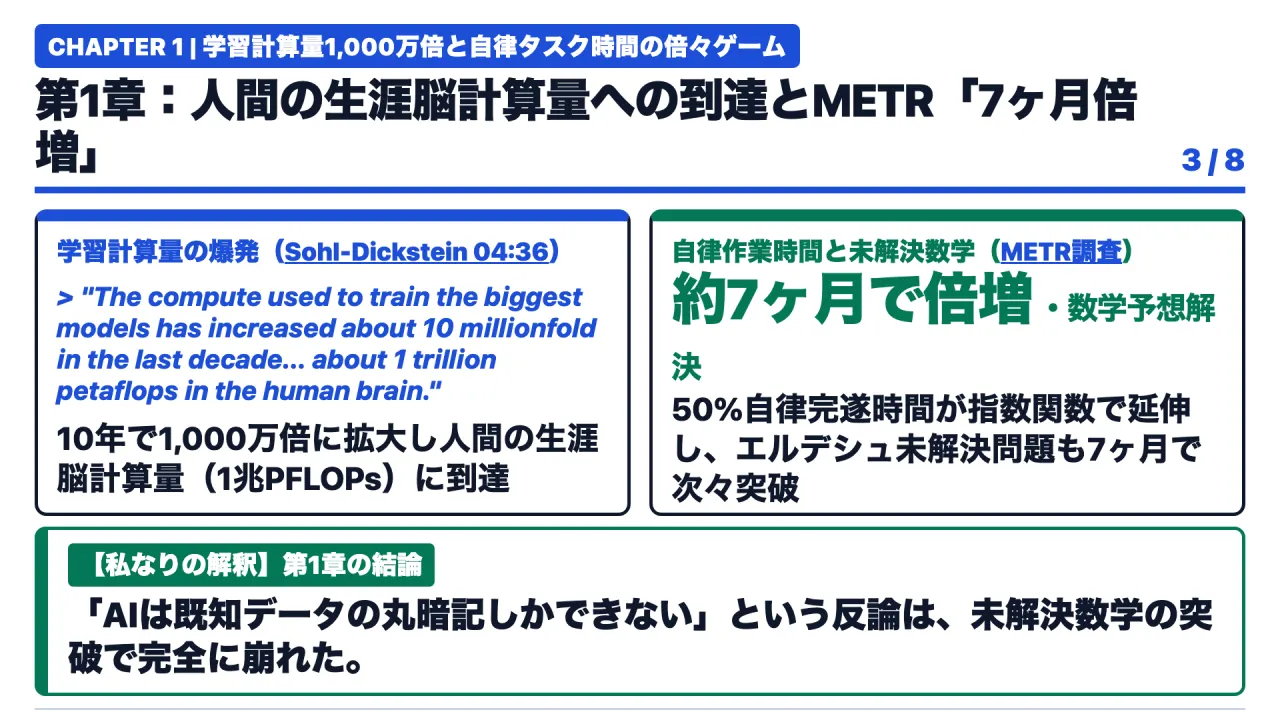
1-1. Super-Exponential Growth: 10 Million Times in Ten Years
Sohl-Dickstein opened by reviewing per-capita human gross domestic product (GDP) from 1500 to the present. Even on logarithmic axes, human productivity reflects a super-exponential curve whose slope steepens over centuries. The primary engine behind the contemporary vertical takeoff is the sheer volume of training compute.
In his primary address (at minute 4:36), Sohl-Dickstein observed:
“The compute used to train the largest models has increased by about a factor of 10 million over the past 10 years. If we assume a biological brain operates with roughly 10^14 synapses computing every millisecond over an entire life, the lifetime computational budget of a human brain is on the order of 10^21 operations. Frontier model training is now entering this exact biological lifetime domain.”
1-2. Dismantling the “Stochastic Parrot” Counter-Argument
Skeptics frequently assert that regardless of scale, language models merely stitch together historical training data and remain incapable of novel reasoning or extended autonomous execution. Sohl-Dickstein dismantled this objection with two empirical benchmarks:
- METR Autonomous Task Horizons (arXiv:2503.14499 / Time Horizon 1.1): Evaluations by the Model Evaluation and Threat Research (METR) organization measure the duration of real-world software engineering and data science tasks that models can complete with a 50% success threshold. Through early 2026, the autonomous task horizon has doubled approximately every seven months.
- Resolution of Unsolved Mathematical Conjectures: Decades-old open mathematical conjectures formulated by Paul Erdős—problems absent from training datasets because no human had solved them—were autonomously resolved by frontier AI systems over the preceding seven months.
Because models resolve previously unsolved problems and execute multi-hour autonomous tasks, claims that AI is restricted to rote interpolation are empirically obsolete.
2. Technical Mechanisms: The Bitter Lesson and the Post-Coding Research Reality

2-1. The Relocation of the Overton Window
Only twelve months prior, predicting general artificial intelligence within a few years invited dismissal. In 2026, figures including Barack Obama, Rishi Sunak, and former Google CEO Eric Schmidt discuss this timeline openly. Schmidt stated that most routine programmers will be replaced within twelve months, with AGI arriving in 3 to 5 years and superintelligence in 6 years.
At minute 14:00 of his keynote, Sohl-Dickstein confirmed the technical perspective within frontier labs:
“If you talk to the people building frontier models today, almost nobody believes there is a fundamental capability wall between where we stand now and artificial superintelligence.”
Historically, newly established benchmarks required two decades to reach human parity. In modern evaluation regimes, newly designed benchmarks are frequently saturated within months.
2-2. The 2-Year Effort Evaporation Warning
This trajectory elevates Richard Sutton’s The Bitter Lesson into an urgent operational mandate. At minute 21:55, Sohl-Dickstein delivered his central warning regarding career and technical investment:
“The outcome you must avoid is working desperately for two years to make progress, only to find that when you finish, someone types one prompt into the next-generation foundation model and achieves superior results.”
Efforts dedicated to manually patching current AI limitations—writing bespoke heuristics, building fragile prompt-chain wrappers, or manually curating narrow rule sets—vanish when the base model advances one generation. Value accrues exclusively to systems whose leverage multiplies as underlying compute scales.
2-3. The Post-Coding Reality: Operating as a Research PI
Sohl-Dickstein described how this reality transformed his daily workflow at Anthropic. At minute 24:28, he revealed:
“I code every day for my research, but I do not write a single line of code myself. I rarely even look at code anymore. Working with large language models is like being a Principal Investigator (PI) running a research lab, directing brilliant but occasionally misguided graduate students.”
Rather than writing syntax, the frontier researcher’s responsibility shifts to framing falsifiable hypotheses, specifying rigorous evaluation harnesses, and directing autonomous model swarms that implement and test solutions in parallel.
3. Structural Reversals: Risk Asymmetry and the 10,000x Compute Horizon
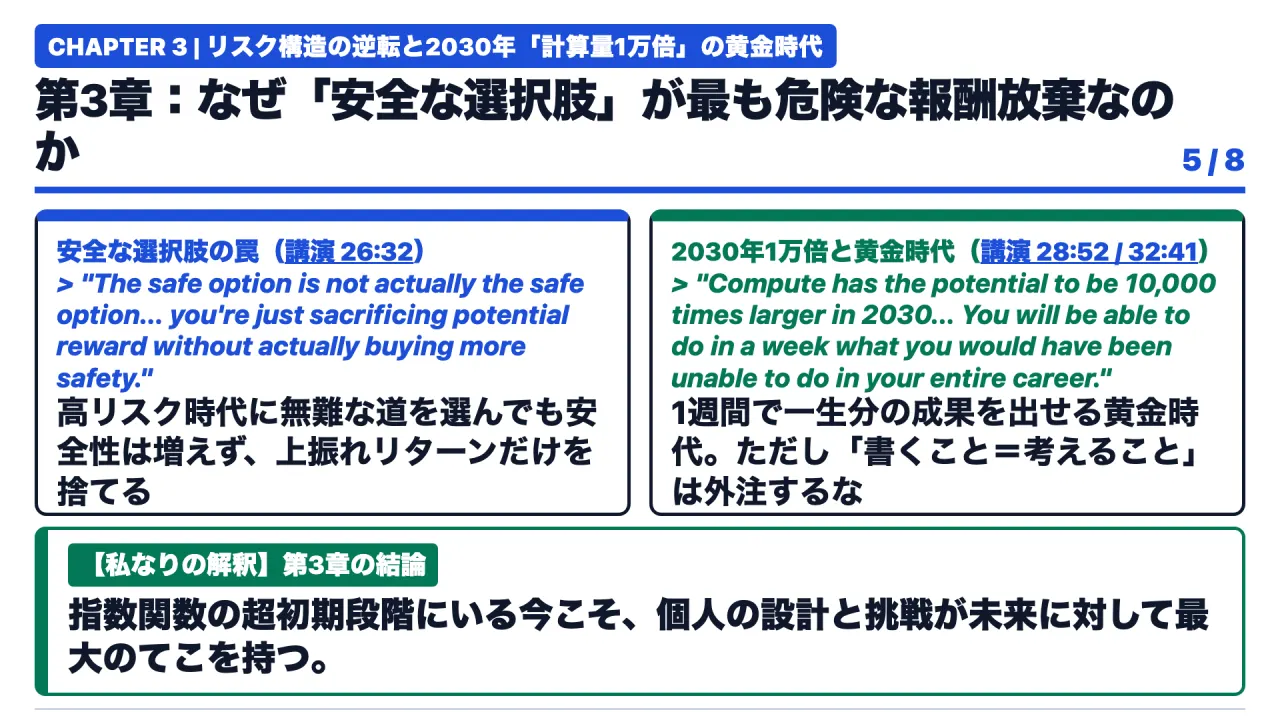
3-1. The Peril of the “Safe” Choice
During rapid technological disruption, instinct drives professionals toward established corporations, traditional credentials, and risk-averse career tracks. At minute 26:32, Sohl-Dickstein exposed this risk-mitigation strategy as mathematically flawed:
“If AI introduces massive disruption across society, the baseline level of risk for everyone is already extremely high. In such an era, choosing traditional ‘safe’ options does not make you safe. You fail to buy safety, but you successfully surrender all your upside.”
When the cost of cognition drops toward zero over five years, traditional career security collapses. Attempting to hedge against an unprecedented structural transformation through incrementalism forfeits the upside while fully absorbing the macro fallout. High-conviction, asymmetric bets represent the rational response.
3-2. The 2030 10,000x Horizon and Historical Contingency
Epoch AI and industry projections estimate that available compute in 2030 will reach up to 10,000 times that of 2025.
At minute 28:52, Sohl-Dickstein emphasized the visual reality of exponential scales:
“The compute available in 2030 could be 10,000 times greater than in 2025. Looking back from the future, all the compute we see deployed today will appear indistinguishable from zero on a linear plot.”
Because society sits at the initial inflection point of an exponential trajectory, decisions made by small teams carry outsized historical leverage—analogous to the standardization of internet routing protocols, the Haber-Bosch chemical process, or the governance foundations of early scientific academies.
At minute 32:41, he characterized the current era:
“We are living in an extraordinary golden age where an individual directing AI systems can accomplish in a single week what previously required an entire career.”
3-3. The Non-Negotiable Boundary: Writing is Thinking
Yet at minute 40:45, Sohl-Dickstein issued a vital governance caveat:
“Writing is thinking. If you outsource your writing entirely to AI, you have outsourced your cognitive processing, and you will lose the ability to truly understand what is happening.”
Delegating code implementation, data wrangling, and compilation to agents is empowering; delegating the formulation of intent, logical deduction, and argument synthesis leads to cognitive atrophy.
4. Architectural Synthesis: The 3-Tier Enterprise Reality

In enterprise consulting, systems architecture, and corporate strategy, Sohl-Dickstein’s thesis is confirmed on the ground.
Teams frequently witness research reports and migration pipelines that formerly consumed months of manual labor generated in hours by autonomous agent pipelines. Yet traditional organizations continue to draft multi-year transformation plans designed around the quirks of today’s models.
Because autonomous capability horizons double every seven months, manual scaffolding becomes redundant before delivery. High-leverage engineering requires constructing independent verifiers, ground-truth evaluation harnesses, and proprietary data moats that appreciate in value as base models grow smarter.

To operationalize these principles, production workflows should adopt a 3-Tier Hybrid Architecture:
3-Tier Autonomous Orchestration Stack:
├── Tier 1: Intent, Falsification & Problem Formulation (Human Sovereign Domain)
│   └── "Writing is thinking" / Non-negotiable conceptual synthesis and hypothesis generation
├── Tier 2: Deterministic Verification & Evaluation Harnesses (Code & CI Layer)
│   └── Unit tests, property assertions, sandboxed execution, and empirical metric trackers
└── Tier 3: Parallel Agent Execution Swarms (Frontier Model Layer)
    └── Multiple non-correlated subagents executing code, refactoring, and data pipelines
5. Implementation Roadmap: Three Strategic Inquiries for the AI Era

Sohl-Dickstein’s address concludes not with software checklists, but with fundamental self-assessments for knowledge workers and technical leaders navigating the compute explosion:
Inquiry 1: Are You Building a Linear Asset That a Prompt Will Obviate?
- Diagnostic: Examine the primary project consuming your professional energy over the coming twelve months. Does it rely on manually bridging current AI gaps—writing custom glue code, manually formatting reports, or curating rules?
- Action: If your project is vulnerable to being solved by a single prompt to a 2027 foundation model, pivot immediately. Reallocate capital and effort into building automated verifiers, proprietary evaluation sets, and domain-specific feedback loops that scale exponentially with frontier compute.
Inquiry 2: Have You Outsourced Your Reasoning While Automating Output?
- Diagnostic: Are you directing AI to generate text while abdicating the intellectual rigor of synthesizing the underlying arguments?
- Action: Reclaim writing as your core cognitive engine. Automate data collection, code execution, and draft styling, but author your thesis, problem framing, and architectural criteria with uncompromised human focus.
Inquiry 3: Are You Clinging to Obsolete “Safe” Paths While Surrendering Upside?
- Diagnostic: Are you remaining in a bureaucratic, risk-averse institutional role under the assumption of stability, even as structural disruption renders traditional career ladders fragile?
- Action: Acknowledge that macroeconomic baseline risk is high everywhere. Seize the unique leverage of the current window—where one person orchestrating agent swarms can match the output of an entire division—to pursue bold, high-conviction initiatives.
Primary Sources and References
- 2026 Conference on Physics and AI: Jascha Sohl-Dickstein Keynote Address (YouTube)
- Stanford Data Science (Center for Decoding the Universe): 2026 Conference on Physics and AI (PAI26)
- METR: Measuring AI Ability to Complete Long Tasks (Official Technical Blog)
- METR Research: Measuring AI Ability to Complete Long Tasks (arXiv:2503.14499)
- METR: Time Horizon 1.1 Update and Milestone Telemetry (January 29, 2026)
- Richard Sutton: The Bitter Lesson (Incomplete Ideas Essay Archive, March 13, 2019)
- Epoch AI: Can AI Scaling Continue Through 2030? Empirical Projections and Resource Constraints
- Jascha Sohl-Dickstein Official Research Index and Publications