Why the U.S. Revocation of 194,000 Foreign Truck Licenses Triggered a 1,000-Truck Order Surge for Aurora ── Inside the 6-Week Ramp Delay and the $0.85/Mile DaaS Break-Even
YouTube (Japanese audio): https://youtu.be/ezBUdMJqa6k
Executive Summary & Key Takeaways
- Core Thesis: For the past decade, industry skeptics viewed autonomous Class 8 trucks as a prolonged R&D science project. In late October 2026, a series of primary filings, earnings transcripts, and federal regulatory actions proved that driverless freight has crossed into an urgent Business Continuity Planning (BCP) phase. At its Q3 2026 Earnings Call (October 28, 2026) and Analyst & Investor Day (October 29, 2026), Aurora Innovation (NASDAQ: AUR) announced that it surpassed 500,000 cumulative fully driverless commercial miles on public roads in September 2026 with zero Aurora-attributed serious collisions and 100% on-time delivery. Simultaneously, Aurora candidly disclosed an approximately 6-week manufacturing ramp delay at its Roush upfit facility in Livonia, Michigan—pushing its 200-truck milestone from year-end 2026 to the end of February 2027 due to complex wire-harness supplier bottlenecks and End-of-Line (EOL) physical fitment calibration, even as upstream Fabrinet sensor-and-compute kits (with 50%+ cost reduction and 1,000-meter FirstLight Lidar on a chip) shipped ahead of schedule. Yet instead of cooling customer demand, Hirschbach Motor Lines (500 trucks) and Charger Logistics (500 trucks) signed multi-year deals totaling 1,000 driverless trucks, while a single major carrier asked to purchase half (150 units) of Volvo’s entire 300+ autonomous truck production run in 2027. The macro catalyst behind this buying frenzy is the U.S. Federal Motor Carrier Safety Administration’s (FMCSA) 2026 Non-Domiciled CDL Final Rule (91 FR 7044, effective March 16, 2026), which eliminated Employment Authorization Document (EAD) eligibility after 17 fatal crashes (30 fatalities) in 2025—forcing ~194,000 non-domiciled CDL holders out of the U.S. driver pool upon renewal.
- Who Should Read This: Logistics, supply-chain, and fleet operations executives; Physical AI, robotics, and autonomous vehicle hardware/software engineers; institutional investors covering mobility and deep tech; and corporate strategy leaders navigating severe labor shortages.
- Key Architectural & Financial Takeaways:
- How Aurora’s 3-stage OEM manufacturing roadmap (Phase 1: Roush upfit at 20 trucks/week by early Dec 2026 → Phase 2: Volvo New River Valley line-side integration of 300+ trucks in 2027 → Phase 3: AUMOVIO Gen 3 Hardware-as-a-Service (HaaS) in late 2027) slashes Aurora’s annual CapEx from $185M in 2027 to under $50M in 2028, driving gross-profit positivity in H1 2027 (~500 trucks) and free-cash-flow breakeven by late 2028 (~7,500 trucks).
- Exact unit economics comparing human-driven trucks ($2.336/mile marginal cost and a razor-thin 0.4% operating margin per ATRI 2026 data) against Aurora DaaS ($0.85+/mile), which unlocks 20–22 hours/day utilization (~250,000 miles/year = 2x human mileage), cuts fleet TCO by 20%+ (~$0.50/mile), and adds +$340,000 in annual revenue and +$160,000 in operating income per truck.
- A head-to-head comparison of the four autonomous trucking leaders in October 2026 (Aurora, Kodiak AI, Waabi, and PlusAI) alongside three real-world operational blind spots: the 500-mile length-of-haul threshold, 1 hour 49 minutes of warehouse detention ($5,392/year loss), and autonomous liability insurance pricing.
Background & Primary Sources Verified

This technical and financial teardown cross-verifies 13 primary sources published through October 29, 2026:
- 1. Aurora Innovation Q3 2026 Earnings Call Transcript (Oct 28, 2026): The Motley Fool Transcript
- 2. Aurora Innovation Official Press Release (Oct 29, 2026): Aurora Outlines 2030 Vision to Scale to 30,000+ Driverless Trucks at Analyst and Investor Day (Aurora IR)
- 3. FreightWaves (Oct 29, 2026): Aurora outlines plan to deploy 30,000+ driverless trucks by 2030 (FreightWaves)
- 4. U.S. DOT / FMCSA Official Regulation & FAQ (2026): 2026 Non-Domiciled CDL Final Rule (91 FR 7044, effective March 16, 2026) (FMCSA Official FAQ)
- 5. Marquee Insurance Group (2026): FMCSA Non-Domiciled CDL Final Rule 2026 & ATRI 2026 Trucking Expense Benchmark ($2.336/mile) (CDL Rule Analysis / ATRI Cost Calculator)
- 6. ACT News & FleetOwner (2026): Aurora Driver Gen 2 Hardware Business Case & Permian Basin Frac Sand Hauls with Detmar Logistics (ACT News / FleetOwner)
- 7. Competitive Primary Sources (Kodiak AI, Waabi, PlusAI): Kodiak 64-Day Uptime Record / Kodiak & DTL 75-Truck Deal (Oct 29, 2026) / Waabi, Volvo & Warp LTL Pilot (Oct 1, 2026) / Waabi $1B Funding / PlusAI SuperDrive
1. Inside the “6-Week Manufacturing Delay”: Upstream Fabrinet Gen 2 Kits vs. Downstream Roush Upfit & the 3-Stage OEM Roadmap
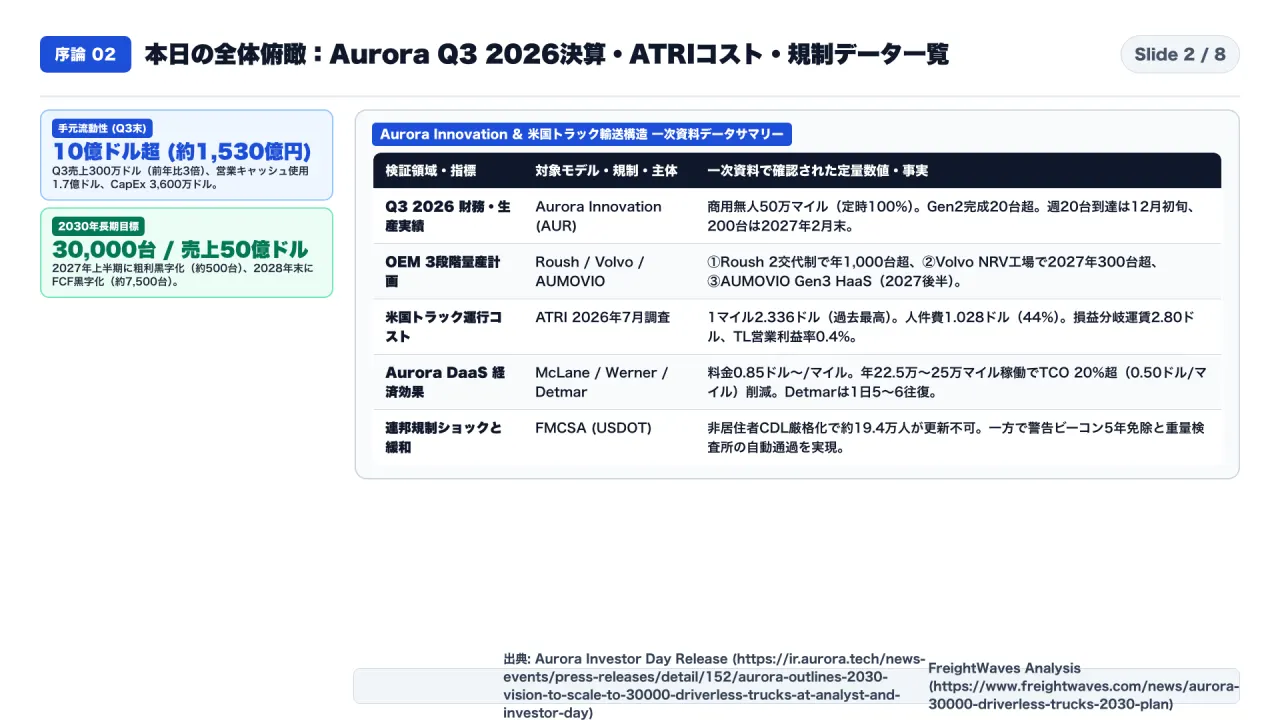
When Aurora reported Q3 2026 earnings on October 28, 2026 ($1M Q3 revenue, doubling sequentially, and $1.8B in total liquidity including $1.5B Q3 cash plus $345M raised in early Q4), management disclosed that its target of deploying 200 driverless trucks would shift by roughly 6 weeks—from year-end 2026 to the end of February 2027.
A close reading of CEO Chris Urmson’s and CFO Sandeep Radhakrishnan’s remarks reveals a critical distinction between upstream silicon/sensor manufacturing and downstream chassis upfitting:
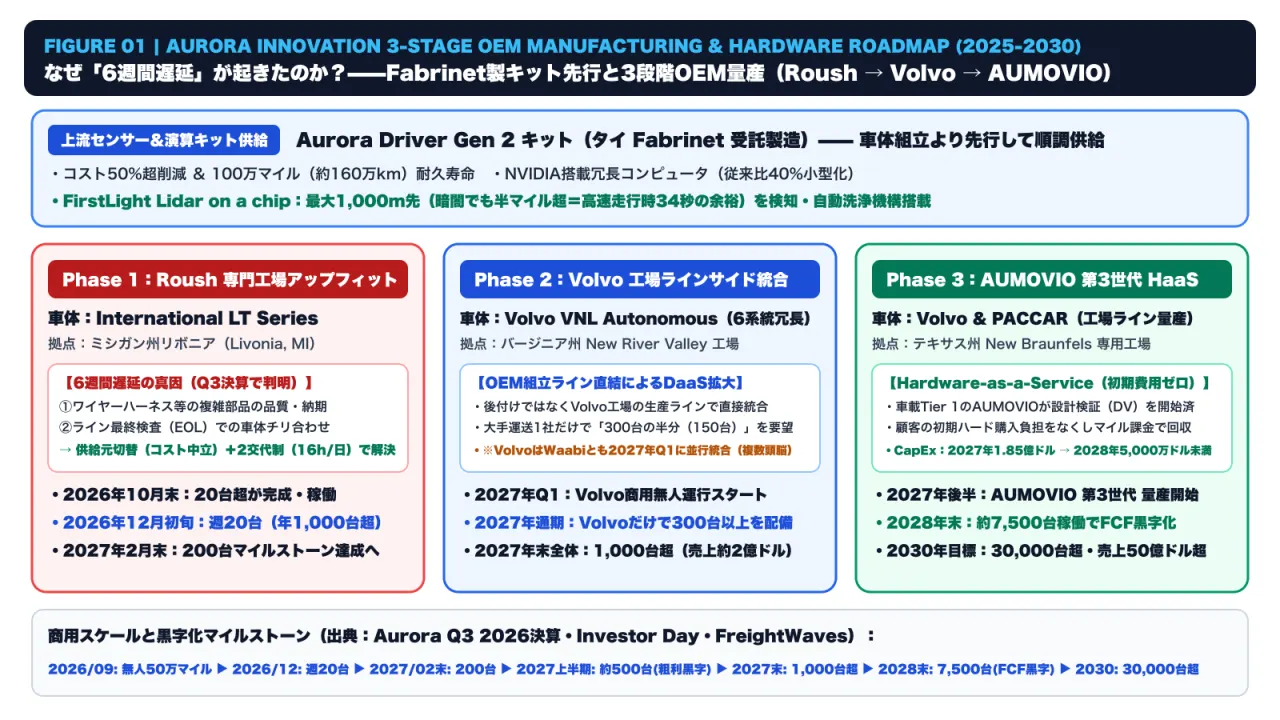
1-1. Upstream Success: Fabrinet Gen 2 Kits Ship Ahead of Chassis Assembly
- 50%+ Cost Reduction & 1,000,000-Mile Durability: Manufactured by contract electronics giant Fabrinet in Thailand, the 2nd-Generation (Gen 2) Aurora Driver hardware kit slashes BOM and manufacturing cost by more than 50% compared to Gen 1 while achieving a 1-million-mile design life and a 40% smaller NVIDIA-powered redundant compute unit.
- FirstLight Lidar on a Chip (1,000m Range = 34 Seconds of Headway): By integrating frequency-modulated continuous-wave (FMCW) optical waveguides onto silicon photonics, Aurora’s FirstLight Lidar detects objects up to 1,000 meters away—and spots unlit obstacles in pitch darkness at over half a mile (>800m), giving a 80,000-lb truck traveling at 65 mph roughly 34 seconds of reaction and stopping time. Integrated high-pressure automated sensor cleaning keeps lenses clear through West Texas dust and rain.
1-2. Downstream Bottleneck: Why Roush Upfitting Slipped 6 Weeks—and How It Was Fixed
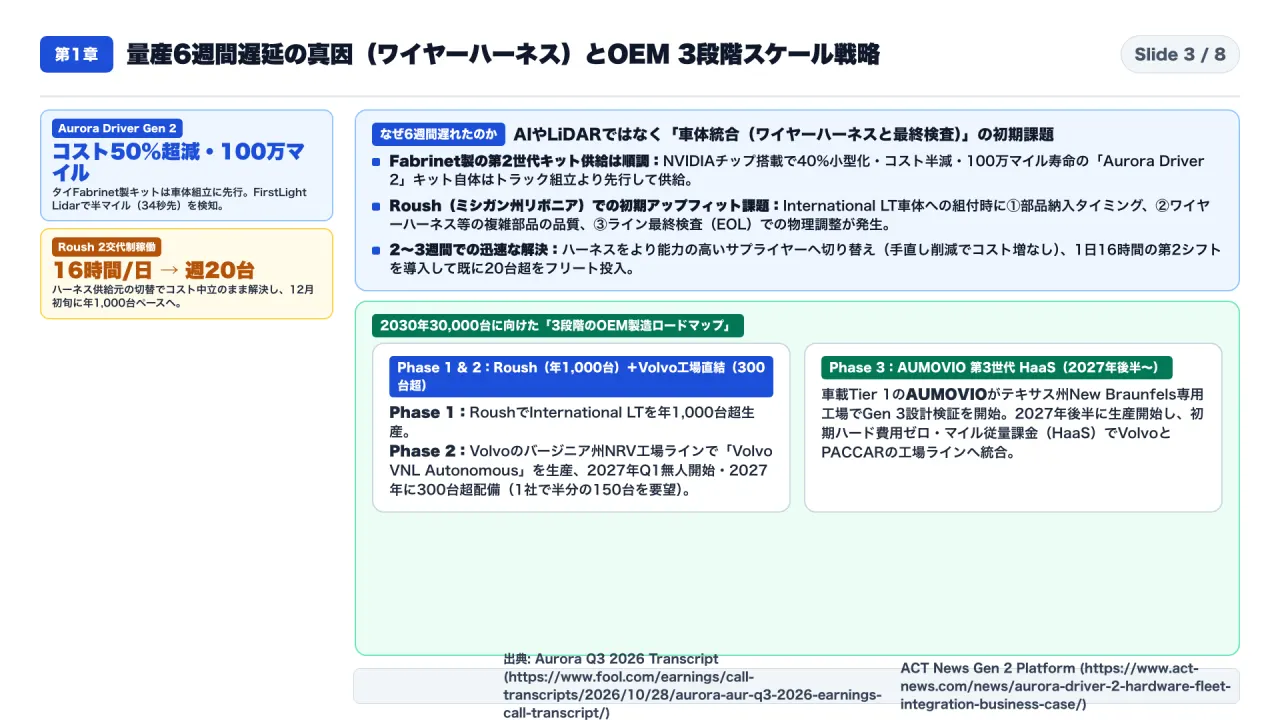
In Phase 1, Aurora integrates these Fabrinet kits onto International LT Series tractors at Roush’s specialized facility in Livonia, Michigan. Two physical bottlenecks caused the 6-week slip:
- 1. Complex Sub-Assembly Supplier Delays (Wire Harnesses): Certain complex mechanical and electrical components—most notably heavy-duty wire harnesses—suffered supplier quality and delivery delays. Aurora resolved this by switching to an alternative supplier on a cost-neutral basis.
- 2. End-of-Line (EOL) Fitment & Calibration: Unlike passenger cars, Class 8 truck cabs exhibit millimeter-level chassis tolerances that complicated End-of-Line (EOL) physical fitment and optical calibration. Roush re-engineered its EOL fixtures and expanded operations to two shifts per day (16 hours/day, 5 days/week).
- Resulting Ramp Trajectory: Over 20 Gen 2 driverless trucks were completed by late October 2026. Beginning in early December 2026, Roush will produce 20 trucks per week (>1,000 trucks/year annualized), hitting the 200-truck milestone by late February 2027.
1-3. Phase 2 (Volvo Line-Side Integration) & Phase 3 (AUMOVIO Gen 3 HaaS)
| Manufacturing Phase | OEM / Tier-1 Partner & Facility | Target Volume & Timeline | Strategic & Financial Mechanism |
|---|---|---|---|
| Phase 1: Specialized Upfit | Roush (Livonia, MI) on International LT Series | 20 trucks/week (Dec 2026) → 200 trucks (Feb 2027) | Bridges initial commercial demand; proves Gen 2 hardware reliability in customer fleets |
| Phase 2: OEM Line-Side Integration | Volvo Trucks (New River Valley, VA) on Volvo VNL Autonomous | Commercial launch Q1 2027 → 300+ Volvo trucks in 2027 (>1,000 total fleet by YE 2027) | Direct assembly-line integration; a single large carrier requested 50% (150 units) of 2027 Volvo output |
| Phase 3: Tier-1 Mass Production & HaaS | AUMOVIO (New Braunfels, TX) for Volvo & PACCAR | Launch 2H 2027 → ~7,500 trucks (YE 2028, FCF+) → 30,000+ trucks (2030, $5B+ rev) | Hardware-as-a-Service (HaaS) eliminates upfront customer hardware cost; Aurora CapEx drops from $185M (2027) to <$50M (2028) |
2. Unit Economics Teardown: Human Trucking ($2.336/Mile, 0.4% Margin) vs. Aurora DaaS ($0.85+/Mile, 2x Utilization)
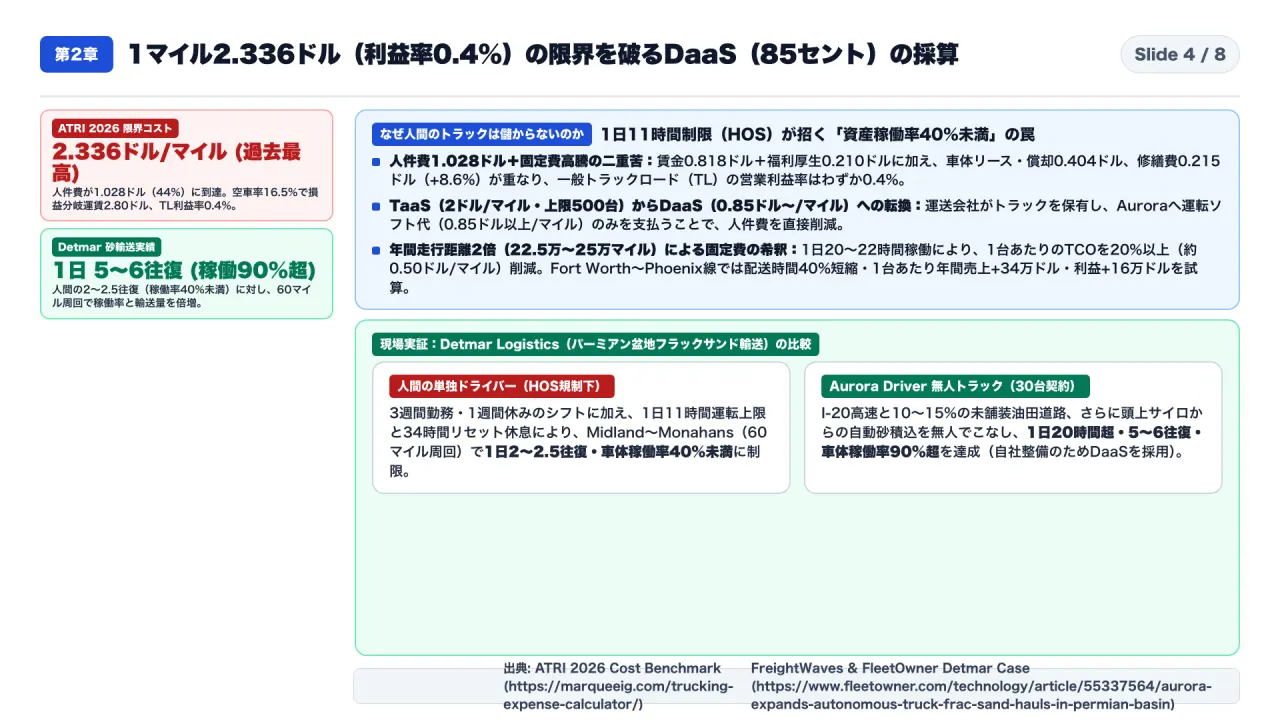
Why are carriers lining up for autonomous capacity despite a 6-week ramp delay? Because the unit economics of human-driven trucking have reached a structural breaking point.
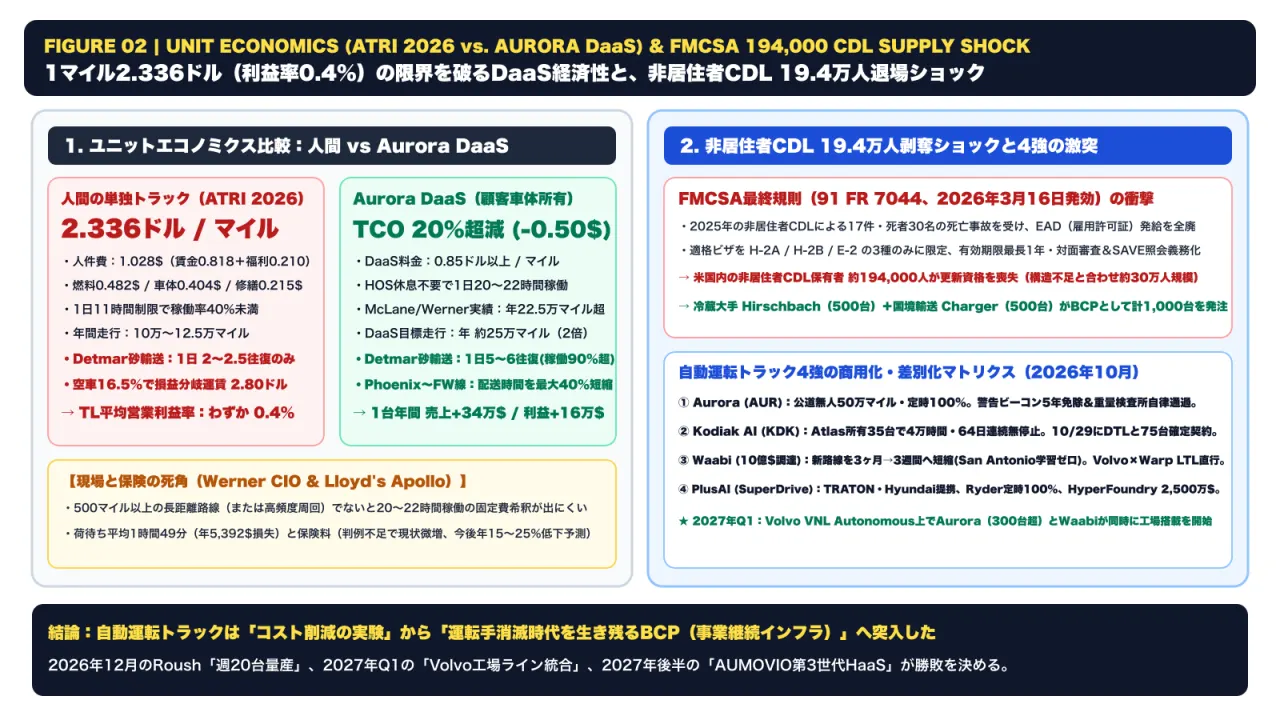
2-1. The Human Baseline (ATRI 2026): $2.336/Mile Cost and a 0.4% Operating Margin
According to the American Transportation Research Institute (ATRI) 2026 Update, the average marginal cost of operating a Class 8 truck in the United States reached $2.336 per mile ($1.854/mile excluding fuel):
- Driver Labor ($1.028/mile = 44% of total cost): $0.818/mile in driver wages plus $0.210/mile in benefits.
- Vehicle & Fuel ($1.308/mile): Fuel ($0.482/mile), truck/trailer lease or purchase ($0.404/mile), repair and maintenance ($0.215/mile), insurance ($0.102/mile), and tires ($0.049/mile).
- The 16.5% Deadhead Trap & 0.4% Operating Margin: With 16.5% of miles driven empty (deadhead), a carrier must charge $2.336 ÷ (1 − 0.165) = ~$2.80 per revenue mile just to break even—leaving the average U.S. Truckload (TL) carrier with an operating margin of just 0.4%.
2-2. The Aurora DaaS Equation: Doubling Annual Mileage to 250,000 Miles/Year
Under Aurora’s Driver-as-a-Service (DaaS) model, the carrier owns and operates the base truck tractor while paying Aurora $0.85+ per mile for the autonomous driver and fleet management software:
- 1. Eliminating the 11-Hour HOS Ceiling (40% → 90%+ Utilization): Federal Hours-of-Service (HOS) rules cap a solo human driver at 11 driving hours per day followed by a mandatory 10-hour rest break, limiting a human-driven truck to 100,000–125,000 miles per year (<40% asset utilization). Aurora’s driverless trucks run 20 to 22 hours per day—already exceeding 225,000 annualized miles/truck in commercial operations with McLane and Werner Enterprises, and targeting ~250,000 miles/year (2x human mileage) at scale.
- 2. 20%+ TCO Reduction (+$340K Revenue / +$160K Operating Income per Truck): Spreading fixed tractor depreciation, insurance, and overhead across 250,000 miles—combined with a lower per-mile driver fee ($0.85+ vs. $1.028) and up to 12% fuel savings—cuts total cost of ownership (TCO) by more than 20% (~$0.50/mile saved). For the carrier, each autonomous truck generates up to +$340,000 in incremental annual revenue and +$160,000 in incremental annual operating income.
- 3. Proven Field Multipliers (Phoenix Corridor & Permian Basin Frac Sand):
- On the 1,000+ mile Fort Worth–El Paso–Phoenix corridor, continuous autonomous operation cuts transit times by up to 40%, matching costly two-person team driving with a single unmanned cab.
- In the Permian Basin, Detmar Logistics deployed Gen 2 Aurora driverless trucks for 24/7 frac-sand hauling across ~60-mile routes, boosting daily output from 2–2.5 round-trips/day (human solo) to 5–6 round-trips/day (>90% utilization).
3. The Regulatory Shockwave: How FMCSA’s 2026 Non-Domiciled CDL Final Rule (91 FR 7044) Removes 194,000 Drivers
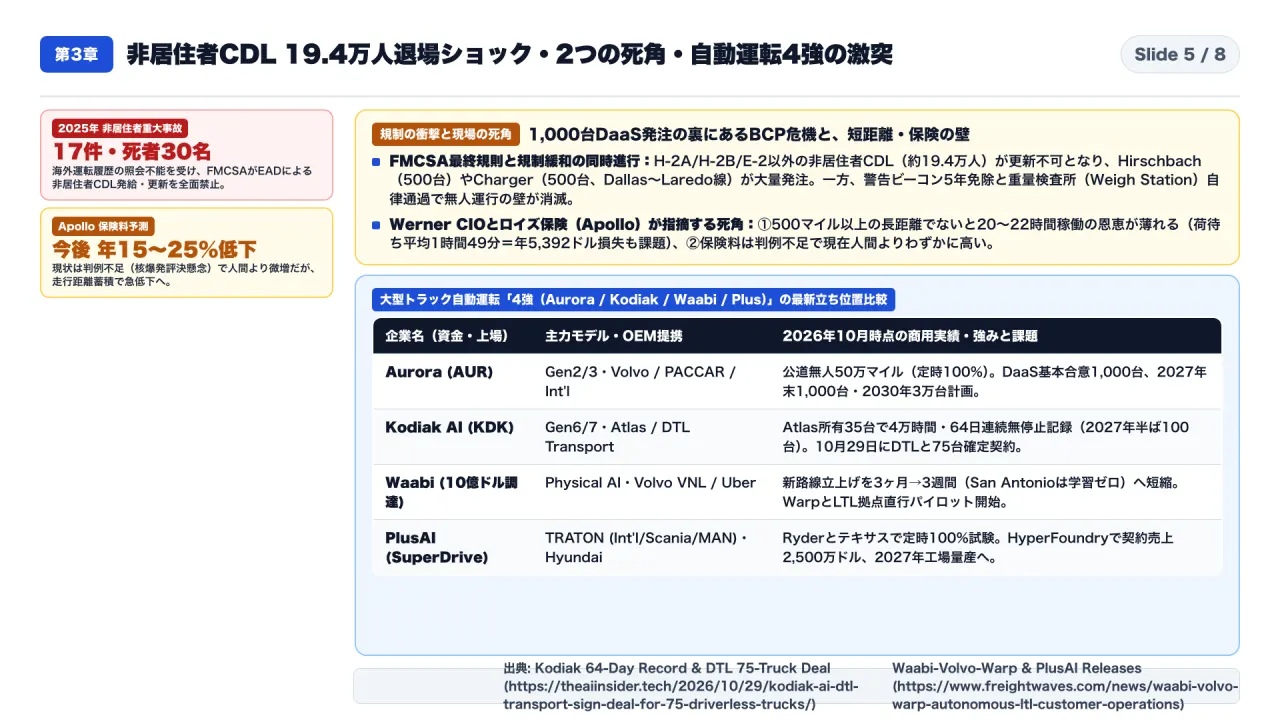
Why did refrigerated freight leader Hirschbach Motor Lines (500 trucks) and cross-border logistics giant Charger Logistics (500 trucks) commit to 1,000 Aurora driverless trucks at Investor Day? Because a historic federal regulatory clampdown is actively removing nearly 200,000 foreign-born truck drivers from U.S. highways.
- The Trigger (17 Fatal Crashes & 30 Deaths in 2025): Following at least 17 fatal crashes resulting in 30 deaths caused by non-domiciled CDL holders in 2025—and federal audits uncovering widespread state DMV failures in California, Texas, Pennsylvania, and Colorado—the FMCSA published the 2026 Non-Domiciled CDL Final Rule (91 FR 7044) on February 13, 2026, with an effective date of March 16, 2026.
- Complete Abolition of EAD-Based CDLs: The final rule eliminates Employment Authorization Documents (EADs) as proof of eligibility for a non-domiciled CDL (affecting asylum seekers, DACA, TPS, and EAD work-permit holders) and restricts eligibility strictly to three non-immigrant visa categories: H-2A, H-2B, and E-2, alongside mandatory annual in-person renewal (max 1-year validity), DHS SAVE verification, and strict English proficiency testing.
- 194,000 Drivers Exiting Upon Renewal: By FMCSA’s own regulatory impact estimate, approximately 194,000 (~200,000) current non-domiciled CDL holders can no longer renew their licenses as they expire over the next 1–3 years. Combined with existing structural shortages (60,000–80,000 drivers) and baby-boomer retirements, North American freight faces a ~300,000-driver supply vacuum.
4. The 4-Way Autonomous Trucking Showdown (Oct 2026) & 3 Real-World Operational Blind Spots
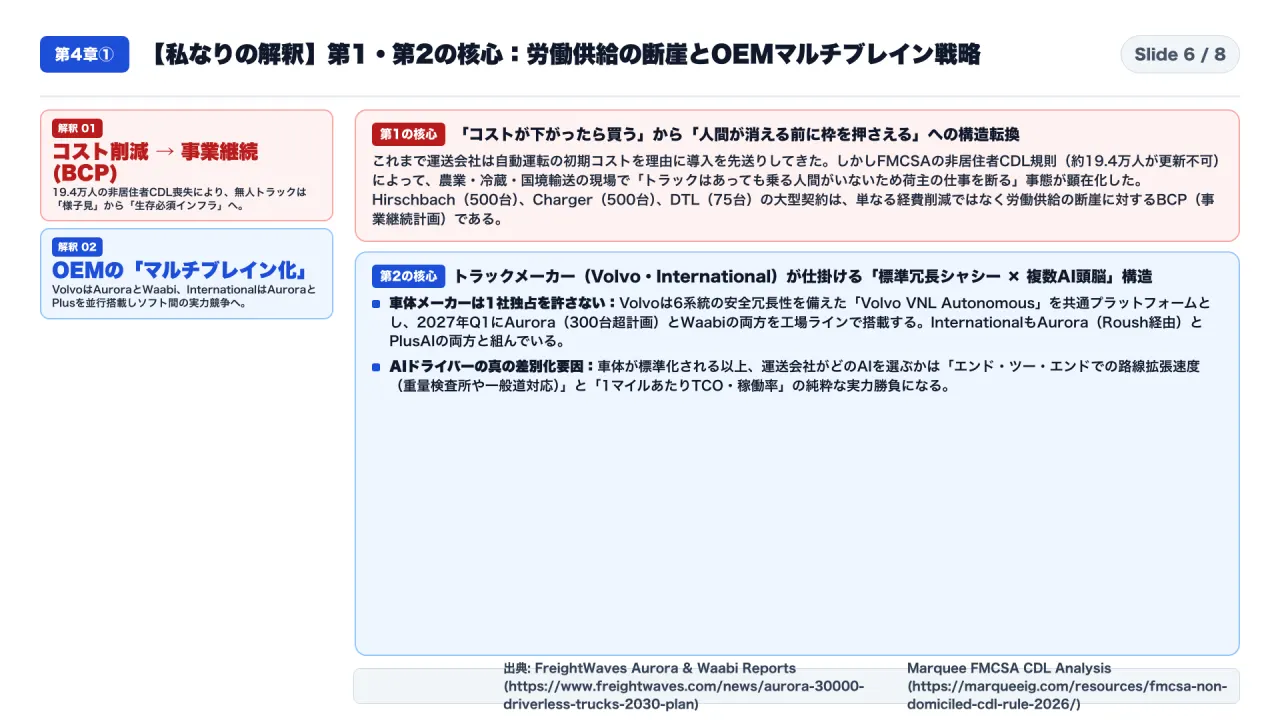
4-1. Comparing the Top 4 Autonomous Trucking Contenders (October 2026)
- 1. Aurora Innovation (NASDAQ: AUR): 500,000+ driverless highway miles, 100% on-time, proprietary 1,000m FirstLight Lidar, 5-year FMCSA exemption for cab-mounted warning beacons, autonomous weigh-station bypass, and a 3-stage OEM ramp (Roush → Volvo → AUMOVIO HaaS).
- 2. Kodiak AI (NASDAQ: KDK): Customer Atlas Energy Solutions owns and operates 35 driverless Kodiak trucks in the Permian Basin, logging 40,000+ autonomous hours, 12M+ lbs of sand, and an industry-record 64 consecutive days (1,500+ hours) of non-stop operation (98% uptime) on Oct 14, 2026. On October 29, 2026, Kodiak signed a binding contract with DTL Transport for 75 driverless trucks along the East Coast I-95 corridor (Florida to New Jersey, delivering from late 2027).
- 3. Waabi ($1B Raised): Led by Raquel Urtasun, Waabi uses its generative Waabi World simulator to cut new route expansion time from 3 months down to 3 weeks (launching its San Antonio line with zero route-specific training). On October 1, 2026, Waabi teamed with Volvo Autonomous Solutions and Warp for direct-to-store LTL runs between Dallas and Houston. Notably, in Q1 2027, both Aurora and Waabi will simultaneously launch commercial integration on the exact same Volvo VNL Autonomous chassis.
- 4. PlusAI (SuperDrive): Merging with Churchill Capital Corp IX (NASDAQ: CCIX, ~$1.2B valuation), PlusAI focuses on factory-installed SuperDrive systems with TRATON Group (International, Scania, MAN) and Hyundai, achieving 100% on-time delivery with Ryder in Texas and securing a $25M (30-truck) contract with HyperFoundry.
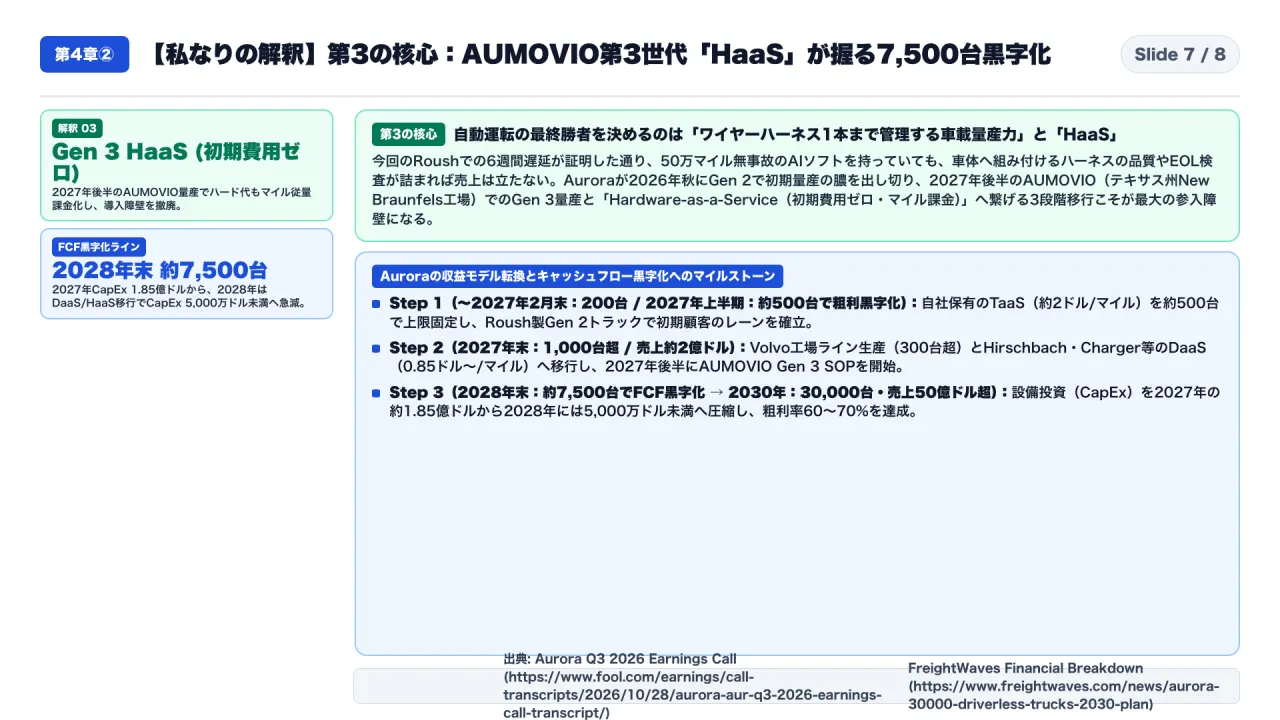
4-2. Three Practical Blind Spots Every Fleet Must Audit
- 1. The 500-Mile Length-of-Haul Threshold (Werner CIO Insight): As Werner Enterprises CIO Darrell Williams notes, the 20–22 hour/day utilization advantage only materializes on long-haul corridors exceeding 500 miles (where solo humans hit the 11-hour HOS wall) or 24/7 closed-loop shuttle routes (like Detmar’s frac sand hauls). Short regional routes with single daily shifts do not amortize fixed autonomous hardware costs.
- 2. Warehouse Detention (1 Hour 49 Minutes Average = $5,392/Year Loss): Per ATRI data, drivers lose an average of 1 hour and 49 minutes per stop waiting at loading docks ($5,392 in lost annual revenue per truck). Autonomous highway speed is wasted if yard turnarounds and drop-and-hook workflows are not automated.
- 3. Autonomous Liability Insurance (Lloyd’s of London / Apollo): According to Apollo’s Smart Follow syndicate at Lloyd’s (Chris Manoilov), a lack of legal precedent over product-liability allocation between carriers, AV developers, and OEMs causes initial autonomous insurance premiums to remain flat or slightly elevated compared to human trucks ($0.102/mile), before projected declines of 15%–25% per year as million-mile safety telemetry accumulates.
5. Actionable Engineering & Executive Playbook
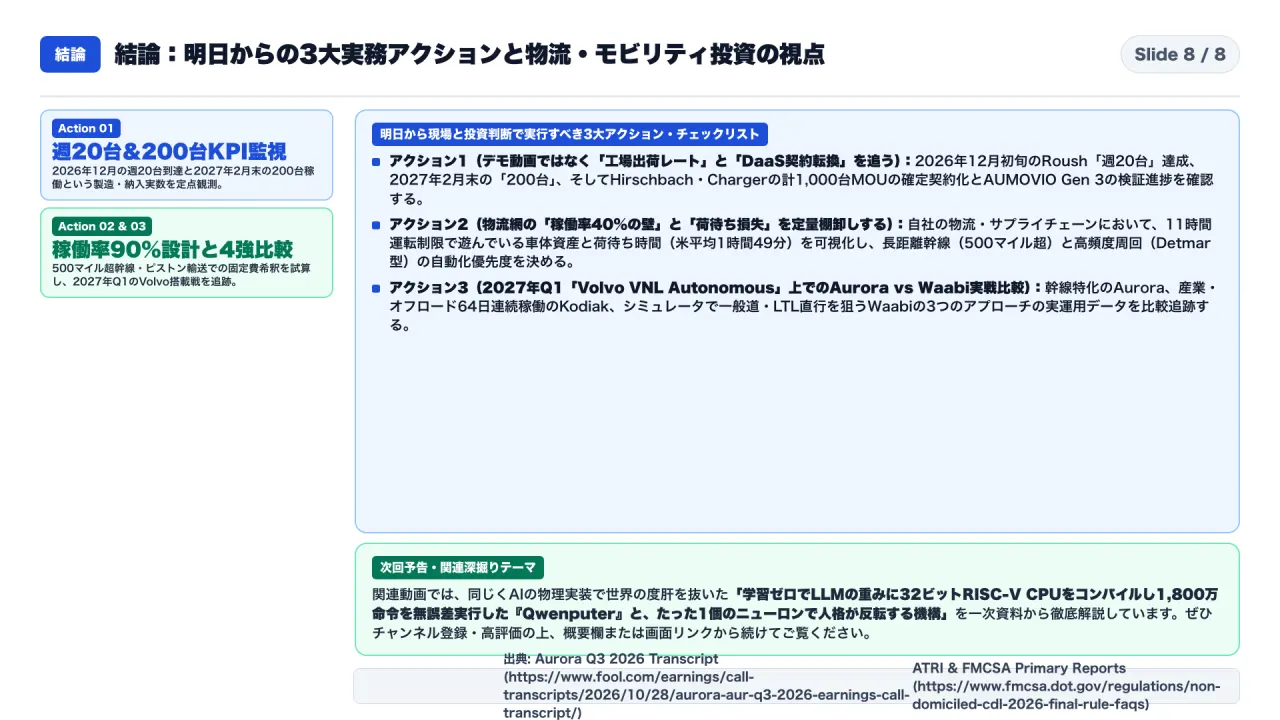
- 1. Segment Your Freight Network by the “500-Mile HOS Wall” and Dock Detention Time:
- Prioritize autonomous DaaS capacity for lanes >500 miles or 24/7 high-frequency shuttles, and eliminate the 1h49m dock detention bottleneck via automated drop-and-hook yards before onboarding driverless tractors.
- 2. Track Manufacturing Throughput Milestones—Not Demo Videos:
- Evaluate autonomous trucking vendors on hard industrial execution: (a) Dec 2026: Roush hitting 20 trucks/week, (b) Q1 2027: Volvo New River Valley line-side integration (300+ Aurora units alongside Waabi), and (c) 2H 2027: AUMOVIO Gen 3 HaaS ramp.
- 3. Lock In Multi-Year Autonomous Carrier Capacity Before the 2027 CDL Renewal Cliff:
- As the 194,000 EAD-based non-domiciled CDLs expire without renewal under 91 FR 7044, spot rates in refrigerated and cross-border freight will tighten sharply across 2027–2028. Shippers should partner early with carriers holding reserved autonomous build slots (Hirschbach, Charger, Werner, McLane, DTL, Ryder).
Primary Sources & References
- Aurora (AUR) Q3 2026 Earnings Call Transcript (The Motley Fool, Oct 28, 2026)
- Aurora Innovation Investor Day Press Release: 2030 Vision to Scale to 30,000+ Driverless Trucks (Oct 29, 2026)
- FreightWaves: Aurora outlines plan to deploy 30,000+ driverless trucks by 2030 (Oct 29, 2026)
- FMCSA Official FAQ: 2026 Non-Domiciled CDL Final Rule (91 FR 7044, effective March 16, 2026)
- Marquee Insurance Group: FMCSA Non-Domiciled CDL Final Rule 2026 Analysis
- Marquee Insurance Group / ATRI 2026 Operational Costs of Trucking ($2.336/mile)
- ACT News: Aurora’s Next-Gen Hardware & Fleet Integration Business Case
- FleetOwner: Aurora Expands Autonomous Truck Frac Sand Hauls in Permian Basin
- Kodiak AI: Industry Record 64 Consecutive Days of Non-Stop Operation (Oct 14, 2026)
- The AI Insider: Kodiak AI & DTL Transport Sign Deal for 75 Driverless Trucks (Oct 29, 2026)
- FreightWaves: Waabi, Volvo and Warp Launch Autonomous LTL Customer Operations (Oct 1, 2026)
- The Robot Report: Waabi Raises $1B to Advance Autonomous Trucks and Robotaxis
- PlusAI: SuperDrive Named to Fast Company’s World Changing Ideas 2026