Why Server Suspension and Password Changes Fail to Contain Breaches: Inside the GMO Desktop Cloud Incident and the Risk to 26,739 Virtual Private Servers
A comprehensive technical and governance investigation into the unauthorized intrusion affecting up to 26,739 virtual private servers at GMO Internet Group’s Onamae.com Desktop Cloud, revealing how default drive redirection, shared administrative architecture, and session persistence turn cloud compromises into endpoint disasters.
Published: October 30, 2026 (Updated: November 3, 2026) | Read time: ~12 min | Watch Video on YouTube
Executive Summary: The Illusion of Containment Post-Incident
When an enterprise hosting provider detects an active intrusion across its virtualized infrastructure, the standard incident response reflex is immediate and predictable: pull the network plug, suspend customer servers, and instruct users to rotate their credentials.
Yet in late October 2026, the unauthorized intrusion into GMO Internet Group, Inc.’s (TSE Prime: 9449) “Onamae.com Desktop Cloud” demonstrated why this conventional playbook catastrophically collapses in complex hosting environments. Even after engineering teams systematically suspended virtual machines across all service tiers, subscribers continued to report unauthorized trading activity and fraudulent asset liquidations in external brokerage accounts. Concurrently, corporate forensic response units were dispatched across Japan to physically collect and inspect end-user laptop and desktop computers.
Key Incident Metrics and Operational Timelines (as of November 3, 2026):
1. Potential Blast Radius:     Up to 26,739 Virtual Private Servers (VPS) across all plans.
2. Initial Infiltration:       August 5, 2026 (adversary infiltrated customer VPS and harvested admin credentials).
3. Management Lateral Move:    August 17, 2026 (adversary accessed central infrastructure management servers).
4. Automated Distribution:     September 20 to October 14, 2026 (malware deployed to customer VPS units).
5. Internal Discovery:         October 20, 2026 (investigation initiated following customer support inquiries).
6. Infrastructure Suspension:  October 21, 2026 at 04:00 JST (progressive shutdown across all customer plans).
7. Cyber Extortion Demands:    50,000,000 USD (~8.0 billion JPY) ransom demand rejected in full by corporate leadership.
8. Continuing External Fraud:  Unauthorized orders executed across 70+ domestic and global financial brokerages.
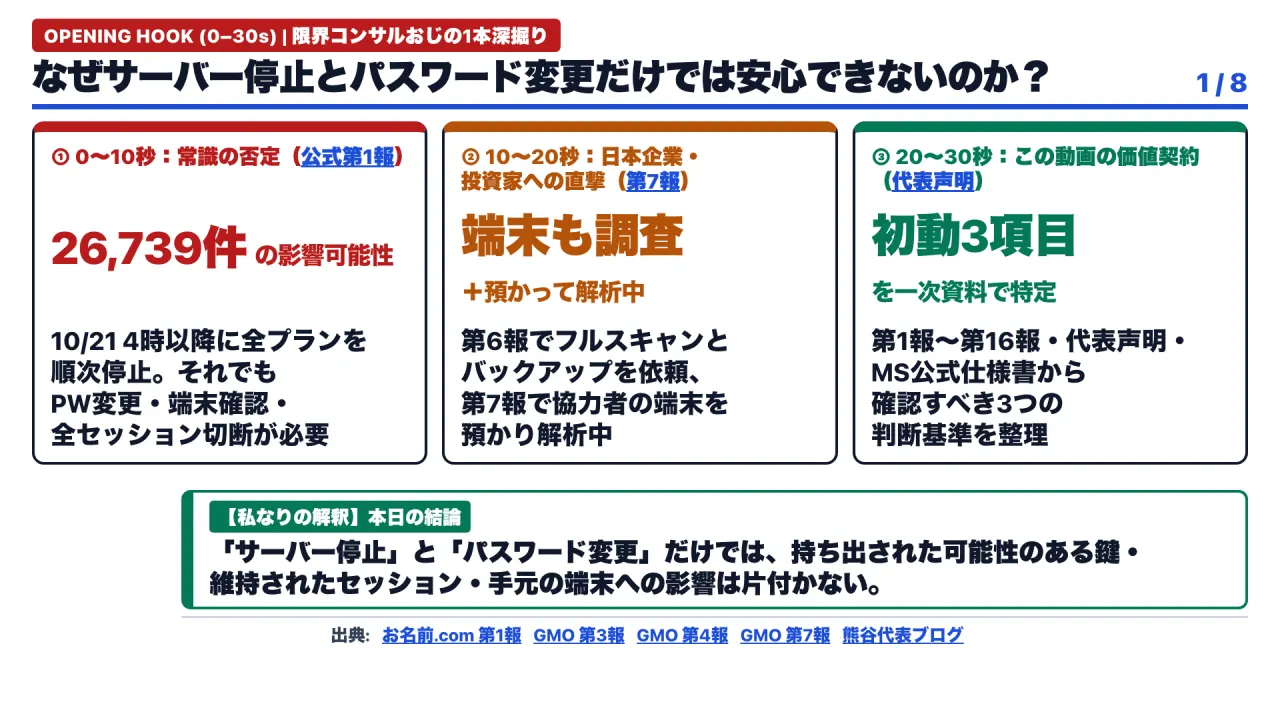
This investigation deconstructs why suspending virtual private servers and resetting passwords proved insufficient to arrest the blast radius of the breach. Synthesizing seven official corporate incident reports (Bulletins 1 through 7), the corporate briefing held on November 2, 2026, executive disclosures by Group CEO Masatoshi Kumagai, official service setup documentation, and Microsoft technical architecture specifications, this study isolates the critical design failures that exposed thousands of financial trading systems and end-user endpoints.
Methodological Framework: Distinguishing Corporate Disclosures, System Configurations, and Technical Inferences
Investigating an active enterprise cybersecurity incident requires strict separation between verified corporate admissions, documented system specifications, and forensic engineering deductions:
- Verified Corporate Admissions: Facts formally disclosed in GMO Internet Group incident bulletins (Reports 1 through 7), official TSE filings, and the formal executive technical presentation delivered on November 2, 2026.
- Documented Configuration Baselines: Technical properties explicitly published in the official Onamae.com Desktop Cloud User Guide and authoritative Microsoft Remote Desktop Protocol (RDP) specifications.
- Authorial Technical Deductions: Forensic deductions formulated by reconciling network management identifiers, Windows Active Directory protocols, credential theft methodologies, and reverse tunneling vulnerabilities.
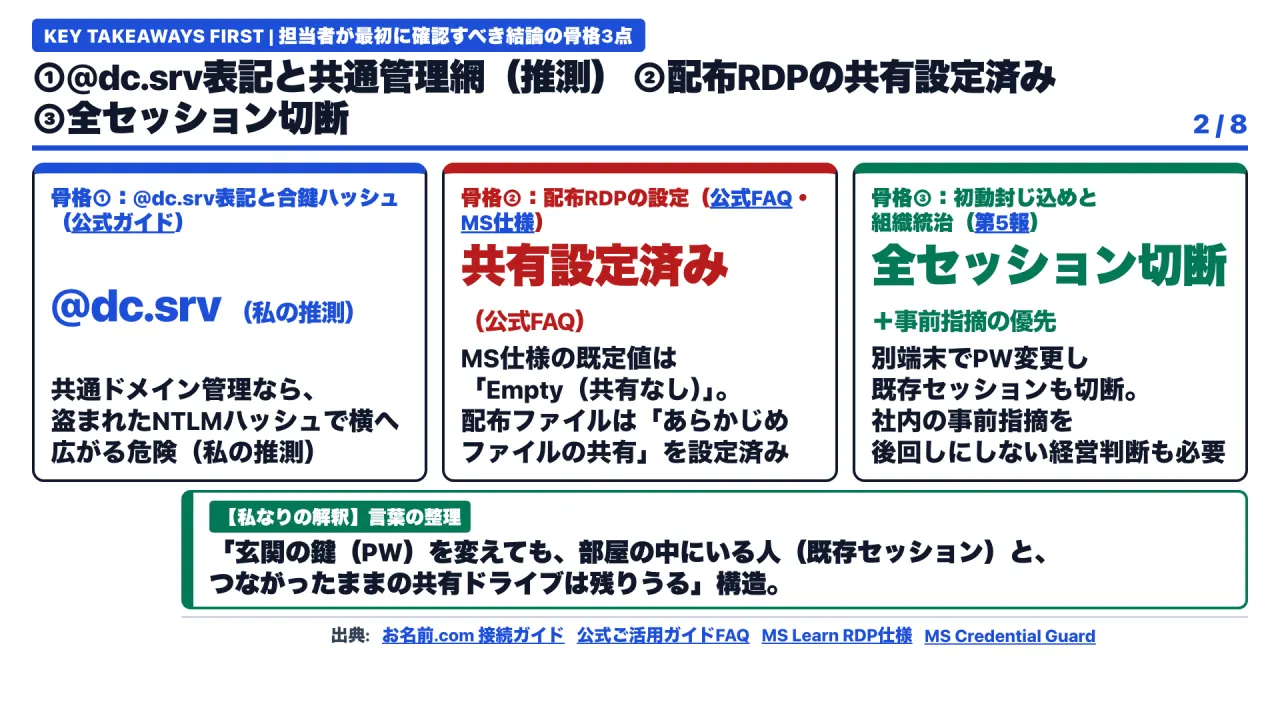
To evaluate post-breach operational security, this analysis establishes three primary verification pillars:
- Administrative Directory Segregation: Determining whether disparate customer environments and underlying hypervisor management nodes share a unified Active Directory forest or credential boundary.
- Endpoint Virtual Channel Redirection: Auditing distributed Remote Desktop Protocol (
.rdp) configuration profiles to verify whether local client storage volumes and peripherals are automatically mapped into the remote server. - Session Revocation Mechanics: Ensuring that credential rotations are executed from isolated, verified devices and accompanied by universal invalidation of active session tokens across downstream third-party services.
Section 1: The @dc.srv Suffix, Flat Active Directory Forests, and Pass-the-Hash Lateral Movement
The first foundational inquiry centers on scale: why did GMO’s official incident reports state that up to 26,739 virtual private servers were potentially impacted, rather than isolating the compromise to a handful of targeted customer instances?
Official Bulletin Report 3 clarified that this 26,739 figure represented the total universe of potentially exposed VPS instances across all customer tiers, rather than the confirmed count of compromised servers. In standard multi-tenant public cloud and VPS hosting architectures, hypervisor isolation boundaries and virtual private networks (VPCs) are engineered to guarantee strict tenant separation. If an individual customer’s virtual machine is infected with malware, hypervisor boundaries prevent the adversary from traversing into adjacent customer workloads or into the provider’s underlying management plane.
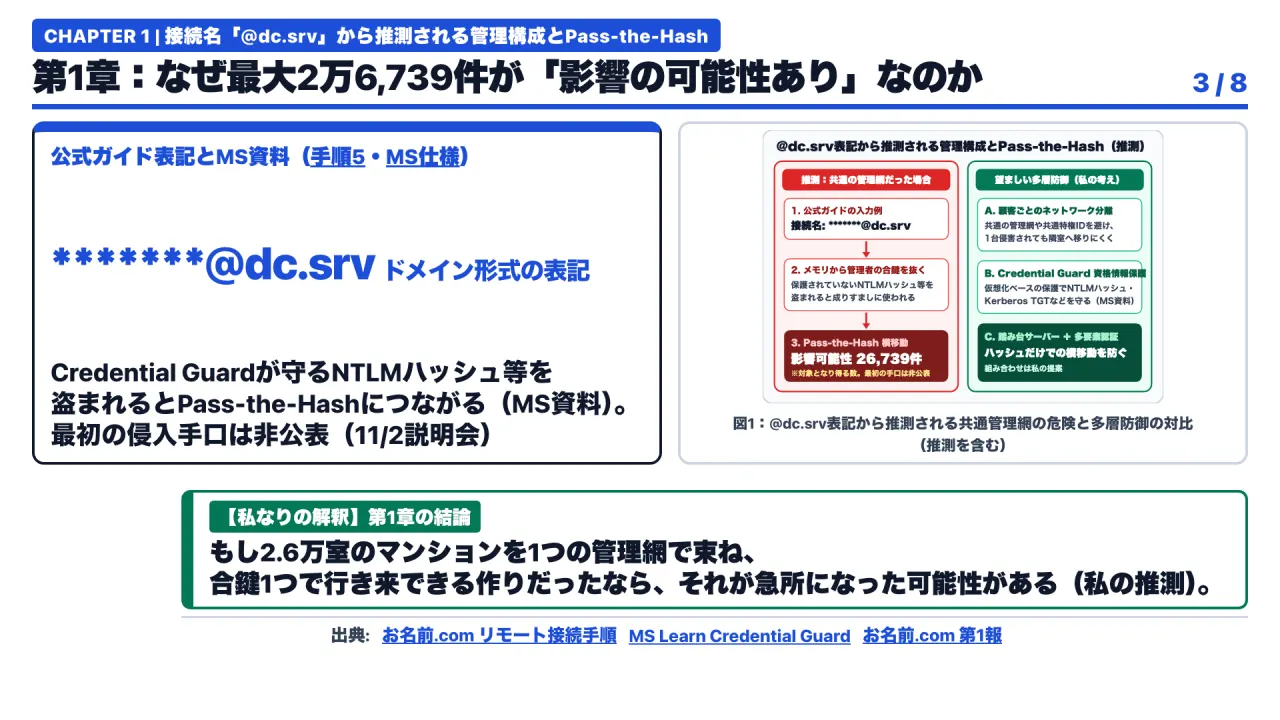
While official bulletins acknowledged that “security issues were present in the service system,” corporate disclosures did not initially publish the underlying directory topology. However, the official Onamae.com Desktop Cloud User Guide provided definitive technical evidence regarding user identity provisioning:
In the official manual explaining how to establish a Remote Desktop connection from Windows clients, Step 5 instructed users to enter a server name containing the identifier dc, while the user account input template was explicitly formatted as *******@dc.srv. Step 4 also instructed users to route their connections through a central Remote Desktop Gateway (RD Gateway) server.
In Windows server administration, the suffix @dc.srv adheres to the standardized User Principal Name (UPN) syntax used within Microsoft Active Directory domain environments. This structural artifact indicates that customer VPS instances were joined to, or governed by, an internal Active Directory domain designated as dc.srv.
Hypothesized Lateral Movement Path in Shared Active Directory Topologies:
[Compromised Customer VPS]
         │
         ▼  (Adversary achieves local administrator privileges)
[Management Account Logs In]
         │
         ▼  (Adversary extracts NTLM hash / Kerberos TGT from memory via LSASS)
[Pass-the-Hash / Pass-the-Ticket Attack]
         │
         ▼  (Authentication without cleartext password)
[Central Management Server Infiltration]
         │
         ▼  (Adversary leverages management authority across the domain)
[Automated Malware Distribution to Up to 26,739 VPS Instances]
This structural clue explains the severe mechanics of a Pass-the-Hash (PtH) attack. In Microsoft’s official security architecture publication, Credential Guard Overview, the operating system vendor explains that Credential Guard isolates secret keys, NTLM password hashes, and Kerberos Ticket Granting Tickets (TGT) inside an isolated, virtualization-based security (VBS) container. If this protection is omitted, an adversary who gains administrative control over a single domain-joined host can extract password hashes and authentication tickets directly from the Local Security Authority Subsystem Service (LSASS) memory.
Because NTLM protocols authenticate identity using the hash itself rather than the original cleartext password, the adversary can reuse the stolen hash to authenticate as the privileged user against any other host or management server within the same domain.
During the corporate briefing on November 2, 2026, GMO executive leadership confirmed the precise chronological progression of the intrusion:
- On August 5, 2026, the attacker compromised an individual customer VPS instance and successfully harvested administrative credentials.
- On August 17, 2026, the attacker leveraged those elevated credentials to infiltrate GMO’s central internal infrastructure management servers.
- Between September 20 and October 14, 2026, the attacker utilized the compromised management servers to distribute malicious payloads across the customer VPS fleet, potentially reaching up to 26,739 machines.
- GMO only discovered this widespread malware distribution on October 20, 2026, after initiating forensic inquiries in response to anomalous customer complaints.
This sequence demonstrates that when thousands of disparate customer systems are managed within a shared administrative boundary, the compromise of a single endpoint can collapse the perimeter of the entire hosting infrastructure.
Section 2: Default File Sharing in Distributed RDP Files and Reverse RDP Exposure
The most unprecedented dimension of the Onamae.com incident was that GMO’s forensic investigation extended beyond the hosted virtual servers to encompass the personal desktop and laptop computers of its subscribers. Bulletins 3 and 5 explicitly stated that the company was investigating potential impacts on customer client devices.
Why would connecting to a cloud-based VPS endanger the local physical machine sitting on a customer’s desk? The operational answer lies in default configuration choices made in the name of user onboarding convenience.
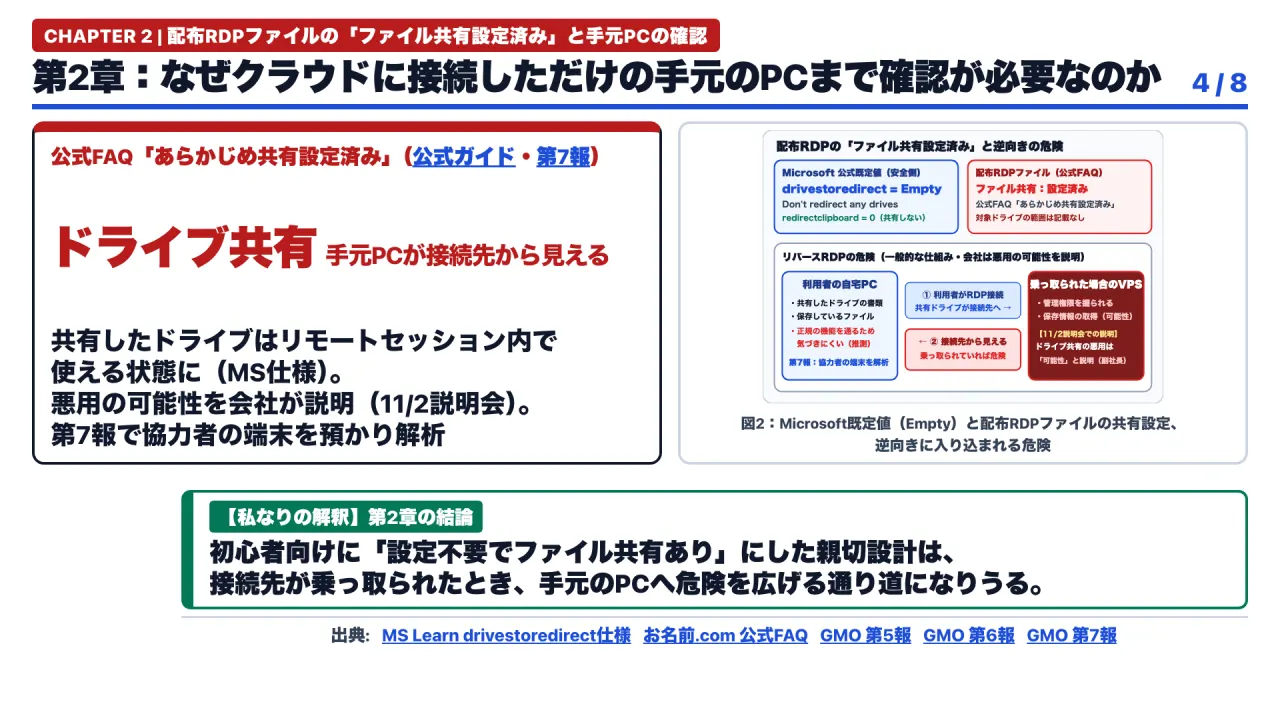
According to Microsoft’s official technical specification, Supported RDP Properties in Azure Virtual Desktop, the standard Remote Desktop configuration parameter drivestoredirect:s: governs whether local logical hard drives, USB mass storage devices, and network shares on the client computer are redirected and mounted inside the remote desktop session. Microsoft’s default baseline value for this property is Empty (no drives redirected). Similarly, clipboard synchronization (redirectclipboard:i:) defaults to disabled (0).
In stark contrast, the official FAQ within the Onamae.com Desktop Cloud User Guide contained the following explicit declaration regarding file exchange between client and server:
“Please note: For connections established using the RDP file downloaded directly from the control panel, file sharing has been pre-configured in advance; therefore, customers are not required to configure the aforementioned settings manually.”
Adjacent sections of the official guide confirmed that redirection for USB printers was also enabled by default. To make it effortless for retail forex traders to transfer custom Expert Advisor (EA) algorithms and trading scripts into MetaTrader 4 (MT4) or MetaTrader 5 (MT5), the hosting provider distributed pre-packaged .rdp files with local filesystem mounting fully activated.
Under Microsoft Remote Desktop Protocol specifications, redirected drives are mounted as network filesystem shares accessible within the remote Windows environment (e.g., \\tsclient\c). If an adversary holds administrative control over the remote server, any local drive shared by a connecting user becomes fully readable and writable from the perspective of the compromised server during the entire duration of the active session.
| Configuration Parameter | Microsoft Specification Baseline | Onamae.com Control Panel Distribution | Operational Security Consequence |
|---|---|---|---|
drivestoredirect:s: |
Empty (No drives redirected) | Pre-configured / All local drives mapped | Remote server holds read/write visibility into client local drives. |
redirectclipboard:i: |
0 (Clipboard disabled) | Enabled | Bidirectional clipboard inspection and data exfiltration. |
| Redirection Architecture | Virtual Channel Isolation | Standard Native Virtual Channels | Operations execute via standard OS APIs, bypassing legacy client antivirus. |
| Privilege Context | Least Privilege User | Shared Administrator Privileges | Adversary on host traverses directly into mounted client storage. |
This vulnerability represents the classic Reverse RDP threat model. Because the adversary reads and writes files across legitimate, authorized Windows operating system virtual channels (tsclient), standard client-side antivirus software frequently fails to flag the activity as anomalous.
The real-world severity of this vector became apparent in late October 2026:
- On October 24 and October 26, 2026 (Reports 5 and 6), GMO urgently implored customers to execute thorough full-system antivirus scans, disconnect machines from the network, back up data exclusively to offline external drives, perform credential changes strictly from alternate clean devices, and disable browser synchronization.
- On the evening of October 26, 2026 (Report 7), GMO revealed that the extortionist had threatened to publicly release customer data and deploy ransomware against subscriber endpoints on October 27 at 12:00 JST.
- In response, GMO mobilized corporate employees nationwide to physically collect personal computers from cooperative subscribers, handing them over to internal white-hat teams to analyze whether malware or ransomware had been planted on client disks.
- During the November 2, 2026 briefing, executive leadership acknowledged that attackers had exfiltrated data from customer VPS instances and personal computers on October 27, confirming that the pre-configured drive redirection feature was the probable pathway for client data theft.
Section 3: Why Unauthorized Trading Continued Post-Shutdown: Session Persistence, Refusal of the $50 Million Ransom, and Restitution Framework
To grasp the full impact of the incident, one must examine the timeline of events that occurred after the infrastructure was suspended on October 21, 2026.
GMO detected the malicious intrusion on October 20, 2026, and initiated a sequential, mandatory shutdown of all customer VPS servers beginning at 04:00 JST on October 21. Yet following this shutdown, retail investors flooded customer support channels reporting unauthorized buy and sell transactions, margin liquidations, and drained account balances across third-party financial institutions.
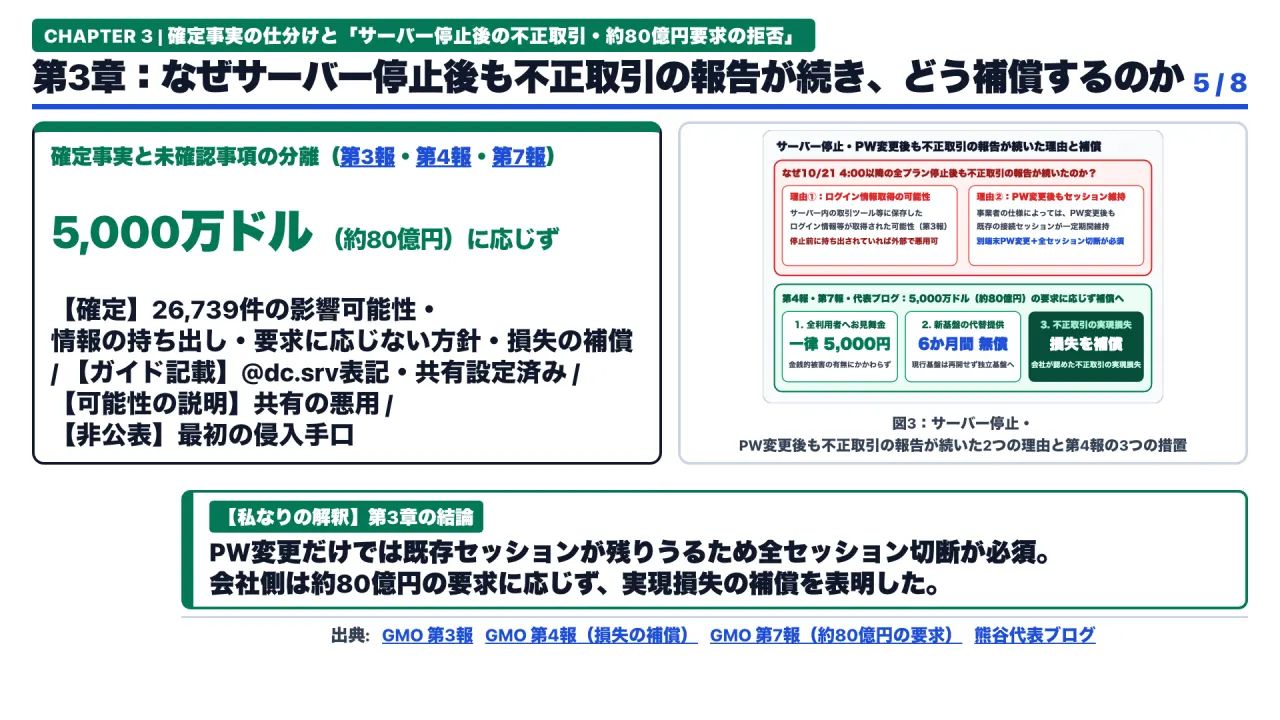
Two technical mechanisms explain how unauthorized financial trading persisted after the source virtual machines were terminated:
- Pre-Shutdown Credential Exfiltration: Trading credentials, API secret keys, and broker connection profiles stored inside automated trading platforms (MT4, MT5) had already been exfiltrated prior to October 21. Once in possession of these credentials, the adversary did not require GMO’s infrastructure; they authenticated directly into brokerage platforms from independent attack nodes located across global infrastructure.
- Session Persistence and Incomplete Revocation: As GMO warned in Bulletins 3 and 5, numerous financial brokerage servers maintain established HTTP, WebSocket, or FIX trading sessions for extended duration windows even after an account password is changed. Unless an active administrative command explicitly invalidates all existing authentication tokens and severs current sessions, an adversary already inside an active session can continue executing trades.
The Session Invalidation Dilemma:
[Subscriber Rotates Password]  ──>  Updates Authentication Secret in Broker DB
                                           │
                                           ▼ (Tokens Remain Active)
[Adversary in Active Session]  ──>  Continues Executing Unauthorized Orders
                                           │
                                           ▼
[Required Defensive Action]    ──>  Explicit "Terminate All Active Sessions" / Revoke Tokens
The underlying motive behind these unauthorized trades was extortion. In Report 4, GMO noted that the extortionist warned that refusal to satisfy demands would trigger “continued impairment of account balances through unauthorized orders.” Destroying account capital served as leverage to coerce corporate leadership into paying ransom.
On October 21, 2026, GMO received an extortion email demanding a ransom of 50 million USD (approximately 8.0 billion JPY). Group CEO Masatoshi Kumagai publicly confirmed this figure on his personal blog, reiterating that the organization refused all extortion demands and made zero ransom payments.
Instead of submitting to extortion, GMO established a comprehensive three-tier customer restitution policy:
- Universal Apology Solatium: A direct payment of 5,000 JPY to all active subscribers registered as of October 23, 2026, irrespective of whether their individual servers or accounts sustained documented financial harm.
- Platform Rebuilding and Free Migration: Total retirement of the compromised infrastructure, replaced by a newly engineered, fully isolated cloud platform offering six months of complimentary service for migrating users.
- Full Restitution of Realized Trading Losses: Complete corporate reimbursement for net realized capital losses and transaction fees resulting directly from unauthorized trading attributable to the breach, including instances where external brokerages and exchanges refused customer refund requests.
Section 4: Organizational Blind Spots: 200 Security Specialists, Prior White-Hat Warnings, and the Availability Dilemma
The Onamae.com incident exposed a profound governance paradox within Japanese enterprise cybersecurity: how did an intrusion of this magnitude compromise an organization that maintains one of the largest specialized cybersecurity talent pools in Asia?
GMO Internet Group encompasses elite cybersecurity subsidiaries, including GMO Cybersecurity by Ierae and GMO Flatt Security. As CEO Kumagai detailed on his corporate blog, the parent company maintains an internal cadre of over 200 dedicated security personnel, including veteran specialists formerly affiliated with the International Criminal Police Organization (Interpol).
Compounding this paradox, just days prior on October 14, 2026, another subsidiary, GMO Research & AI, had issued its second official bulletin regarding a separate intrusion into its “infoQ” survey platform. In that breach, an exploited software vulnerability resulted in the exfiltration of 894,082 personal records and 611 incidents of unauthorized rewards point redemptions totaling 2,869,500 JPY.
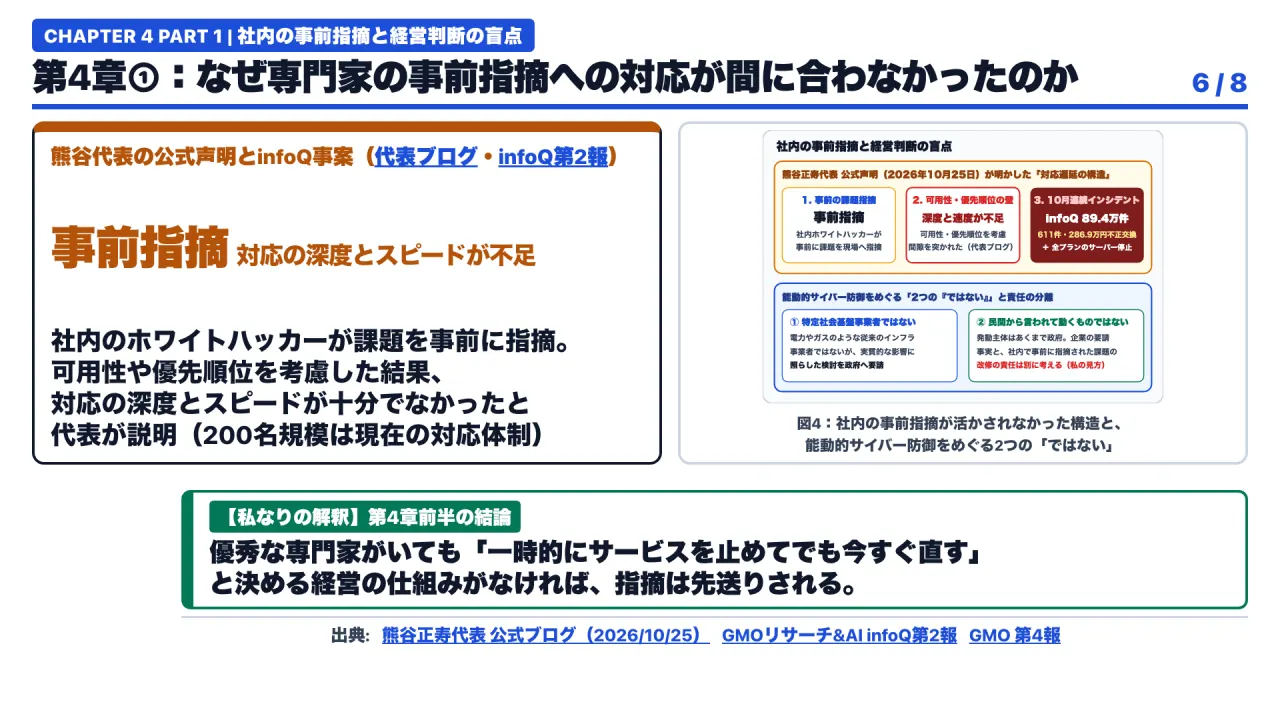
On October 25, 2026, CEO Masatoshi Kumagai published a remarkable admission addressing why his organization’s defensive expertise had failed to avert the disaster:
“Speaking not as an excuse, but strictly as a matter of fact: regarding the security of this service, our internal white-hat hackers had previously identified issues requiring remediation and had warned frontline engineering teams in advance.
The operational teams received these warnings and were progressing with countermeasures. However, as a consequence of proceeding cautiously while balancing the potential impact on service availability against competing operational priorities, the depth and speed of the response were insufficient, allowing the attacker to exploit that very gap.“
This confession articulates the classic enterprise availability dilemma. Elite technical analysts had identified the structural weaknesses prior to the attack. However, frontline operations prioritized service uptime and customer convenience over immediate remediation. Without a corporate governance policy mandating that critical security vulnerabilities trigger immediate maintenance downtime, executive risk management broke down.
In subsequent disclosures, GMO framed this event as a critical test case for Japan’s newly enacted Active Cyber Defense framework, which had become law on October 1, 2026. Kumagai publicly requested emergency governmental intervention, noting that defensive researchers at subsidiary Ierae had identified threat actors using autonomous AI penetration testing tools like “ARTEX” against roughly 20 Japanese corporations.
Simultaneously, Kumagai acknowledged two critical legal realities:
- GMO Internet Group is not classified as a “Specified Critical Infrastructure Operator” under the statutory definitions governing power, water, and telecommunications utilities.
- Active cyber defense powers are strictly state-directed prerogatives executed by government authorities, not commercial remedies initiated at the behest of private enterprise.
Nevertheless, corporate leadership argued that when cyberattacks compromise connectivity to over 70 financial institutions and take the private files of retail investors hostage, national security frameworks must evolve to encompass commercial hosting backbones.
Section 5: The Operational Paradigm: Default Convenience vs. Security Blast Radius
To translate these complex architectural dynamics into actionable operational intuition, consider an analogy drawn from everyday consumer hardware:
Suppose an individual operates a desktop workstation in a home office and a portable laptop in the living room. Finding it cumbersome to transfer files via USB thumb drives, the individual establishes a permanent Remote Desktop profile with full drive redirection enabled, permitting seamless bidirectional file access under a shared administrator password. Under normal conditions, this configuration delivers flawless convenience.
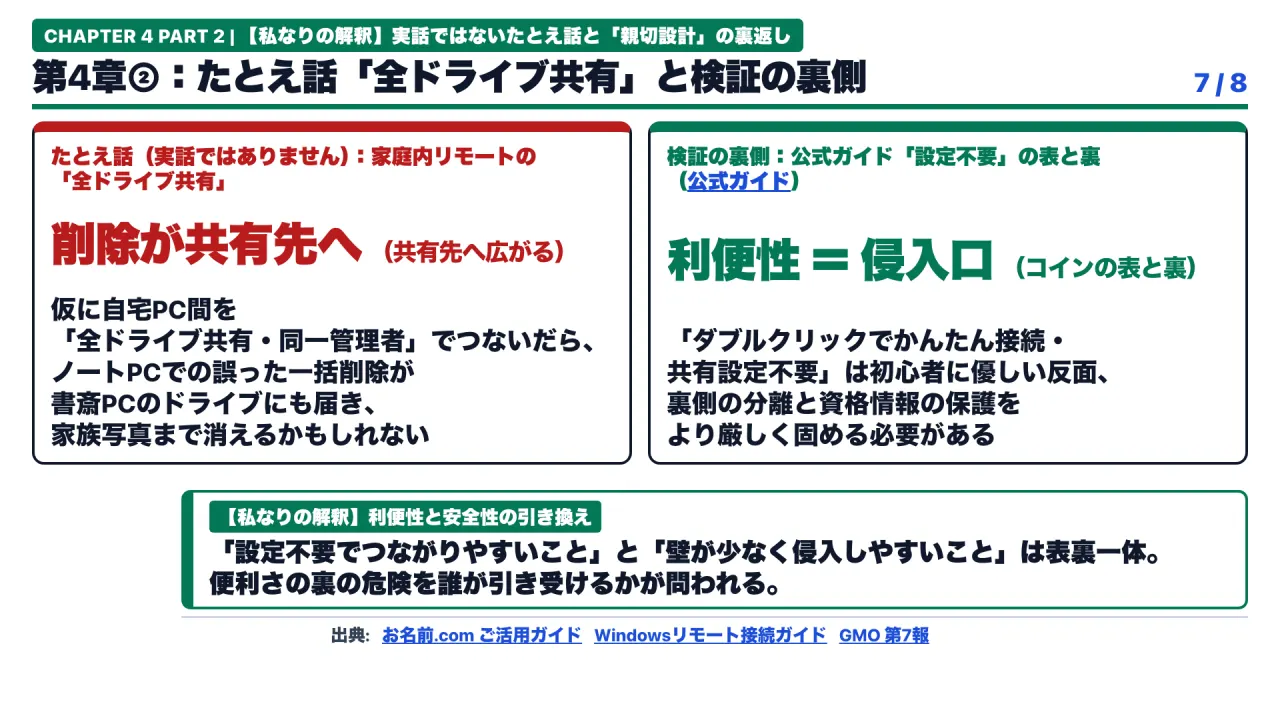
However, suppose that while operating the laptop, the user accidentally executes an automated cleanup script containing a path error. Because unrestricted drive redirection remains persistently mounted across the network, the destructive command traverses the virtual channel and deletes personal photo archives stored on the office desktop.
This analogy illustrates the fundamental hazard of pre-configured convenience. “Turnkey” features that eliminate user configuration during onboarding simultaneously establish unmonitored bridges that adversaries can exploit when an incident occurs.
The Convenience-Security Paradox:
[User Onboarding Optimization]  ──>  Pre-Enable Drive Redirection & Shared Admin Suffixes
                                             │
                                             ▼
[Friction Removed for Users]    ──>  Friction Removed for Threat Actors
                                             │
                                             ▼
[Resulting Incident Profile]    ──>  Single VPS Breach Becomes Enterprise Endpoint Crisis
In retail financial hosting, service providers compete vigorously on user experience. Customers seeking to operate automated trading algorithms are frequently retail investors rather than seasoned systems administrators. Designing an onboarding workflow where a customer simply double-clicks a pre-packaged .rdp file to begin trading creates immediate commercial value.
However, in professional cybersecurity architecture, making a system frictionless for beginners without reinforcing underlying isolation guarantees creates a dangerous illusion of safety. If a provider offers a zero-configuration product, the engineering organization must enforce hyper-strict isolation, virtualization-based credential protection, and virtual channel filtering behind the scenes.
Section 6: Actionable Conclusion: Three Non-Negotiable Operational Baseline Checks
The post-breach reality of the Onamae.com incident proves that stopping a virtual server and changing an account password cannot guarantee containment when architectural flaws remain unaddressed.
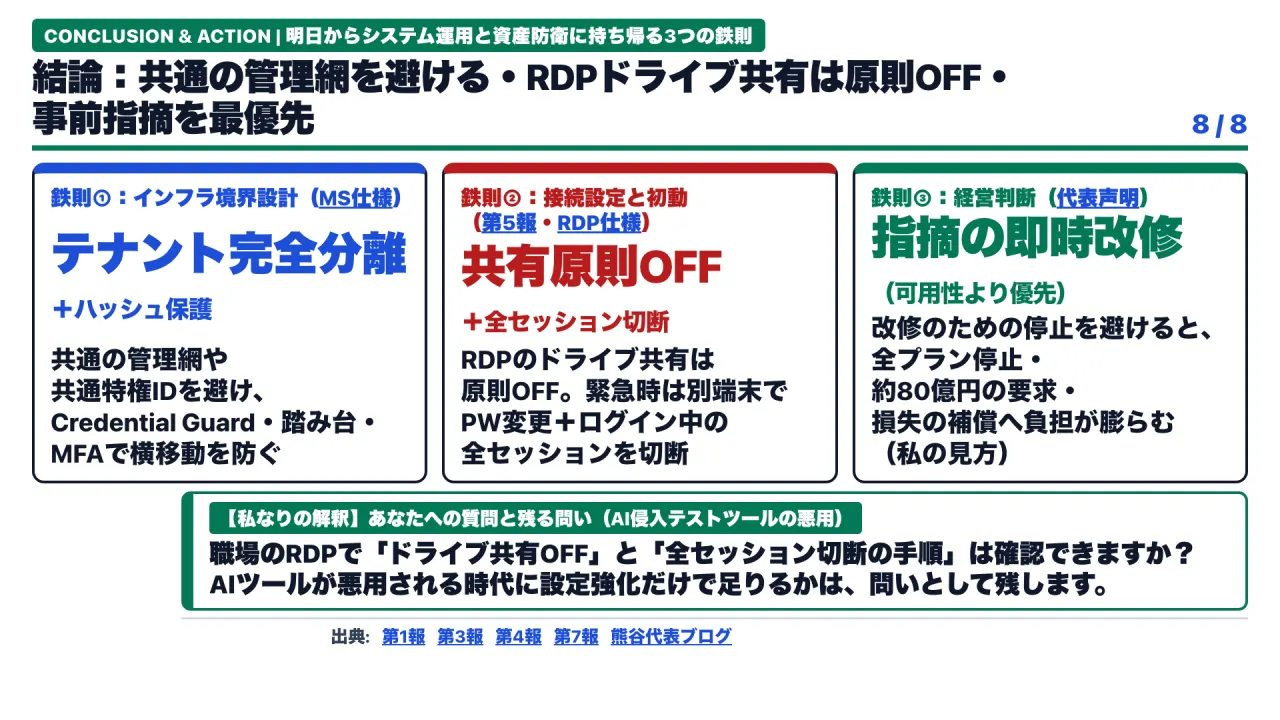
From this exhaustive analysis, enterprise infrastructure architects, security operations leads, and retail investors can extract three non-negotiable operational principles:
1. Eliminate Shared Privileged Domains Across Multi-Tenant Environments
Never permit disparate tenant workloads, customer virtual machines, or operational management servers to reside within a common Active Directory domain, forest, or flat administrative network.
- Deploy strict network micro-segmentation between tenant hypervisors.
- Mandate Microsoft Credential Guard across all virtualization hosts to mitigate Pass-the-Hash and Pass-the-Ticket credential harvesting from LSASS memory.
- Enforce hardened bastion jump hosts and multi-factor authentication (MFA) for every administrative session.
2. Disable Virtual Channel Redirection by Default and Mandate Universal Session Termination
In all Remote Desktop, Virtual Desktop Infrastructure (VDI), and cloud access profiles, enforce strict principle-of-least-privilege defaults:
- Explicitly disable client logical drive redirection (
drivestoredirect:s:) and clipboard sharing (redirectclipboard:i:0) unless explicitly justified and monitored. - In any suspected incident, mandate that password resets be performed exclusively from a physically separate, uncompromised device.
- Ensure incident response playbooks include immediate execution of universal session termination commands to invalidate active tokens across downstream APIs, brokerages, and partner services.
3. Establish Executive Governance Over Availability-Driven Security Deferrals
An organization can retain hundreds of world-class white-hat hackers, but those capabilities provide zero defensive protection if operational management can defer critical remediation in the name of service availability.
- Implement explicit governance policies where identified critical vulnerabilities automatically trigger mandatory remediation windows.
- Recognize that the operational inconvenience of a planned, temporary service maintenance window is negligible compared to the catastrophic liabilities of fleet-wide suspension, ransom extortion, and compensatory restitution.
Post-Breach Verification Checklist:
[ ] Multi-Tenant Isolation: Verified absence of shared domain controllers or administrative credentials.
[ ] RDP Configuration Audit: Confirmed drivestoredirect:s: is Empty and clipboard redirection is 0.
[ ] Incident Rotation Protocol: Password reset executed strictly from isolated secondary hardware.
[ ] Token Revocation: Confirmed downstream API and web session termination across all financial endpoints.
[ ] Governance Safeguard: Executive authorization mechanism established to prioritize security over uptime.
Editorial Epilogue: Revisions and Document History
This analytical study was initially compiled from official incident bulletins, technical specifications, and corporate blog posts through October 31, 2026. Following the public corporate briefing held by GMO Internet Group on November 2, 2026, this document was updated on November 3, 2026 to incorporate official admissions regarding the exact chronological progression of the intrusion (August 5 VPS compromise, August 17 management server infiltration, and September 20 to October 14 malware distribution), the confirmed exfiltration of customer data on October 27, and the operational acknowledgment of drive sharing as a probable vector for client endpoint compromise.
Prior to publication, all official alert portals, executive blog posts, and technical documentation were re-verified to confirm strict alignment with primary records.
Primary Sources and References
- GMO Research & AI Incident Notice - October 14, 2026
- GMO Internet Group Alert Notice - Report #1 (October 23, 2026)
- GMO Internet Group Alert Notice - Report #2 (October 24, 2026)
- GMO Internet Group Alert Notice - Report #3 (October 24, 2026)
- GMO Internet Group Alert Notice - Report #4 (October 26, 2026)
- GMO Internet Group Alert Notice - Report #5 (October 26, 2026)
- GMO Internet Group Alert Notice - Report #6 (October 27, 2026)
- GMO Internet Group Alert Notice - Report #7 (October 27, 2026)
- GMO Internet Group Alert Notice - Report #8 (October 27, 2026)
- GMO Internet Group Alert Notice - Report #9 (October 27, 2026)
- GMO Internet Group Alert Notice - Report #10 (October 27, 2026)
- GMO Internet Group Alert Notice - Report #11 (October 28, 2026)
- GMO Internet Group Alert Notice - Report #12 (October 28, 2026)
- GMO Internet Group Alert Notice - Report #13 (October 29, 2026)
- GMO Internet Group Alert Notice - Report #14 (October 29, 2026)
- Microsoft Learn: Supported RDP Properties in Azure Virtual Desktop
- Microsoft Learn: Windows Defender Credential Guard Overview
- Masatoshi Kumagai Official Blog: Incident Disclosure and Perspective (October 25, 2026)
- Onamae.com Desktop Cloud Official User Guide
- Onamae.com Desktop Cloud RDP Connection Guide
- Onamae.com Service Alert and Maintenance Archive
- GMO Internet Group Corporate Briefing Video Archive