Why Marvell Bid $85B for Lumentum Despite a 13% Stock Drop—and How Samsung's Record $80B Profit Masked a Mobile Loss ── Inside CPO "DSP Elimination," 5 InP Laser Fabs, and HBM4
YouTube (Japanese audio): https://youtu.be/LbtcjsgmEzk
Executive Summary & Key Takeaways
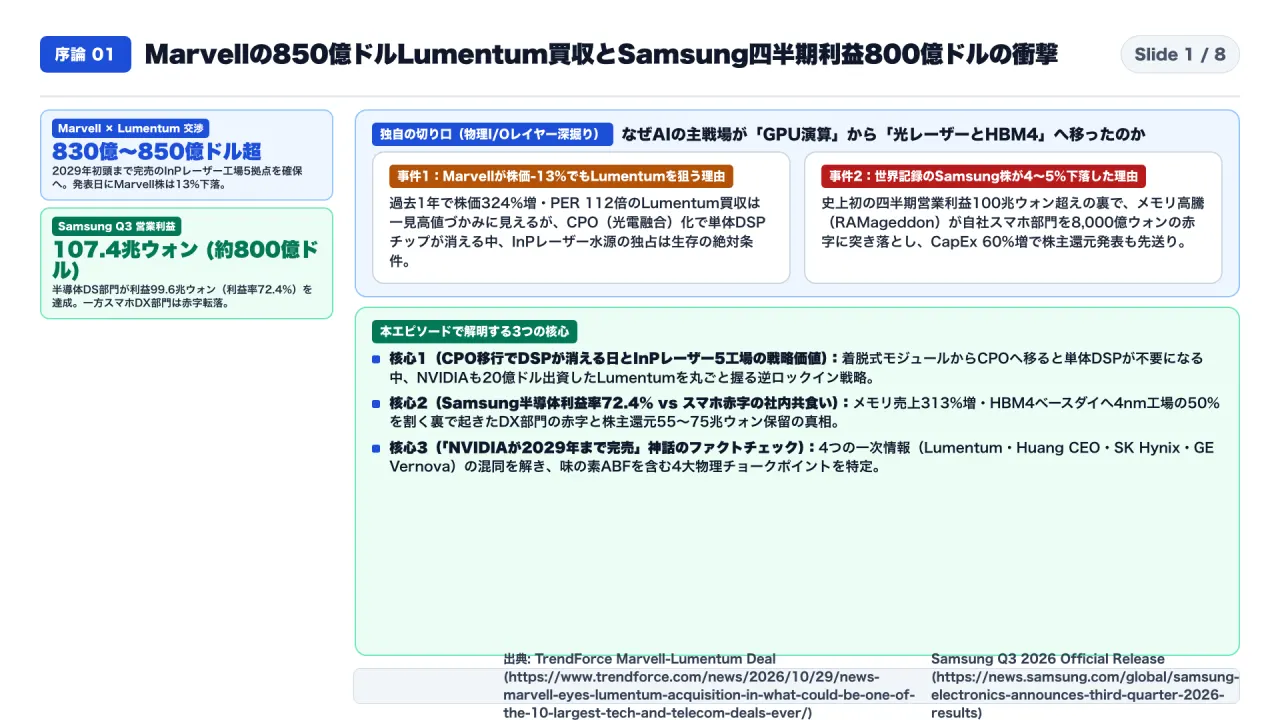
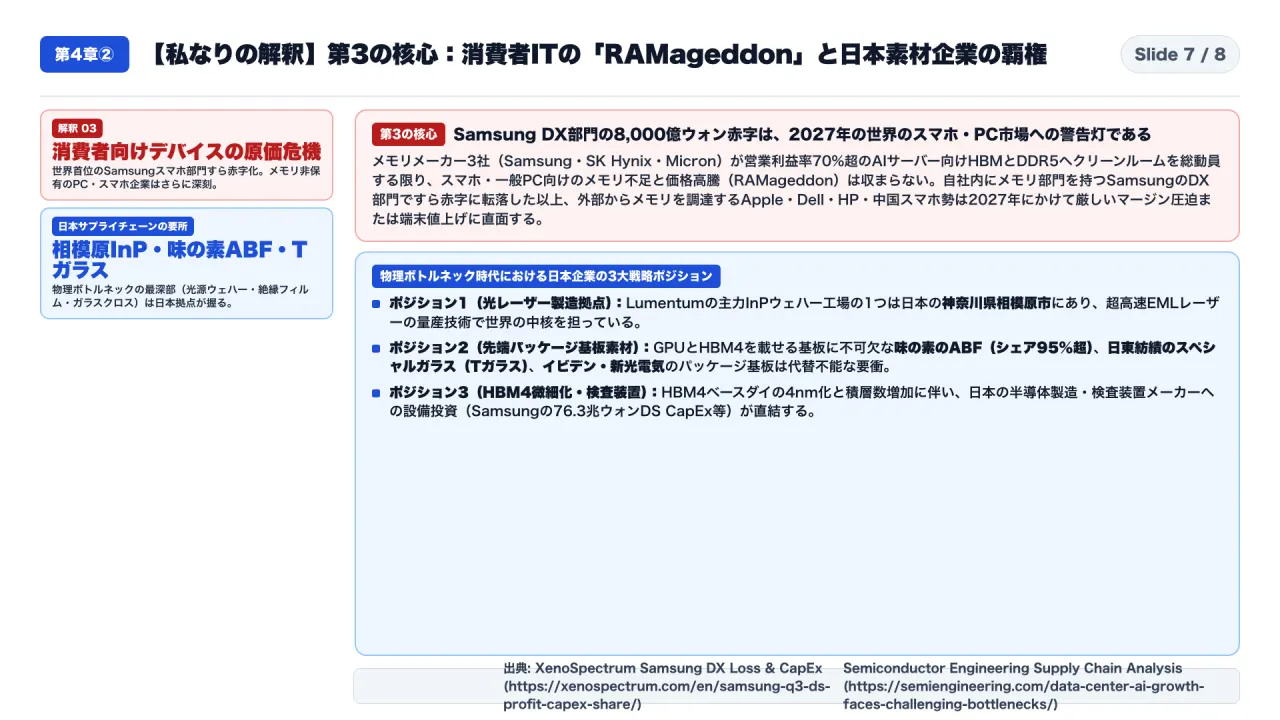
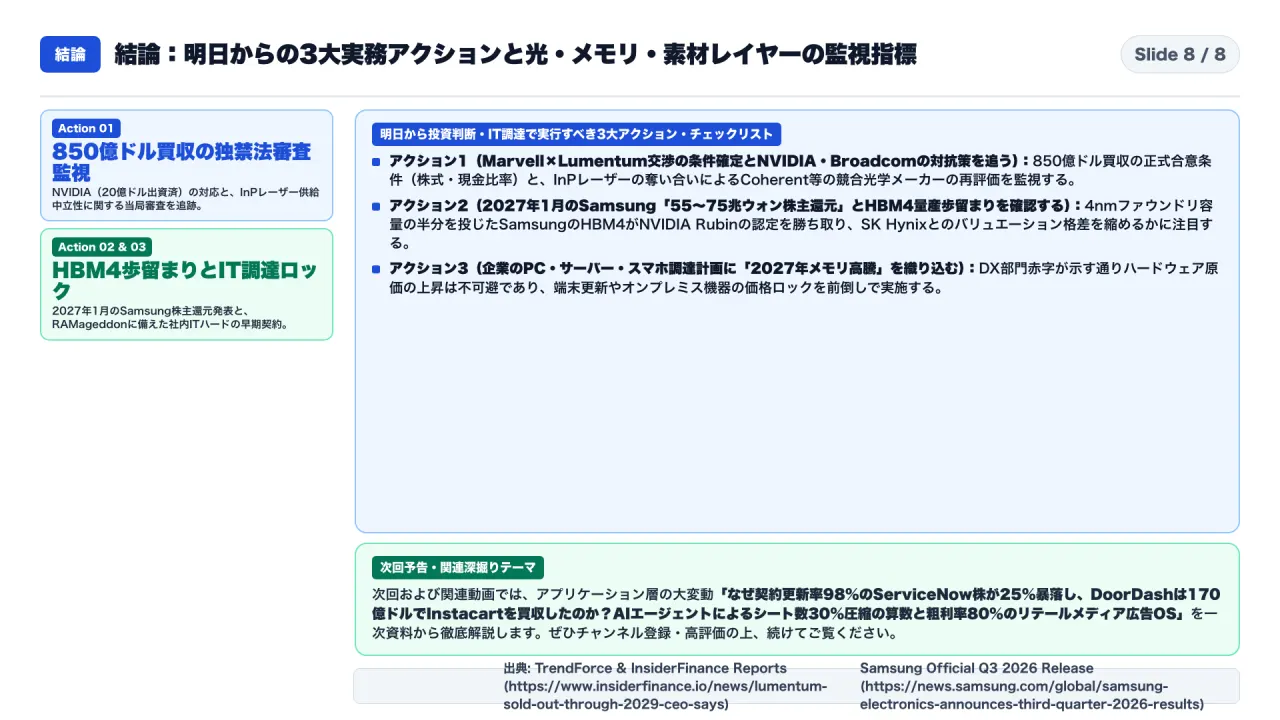
- Core Thesis: Between October 28 and October 29, 2026, two seismic events proved that the physical bottleneck of AI infrastructure has shifted from standalone GPU compute to optical interconnects (photonics) and next-generation memory (HBM4). First, custom ASIC and optical DSP leader Marvell Technology (NASDAQ: MRVL, ~$221B market cap) entered advanced negotiations to acquire optical laser powerhouse Lumentum Holdings (NASDAQ: LITE, ~$83B–$85B valuation). Marvell’s stock plunged 12%–13% on fears of massive equity dilution and gross-margin compression—while Lumentum jumped 10%–12% (completing a ~1,500% 18-month surge). Why is Marvell willing to risk near-term dilution? Because as AI clusters scale to 1.6T/3.2T and transition from pluggable transceivers to Co-Packaged Optics (CPO), standalone re-timing DSP chips inside pluggable modules are structurally eliminated—saving >20W per port and cutting optical link power by 50%–70%. By acquiring Lumentum’s five global Indium Phosphide (InP) wafer fabs (in Japan, the UK, and the US)—whose continuous-wave (CW) lasers are sold out through early 2029—Marvell locks up the irreplaceable physical light source of the CPO era and even reverse-locks NVIDIA, which had invested $2 billion in Lumentum in March 2026. Second, Samsung Electronics reported an all-time world-record quarterly operating profit of 107.4 trillion KRW (~$80 billion, +831% YoY) driven by a 72.4% operating margin in its Device Solutions (DS) semiconductor division—yet its stock fell 4.1%–5.3% because “RAMageddon” (DRAM prices +182% YoY, NAND +72% YoY) pushed Samsung’s own DX (Mobile/Appliances) division into an 800 billion KRW operating loss, while Samsung hiked 2026 CapEx by 60% to 84.4 trillion KRW (allocating 50% of its 4nm foundry capacity to HBM4 logic base dies) and withheld its 55T–75T KRW special shareholder return.
- Who Should Read This: Semiconductor, photonics, and AI hardware architects; data-center network engineers; supply-chain strategists; and institutional deep-tech investors.
- Key Architectural & Financial Takeaways:
- 1. Pluggable DSP vs. CPO External Laser Source (ELS): Why silicon cannot emit light efficiently, why CPO eliminates standalone DSPs, and why Lumentum’s 5 InP fabs (4-inch to 6-inch wafer transition) are the ultimate choke point of optical networking.
- 2. Samsung’s “RAMageddon” Cannibalization & HBM4 Turnaround: How shifting wafer capacity to HBM starved legacy DRAM, why Samsung’s integrated Memory + 4nm Logic Foundry model gives it a structural edge in HBM4/HBM4e custom logic base dies (already testing with NVIDIA, Google, AMD, Broadcom, and OpenAI), and why investors balked at the 84.4T KRW CapEx hike.
- 3. Fact-Checking the “NVIDIA Sold Out Until 2029” Myth: How a viral market rumor conflated four separate primary facts—Lumentum InP lasers (early 2029), SK Hynix HBM (2026 sold out), NVIDIA $1T order visibility through 2027, and GE Vernova gas turbines (sold out through 2029)—plus the hidden monopoly of Ajinomoto Build-up Film (ABF).
Background & Primary Sources Verified
This technical and financial teardown cross-verifies 13 primary sources published through October 29, 2026:
- 1. Marvell Technology $85B Acquisition Talks for Lumentum & CPO Physics: CopyPost / Bloomberg M&A Analysis / SemiAnalysis / Optical Interconnect & InP Fabs / Marvell Investor Relations / Lumentum Investor Relations
- 2. Samsung Electronics Q3 2026 Record 107.4T KRW Operating Profit, 72.4% DS Margin & DX Mobile Loss: Samsung Global IR Q3 2026 Results / Korea Economic Daily / KED Global / TrendForce DRAM & HBM4 Supply Chain Report
- 3. Supply-Chain Bottlenecks (GE Vernova Turbines & Ajinomoto ABF): GE Vernova Investor Relations / Ajinomoto Electronic Materials (ABF)
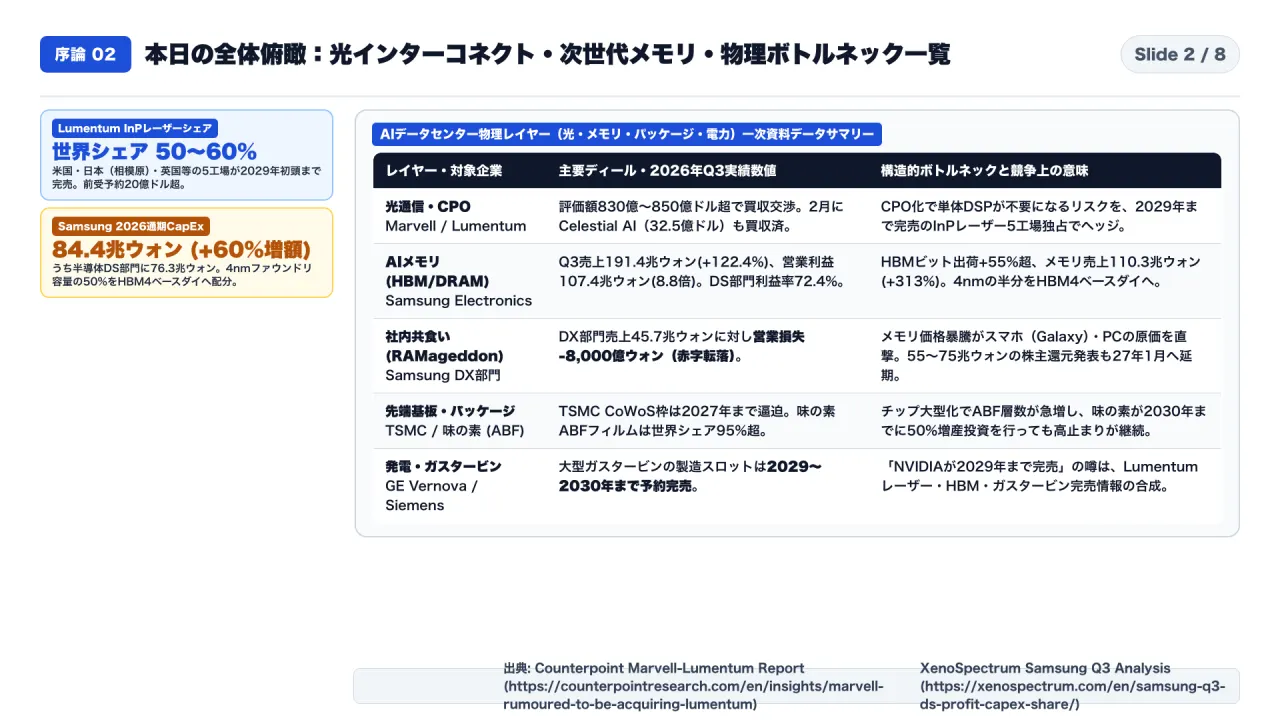
| Strategic Pillar | Primary Quantitative Metric | Immediate Market Reaction | Structural Mechanism & Bottleneck |
|---|---|---|---|
| Marvell × Lumentum M&A Talks | ~$83B–$85B valuation (vs. Marvell $221B market cap) | MRVL -12% to -13% / LITE +10% to +12% (+1,500% in 18 mos) | Transition from Pluggable DSP to CPO eliminates standalone DSPs (>20W/port saved); Marvell secures 5 InP laser fabs |
| Lumentum InP Wafer Fabs | 5 global fabs (Sagamihara Japan, Caswell UK, San Jose US, etc.) | Backlog sold out through early 2029; scaling 4-inch → 6-inch | Silicon cannot emit laser light; Indium Phosphide (InP) CW lasers and ELS modules are mandatory for CPO |
| NVIDIA’s $2B Lumentum Stake | $2.0B investment (March 2026) for 2027–2029 laser capacity | Potential “reverse lock-in” by Marvell (custom XPU rival) | Owning Lumentum gives Marvell control over the optical supply chain used by NVIDIA, Google, and AWS |
| Samsung Q3 2026 Operating Profit | 107.4T KRW (~$80B, +831% YoY) on 240T KRW revenue (+179%) | Samsung stock fell -4.1% to -5.3% after earnings | DS Semiconductor profit hit 98.6T KRW (72.4% margin), but DX (Mobile/Appliances) swung to -800B KRW loss |
| Samsung HBM4 & CapEx Surge | 84.4T KRW CapEx (+60%); 50% of 4nm foundry for HBM4 base die | 55T–75T KRW shareholder return delayed; 77.7T KRW cash kept | HBM4 replaces dumb memory base die with 4nm custom logic base die, playing to Samsung’s Memory+Foundry integration |
| “Sold Out Until 2029” Fact-Check | 4 distinct timelines conflated in viral social-media posts | Separates component lead times from GPU purchase orders | InP lasers (early 2029), GE gas turbines (2029), NVIDIA visibility (2027), SK Hynix HBM (2026) |
1. Why Marvell Risked a 13% Stock Drop to Bid $85B for Lumentum: The Day CPO Kills the Standalone DSP
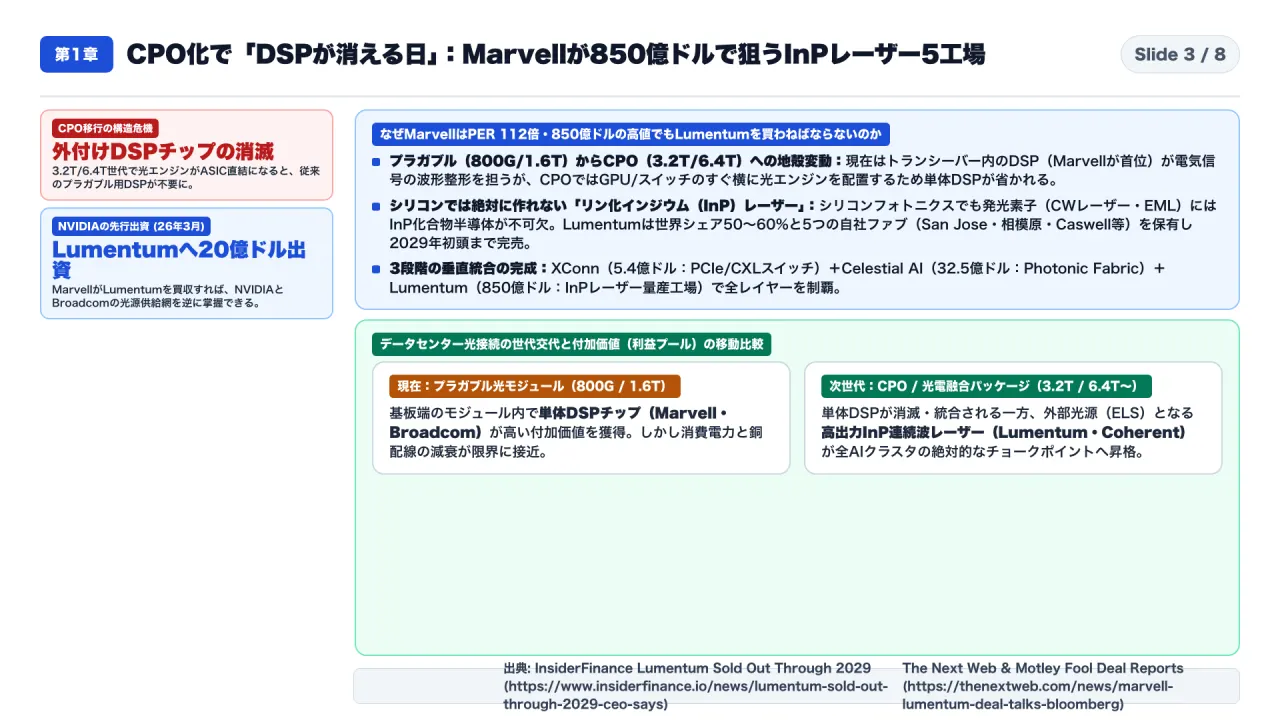
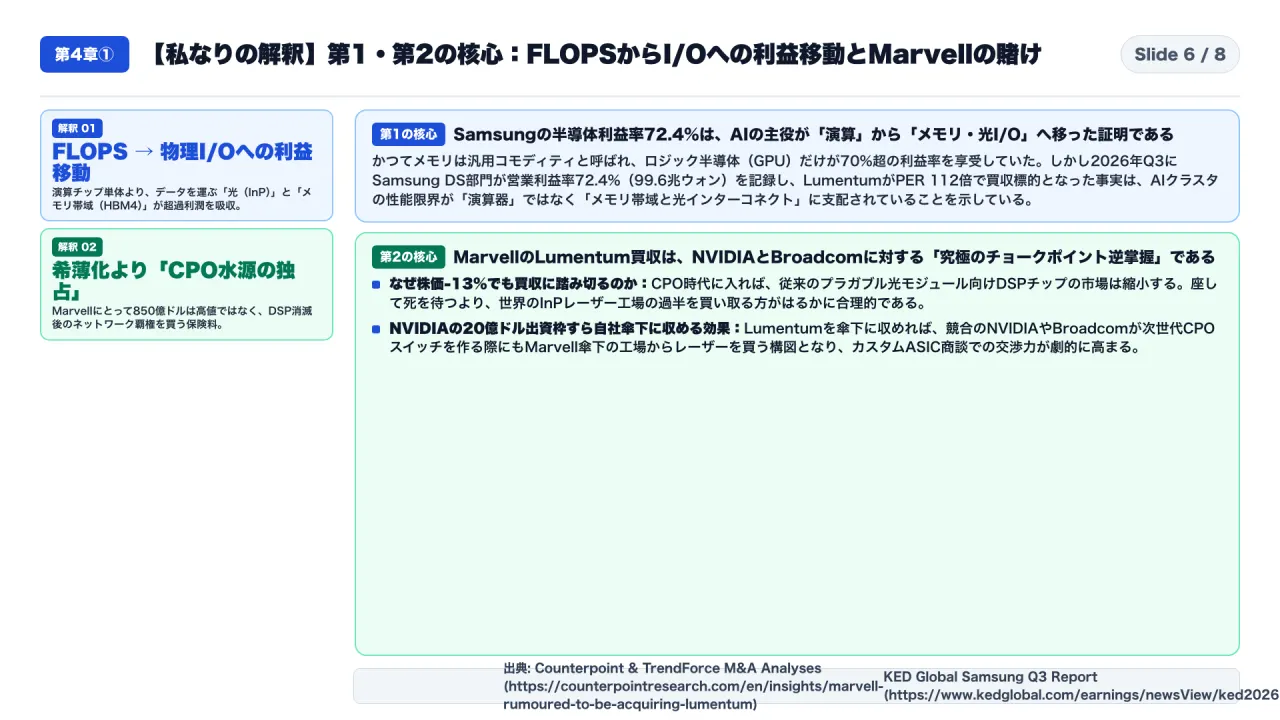
Today, through its historic acquisition of Inphi, Marvell Technology commands a dominant share of the high-margin optical Digital Signal Processor (DSP) market for 800G and 1.6T pluggable transceivers. Why would a company with software-like fabless margins offer $83 billion to $85 billion for Lumentum, a vertically integrated manufacturer of physical optical components and lasers?
1-1. The Physics of Pluggable Copper Traces vs. Co-Packaged Optics (CPO)
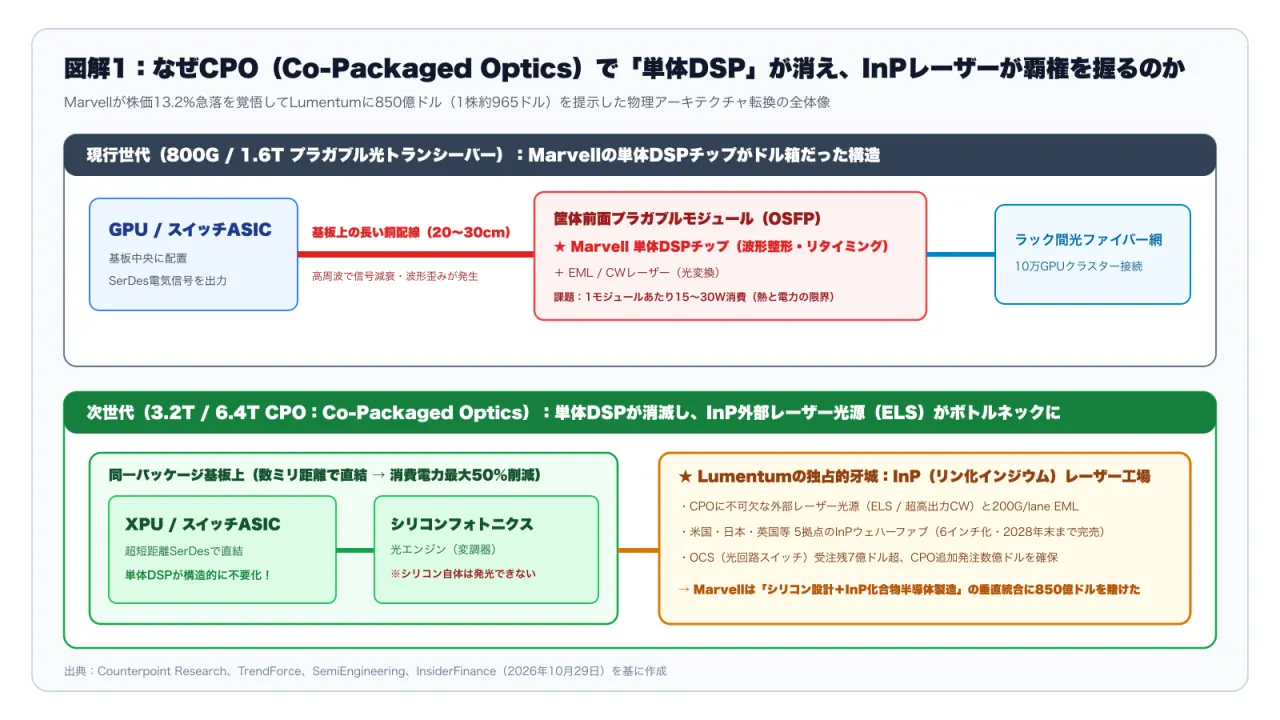
- Why Pluggable Transceivers Need a DSP Today: In a traditional rack switch or GPU server, electrical signals travel 10 to 30 centimeters across a printed circuit board (PCB) from the central ASIC/XPU to the front-panel pluggable transceiver cage. At 100G–200G per lane, copper trace attenuation severely distorts the waveform, requiring a power-hungry standalone DSP chip inside every pluggable module to re-time and equalize the signal—consuming over 20 watts per port (and up to 30% of total rack power).
- Why CPO Eliminates the Standalone DSP (“DSP-less” Architecture): Under Co-Packaged Optics (CPO), optical engines are mounted directly onto the same substrate just millimeters away from the switch ASIC or custom XPU. Because the electrical trace is ultra-short, the standalone pluggable DSP is no longer needed—slashing optical interconnect power consumption by 50% to 70%. For Marvell, standing still meant watching its lucrative standalone DSP business get cannibalized by CPO.
1-2. The Irreplaceable Physical Moat: Lumentum’s 5 Indium Phosphide (InP) Fabs & NVIDIA Reverse Lock-In
- Silicon Cannot Emit Light: Even when optical modulators move onto silicon photonics inside a CPO package, silicon (an indirect-bandgap semiconductor) cannot efficiently generate laser light. Every CPO switch and XPU still requires an external, ultra-stable Continuous-Wave (CW) laser made from Indium Phosphide (InP) housed in a serviceable External Laser Source (ELS) module.
- Monopolizing 5 Global InP Fabs (Sold Out Through Early 2029): Building and qualifying a compound semiconductor InP fab takes 4 to 5 years. Lumentum operates five premier InP wafer fabs worldwide (including Sagamihara in Japan, Caswell in the UK, and San Jose in the US), is actively migrating from 4-inch to 6-inch InP wafers, and has its capacity completely booked through early 2029.
- Reverse-Locking NVIDIA’s $2 Billion Investment: In March 2026, NVIDIA invested $2 billion in Lumentum (alongside Coherent) to secure multi-year laser supply for its Rubin/Spectrum-X photonics roadmap. By acquiring Lumentum outright, Marvell not only achieves end-to-end vertical integration (Custom XPU + PCIe/CXL Retimers + CPO Silicon Photonics + InP Lasers) to rival Broadcom, but effectively becomes the landlord of NVIDIA’s critical optical laser supply.
2. Samsung’s 107.4 Trillion KRW (~$80B) Profit Paradox: 72.4% Chip Margin vs. “RAMageddon” Mobile Losses & HBM4
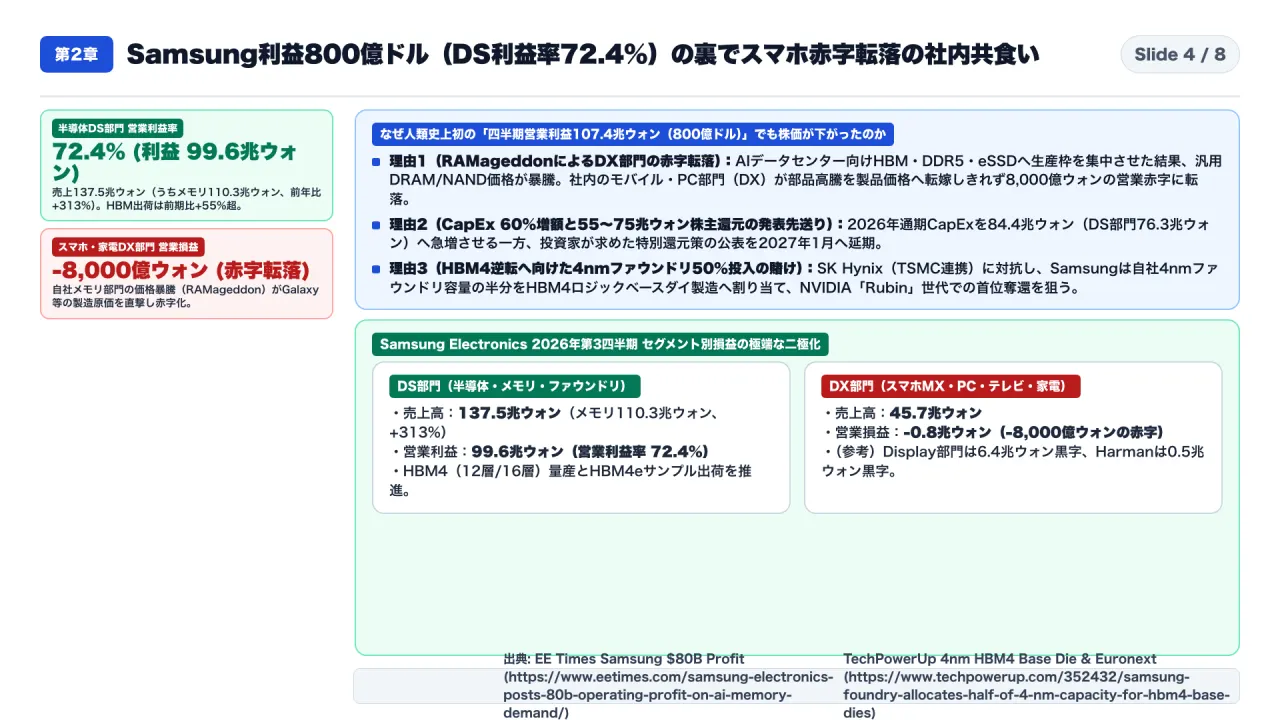
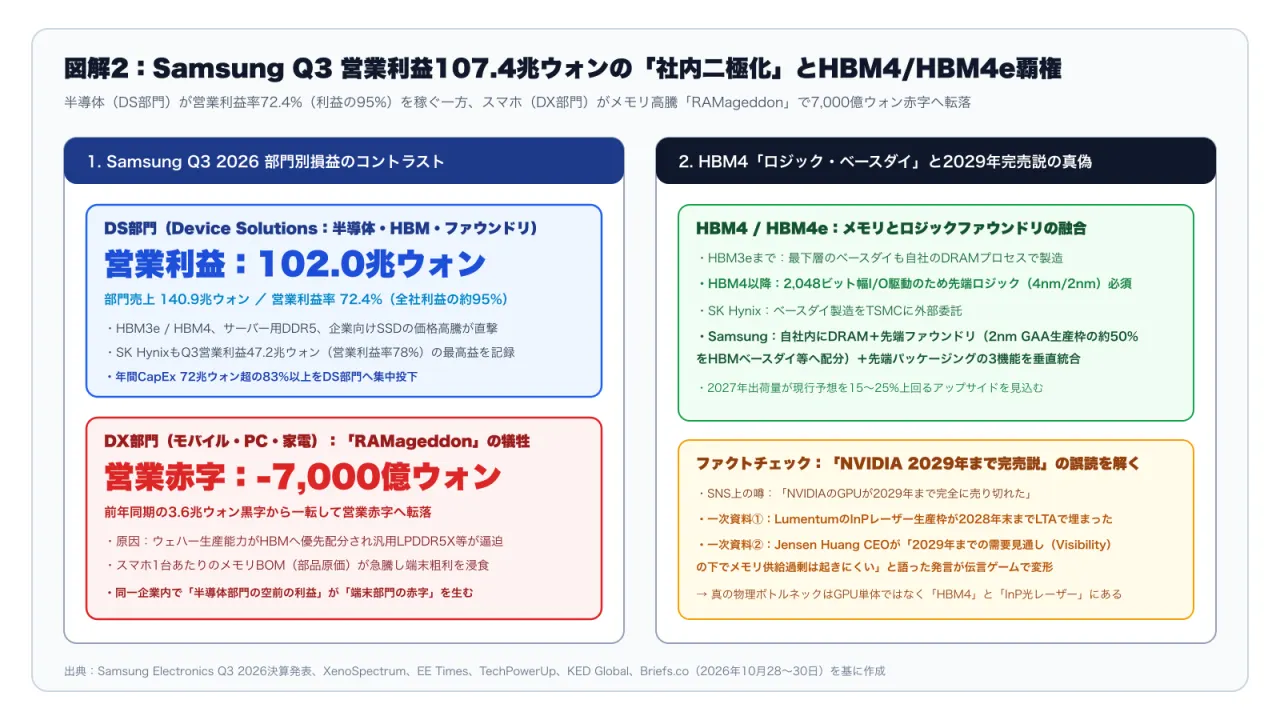
On October 29, 2026, Samsung Electronics reported the highest single-quarter operating profit in global corporate history: 107.4 trillion KRW (~$80 billion, +831% YoY) on revenue of 240 trillion KRW (+179% YoY). Yet Samsung’s share price fell 4.1% to 5.3% in Seoul trading. Three numbers explain why:
2-1. “RAMageddon” Internal Cannibalization: DS Earns 98.6T KRW (72.4% Margin) While DX Loses 800B KRW
- Semiconductor Supercycle (72.4% Operating Margin): As Samsung, SK Hynix, and Micron reallocated cleanroom wafer capacity to HBM, conventional server and mobile DRAM supply collapsed. In Q3 2026, DRAM ASP surged +182% YoY (+55% QoQ) and NAND ASP climbed +72% YoY (+42% QoQ), propelling Samsung’s Device Solutions (DS) semiconductor division to 98.6 trillion KRW in operating profit on 136.2 trillion KRW in revenue (a 72.4% operating margin).
- Mobile & Appliance Division Crushed by Memory Costs (-800B KRW Loss): Because Samsung operates strict arm’s-length transfer pricing between divisions, its Device eXperience (DX) division (Galaxy smartphones, PCs, TVs, and appliances) had to pay sky-high market prices for DRAM and NAND—causing DX to swing into an 800 billion KRW operating loss despite healthy handset unit shipments.
2-2. How HBM4’s “4nm Logic Base Die” Flips the Script Against SK Hynix—and Why 84.4T KRW CapEx Spooked Markets
- Why HBM4 Changes the Architecture: Through HBM3e (5th generation), the bottom base die of an HBM stack was produced using standard memory processes, where SK Hynix held a yield lead. In HBM4 and HBM4e (6th generation), the interface widens to 2,048 bits and the base die transforms into a custom advanced logic die (4nm/3nm foundry process) that integrates memory controllers and custom customer IP directly underneath the DRAM stack.
- Samsung’s Integrated Memory + Foundry Advantage: While SK Hynix must partner externally with TSMC to fabricate logic base dies, Samsung owns both world-class DRAM fabs and a 4nm/2nm logic foundry under one roof. Samsung allocated 50% of its total 4nm foundry capacity to HBM4 logic base dies, enabling +15%–25% higher I/O bandwidth and energy efficiency, and is already in qualification testing with five mega-customers (NVIDIA, Google, AMD, Broadcom, and OpenAI).
- Why Investors Sold the News: To fund this HBM4/HBM4e ramp and its Taylor, Texas fab, Samsung hiked 2026 CapEx by 60% to 84.4 trillion KRW and froze its anticipated 55T–75T KRW special shareholder return program (hoarding 77.7T KRW in net cash).
3. Forensic Fact-Check: Debunking the “NVIDIA Sold Out Until 2029” Myth & Mapping the 4 Real Choke Points
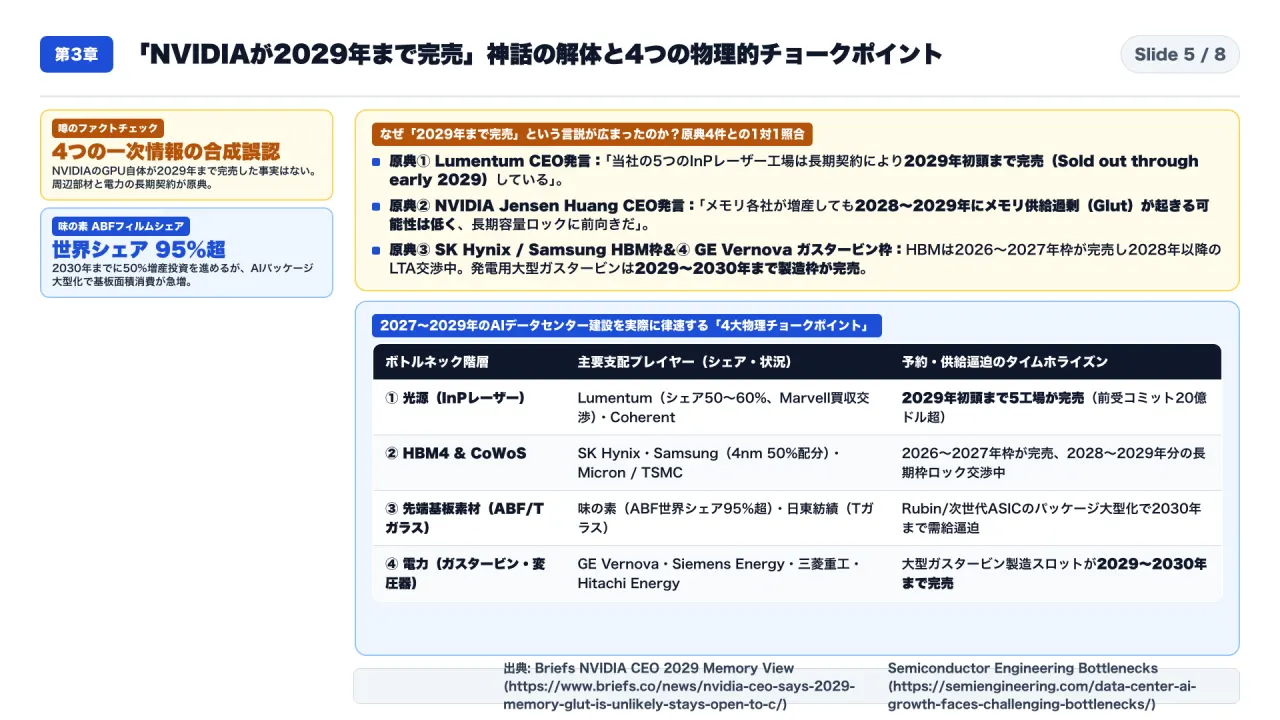
In late October 2026, a viral claim circulated across financial media asserting that “NVIDIA’s AI GPUs are completely sold out until 2029.” Cross-checking primary disclosures shows this is a conflation of four separate supply-chain timelines:
- 1. Lumentum InP Optical Lasers (Sold Out Through Early 2029): True for upstream InP CW laser capacity under long-term take-or-pay agreements, not GPU purchase orders.
- 2. SK Hynix HBM Memory (2026 Sold Out, 2027 Allocating): Binding HBM supply contracts cover 2026 and portions of 2027, not 2029.
- 3. NVIDIA GPU Order Visibility ($1 Trillion Cumulative Through 2027): CEO Jensen Huang cited $1 trillion in cumulative data-center demand visibility through 2027; binding customer GPU purchase orders typically extend 12 to 18 months.
- 4. GE Vernova Heavy-Duty Gas Turbines (Sold Out Through 2029 & Exploring 2030): Power-plant gas turbines for multi-gigawatt AI data centers are indeed booked out to 2029–2030, alongside Ajinomoto Build-up Film (ABF) substrate insulation (where Ajinomoto holds a >95% global monopoly and is expanding capacity by 50% through 2030).
Primary Sources & References
- CopyPost / Bloomberg: Marvell Technology in Advanced Talks to Acquire Lumentum in ~$85B Deal (Oct 29, 2026)
- Marvell Technology Investor Relations: Custom AI Silicon, Electro-Optics & CPO Architecture
- Lumentum Holdings Investor Relations: Indium Phosphide (InP) Wafer Fabs & Ultra-High-Power CW Lasers
- Samsung Electronics Global IR: Q3 2026 Financial Results (107.4T KRW Operating Profit, DS 72.4% Margin & HBM4)
- GE Vernova Investor Relations: Gas Power Turbine Backlog & Data Center Electrification