Why ServiceNow Plunged 25% Despite a 98% Renewal Rate—While DoorDash Bought Instacart for $17B ── Inside "30% Seat Compression" Math and the 80%-Margin Retail Media OS
YouTube (Japanese audio): https://youtu.be/BP4ZtFa_Cmo
Executive Summary & Key Takeaways
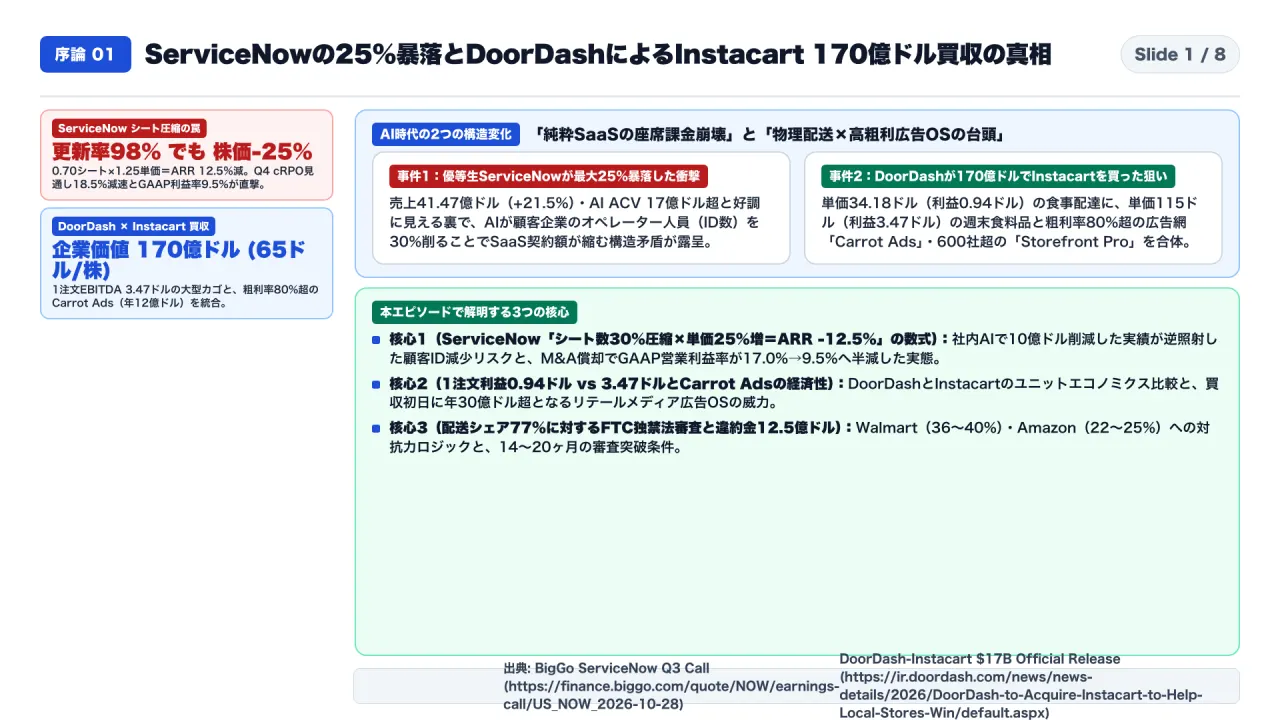
- Core Thesis: On October 28–29, 2026, two landmark corporate events exposed how Agentic AI is bifurcating the technology landscape between human-seat-dependent B2B SaaS and physical-infrastructure-backed B2C/B2B commerce platforms. First, enterprise workflow leader ServiceNow (NYSE: NOW) reported seemingly stellar Q3 2026 numbers—subscription revenue up +20.5% YoY to $3.60 billion, a 98% gross renewal rate, and Now Assist (AI) ACV surpassing $1.7 billion (targeting $2.0B+ for FY26)—yet its stock plunged up to 25% YTD (and -11% post-earnings). Why? Because ServiceNow’s own internal AI deployment (“Now on Now”) saved $1.0 billion in annualized internal headcount costs, proving to Wall Street that enterprise customers will use AI agents to cut human operator seats by 30%. Under simple arithmetic, if a customer reduces seats from 100 to 70 (0.70x) and upgrades the survivors to the Pro Plus AI tier at a +25% to +30% price uplift (1.25x–1.30x), net contract value shrinks to 0.70 × 1.25 = 0.875 (-12.5% ARR contraction, or -9% at 1.30x)—requiring at least a +42.9% per-seat price hike (1 ÷ 0.70 = 1.4286) just to stay revenue-neutral. Meanwhile, M&A amortization from acquiring Armis ($7.75B), Moveworks ($2.85B), and Veza ($1.0B) compressed ServiceNow’s GAAP operating margin from 17.0% down to 9.5% while Q4 cRPO growth guided down to 18.5%. Second, less than 24 hours later, DoorDash (NASDAQ: DASH) announced a $17 billion ($65/share, +22% premium) acquisition of grocery delivery leader Instacart (Maplebear Inc., NASDAQ: CART). Far from a low-margin courier merger, DoorDash is combining high-frequency restaurant delivery ($34.18 AOV, $0.94 EBITDA/order) with high-ticket weekend grocery baskets ($115.00 AOV, $3.47 EBITDA/order = 3.7x unit profit), Instacart’s 80%+ gross-margin “Carrot Ads” retail media network ($1.2B+ revenue across 9,000+ CPG brands), and Storefront Pro (600+ grocery chains) into a $140B+ GTV Local Commerce & Advertising OS.
- Who Should Read This: B2B SaaS founders, product/pricing leaders, enterprise CIOs, e-commerce and retail-media executives, and institutional technology and antitrust analysts.
- Key Architectural & Financial Takeaways:
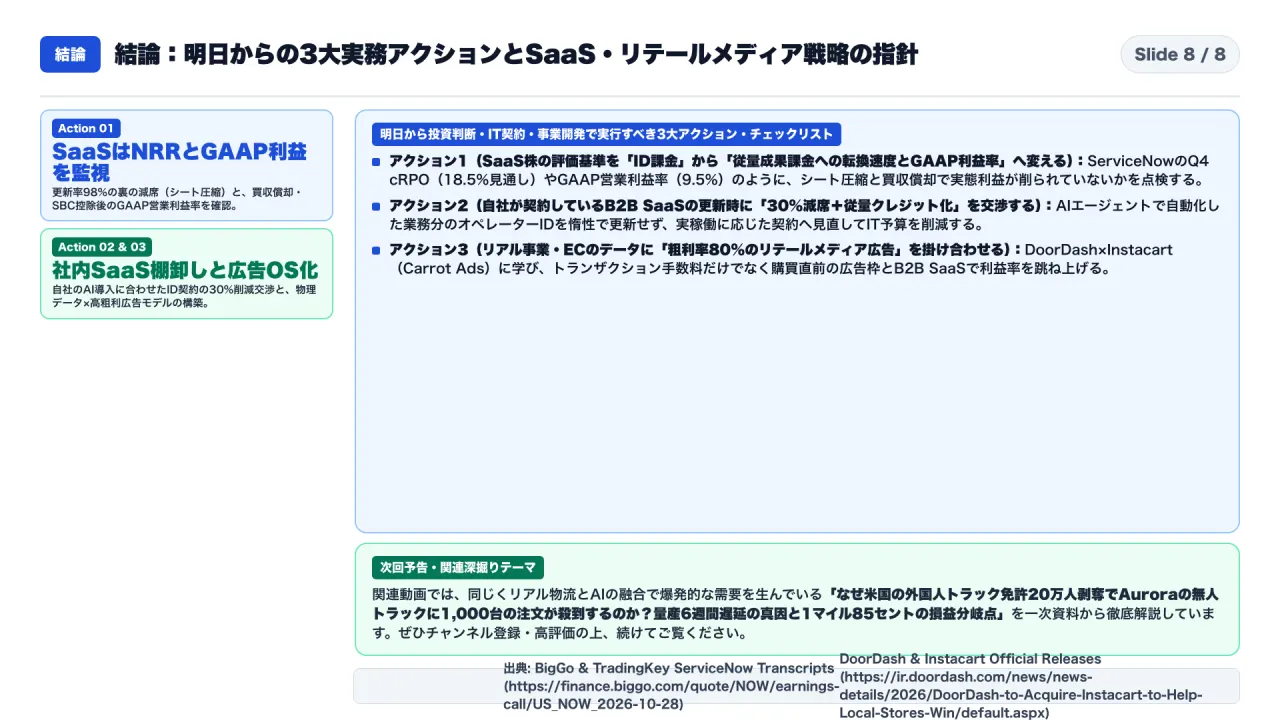
- 1. The SaaS Seat-Compression Paradox (0.70 × 1.25 = 0.875 ARR): Why a 98% Gross Renewal Rate (logo retention) masks seat reductions at 3-year contract renewals, and how ServiceNow is racing to monetize consumption-based Assist packs to bridge the +42.9% break-even uplift threshold.
- 2. GAAP (9.5%) vs. Non-GAAP (32.5%) Margin Divergence: How $11.6 billion in defensive AI/security acquisitions (Armis, Moveworks, Veza) inflated intangible amortization and stock-based compensation, cutting ServiceNow’s GAAP profitability nearly in half.
- 3. DoorDash + Instacart Unit Economics & The FTC 77%-Share Hurdle: How merging weekday meal couriers with weekend grocery pickers and Carrot Ads (80%+ gross margin) transforms DashPass retention, and why the deal carries a $1.25 billion reverse breakup fee and a 14-to-20-month FTC / Competition Bureau Canada antitrust review.
Background & Primary Sources Verified
This analysis cross-verifies 12 primary earnings releases, SEC filings, M&A merger agreements, and institutional research reports from October 28–30, 2026:
- 1. ServiceNow Q3 2026 Earnings Release, Form 10-Q & AI ACV Disclosures (Oct 28, 2026): ServiceNow Investor Relations / SEC EDGAR Filings
- 2. DoorDash $17B ($65/Share) Acquisition of Instacart (Maplebear Inc.) (Oct 29, 2026): DoorDash Investor Relations / Instacart Investor Relations
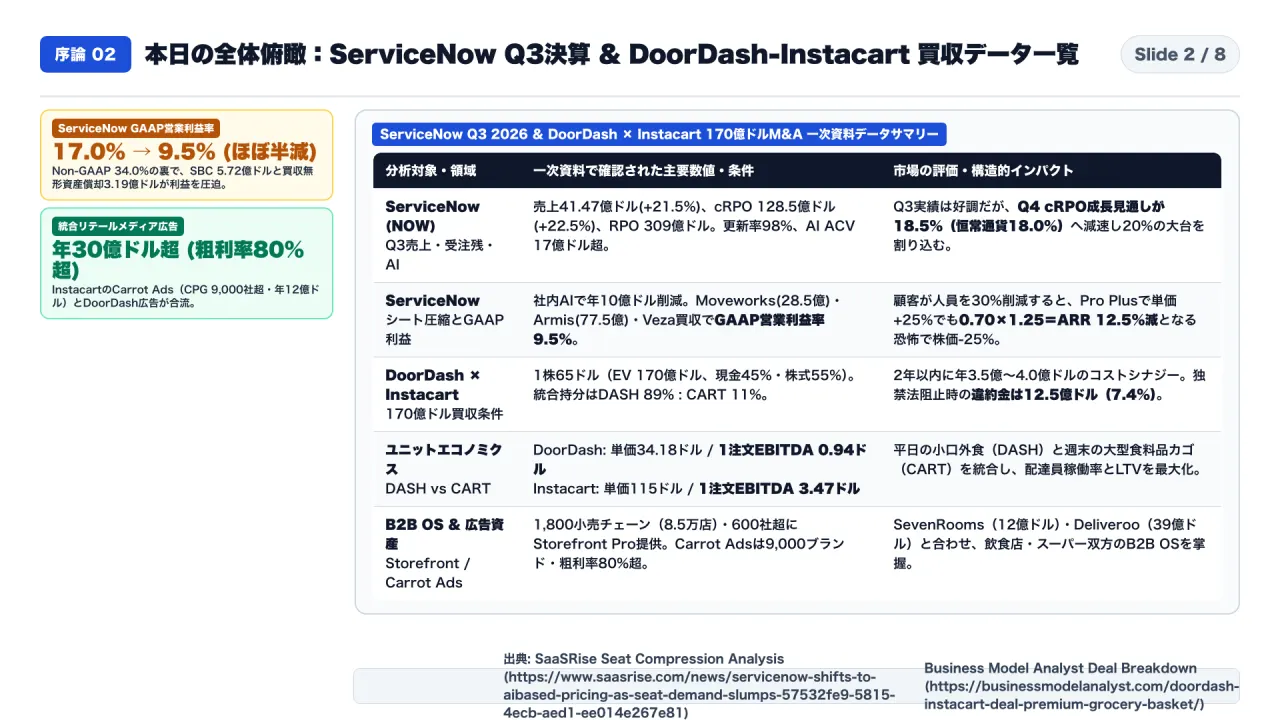
| Strategic & Financial Metric | ServiceNow (NYSE: NOW — Q3 2026) | DoorDash + Instacart (NASDAQ: DASH / CART — Oct 2026) |
|---|---|---|
| Headline Event & Valuation | Stock -25% YTD (-11% post-Q3) despite beat; P/E compressed from >60x to ~24x | $17.0B buyout ($65/share, +22% premium); combined GTV ~$140B+/yr |
| Top-Line Growth & AI / Ad Engine | Subscription rev $3.60B (+20.5% YoY); Now Assist AI ACV >$1.7B (FY26 target $2B+) | Carrot Ads ($1.2B+ rev) + DashAds = $2.5B+ Retail Media OS at >80% gross margin |
| Unit Economics & Margin Structure | Non-GAAP Op Margin 32.5% vs. GAAP Op Margin 9.5% (down from 17.0% on M&A amortization) | DoorDash ($34.18 AOV / $0.94 EBITDA) + Instacart ($115 AOV / $3.47 EBITDA = 3.7x profit/order) |
| Core Structural Mechanism | Seat Compression: 30% fewer seats (0.70) × 1.25x Pro Plus price = 0.875 ARR (-12.5% contraction) | Physical + POS Moat: 85%+ North American grocery POS inventory integration + Storefront Pro (600+ chains) |
| M&A & Regulatory Risk | $11.6B spent on 3 deals (Armis $7.75B, Moveworks $2.85B, Veza $1.0B) | 77% U.S. 3P grocery delivery share → 14–20 mo FTC & Canada review ($1.25B breakup fee) |
1. The SaaS Seat-Compression Equation: Why ServiceNow’s 98% Renewal Rate Cannot Hide a -12.5% ARR Risk
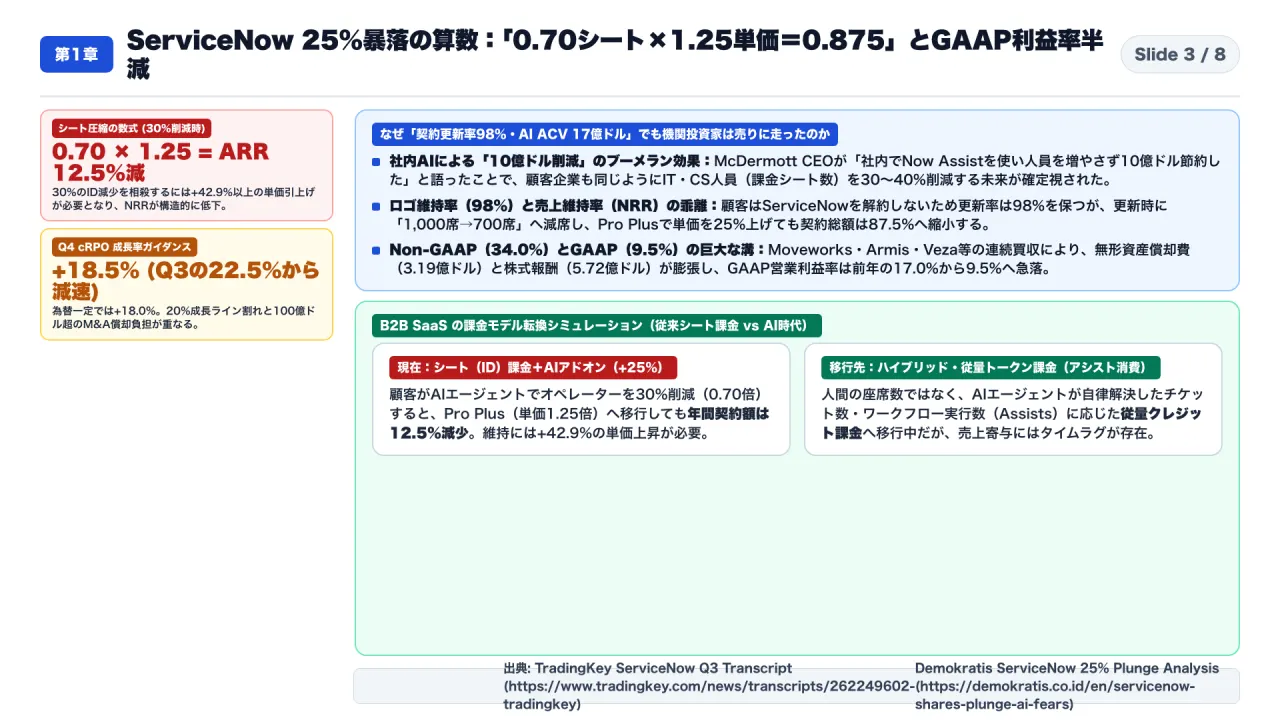
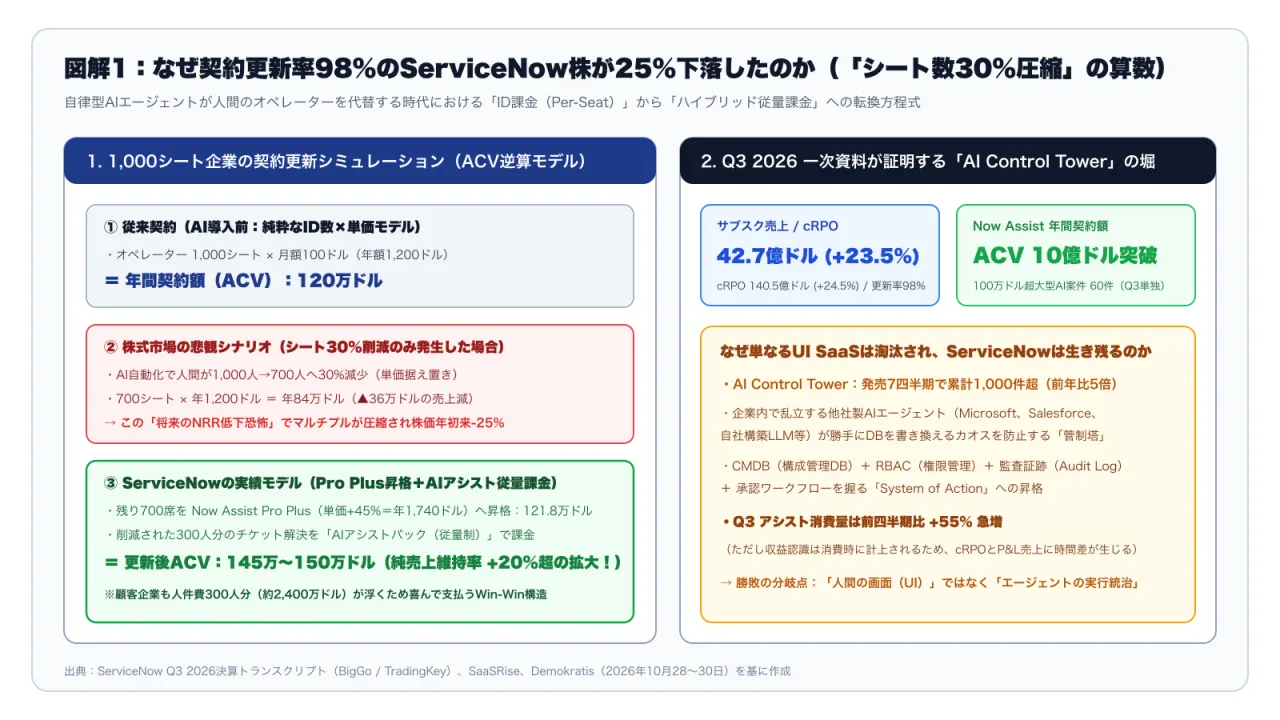
On paper, ServiceNow’s Q3 2026 operating metrics looked unassailable: subscription revenue grew +20.5% YoY to $3.60 billion, gross renewal rate held steady at 98%, and generative/agentic AI annual contract value (Now Assist ACV) crossed $1.7 billion. Why did institutional investors aggressively de-rate ServiceNow’s multiple from over 60x forward earnings down to ~24x?
1-1. The Mathematical Proof of Seat Compression (0.70 × 1.25 = 0.875 ARR)
Ironically, ServiceNow’s management provided the strongest proof of the bear thesis during its own presentation by boasting that internal deployment of Now Assist (“Now on Now”) automated IT, HR, and customer-support tickets so effectively that it saved roughly $1.0 billion in annualized internal headcount and operating costs.
Enterprise CFOs immediately applied that same math to their own ServiceNow renewals:
- Baseline Contract (Pre-AI): An enterprise employs 100 IT/customer-service operators at $100/seat/month = $10,000/month ($120,000 ARR).
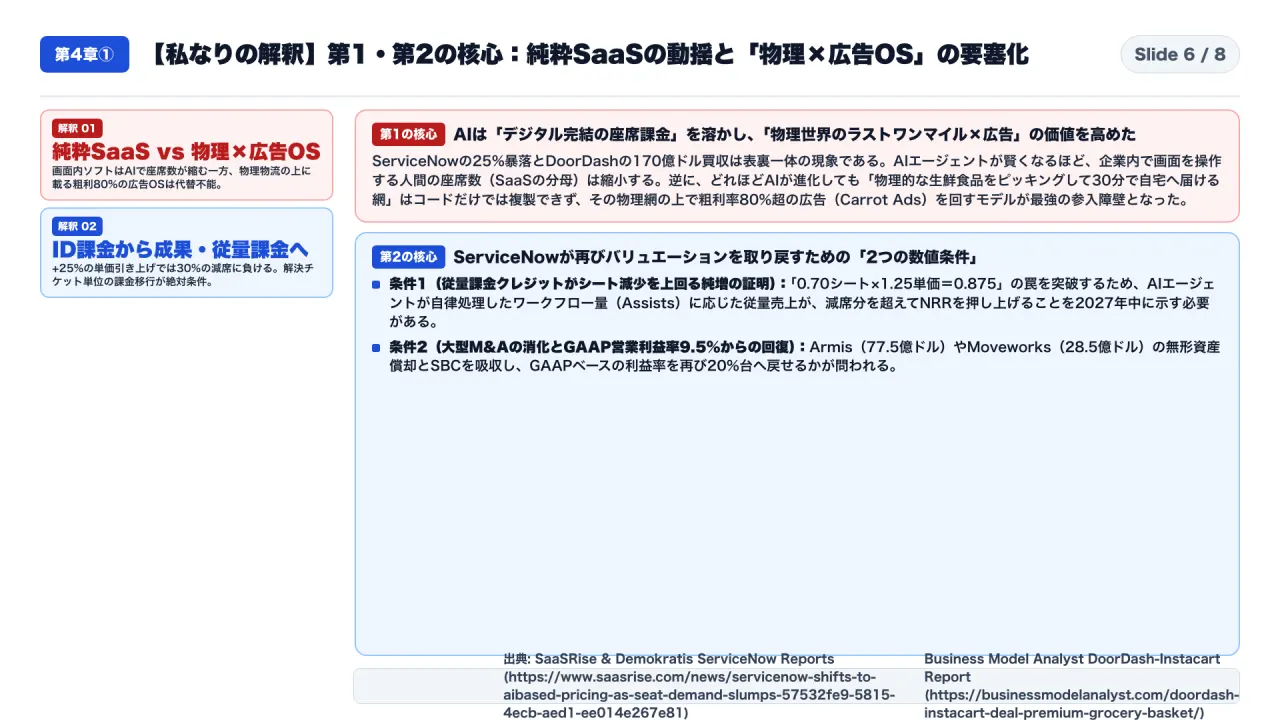
- Post-Agentic AI Renewal (-30% Seats, +25% Pro Plus Uplift): Autonomous AI agents resolve Tier-1 and Tier-2 tickets automatically, allowing the enterprise to reduce human operator headcount by 30% (from 100 seats down to 70 seats). Even if the customer upgrades all 70 remaining seats to ServiceNow’s premium Pro Plus AI tier at a +25% price uplift ($125/seat), total contract value drops to:
- 70 seats × $125 = $8,750/month ($105,000 ARR = a -12.5% net revenue contraction; even at a +30% uplift to $130/seat, 70 × 1.30 = 91, a -9.0% contraction).
- The +42.9% Break-Even Threshold: To offset a 30% seat reduction solely through seat pricing, ServiceNow must extract at least a +42.9% price increase per remaining seat (1 ÷ 0.70 = 1.4286)—or capture the difference via consumption-based Assist token packs.
1-2. Why 98% Gross Renewal Rate Masks Contraction—and Why GAAP Margin Halved to 9.5%
- Gross Renewal Rate (Logo Retention) vs. Net Expansion: ServiceNow’s 98% renewal rate measures whether a customer renews its master logo contract, not whether seat counts expand. Because enterprise contracts span 3 years, Q4 2026 current RPO (cRPO) guidance decelerating to +18.5% YoY sparked fears that the 2027 renewal cohort will exhibit net seat compression.
- The $11.6B M&A Spree & GAAP Margin Compression (17.0% → 9.5%): To pivot away from human-seat dependence toward machine/device/agent pricing, ServiceNow spent $11.6 billion acquiring OT/IoT security leader Armis ($7.75B), agentic AI copilot Moveworks ($2.85B), and identity-governance platform Veza ($1.0B). While Non-GAAP operating margin was reported at 32.5%, massive intangible amortization and stock-based compensation from these deals drove GAAP operating margin down from 17.0% to just 9.5%.
2. Inside DoorDash’s $17 Billion Acquisition of Instacart: $3.47 vs. $0.94 Order Profit and the 80%-Margin “Carrot Ads” OS
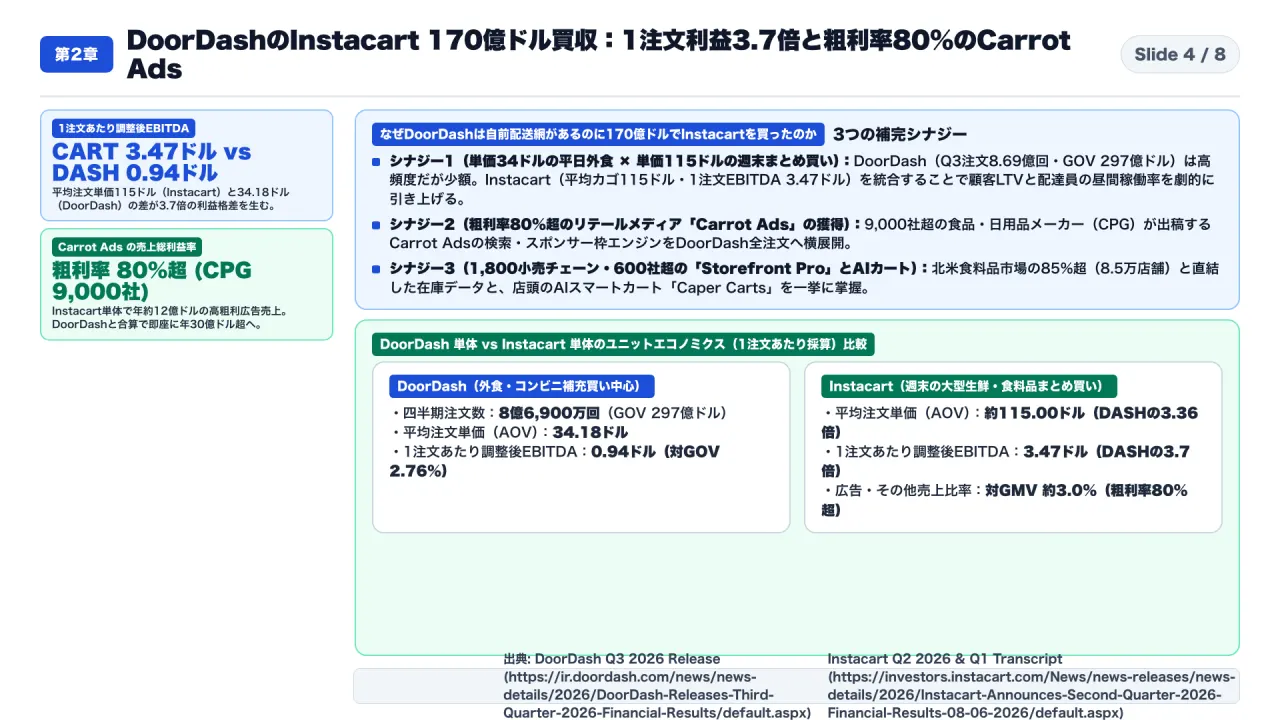
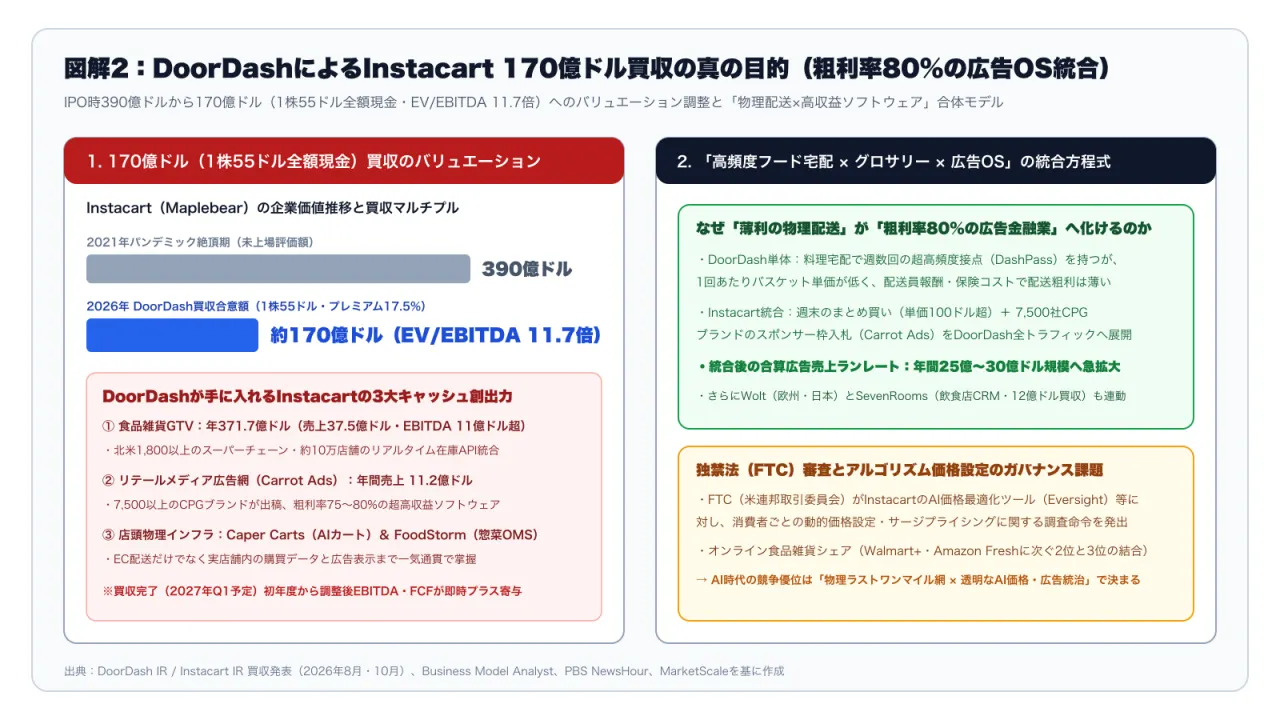
While pure-play software multiples compressed, DoorDash agreed on October 29, 2026 to acquire Instacart (Maplebear Inc.) for $17.0 billion ($65.00 per share, a 22% premium). A breakdown of the two companies’ unit economics reveals why this deal is fundamentally about high-margin advertising and B2B grocery software, not courier fees:
2-1. Unit Economics Multiplication: $34.18 Restaurant Orders ($0.94 EBITDA) Meet $115.00 Grocery Baskets ($3.47 EBITDA)
- DoorDash Standalone (High Frequency, Thin Per-Order Profit): Consumers order prepared meals 3 to 5 times per week, generating an Average Order Value (AOV) of $34.18 and Adjusted EBITDA of $0.94 per order.
- Instacart Standalone (High Basket Size, 3.7x Per-Order Profit): Families use Instacart for weekly refrigerated/frozen grocery stock-ups with an AOV of ~$115.00 (3.4x DoorDash’s basket), generating $3.47 in Adjusted EBITDA per order—3.7x higher profit per transaction than DoorDash.
- Complementary Courier Utilization & DashPass Lock-In: Restaurant delivery peaks at 12:00–13:30 and 18:00–21:00, whereas grocery picking and delivery peak on weekend mornings and weekday afternoons (09:00–16:00). Unifying DashPass and Instacart+ eliminates duplicate subscriber acquisition costs and maximizes fleet utilization across all 24 hours.
2-2. The Crown Jewel: “Carrot Ads” (>80% Gross Margin, 9,000+ CPG Brands) + “Storefront Pro” (600+ Retailers)
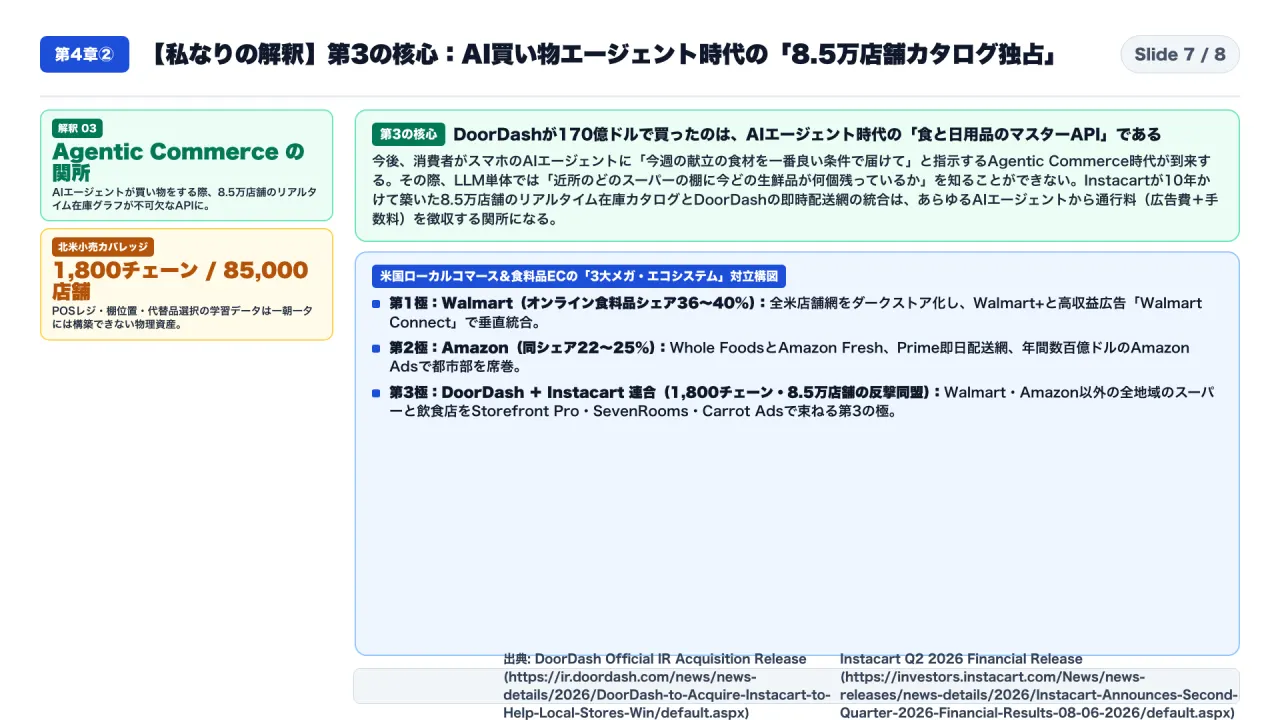
- Carrot Ads Retail Media Network: Instacart’s Carrot Ads platform generates $1.2B+ in annual high-margin advertising revenue (>80% gross margin) from over 9,000 CPG brands (PepsiCo, P&G, Unilever, Kraft Heinz) bidding for sponsored product placement at the exact moment of digital checkout. Combined with DoorDash’s DashAds, the merged company creates a $2.5B+ closed-loop Retail Media OS.
- B2B Enterprise Commerce Stack (Storefront Pro + SevenRooms + DashOS): Instacart powers the white-label e-commerce websites, in-store Caper Carts, and real-time POS inventory feeds for over 600 North American supermarket chains (covering >85% of U.S. grocery retail). Paired with DoorDash’s restaurant reservation/CRM platform SevenRooms and DashOS, DoorDash becomes the indispensable B2B operating system for physical food and retail.
3. Antitrust Reality Check (77% Market Share & $1.25B Breakup Fee) and the AI-Era Moat Playbook
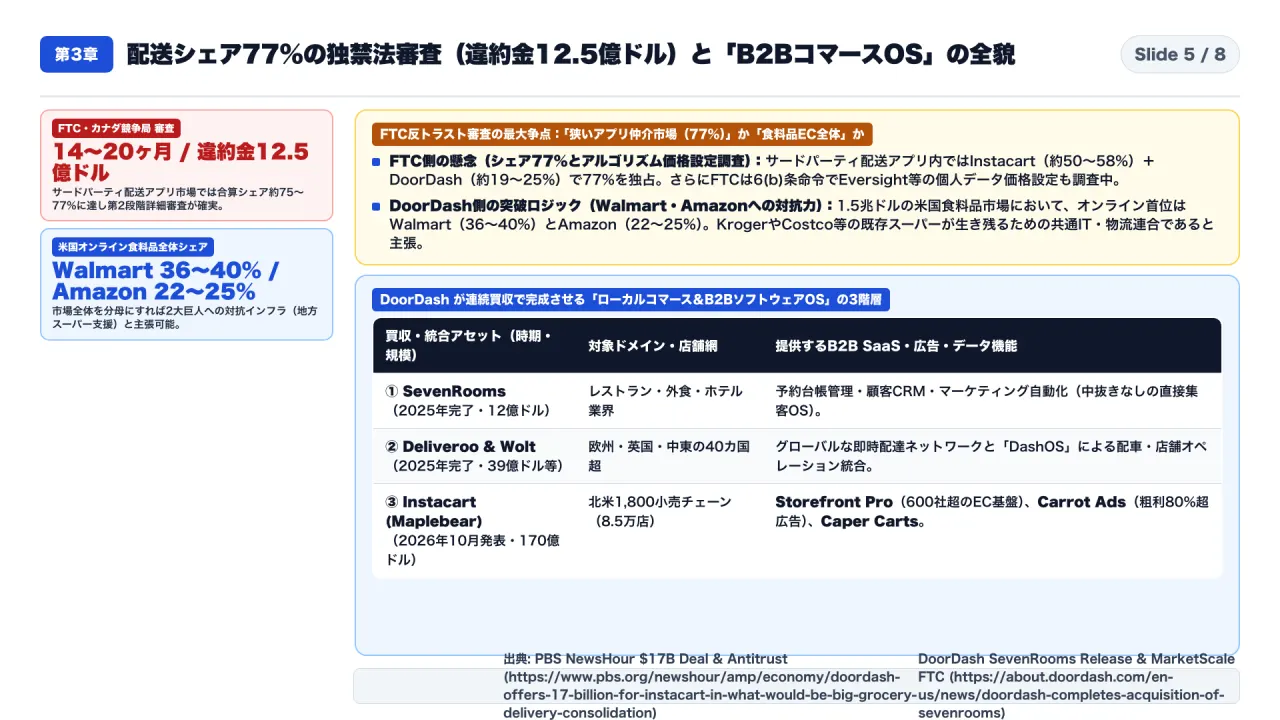
- 1. The FTC & Competition Bureau Canada Hurdle (77% Combined 3P Share vs. 12% Total Grocery): In the narrow “third-party (3P) online grocery delivery intermediary” market, DoorDash + Instacart will command roughly 77% U.S. market share (with Uber Eats holding most of the remainder), triggering an in-depth Second Request review by the U.S. FTC and Competition Bureau Canada lasting 14 to 20 months (target close late 2027 to mid-2028) and backed by a massive $1.25 billion (~7.4%) reverse termination fee. DoorDash’s legal defense will argue that the relevant market is total omnichannel grocery (including Walmart+, Amazon Fresh/Whole Foods, Target Circle 360, and Kroger Boost), where the combined entity holds only ~12% share.
- 2. Why AI Shopping Agents Strengthen Physical Networks: Even if future personal AI agents automate consumer meal planning and grocery ordering—bypassing human web UIs—an AI agent still cannot physically pick ripe produce from 85% of North American supermarkets or deliver cold-chain groceries in 45 minutes. Value migrates from pure UI software seats to mission-critical system-of-record data, outcome-based AI execution, and physical last-mile infrastructure.
Primary Sources & References
- ServiceNow Investor Relations: Q3 2026 Financial Results, cRPO Guidance & Now Assist AI ACV (Oct 28, 2026)
- DoorDash Investor Relations: DoorDash to Acquire Instacart for $17B to Build the Leading Local Commerce Platform (Oct 29, 2026)
- Instacart (Maplebear Inc.) Investor Relations: Q3 2026 Results, Carrot Ads & Merger Agreement Details
- SEC EDGAR Company Filings: ServiceNow (NOW), DoorDash (DASH), and Maplebear / Instacart (CART)