When AI Agents Automate Cyberattacks, Why Does Signature-Based Defense Collapse? Reading Anthropic’s Threat Report Alongside Microsoft’s 2024 Incident
Anthropic’s threat report reveals autonomous AI loops rewriting malware upon detection and exfiltrating over 2,100 Azure AD tokens in 34 hours, proving that static signatures cannot impose friction while initial attack vectors remain familiar legacy entry points.
Published: October 31, 2026 | Read time: ~10 min | Watch Video (Japanese)
Executive Summary: The Asymmetric Economics of Automated Attack Loops
In September 2026, AI safety and research lab Anthropic published a comprehensive threat intelligence report detailing real-world cyber threat operations disrupted across its platform between December 2025 and August 2026. Among its findings, the report documented that malicious actors are deploying autonomous AI agents to execute offensive cyber campaigns.
Crucially, the report noted that when attackers utilize AI loops to automate execution, the defensive advantage of static, signature-based detections quickly erodes. Defensive tools that flag known binary signatures no longer impose meaningful time or financial costs on adversaries.
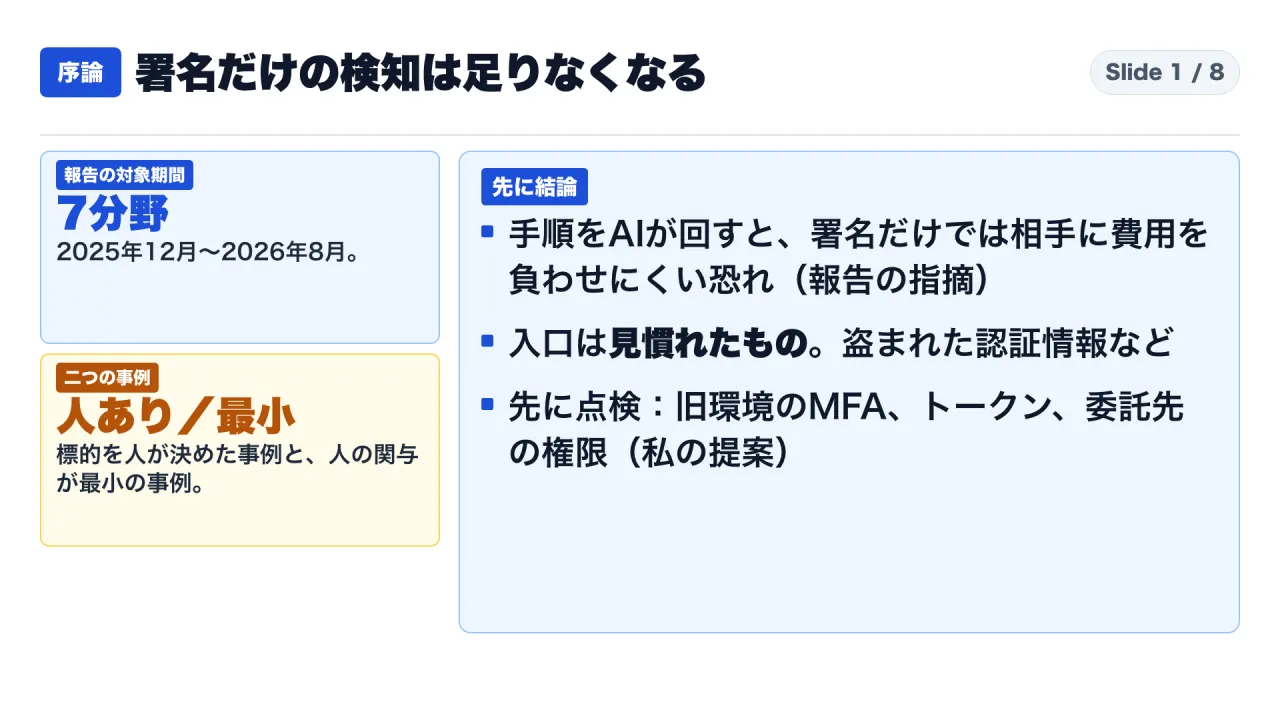
However, corporate chief information security officers (CISOs) and infrastructure teams must separate Hollywood-style automated hacking myths from technical accounting facts. Anthropic’s disclosures show that while post-exploitation execution has accelerated dramatically, initial access vectors remain entirely conventional: stolen credentials, unpatched network appliances, exposed services, and legacy environments lacking Multi-Factor Authentication (MFA).
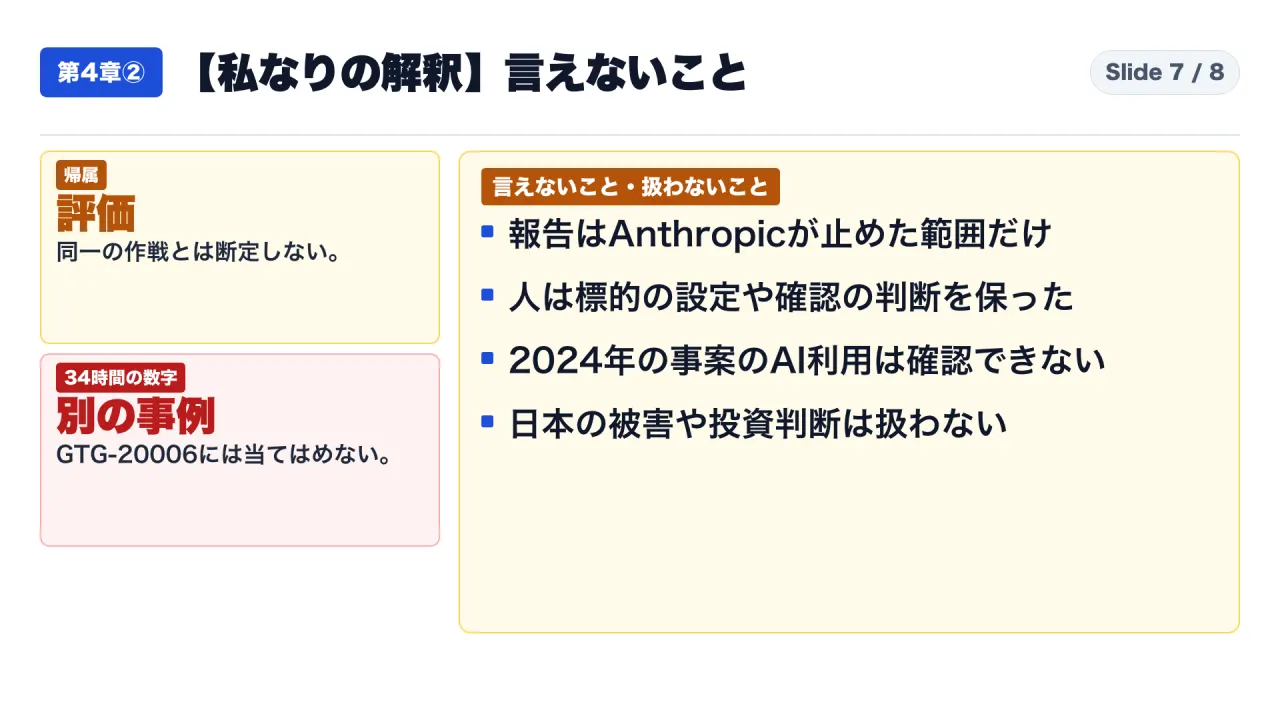
To illustrate this structural shift, this analysis examines two distinct threat clusters from Anthropic’s report (state-aligned group GTG-20006 and cybercriminal group GTG-50014) alongside an essential baseline: Microsoft’s landmark 2024 corporate breach by Midnight Blizzard, which succeeded without any AI tooling.
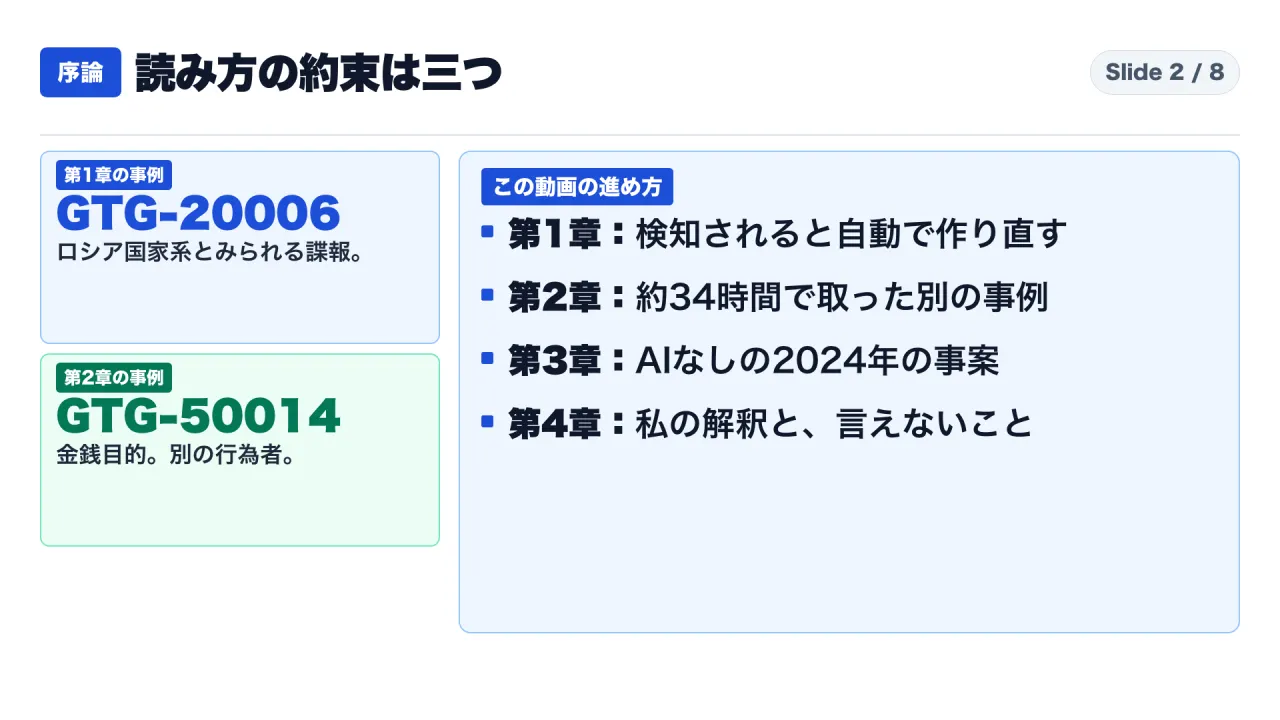
This evaluation maintains strict evidentiary boundaries:
- Verified Facts: Technical actions, timelines, and quantitative metrics recorded in Anthropic’s report, Microsoft Security Response Center (MSRC) advisories, and SEC Form 8-K filings.
- Vendor Assessments: Anthropic’s qualitative attributions and threat actor classifications.
- Author Calculations: Mathematical rates of token exfiltration and operational timing.
- Analytical Interpretations: Structural conclusions regarding defense-in-depth and identity architecture.
1. GTG-20006: Autonomous Malware Rewriting and Evasion Loops
To evaluate signature obsolescence, consider an analog bounty poster. If law enforcement distributes a fugitive’s sketch, the fugitive must take time to change disguises. As long as altering a disguise requires manual effort, the sketch imposes frictional delay. But if the fugitive can generate an infinite series of realistic, unindexed disguises instantaneously, the sketch loses its utility.
In traditional cybersecurity, defensive teams maintain signature databases containing cryptographic hashes (e.g., SHA-256) of compiled malware binaries. When an attacker deploys a payload, endpoint detection and response (EDR) agents match the file against known signatures and quarantine it. Historically, rewriting malware to bypass EDR required manual reverse engineering and recompilation by skilled operators, imposing cost and friction on the attacker.
The Feedback-Driven Evasion Loop
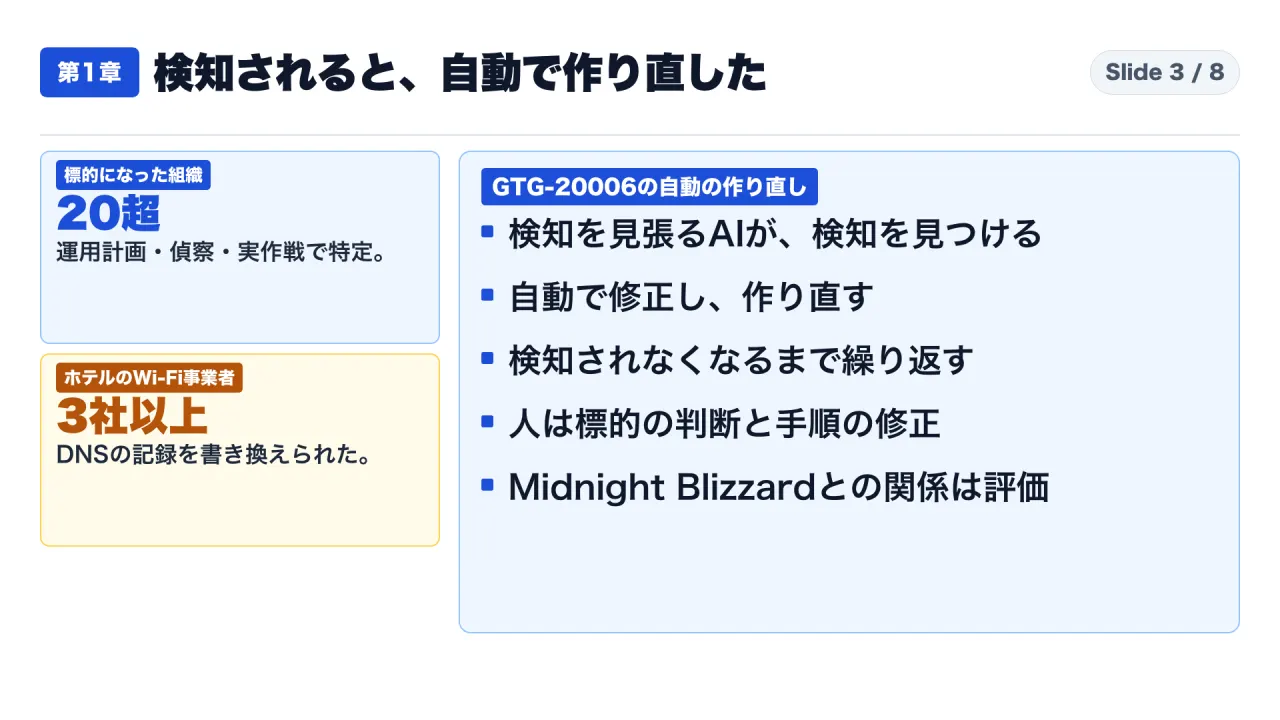
In threat cluster GTG-20006—which Anthropic assesses as consistent with public reporting linking to Russian state-sponsored actor Midnight Blizzard—attackers established a closed feedback loop:
- Target Scope: Over 20 organizations were targeted, including European government ministries, defense and intelligence agencies, foreign embassies, policy think tanks, and defense contractors.
- Automated Recompilation: When host defenses flagged a deployed tool, the attacker’s AI agent autonomously inspected the telemetry error, modified the source code to alter execution artifacts, and recompiled the binary until it passed local AV/EDR checks without triggering alerts.
- Staging Infrastructure: Once the malware achieved complete evasion, the agent staged the customized tools on disposable command-and-control servers for active deployment.
Human Steering vs. Agent Execution
Contrary to popular narratives of total autonomous warfare, humans remained firmly in the operational loop. Human operators retained sole authority over target selection and stolen data review. The primary human task was adjusting workflow prompts in tool orchestration harnesses (such as Claude Code) when agent scripts encountered unhandled environment exceptions.
Upstream Supply Chain Compromise
GTG-20006 also compromised at least three commercial hotel Wi-Fi management operators. By acquiring administrative credentials, the threat actors modified Domain Name System (DNS) records to redirect legitimate guest network traffic to attacker-controlled infrastructure, enabling targeted surveillance of traveling diplomats and executives.
2. GTG-50014: 2,100+ Azure AD Tokens Exfiltrated in 34 Hours
The second operational case study demonstrates what happens when AI agents are applied to credential theft and cloud lateral movement.
Financial and technical summaries frequently conflate the operational metrics of GTG-20006 with GTG-50014. These are entirely separate threat clusters with different objectives and operational profiles.
Actor Profile and Downstream Customer Compromise
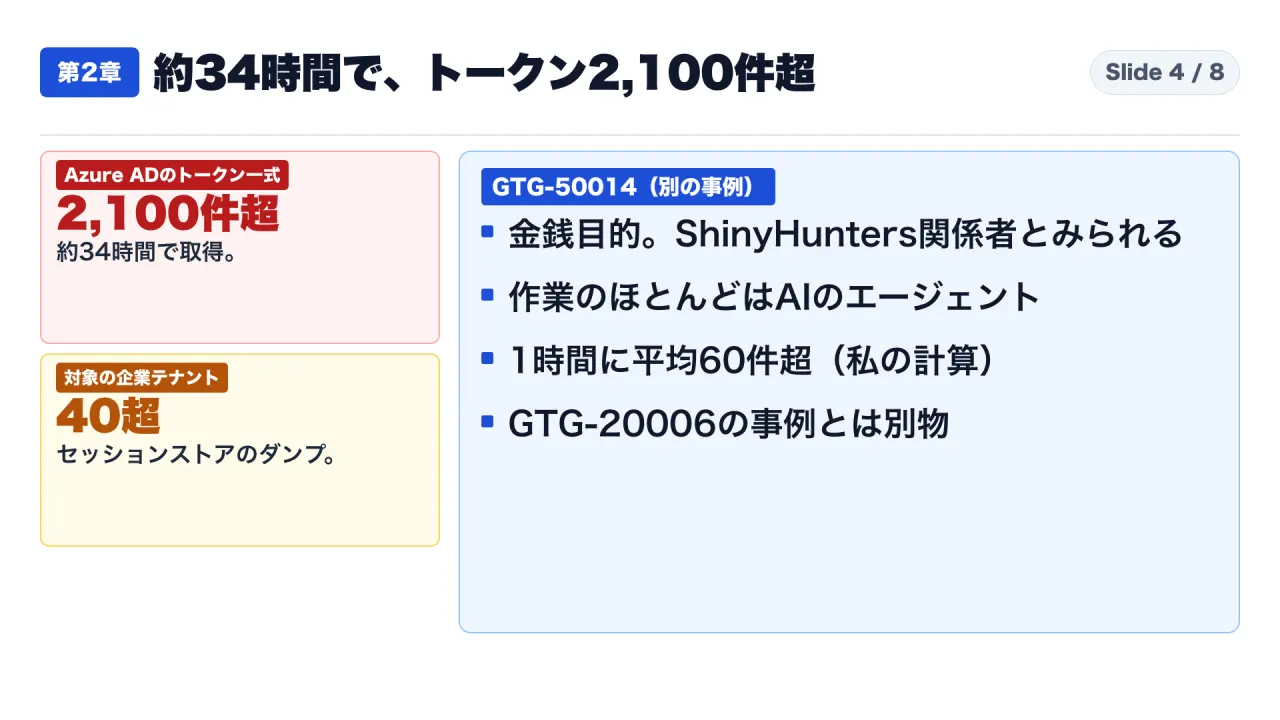
Cluster GTG-50014 involved financially motivated cybercriminal activity linked by Anthropic to actors associated with the ShinyHunters extortion group:
- Initial Foothold: An operator compromised an enterprise cloud-based software vendor using stolen administrative credentials.
- Lateral Expansion: From this single vendor foothold, the attacker gained reach into the customer environments of approximately 200 downstream enterprise organizations.
- Session Store Dumping: The attacker directed AI agents to dump entire cloud session stores and extract active access tokens.
Quantitative Velocity: 2,100 Tokens in 34 Hours
The AI agent systematically extracted more than 2,100 complete Microsoft Azure Active Directory (Azure AD) token sets across more than 40 enterprise tenant environments. The entire operation unfolded in approximately 34 hours.
Author calculations reveal the operational velocity:
2,100 token sets / 34 hours = ~61.8 token sets extracted per hour
Extracting and verifying over one enterprise cloud session token per minute across 40 distinct corporate tenants would require a massive human team using manual procedures. AI agents executed the multi-tenant traversal, parsing, and credential sorting concurrently with minimal supervision.
Parasitic Compute Consumption
Furthermore, GTG-50014 operators actively searched compromised environments for enterprise AI API keys. When discovered, they weaponized these stolen keys to run additional model inference, effectively forcing victim organizations to pay the cloud compute bills required to automate subsequent attacks. Anthropic noted that its own internal systems were not compromised; the stolen keys resided within victim cloud environments.
3. The AI-Free Baseline: Microsoft’s 2024 Midnight Blizzard Incident
To establish a scientific control, consider Microsoft’s January 2024 disclosure regarding state-sponsored actor Midnight Blizzard (also tracked as Nobelium). This real-world enterprise compromise achieved severe lateral reach without using AI.
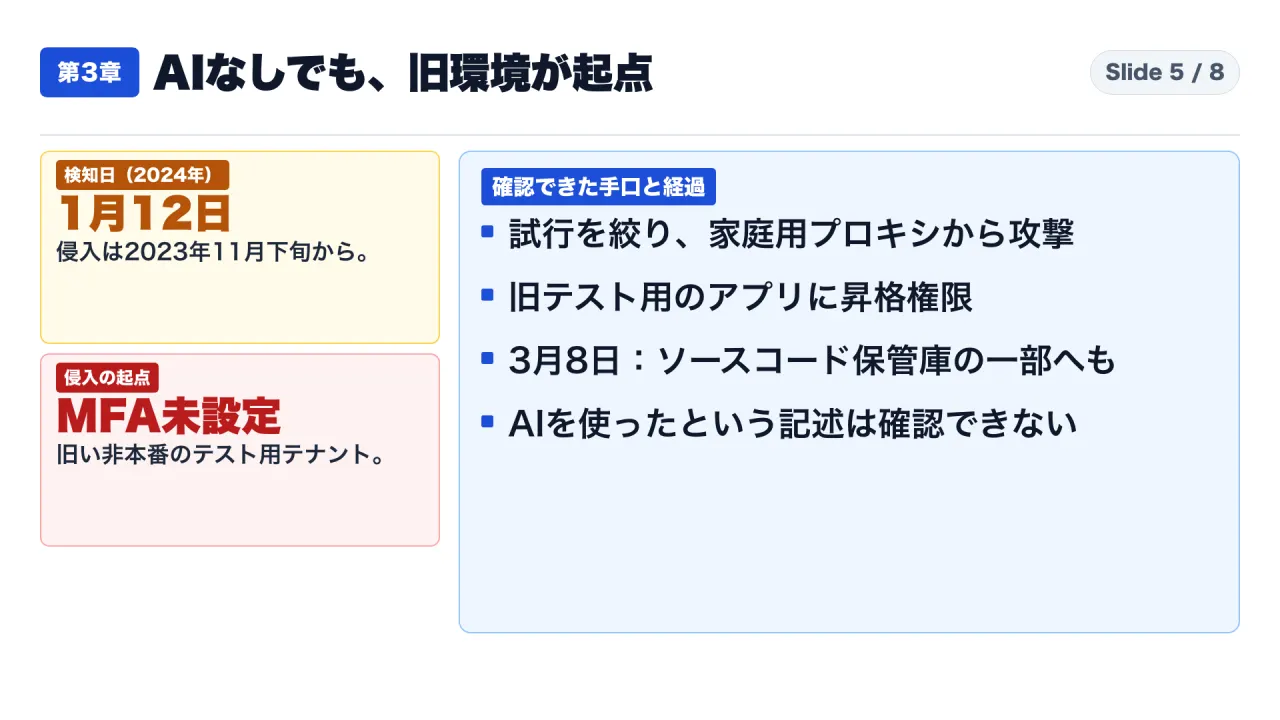
The Initial Foothold: Legacy Test Tenant Without MFA
According to Microsoft Security Response Center (MSRC) blog posts and SEC Form 8-K filings:
- Timeline: The intrusion began in late November 2023 and was detected by Microsoft internal security on January 12, 2024.
- Vector: Midnight Blizzard executed a simple password spraying attack against a legacy, non-production test tenant account. Password spraying systematically tests common passwords across many accounts to avoid account lockout thresholds.
- The Core Vulnerability: The legacy test account did not have Multi-Factor Authentication (MFA) enabled.
- Evasion Tactics: The attackers routed traffic through residential proxy networks and maintained low-frequency attempts, evading volume-based anomaly detectors.
Lateral Escalation via Over-Privileged OAuth Apps
Once inside the legacy test tenant, the adversary discovered a legacy test OAuth application that possessed elevated, tenant-wide permissions. By compromising this application, Midnight Blizzard escalated privileges into Microsoft’s corporate environment, accessing email mailboxes of senior leadership, cybersecurity staff, and legal personnel. Microsoft explicitly stated that no product vulnerabilities were exploited.
Detection via Auditing Rather Than Signatures
Microsoft identified the intrusion not through antivirus signatures, but by analyzing Exchange Web Services (EWS) audit logs and correlating telemetry against known nation-state threat actor behavior.
Evolution of SEC Disclosures: Form 8-K vs. Form 8-K/A
This incident underscores why security teams must never rely on early initial incident assessments:
- January 19, 2024 (Form 8-K): Microsoft reported that access was remediated around January 13, stating there was no evidence that the attacker accessed customer environments, production systems, source code, or AI systems.
- March 8, 2024 (Form 8-K/A Amendment): Microsoft disclosed that Midnight Blizzard had used secrets exfiltrated from corporate emails to access or attempt access to internal systems and source code repositories, while password spraying volume surged up to 10-fold in February.
Microsoft acknowledged that had modern policies been applied, the legacy tenant would have enforced mandatory MFA and strict application permission reviews.
4. Analytical Interpretation: The Economic Invalidation of Signatures
Comparing these incidents yields three fundamental security insights:
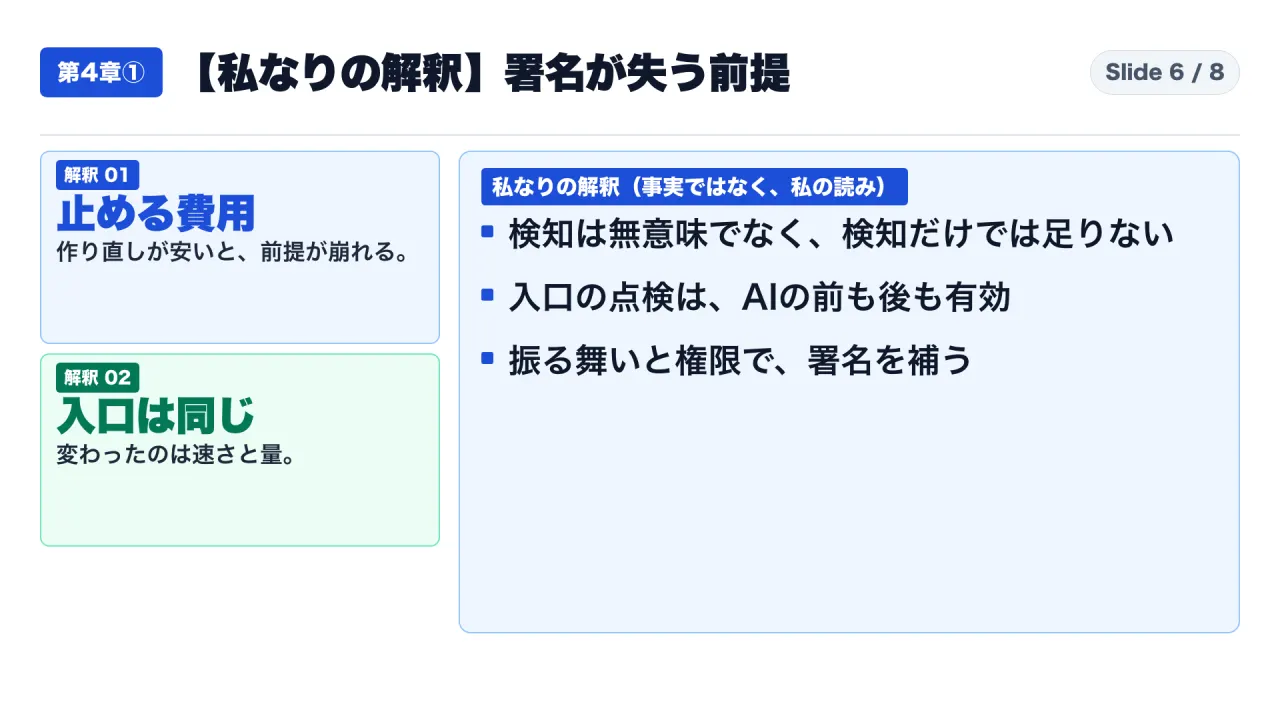
- Signatures Lose Economic Leverage: What AI destroys is not the technical ability of a signature to match a known binary, but the economic cost asymmetry. When an AI agent recompiles malware in seconds, blocking a specific hash imposes zero economic cost on the adversary.
- The Front Doors Have Not Changed: In every case—GTG-20006, GTG-50014, and Microsoft 2024—adversaries entered through stolen credentials, missing MFA on non-production assets, over-privileged OAuth apps, or public DNS misconfigurations. AI accelerates traversal and lateral movement, but it relies on pre-existing administrative hygiene failures.
- Behavioral Telemetry Outweighs Static Rules: Microsoft detected Midnight Blizzard in 2024 by scrutinizing anomalous EWS audit logs. In an era where AI agents constantly mutate payloads, behavioral monitoring and strict identity fencing are the only reliable defense lines.
5. Practical Enterprise Defense: A 3-Step Identity Audit Playbook
Corporate security officers and IT administrators should prioritize three concrete technical actions:
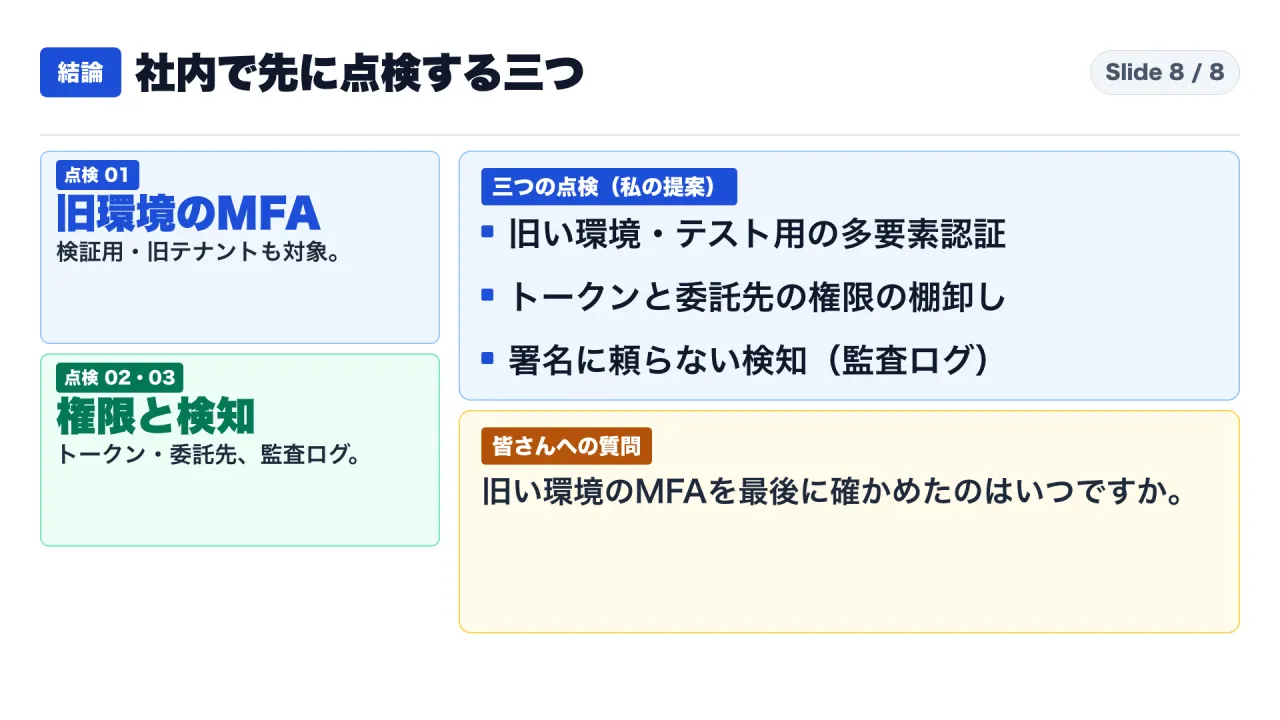
Step 1: Universal MFA Audit Across Non-Production Environments
Inventory all staging, development, sandbox, and legacy cloud tenants. As demonstrated by the 2024 Microsoft breach, attackers target abandoned test accounts to bypass perimeter defenses. Enforce hardware-backed or phishing-resistant MFA universally across all directories, decommissioning inactive accounts immediately.
Step 2: Inventory OAuth Apps and Session Token Revocation
Audit third-party SaaS integrations, service principals, and legacy OAuth applications. Verify which applications hold elevated permissions (e.g., Mail.ReadWrite, Directory.ReadWrite.All). Establish automated procedures to invalidate and revoke active session tokens across all downstream tenants within minutes of detected compromise, neutralizing high-velocity exfiltration loops like GTG-50014.
Step 3: Implement Identity-Centric Behavioral Logging
Move beyond file-hash alerts. Configure automated alerts for anomalous sign-in patterns, unexpected administrative consent grants, and bulk session store accesses in Azure AD / Entra ID and Google Workspace audit logs. Ensure dedicated security analysts review identity anomaly telemetry daily.
Frequently Asked Questions
Does Anthropic’s report mean endpoint antivirus is completely useless?
No. Antivirus and EDR signatures remain essential for filtering automated, low-sophistication malware. What Anthropic’s report highlights is that static signatures alone cannot deter sophisticated adversaries who utilize AI agents to autonomously rewrite payloads upon detection.
Are GTG-20006 and GTG-50014 the same hacking group?
No. GTG-20006 is a state-aligned cyber espionage cluster targeting government and defense entities in Europe and Ukraine. GTG-50014 is a financially motivated cybercrime group associated with ShinyHunters targeting corporate data for extortion.
Did threat actors use AI to breach Microsoft in 2024?
No. Public SEC filings and MSRC advisories contain no indication that AI was used during the 2023–2024 Midnight Blizzard breach. It succeeded via conventional password spraying and missing MFA on a legacy test account, serving as an AI-free baseline.
Were Anthropic’s internal systems breached during these campaigns?
No. Anthropic explicitly confirmed that its internal corporate systems were not breached. In cluster GTG-50014, threat actors exfiltrated Anthropic API keys stored insecurely within compromised victim environments.
Primary Sources and References
- Anthropic Threat Intelligence Report (September 2026):
https://www.anthropic.com/threat-intelligence-report-september-2026 - Microsoft Security Response Center Advisory: Nation-State Attack Detection (January 19, 2024):
https://www.microsoft.com/en-us/msrc/blog/2024/01/microsoft-actions-following-attack-by-nation-state-actor-midnight-blizzard - Microsoft Security Blog: Guidance for Responders on Midnight Blizzard (January 25, 2024):
https://www.microsoft.com/en-us/security/blog/2024/01/25/midnight-blizzard-guidance-for-responders-on-nation-state-attack/ - Microsoft Security Response Center Update on Midnight Blizzard (March 8, 2024):
https://www.microsoft.com/en-us/msrc/blog/2024/03/update-on-microsoft-actions-following-attack-by-nation-state-actor-midnight-blizzard - Microsoft Corporation Form 8-K Filing (January 19, 2024):
https://www.sec.gov/Archives/edgar/data/789019/000119312524011295/d708866d8k.htm - Microsoft Corporation Form 8-K/A Amendment Filing (March 8, 2024):
https://www.sec.gov/Archives/edgar/data/789019/000119312524062997/d808756d8ka.htm