Credit Ratings and Foundation Model Debt: Disentangling Anthropic's S-1 Credit Facility from Financial Times Headlines
A forensic legal and financial audit examines how credit rating triggers operate within Anthropic’s $15 billion credit agreement and why Blackstone’s reported junk-rating warning remains distinct from statutory SEC disclosures.
Published: October 31, 2026 | Read time: ~10 min | Watch Video (Japanese)
Executive Summary: Rating Covenants vs. Secondary Press Reporting
In corporate credit analysis, debt covenants linked to agency credit ratings represent critical governing mechanisms. On October 26, 2026, Anthropic PBC filed its Form S-1 registration statement with the U.S. Securities and Exchange Commission (SEC), disclosing an amended $15.0 billion secured revolving credit facility containing explicit rating-dependent collateral release clauses.
Four days later, on October 30, 2026, the Financial Times published an article with the headline:
“Anthropic may not secure investment-grade rating after IPO, Blackstone tells investors”
Subtitle: “Private capital giant says AI group is expected to receive ‘high’ junk rating in shift from previous guidance”
This headline generated immediate speculation across corporate finance circles. Commentators questioned whether Anthropic’s balance sheet was vulnerable to credit rating agency downgrades.
However, an empirical reconciliation between statutory SEC filings and press reporting establishes a crucial distinction:
- The Documented Reality (Form S-1): Anthropic’s filing details the contractual mechanics of its $15.0 billion facility, including the criteria under which corporate asset liens and subsidiary guarantees fall away upon securing an investment-grade rating from two major rating agencies. Crucially, the S-1 does not disclose any assigned credit rating, nor does it assert that Anthropic has obtained investment-grade status.
- The Reported Narrative (Financial Times): The assertion that Anthropic may receive a speculative-grade (“junk”) rating originates from communications between Blackstone and its private wealth investors. It reflects an asset manager’s internal advisory assessment rather than an official rating action by Moody’s, S&P Global, or Fitch Ratings.
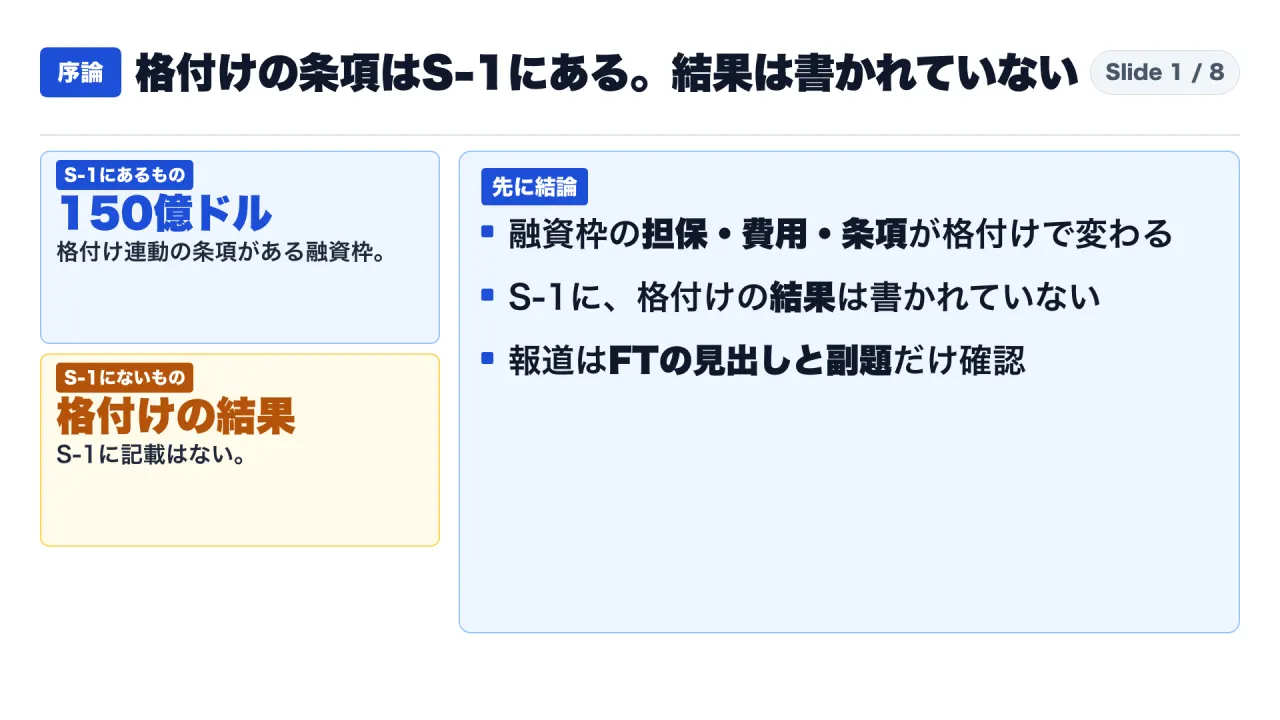
This analysis dissects the statutory mechanics of Anthropic’s credit agreement, audits the balance-sheet liquidity buffer of $131.7 billion against multi-hundred-billion-dollar infrastructure liabilities, and provides an enterprise playbook for interpreting debt covenants.
Epistemological Framework: Fact, Press Reporting, and Financial Derivation
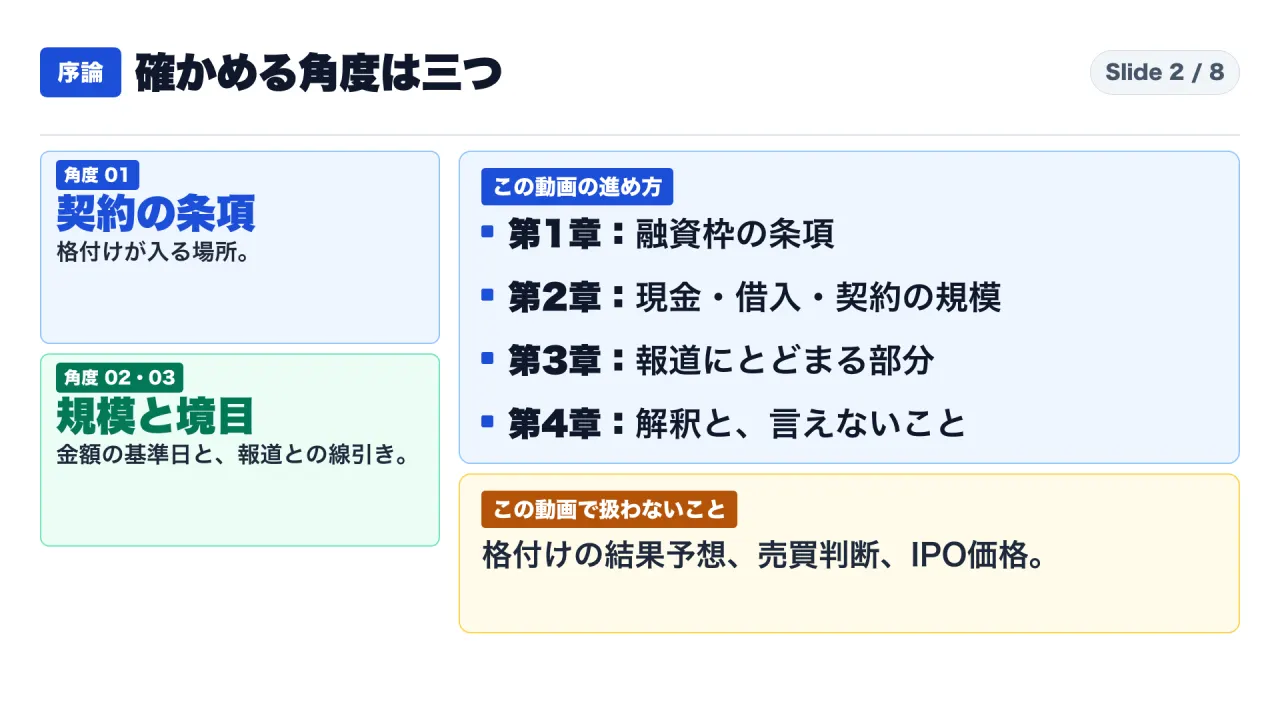
To establish clear evidential boundaries, this audit categorizes all statements under four designations:
- [Fact]: Verifiable figures, legal clauses, and accounting balances extracted directly from Anthropic’s Form S-1 registration statement.
- [FT Report]: Assertions, headlines, and subheadings published by the Financial Times citing secondary communications from Blackstone.
- [Author Calculation]: Mathematical derivations calculated directly from disclosed figures (formulas explicitly documented).
- [Analytical Interpretation]: Deductive assessments regarding debt covenant structures, balance-sheet leverage, and capital market access.
Key Credit and Capital Terminology
- Credit Rating: An evaluation of an obligor’s creditworthiness issued by registered rating agencies (Moody’s, S&P, and Fitch).
- Investment Grade: Senior rating tiers (typically Baa3/BBB- and above). In Anthropic’s credit agreement, this refers to the contractual definition of “Investment Grade Rating.”
- Speculative Grade (“Junk”): Market vernacular for debt rated below investment grade (Ba1/BB+ and lower). This term does not appear in Anthropic’s S-1.
- Revolving Credit Facility: A committed credit line permitting flexible borrowing, repayment, and redrawing up to a contractual ceiling ($15.0 billion).
- Guarantee and Collateral Release Date: The contractual date when subsidiary guarantees and asset liens terminate following qualifying investment-grade ratings.
- Cross-Default: A contractual provision where a default under one material agreement triggers an immediate event of default across adjacent financing facilities.
1. Mechanics of the $15 Billion Credit Facility in Form S-1
Statutory Terms of the September 2026 Credit Agreement
According to Anthropic’s Form S-1, the company restructured its commercial banking arrangements in September 2026:
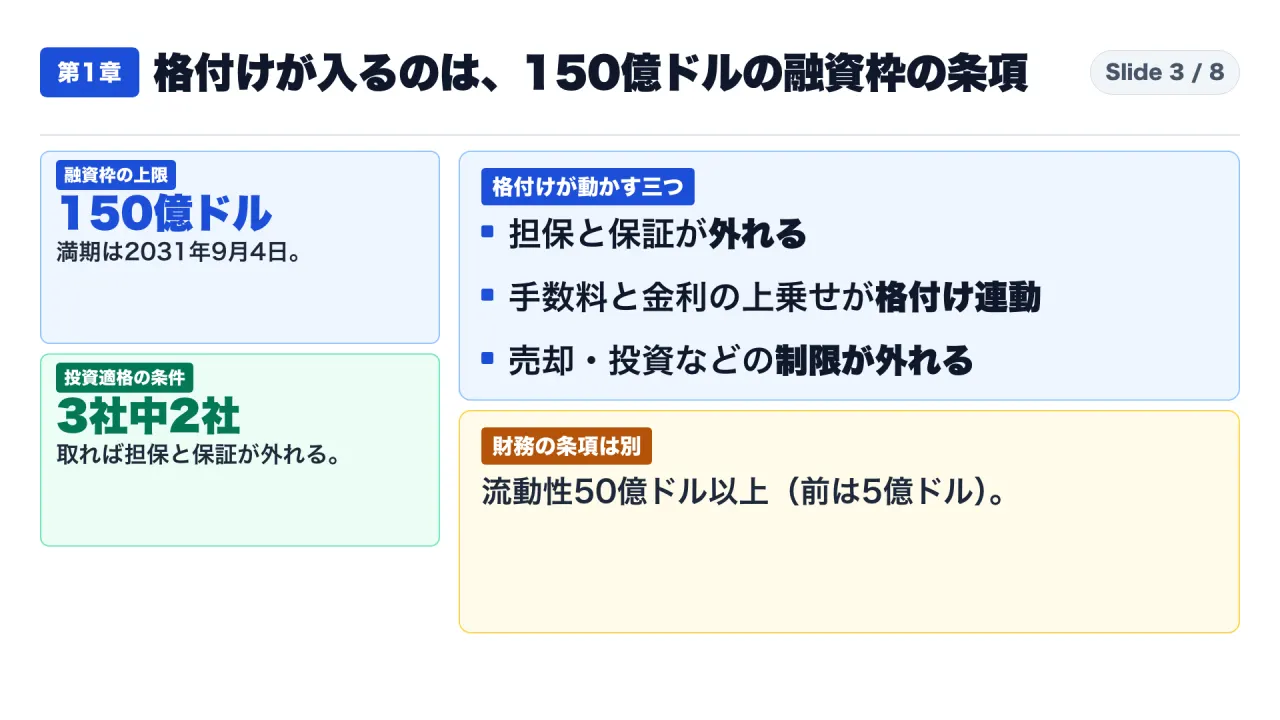
- Facility Structure: A $15.0 billion secured revolving credit facility maturing on September 4, 2031.
- Expansion Scale: The facility replaced an earlier credit facility of approximately $3.3 billion, representing an expansion of approximately 4.54x (15.0 / 3.3).
- Historical Utilization: As of June 30, 2026, zero borrowings were drawn under the prior $3.3 billion facility.
- Baseline Collateral: The facility is guaranteed by Anthropic’s material subsidiaries and secured by first-priority liens across substantially all corporate and subsidiary assets.
Three Structural Consequences of Achieving Investment Grade
The S-1 defines an explicit operational mechanism triggered if Anthropic obtains investment-grade ratings:
- Full Collateral and Guarantee Release: If Anthropic receives an Investment Grade Rating from at least two of Moody’s, S&P, and Fitch, the company may elect to release all asset liens and terminate subsidiary guarantees (the “Guarantee and Collateral Release Date”).
- Margin Spread Adjustments: Following the release date, undrawn facility commitment fees and borrowing interest spreads transition to a grid based on credit rating tiers (pricing grids defined within the credit agreement, omitted from S-1 text).
- Covenant Relief: Restrictive negative covenants—including limitations on asset sales, capital investments, restricted payments (dividends and share repurchases), and affiliate transactions—terminate upon collateral release. Certain debt incurrence and lien limitations are modified to standard investment-grade provisions.
What Does Not Fall Away: The $5.0 Billion Liquidity Covenant
Crucially, the S-1 notes that the credit facility incorporates a mandatory financial covenant:
- Minimum Liquidity Floor: Anthropic must maintain unencumbered liquid assets of at least $5.0 billion at the end of each fiscal quarter, commencing with the quarter ending December 31, 2026.
- Tenfold Threshold Increase: Under the prior credit facility, the minimum liquidity threshold was $500 million. The restructured agreement increased this requirement by 10.0x ($5.0B / $500M = 10.0).
- The statutory text does not state that this $5.0 billion liquidity covenant terminates upon achieving investment-grade status. It remains an active operational balance-sheet constraint.
| Facility Parameter | Documented Contractual Terms in Form S-1 |
|---|---|
| Credit Facility Ceiling | $15.0 Billion (Senior secured revolving credit facility) |
| Final Maturity Date | September 4, 2031 |
| Rating Release Condition | Investment Grade Rating from at least 2 of 3 agencies (Moody’s, S&P, Fitch) |
| Collateral Impact | Subsidiary guarantees and all asset liens released at company election |
| Covenant Relief | Restrictions on asset sales, investments, restricted payments, and affiliate deals fall away |
| Minimum Liquidity Floor | $5.0 Billion at each quarter-end (commencing December 31, 2026; up from $500M) |
| Assigned Rating in S-1 | None (Filing contains zero assigned rating results) |
2. Balance-Sheet Realities: $131.7 Billion in Cash vs. Multi-Hundred-Billion Liabilities
Liquid Assets as of June 30, 2026
An audit of the consolidated balance sheet in Form S-1 demonstrates that Anthropic entered the second half of 2026 with an unprecedented liquidity cushion:
- Cumulative Equity and Convertible Capital Raised: $141.1 billion.
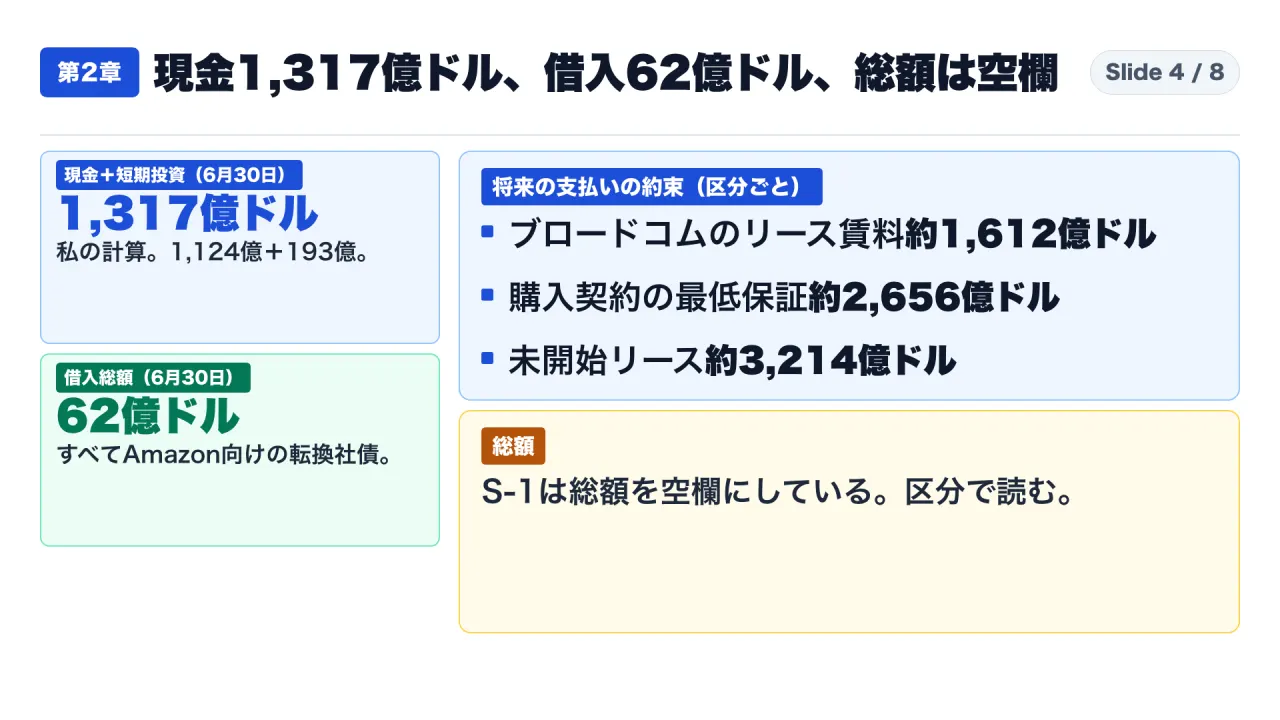
- Cash and Cash Equivalents: $112.4 billion.
- Short-Term Marketable Investments: $19.3 billion.
- Total Liquid Assets: $131.7 billion ($112.4B + $19.3B).
- Outstanding Funded Debt: $6.2 billion (convertible promissory notes issued to Amazon).
- [Author Calculation]: Cash and short-term investments exceeded funded debt by 21.24x ($131.7B / $6.2B).
- Restricted Cash: $2.5 billion (pledged to support facility leases and collateral requirements).
The Scale of Off-Balance-Sheet Procurement Commitments
While current balance-sheet leverage is minimal, Anthropic has executed massive multi-decade infrastructure agreements:
- Broadcom Master Equipment Lease: Anthropic executed a five-year master equipment lease with Broadcom for specialized hardware clusters. Contractual rent obligations total approximately $161.2 billion (excluding interest), payable quarterly. The leases are executed through two special purpose subsidiaries, guaranteed by Anthropic, and non-cancellable by either party. To support these lease payments, Anthropic secured an agreement permitting the issuance of up to $42.0 billion in convertible promissory notes bearing 9.0% Payment-in-Kind (PIK) interest. The filing states Anthropic does not anticipate issuing these notes prior to IPO completion, and availability remains conditioned upon ongoing compliance with credit facility liquidity covenants.
- Fixed and Minimum Purchase Obligations: Under Note 13, future minimum commitments under executed commercial agreements totaled approximately $265.6 billion as of June 30, 2026, spanning 1 to 20 years.
- Uncommenced Lease Obligations: Undiscounted future commitments under equipment and facility leases executed but not yet commenced totaled approximately $321.4 billion as of June 30, 2026.
- Post-June 30 Subsequent Commitments: Between July 1, 2026, and October 26, 2026, Anthropic executed additional commitments with minimum payment guarantees of approximately $245.0 billion, alongside short-duration non-cancellable commitments of $21.0 billion.
- Contractual Aggregate Left Blank:
Crucially, Anthropic leaves the total aggregate contractual commitment figure explicitly blank in its S-1 summary text (
$[___]). The filing notes that commitments outside 2030 are primarily concentrated between 2031 and 2045.
Analysts must refrain from summing these individual commitment categories. Because baseline dates, commencement schedules, and commercial terms overlap, calculating an arbitrary total without statutory reconciliations distorts corporate commitments.
3. Dissecting the Financial Times Report: Sourcing and Evidential Limits
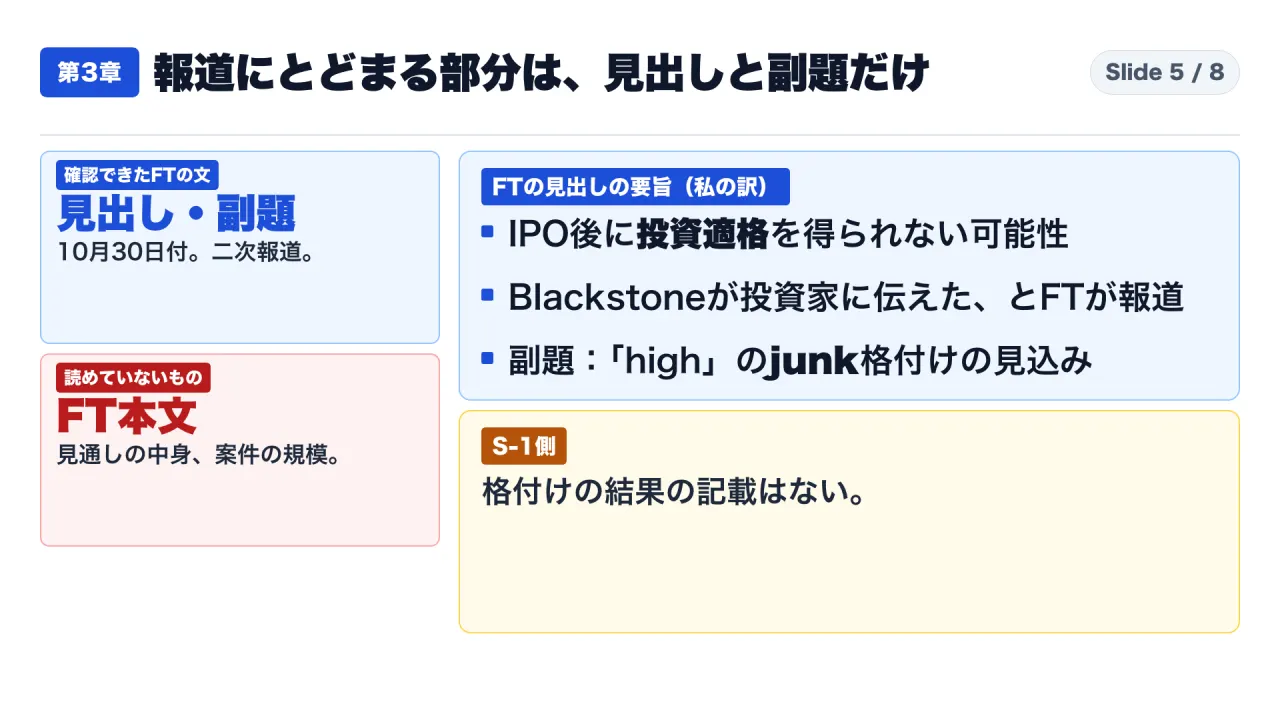
Parsing the FT Headline and Subtitle
A forensic analysis of the October 30, 2026 Financial Times report reveals key structural boundaries:
- The Reported Attribution: The statement that Anthropic may receive a “high junk” rating is attributed exclusively to Blackstone communicating to its private wealth investors. The report does not cite a published credit opinion or rating committee resolution from Moody’s, S&P, or Fitch.
- The Shift from “Previous Guidance”: The FT subtitle references an internal change in Blackstone’s underwriting outlook (“in shift from previous guidance”). However, the substance, parameters, and timing of Blackstone’s prior guidance are not documented in public SEC records.
- Absence of Blackstone as a Statutory Lender: Full-text queries across Anthropic’s Form S-1 confirm that Blackstone does not appear as an administrative agent, arranger, or syndicated lender in the $15.0 billion credit facility (appearing solely within an executive’s historical employment biography).
- The Evidential Boundary: The FT report represents private secondary market commentary. While Blackstone’s perspective carries weight in private credit markets, an investor memo cannot be equated with an audited statutory disclosure or an official credit rating.
4. Strategic Governance: Credit Ratings as Corporate Health Gauges
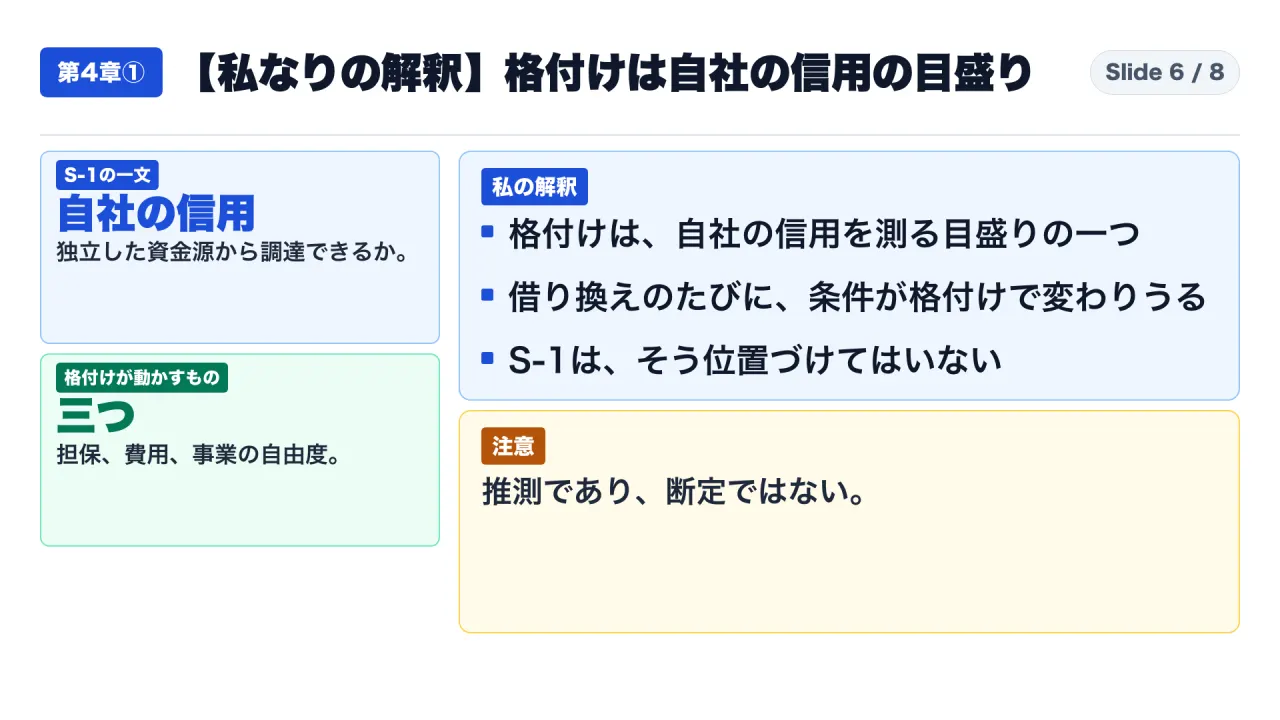
Integrating statutory evidence establishes three governance principles:
- Transition from Vendor Financing to Independent Capital: In the MD&A, Anthropic’s management notes that early AI infrastructure was financed through capital and credit enhancements provided by cloud hyperscalers and silicon suppliers. Reducing dependence on vendor financing requires accessing public institutional debt markets on the strength of Anthropic’s standalone corporate credit.
- Ratings Determine Financial Flexibility, Not Imminent Solvency: The operational consequence of receiving an investment-grade rating is the release of asset liens and the elimination of negative covenants. Failing to achieve investment grade does not trigger loan acceleration; it simply maintains existing asset liens and reporting covenants.
- Long-Term Refinancing Dynamics: With multi-decade infrastructure liabilities extending through 2045, Anthropic will periodically access debt capital markets to refinance maturing tranches. Credit ratings directly influence borrowing spreads and refinancing costs over this multi-decade investment cycle.
5. Scope Boundaries and Information Limitations
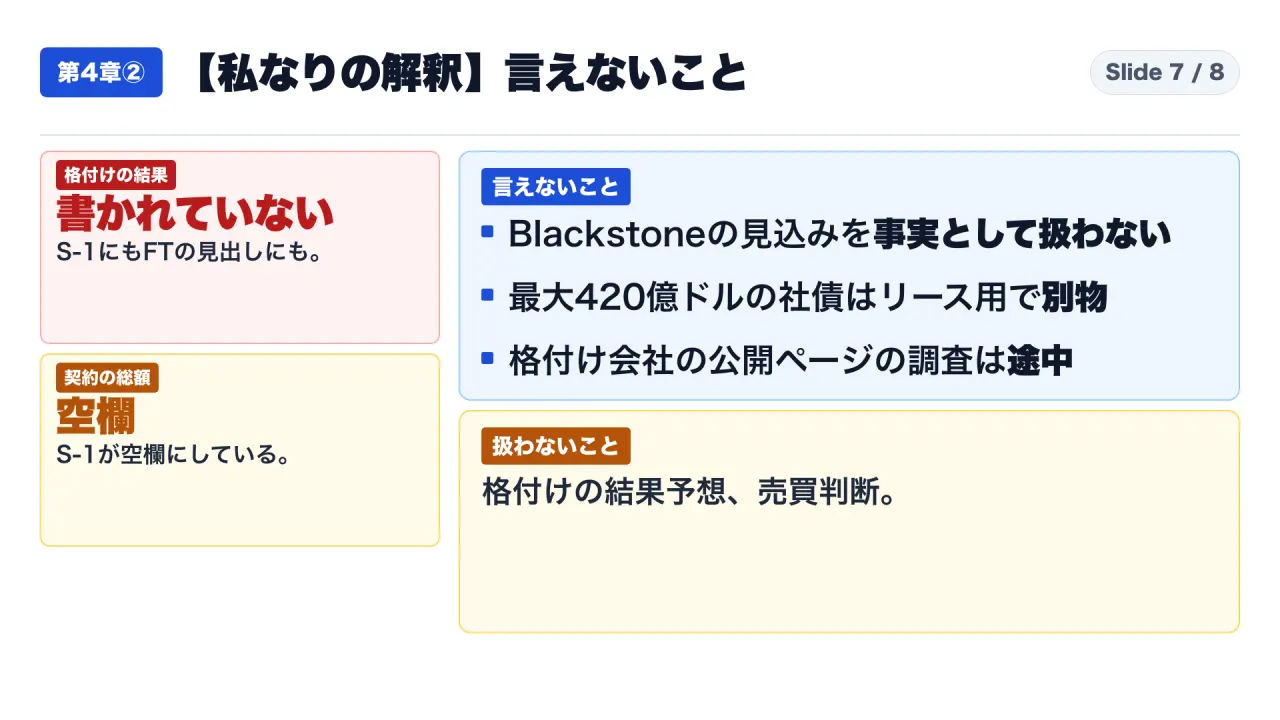
Corporate analysts must observe explicit evidential boundaries:
- No Assigned Rating: Neither the Form S-1 nor the FT headline documents an assigned credit rating from Moody’s, S&P, or Fitch.
- Incomplete Press Review: This analysis audits the verified public headline and subtitle of the FT article; proprietary subscription text was not independently accessed.
- Unconsolidated Commitments: Aggregate multi-decade commitment figures remain unstated in S-1 records; adding sub-totals is methodologically invalid.
- No Equity Valuation Opinions: This review evaluates credit covenants and balance-sheet liquidity, omitting equity price forecasts or investment solicitations.
6. Enterprise Implementation Playbook: Auditing Counterparty Debt Covenants
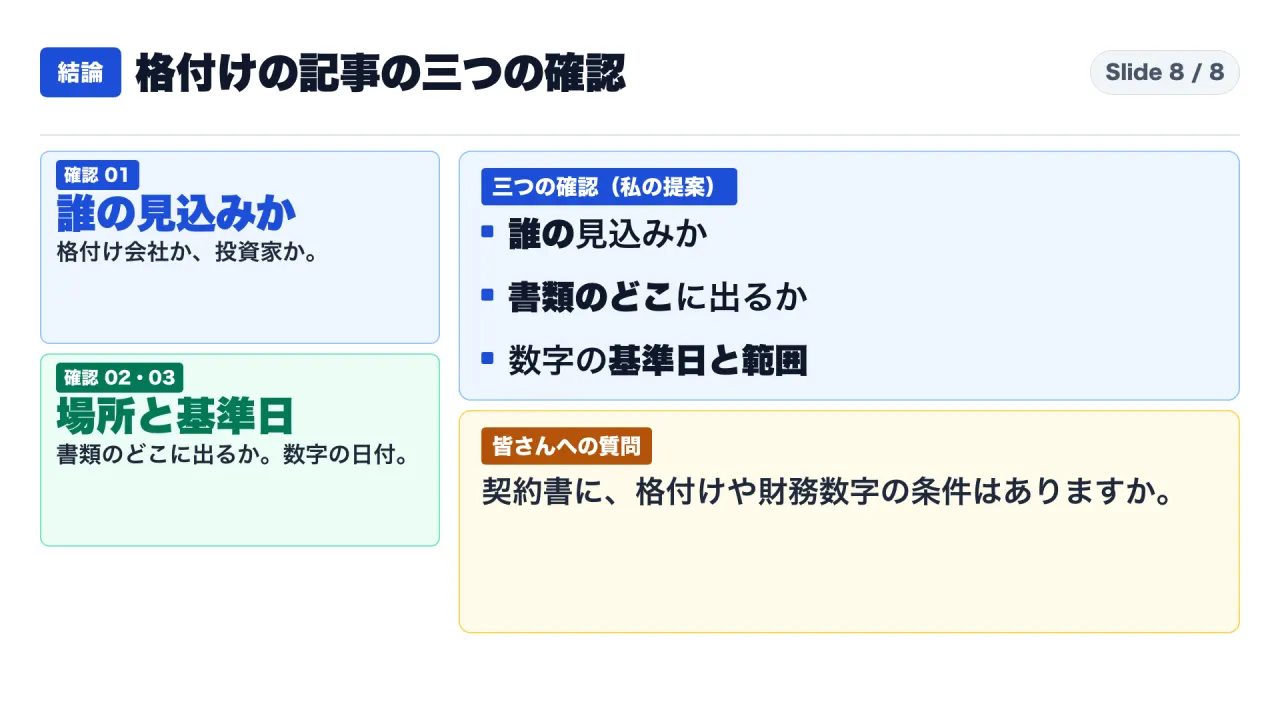
Corporate treasurers, credit risk managers, and enterprise procurement directors should apply a disciplined three-step protocol when evaluating counterparty credit news:
Step 1: Trace the Attribution of Credit Commentary
Determine whether market commentary reflects an agency rating action or secondary speculation:
- Is the statement an official press release from Moody’s, S&P, or Fitch?
- Or is it an advisory communication from an asset manager or syndicate participant? In this instance, the commentary reflects Blackstone’s internal investor perspective rather than an official agency rating.
Step 2: Locate Statutory Covenant Language in SEC Filings
Search EDGAR filings for credit rating, Investment Grade, and collateral release:
- Identify what covenants actually hinge on ratings (e.g., collateral release vs. mandatory acceleration).
- In Anthropic’s agreement, rating upgrades release collateral, while rating shortfalls leave existing protections intact without triggering acceleration.
Step 3: Align Balance-Sheet Dates and Contractual Commitments
Construct a multi-horizon liquidity matrix segregating funded debt from contingent liabilities:
| Financial Metric | Documented Balance | Balance Sheet Date | Governance Classification |
|---|---|---|---|
| Liquid Cash & Equivalents | $112.4 Billion | June 30, 2026 | Unrestricted balance-sheet cash |
| Short-Term Investments | $19.3 Billion | June 30, 2026 | Liquid marketable securities |
| Funded Long-Term Debt | $6.2 Billion | June 30, 2026 | Convertible notes issued to Amazon |
| Secured Revolving Facility | $15.0 Billion | September 2026 | Undrawn committed borrowing capacity |
| Minimum Liquidity Floor | $5.0 Billion | Commencing Dec 31, 2026 | Mandatory quarter-end covenant |
| Broadcom Master Lease Rent | ~$161.2 Billion | 5-Year Term | Non-cancellable hardware lease obligations |
| Fixed Purchase Commitments | ~$265.6 Billion | 1 to 20 Years | Future take-or-pay purchase agreements |
By systematically separating statutory covenants from secondary market reporting, enterprise leaders can navigate hyperscaler credit announcements with evidentiary precision.
Primary Sources and References
- Anthropic PBC Form S-1 Registration Statement (Filed October 26, 2026): SEC EDGAR Preliminary Prospectus
- Financial Times Reporting on Blackstone Investor Communications (October 30, 2026): Financial Times Article