What Do Amazon's SEC Filings Actually Disclose About AWS Remaining Performance Obligations and $80 Billion Supplier Financing?
A forensic accounting analysis of Amazon’s Q3 2026 Form 10-Q demonstrates how to evaluate $578 billion in unearned commitments and up to $80 billion in equipment credit lines without confusing contractual backlog with recognized revenue.
Published: October 31, 2026 | Read time: ~10 min | Watch Video (Japanese)
Executive Summary: Reading Statutory Disclosures Without Speculative Overreach
When technology hyperscalers announce earnings, market commentary often fixates on commercial commitments and infrastructure financing. In Amazon.com, Inc.’s Form 10-Q for the quarter ended September 30, 2026 (filed with the SEC on October 30, 2026), two figures attracted immediate attention:
- $578 Billion in Unrecognized Performance Obligations: Uncompleted contracts primarily related to AWS, with a weighted-average remaining life of 6.1 years.
- Up to $80 Billion in Secured Supplier Financing: A facility established to fund technology infrastructure purchases between early 2027 and late 2028.
Financial media frequently conflate contractual commitments with immediate revenue and credit facilities with drawn balance-sheet debt. This analysis examines what Amazon’s filings explicitly document, what independent calculations reveal, and where disclosure boundaries leave critical details unstated.
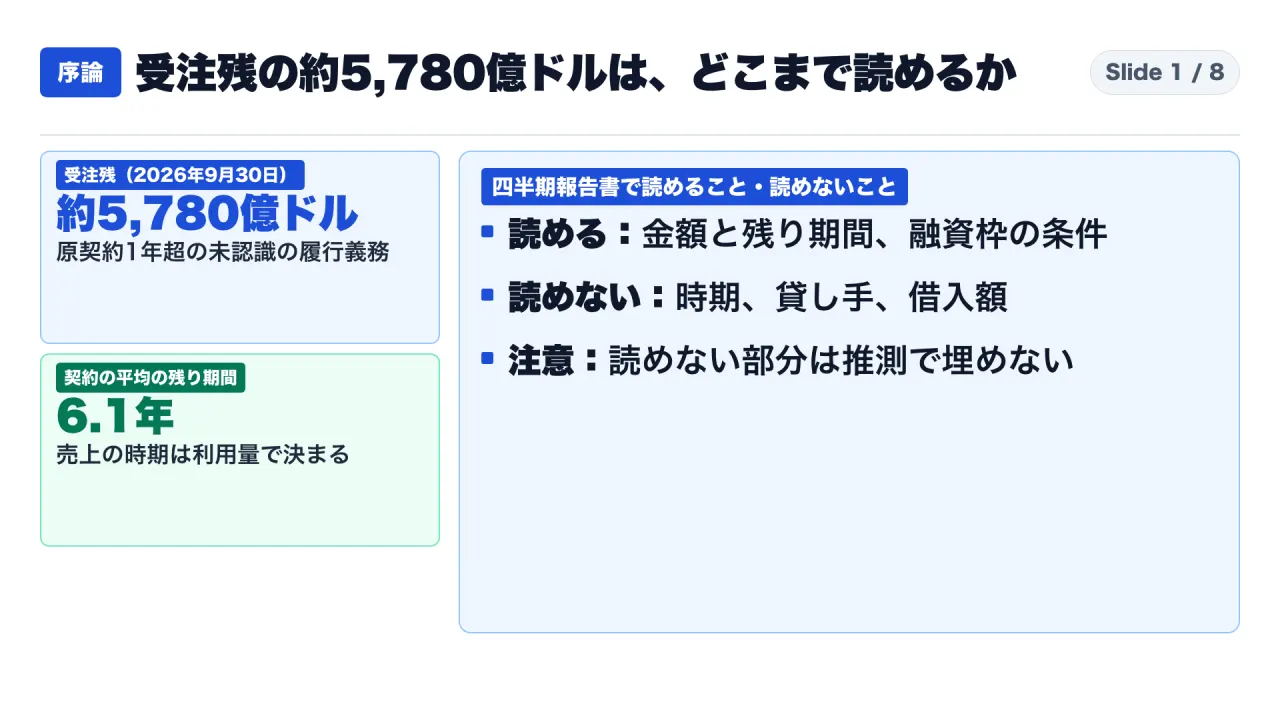
The Core Regulatory Boundary
Based on Amazon’s Form 10-Q, corporate analysts can verify three documented facts:
- Contractual Commitment Balance: Amazon estimates unrecognized performance obligations with original terms exceeding one year at approximately $578 billion as of September 30, 2026, with a weighted-average remaining life of 6.1 years.
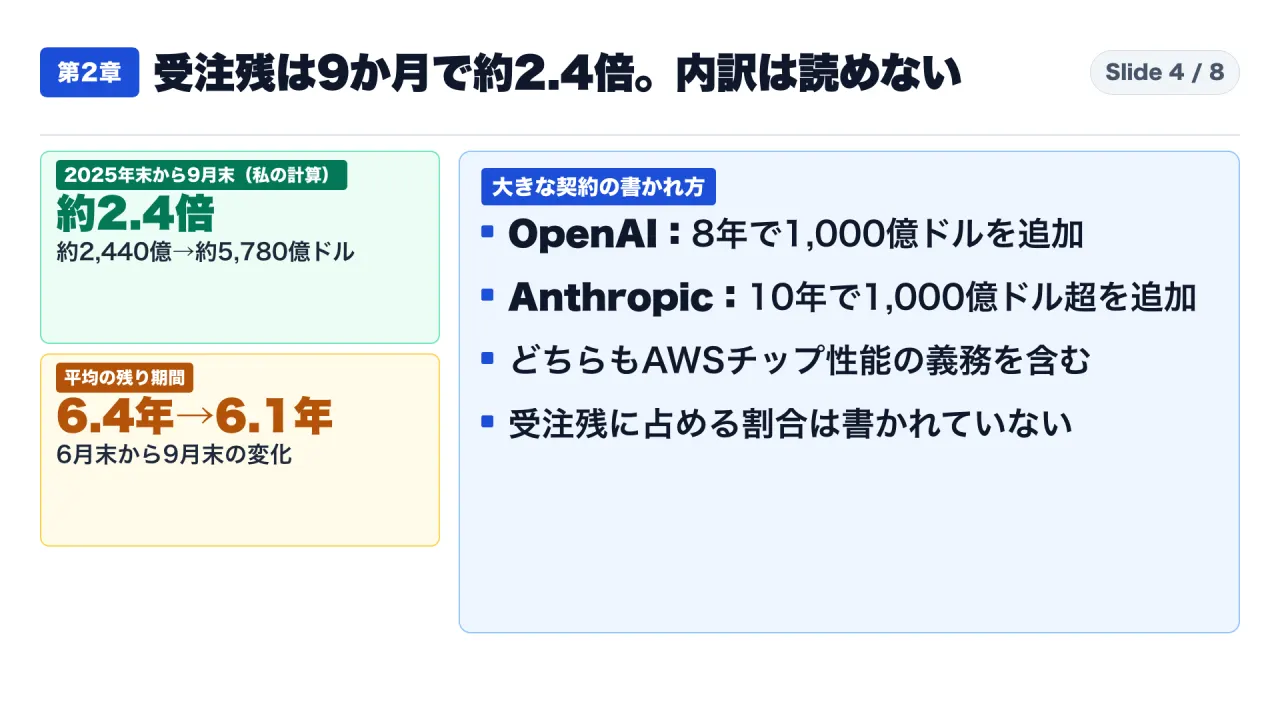
- Sequential Backlog Progression: Across four reporting periods from December 31, 2025, to September 30, 2026, this obligation balance expanded from $244 billion to $578 billion—a 2.37-fold increase (~2.4x).
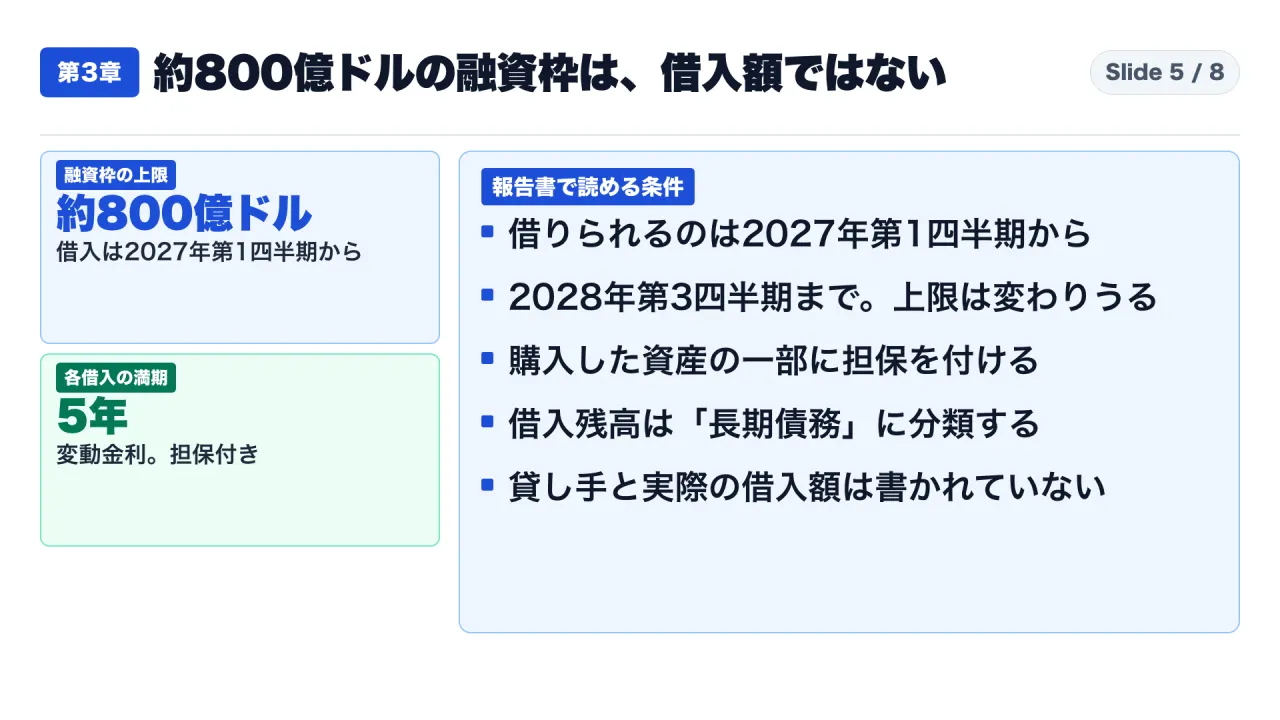
- Financing Facility Parameters: Amazon established a secured loan facility up to approximately $80 billion for tech infrastructure assets, exercisable at Amazon’s discretion between Q1 2027 and Q3 2028, maturing five years from each draw date at variable rates.
Conversely, statutory filings do not disclose:
- Revenue Recognition Cadence: The filing provides no schedule detailing when the $578 billion converts to revenue, noting timing depends on customer usage and may extend beyond contract terms.
- Customer Concentration: While Note 1 references multi-year commitment expansions with OpenAI and Anthropic, the filing omits specific dollar balances or percentages attributed to individual customers within the $578 billion total.
- Lender Identities and Drawn Debt: The filing omits lender identities and reports no debt drawn under this facility as of September 30, 2026.

Epistemological Framework: Fact, Calculation, and Interpretation
This audit applies four explicit analytical designations:
- [Fact]: Verifiable figures and statutory notes extracted from Amazon’s Form 10-Q, Form 10-K, and earnings releases.
- [Calculated Value]: Mathematical derivations calculated directly from published statutory figures.
- [Corporate Disclosure Limitation]: Items where disclosures explicitly state that data is estimated or omitted.
- [Analytical Interpretation]: Deductions regarding corporate procurement, financial risk, and governance.
Core Terminology Definitions
- Performance Obligations: Contractual promises to deliver services in future periods. In Amazon’s filings, this captures estimated unrecognized revenue from contracts with original terms exceeding one year, primarily AWS. Note that “backlog” and “RPO” do not appear in the Form 10-Q; the statutory term is strictly “performance obligations.”
- Weighted-Average Remaining Life: The contract-weighted duration remaining across multi-year agreements. The weighting formula is unstated.
- Unearned Revenue: Consideration received or billed prior to service performance ($25.0 billion at December 31, 2025, with $18.1 billion recognized as revenue during the nine months ended September 30, 2026). The filing does not clarify whether unearned revenue is embedded within the $578 billion figure.
- Secured Loan Facility: A credit arrangement permitting capital draws up to a predetermined ceiling against specified collateral.
1. Deconstructing the $578 Billion in Unrecognized Performance Obligations
Statutory Location within Form 10-Q
In Note 1: Description of Business, Accounting Policies, and Supplemental Disclosures, following the unearned revenue table:
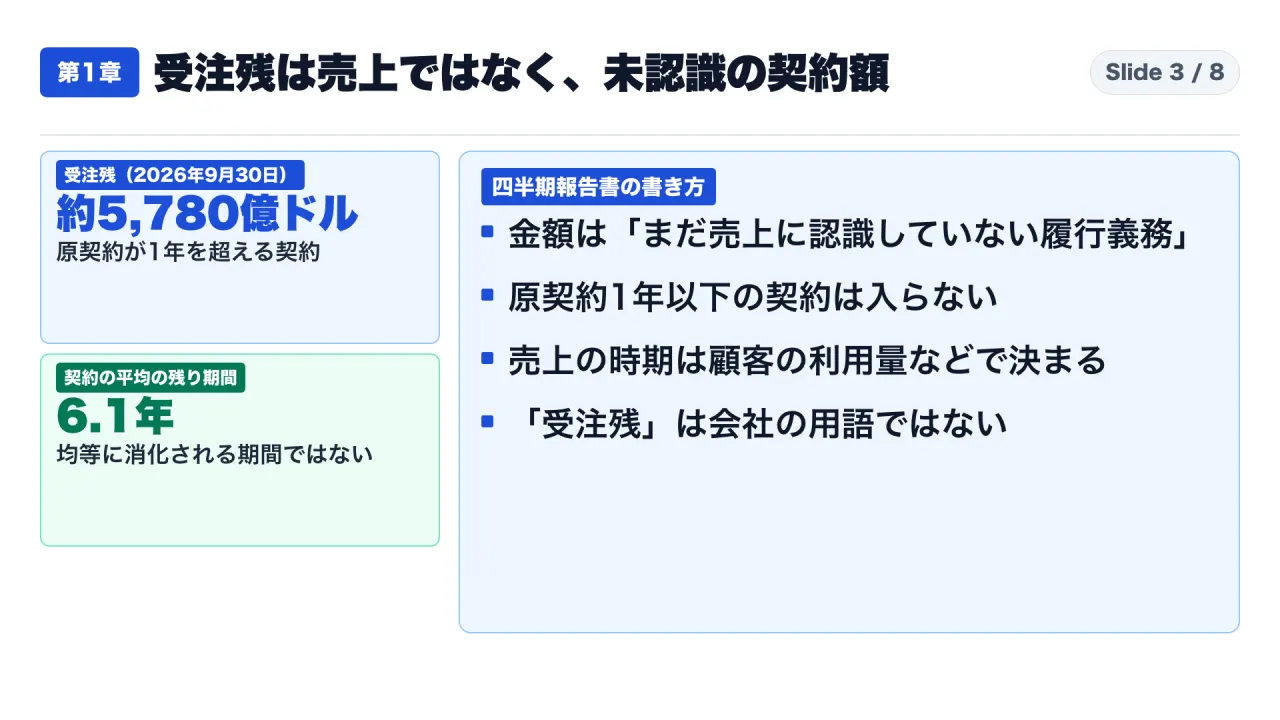
“[Fact] As of September 30, 2026, the estimated amount of our performance obligations, primarily related to AWS, that have an original duration longer than one year and are not yet recognized as revenue was approximately $578 billion, with a weighted-average remaining life of 6.1 years. Revenue will be recognized as services are rendered, which will depend on factors such as customer usage and our performance in accordance with contractual obligations, and may extend beyond the original contract period.”
Three Essential Analytical Qualifications
- Exclusion of Short-Term Contracts: The $578 billion total excludes agreements with original terms of one year or less, so it does not capture all AWS customer commitments.
- Non-Linear Recognition: A weighted-average life of 6.1 years does not mean equal annual revenue of $94.75 billion ($578B / 6.1). Recognition is contingent on customer compute consumption.
- Estimated Accounting Valuation: Amazon designates the figure as an “estimated amount”—anticipated future billings under master agreements, not fixed receivables.
Benchmark Context Against Quarterly AWS Financials
Amazon’s Q3 2026 release reported AWS net sales of approximately $46.0 billion (+39% YoY) and operating income of approximately $17.8 billion:
- [Calculated Value]: Dividing $578 billion by quarterly AWS sales of $46.0 billion yields ~12.57x (~12.6x), equaling roughly 12.6 quarters (~3.1 years) of trailing quarterly revenue.
- [Calculated Value]: Dividing operating income of $17.8 billion by net sales of $46.0 billion yields an operating margin of approximately 38.70% (~38.7%), an independent calculation based on rounded figures.
2. Tracking the 2.37x Expansion Across Four Consecutive Reporting Periods
Sequential Progression of Contract Balances
Compiling Amazon’s performance obligation disclosures across 2026 illustrates rapid expansion:
| Balance Sheet Date | Regulatory Source | Performance Obligations (>1 Year) | Weighted-Average Remaining Life | Sequential Net Increase |
|---|---|---|---|---|
| December 31, 2025 | Form 10-K (Annual Report) | ~$244 Billion | 4.1 Years | Base Period |
| March 31, 2026 | Form 10-Q (Q1 Report) | ~$364 Billion | 5.5 Years | +$120 Billion |
| June 30, 2026 | Form 10-Q (Q2 Report) | ~$496 Billion | 6.4 Years | +$132 Billion |
| September 30, 2026 | Form 10-Q (Q3 Report) | ~$578 Billion | 6.1 Years | +$82 Billion |
Forensic Derivations
- [Calculated Value]: From December 31, 2025, to September 30, 2026, obligations grew by $334 billion ($578B - $244B), a 2.37-fold increase (578 / 244 = 2.3688).
- [Calculated Value]: Net quarterly additions were $120 billion in Q1, $132 billion in Q2, and $82 billion in Q3, summing to $334 billion.
- [Calculated Value]: Weighted-average duration contracted by 0.3 years between June 30 (6.4 years) and September 30 (6.1 years).
- [Corporate Disclosure Limitation]: Amazon provides no commentary explaining the 0.3-year reduction, whether from contract burn-down or onboarding shorter multi-year commitments.
Deconstructing the OpenAI and Anthropic Disclosures
Note 1 references two mega-cap commitments executed in early 2026:
- OpenAI (Q1 2026): Expanded multi-year partnership by $100 billion over eight years (augmenting an existing $38 billion commitment).
- Anthropic (Q2 2026): Expanded multi-year partnership by over $100 billion over ten years. Both highlight contractual obligations concerning custom AWS silicon deployment and performance.
A common error is summing these announcements ($100B + $100B = $200B+) and dividing by nine-month obligation growth ($334B) to conclude that “OpenAI and Anthropic accounted for roughly 60% of growth.”
This derivation is invalid under SEC disclosure standards. The Form 10-Q does not disclose what portion of these announcements met revenue recognition thresholds for inclusion in the $578 billion balance, nor baseline cancellation rights. Attributing a specific percentage to these entities is unsupportable from statutory filings.
3. Dissecting the $80 Billion Secured Loan Facility
Statutory Contractual Parameters
Disclosures concerning infrastructure procurement financing appear in Note 5: Debt:
“[Fact] In connection with purchases of certain technology infrastructure assets, we have entered into supplier financing arrangements, including a secured loan facility (the ‘Loan Facility’). Under the Loan Facility, we may borrow, at our discretion, up to approximately $80 billion from the first quarter of 2027 through the third quarter of 2028, subject to variability depending on the volume and timing of orders placed and pricing terms. Borrowings under the Loan Facility bear interest at variable rates and mature five years from the date of each borrowing. We will grant a security interest in certain purchased assets. We will classify any outstanding borrowings under the Loan Facility as Long-term debt on our consolidated balance sheets, and principal payments will be reported as financing activities on our consolidated statements of cash flows.”
Detailed Clause Analysis
Key legal terms in this disclosure include:
| Statutory Contract Term | Exact Legal Phrasing | Governance and Accounting Significance |
|---|---|---|
| Borrowing Discretion | “at our discretion” | Amazon holds the right, not the obligation, to draw capital. Represents optional credit rather than debt. |
| Availability Window | “from Q1 2027 through Q3 2028” | Facility operates in future periods relative to September 30, 2026. Zero capital was drawn in Q3 2026. |
| Capacity Ceiling | “up to approximately $80 billion” | Upper ceiling subject to adjustment based on order volume and vendor pricing. |
| Interest Rate | “variable rates” | Exposes Amazon to benchmark rate fluctuations. Benchmark and spreads are omitted. |
| Maturity Structure | “mature five years from the date of each borrowing” | Tranches mature on a rolling five-year schedule from their respective draw dates. |
| Collateral Scope | “security interest in certain purchased assets” | Pledges specific acquired hardware. General assets remain unencumbered. |
| Balance Sheet Classification | “Long-term debt” | Future drawn balances sit within long-term liabilities rather than trade payables. |
| Cash Flow Accounting | “financing activities” | Principal repayments appear in Financing Cash Flows rather than Operating Cash Flows. |
Comparative Audit: Term Loan vs. Loan Facility
The difference in disclosure depth is clear when comparing the Loan Facility to the unsecured term loan in Note 5:
| Financing Mechanism | 2026 Unsecured Term Loan (Note 5) | Secured Loan Facility (Note 5) |
|---|---|---|
| Collateral | Unsecured (No asset pledges) | Secured (Pledges purchased assets) |
| Committed Capital | $17.5 Billion (Drawn September 2026) | Up to ~$80 Billion (Undrawn ceiling) |
| Interest Rate | SOFR + 0.625% to 0.875% | Variable Rates (Spread omitted) |
| Maturity Date | September 2029 (Explicit calendar date) | Five Years from Each Draw Date |
| Balance at Sep 30, 2026 | $17.5 Billion | $0 / Unstated (Borrowing starts Q1 2027) |
Segregating Extended Payment Terms from Loan Facilities
Analysts must not confuse this facility with trade credit arrangements in Note 4: Commitments and Contingencies, which details payment terms up to one year for equipment additions:
- Unpaid balances under extended terms are classified as Accounts payable.
- Payments appear as Purchases of property and equipment (Operating/Investing cash flows).
- Conversely, the $80 billion Loan Facility classifies balances as Long-term debt and repayments as Financing cash outflows. Conflating these mechanisms mischaracterizes working capital.
4. Strategic Governance: Backlog as “Contractual Depth” and Credit as “Procurement Optionality”
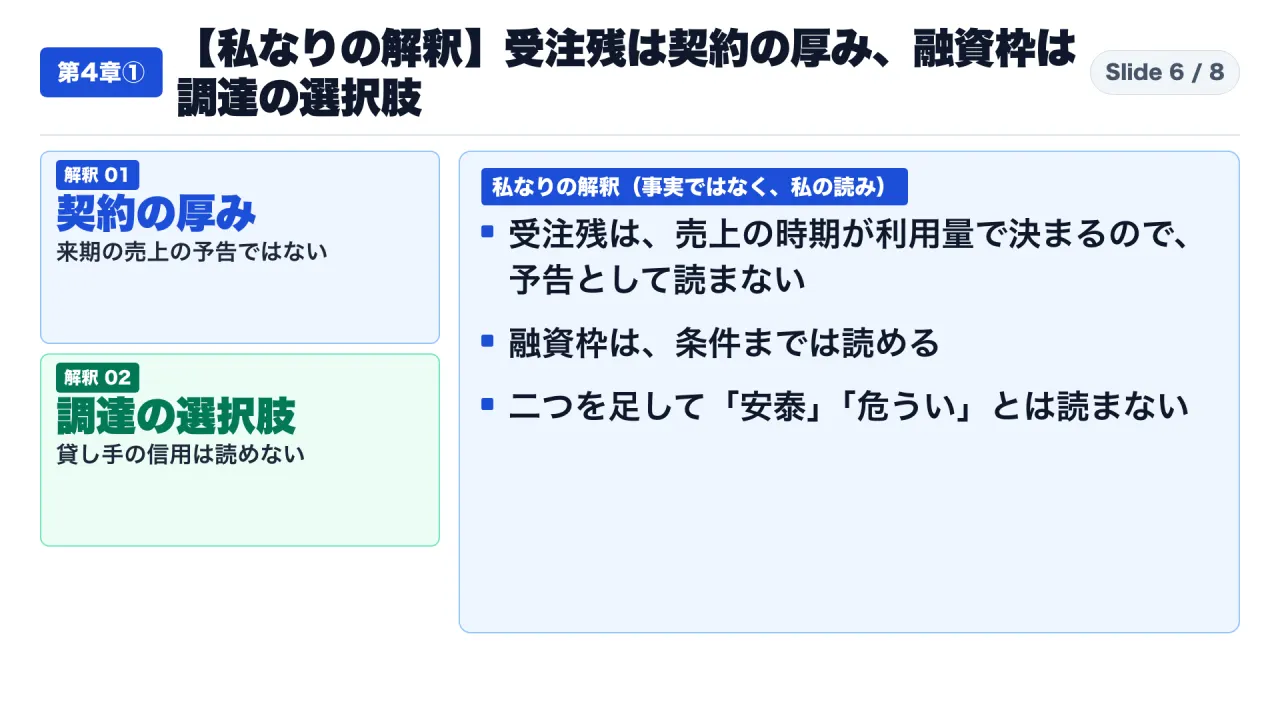
Synthesizing statutory evidence establishes three governance principles:
- Backlog Reflects Contractual Depth, Not Guaranteed Revenue: Multi-year agreements provide visibility, but realization is governed by data center delivery, chip milestones, and customer usage.
- Financing Facilities Represent Procurement Optionality: Up to $80 billion in equipment credit ensures Amazon can scale compute without relying exclusively on liquid cash reserves.
- Executive Outlooks Differ from Audited Filings: Management’s expectation that AWS net sales growth will exceed 40% in 2027 and 2028 is forward-looking commentary, not an audited performance obligation disclosure.
5. Scope Boundaries and Information Limitations
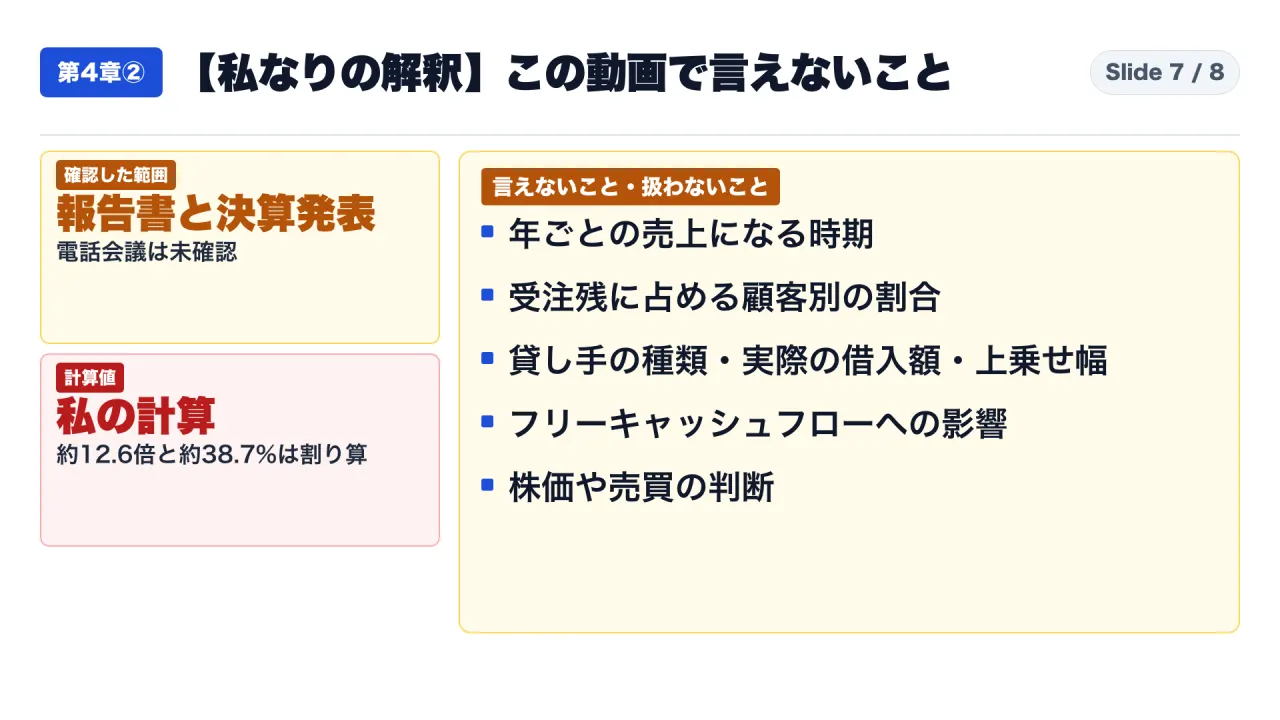
Corporate strategists must maintain explicit analytical guardrails:
- No Temporal Schedule: Amazon does not publish an annual run-off table for its $578 billion obligations.
- No Customer Backlog Breakdown: Specific backlog percentages for OpenAI, Anthropic, or others cannot be derived from SEC records.
- No Lender Identification: The participating financing entities remain undisclosed.
- Unstated Cash Flow Effects: Statutory notes omit representations on how initial equipment deliveries affect Free Cash Flow prior to principal amortization.
6. Enterprise Implementation Playbook: Three Practical Audits
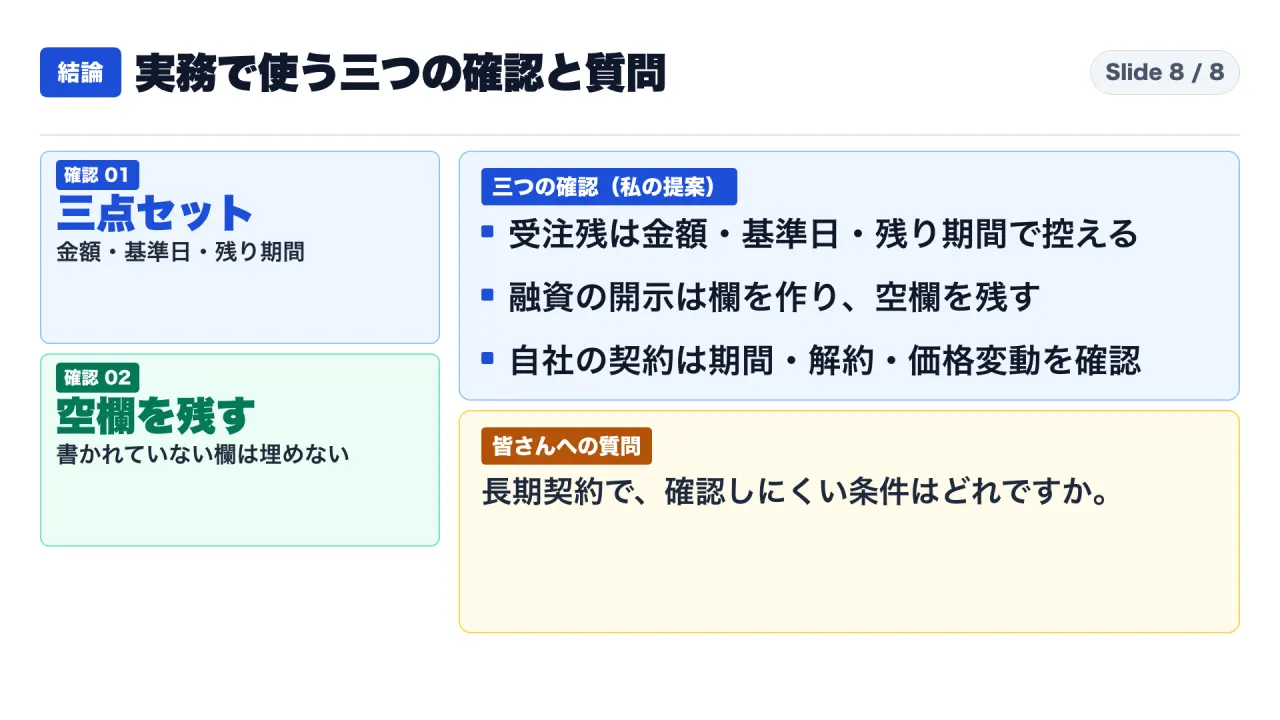
Procurement officers, credit managers, and treasury analysts should follow a structured three-step protocol:
Step 1: Record Performance Obligations as a Four-Part Metric
Capture: [Dollar Value: ~$578B] + [Balance Sheet Date: Sep 30, 2026] + [Weighted Duration: 6.1 Years] + [Scope: Contracts > 1 Year]. Tracking these parameters sequentially reveals whether growth represents expanding duration or near-term commitments.
Step 2: Construct Financing Matrices with Explicit Blank Cells
Leave unstated terms explicitly blank:
| Financing Parameter | Documented Corporate Status |
|---|---|
| Facility Capacity Ceiling | Up to ~$80 Billion (Subject to order volume and pricing) |
| Borrowing Horizon | Q1 2027 through Q3 2028 |
| Interest Rate Benchmark | Variable (Benchmark index unstated) |
| Interest Rate Spread | (Blank: Unstated in filing) |
| Tranche Maturity | Five years from individual draw dates |
| Pledged Collateral | Security interest in specified purchased infrastructure assets |
| Lender Identities | (Blank: Unstated in filing) |
| Drawn Capital at Balance Date | (Blank: Facility inactive at September 30, 2026) |
Leaving unstated cells blank prevents planning teams from substituting rumors for statutory evidence.
Step 3: Prioritize Internal Contract Terms Over Vendor Disclosures
When negotiating enterprise cloud agreements, primary risk mitigation lies in internal contract terms:
- Explicit multi-year price escalation caps.
- SLA termination rights without penalty.
- Compute availability guarantees tied to infrastructure deployment schedules. Vendor regulatory disclosures provide context on scale, but never substitute for negotiated contractual protections.
Primary Sources and References
- Amazon.com, Inc. Form 10-Q (Quarter Ended September 30, 2026, Filed October 30, 2026): SEC EDGAR Filing
- Amazon.com, Inc. Form 10-Q (Quarter Ended June 30, 2026): SEC EDGAR Filing
- Amazon.com, Inc. Form 10-Q (Quarter Ended March 31, 2026): SEC EDGAR Filing
- Amazon.com, Inc. Form 10-K (Fiscal Year Ended December 31, 2025): SEC EDGAR Filing
- Amazon.com, Inc. Q3 2026 Financial Results Announcement (October 29, 2026): Amazon Investor Relations News Release