How $6.3B Drained Without Stolen Keys: Inside the Binance Signing Infrastructure Breach, EIP-7702 Delegations, and Enterprise Signing Controls
When attackers forced Binance’s internal signing infrastructure to sign transactions across 11 chains without leaking private keys, they executed the largest theft in history and redefined internal controls for automated signing systems.
Published: October 31, 2026 | Read time: ~10 min | Watch Video (Japanese)
Executive Summary: Key Custody vs Signing Authority
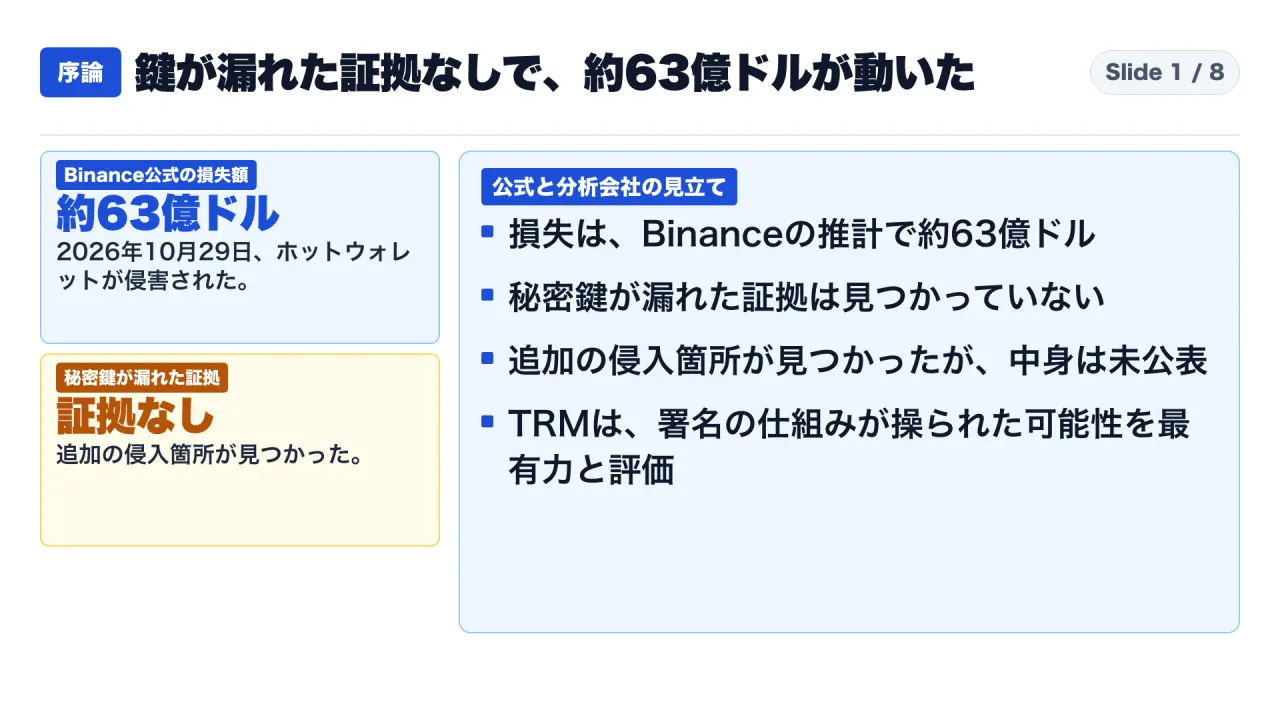
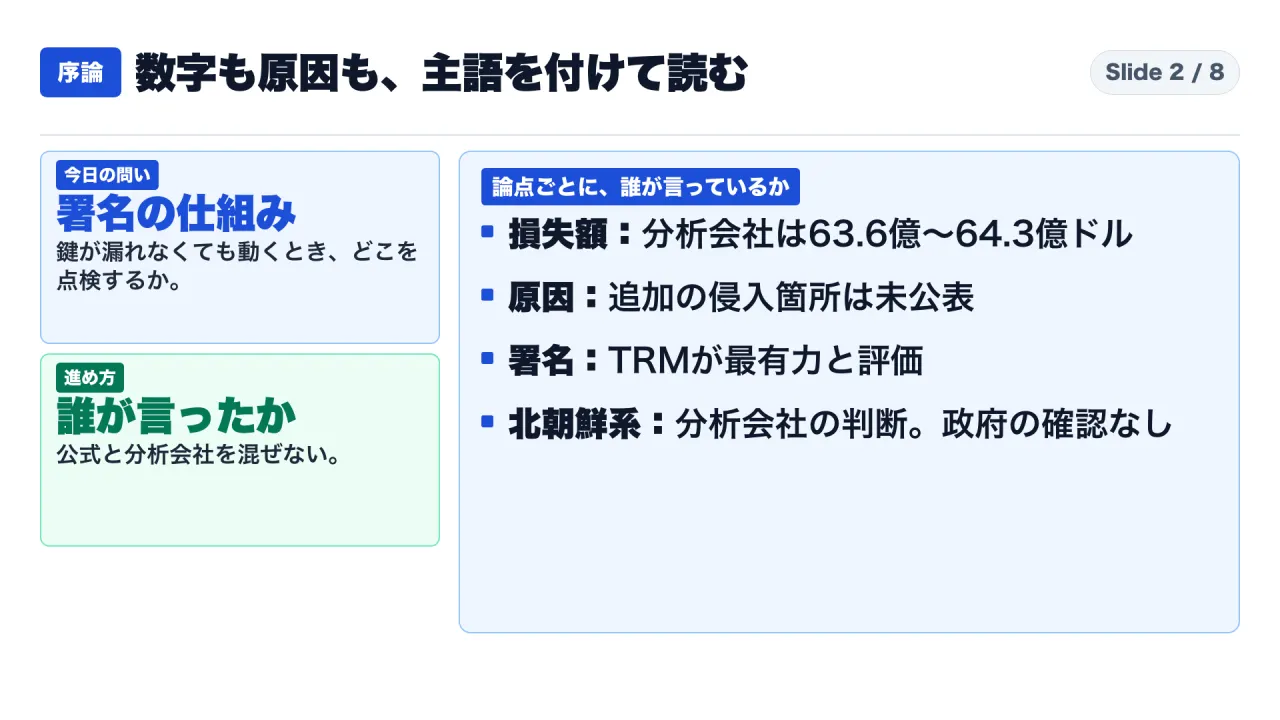
On October 29, 2026, at approximately 20:05 UTC, hot wallets operated by Binance were compromised in a cross-chain intrusion. Forensic estimates from Elliptic, TRM Labs, and Chainalysis place assets drained between $6.30 billion and $6.43 billion, making it the largest single theft in financial history.
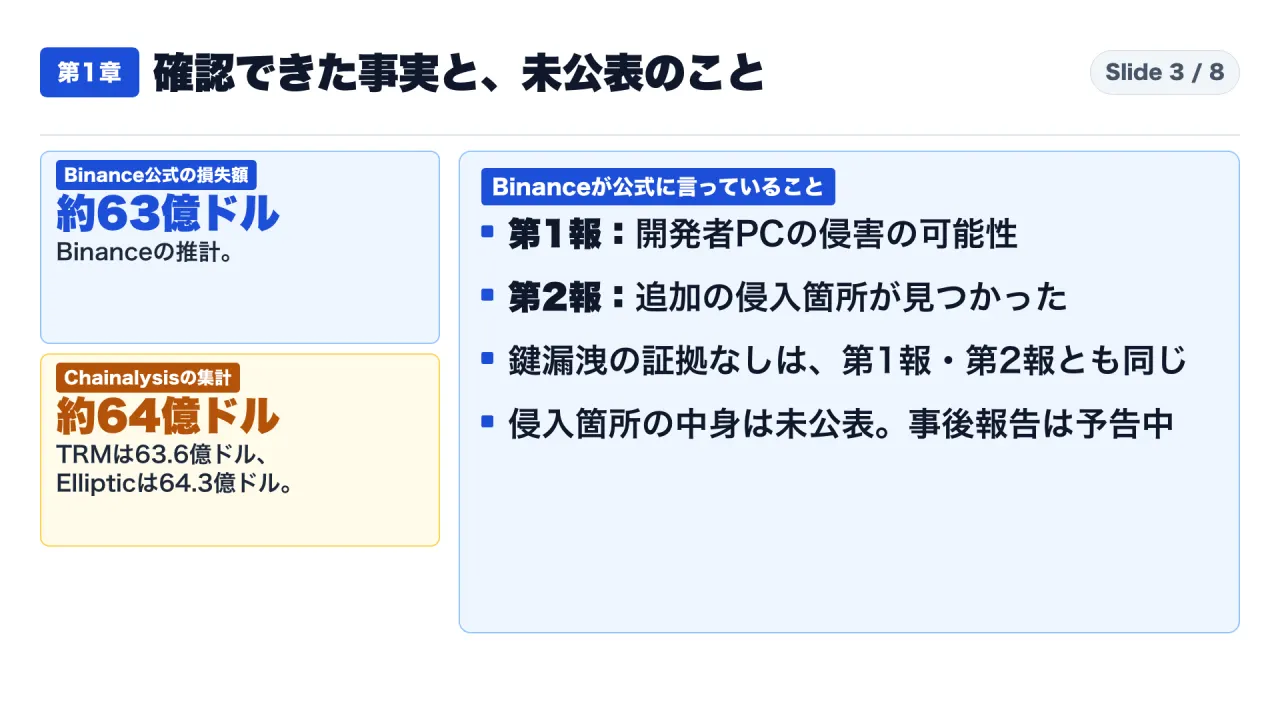
In security updates on October 30, 2026, Binance disclosed that investigators found “no evidence that wallet private keys were compromised.” While an initial update pointed to a DevOps laptop, a second update stated that analysis “uncovered additional vectors of compromise.”
Evaluations by TRM Labs and Elliptic conclude that attackers did not extract raw cryptographic keys. Instead, the adversary co-opted pathways feeding Binance’s internal signing infrastructure, instructing automated signing engines to emit valid cryptographic signatures for attacker transactions across 11 blockchain networks within 30 minutes.
This forensic analysis examines the breach mechanics—including Ethereum’s EIP-7702 delegation framework—and the race to freeze $2.8 billion in stablecoins, extracting five universal governance controls for automated enterprise signing systems.
Analytical Methodology and Evidentiary Boundaries
To maintain factual integrity during an evolving global incident, this review classifies statements across three evidentiary tiers:
- [Factual Record]: Verified chronological data and on-chain ledger transactions confirmed by Binance official announcements or empirical block explorer records.
- [Analytical Evaluation]: Forensic assessments published by TRM Labs, Elliptic, and Chainalysis. These represent specialized third-party interpretations of on-chain telemetry, not certified admissions by Binance.
- [Author Interpretation]: Architectural deductions and general enterprise control frameworks synthesized from available public records.
Dollar values are presented in U.S. dollars as calculated by forensic firms at the time of transaction; foreign exchange conversions are omitted to prevent currency distortion.
Technical Definitions & Operating Terminology
- Hot Wallet: An internet-connected wallet used by exchanges to automate customer withdrawals in real time.
- Signing Infrastructure: Internal server clusters and HSMs that receive transfer requests and generate cryptographic signatures.
- EIP-7702: An Ethereum standard activated in May 2025 allowing accounts to temporarily delegate execution to a smart contract via a signed authorization.
- Nonce: A sequential counter tracking account transaction order.
- SAFU: Binance’s internal insurance fund protecting user deposits.
- On-Chain Freeze: Blacklisting addresses via smart contracts (USDT/USDC) to halt transfers.
1. Chronology of the Exploit and Macro Metrics
Reconstructing the breach requires examining the variance across forensic firm aggregations and the attacker’s pre-operational timeline.
Divergent Loss Totals Across Forensic Aggregators
Loss metrics vary across reports based on pricing timestamps, chain coverage, and accounting exclusions:
| Forensic Source | Disclosed Loss Total | Chains Monitored | Methodological Scope |
|---|---|---|---|
| Binance (Update #2) | ~$6.30 Billion | Unspecified | Company internal loss estimate |
| TRM Labs | ~$6.36 Billion | 10 Chains | Priced at time of theft; re-evaluated at ~$6.23B post-hack |
| Elliptic | $6.43 Billion | 11 Chains | Excludes ~$169M internal fund sweep by Binance post-freeze |
| Chainalysis | ~$6.40 Billion | Multiple | Preliminary estimate based on post-hack on-chain telemetry |
- [Analytical Evaluation]: Elliptic excluded ~$169 million from its total, confirming this was an internal Binance safeguarding transfer post-shutdown. Elliptic characterized the theft as “almost certainly the largest single theft of any kind in history,” over four times the $1.46 billion stolen from Bybit in February 2025.
Pre-Operational Timeline: 36-Hour Staging
- [Analytical Evaluation]: TRM Labs discovered that the attacker’s wallet received three Tornado Cash withdrawals on the morning of October 28, 2026—at least 36 hours prior to the theft.
- [Analytical Evaluation]: On October 29, 2026, at 15:59 UTC, attackers deployed the exploit contract, testing transactions across three test wallets before targeting Binance’s production hot wallet four hours later.
Binance’s Immediate Operational Response and Solvency Pledges
- [Factual Record]: In its second update, Binance pledged that 100% of customer losses would be covered through SAFU reserves and company equity.
- [Factual Record]: Management stated it had already secured over $6.34 billion in corporate funds, holding $5.0 billion in the identical token denominations that were stolen, covering approximately 80% of the financial exposure immediately.
- [Factual Record]: Binance halted platform withdrawals while keeping deposits active, setting an operational target to resume phased withdrawals within 34 hours and release technical findings within 48 hours.
2. Technical Anatomy: Weaponizing EIP-7702 and Cross-Chain Signing
The central mystery of the incident was how billions in capital moved across diverse blockchains without private keys being compromised.
The Ethereum Vector: Batched Nonce EIP-7702 Delegation
On Ethereum, the intrusion weaponized modern account abstraction primitives:
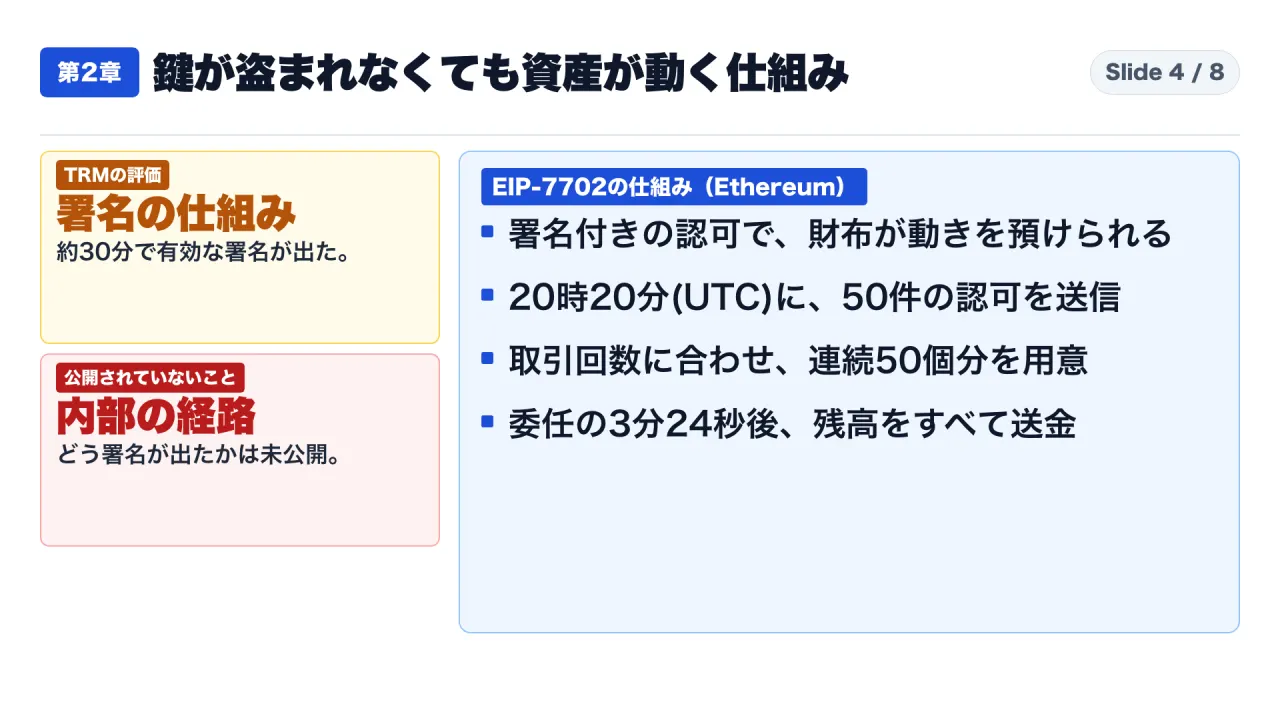
- [Factual Record]: At 20:20 UTC on October 29, 2026, the attacker’s address submitted a single transaction containing 50 distinct authorization tuples to the Ethereum network.
- [Analytical Evaluation]: Elliptic and TRM Labs verified that these authorizations were cryptographically signed by the genuine private key of the “Binance 14” hot wallet. Under EIP-7702, each authorization delegated execution authority of the Binance 14 wallet to an external drainer contract controlled by the attacker.
- [Analytical Evaluation]: TRM Labs explained why 50 authorizations were batched: because Binance 14 was processing customer withdrawals continuously, its transaction nonce was advancing rapidly. An authorization tuple is valid only at a specific nonce. To ensure execution, the attackers pre-generated 50 authorizations across sequential nonces. When the transaction landed, matching one valid nonce was sufficient to bind the contract.
The $2.53B Single-Transaction Sweep
- [Analytical Evaluation]: At 20:24 UTC—3 minutes and 24 seconds after delegation—attackers invoked the contract, sweeping 167,464 ETH and 63 tokens (including 1.615B USDT) in one atomic transaction.
- [Analytical Evaluation]: Elliptic noted $3.8 billion was stolen on Ethereum across 186 tokens, with $2.53 billion extracted in that single transaction. Attackers executed follow-up sweeps at 20:41, 20:59, 21:04, 21:44, 22:39, and 23:56 UTC as incoming deposits arrived.
Chronology of the Ethereum EIP-7702 Exploit (October 29, 2026)
--------------------------------------------------------------------------------------
Timestamp (UTC)   Action Taken                      Technical Mechanics
--------------------------------------------------------------------------------------
15:59 UTC         Contract Deployment               Attacker deploys drainer contract
20:05 UTC         Intrusion Detection Window        First abnormal telemetry recorded
20:20 UTC         EIP-7702 Delegation               Single TX submits 50 pre-signed nonces
20:24 UTC         Initial Liquidity Sweep           Single TX drains 167,464 ETH + $1.6B USDT ($2.53B)
20:41–23:56 UTC   Secondary Sweeps (6 intervals)    Sweeps incoming customer deposits
--------------------------------------------------------------------------------------
The Cross-Chain Reality: Standard Cryptographic Signatures
The breach extended far beyond Ethereum’s smart contract capabilities:
- [Analytical Evaluation]: On 10 other networks—including Bitcoin, Solana, Tron, XRP Ledger, Arbitrum, Avalanche, Optimism, and Base—funds were transferred via standard, valid cryptographic transactions. A secondary Ethereum hot wallet (“Binance 16”) also transferred 28,006 ETH ($174 million) via standard direct transfer without EIP-7702 delegation.
- [Analytical Evaluation]: TRM Labs underscored that these wallets utilized completely different elliptic curves and signature algorithms (e.g., ECDSA on secp256k1 for Bitcoin/Ethereum, Ed25519 on Curve25519 for Solana, and Schnorr variations). Despite these technical divergences, all wallets emitted valid signatures for attacker destinations within a 30-minute window.
Forensic Deductions: Subverting the Signing Infrastructure
- [Analytical Evaluation]: TRM Labs concluded that the most plausible explanation is that attackers compromised Binance’s hot wallet signing infrastructure, gaining the capability to instruct the system to sign attacker-chosen transactions across chains.
- [Analytical Evaluation]: Elliptic concurred, stating that the on-chain evidence indicates attackers were able to make Binance’s own systems sign on their behalf rather than stealing the keys, pointing to a breach far broader than an isolated workstation.
- [Analytical Evaluation]: Elliptic reported that Binance Co-CEO Richard Teng stated in an October 30 video that the attack involved multiple actors, anti-forensic measures, and that the EIP-7702 delegation bypassed standard approval controls.
3. The On-Chain Countermeasure: Freezing $2.8B in Stablecoins
Following the intrusion, a high-stakes coordination race commenced between the attackers attempting to liquidate stolen tokens and centralized issuers executing emergency freezes.
Quantifying On-Chain Freezes
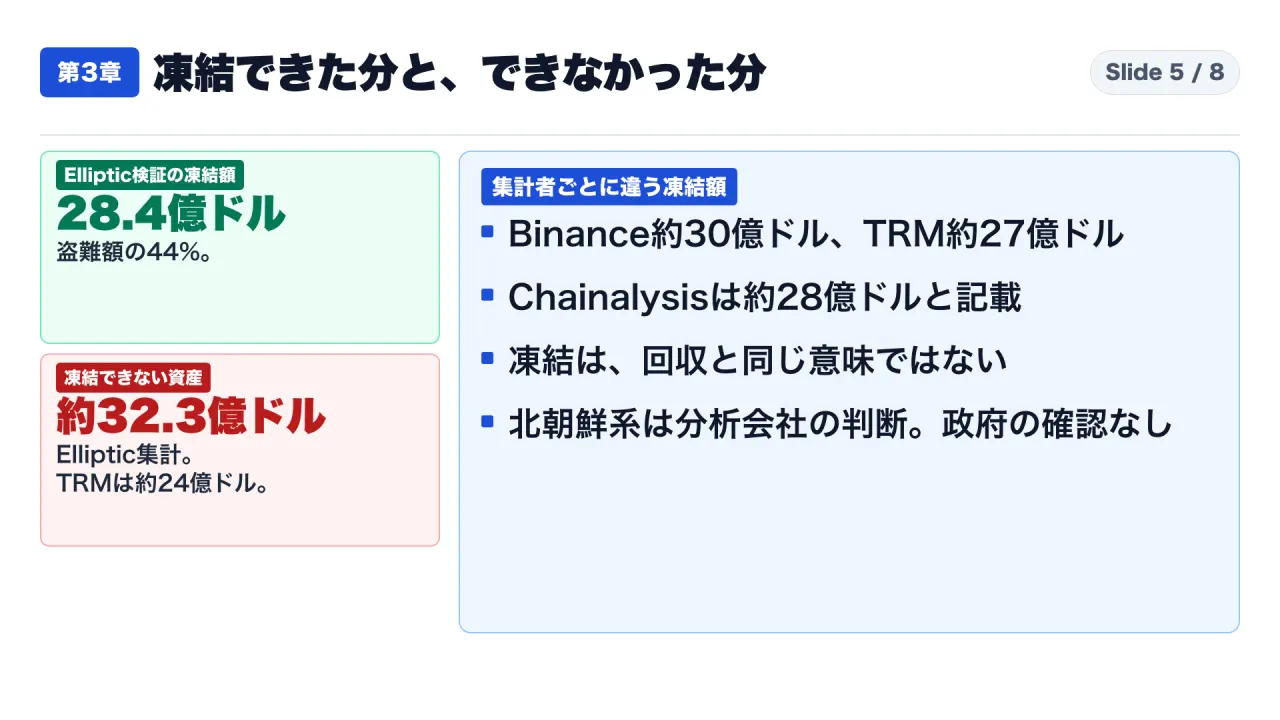
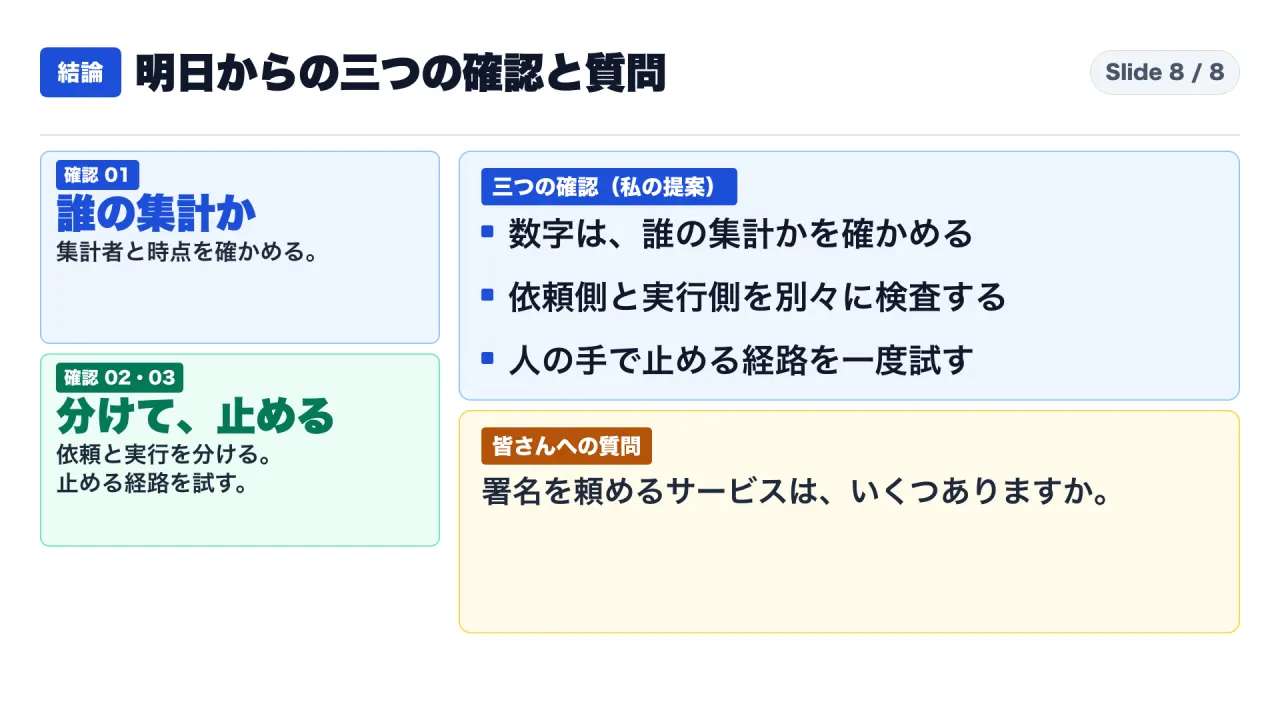
- [Analytical Evaluation]: Aggregators reported $2.7B to $3.0B frozen on-chain (Binance ~$3.0B; TRM ~$2.7B; Elliptic $2.84B [44%]; Chainalysis ~$2.8B). Elliptic noted 94% of frozen assets were stablecoins (USDT/USDC) on Ethereum and Tron possessing blacklist functions.
Asset Recovery & Liquidation Profile (Elliptic Forensic Audit)
--------------------------------------------------------------------------------------
Centralized Stablecoins     $2.84 Billion (44%)   Frozen on-chain by issuers
Unfreezable Native Assets   $3.23 Billion (50%)   Held by attacker (ETH, BTC, TRX, XRP)
Slipped Liquidation Swaps   $786 Million          Swapped to ETH/TRX at 12-26% slippage
--------------------------------------------------------------------------------------
Unfreezable Native Assets and Liquidation Velocity
- [Analytical Evaluation]: Native layer-1 assets lack administrative freeze functions. Elliptic calculated attackers secured $3.23 billion in unfreezable assets (519,104 ETH, 18,270 BTC, 233M XRP, 575M TRX). TRM Labs estimated unfreezable assets at ~$2.4 billion.
- [Analytical Evaluation]: Before freezes landed, attackers swapped $786 million in stablecoins to ETH and TRX on decentralized exchanges, taking 12% to 26% price slippage to prioritize speed over value.
- [Author Interpretation]: Freezing tokens prevents transfer but does not return funds. Recovery requires cross-jurisdictional forfeiture litigation.
4. Threat Actor Attribution: Forensic Evaluations vs Official Silence
Attribution in sophisticated intrusions requires distinguishing analytical consensus from law enforcement certification.
The Divergence Among Analytics Firms
- [Analytical Evaluation]: Chainalysis and TRM Labs assessed with high confidence that the attack was executed by North Korean syndicate TraderTraitor, citing on-chain co-mingling with Bitget breach funds, Tornado Cash staging, and batch pre-signed nonces.
- [Analytical Evaluation]: Elliptic stated North Korean involvement was probable but noted counter-indicators: minimal co-mingling, shared laundering infrastructure across groups, slower stablecoin liquidation, and the absence of formal FBI attribution.
[Author Interpretation]: While indicators point toward North Korean state actors, attribution represents expert analysis rather than certified legal indictment.
5. Architectural Governance: The Five Checks for Signing Infrastructure
The Binance incident establishes that securing cryptographic private keys inside HSMs is insufficient if the systems requesting signatures can be co-opted.
The Five Checks for Enterprise Signing Infrastructure
======================================================================================
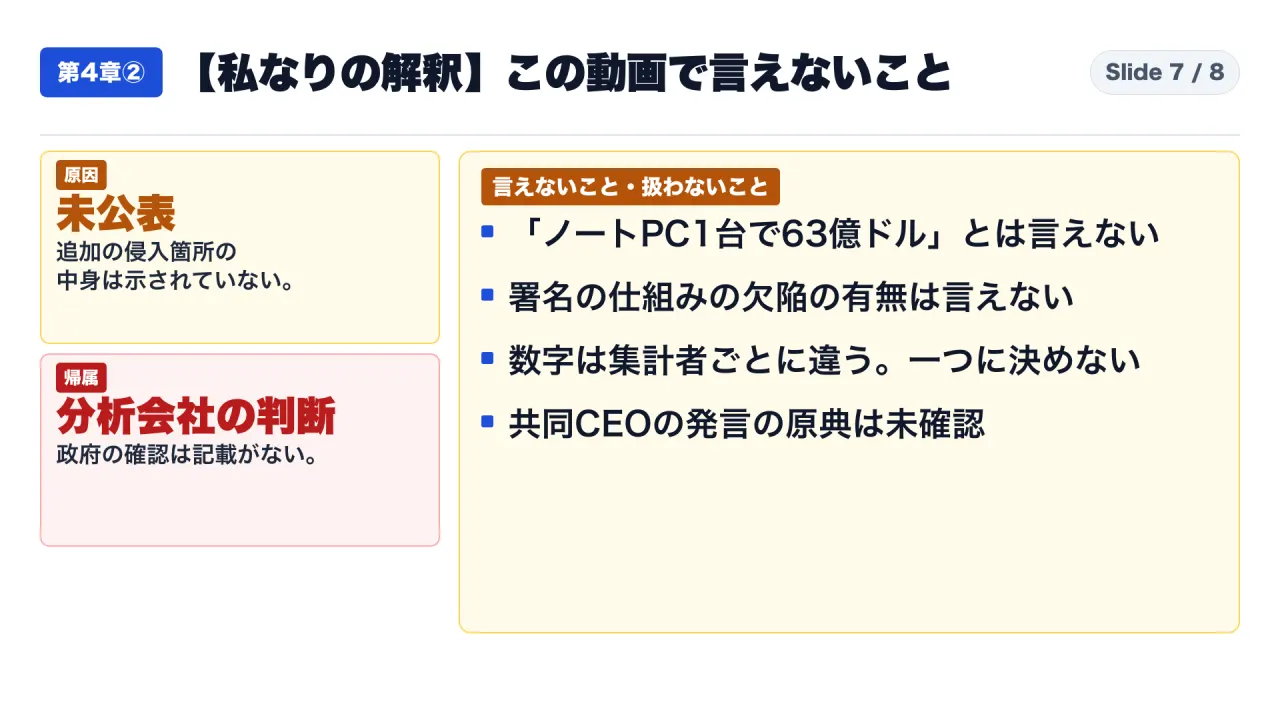
Check 1: Requestor Whitelisting   -> Enforce strict service registry with least privilege
Check 2: Independent Inspection   -> Signing module must inspect destination, rate, value
Check 3: Privilege Separation     -> Segregate delegation/config updates from standard transfers
Check 4: Workstation Quarantine   -> Short-lived session tokens and rapid revocation drills
Check 5: Out-of-Band Kill-Switch  -> Tested manual circuit breakers with designated proxies
======================================================================================
Check 1: Audit Requesting Service Registries
- Action: Inventory every internal microservice, workstation, and task authorized to submit requests to the signing cluster.
- Remediation: If undocumented callers exist, revoke signing credentials and enforce an explicit service whitelist.
Check 2: Independent Semantic Inspection at Signing Layer
- Action: Signing modules must not act as rubber stamps. They must independently parse payloads to enforce whitelists, velocity limits, and value ceilings.
- Remediation: If signing hardware lacks inspection logic, insert an immutable policy proxy before the signing module.
Check 3: Segregate Privilege-Altering Transactions
- Action: Isolate operational transfers from transactions altering permissions (EIP-7702 delegations, ownership transfers).
- Remediation: Enforce dual-custody authorization and out-of-band approvals for payloads modifying account delegation.
Check 4: Restrict Workstation Session Lifetimes
- Action: Ensure developer workstations do not retain persistent access tokens reaching production signing orchestrators.
- Remediation: Restrict session tokens to eight hours and conduct credential revocation drills simulating endpoint compromise.
Check 5: Out-of-Band Manual Circuit Breakers
- Action: Implement out-of-band kill-switches capable of halting automated signing instantly during anomalous spikes.
- Remediation: Designate proxy decision-makers with pre-authorized revocation credentials to prevent off-hours delays.
Author Synthesis: What the Public Record Cannot Claim
Enterprise risk committees must maintain strict discipline regarding the limits of current documentation:
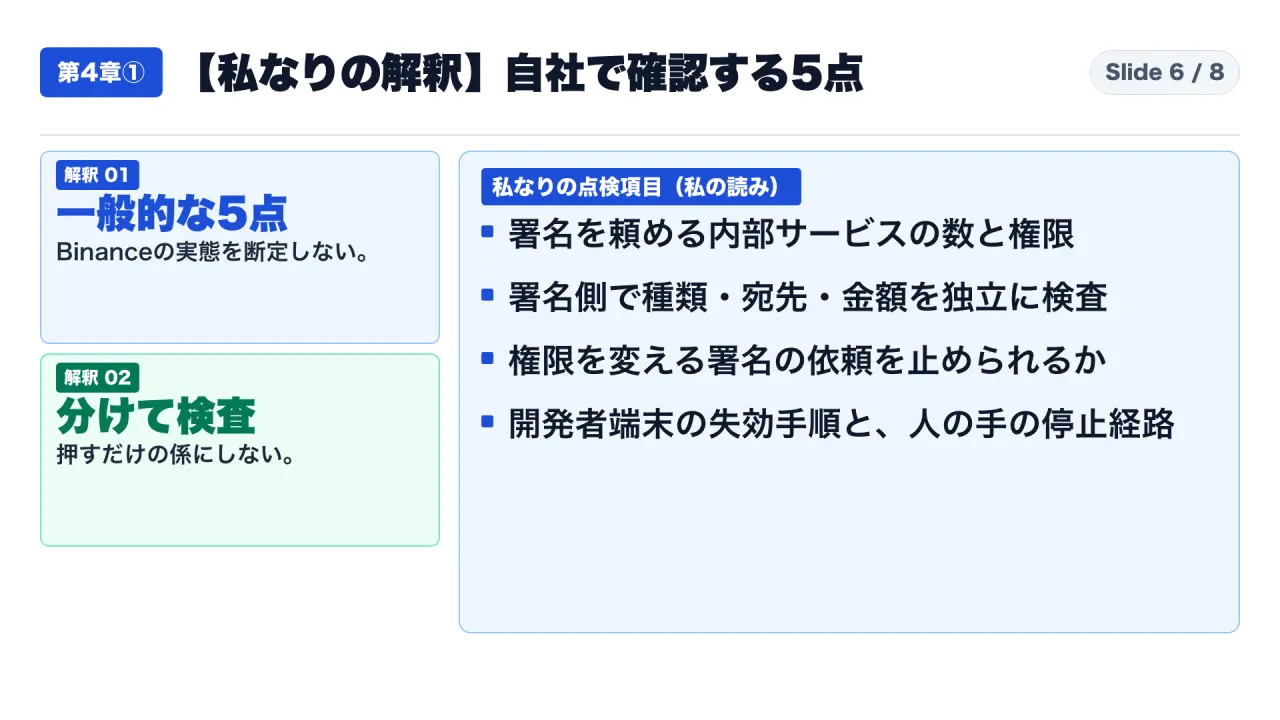
- Root Cause Is Unconfirmed: Binance disclosed that additional vectors of compromise were uncovered, but has not released technical post-mortems. Asserting that a single laptop caused the breach is contradicted by primary updates.
- Architecture Flaws Are Inferred: While TRM and Elliptic deduced that signing infrastructure was co-opted, Binance’s internal network topology remains proprietary.
- Attribution Is Uncertified: No law enforcement agency has published formal indictments or warrants identifying specific individuals or state agencies.
Actionable Operational Checklist
Before authorizing automated signing systems for enterprise operations, verify the following:
- Maintain a complete registry of internal services authorized to request signatures.
- Verify that the signing engine independently evaluates payload amounts, destinations, and rates.
- Establish segregated approval pathways for administrative and delegation transactions.
- Test endpoint credential revocation runbooks annually to ensure compromised sessions can be terminated within 30 minutes.
- Verify that manual operational circuit breakers function during complete network blackouts.
Frequent Misconceptions & Diagnostic Q&A
Q1: Did attackers steal Binance’s private keys?
Binance’s first and second official updates confirmed that internal investigation found no evidence that wallet private keys were compromised. Forensic firms conclude attackers co-opted the signing infrastructure to emit valid signatures.
Q2: Was the hack caused solely by a DevOps laptop compromise?
No. While an engineer’s laptop was cited in the initial update, Binance’s second update stated that further analysis revealed additional vectors of compromise, and on-chain evidence reflects a broad enterprise breach.
Q3: Does freezing $2.8 billion mean Binance recovered the funds?
No. An on-chain freeze prevents tokens from moving on the ledger. Actual financial recovery requires legal forfeiture and administrative claims.
Q4: Does EIP-7702 represent a security flaw in Ethereum?
EIP-7702 functions as designed to allow account abstraction. The vulnerability was that Binance’s signing pipeline approved delegation authorizations that should have been rejected by internal policies.
Primary Sources and References
- Binance, Official Security Incident Update (October 30, 2026): https://www.binance.com/en/support/announcement/detail/c5a8729a97ac486d963784d96c5642d7
- Binance, Official Security Incident Update #2 (October 30, 2026): https://www.binance.com/en/support/announcement/detail/d3306d9dca5243548c813b605e1d1751
- TRM Labs, “North Korea Steals USD 6.36 Billion From Binance in the Largest Hack in History” (October 30, 2026): https://www.trmlabs.com/resources/blog/north-korea-steals-usd-6-36-billion-from-binance-in-the-largest-hack-in-history
- Elliptic, “The Largest Theft in History: North Korea Likely Behind the $6.4 Billion Binance Hack” (October 30, 2026): https://www.elliptic.co/insights/binance-largest-hack-in-history/
- Chainalysis, “Binance Exploit: Latest Findings and Response” (October 30, 2026): https://www.chainalysis.com/blog/binance-exploit-latest-findings-and-response/