A Single Unprotected Gateway Cost $3.09B: The Change Healthcare Breach, Congressional Testimony, and the Policy-Implementation Gap
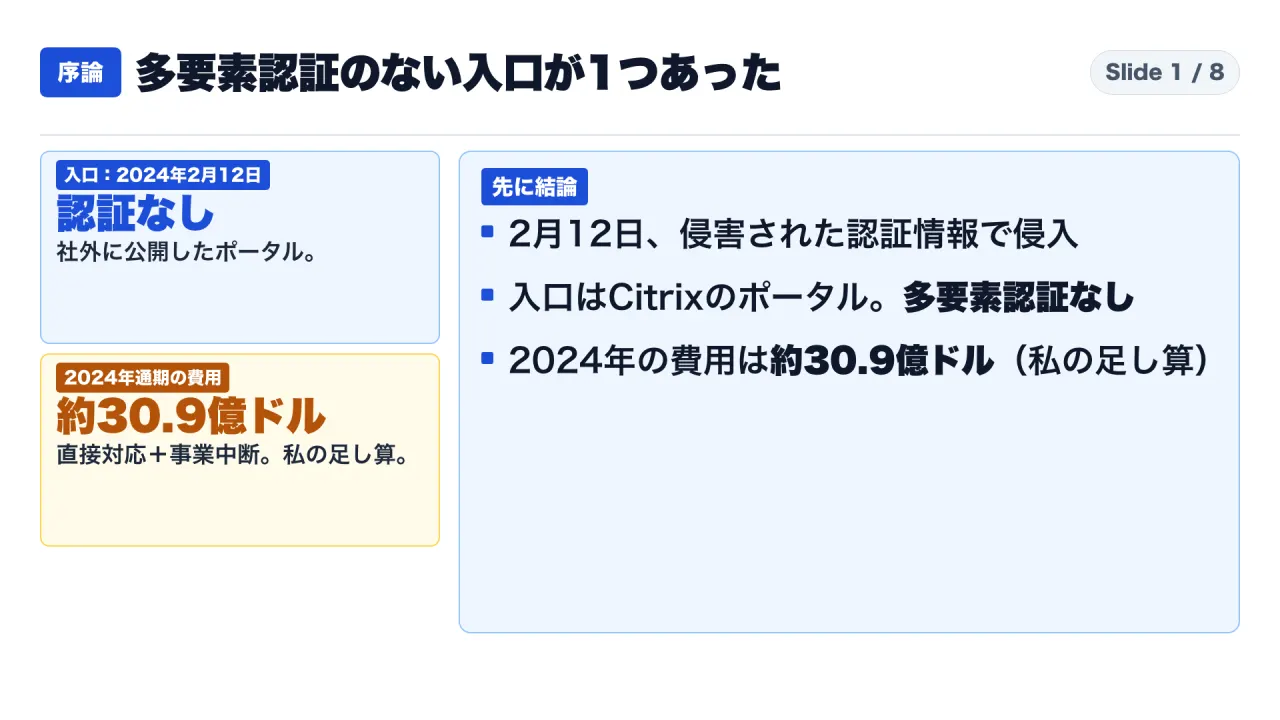
When an acquired Citrix portal lacking multi-factor authentication was breached on February 12, 2024, it unleashed a $3.09 billion financial impact, grounded provider claims, and led to breach notices for 192.7 million individuals.
Published: October 31, 2026 | Read time: ~10 min | Watch Video (Japanese)
Executive Summary: How One Gateway Bypassed Enterprise Policy
On February 12, 2024, an unauthorized actor logged into an external Citrix portal operated by Change Healthcare, a subsidiary of UnitedHealth Group (NYSE: UNH), using compromised credentials. In sworn testimony on May 1, 2024, CEO Andrew Witty confirmed that despite corporate policies mandating multi-factor authentication (MFA) across all external connections, this Citrix gateway lacked MFA.
Nine days later, on February 21, 2024, ransomware was detonated by ALPHV/BlackCat, paralyzing medical claims processing nationwide. A review of primary sources highlights three structural takeaways:
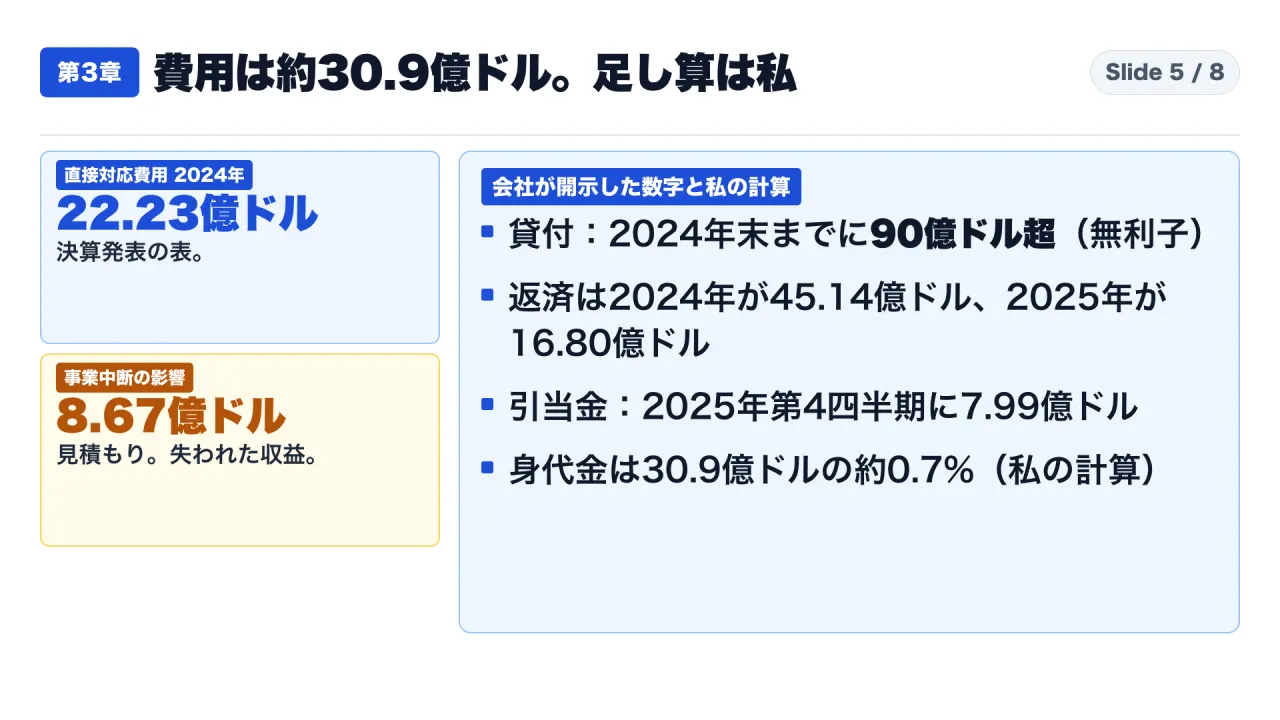
- $3.09B Combined Financial Impact: UnitedHealth Group reported full-year 2024 direct response costs of $2.223 billion and an estimated $867 million in Optum Insight business disruption revenue losses, totaling $3.090 billion. To stabilize healthcare providers, the company disbursed over $9.0 billion in advance loans, recording a $799 million reserve for uncollectible advances in Q4 2025.
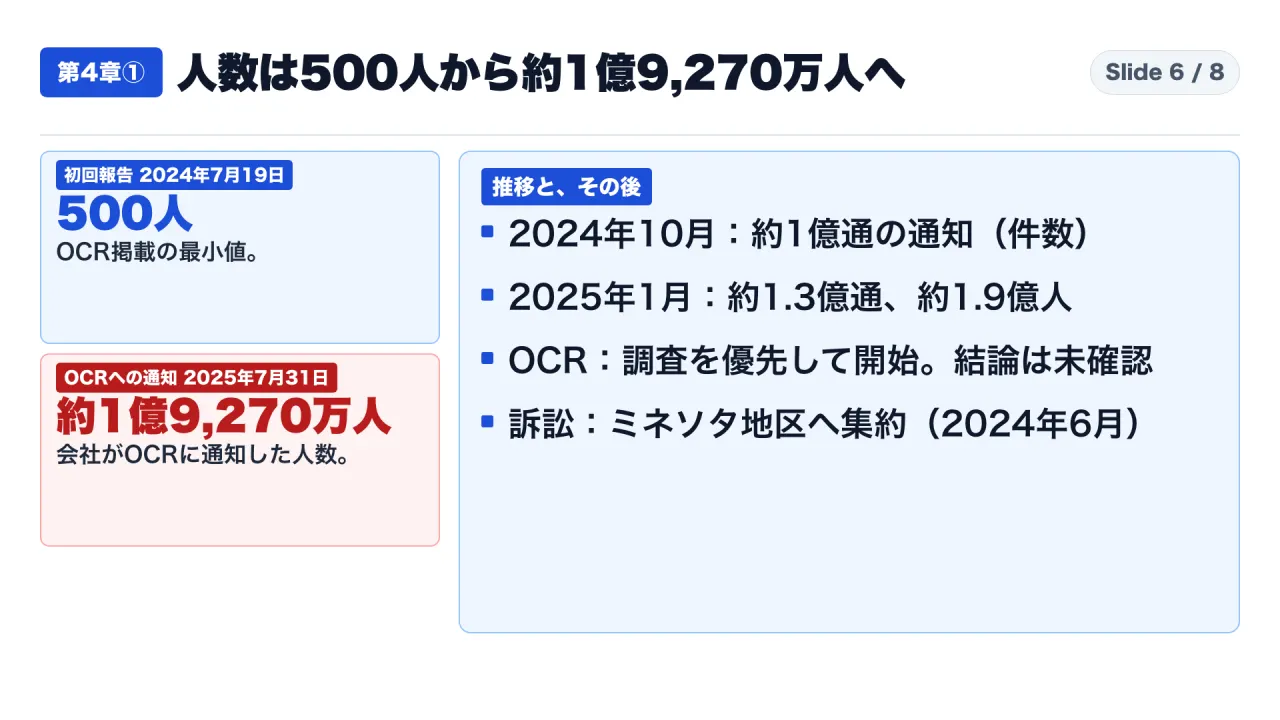
- Breach Notices Escalating from 500 to 192.7 Million: Change Healthcare initially posted an administrative placeholder of 500 affected individuals to the HHS Office for Civil Rights (OCR) on July 19, 2024. By July 31, 2025, the formal tally submitted to OCR reached approximately 192.7 million individuals.
- The Policy-Implementation Divide: Congressional testimony revealed that leadership believed an enterprise MFA mandate was in effect, but Change Healthcare—acquired 18 months prior—retained legacy infrastructure that was never brought into compliance.
This review reconstructs the operational timeline, accounting records, and dockets to extract governance lessons for enterprise infrastructure leaders managing M&A perimeters.
Analytical Methodology and Evidentiary Boundaries
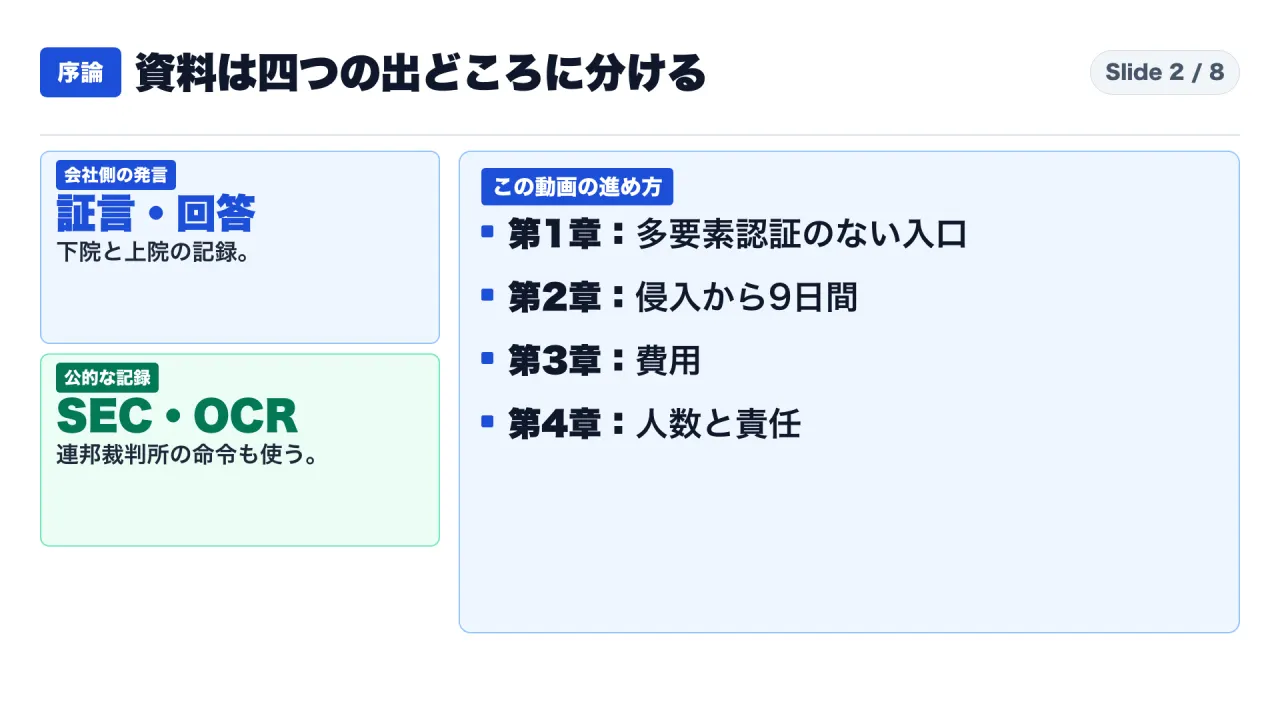
To separate corporate testimony from certified regulatory filings, this study tags statements across five evidentiary categories:
- [Congressional Testimony]: Sworn statements by executive leadership before House and Senate committees.
- [SEC Disclosure]: Audited Form 10-K, Form 8-K, and earnings reports filed with the SEC.
- [OCR Record]: Official breach registry entries and updates from the HHS Office for Civil Rights.
- [Judicial Docket]: Federal court orders under JPML Docket MDL-3108.
- [Author Calculation]: Arithmetic combinations of accounting entries, distinct from statutory losses.
The analysis is grounded in public dockets, avoiding speculative dark-web reports regarding initial credential theft.
Technical Definitions & Operating Terminology
- Multi-Factor Authentication (MFA): Authentication requiring two or more distinct verification factors (e.g. password plus out-of-band token).
- Citrix Portal: An internet-facing gateway enabling remote desktop and virtualized application access to internal networks.
- Form 8-K vs 10-K: Form 8-K is an unscheduled material event notice; Form 10-K is an audited comprehensive annual report.
- HHS OCR: The federal agency enforcing HIPAA Security and Breach Notification Rules.
- Multidistrict Litigation (MDL): Federal procedure consolidating civil actions with shared factual questions into a single court.
1. Initial Access: The Unprotected Citrix Gateway
Understanding how a multibillion-dollar healthcare conglomerate was paralyzed begins with the architecture of its internet-facing perimeter.
The Mechanics of the Breach
- [Congressional Testimony]: In written testimony to the House Subcommittee on May 1, 2024, CEO Andrew Witty confirmed that on February 12, 2024, attackers accessed Change Healthcare’s remote environment using compromised credentials on a Citrix portal lacking MFA.
- [Author Interpretation]: An internet-exposed portal accessible via single-factor credentials enables credential-stuffing and brute-force access. Omitting MFA removed the essential barrier protecting internal networks.
Credential Sourcing and Policy Divergence
- [Congressional Testimony]: Testimony referenced “compromised credentials” without specifying their origin. Public filings do not state whether credentials were stolen via info-stealers, phishing, or illicit broker markets.
- [Congressional Testimony]: In Senate Finance Committee questioning on May 1, 2024, Witty stated: “We had a policy to have MFA on all of our external systems.” Explaining the lapse, leadership noted Change Healthcare had been part of UnitedHealth Group for approximately 18 months, retaining legacy technology.
[Author Interpretation]: Policy text establishes intent; gateway configuration governs behavior. Auditing policy manuals cannot detect an unconfigured server. M&A transitions represent high-vulnerability periods where acquired infrastructure frequently evades parent security baselines.
Disclosure Asymmetry: SEC Filings vs Congressional Records
- [SEC Disclosure]: In its Form 8-K filed on February 22, 2024, UnitedHealth Group reported that a suspected nation-state threat actor accessed systems. The filing contained no mention of Citrix, missing MFA, or ransom negotiations. The 2024 and 2025 Form 10-K reports also omit “Citrix” and “MFA.”
- [Author Interpretation]: Public corporations reveal data selectively: shareholder disclosures emphasized broad financial impact, while technical details emerged only under congressional oversight.
2. Chronology: From Entry to Extortion and Ransom
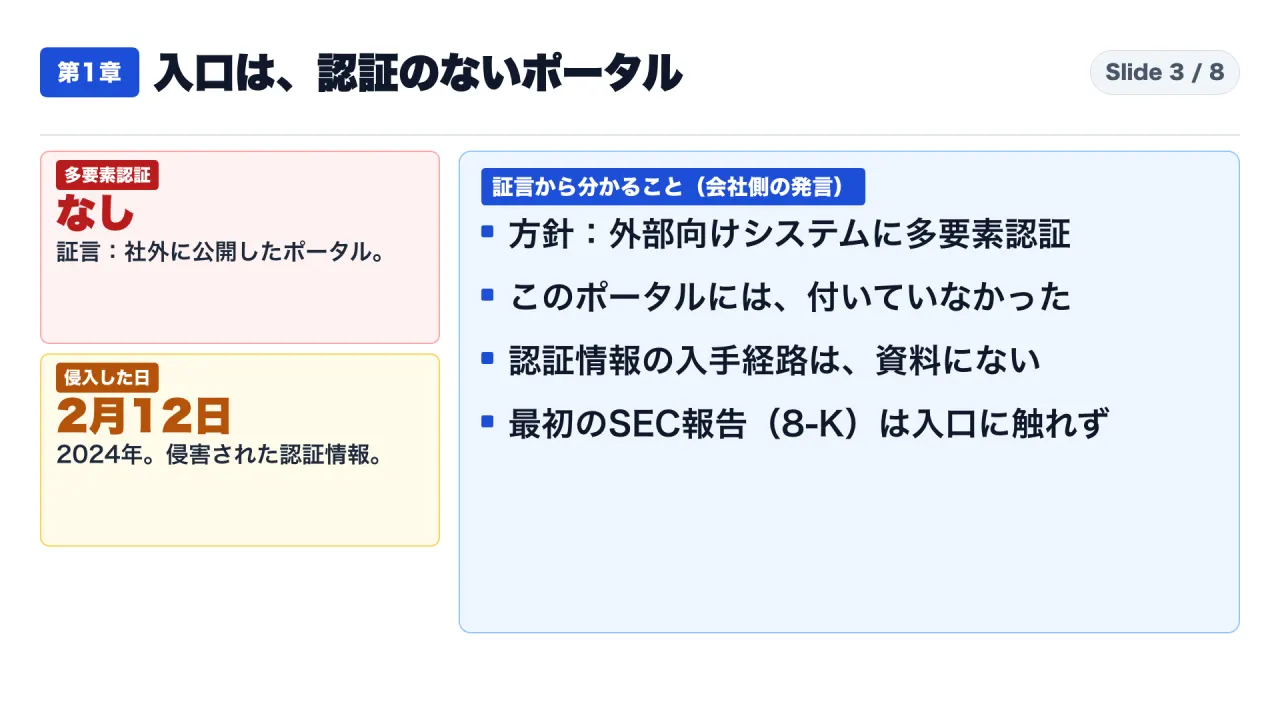
The nine-day gap between initial access and ransomware execution illustrates the typical dwell time of sophisticated intrusion campaigns.
The Nine-Day Lateral Movement Window
- [Congressional Testimony]: Threat actors breached the gateway on February 12, 2024, traversing the network laterally and compromising internal backups.
- [Congressional Testimony]: In Senate written responses, UnitedHealth Group confirmed that protected health information (PHI) was exfiltrated between February 17 and February 20, 2024.
- [Congressional Testimony]: On February 21, 2024, attackers deployed ransomware, identifying themselves as ALPHV/BlackCat.
| Date (2024) | Operational Breach Event | Evidentiary Source |
|---|---|---|
| February 12 | Intrusion via compromised credentials on Citrix portal without MFA | House Written Testimony |
| February 17–20 | Exfiltration of protected health information (PHI) | Senate Written Responses |
| February 21 | Detonation of ransomware and system encryption | House Written Testimony |
| February 22 | Form 8-K filing citing suspected nation-state threat actor | SEC EDGAR Archive |
Author Calculation: Attackers dwelled for five days before exfiltrating data, and nine days before detonating ransomware.
The $22 Million Ransom Payment
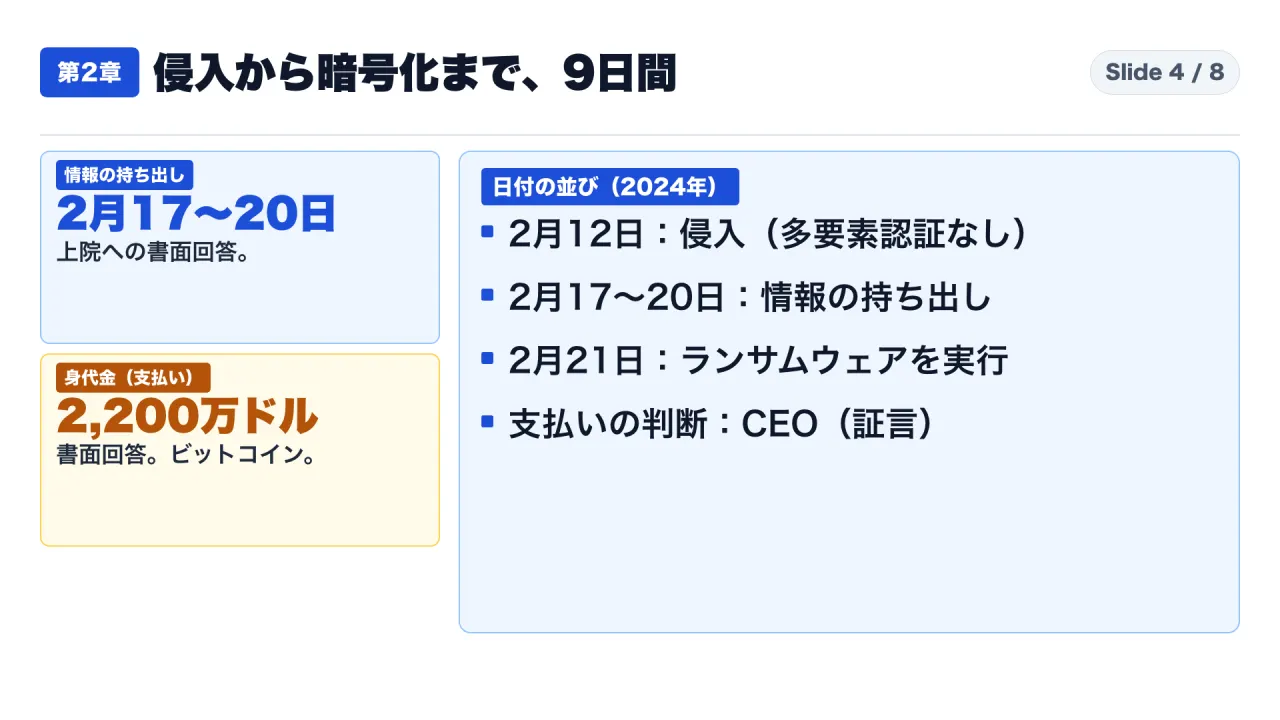
- [Congressional Testimony]: UnitedHealth Group paid a $22 million ransom in Bitcoin for decryption tools. Addressing the decision, Witty testified: “The decision to pay a ransom was mine.”
- [Congressional Testimony]: Witty stated that the attack disabled primary systems and corrupted internal backups, lengthening recovery and driving the ransom decision.
[Author Interpretation]: When perimeter defenses fail, internal controls must prevent lateral spread. The compromise of backups left leadership dependent on extortion negotiations.
3. Financial Forensic: Deconstructing the $3.09B Impact and Advance Loans
A forensic audit of UnitedHealth Group’s Form 10-K and earnings disclosures outlines the aggregate financial scale of the incident.
Accounting for Direct Costs vs Business Disruption
- [SEC Disclosure]: For full-year 2024, UnitedHealth Group disclosed direct cyber response costs of $2.223 billion ($2,223 million). In Form 10-K notes, management stated these costs included customer support programs, forensic remediation, legal expenses, and administrative loan overhead.
- [SEC Disclosure]: Concurrently, the company recorded an estimated business disruption impact of $867 million within its Optum Insight division, reflecting lost transaction revenues and foregone customer fees.
UnitedHealth Group 2024 Incident Financial Impact
--------------------------------------------------------------------------------------
Accounting Category               Disclosed Amount ($M)  Nature of Allocation
--------------------------------------------------------------------------------------
Direct Response Costs             $2,223                 Direct operational cash outflows
Business Disruption (Optum)       $867                   Estimated lost operating revenues
--------------------------------------------------------------------------------------
Author Combined Total             $3,090                 Combined Financial Impact
Ransom Payment ($22M) Share       ~0.71%                 Share of combined total ($22M / $3,090M)
--------------------------------------------------------------------------------------
Author Calculations: $2,223M + $867M = $3,090M ($3.090 billion). Ransom share: $22M / $3,090M = 0.71%.
[Author Interpretation]: While public attention focused on the $22 million ransom, it accounted for less than 1% of the total financial impact. The primary costs stemmed from forensic remediation, business disruption, and customer support. Furthermore, because direct costs represent cash expenses while disruption reflects lost revenue estimates, the $3.09 billion total represents an analytical calculation rather than an official accounting net loss.
Provider Advance Loan Program and Credit Reserves
- [SEC Disclosure]: To maintain provider liquidity, UnitedHealth Group extended over $9.0 billion in interest-free advance loans. Cash flow statements show disbursements reached $9.033 billion in 2024, with repayments recovering $4.514 billion in 2024 and $1.680 billion in 2025.
- [Author Calculation]: Unrecovered disbursements stood at approximately $2.839 billion ($9.033B minus $4.514B minus $1.680B).
- [SEC Disclosure]: In Q4 2025, UnitedHealth Group established an allowance of $799 million against anticipated credit losses on provider advances.
4. Breach Scope: Evolution from 500 to 192.7 Million Individuals
The Notification Trajectory
- [OCR Record]: On July 19, 2024, Change Healthcare posted an initial breach entry on the HHS OCR portal listing 500 affected individuals.
- [OCR Record]: Regulatory documentation notes that 500 individuals is the minimum statutory threshold required to trigger immediate public reporting under HIPAA. Change Healthcare clarified that this figure served as an administrative placeholder while data reviews continued.
- [OCR Record]: On October 22, 2024, the company announced that it had mailed approximately 100 million breach notification letters.
- [OCR Record]: On January 24, 2025, OCR updated its public portal, noting that approximately 130 million notification letters had been mailed, with total impacted individuals estimated at approximately 190 million.
- [OCR Record]: By July 31, 2025, the formal notification tally registered on the HHS OCR portal reached approximately 192.7 million individuals.
| Milestone Date | Disclosed Affected Count | Regulatory Context |
|---|---|---|
| July 19, 2024 | 500 individuals | Statutory minimum reporting placeholder |
| October 22, 2024 | ~100 million letters mailed | Notification letters dispatched |
| January 24, 2025 | ~190 million individuals estimated | Letters reached ~130M; individuals revised |
| July 31, 2025 | ~192.7 million individuals | Formal tally registered with HHS OCR |
[Author Interpretation]: Observers frequently confuse “notification letters mailed” with “unique individuals impacted.” A single individual may receive multiple letters from different healthcare entities covered by Change Healthcare’s clearinghouse. Tracking both metrics separately avoids analytical error.
Enforcement Inquiries and Multidistrict Litigation
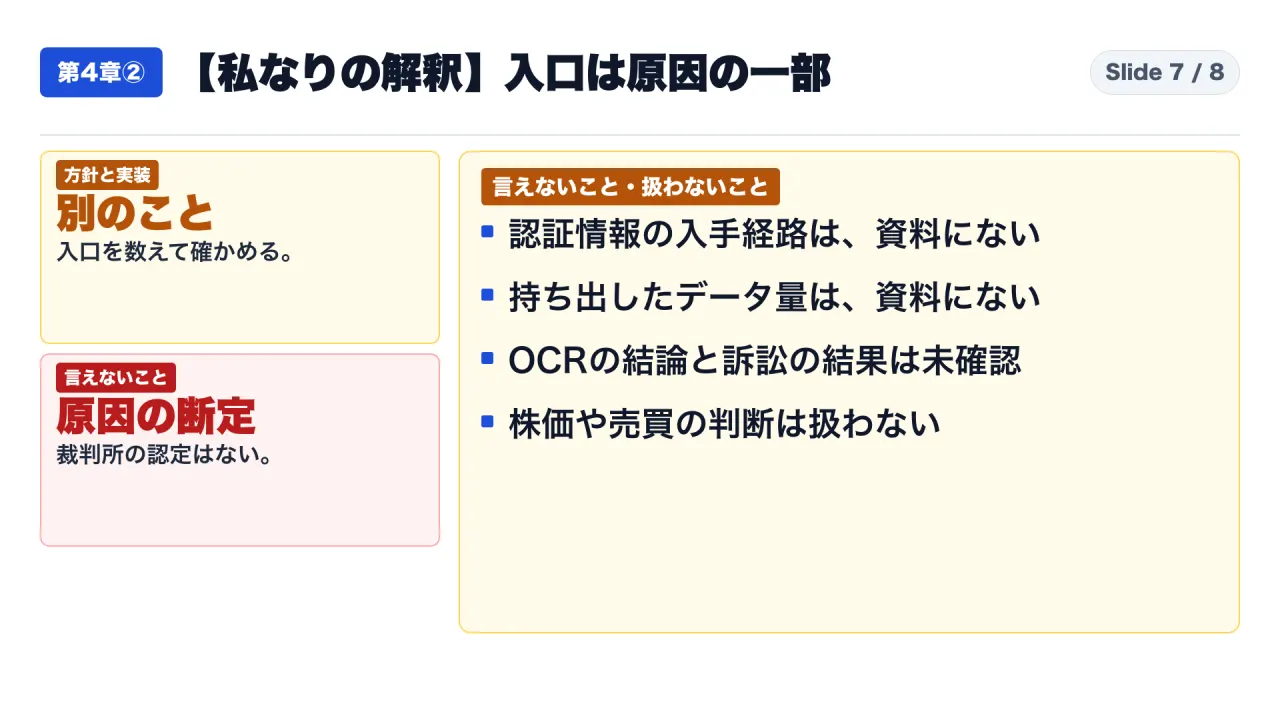
- [OCR Record]: In March 2024, HHS OCR initiated an expedited compliance investigation into Change Healthcare and UnitedHealth Group regarding HIPAA Security Rule compliance. As of October 31, 2026, OCR has not issued final enforcement rulings.
- [Judicial Docket]: On June 7, 2024, the JPML centralized consumer, provider, and institutional lawsuits into the District of Minnesota (Docket MDL-3108).
- [Judicial Docket]: On December 19, 2025, the federal court granted in part and denied in part defense motions to dismiss, ruling that plaintiffs adequately pled negligence regarding cybersecurity controls, advancing claims into discovery.
Author Synthesis: Bridging the Policy-Implementation Divide
The technical record demonstrates that enterprise security cannot be governed through policy text alone:
- Gateways Require Discovery: Proclaiming an MFA mandate without continuous external discovery guarantees that legacy gateways will be overlooked. Security governance must operate from network reality, not policy manuals.
- M&A Environments Require Quarantines: When acquiring legacy entities, parent networks must remain segregated until external gateways undergo complete authentication baselining. Acquired technical debt becomes parent liability upon peering.
- Defense-in-Depth Is Essential: A single missing authentication factor allowed initial entry, but the subsequent failure of segmentation and backup isolation converted an unauthorized login into a systemic disaster.
Operational Governance Playbook: External Gateway Audit
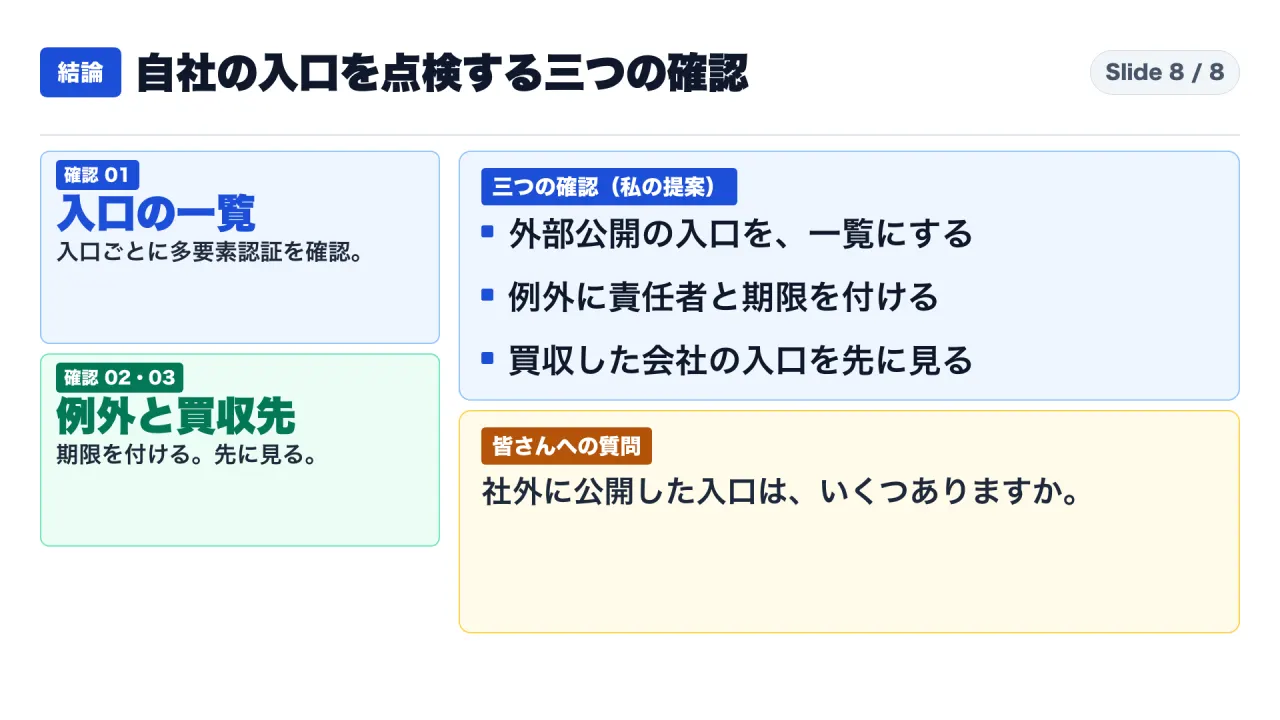
To ensure corporate perimeters do not harbor unauthenticated access points, enterprise infrastructure teams must enforce:
- Step 1: Automated Attack Surface Mapping: Continuously scan corporate ASNs and DNS records for public-facing portals, administrative panels, and VPN endpoints.
- Step 2: Deterministic Status Reporting: Replace vague policy statements with quantitative reporting: “N external access points; M verified MFA-enforced; K operating under approved, time-bounded exceptions.”
- Step 3: Eliminate Perpetual Exceptions: Place legacy gateways incapable of native MFA behind identity-aware proxies or decommission them. Exceptions must expire within 90 days.
- Step 4: M&A Perimeter Quarantine: Maintain strict firewalls around acquired networks until an audit certifies that every external gateway complies with parent authentication baselines.
External Gateway Audit Schema
--------------------------------------------------------------------------------------
Gateway:       Citrix Virtual Gateway (US-East) -> Corporate Intranet
Auth / MFA:    SAML 2.0 IDP Integration; Enforced FIDO2 / Authenticator
Exceptions:    Zero unapproved single-factor exemptions permitted
Discovery:     Bi-weekly external ASN port scan and Shodan API audit
Cadence:       Continuous automated probe; monthly executive review
--------------------------------------------------------------------------------------
Frequent Misconceptions & Diagnostic Q&A
Q1: Was the Change Healthcare incident caused by an unpatched zero-day vulnerability?
No. Congressional testimony established that the intrusion occurred via valid compromised credentials entered into a Citrix portal that lacked multi-factor authentication.
Q2: Did UnitedHealth Group have an MFA policy prior to the breach?
Yes. CEO Andrew Witty testified that UnitedHealth Group maintained an enterprise policy requiring MFA on all external systems, but legacy infrastructure at Change Healthcare was never configured to adhere to that policy.
Q3: Is the $3.09 billion figure an official net loss reported by UnitedHealth Group?
No. The $3.09 billion total is an analytical calculation combining $2.223 billion in full-year 2024 direct response expenses with $867 million in Optum Insight business disruption revenue loss estimates.
Q4: Did 192.7 million individuals receive breach notification letters?
Approximately 192.7 million individuals were reported to OCR as affected, while letters mailed reached ~130 million. Multiple clearinghouse records often map to the same individual.
Primary Sources and References
- U.S. House Committee on Energy and Commerce, Subcommittee on Oversight and Investigations, Written Testimony of Andrew Witty, CEO of UnitedHealth Group (May 1, 2024): https://docs.house.gov/meetings/IF/IF02/20240501/117242/HHRG-118-IF02-Wstate-WittyS-20240501-U5.pdf
- U.S. Senate Committee on Finance, Hearing Record on Cyberattack on America’s Health Care System, Senate Hearing 118-785 (May 1, 2024): https://www.govinfo.gov/content/pkg/CHRG-118shrg63595/html/CHRG-118shrg63595.htm
- UnitedHealth Group, Form 8-K Current Report (Filed February 22, 2024): https://www.sec.gov/Archives/edgar/data/731766/000073176624000045/unh-20240221.htm
- UnitedHealth Group, Form 10-K Annual Report for the Year Ended December 31, 2024: https://www.sec.gov/Archives/edgar/data/731766/000073176625000063/unh-20241231.htm
- UnitedHealth Group, Form 10-K Annual Report for the Year Ended December 31, 2025: https://www.sec.gov/Archives/edgar/data/731766/000073176626000062/unh-20251231.htm
- UnitedHealth Group, 2024 Full Year Earnings Release and Supplementary Tables (Form 8-K Exhibit 99.1): https://www.sec.gov/Archives/edgar/data/731766/000073176625000022/a2024q4exhibit991.htm
- U.S. Department of Health and Human Services (HHS), Office for Civil Rights (OCR), Change Healthcare Cybersecurity Incident FAQs: https://www.hhs.gov/hipaa/for-professionals/special-topics/change-healthcare-cybersecurity-incident-frequently-asked-questions/index.html
- U.S. Judicial Panel on Multidistrict Litigation (JPML), Transfer Order, Docket MDL-3108 (June 7, 2024): https://jpml.uscourts.gov/sites/jpml/files/MDL-3108-Transfer_Order-5-24.pdf
- U.S. District Court for the District of Minnesota, Memorandum Opinion and Order on Motion to Dismiss, Docket MDL-3108 (December 19, 2025): https://www.mnd.uscourts.gov/sites/mnd/files/20251219_24md3108-Ord-MTD.pdf