What Was Claude's "Max 20x" Actually 20 Times Of? Deconstructing Plan Multipliers Across Rolling Windows, Weekly Caps, and Enterprise SOPs
Anthropic’s rebranding of “Max 20x” to “Ultra” resolves a persistent architectural confusion: the 20x multiplier governed only the 5-hour rolling window, while weekly capacity was capped at 10x Pro.
Published: October 31, 2026 | Read time: ~10 min | Watch Video (Japanese)
Executive Summary: Multipliers Require Defined Baselines and Windows
On October 30, 2026, Anthropic restructured its individual Claude subscription lineup. The tier formerly named “Max 5x” ($100/month) became “Max,” while “Max 20x” ($200/month) was renamed “Ultra.” Subscription pricing remained unchanged. Concurrently, Anthropic removed the 5-hour rolling limit for automated verified accounts on the Ultra tier. However, the overarching weekly utilization limits remained fixed: 5x Pro for Max, and 10x Pro for Ultra.
The historical “20x” moniker generated widespread enterprise confusion. Disclosures from Anthropic’s product lead revealed that when the top-tier plan launched in April 2025, it enforced a single limit: a 5-hour rolling threshold set to 20x Claude Pro. When Anthropic subsequently added weekly capacity caps to manage compute demand, the weekly limit was set at 10x Pro while the 5-hour limit remained at 20x Pro. Because the marketing name highlighted “20x,” many subscribers assumed the multiplier applied across both operational windows.
This forensic guide analyzes the mechanics of multi-tier AI subscription limits across Anthropic, OpenAI, and Google. It provides engineering managers, operations leads, and finance directors with a standardized framework to translate marketing multipliers into deterministic Standard Operating Procedures (SOPs), separating shared pools, rolling windows, and non-convertible credits.

Analytical Methodology and Evidentiary Boundaries
To prevent marketing semantics from obscuring computational constraints, this analysis enforces strict evidentiary criteria:
- [Fact]: Pricing tiers, rate limits, and policy terms published on official vendor pricing portals, documentation hubs, and corporate release notes.
- [Executive Statement]: Direct explanations from product engineering leadership regarding system intent, naming history, and future roadmaps.
- [Author Calculation]: Mathematical derivations of cost-per-multiplier ratios and effective quota allocations.
- [Author Interpretation]: Operational frameworks for workflow scheduling, team resource allocation, and failover design.
Documentation was compiled on October 31, 2026, cross-referencing Anthropic’s pricing pages, support articles, and product announcements, alongside OpenAI’s ChatGPT Pro tier documentation and Google’s Gemini subscription disclosures.

Technical Definitions & Operational Terminology
- Claude Pro, Max, and Ultra: Anthropic’s individual paid tiers priced at $20, $100, and $200 per month.
- 5-Hour Rolling Window: A rate limiter resetting dynamically based on tokens consumed during the preceding five hours.
- Weekly Capacity Cap: An aggregate ceiling measured over a seven-day rolling window governing total compute.
- Verified Account: An automated classification based on account history; verified Ultra accounts operate without 5-hour limits.
- Claude Fable: Anthropic’s advanced model family included within Max and Ultra under dedicated quota rules.
- Monthly API Credits: Bundled credits ($100 on Max, $200 on Ultra) for programmatic development via the Claude API Console.
1. Deconstructing the “20x” Discrepancy: 5-Hour Bursts vs Weekly Endurance
A numerical multiplier is meaningless without its baseline denominator and measurement window.
The Origin of the Dual-Limit Structure
Consider an enterprise mobile data contract advertised as “20x standard daily bandwidth.” If the monthly data allowance is only 10x the standard package, sustained heavy usage will exhaust the monthly allowance long before daily limits are reached.
This dynamic defined the Claude Max 20x architecture:
- [Executive Statement]: On October 30, 2026, Anthropic’s product lead for consumer subscriptions published an explanation detailing the plan’s evolution. When the top-tier plan was introduced in April 2025, the platform enforced only a single usage governor: a 5-hour rolling window set to 20 times the Claude Pro allowance. The tier was accordingly designated “Max 20x.”
- [Executive Statement]: When Anthropic later added a weekly quota to mitigate sustained cluster congestion, the weekly cap was set to 10 times Claude Pro, while the 5-hour burst ceiling remained at 20 times Pro.
- [Executive Statement]: The product lead acknowledged that subscribers naturally assumed the 20x multiplier applied to total weekly throughput, stating: “We could have done better here, and I’m sorry.”
The Post-Rebrand Reality: Max and Ultra
Under the October 30, 2026 restructuring, Anthropic eliminated multiplier numbers from plan titles to prevent ambiguity:
- [Fact]: Max ($100/month) provides 5x the 5-hour limit of Pro and 5x the weekly limit of Pro.
- [Fact]: Ultra ($200/month) eliminates the 5-hour limit entirely for verified accounts, while maintaining the weekly capacity cap at 10x Pro.
Anthropic Claude Plan Architecture (October 31, 2026)
--------------------------------------------------------------------------------------
Tier     Price / Month   5-Hour Rolling Limit      Weekly Aggregate Cap   Fable Quota
--------------------------------------------------------------------------------------
Pro      $20             1x Baseline               1x Baseline            Usage Credits
Max      $100            5x Pro                    5x Pro                 Up to 50% Cap
Ultra    $200            Uncapped (Verified Accounts) 10x Pro             Up to 50% Cap
--------------------------------------------------------------------------------------
Author Calculation: At $200/month, Ultra costs 2.0x Max ($100/month) and delivers 2.0x the weekly capacity (10x Pro vs 5x Pro).
Multipliers Are Capacity Weights, Not Message Guarantees
Anthropic’s official documentation explicitly warns that rate limits do not guarantee a fixed number of prompts or conversational turns:
- [Fact]: The rate at which an account approaches limits depends dynamically on model selection, conversational context length, and the size of uploaded attachments.
- [Author Interpretation]: A “5x” or “10x” multiplier denotes the computational token allocation relative to Pro under identical conversational parameters. A developer feeding large codebases into 200,000-token context windows will consume quota significantly faster than an administrative user issuing single-turn queries.

2. Granular Dissection of the New Plan Specifications
To build reliable enterprise workflows, engineering leads must decompose the new plan specifications into four distinct functional pillars.
Pillar 1: The 5-Hour Rolling Window and Account Verification
- [Fact]: For Ultra subscribers, the 5-hour rolling session limit is removed for verified accounts. Anthropic noted that this exemption rolled out immediately to most existing subscribers, with progressive expansion across the base.
- [Fact]: Account verification is executed automatically by Anthropic’s risk engines, evaluating tenure, billing history, and usage patterns. Entering a phone number during checkout does not constitute account verification.
- [Fact]: Subscribers can determine verification status directly within console settings. If the “Current session” utilization bar is absent from the usage dashboard, the account is verified. When an account transitions to verified status, an automated confirmation email is dispatched. Unverified accounts remain subject to interim 5-hour governors to prevent programmatic abuse.
Pillar 2: Weekly Quotas and Capacity Management
- [Fact]: Weekly quotas remain the ultimate operational ceiling for all tiers. For Ultra, the weekly cap is 10x Pro.
- [Fact]: Anthropic’s documentation notes that beyond standard tier caps, additional administrative governors may be dynamically applied during periods of extreme global cluster demand to preserve service availability.
Pillar 3: Claude Fable Model Inclusion Boundaries
- [Fact]: Max and Ultra tiers include access to Claude Fable models without additional subscription fees, up to 50% of the account’s total weekly capacity.
- [Author Interpretation]: The “50%” parameter represents an internal ceiling on the proportion of weekly compute that may be allocated to Fable; it does not expand total weekly quota by 50%. Furthermore, Fable models consume quota at a faster rate per token than standard Claude 3.5 Sonnet models.
- [Fact]: Once an account reaches the 50% Fable allocation, users have two operational choices: switch to alternative models (such as Sonnet) within the remaining weekly quota, or purchase pay-as-you-go usage credits to continue utilizing Fable. On Claude Pro, Fable is accessible exclusively through usage credits.
Pillar 4: Monthly API Credit Allocation Rules
- [Fact]: Max subscribers receive $100 per month in API credits, while Ultra subscribers receive $200 per month. Pro and Free tiers receive zero API credits.
- [Fact]: These credits are exclusively designated for software development via the Claude API Console. They cannot be applied to interactive browser chat, Claude Code terminal CLI sessions, or subscription overage fees.
- [Fact]: API credits expire at the conclusion of each billing cycle without rollover. To access credits, users must link a valid organization in the Claude Console. For newly established subscriptions, credits become redeemable seven days post-activation.

3. Comparative Landscape: Divergent Metrics Across OpenAI and Google
Evaluating AI subscription costs across vendors is frequently complicated by non-standardized capacity metrics.
OpenAI: Tiered Fixed Fees and Consumption Velocity Multipliers
OpenAI structures its high-tier subscriptions through ChatGPT Pro:
- [Fact]: ChatGPT Pro provides three billing tiers: Pro 100 ($100/month), Pro 200 ($200/month), and Pro 500 ($500/month). The highest-speed execution setting, Ultrafast, is restricted exclusively to Pro 500.
- [Fact]: On OpenAI’s platform, the term “multiplier” describes consumption velocity rather than total bucket capacity. In contrast to standard generation speeds, Fast mode consumes account allocation at 2.5x speed, while Ultrafast consumes allocation at 8.0x speed on frontier models such as GPT-6 Astra and GPT-6.1 Sol.
- [Fact]: OpenAI documentation does not publish a standardized “Nx Plus” capacity multiple.
Google Gemini: Chained Multipliers Anchored to AI Pro
Google measures capacity through comparative multiples tied to intermediate tiers:
- [Fact]: Google establishes its baseline with Google One AI Pro ($19.99/month), which provides 4x the capacity of the free tier.
- [Fact]: Google AI Ultra offers two tiers: $99.99/month (delivering 5x the capacity of AI Pro) and $199.99/month (delivering 20x the capacity of AI Pro).
- [Fact]: Usage caps on the Gemini platform refresh across 5-hour rolling windows up to an aggregate weekly limit, dynamically adjusting based on prompt complexity, multimodal inputs, and context length.
Cross-Vendor Capacity Metric Taxonomy
--------------------------------------------------------------------------------------
Vendor       Base Reference Tier   Primary Window         Multiplier Metric Type
--------------------------------------------------------------------------------------
Anthropic    Claude Pro ($20)      Weekly (5-hr removed)  Capacity Volume (5x / 10x)
Google       AI Pro ($19.99)       5-Hour + Weekly        Chained Volume (5x / 20x)
OpenAI       Fixed Dollar Tiers    Monthly Allotment      Burn Velocity (2.5x / 8.0x)
--------------------------------------------------------------------------------------
[Author Interpretation]: Direct price-per-multiplier comparisons between vendors are mathematically invalid because the underlying denominators represent fundamentally different compute allowances.

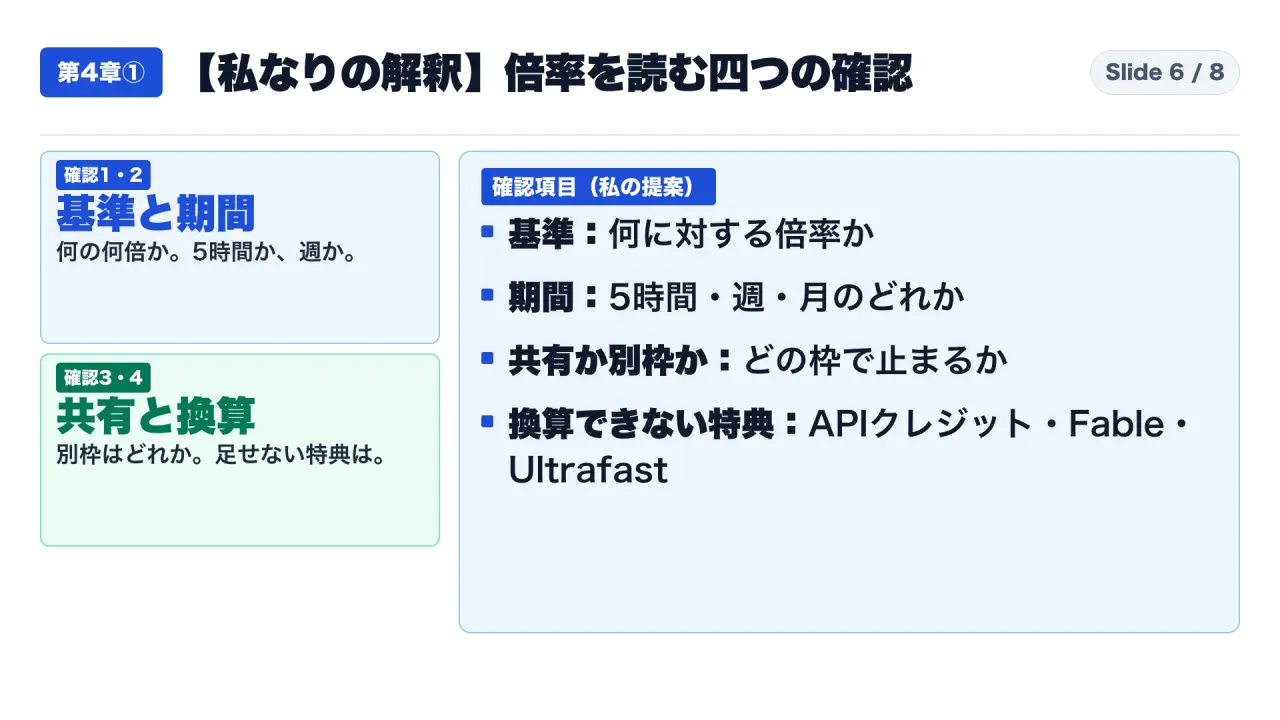
Author Synthesis: The Four Checks for Decoding Plan Multipliers
When integrating high-tier AI subscriptions into mission-critical engineering workflows, teams must apply four deterministic audits:
- Denominator Verification: Identify the exact baseline tier. Is the multiplier calculated against a $20 Pro plan, a free consumer tier, or a raw token budget? Without a defined baseline, capacity cannot be modeled.
- Horizon Mapping: Separate short-term burst windows from long-term capacity caps. Map whether a plan constrains 5-hour rolling throughput, daily volumes, or weekly consumption. In multi-window architectures, workloads stall at whichever threshold is reached first.
- Pool Partitioning: Determine whether specialized reasoning models share the general compute allocation or operate under isolated sub-caps. On Claude Ultra, Fable is capped at 50% of the weekly pool; on OpenAI, coding workspaces are segregated from chat messaging.
- Perk Isolation: Identify features that cannot be converted into core inference throughput. Monthly API credits, dedicated customer support lines, and speed multipliers cannot be summed into interactive model capacity.
Operational Governance Playbook: Standard Operating Procedures
To prevent team workflow stalls when individual or team accounts hit undocumented caps, implement the following operational controls:
- Step 1: Standardize Workflow Registry: Document vendor, plan name, effective multiplier baseline, and verification status for all enterprise seats.
- Step 2: Establish Model Degradation Runbooks: Define explicit fallback sequences when high-tier models hit limits. For example, mandate automatic failover from Fable to Sonnet, or from interactive chat to batch API processing.
- Step 3: Segregate Interactive from Programmatic Tasks: Prohibit the use of web UI subscriptions for automated background batch jobs. Route high-volume automation through the Anthropic API Console using allocated monthly credits.
- Step 4: Maintain Multi-Seat Load Balancing: For critical sprint cycles, distribute workloads across multiple verified accounts rather than overloading a single seat, mitigating single-account weekly rate lockouts.
Enterprise AI Subscription Audit Schema
======================================================================================
Plan Identifier:          Claude Ultra ($200/month)
Baseline Denominator:     Claude Pro ($20/month) = 1.0x Baseline
Short-Term Throttle:      Uncapped (Subject to automated account verification)
Weekly Capacity Ceiling:  10x Pro baseline (Shared model pool)
Model Sub-Allocations:    Claude Fable capped at 50% of total weekly capacity
Non-Convertible Credits:  $200/mo API Console credits (Expires monthly, no web UI rollover)
Failover Protocol:        Switch to Claude 3.5 Sonnet upon Fable exhaustion
======================================================================================

Frequent Misconceptions & Diagnostic Q&A
Q1: Did the Claude Max 20x plan ever provide 20 times the weekly capacity of Pro?
No. The 20x multiplier applied strictly to the 5-hour rolling window. Weekly capacity was capped at 10x Pro, a structural distinction that led Anthropic to retire the moniker on October 30, 2026.
Q2: Does Claude Ultra provide unlimited usage?
No. While verified accounts are free from 5-hour rolling limits, they remain bound by the 10x Pro weekly capacity ceiling and fair-use concurrency controls.
Q3: Can the $200 monthly API credit be used to fund Claude Code CLI sessions?
No. Official Anthropic documentation states that monthly subscription API credits cannot be applied to Claude Code terminal sessions or consumer web overage.
Q4: How do I verify if my Ultra account has the 5-hour limit removed?
Navigate to Account Settings -> Usage. If the “Current session” progress bar is absent, the account has achieved verified status and operates without 5-hour limits.
Actionable Operational Checklist
Before procuring high-tier AI subscriptions for engineering teams, verify the following:
- Document the exact baseline tier defining all advertised multipliers.
- Separate 5-hour rolling limits, weekly caps, and monthly billing cycles into distinct operational tracking columns.
- Confirm whether advanced reasoning models operate within shared or dedicated capacity pools.
- Verify that bundled API credits are allocated to distinct engineering teams rather than conflated with chat subscriptions.
- Inspect the Account Settings usage dashboard to verify that enterprise seats have attained verified status.
- Establish written model fallback protocols in team runbooks before launching high-intensity project sprints.

Primary Sources and References
- Anthropic, Claude Pricing and Plans Overview: https://claude.com/pricing
- Anthropic Official Announcement, Subscription Plan Updates (October 30, 2026): https://x.com/claudeai/status/2116220869479428500
- Michael Boverell (Product Lead for Consumer Subscriptions, Anthropic), Technical Explanation of Claude Subscription Limits (October 30, 2026): https://x.com/mboverell/status/2116221457252659275
- Anthropic Support, Understanding the Claude Ultra Plan: https://support.claude.com/en/articles/17728952-what-is-the-ultra-plan
- Anthropic Support, Claude Fable Model Availability and Quotas: https://support.claude.com/en/articles/15424964-claude-fable-models-on-your-plan
- Anthropic Support, Monthly API Credits for Max, Ultra, and Team Plans: https://support.claude.com/en/articles/17154008-monthly-api-credits-for-max-ultra-and-team-plans
- Anthropic Help Center, Product Release Notes: https://support.claude.com/en/articles/12138966-release-notes
- OpenAI Help Center, ChatGPT Pro Subscription Tiers and Ultrafast Features: https://help.openai.com/en/articles/9793128-about-chatgpt-pro-tiers
- Google Subscriptions, Google One AI Premium and AI Ultra Tiers: https://gemini.google/us/subscriptions/