How Security Updates Crashed 8.5M Endpoints: Deconstructing the CrowdStrike Channel 291 Outage and Vendor Control Boundaries
When CrowdStrike’s Channel 291 Rapid Response Content passed 20 inputs to a 21-field template, it triggered an out-of-bounds kernel read that grounded 7,000 flights and exposed the critical gap between sensor binary policies and dynamic cloud rule updates.
Published: October 31, 2026 | Read time: ~10 min | Watch Video (Japanese)
Executive Summary: Protection Mechanisms as Single Points of Failure
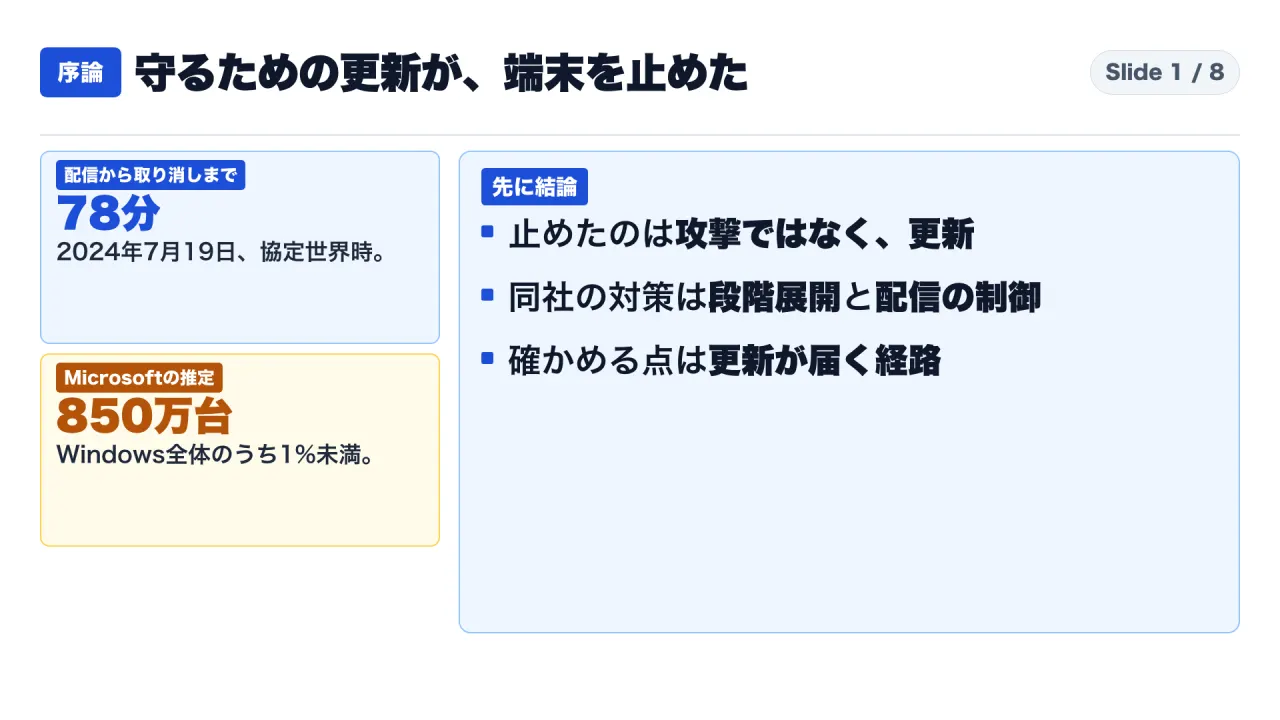
On July 19, 2024, an estimated 8.5 million Windows endpoints crashed into persistent Blue Screen of Death (BSOD) loops. The outage was not caused by a cyberattack or adversary action, but by an automated configuration update from CrowdStrike (NASDAQ: CRWD).
According to CrowdStrike’s Root Cause Analysis (RCA), a newly introduced template type defined 21 input fields, but sensor integration code supplied only 20 input values. Prior validation tests and releases used wildcard criteria for the 21st parameter, masking the defect. When non-wildcard criteria deployed to the 21st field on July 19, 2024, the sensor attempted an out-of-bounds memory read, crashing the host kernel.
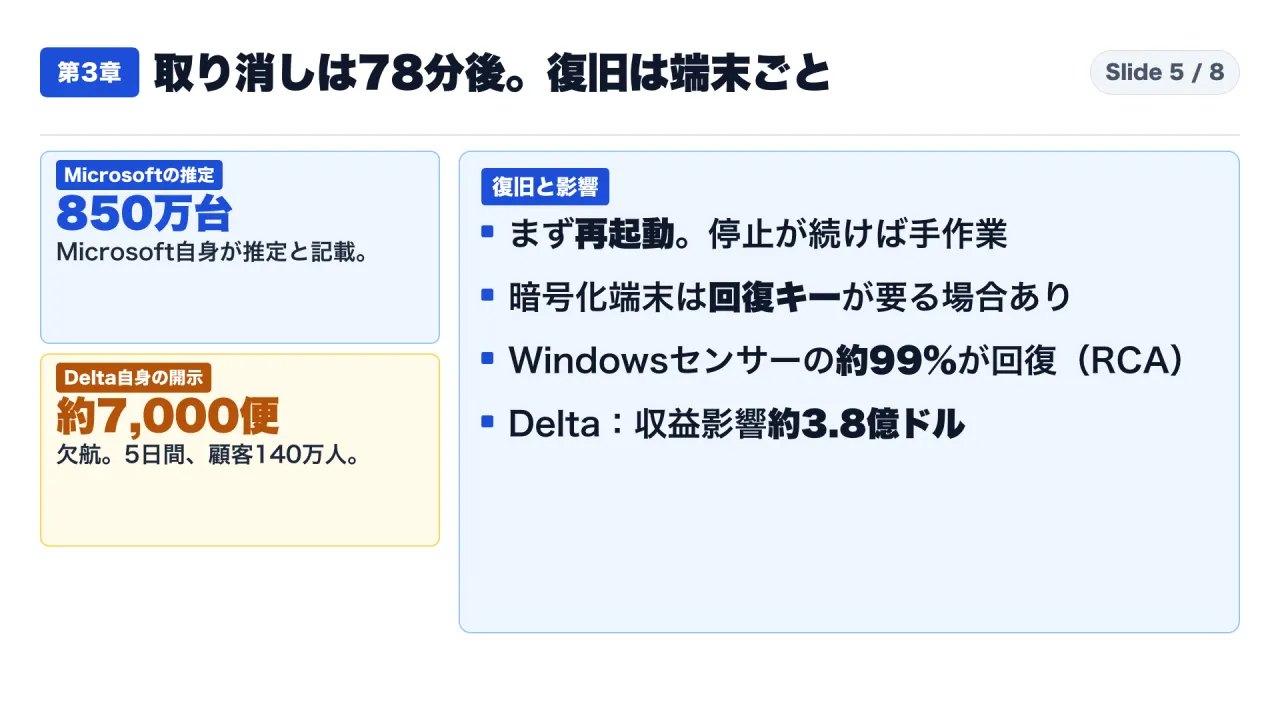
While CrowdStrike revoked the update within 78 minutes, recovery required device-by-device intervention, entering BitLocker recovery keys and removing driver files. Delta Air Lines disclosed 7,000 cancelled flights, 1.4 million impacted passengers, and over $550 million in direct revenue disruption and expense.
This post-mortem analyzes the technical breakdown, legal proceedings, and architectural lessons from primary SEC filings, Microsoft engineering estimates, and CrowdStrike’s RCA. It establishes a practical framework for enterprise infrastructure teams to audit auto-update pathways across third-party endpoint protection agents.
Analytical Methodology and Evidentiary Boundaries
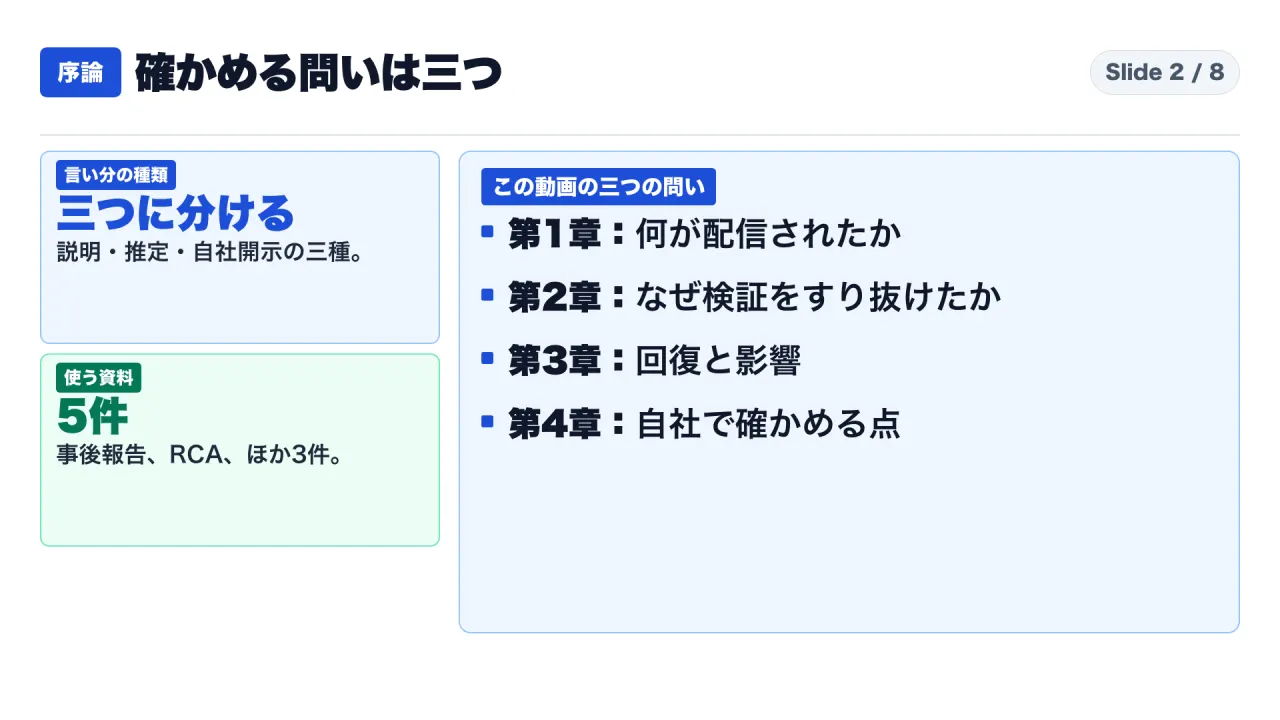
To ensure rigorous analysis, statements in this review are classified into distinct evidentiary categories:
- [Vendor Explanation]: Claims sourced directly from CrowdStrike’s Preliminary Post-Incident Review (PIR), Root Cause Analysis (RCA) published August 6, 2024, and official remediation portals. These represent the vendor’s internal assessment.
- [Third-Party Estimate]: Independent technical assessments, such as Microsoft’s global device impact models.
- [Party Disclosure]: Audited regulatory disclosures, including Delta Air Lines’ 2024 Form 10-K and CrowdStrike’s Form 10-Q for the fiscal quarter ended July 31, 2026.
- [Fact]: Verifiable chronological events, docket filings, and judicial rulings.
- [Author Interpretation]: Analytical synthesis regarding systems engineering, update gating, and disaster recovery architecture.
The evidentiary baseline excludes speculative secondary reports and unverified damage estimates.
Technical Definitions & Architecture
- Falcon Sensor: CrowdStrike’s client agent on host operating systems, running as a kernel-mode driver on Windows.
- Sensor Content: Core detection code compiled directly into the sensor binary, updated only via sensor version upgrades.
- Rapid Response Content: Dynamic behavioral detection rules delivered from the cloud without modifying sensor binaries.
- Channel Files: Binary payload files distributing Rapid Response Content. Channel 291 governs named-pipe behavioral detection.
- Template Types and Instances: A Template Type provides the input schema; an Instance populates it with concrete matching criteria.
- Canary Deployment & Rings: Releasing updates to isolated endpoint cohorts separated by telemetry soak windows.
1. Update Anatomy: Dynamic Rules vs Sensor Binaries
Understanding why standard update policies failed to block Channel 291 requires dissecting CrowdStrike’s dual delivery channels.
Delivery Pathways: Sensor Content vs Rapid Response Content
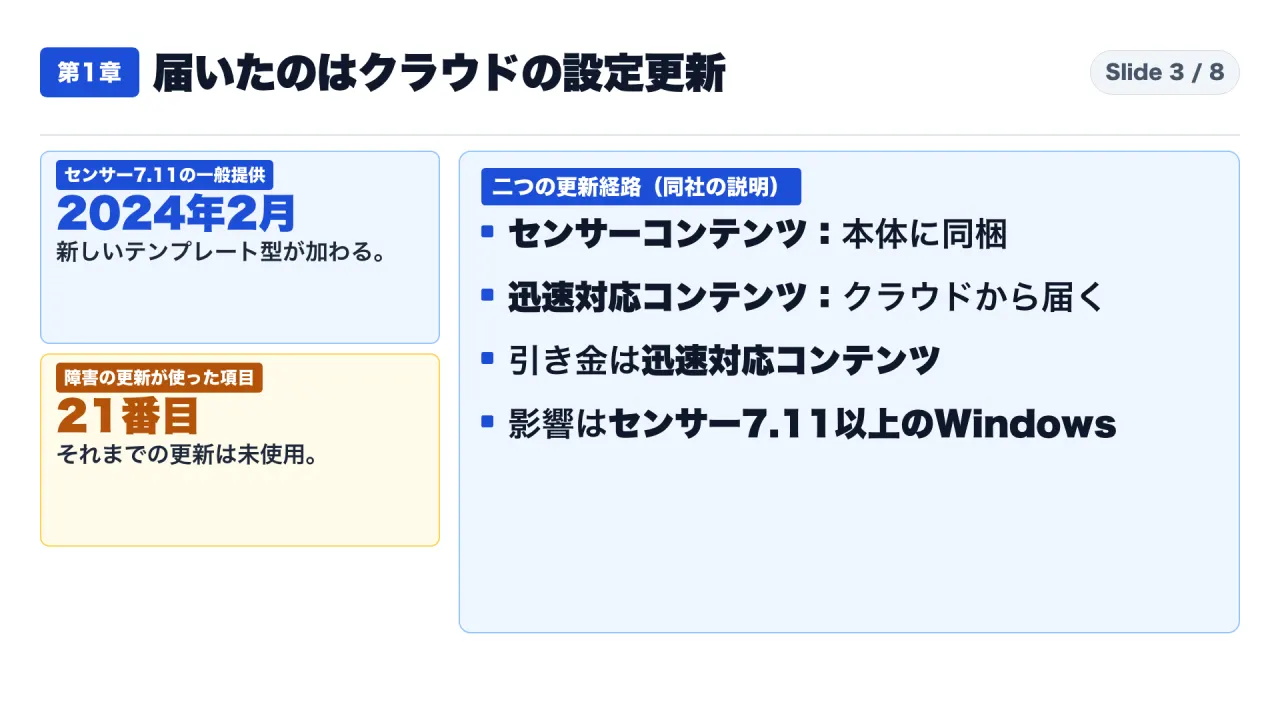
CrowdStrike structures updates across two operational tracks:
- Sensor Content: Bundled directly within the sensor binary. Customers control these updates via console policies, maintaining options to pin agents to N, N-1, or N-2 builds.
- Rapid Response Content: Designed to adapt endpoint defenses without software recompilation, classified by CrowdStrike as configuration data rather than executable code.
[Author Interpretation]: While classified as configuration data, this data dictates kernel-mode evaluation routines. In kernel space, the boundary between code and configuration is porous: malformed configuration read by privileged drivers causes identical system panics as corrupted executables.
The Evolution of Sensor Version 7.11 and Channel 291
- [Vendor Explanation]: On February 28, 2024, CrowdStrike released Falcon Sensor Version 7.11 for Windows, introducing a new Template Type designed to detect novel exploitation techniques leveraging named pipes.
- [Vendor Explanation]: The first Template Instance for this new type was deployed to production on March 5, 2024. Between April 8 and April 24, 2024, three additional Template Instances were delivered. CrowdStrike reported that all executed as intended in production environments without incident.
- [Vendor Explanation]: On July 19, 2024, CrowdStrike distributed two additional Template Instances via Channel File 291. One of these instances contained a non-wildcard evaluation criterion directed at the 21st parameter, activating previously dormant evaluation logic.
Affected Scope and Customer Control Limitations
- [Vendor Explanation]: The outage exclusively affected Windows endpoints running Falcon Sensor Version 7.11 or higher that were online and received Channel 291 between 04:09 UTC and 05:27 UTC on July 19, 2024. Linux and macOS sensors do not consume Channel 291 and were unaffected.
- [Vendor Explanation]: Prior to the incident, enterprise customers could control sensor binary upgrades (Sensor Content), but Rapid Response Content was automatically pushed to all online hosts to ensure synchronized protection against active threats.
2. Root Cause Analysis: The 21 vs 20 Parameter Discrepancy
CrowdStrike’s RCA identified an unhandled index out-of-bounds read caused by architectural misalignment between schema definition and integration code.
The Input Mismatch Mechanics
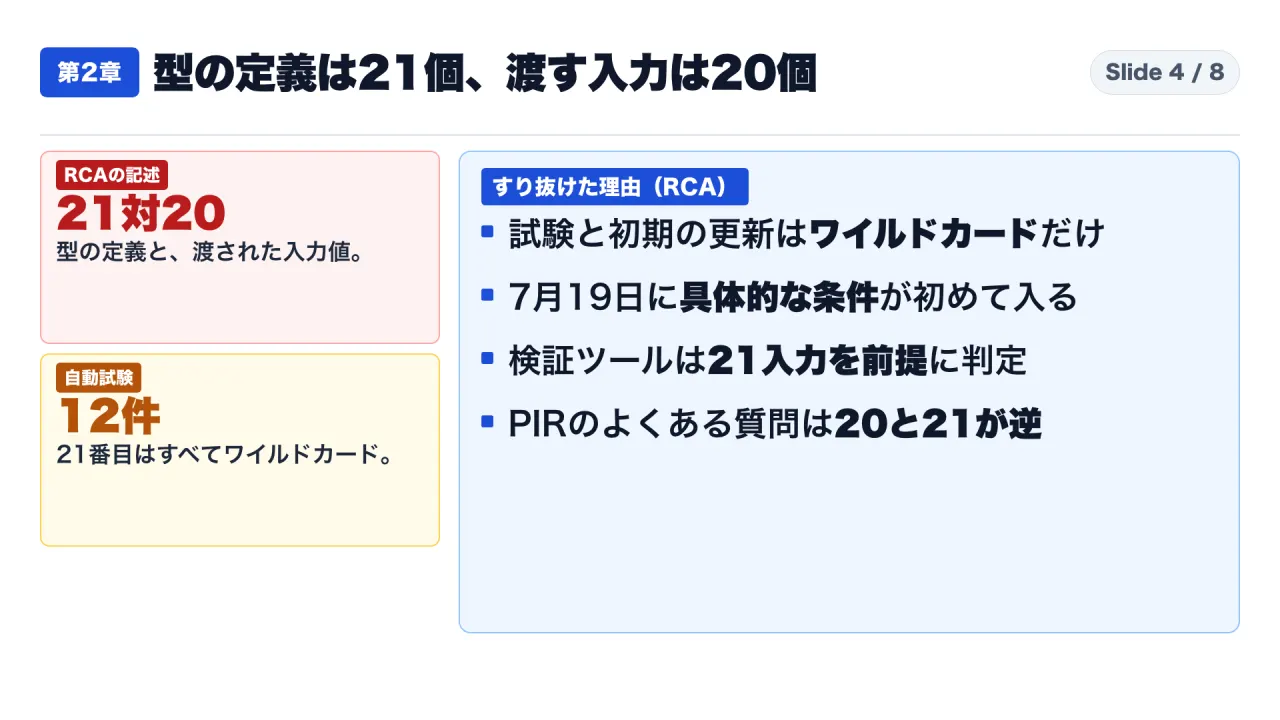
- [Vendor Explanation]: The Template Type defined 21 input fields available for threat detection matching. However, the Sensor integration code responsible for invoking this template supplied only 20 input values.
- [Vendor Explanation]: The RCA notes that during initial testing and prior production releases, the 21st field was set to a wildcard match (
*). Because wildcard criteria match any input without evaluating specific values, the sensor never attempted to read the 21st input value, leaving the omission hidden. - [Vendor Explanation]: On July 19, 2024, when a Template Instance populated the 21st field with a concrete, non-wildcard value, the sensor attempted to read beyond the 20 inputs provided by the integration code. This resulted in an out-of-bounds memory read (Page Fault in Nonpaged Area), triggering Windows bug check
0x00000050.
CrowdStrike Channel 291 Parameter Mismatch
--------------------------------------------------------------------------------------
Component               Parameter Count   Behavior
--------------------------------------------------------------------------------------
Template Type Schema    21 Fields         Expects 21 discrete input attributes
Sensor Integration Code 20 Fields         Passes 20 discrete input values
March-April Releases    21st = Wildcard   Wildcard bypasses value lookup (No Fault)
July 19, 2024 Release   21st = Explicit   Sensor reads beyond 20th index -> Crash
--------------------------------------------------------------------------------------
Note on Source Divergence: CrowdStrike’s post-incident FAQ phrased the issue conversely, stating the sensor expected 20 values while the update provided 21. This analysis adopts the technical specification in the formal RCA published on August 6, 2024. Both accounts agree that a 20-versus-21 parameter mismatch triggered the system crash.
Flaws in Testing and Content Validation
- [Vendor Explanation]: CrowdStrike utilized an automated Content Validator tool to inspect Channel files prior to distribution. However, the Content Validator contained a critical logic flaw: it assumed that all 21 inputs defined in the schema would be successfully provided by the runtime engine. Consequently, the validator cleared the malformed file for release.
- [Vendor Explanation]: Test coverage for Channel 291 relied on 12 static test suites using synthetic channel files where the 21st field was universally populated with wildcards. Dynamic integration testing against the compiled sensor driver under varying parameter permutations was not performed.
- [Vendor Explanation]: The RCA identified six systemic gaps: lack of compile-time schema field validation; absence of runtime array bounds checking; narrow coverage in regression testing; logic errors in the Content Validator; insufficient integration testing; and absence of staged rollout rings.
3. Incident Timeline, Fleet Recovery, and Macro Impact
The incident demonstrated the asymmetric speed of automated software delivery versus manual operational recovery.
The 78-Minute Dissemination and Rollback Window
- [Vendor Explanation]: Channel 291 was released at 04:09 UTC on July 19, 2024. CrowdStrike engineers identified the crash pattern, isolated the cause, and revoked the update at 05:27 UTC.
- [Fact]: The duration between initial release and global revocation was exactly 78 minutes. Devices connecting to the internet after 05:27 UTC did not download the faulty file and remained operational.
| Timestamp (UTC, July 19, 2024) | Operational Milestone | Source |
|---|---|---|
| 04:09 UTC | Defective Channel 291 update released globally | CrowdStrike RCA |
| 05:27 UTC | Defective Channel 291 revoked; fixed update published | CrowdStrike RCA |
| Total Rollback Duration | 78 minutes | Derived |
The Mechanics of Manual Remediation
Because affected machines crashed before establishing network connectivity, endpoints could not receive the cloud revocation automatically. Remediation required hands-on operational recovery:
- Physical Boot Intervention: Booting endpoints into Safe Mode or the Windows Recovery Environment (WinRE).
- BitLocker Authentication: For corporate endpoints utilizing full-disk encryption, technicians had to locate and manually enter 48-character BitLocker recovery keys stored in Active Directory or mobile device management (MDM) vaults.
- Driver Removal: Navigating to
C:\Windows\System32\drivers\CrowdStrikeand deleting the specific file matching the patternC-00000291*.sys. - Cloud Infrastructure Remediation: In virtualized environments, administrators had to detach OS disks, attach them to rescue worker VMs, delete the file, and reattach disks, or restore pre-04:09 UTC storage snapshots.
- [Vendor Explanation]: CrowdStrike reported that by 17:00 Pacific Time on July 29, 2024 (ten days post-incident), approximately 99% of impacted Windows sensors were restored to online operations.
Quantifying the Economic and Operational Blast Radius
- [Third-Party Estimate]: On July 20, 2024, Microsoft estimated that the incident affected 8.5 million Windows devices, representing less than 1% of the global Windows install base. Microsoft underscored that despite the small percentage, the high concentration of Falcon in critical commercial infrastructure amplified the macroeconomic disruption.
- [Party Disclosure]: In its 2024 Form 10-K, Delta Air Lines disclosed that the outage caused approximately 7,000 flight cancellations over a five-day operational collapse, disrupting travel for 1.4 million customers. Delta recorded a direct revenue reduction of $380 million (lowering 2024 capacity growth by 0.4 percentage points) and $170 million in non-fuel operating expenses (primarily customer compensation and crew positioning), totaling $550 million in operational disruption impact.
Litigation and Regulatory Disclosures
- [Party Disclosure]: In its Form 10-Q for the quarter ended July 31, 2026, CrowdStrike detailed the status of legal actions:
- Passenger Class Action: Dismissed with prejudice by the federal district court on June 18, 2025; affirmed by the Court of Appeals on May 20, 2026, with en banc rehearing denied on June 15, 2026.
- Delta Air Lines Litigation: Filed in Georgia state court on October 25, 2024; on May 16, 2025, the court granted in part and denied in part CrowdStrike’s motion to dismiss, moving the dispute into formal discovery.
- Shareholder Derivative Actions: Federal derivative claims against officers and directors were dismissed in March and April 2026.
4. Vendor Remediation Commitments vs Architectural Reality
CrowdStrike instituted three core remediation initiatives following the incident:
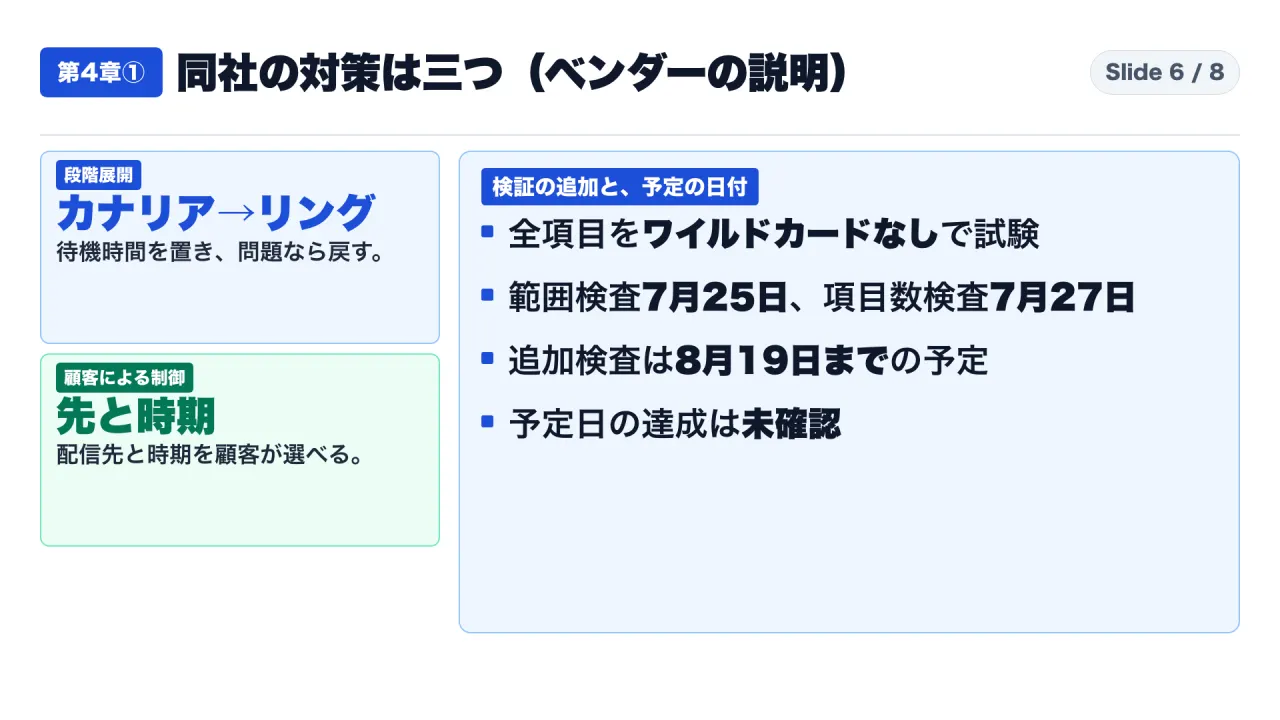
- Staged Deployment Rings: Implementing progressive rollout tiers for Rapid Response Content, starting in internal canaries before progressing to customer cohorts separated by telemetry soak times.
- Layered Verification Gates: Introducing runtime array bounds checking in the sensor driver (deployed July 25, 2024), compile-time input count validation (deployed July 27, 2024), and improved content validation.
- Customer Deployment Controls: Modifying the Falcon platform to provide administrators with granular scheduling controls over Rapid Response Content, enabling organizations to designate staging groups.
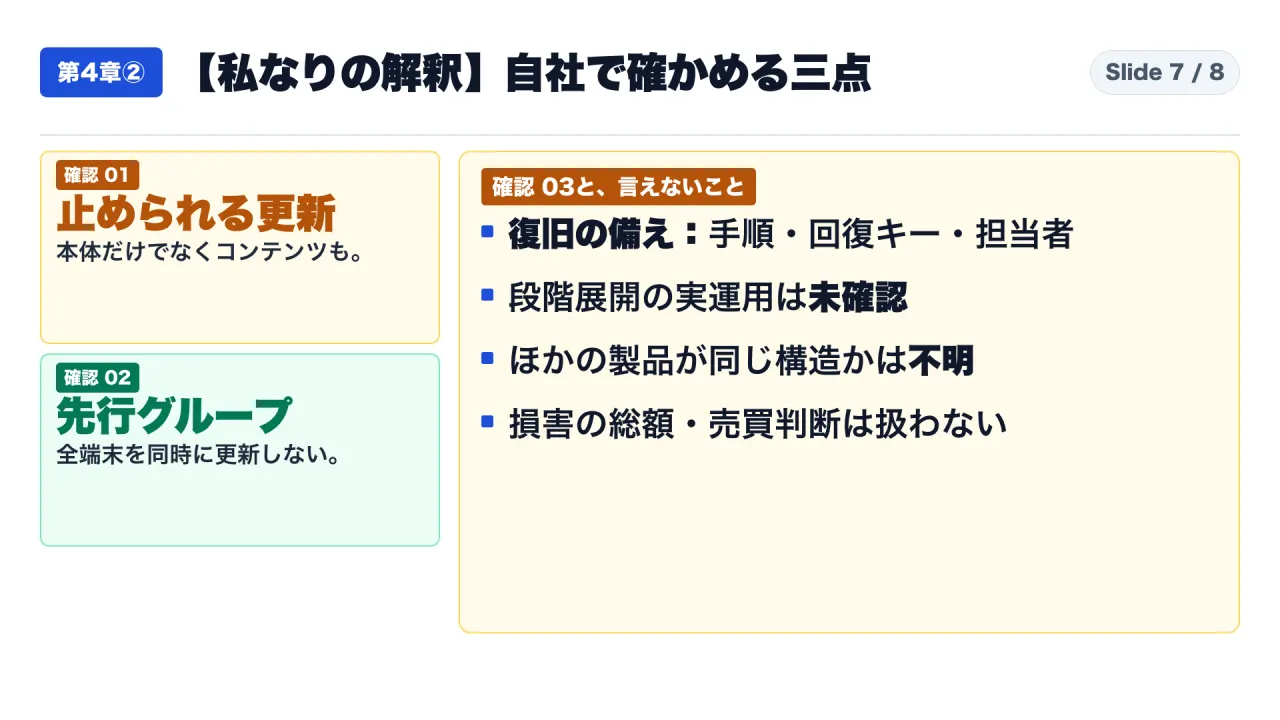
[Author Interpretation]: The three remediation measures serve fundamentally different engineering functions: validation catches defects before release; staged rollout limits the blast radius of escaped defects; and customer control transfers release scheduling authority to the enterprise. Enterprise teams must focus on the third measure, as it is the only component directly verifiable within corporate tenant settings.
Author Synthesis: The Three Internal Verifications for Enterprise IT
Infrastructure and security leaders cannot rely solely on vendor promises. Enterprises must enforce defenses across three operational domains:
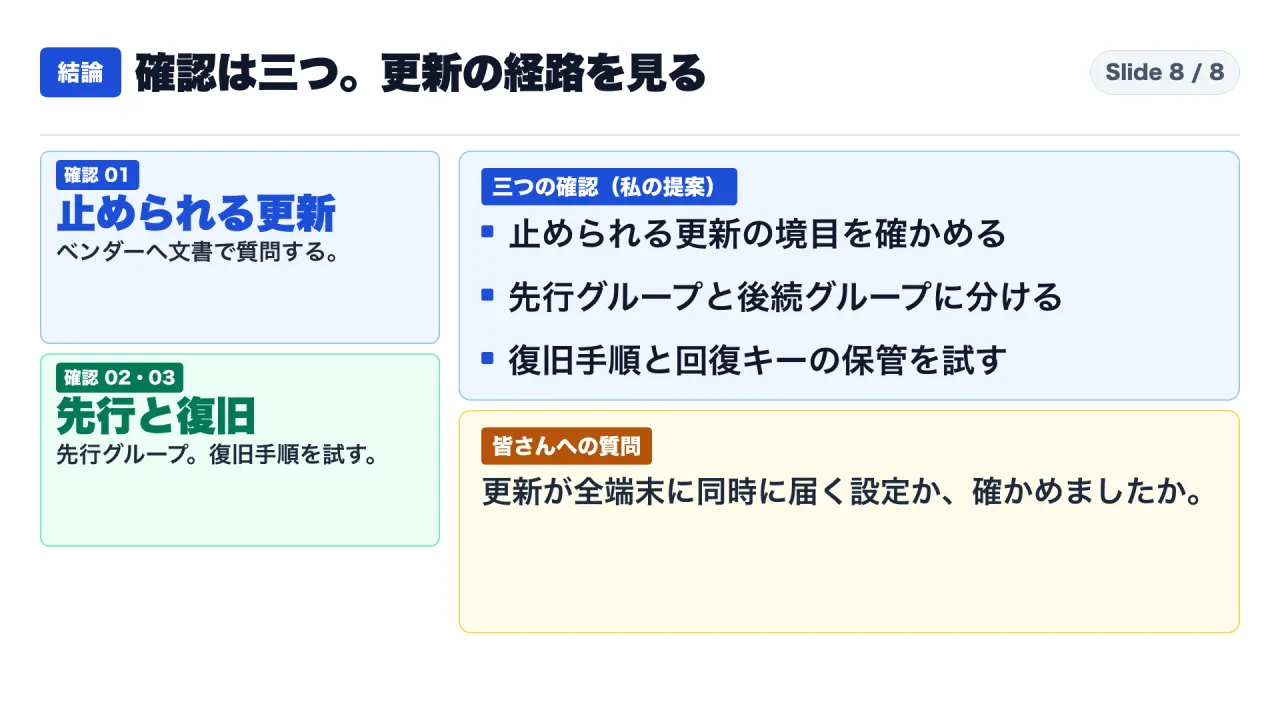
- Audit Gating Boundaries: Open administrative consoles across all security agents (EDR, DLP, VPN) to identify which channels allow customer staging versus unannounced push updates.
- Establish Internal Canary Rings: Never permit simultaneous updates across 100% of enterprise fleets. Segment systems into validation tiers (non-critical machines) and delayed production tiers (core database clusters, payment gateways).
- Institutionalize Offline Recovery: Maintain offline-accessible key escrow for BitLocker and local admin credentials. Disaster recovery runbooks that assume network access fail during total endpoint blackouts.
Operational Governance Playbook: Auto-Update Audit Framework
To protect infrastructure against single-point configuration failures, execute this diagnostic review across enterprise software tooling:
- Step 1: Map Update Topologies: Inventory all privileged endpoint agents. Distinguish binary patches from cloud rule updates, verifying whether each stream can be paused, pinned, or delayed.
- Step 2: Enforce Staged Ring Architecture: Divide corporate endpoints into Canary (1-5%), Pilot (15%), and Production (80%) rings. Enforce a minimum 24-hour soak window between ring promotions.
- Step 3: Validate Key Escrow and Out-of-Band Runbooks: Verify that BitLocker recovery keys can be retrieved during complete network blackouts. Conduct annual physical drills restoring a blue-screened host using offline documentation.
- Step 4: Formalize Vendor Contract Inquiries: Demand contractual clarity regarding vendor canary testing, staging soak times, and liability boundaries for automated push files.
Frequent Misconceptions & Diagnostic Q&A
Q1: Was the CrowdStrike outage caused by a cyberattack?
No. CrowdStrike confirmed that the outage resulted from an internal software defect in Channel File 291, not adversary action or compromised credentials.
Q2: Did Microsoft publish the 8.5 million device figure?
Yes. Microsoft published the 8.5 million estimate on its corporate blog on July 20, 2024, noting it represented less than 1% of all Windows machines globally.
Q3: Did revocation within 78 minutes resolve the incident?
No. Revoking the file stopped new infections, but already crashed endpoints remained offline until technicians manually entered recovery keys and deleted the corrupted driver file.
Q4: Does the template mismatch mean the driver was poorly coded?
CrowdStrike’s RCA identified multiple compounding failures: an omission in integration code, flawed validation logic, and a lack of bounds checking in the driver.
Primary Sources and References
- CrowdStrike, Falcon Content Update Remediation and Guidance Hub: https://www.crowdstrike.com/falcon-content-update-remediation-and-guidance-hub/
- CrowdStrike, Channel File 291 Incident Root Cause Analysis (August 6, 2024): https://www.crowdstrike.com/wp-content/uploads/2024/08/Channel-File-291-Incident-Root-Cause-Analysis-08.06.2024.pdf
- Microsoft Official Blog, Helping Our Customers Through the CrowdStrike Outage (July 20, 2024): https://blogs.microsoft.com/blog/2024/07/20/helping-our-customers-through-the-crowdstrike-outage/
- Delta Air Lines, Inc., Form 10-K Annual Report for the Year Ended December 31, 2024: https://www.sec.gov/Archives/edgar/data/27904/000002790425000004/dal-20241231.htm
- CrowdStrike Holdings, Inc., Form 10-Q Quarterly Report for the Period Ended July 31, 2026: https://www.sec.gov/Archives/edgar/data/1535527/000153552726000031/crwd-20260731.htm