Can On-Site Generation Solve Data Center Power Bottlenecks? Separating Regulatory Orders and SEC Filings from Corporate Ambition
While behind-the-meter fuel cells offer interim capacity during grid interconnection queues, FERC’s October 9 rejection of PJM’s BYONC mandate and FuelCell Energy’s SEC disclosures reveal that 64% of claimed backlogs remain non-binding customer options.
Published: October 31, 2026 | Read time: ~10 min | Watch Video (Japanese)
Executive Summary: Interim Option vs Definitive Solution
Facing multi-year transmission interconnection queues across North America, data center operators are evaluating on-site, behind-the-meter generation. However, based on verified regulatory orders and public filings as of October 31, 2026, the thesis that on-site generation resolves power constraints cannot be confirmed. This conclusion rests on three structural findings:
- Regulatory Mandates Rejected: On July 27, 2026, PJM Interconnection proposed subjecting new large loads without dedicated generation to emergency curtailment by June 1, 2027. On October 9, 2026, the Federal Energy Regulatory Commission (FERC) formally rejected this mechanism, ruling that mandatory self-generation cannot be enforced under regional transmission tariffs.
- Backlogs Dominated by Unexercised Options: In FuelCell Energy’s (NASDAQ: FCEL) Form 10-Q for the quarter ended July 31, 2026, the company reported a $3.65 billion backlog. However, only $1.30 billion represents binding contractual backlog, while $2.35 billion (64.5%) represents “Awarded Capacity Backlog,” which management notes does not constitute firm purchase orders.
- Flagship Projects Are Hybrid Deployments Under Review: The Newport Township project in Luzerne County, Pennsylvania, developed by Fit Energy, does not operate off-grid. Disclosures confirm it is a hybrid facility combining fuel cells with utility supply from UGI Utilities, having secured zoning while awaiting full land development approvals.
This forensic review provides corporate strategy, infrastructure finance, and procurement leaders with a deterministic framework to audit behind-the-meter claims by cross-referencing SEC disclosures against federal dockets.

Analytical Methodology and Evidentiary Boundaries
To prevent speculative market narratives from obscuring technical realities, this study enforces a strict taxonomy:
- [Fact]: Verifiable data extracted verbatim from regulatory orders, gubernatorial letters, or SEC registration statements.
- [Company Statement]: Management claims reflecting corporate projections rather than audited operational performance.
- [Author Calculation]: Mathematical derivations computed directly from primary data via transparent formulas.
- [Author Interpretation]: Analytical deductions regarding risk allocation and regulatory sequencing.
- [Unverified]: Industry figures that cannot be substantiated through official docket filings.
The evidentiary scope relies exclusively on primary records from PJM Interconnection, FERC Docket ER26-3515-000, the Texas Governor’s Office, FuelCell Energy Form 10-Q/8-K filings, and Fit Energy disclosures.

1. Grid Demand Forecasts vs Empirical Capacity Shortfalls
The market narrative driving on-site power claims stems from widening deficits between forecasted digital demand and thermal generation retirements across regional transmission networks.
Forecasts vs Realized Auction Outcomes
The distinction between econometric modeling and binding auction clearing is fundamental:
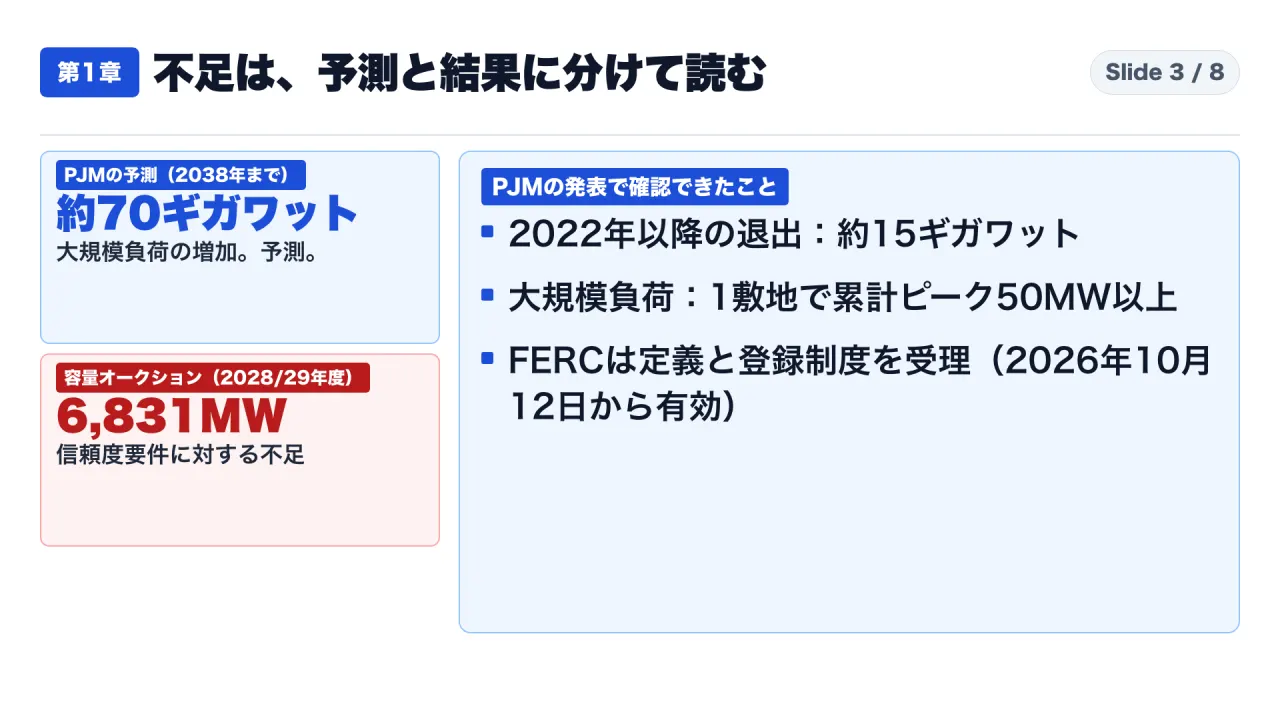
- [Fact]: On July 27, 2026, PJM projected that large load additions could exceed 70 gigawatts (GW) across its footprint by 2038, while noting that approximately 15 GW of thermal generation retired since 2022.
- [Fact]: In PJM’s 2028/2029 Base Residual Auction, cleared capacity fell short of the regional reliability requirement by 6,831 MW. PJM’s reliability standard requires a Loss of Load Expectation (LOLE) not exceeding one outage event per decade.
[Author Interpretation]: Analysts frequently conflate PJM’s 70 GW projection with immediate physical shortages. The 70 GW figure represents a multi-decade prospective estimate, whereas the 6,831 MW deficit reflects a binding, cleared auction outcome for the 2028/2029 delivery year. While an immediate 6.8 GW deficit poses acute reliability challenges, it cannot be mathematically treated as an instantaneous 70 GW deficit.
Large Load Classification and Tracking Mandate
- [Fact]: PJM defines a large load as a single customer facility with a cumulative peak demand of 50 megawatts (MW) or greater within a one-mile radius, aggregating multiple delivery points.
- [Fact]: In its October 9, 2026 order, FERC approved PJM’s large load definition and established a mandatory tracking registry effective October 12, 2026. The Commission required PJM to submit compliance filings within 30 days detailing the mechanical implementation of this registry.
2. Regulatory Reality: FERC’s October 9 Rejection of PJM’s On-Site Mandate
The primary commercial argument for mandatory on-site power stemmed from PJM’s emergency tariff proposal. A review of FERC records reveals that federal regulators dismantled this framework.
The PJM Board Proposal and the BYONC Mechanism
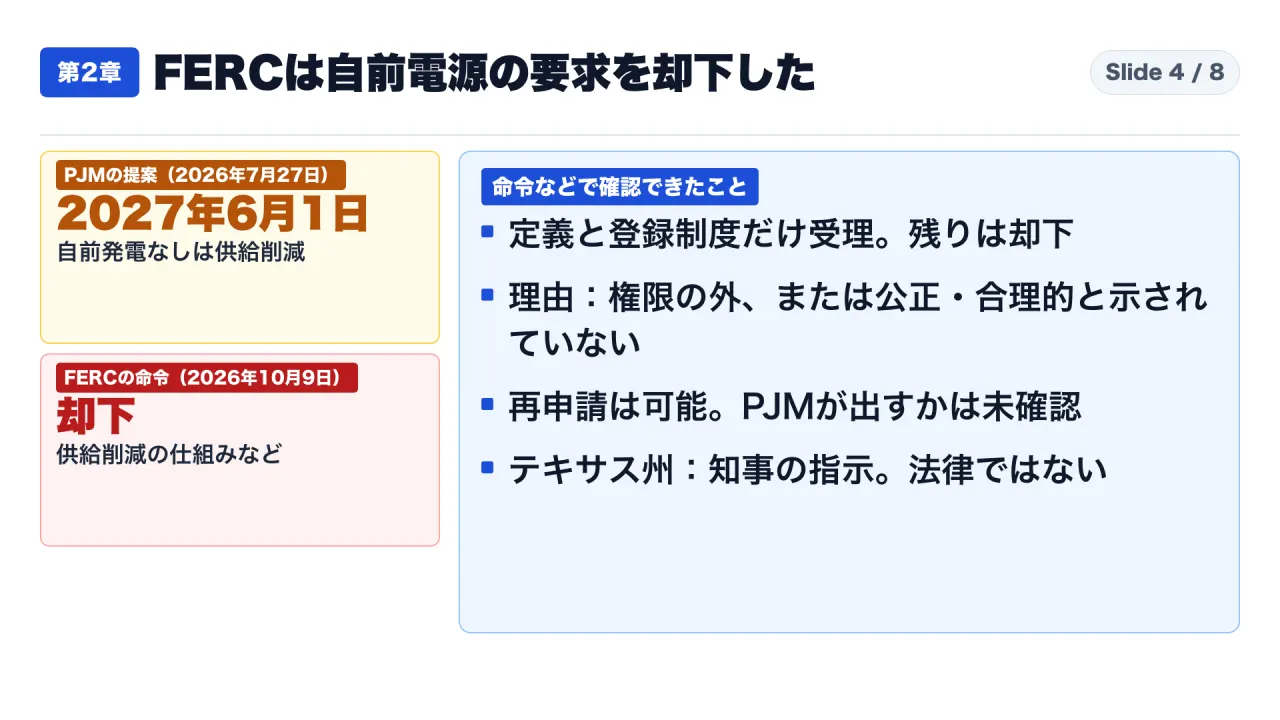
On July 27, 2026, PJM’s Board approved emergency rules submitted to FERC on August 13, 2026. The filing comprised six elements: 50 MW large load thresholds, an interconnection registry, Interim Resource Adequacy Service (IRAS), co-located generation rules, the “Bring Your Own New Capacity” (BYONC) framework, and excluding qualifying large loads from capacity demand curves. Under IRAS and BYONC, new large loads entering service before June 1, 2027, without dedicated generation faced administrative curtailment.
FERC Docket ER26-3515-000 Rejection Order
- [Fact]: On October 9, 2026, FERC issued its ruling on Docket ER26-3515-000. While approving the baseline large load definitions and the informational registry, the Commission summarily rejected IRAS, BYONC, and the associated curtailment rules.
- [Fact]: FERC ruled that PJM failed to show IRAS and BYONC were just, reasonable, and non-discriminatory under Section 205 of the Federal Power Act. The span from PJM’s July 27 board announcement to FERC’s October 9 rejection was exactly 74 days.
- [Fact]: As of October 31, 2026, PJM has not filed an alternative capacity mechanism.
[Author Interpretation]: Corporate claims asserting that data centers must construct on-site generation by June 2027 to avoid grid shutoffs rely on an invalidated regulatory proposal. The legal foundation for mandatory behind-the-meter generation under PJM tariffs was eliminated on October 9, 2026.
FuelCell Energy’s Investor Presentations and the Texas Executive Directive
- [Fact]: On September 2, 2026, FuelCell Energy published an investor presentation quoting PJM’s July 27 proposal, highlighting language that large loads without self-generation would face curtailment by June 1, 2027. This investor presentation was issued 37 days before FERC formally struck down the cited PJM provisions.
- [Unverified]: As of October 31, 2026, there is no public record indicating whether FuelCell Energy has revised its investor slide deck to reflect FERC’s October 9 rejection.
- [Fact]: On September 21, 2026, Texas Governor Greg Abbott delivered a formal executive directive to the Texas Commission on Environmental Quality (TCEQ) instructing the agency to pause environmental permits for new data centers pending a grid impact audit by ERCOT. The directive established an initial compliance deadline of October 19, 2026.
[Author Interpretation]: The Texas directive represents an administrative permitting pause by executive instruction, not a legislative ban on data center construction.
3. Financial Forensic: Deconstructing the $3.65B Backlog and Fit Energy Contract
On September 2, 2026, FuelCell Energy reported financial results for the fiscal third quarter ended July 31, 2026, highlighting an aggregate commercial backlog of $3.65 billion. A forensic analysis of Form 10-Q disclosures reveals the composition of this figure.
Binding Commitments vs Conditional Capacity Allocations
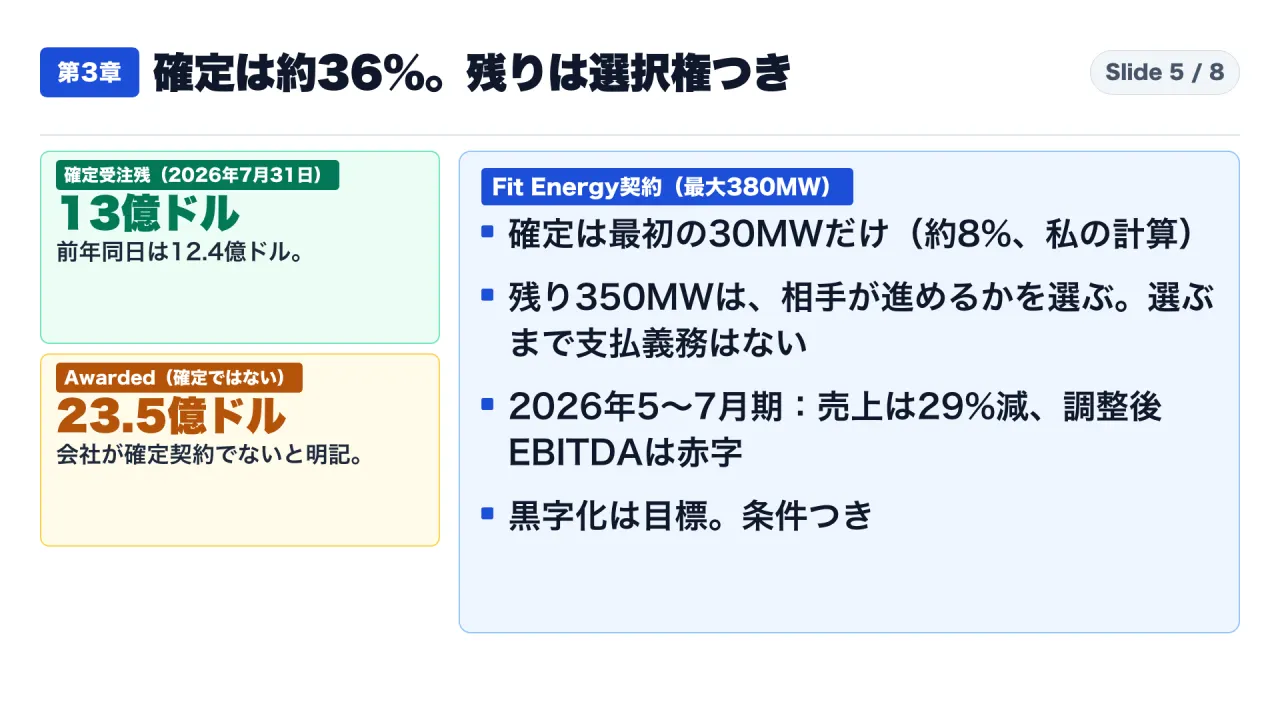
- [Fact]: As of July 31, 2026, FuelCell Energy reported a binding contractual backlog of $1,296,010,000 ($1.30 billion), compared to $1.24 billion in the prior-year period.
- [Fact]: The company introduced a distinct reporting line titled “Awarded Capacity Backlog” totaling $2,350,250,000 ($2.35 billion), bringing aggregate backlog to $3,646,260,000 ($3.65 billion).
- [Company Statement]: FuelCell Energy explicitly footnotes that the Awarded Capacity Backlog does not represent executed contracts, firm purchase orders, or legal guarantees of future revenue.
| Classification | Carrying Value ($000) | Percentage Share | Contract Status |
|---|---|---|---|
| Firm Contract Backlog | $1,296,010 | 35.5% | Executed / Legally Binding |
| Awarded Capacity Backlog | $2,350,250 | 64.5% | Conditional Customer Option |
| Total Disclosed Backlog | $3,646,260 | 100.0% | Mixed Accounting Base |
Author Calculations: 1,296,010 / 3,646,260 = 35.54%; 2,350,250 / 3,646,260 = 64.46%.
The Fit Energy 380 MW Master Agreement Structure
The entire $2.35 billion Awarded Capacity Backlog originates from a single multi-phase supply agreement executed with Fit Energy for a maximum potential capacity of 380 MW.
- [Fact]: The master contract specifies four discrete development phases: Phase 0 (30 MW firm); Phase 1 (100 MW optional); Phase 2 (125 MW optional); and Phase 3 (125 MW optional). Fit Energy retains sole discretion regarding whether to execute Phases 1 through 3. No binding financial obligations accrue until formal option exercise notices are delivered.
[Author Calculation]: Of the 380 MW potential contract volume, the firm execution volume (Phase 0) represents exactly 7.89% (30 MW / 380 MW). Conversely, 92.11% (350 MW / 380 MW) represents conditional customer options.
Current Operating Performance & Profitability Hurdles
- [Fact]: For the quarter ended July 31, 2026, FuelCell Energy reported revenues of $33.0 million, down 29.3% YoY from $46.7 million. Gross loss widened to $24.5 million (vs $5.1 million in Q3 FY2025), and Adjusted EBITDA deficit widened to -$36.7 million (vs -$16.4 million in Q3 FY2025).
- [Company Statement]: Management noted that product manufacturing costs exceed contract pricing on initial units. Annual manufacturing run-rate was 37.1 MW, targeting 100 MW by October 2026 and 500 MW by June 2028 via a $200M-$275M factory expansion. Positive Adjusted EBITDA is targeted for Q4 FY2027. Total cash stood at $737.3 million ($658.1 million unrestricted).
Forensic Audit of Levelized Cost Assumptions
- [Company Statement]: FuelCell Energy models an estimated levelized electricity cost of approximately $0.09 per kilowatt-hour ($90/MWh).
- [Fact]: Underwriting assumptions include a 20-year asset life, 8.0% WACC, 30% Investment Tax Credit monetization, and baseline natural gas commodity pricing. Crucially, the $0.09/kWh estimate explicitly omits dual-utility grid interconnect construction, civil site engineering, municipal permitting fees, emissions offsets, and local ad valorem taxes.
[Author Interpretation]: An on-site generation estimate omitting interconnect and permitting overhead cannot be compared directly against utility all-in tariff rates.
4. The Newport Township Case Study: Hybrid Interconnection Reality
The primary deployment referenced by project developers is the proposed data center campus in Newport Township, Luzerne County, Pennsylvania, developed by Fit Energy.
Operational Campus Architecture & Utility Interconnection
- [Fact]: On October 6, 2026, Fit Energy announced plans to develop a data center campus in Newport Township, noting that the township granted municipal zoning approval in August 2026.
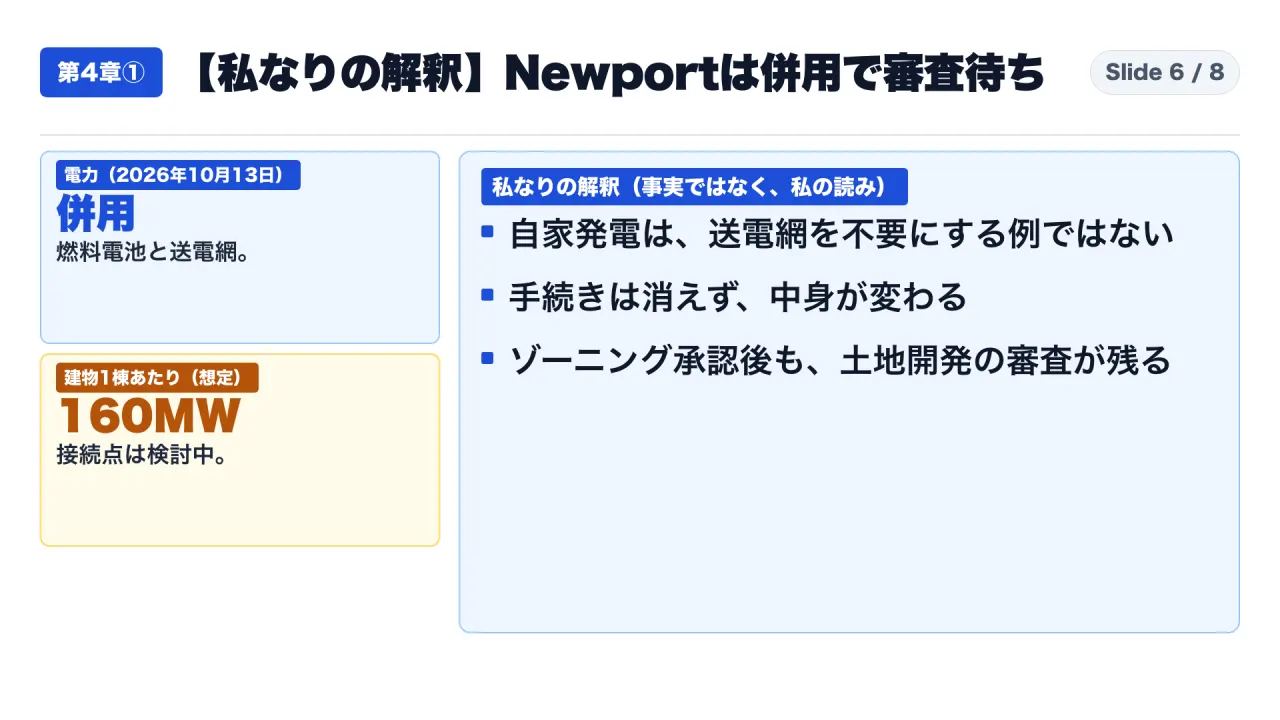
- [Fact]: In a formal community clarification issued on October 13, 2026, Fit Energy confirmed its technical architecture: the campus is designed as a hybrid facility combining behind-the-meter natural gas fuel cells with bulk utility grid power from UGI Utilities. It is not an islanded system.
- [Fact]: Exhibition boards presented at the Newport Township open house on October 28, 2026, indicated an estimated IT load of 160 MW per data center building. Electrical service planning with UGI Utilities evaluates dual-voltage feeds at 66 kV and 230 kV across phased deployment windows. Interconnection points and substation ownership remain under active evaluation.
- [Unverified]: Total building counts, cumulative campus megawatt capacity, and transcripts of public opposition remain unconfirmed in official municipal records as of October 31, 2026.
Author Synthesis: Permitting Transformation vs Elimination
The empirical record dismantles the thesis that on-site fuel cells allow hyperscalers to bypass infrastructure bottlenecks:
- Grid Interconnection Dependency Persists: Newport Township engineering specifications establish that behind-the-meter generation operates as a supplementary asset. Because mission-critical facilities require 99.999% availability, developers demand dual-feed utility connections for maintenance cycling and black-start backup.
- Procedural Substitution: On-site generation substitutes transmission queue delays for environmental, gas pipeline, and municipal land development reviews. Fuel cells require pipeline capacity, air permits, and zoning allowances.
- Regulatory Volatility: PJM’s BYONC docket proves that regulatory policies evolve faster than facility construction. Relying on unapproved market rules exposes capital to immediate regulatory invalidation.

Operational Governance Playbook: Due Diligence on Behind-the-Meter Power
For infrastructure investors and corporate procurement teams auditing on-site power proposals, the following framework prevents capital misallocation:
- Step 1: Contract De-averaging: Decompose backlog numbers into firm commitments versus customer options, checking deposit triggers and expiration dates.
- Step 2: Utility Scope Verification: Require engineering schematics defining interconnect voltage and capacity, verifying whether utility tariffs demand standby rates.
- Step 3: Regulatory Status Validation: Cross-reference cited market rules against effective FERC/RTO orders, requiring filing dates to verify legal enforceability.
- Step 4: Full-Cost LCOE Reconciliation: Re-underwrite LCOE models to include civil engineering, gas pipeline taps, and standby utility charges.

Frequent Misconceptions & Diagnostic Q&A
Q1: Does behind-the-meter generation eliminate data center power delays?
No. While on-site units can be delivered in advance of transmission substations, facilities remain tethered to utility grids for reliability. Furthermore, fuel supply infrastructure and municipal site approvals introduce distinct development queues.
Q2: Did PJM mandate that large loads must provide their own power by June 2027?
No. PJM proposed this rule on July 27, 2026, but FERC rejected the IRAS and BYONC mechanisms on October 9, 2026, rendering the proposal legally unenforceable.
Q3: Can FuelCell Energy’s $3.65 billion backlog be booked as predictable revenue?
No. Exactly $2.35 billion (64.5%) consists of Awarded Capacity under the Fit Energy contract, giving the customer uncommitted options across Phases 1 through 3.
Q4: Is the Newport Township project completely off-grid?
No. Official company filings and exhibition boards confirm it is a hybrid project interconnecting with UGI Utilities at 66 kV and 230 kV.
Primary Sources and References
- FuelCell Energy, Inc., Form 10-Q & Q3 FY2026 Earnings Release (September 2, 2026): https://www.sec.gov/Archives/edgar/data/886128/000110465926104498/fcel-20260902xex99d1.htm
- FuelCell Energy, Inc., Investor Presentation (September 2, 2026): https://www.sec.gov/Archives/edgar/data/886128/000110465926104498/fcel-20260902xex99d2.htm
- PJM Interconnection Board of Managers, Action Announcement on Resource Adequacy (July 27, 2026): https://insidelines.pjm.com/pjm-board-directs-action-on-resource-adequacy-affordability-and-large-loads/
- Federal Energy Regulatory Commission (FERC), Order on Tariff Revisions, Docket ER26-3515-000 (October 9, 2026): https://www.pjm.com/pjmfiles/directory/etariff/FercOrders/9207/20261009-er26-3515-000.pdf
- Fit Energy, Newport Township Project Press Release (October 6, 2026): https://newportdatacenter.com/documents/2026-10-06-newport-township-press-release.pdf
- Fit Energy, Newport Township Community Statement (October 13, 2026): https://newportdatacenter.com/documents/2026-10-13-newport-township-community-statement.pdf
- Fit Energy, Newport Township Open House Information Boards (October 28, 2026): https://newportdatacenter.com/documents/2026-10-28-newport-township-open-house-boards.pdf
- Office of the Governor of Texas, Executive Directive on Data Center Permitting (September 21, 2026): https://gov.texas.gov/uploads/files/press/TCEQ_Data_Center.pdf