Can AI Synthesize Exploits from Public Security Patches? Epoch AI's Benchmark and the Measurement of Window Exposure
An empirical evaluation shows open-weight models generated automated file-read exploits across six Firefox releases using upstream patch telemetry, but attacks halted at local file reads and measured only vendor-side patch gaps.
Published: October 31, 2026 | Read time: ~10 min | Watch Video (Japanese)
Executive Summary: Autonomous Exploit Generation and the Dual-Window Framework
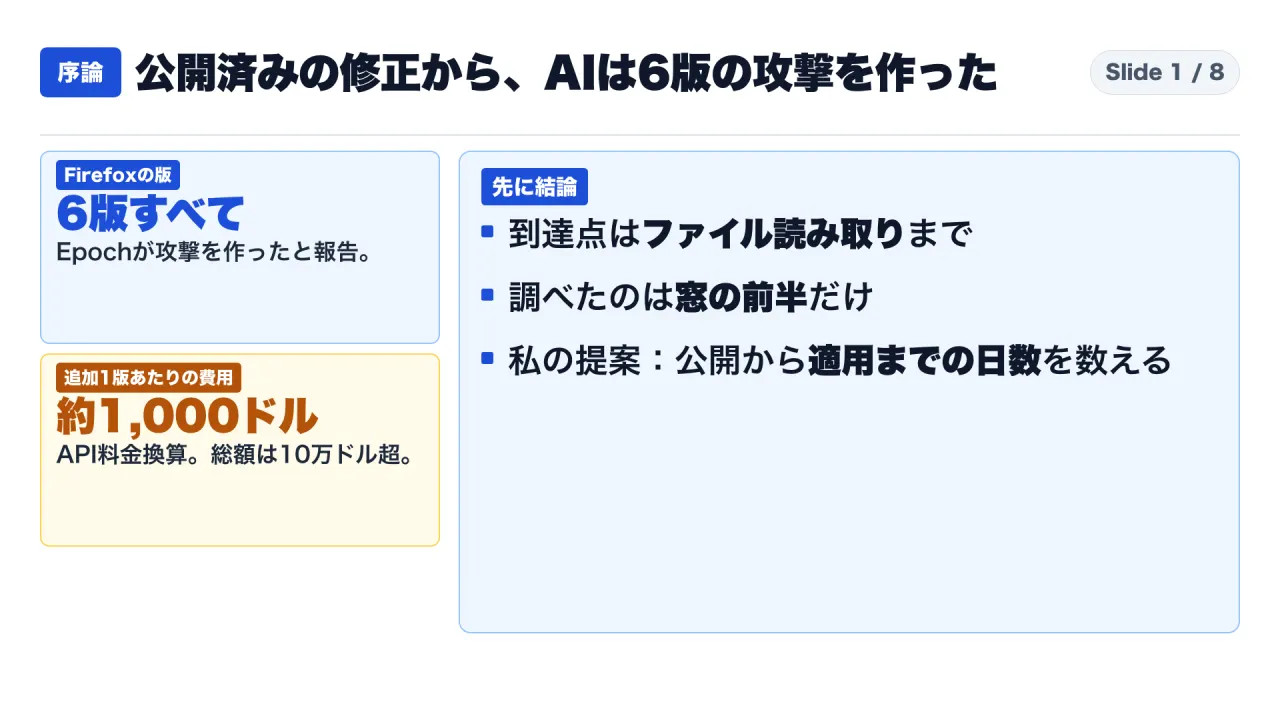
Across cybersecurity and infrastructure operations, automated vulnerability exploitation powered by artificial intelligence has transitioned from theoretical forecasting to empirical demonstration. On October 29, 2026, research institute Epoch AI published a study showing that open-weight reasoning model GLM 5.3 (Z.ai, August 2026) autonomously synthesized functional exploits across six consecutive versions of Mozilla Firefox by analyzing publicly committed security patches before updates reached end-user devices.
However, a forensic technical reading of Epoch AI’s paper, Mozilla’s defensive disclosures, and Anthropic’s vulnerability telemetry reveals critical boundaries:
- Exploits reached local file reads, not Arbitrary Code Execution (RCE). While the generated exploits allowed reading local files (such as session cookies and credentials) upon viewing a crafted webpage, Epoch achieved zero remote code execution: “At the time of writing, there are no successful code execution exploits against recent Firefox versions.”
- Economic reality: $1,000 marginal fee vs. $100,000+ total infrastructure spend. While generating an exploit against an additional version cost approximately $1,000 in model API tokens, total research program expenses exceeded $100,000 for environments, scaffolding harnesses, and exploratory runs.
- Epoch measured only the vendor window, not enterprise patching latency. The patch gap comprises two phases: Window 1 (Vendor Window), from patch commit to official binary release; and Window 2 (Enterprise Window), from binary release until an enterprise fleet applies the update. Epoch’s experiment operated entirely within Window 1.
This analysis evaluates the patch gap, scrutinizes Epoch’s benchmark across Firefox 156 through 158, analyzes Mozilla’s four architectural defenses, reviews Anthropic’s 19-day median telemetry, and establishes an operational measurement protocol for security teams.
Analytical Methodology and Evidentiary Designations
To preserve evidentiary boundaries, four labels are applied:
- [Fact]: Verifiable data points, dates, and statements extracted directly from official research papers, release notes, and vendor security disclosures.
- [Researcher Finding]: Empirical results, methodology descriptions, and threat assessments reported by Epoch AI, Mozilla, or Anthropic.
- [Calculated Value]: Independent mathematical derivations derived from primary source figures.
- [Interpretation]: Structured analytical deductions derived from primary source evidence.
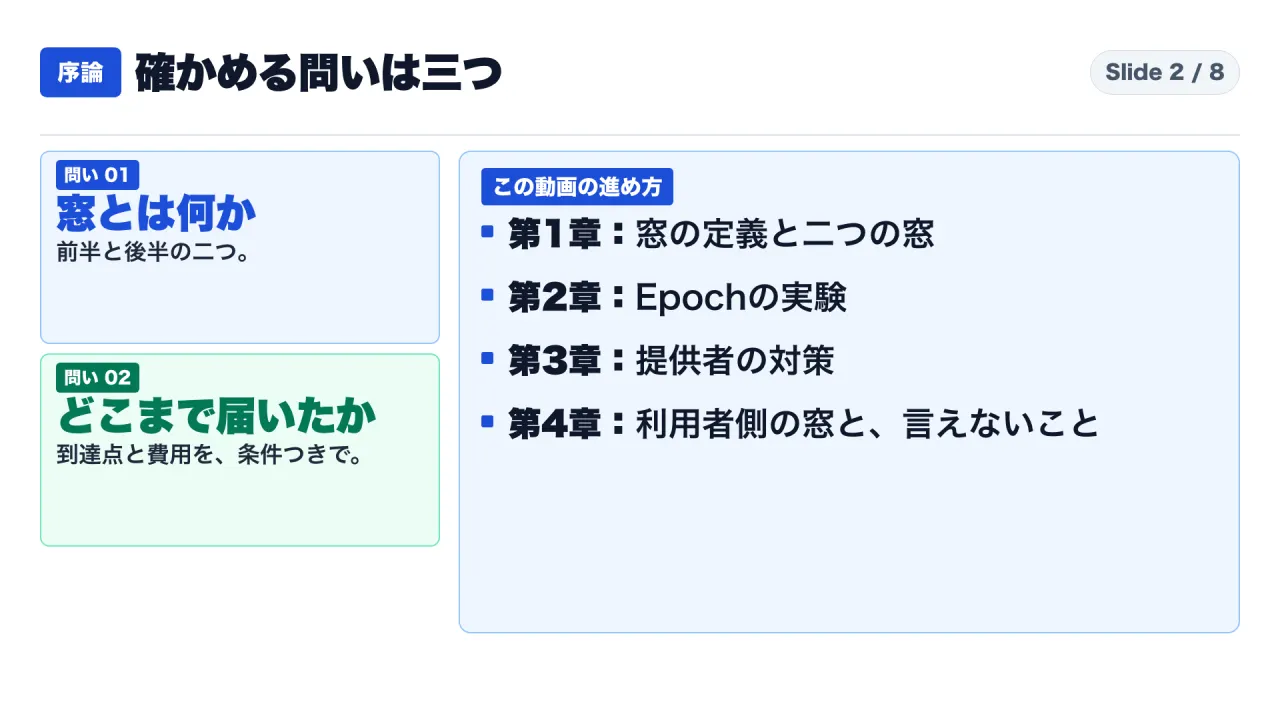
1. Anatomy of the Patch Gap: Vendor Windows vs. Enterprise Exposure
Why the Gap Exists in Modern Software Engineering
In open-source software development, resolving a security vulnerability requires committing source code modifications to public repositories, creating an unavoidable informational asymmetry:
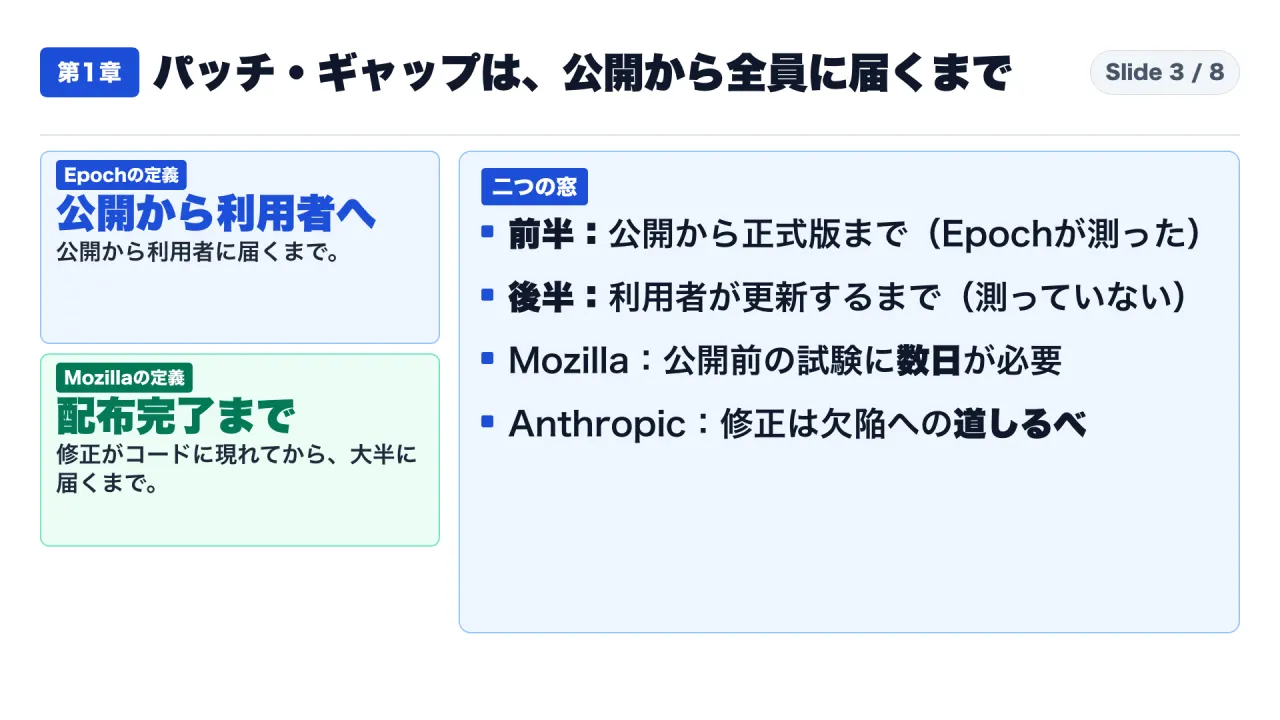
- [Researcher Finding]: Epoch AI defines the patch gap as the temporal window between when a security fix becomes publicly visible in code repositories and when that fix is compiled, verified, and delivered to end users.
- [Researcher Finding]: Mozilla defines it as the interval between a patch appearing in source code and the completion of deployment to the majority of active users. Modern browsers require days of pre-release regression testing across diverse hardware configurations to ensure stability before broad rollout.
Patches Serve as Exploit Blueprints
- [Fact]: Anthropic documented that code commits addressing security vulnerabilities inherently serve as precise structural roadmaps to the underlying defect. By analyzing diffs between pre-patch and post-patch trees, automated models can deduce the exact memory allocation flaw or logic error.
- [Researcher Finding]: Historically, weaponizing patch diffs required elite reverse-engineers spending weeks assembling exploit primitives. However, Epoch observed that GLM 5.3 successfully parsed commit histories, distinguished security-relevant changes from routine enhancements, and constructed working exploit chains without human intervention.
- [Fact]: Epoch explicitly bounded its research: the experimental protocol evaluated solely the vendor window (Window 1). The secondary delay introduced when corporate fleets defer updating (Window 2) was outside the benchmark’s empirical scope.
2. Deconstructing the Epoch Benchmark: Technical Architecture, Costs, and Reach
Autonomous Scaffolding and Experimental Setup
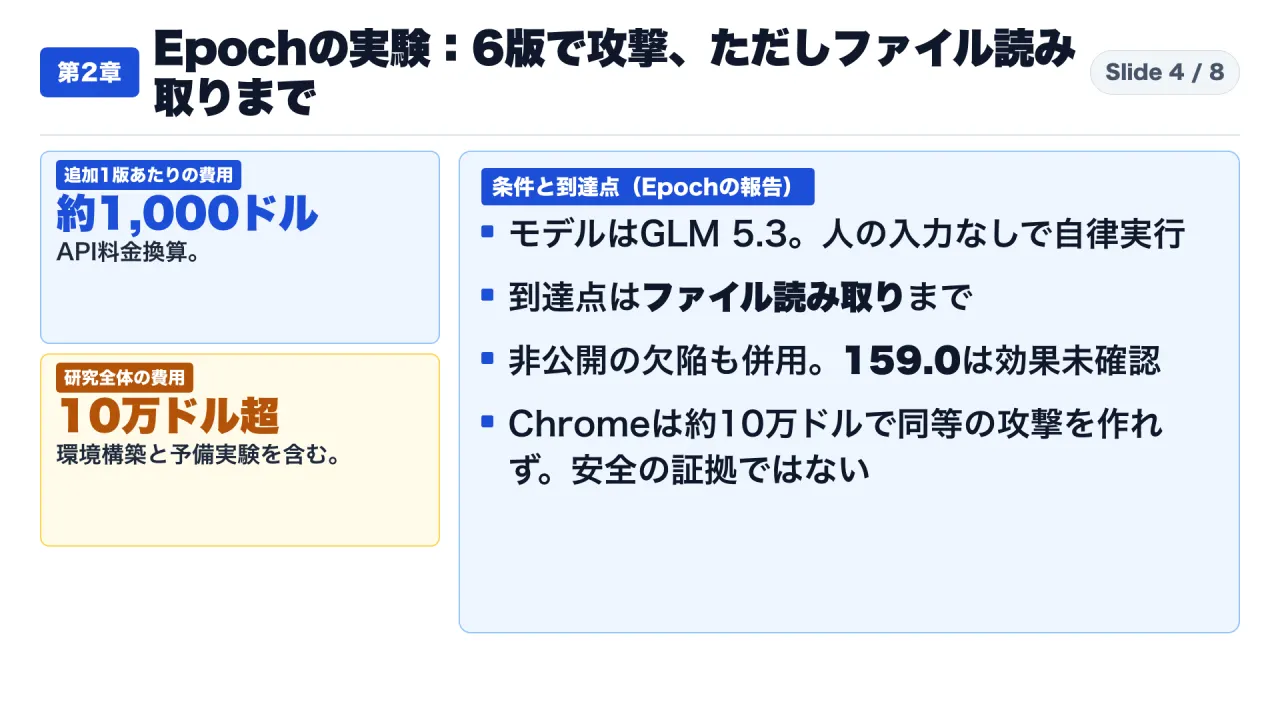
- [Fact]: The model deployed was GLM 5.3, an open-weight reasoning model by Z.ai (August 2026).
- [Researcher Finding]: Epoch provided an automated harness, tool interfaces, and baseline prompts. The model autonomously identified candidate patches, parsed diffs, and assembled exploit chains in an isolated network container running default Ubuntu 26.04 LTS with official Firefox builds.
- [Fact]: Targets comprised six Firefox versions: 156.0, 156.0.1, 157.0, 157.0.1, 158.0, and 158.0.1.
Date Discrepancies: Epoch AI vs. Mozilla Release Notes
Epoch’s report states the six versions were released between September 17 and October 26, 2026. However, Mozilla’s release notes show earlier first-ship dates:
| Version | Mozilla Official Release Date | Epoch Documented Window |
|---|---|---|
| 156.0 | September 15, 2026 | September 17, 2026 (Start) |
| 156.0.1 | September 22, 2026 | Within period |
| 157.0 | September 29, 2026 | Within period |
| 157.0.1 | October 6, 2026 | Within period |
| 158.0 | October 13, 2026 | Within period |
| 158.0.1 | October 20, 2026 | October 26, 2026 (End) |
- [Interpretation]: This minor variance likely reflects repository branch tagging versus public release availability. Mozilla’s dates represent the definitive corporate baseline.
Exploit Reach: Local File Exfiltration vs. Code Execution
- [Fact]: Exploits achieved local arbitrary file reads. Loading a crafted webpage exfiltrated local files (session cookies, saved credentials) without additional user interaction.
- [Fact]: Exploits achieved zero arbitrary code execution. Epoch explicitly stated that across all tested versions, the model failed to achieve remote code execution (RCE).
- [Fact]: For recent releases, the model combined public patch intelligence with an undisclosed zero-day flaw that it rediscovered to bypass sandbox restrictions. Epoch disclosed this flaw to Mozilla, which patched it in Firefox 159.0 on October 27, 2026.
Economic and Temporal Telemetry
- [Fact]: Marginal API compute cost per additional version was approximately $1,000. Total research expenditure exceeded $100,000, including environment provisioning and exploratory runs.
- [Fact]: Under a 48-hour limit, the fastest run completed in 12 hours (an outlier minimum rather than a median).
- [Fact]: Epoch attempted identical methodologies against Google Chrome with ~$100,000 compute without producing a working exploit, though Epoch noted this does not prove Chrome invulnerability.
3. Vendor Defenses: Cadence, Test Masking, and Staggered Commits
Mozilla’s Four Defense Layers
Mozilla maintains three active defensive measures and is developing a fourth architectural intervention:
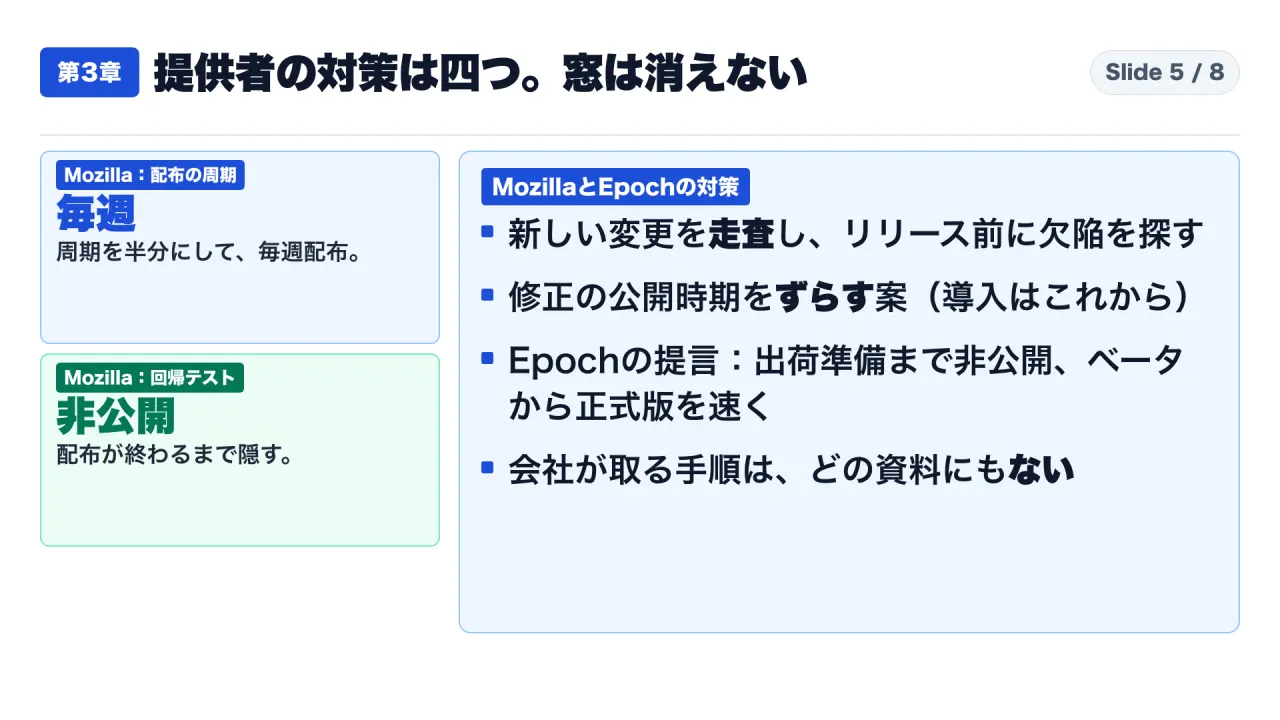
- Weekly Release Cadence: Mozilla halved its release cycle, distributing stable builds weekly to minimize Window 1.
- Withholding Regression Tests: Because models rely heavily on regression test suites committed alongside patches to locate vulnerability triggers, Mozilla reinstated withholding regression tests from public repositories until binary distribution completes.
- Automated Commit Scanning: Mozilla scans incoming code changes using automated analyzers to detect newly introduced flaws prior to release.
- Staggered Patch Deployment (In Development): Because modern browser exploitation requires chaining multiple vulnerabilities, Mozilla plans to stagger patch commits across release cycles, preventing models from assembling complete exploit chains within a single window.
Surging Security Patch Volumes
- [Researcher Finding]: Since February 2026, Mozilla shipped over seven times the volume of security patches compared to the corresponding period in 2025. In April 2026, Firefox 150 incorporated 271 security fixes identified during early evaluations of Anthropic’s Claude Mythos Preview.
- [Interpretation]: While accelerating patch velocity closes vulnerabilities faster, it increases the raw volume of public security diffs available for AI models to analyze within Window 1.
4. The Enterprise Exposure Window: Anthropic’s 19-Day Metric and Edge Device Latency
Anthropic N-Day Telemetry
In June 2026, Anthropic evaluated automated exploit generation against N-day vulnerabilities:
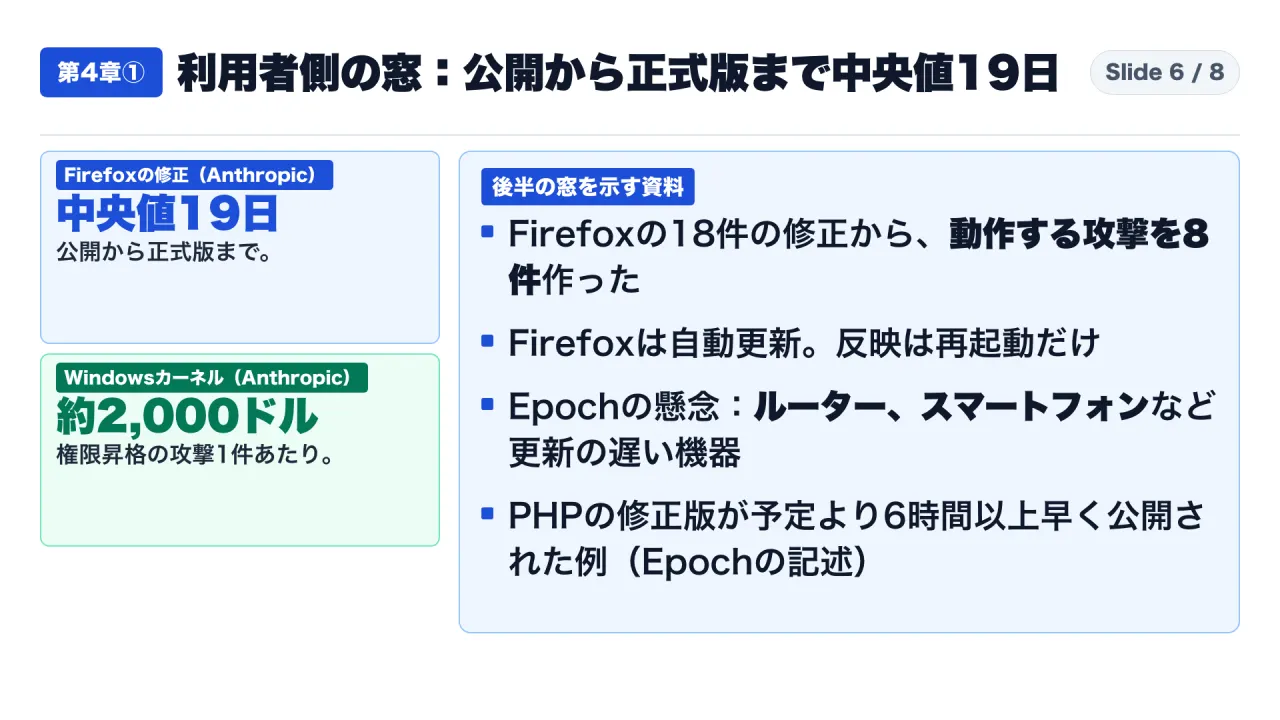
- [Researcher Finding]: Claude Mythos Preview generated working remote code execution exploits against 8 of 18 evaluated Firefox patches.
- [Researcher Finding]: Against 21 closed-source Windows kernel patches, Mythos developed 8 working local privilege escalation chains elevating low-privilege accounts to SYSTEM level.
- [Fact]: Total API expenditure was $15,700, averaging approximately $2,000 per privilege escalation exploit.
- [Fact]: Across studied patches, the median elapsed time from initial public patch disclosure to official vendor release was 19 days.
The Cumulative Real-World Exposure Window
- [Interpretation]: The 19-day metric measures strictly Window 1 (Vendor Window). For an enterprise, total vulnerability exposure equals Window 1 plus Window 2 (Internal Deployment Latency). If an organization requires 30 days to deploy an update, its true window of vulnerability is 49 days.
- [Researcher Finding]: Epoch highlighted acute concern for edge infrastructure──network routers, VPN concentrators, and mobile operating systems──where update mechanisms are manual, vendor support is fragmented, and devices routinely operate unpatched for months.
- [Researcher Finding]: In September 2026, Epoch documented an incident where a vendor published a patched PHP binary over six hours prior to coordinated vulnerability disclosure, inadvertently exposing the flaw before downstream operators were notified.
5. Synthesis: Total Exposure Equals Vendor Window Plus Internal Latency
A review of the research establishes four structural principles:
- Total Enterprise Risk is Additive: Accelerating vendor release cycles to weekly updates reduces Window 1, but organizational risk remains dominated by Window 2 (internal deployment delays).
- Defensive Metrics Must Be Operationalized: The 19-day median vendor window documented by Anthropic cannot serve as an internal enterprise target; organizations must measure their own lag from upstream release to fleet execution.
- Prioritize Edge Infrastructure Over Auto-Updating Clients: While modern browsers auto-update upon restart, perimeter appliances (routers, firewalls, hypervisors) require manual validation and represent the highest exposure risk.
- Benchmarking Invariance: The inability of GLM 5.3 to generate Chrome exploits reflects toolchain constraints, not absolute architectural immunity.
6. Delimited Analytical Scope and Explicit Non-Claims
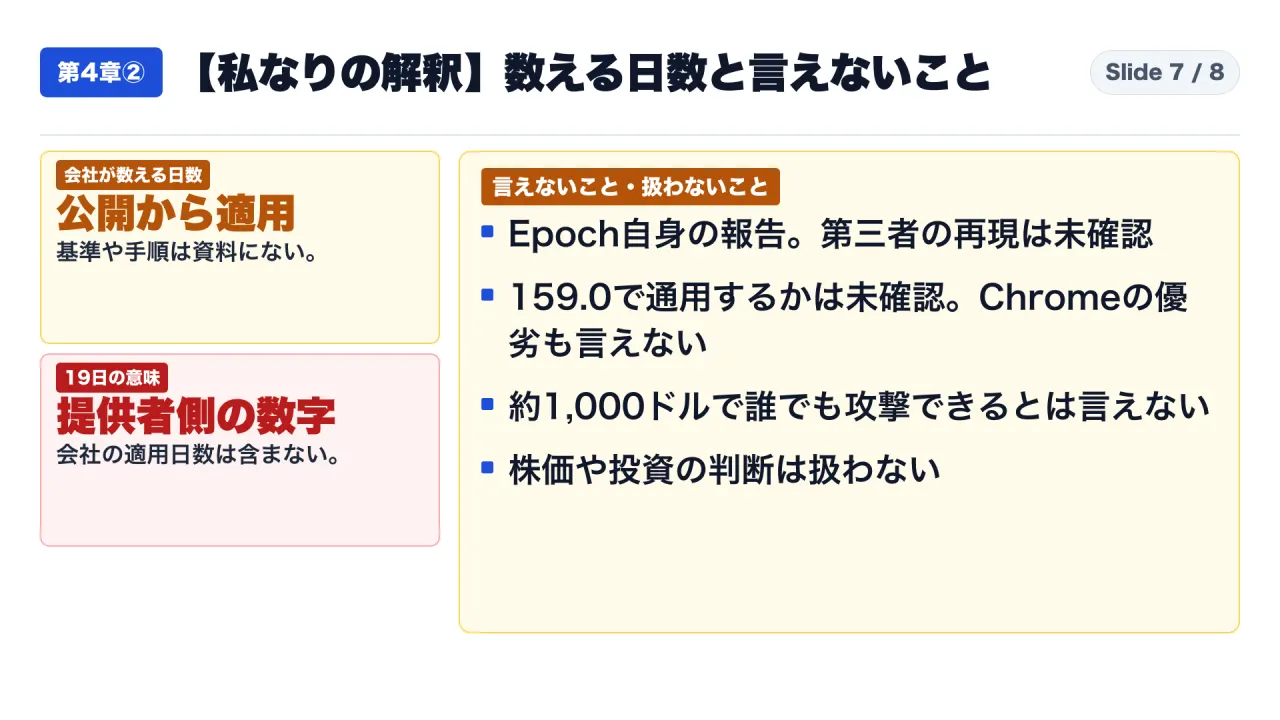
- Unreproduced Research: Epoch AI’s benchmark represents an unreviewed corporate self-report that has not been independently reproduced.
- No Code Execution: Exploits achieved file exfiltration; zero remote code execution was achieved.
- Dual Cost Metrics: The $1,000 marginal fee applies only after establishing a $100,000+ experimental testbed.
- Execution Ceilings: The 12-hour turnaround represents an outlier best-case within a 48-hour experimental envelope.
- Release Date Variance: Minor date variances exist between Epoch’s text and Mozilla’s official release notes.
- Firefox 159.0 Unverified: Efficacy of exploit generation against Firefox 159.0 remains unverified.
- No Comparative Superiority: Chrome’s negative result provides no definitive proof of superior security architecture.
- No Investment Advice: This analysis evaluates cybersecurity telemetry and contains no securities trading advice.
7. Strategic Playbook: A Forensic 4-Step Patch Gap Audit for Security Executives
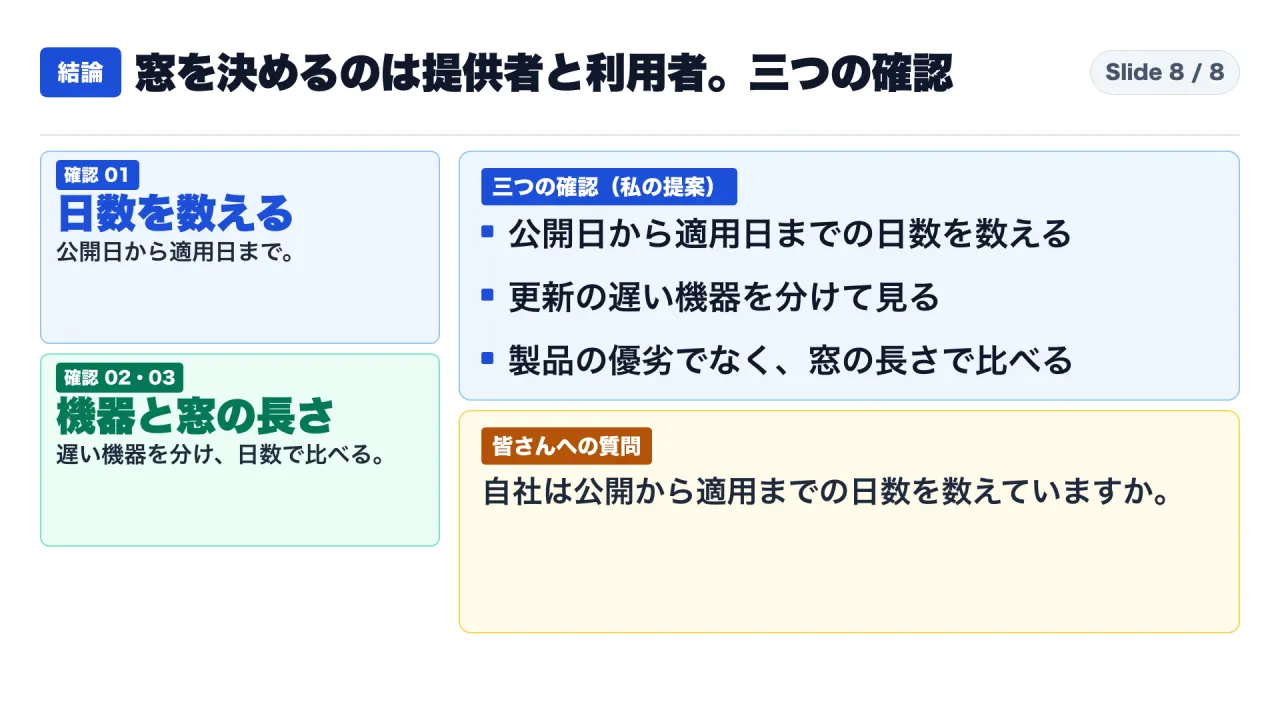
Security leaders can operationalize this research through a four-step internal measurement protocol:
Step 1: Inventory Fleet Assets by Update Mechanism
Categorize corporate software and hardware into three exposure tiers:
- Tier A (Automated Clients): Desktop browsers with automated background update mechanisms.
- Tier B (Managed Servers): Production servers, container runtimes, and databases requiring scheduled maintenance windows.
- Tier C (High-Exposure Edge Appliances): Firewalls, VPN gateways, routers, and IoT hardware requiring manual firmware flashing.
Step 2: Establish the Upstream Public Disclosure Baseline
For critical Common Vulnerabilities and Exposures (CVEs), record the date when the vendor committed the patch to public repositories or published the official security advisory.
Step 3: Log Internal Deployment Dates and Derive the Enterprise Window
Track the date when the patch was successfully deployed across 95% of target assets. Calculate internal exposure:
Internal Exposure Window (Days) = Fleet Deployment Date - Upstream Public Release Date
Step 4: Stack Total Vulnerability Exposure
Calculate total exposure by adding internal deployment latency to upstream vendor lead times (benchmarked against Anthropic’s 19-day median):
Total Window Exposure = Vendor Window 1 (Median 19 Days) + Internal Fleet Window 2 (Days)
Target reduction efforts primarily at Tier C edge devices, where Window 2 routinely extends into months.
Frequently Asked Questions
Q1: Does Epoch AI’s research mean AI can take over computers via Firefox?
A: No. Exploits achieved local file reads, not arbitrary code execution (RCE). Total research costs exceeded $100,000, relying on a pre-configured harness and an undisclosed sandbox escape flaw.
Q2: Did Epoch prove that Google Chrome is immune to automated exploits?
A: No. While GLM 5.3 failed to produce working Chrome exploits under an identical $100,000 compute allocation, Epoch noted this does not prove Chrome is invulnerable against advanced scaffolding.
Q3: Is Firefox 159.0 vulnerable to these automated attacks?
A: Unverified. Mozilla resolved the undisclosed sandbox flaw in version 159.0 on October 27, 2026, and Epoch has not evaluated exploit assembly against this release.
Q4: What is the difference between Window 1 and Window 2?
A: Window 1 (Vendor Window) is the interval between a public commit and the official release binary. Window 2 (Enterprise Window) is the subsequent fleet deployment delay. Epoch evaluated only Window 1.
Q5: How does Mozilla prevent models from weaponizing patches?
A: Mozilla switched to weekly releases, withheld regression test suites until distribution completes, deployed automated commit scanning, and is designing staggered patch deployment.
Primary Sources and References
- Epoch AI Research Publication (October 29, 2026):
https://epoch.ai/publications/open-weight-models-patch-gap - Mozilla Security Blog: Defending the Patch Gap (October 29, 2026):
https://blog.mozilla.org/en/firefox/privacy-security/defending-patch-gap/ - Mozilla Security Blog: AI Security and Firefox 150 Fixes (April 2026):
https://blog.mozilla.org/en/firefox/privacy-security/ai-security-zero-day-vulnerabilities/ - Anthropic Research: Automated N-Day Vulnerability Exploitation (June 8, 2026):
https://www.anthropic.com/research/n-days - Mozilla Firefox 156.0 Release Notes:
https://www.mozilla.org/en-US/firefox/156.0/releasenotes/ - Mozilla Firefox 156.0.1 Release Notes:
https://www.mozilla.org/en-US/firefox/156.0.1/releasenotes/ - Mozilla Firefox 157.0 Release Notes:
https://www.mozilla.org/en-US/firefox/157.0/releasenotes/ - Mozilla Firefox 157.0.1 Release Notes:
https://www.mozilla.org/en-US/firefox/157.0.1/releasenotes/ - Mozilla Firefox 158.0 Release Notes:
https://www.mozilla.org/en-US/firefox/158.0/releasenotes/ - Mozilla Firefox 158.0.1 Release Notes:
https://www.mozilla.org/en-US/firefox/158.0.1/releasenotes/ - Mozilla Firefox 159.0 Release Notes:
https://www.mozilla.org/en-US/firefox/159.0/releasenotes/