Where Does the Budget for Grand Theft Auto VI Actually Exist in SEC Filings? Parsing Video Game AAA Costs, Studio Layoffs, and AI Capital Across Three Information Tiers
An empirical forensic audit reveals that individual blockbuster budgets never appear in Take-Two’s statutory filings, requiring corporate strategists to disentangle verified regulatory disclosures, industry research bounds, and anonymous press reporting.
Published: October 31, 2026 | Read time: ~10 min | Watch Video (Japanese)
Executive Summary: The Myth of the 10-Figure Budget and Information Provenance
Across corporate planning and financial analysis, mega-cap figures circulating through trade media routinely shape strategic assumptions. When headlines claim that Grand Theft Auto VI costs over $1 billion, that AAA budgets average $300 million, or that one-third of gaming workers were laid off in 2025, analysts often adopt these numbers as industry benchmarks.
However, an empirical audit of primary records establishes a core reality: individual video game production budgets are virtually never disclosed in statutory securities filings.
In Take-Two Interactive Software, Inc.’s Form 10-K for the fiscal year ended March 31, 2026, and its Form 10-Q for the period ended June 30, 2026, the development budget for Grand Theft Auto VI does not appear. Regulatory filings disclose aggregate headcount and corporate-wide capitalized software balances, but omit project-level expenditures.
Corporate strategists must divide industry metrics into three information tiers:
- Tier 1: Statutory SEC Filings: Audited Form 10-K and Form 10-Q reports capturing enterprise headcount and capitalized software assets.
- Tier 2: Structured Research Reports: Studies from consultancies (BCG), trade groups (GDC), and investment banks (Drake Star) operating under specific bounding qualifiers and sample limits.
- Tier 3: Press Reports and Anonymous Sourcing: Investigative journalism and leaked communications carrying variable third-party credibility but lacking corporate verification.
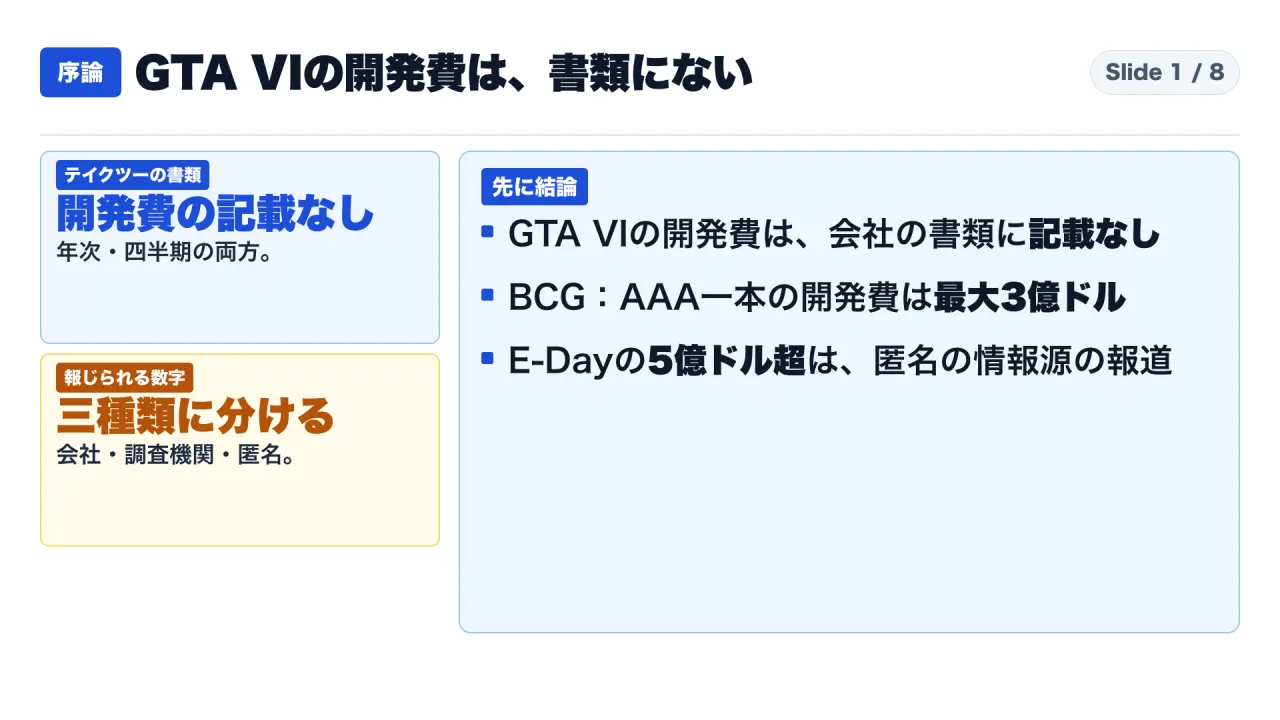
This analysis evaluates each tier using primary records, contextualizing BCG’s $300 million ceiling, GDC’s 24-month layoff data, Drake Star’s $1.62 billion private capital distribution, and Microsoft’s unconfirmed $500 million Gears of War: E-Day budget rumor.
Analytical Methodology and Evidentiary Designations
To preserve evidentiary boundaries, four labels are applied:
- [Fact]: Verifiable figures, dates, and statements extracted directly from regulatory SEC filings, official research publications, and corporate statements.
- [Press Report]: Media claims citing unnamed sources or internal communications unconfirmed by corporate spokespersons.
- [Calculated Value]: Independent mathematical derivations calculated directly from published primary figures.
- [Interpretation]: Analytical deductions derived from primary source evidence.
1. Statutory Disclosures: Headcount, Capitalized Balances, and What Take-Two Does Not Disclose
What Take-Two Formally Discloses
In Take-Two’s Form 10-K (fiscal year ended March 31, 2026), the company confirms commercial timing:
“[Fact] Rockstar plans to release Grand Theft Auto VI on November 19, 2026.”
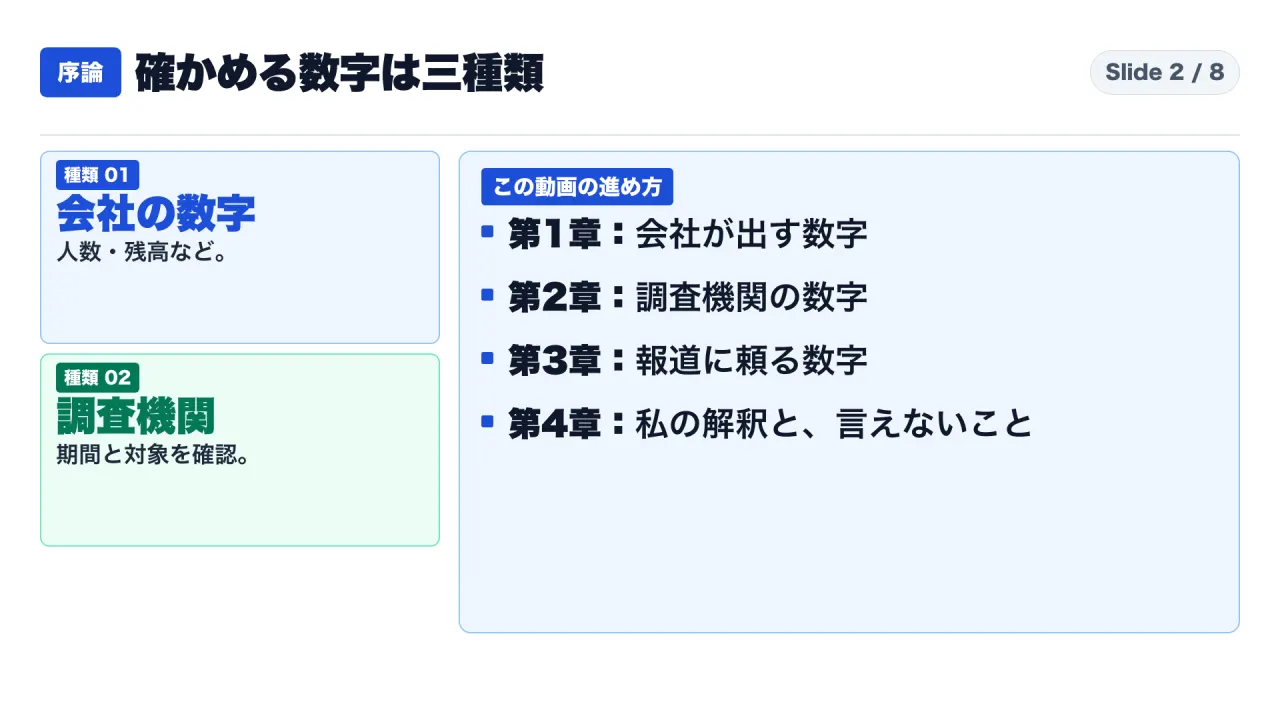
Its Form 10-Q (quarter ended June 30, 2026) notes that pre-orders commenced in June 2026. The Form 10-K also discloses 12,909 total full-time employees, with 9,998 allocated to internal development studios.
- [Calculated Value]: 9,998 studio staff divided by 12,909 total staff equals 77.4% developer concentration across Take-Two.
The Absence of Title-Specific Budgets
Despite pervasive rumors of a $1 billion to $2 billion budget, Take-Two’s SEC filings contain no project-level budget disclosures. The Form 10-K discusses production costs strictly as general risk:
“[Fact] Our business is driven by hit titles, which require increasing budgets for development and marketing.”
Full-text queries across both filings show zero budget disclosures for Grand Theft Auto VI. While “1.0 billion” appears in the Form 10-K, it refers exclusively to corporate tax thresholds.
Capitalized Software Balances Reflect Aggregate Operations
In Note 7, Take-Two reports capitalized internal-use software development costs:
| Reporting Date | Current Balance | Non-Current Balance | Total Capitalized |
|---|---|---|---|
| March 31, 2026 (Form 10-K) | $46.1 Million | $2,224.6 Million | $2,270.7 Million |
| June 30, 2026 (Form 10-Q) | $22.8 Million | $2,363.4 Million | $2,386.2 Million |
- [Calculated Value]: Non-current capitalized software as of June 30, 2026, is $2,363.4 million, or approximately $2.36 billion.
- [Interpretation]: This $2.36 billion asset reflects cumulative capitalized costs across all active internal pipelines (Rockstar, 2K, Private Division, Zynga) net of amortization. It cannot be equated to the budget of Grand Theft Auto VI.
2. Research Organization Benchmarks: Scrutinizing Upper Bounds and Scopes
Boston Consulting Group (BCG): The $300 Million Ceiling
In the BCG Video Gaming Report 2026, researchers assess industry production costs:
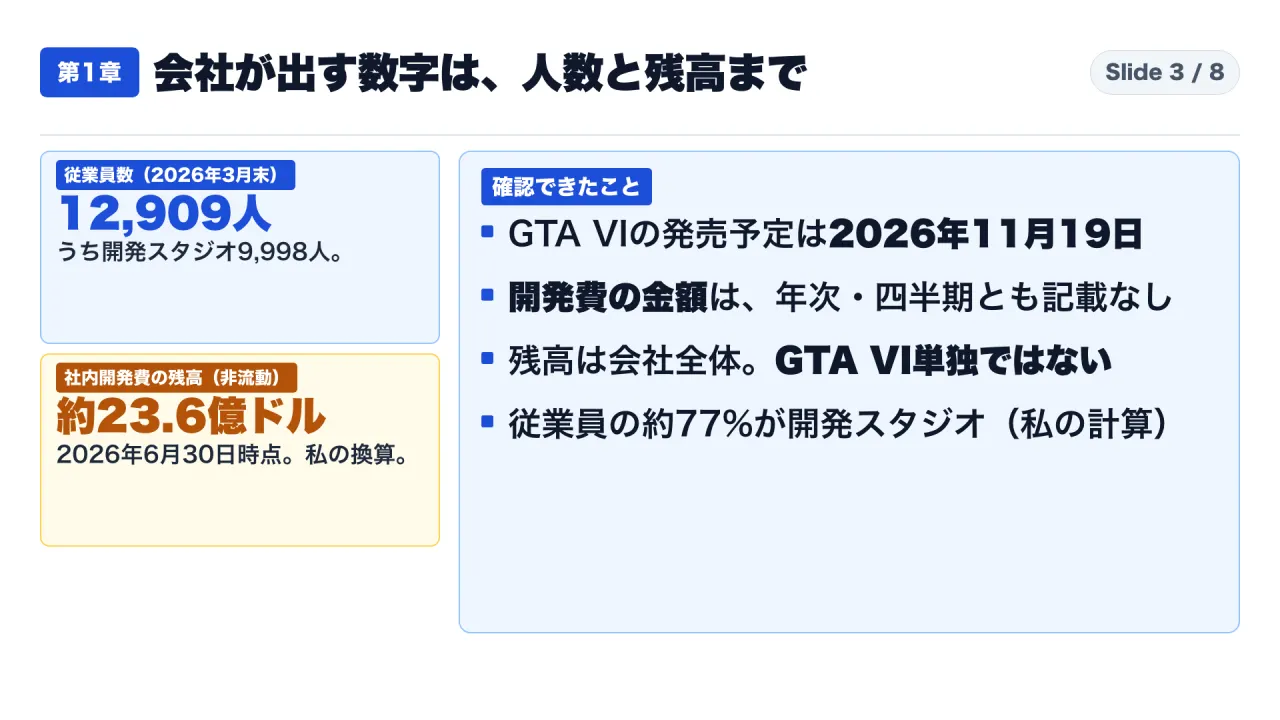
“[Fact] …development costs, which can reach $300 million for an AAA-rated game.”
- [Interpretation]: BCG’s phrase “can reach” establishes an upper-bound ceiling for outlier productions, not an industry average or median. Secondary summaries reporting that average AAA games cost $300 million turn an exceptional ceiling into an erroneous baseline.
BCG also reports telemetry on artificial intelligence adoption:
- [Fact]: Approximately 50% of studios utilize AI tools in production workflows.
- [Fact]: Approximately 20% of Steam releases disclose AI usage, double the rate from October 2025.
- [Fact]: Vendor claims of 90% development acceleration are documented by BCG as vendor assertions (“some vendors say”), not verified benchmarks.
Game Developers Conference (GDC): The 24-Month Layoff Horizon
The GDC 2026 State of the Game Industry survey (2,300+ respondents) reports:
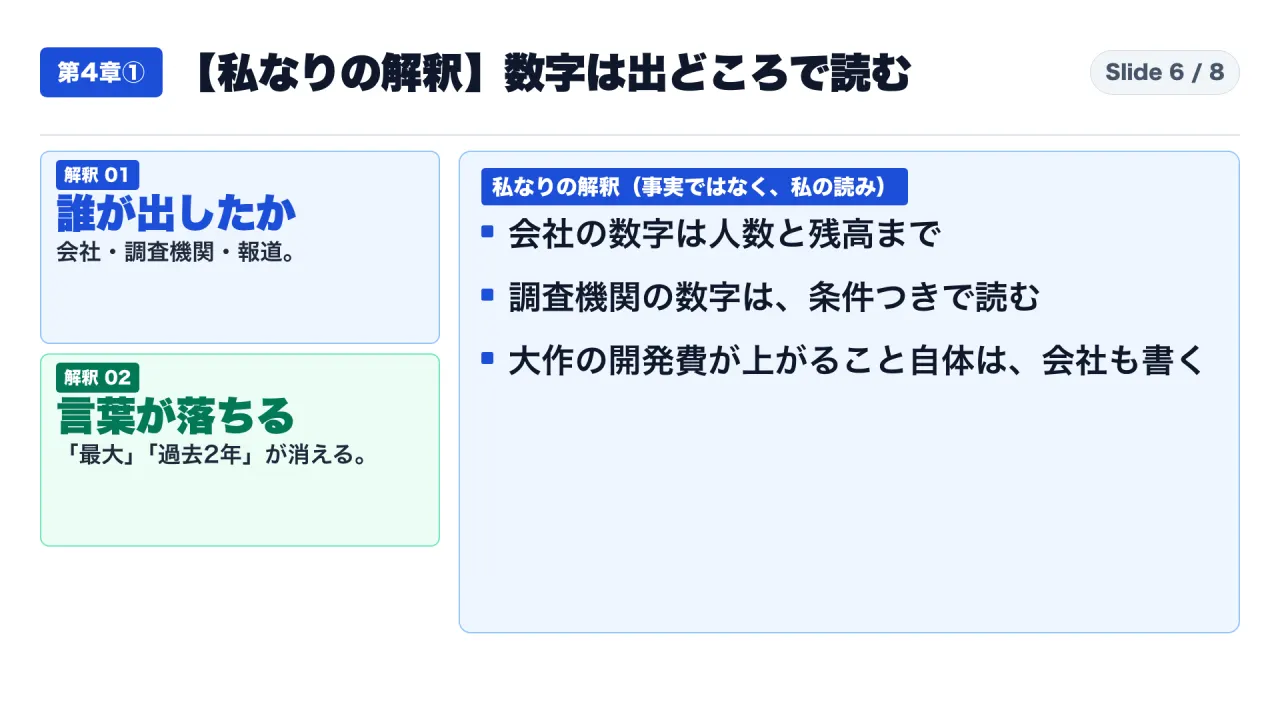
“[Fact] 28% of survey respondents reported being laid off in the past two years, rising to 33% among respondents based in the United States.”
- [Interpretation]: This metric spans two years (2024 and 2025), not a single calendar year, and measures survey respondents rather than an audited global census. Media reporting that one-third of US gaming workers were laid off in 2025 distorted both timeframe and denominator.
- [Fact]: Two-thirds of AAA studio respondents observed layoffs at their companies. Additionally, 52% stated generative AI negatively impacts the industry, up from 30% in 2025 and 18% in 2024.
- [Fact]: Assertions that two-thirds of global layoffs occurred in North America do not appear in GDC’s official publication.
Drake Star Partners: Composition of the $1.62 Billion Private Capital Flow
In its Global Gaming Report Q3 2026, Drake Star Partners tracked private financing:
- [Fact]: 106 transactions generated $1,622 million ($1.622 billion).
- [Fact]: The report text notes gaming AI and tools captured over 80% of capital.
- [Fact]: In Drake Star’s breakdown, the category is titled “AI / Platform / Tools,” accounting for $1,314 million across 34 deals.
- [Calculated Value]: $1,314 million divided by $1,622 million yields 81.0%.
- [Fact]: Major rounds included Meshy ($400M), General Intuition ($220M), Blacknut ($215M), Nex ($150M), and VAST Tripo AI ($150M).
- [Interpretation]: The category bundles cloud gaming infrastructure (Blacknut) and platforms alongside AI tools. Reducing this category to pure-play AI tooling distorts capital allocation.
3. Press Reporting and Anonymous Sourcing: Differentiating Leak Tiers
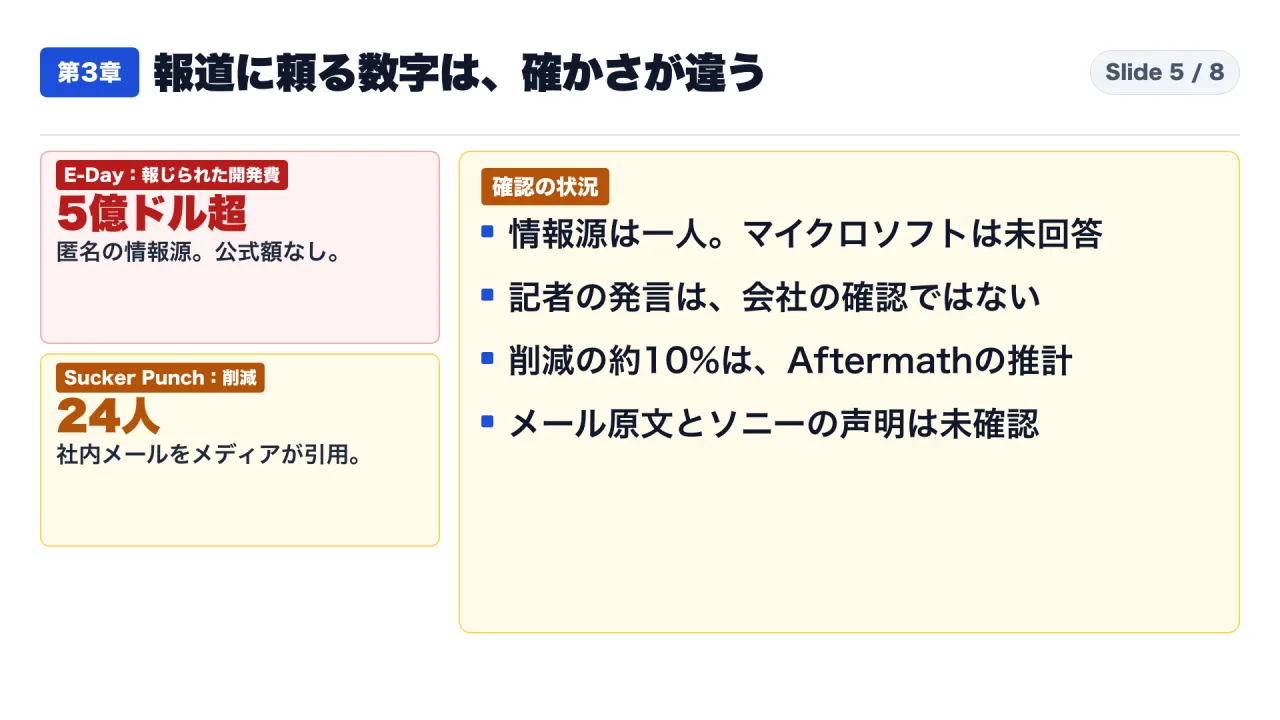
Case A: Gears of War: E-Day ($500 Million Rumor)
In October 2026, Pure Xbox examined reporting regarding Microsoft’s Gears of War: E-Day:
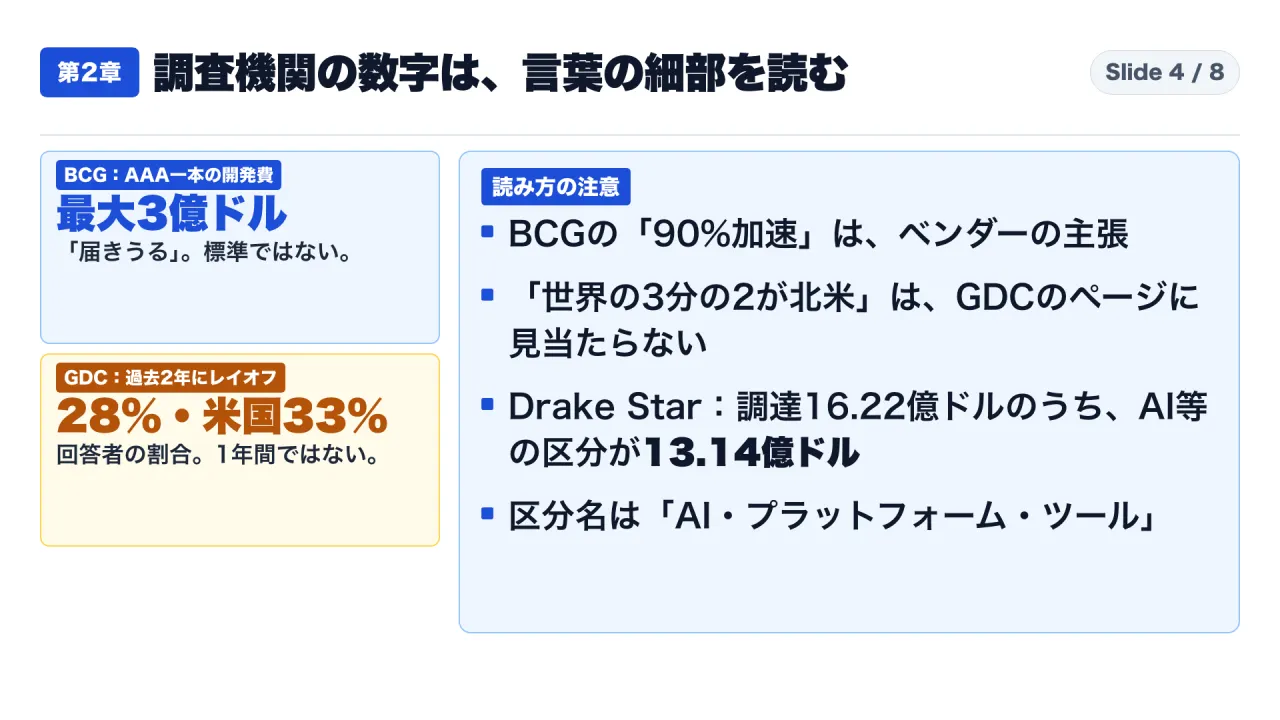
- [Press Report]: Citing Kotaku, Pure Xbox noted a single anonymous source claiming production exceeded $500 million, excluding marketing.
- [Press Report]: Microsoft issued no official response, and no corporate documentation substantiates the number.
- [Press Report]: Bloomberg reporter Jason Schreier and Windows Central reporters commented publicly that the figure was credible, though allocation across engine tooling and studio overhead remained unknown.
- [Interpretation]: Journalist commentary does not equal corporate verification. Analysts must record this as an unconfirmed press report rather than an established expenditure.
Case B: Sucker Punch Productions (Documented Studio Reduction of 24 Staff)
Conversely, workforce reductions at Sony subsidiary Sucker Punch Productions (Ghost of Yotei) demonstrate verified reporting:
- [Press Report]: Game Developer reported Sucker Punch eliminated 24 positions, initially broken by Aftermath and confirmed by studio management.
- [Press Report]: An internal email stated: “Several positions across Sucker Punch will be eliminated as a result.”
- [Press Report]: Aftermath estimated this represented roughly 10% of headcount.
- [Interpretation]: Sucker Punch confirmed the absolute reduction (24 staff), whereas the percentage reduction remained an external estimate.
4. Deconstructing Four Semantic Distortions in Secondary Summaries
| Domain | Primary Source Phrasing | Secondary Media Mutation | Analytical Impact |
|---|---|---|---|
| 1. AAA Budgets | BCG: Costs “can reach $300 million” | “Average AAA game costs $300M” | Eliminates upper bound, converting an extreme ceiling into a baseline. |
| 2. Workforce Layoffs | GDC: “28% laid off in past two years” | “One-third laid off in 2025” | Halves the 24-month horizon and conflates survey sample with census. |
| 3. Private Capital | Drake Star: $1.31B in “AI / Platform / Tools” | “AI startups captured 81% of capital” | Collapses cloud platforms and tools into standalone AI models. |
| 4. Project Budgets | Pure Xbox / Kotaku: Single anonymous source ($500M) | “Bloomberg verified Microsoft’s $500M budget” | Conflates informal journalist commentary with audited corporate accounting. |
5. Delimited Analytical Scope and Explicit Non-Claims
This analysis maintains explicit boundaries:
- Undisclosed GTA VI Budget: Take-Two does not disclose title-level production costs in SEC filings.
- Unverified E-Day Expenditures: The rumored $500 million budget rests on an anonymous source and lacks Microsoft verification.
- Survey Demographics vs. Census: GDC survey metrics reflect voluntary respondents over 24 months, not an audited global workforce census.
- Sectoral Scope of Investment: Drake Star’s 81.0% figure includes cloud infrastructure and developer platforms alongside AI.
- No Investment Advisory: This analysis provides no opinion on the securities valuation or investment merits of Take-Two, Microsoft, or Sony.
6. Strategic Playbook: A Forensic 3-Step Verification Protocol
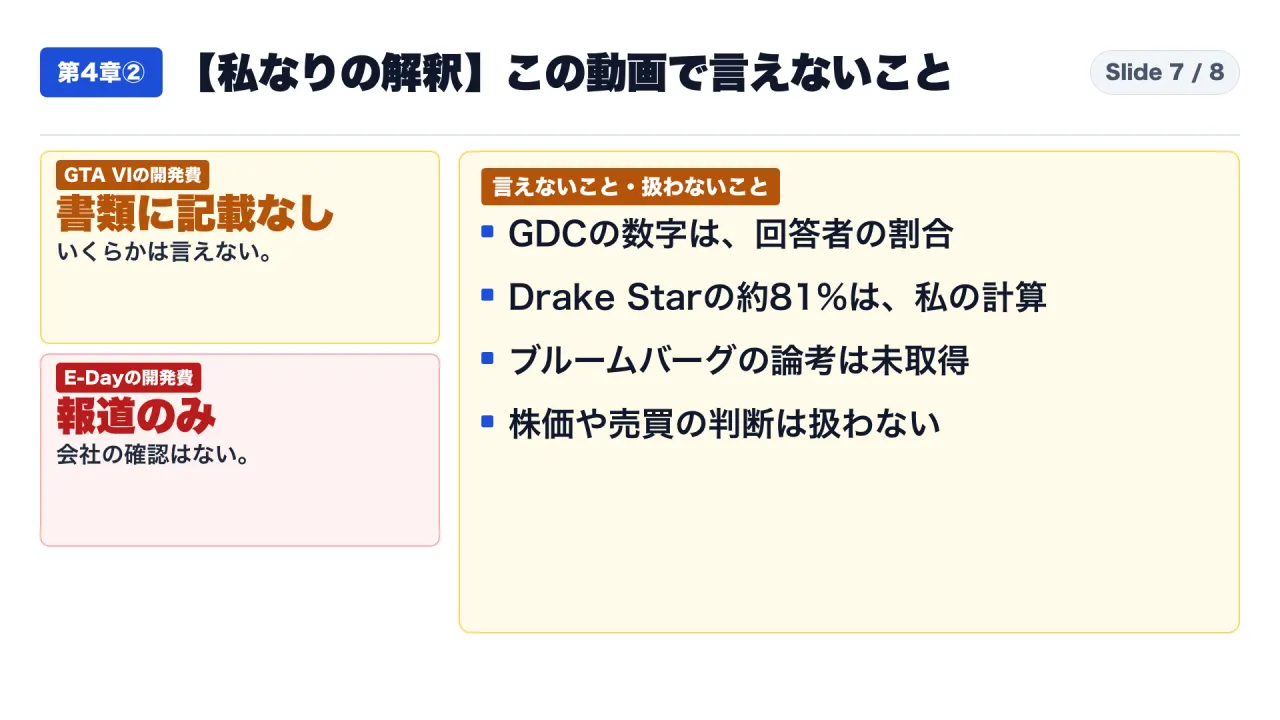
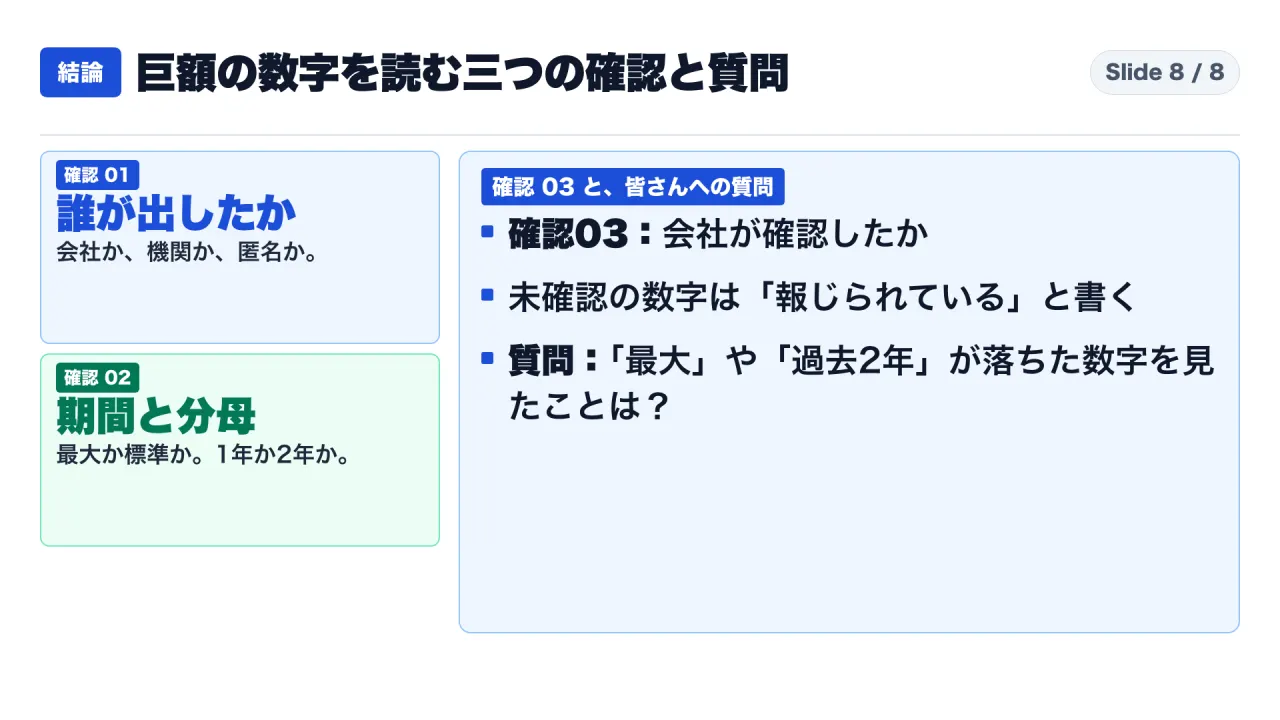
Corporate planners should apply three verification steps when evaluating reported mega-cap metrics:
Step 1: Attribute Information Provenance
Determine whether a metric originates from an audited statutory filing (Form 10-K/10-Q), an empirical research report (BCG, GDC, Drake Star), or an unconfirmed press leak.
Step 2: Audit Modifiers, Denominators, and Observation Windows
Examine textual qualifiers. Identify whether figures represent an upper-bound ceiling (“can reach”) or a central tendency. Verify observation timeframes (single quarter versus 24 months) and categorical scopes.
Step 3: Establish Corporate Confirmation Status in Executive Memos
Apply precise attribution framing in executive communications:
- Statutory Filings: “Take-Two Interactive’s Form 10-K and Form 10-Q disclose enterprise capitalized software of $2.36 billion across 9,998 studio staff, but report no title-level budget for Grand Theft Auto VI.”
- Research Reports: “BCG reports that AAA development costs can reach an upper ceiling of $300 million, representing an outlier threshold rather than an industry median.”
- Press Reports: “Media reports citing an unnamed insider claim production on Gears of War: E-Day exceeded $500 million, though Microsoft has issued no formal verification.”
Frequently Asked Questions
Q1: Is the rumored $1 billion to $2 billion budget for Grand Theft Auto VI verified in SEC filings?
A: No. Take-Two’s Form 10-K and Form 10-Q do not disclose title-specific budgets. While Take-Two held $2.36 billion in non-current capitalized software assets as of June 30, 2026, this aggregates all internal studio pipelines and cannot be attributed to a single title.
Q2: Does BCG report that $300 million is the average cost of an AAA title?
A: No. BCG explicitly uses the phrase “can reach $300 million,” indicating an extreme ceiling observed among outlier productions rather than an industry median.
Q3: Did 33% of US gaming professionals lose their jobs in 2025?
A: No. GDC’s survey reported that 33% of US respondents experienced a layoff across a 24-month window (2024 and 2025). The figure reflects voluntary survey respondents rather than a global industry census.
Q4: Did AI startups capture 81% of gaming venture funding in Q3 2026?
A: No. Drake Star’s $1.314 billion category is titled “AI / Platform / Tools,” combining cloud distribution platforms and engine toolchains alongside AI applications.
Q5: Did Bloomberg officially confirm that Gears of War: E-Day cost $500 million?
A: No. The claim originated from an anonymous source cited by Kotaku. While journalist Jason Schreier commented publicly on its credibility, Microsoft has issued no verification.
Primary Sources and References
- Take-Two Interactive Software, Inc. Form 10-K (FY ended March 31, 2026):
https://www.sec.gov/Archives/edgar/data/946581/000162828026037434/ttwo-20260331.htm - Take-Two Interactive Software, Inc. Form 10-Q (Quarter ended June 30, 2026):
https://www.sec.gov/Archives/edgar/data/946581/000162828026054870/ttwo-20260630.htm - Boston Consulting Group (BCG) Video Gaming Report 2026:
https://www.bcg.com/publications/2025/video-gaming-report-2026-next-era-of-growth - Game Developers Conference (GDC) State of the Game Industry 2026:
https://gdconf.com/article/gdc-2026-state-of-the-game-industry-reveals-impact-of-layoffs-generative-ai-and-more/ - Drake Star Global Gaming Report Q3 2026:
https://www.drakestar.com/hubfs/Research/GAMING/Drake%20Star%20Global%20Gaming%20Report%20Q3%202026.pdf - Game Developer (Sucker Punch Studio Reductions):
https://www.gamedeveloper.com/business/sucker-punch-lays-off-24-to-align-with-current-market-next-project-needs - Pure Xbox (Gears of War: E-Day Budget Analysis):
https://www.purexbox.com/news/2026/10/rumours-persist-that-xbox-spent-usd500-million-on-gears-of-war-e-day-despite-some-objections