When Ransomware Demands Are Refused: Inside GMO's Multi-Tier Customer Compensation Architecture
An analysis of GMO Internet Group’s public crisis bulletins and three Tokyo Stock Exchange filings reveals how corporate leadership rejected extortion demands while constructing a multi-tier customer compensation framework whose consolidated financial liability remains “currently uncalculable.”
Published: October 31, 2026 | Read time: ~10 min | Watch Video (Japanese)
Executive Summary: Rejecting Cyber Extortion and Defining Customer Restitution
When cybercriminals infiltrate critical enterprise hosting and cloud infrastructure, executive leadership faces an immediate ethical, operational, and financial crossroads: negotiate with extortionists to suppress stolen data, or publicly refuse ransom demands and bear the full financial burden of customer restitution.
In late October 2026, GMO Internet Group, Inc. (TSE Prime: 9449) took an uncompromising public stance following unauthorized intrusions into its “Onamae.com Desktop Cloud” environment. Management formally announced that it would not pay ransom demands to attackers or negotiate the repurchase of stolen data.
Summary of GMO Customer Restitution and Bounty Framework (as of October 31, 2026):
1. Universal Apology Payout:      5,000 JPY to all active service users (independent of verified damage).
2. Fraudulent Loss Reimbursement: 100% of validated realized trading losses (net of exchange recoveries).
3. Special Data Exposure Relief:  10,000 to 25,000 JPY per leaked data category (capped at 3,000,000 JPY per publication).
4. Public Investigation Bounty:   Up to $1,000,000 USD aggregate pool (funded directly by the parent holding company).
5. TSE Regulatory Impact:         Consolidated financial impact stated as "Currently Cannot Be Calculated."
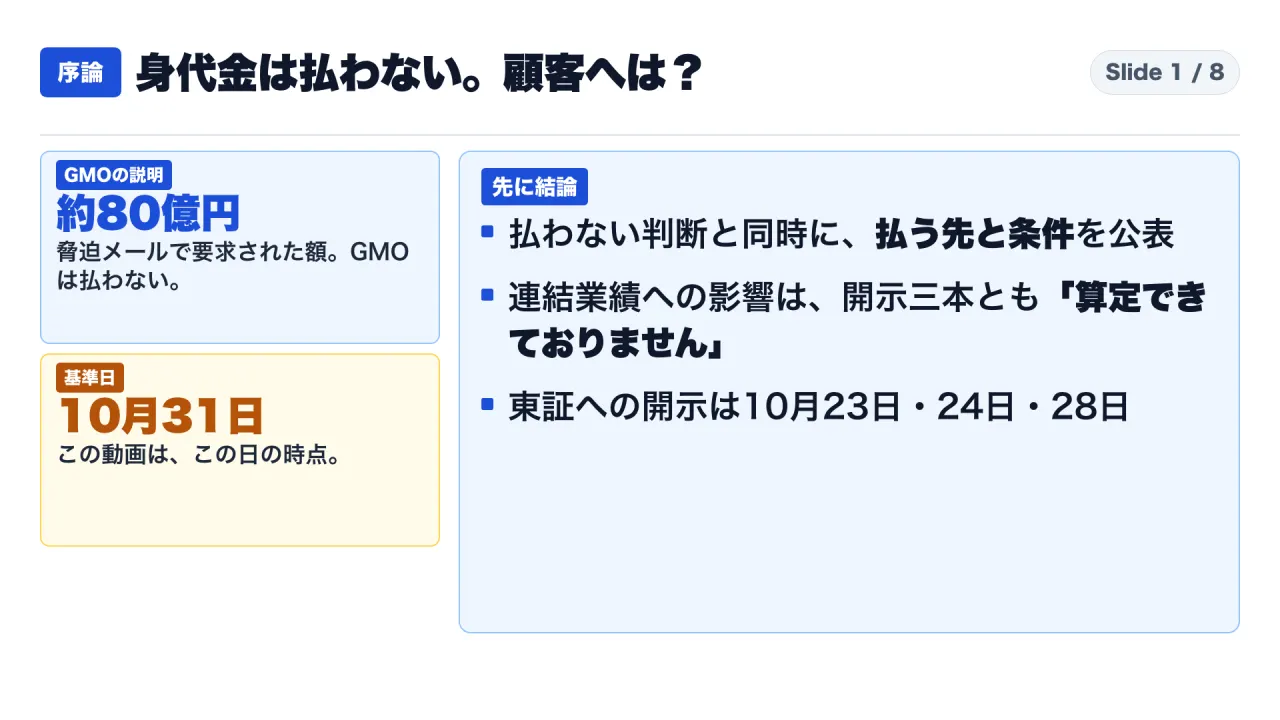
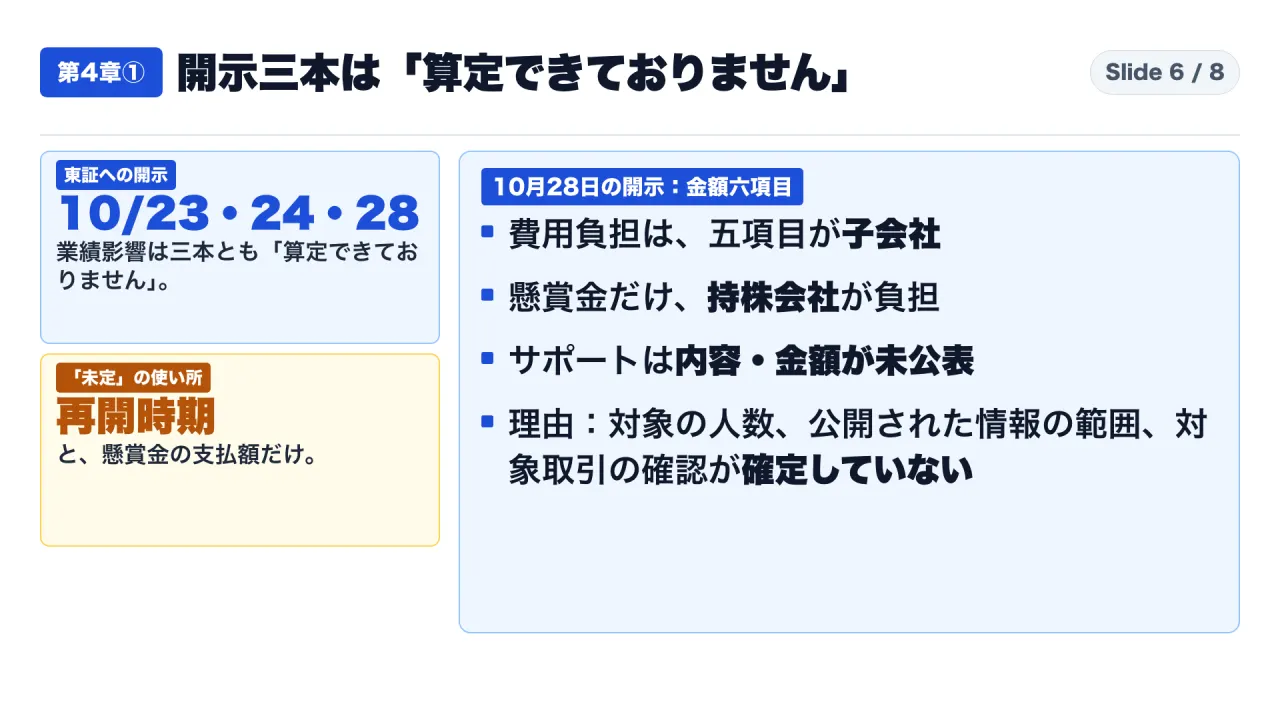
While corporate media focused heavily on the decision to withhold extortion payments, corporate risk officers and equity analysts confronted a more complex accounting challenge. Across three consecutive timely disclosures submitted to the Tokyo Stock Exchange (TSE), GMO Internet Group repeatedly stated that the impact on its consolidated financial performance “currently cannot be calculated” (算定できておりません).
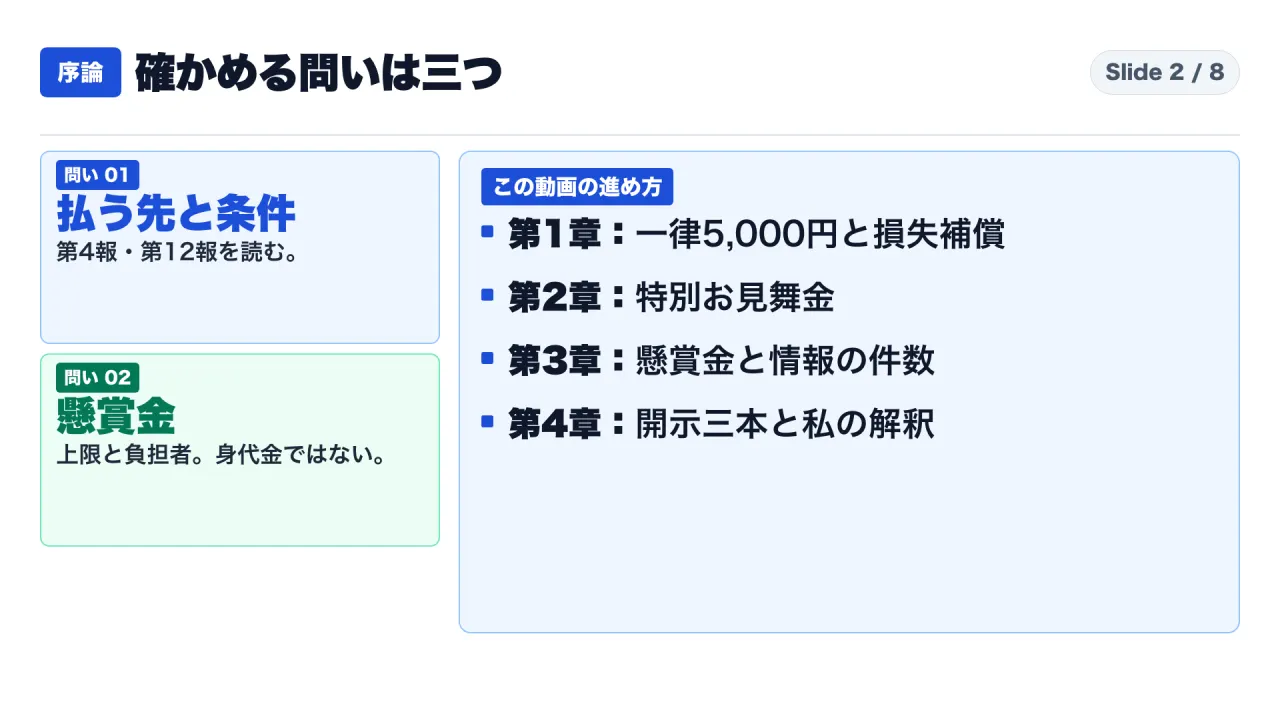
This investigation analyzes the architecture of GMO’s customer compensation program. Drawing directly from GMO’s official incident alerts (Reports 4, 12, 15, and 16) and TSE regulatory submissions through October 31, 2026, this analysis deconstructs payment formulas, contractual eligibility caps, entity cost allocations, and regulatory disclosure mechanics.
Methodological Taxonomy: Distinguishing Stated Terms, Corporate Descriptions, and Financial Inferences
Navigating crisis disclosures requires strict analytical discipline. Statements are evaluated under four distinct categories:
- Audited Regulatory Filings: Timely disclosures filed by GMO Internet Group with the Tokyo Stock Exchange on October 23, October 24, and October 28, 2026.
- Corporate Incident Bulletins: Official operational updates released on the GMO corporate alert portal through October 31, 2026.
- Direct Mathematical Derivations: Calculations performed by the author reconciling published category additions and investigative tip counts.
- Analytical Governance Inferences: Authorial interpretations regarding structural compensation liabilities, cost boundaries, and disclosure language.
All figures reflect the baseline established on October 31, 2026. While GMO committed to announcing detailed application procedures by November 6, 2026, this study examines the public record established during the immediate aftermath of the incident.
Baseline Terminology and Corporate Governance Boundaries
Understanding the operational boundaries of GMO’s restitution package requires precise technical definitions:
| Operational Term | Primary Source Context | Governance and Accounting Significance |
|---|---|---|
| Universal Apology Payout (一律お見舞金) | 5,000 JPY allocated to every registered user active on October 23, 2026. | Granted regardless of whether the individual user experienced data exfiltration or financial fraud. |
| Realized Loss Compensation (損失補償) | Direct reimbursement for fraudulent trades executed via compromised credentials. | Covers verified net losses; explicitly excludes unrealized paper losses, opportunity costs, and exchange refunds. |
| Special Solatium (特別お見舞金) | Tiered payments for individuals whose personal data was publicly leaked. | Structured into three discrete data severity tiers, summing cumulatively up to a 3,000,000 JPY cap per publication. |
| Investigation Bounty (懸賞金) | Up to $1,000,000 USD aggregate reward pool for investigative information. | Funded entirely by the listed parent holding company; legally separated from criminal extortion payments. |
| Currently Uncalculable (算定できておりません) | Standardized regulatory terminology utilized in TSE disclosures. | Denotes that while liability formulas exist, total gross financial exposure depends on unresolved empirical claims. |
Tier 1 & 2: Universal Payouts and Fraudulent Transaction Compensation
The first operational pillar of GMO’s compensation program was detailed in Incident Report #4, published on October 24, 2026:
The Universal 5,000 JPY Apology Payout
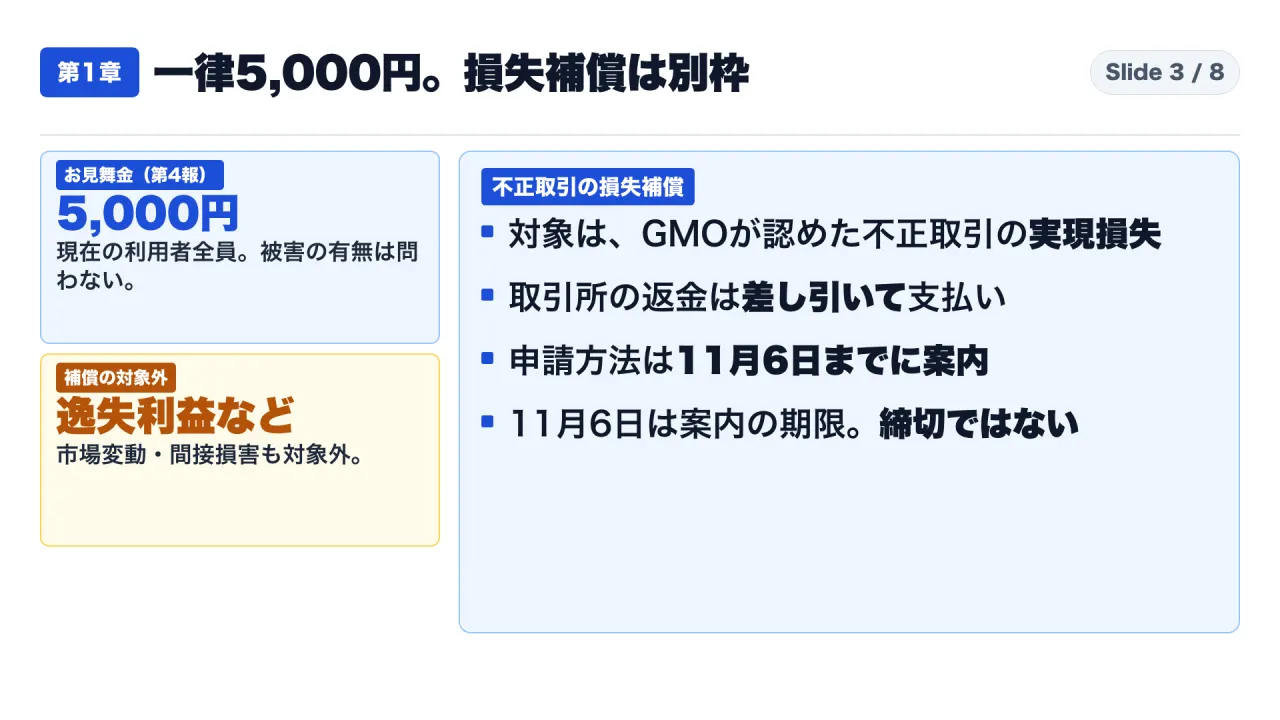
Management established a universal payment of 5,000 JPY for all customers actively utilizing “Onamae.com Desktop Cloud” as of October 23, 2026. This payout operates under two specific legal conditions:
- Absence of Damage Precondition: Customers are eligible to receive the 5,000 JPY payout regardless of whether their specific virtual environments suffered unauthorized intrusions, data exfiltration, or financial losses.
- Alternative Platform Migration: For customers opting to transition to alternative hosting solutions, GMO offered six months of complimentary infrastructure usage, explicitly guaranteeing that no accounts would be migrated without affirmative customer consent.
Fraudulent Transaction Loss Reimbursement
Beyond the universal apology sum, GMO established a separate compensation channel for direct financial losses. Because desktop cloud instances were widely utilized by retail investors running automated trading software for foreign exchange (FX) and crypto assets, unauthorized access exposed trading terminal credentials.
GMO’s published conditions draw clear boundaries regarding loss recovery:
- Covered Scope: 100% reimbursement of realized financial losses resulting from transactions formally verified and recognized by GMO as unauthorized.
- Excluded Damages: Speculative lost profits, unrealized paper drawdowns, and opportunity costs resulting from platform downtime are strictly excluded from reimbursement.
- Offsetting Recovery Provisions: Any financial restitution, chargebacks, or reimbursed funds recovered directly from financial exchanges or brokers are subtracted from GMO’s settlement payout to prevent double recovery.
Tier 3: Tiered Special Solatium for Publicly Leaked Information
When extortionists attempt to pressure enterprises by leaking stolen records onto public forums or the dark web, consumer anxiety escalates rapidly. In Incident Report #12 (published October 27, 2026), GMO established a structured “Special Solatium” (特別お見舞金) protocol:
Three Granular Data Classification Tiers
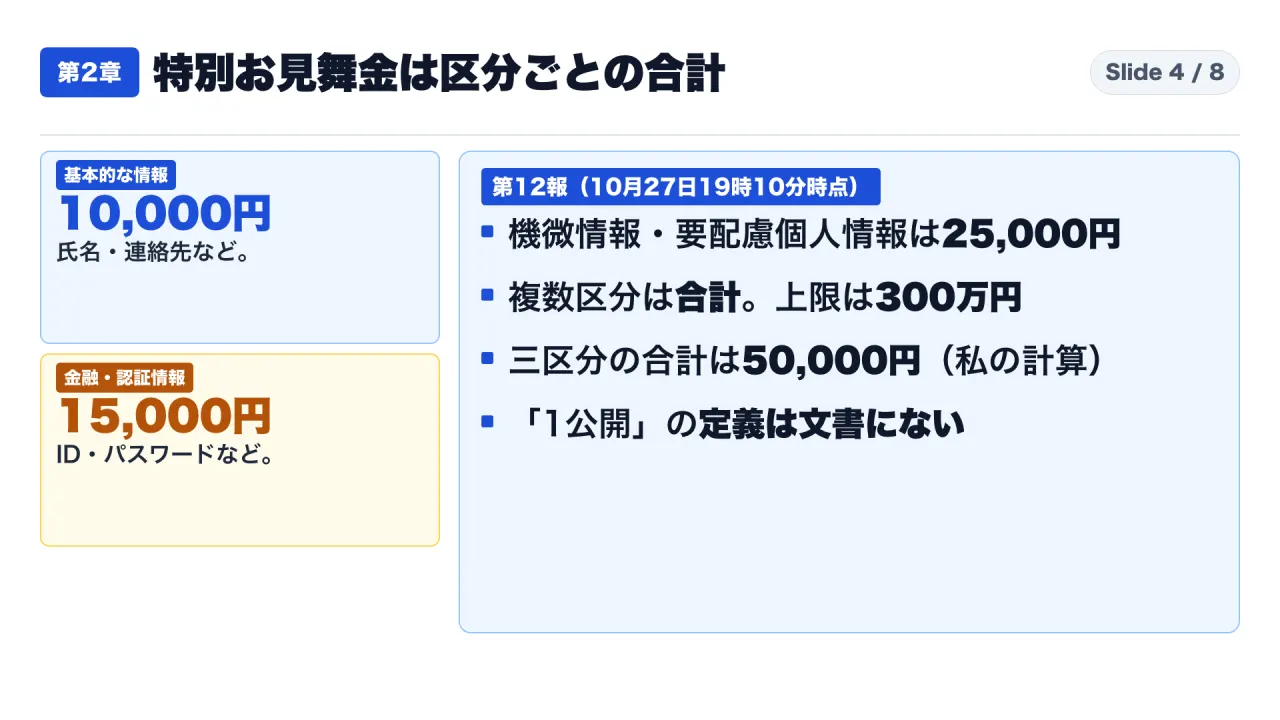
Rather than offering arbitrary lump-sum settlements, GMO categorized leaked data into three severity tiers, allowing payments to accumulate cumulatively if multiple categories were exposed:
Special Solatium Payment Matrix:
- Category 1: Basic Identifiers (Name, physical address, phone number, email): 10,000 JPY
- Category 2: Financial & Auth Data (Banking information, service credentials):   15,000 JPY
- Category 3: Highly Sensitive Data (Confidential operational records):            25,000 JPY
Cumulative Maximum per Exposed Profile:                                            50,000 JPY
If an individual customer suffered public exposure across all three categories, the baseline solatium reached 50,000 JPY (10,000 + 15,000 + 25,000).
The 3,000,000 JPY Ceiling and Unresolved Support Provisions
Critically, GMO instituted an overarching financial ceiling: payments are capped at “up to 3,000,000 JPY per publication” (1公開につき300万円).
However, primary source filings omit a technical definition for “one publication.” It remains legally ambiguous whether a single multi-gigabyte torrent release constitutes one publication, or whether each individual forum posting represents a separate occurrence. Furthermore, GMO noted that customers suffering tangible secondary damages would receive tailored corporate support, but marked the specific parameters of this assistance as “undisclosed” in its October 28 TSE filing.
Tier 4: The $1,000,000 USD Investigation Bounty: Governance and Legal Separation
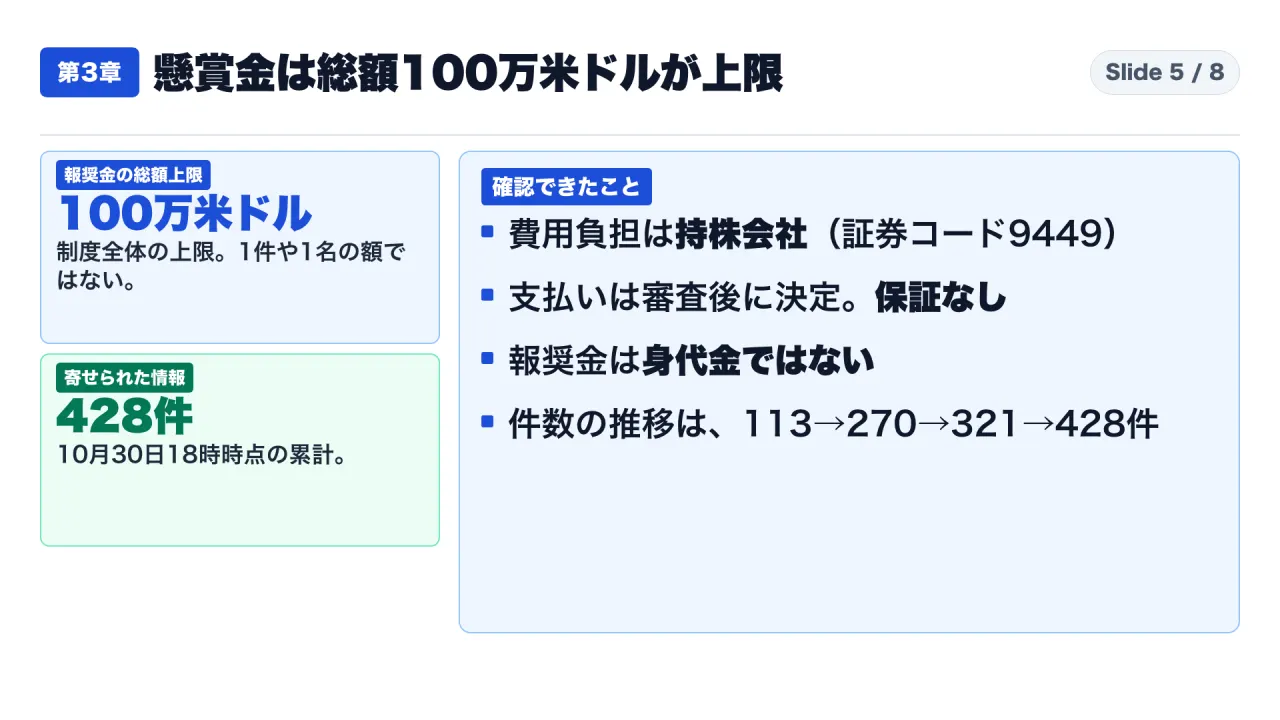
In Report #15 (October 29, 2026), GMO introduced an unconventional crisis management mechanism: establishing a public investigative reward of up to $1,000,000 USD for verified information leading to the identification and arrest of the perpetrators.
The Legal Barrier Between Bounties and Ransoms
GMO drew strict legal boundaries separating this reward program from illicit extortion compliance:
- Entity Expense Allocation: The entire financial obligation for the bounty pool is borne directly by the parent holding company, GMO Internet Group, Inc., rather than the operating subsidiary.
- Post-Screening Discretion: Submissions are subject to exhaustive law enforcement and corporate legal vetting; payments are not guaranteed upon submission and are disbursed only if telemetry directly results in criminal identification.
- Strict Non-Ransom Definition: GMO reiterated that reward funds are paid to legitimate whistleblowers and investigators, legally precluding any payment or data buyback agreements with the extortionists themselves.
Telemetry published in Incident Report #16 documented rapid public engagement: cumulative investigative submissions expanded from 113 tips on October 29 to 321 tips by October 30 morning, reaching 428 tips by 18:00 JST on October 30.
The Regulatory Filings: Decoding the Tokyo Stock Exchange Disclosures
While operational bulletins provided customer-facing assurances, corporate finance officers must examine the three timely disclosures filed with the Tokyo Stock Exchange on October 23, October 24, and October 28, 2026.
Analyzing the October 28 TSE Multi-Entity Cost Table
The October 28 filing presented a comprehensive breakdown mapping six compensation categories against corporate funding entities:
| Restitution Category | Stated Monetary Terms | Expense Allocation Entity | Current Assessment Status |
|---|---|---|---|
| Universal Apology Payout | 5,000 JPY per active user | Operating Subsidiary | Detailed procedures to be announced by November 6. |
| Alternative Migration | 6 months complimentary service | Operating Subsidiary | Non-cash operating expense absorption. |
| Fraudulent Loss Coverage | 100% of validated net trading loss | Operating Subsidiary | Contingent on individualized transaction audits. |
| Special Leaked Solatium | 10k / 15k / 25k JPY (Capped at 3M JPY) | Operating Subsidiary | Contingent on verified public leak monitoring. |
| Secondary Damage Support | Undisclosed / Tailored | Operating Subsidiary | Case-by-case corporate determination. |
| Investigative Bounty | Up to $1,000,000 USD pool | Parent Holding Company | Contingent on prosecutorial verification. |
The Precision of Regulatory Language: “Undetermined” versus “Cannot Be Calculated”
In corporate regulatory filings, language is selected with surgical precision:
- “Undetermined” (未定): Utilized exclusively for the physical service reactivation date and the final bounty disbursement total, denoting events whose occurrence is pending operational decisions.
- “Currently Cannot Be Calculated” (算定できておりません): Utilized consistently across all three disclosures regarding consolidated earnings impact. Total financial liability cannot be stated because three variables remain unresolved: total registered customer claims, total validated trading losses, and the geographic scope of leaked databases.
Crucially, text extraction across all three regulatory filings reveals zero occurrences of the terms “reserve provision” (引当) or “extraordinary loss” (特別損失). As of October 31, 2026, GMO had not published formal balance sheet reserve estimates.
Analytical Synthesis: The Mechanics of Liability Capping
Synthesizing GMO’s crisis architecture reveals a highly calculated corporate risk mitigation strategy:
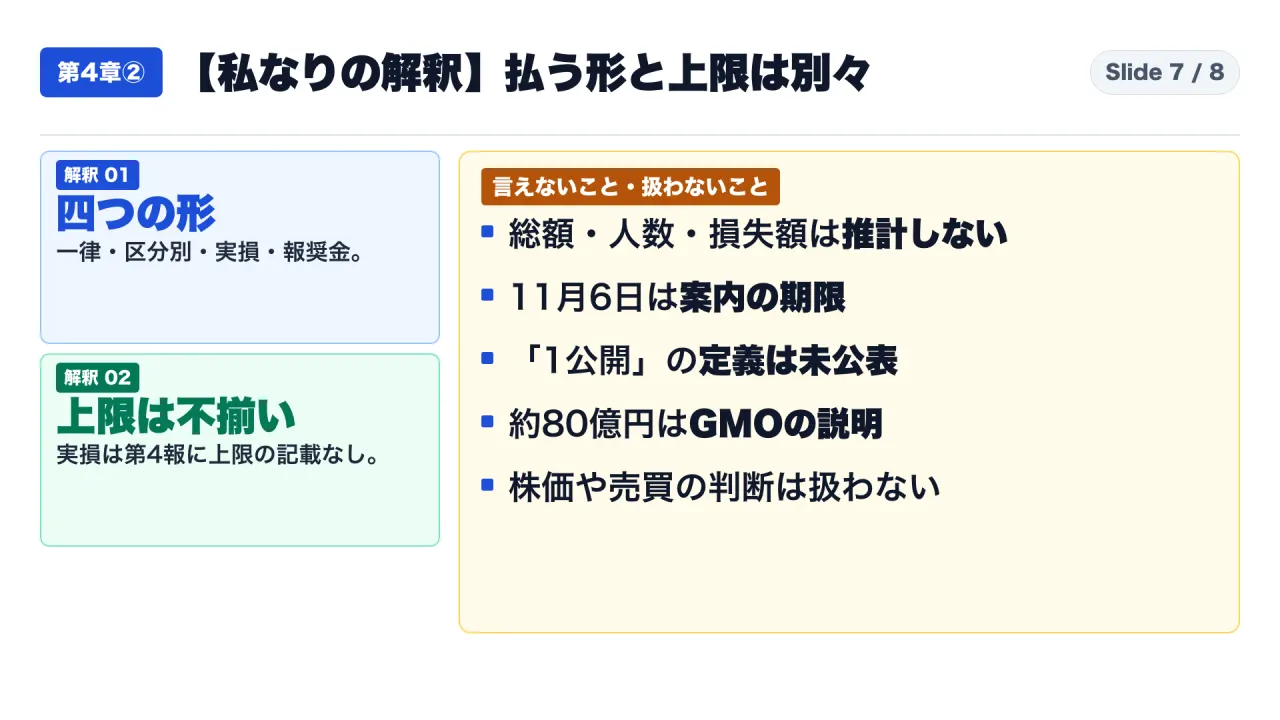
- Decoupling Parent and Subsidiary Liabilities: By isolating customer restitution liabilities within the operating subsidiary while absorbing the $1M bounty at the holding level, corporate leadership ring-fences core group cash flows.
- Formulaic Boundaries vs Open Liabilities: While total consolidated exposure remains uncalculable, individual exposure components are mathematically bounded: 5,000 JPY base, 50,000 JPY solatium sub-caps, and 3,000,000 JPY maximums per leak event.
- Temporal Buffers: Designating November 6, 2026 as the target for publishing application procedures provided corporate accountants and forensic investigators critical runway to triage claims before formal financial booking.
Actionable Playbook: Designing Enterprise Cybersecurity Compensation Architecture
For corporate Chief Financial Officers, general counsels, and risk management directors constructing incident compensation policies, GMO’s disclosures offer a practical blueprint:
Incident Compensation Architecture Protocol:
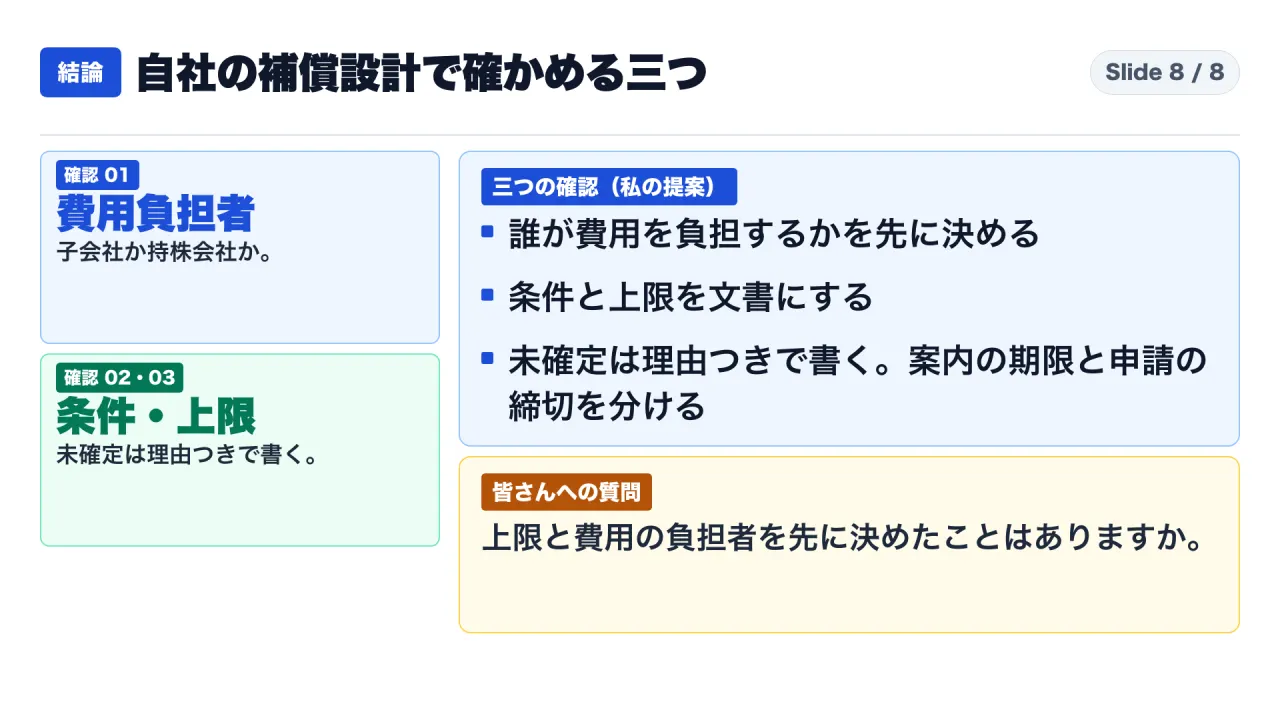
[ ] Funding Entity Allocation: Formally assign compensation liabilities between parent and subsidiaries.
[ ] Formulaic Caps Established: Define per-user, per-category, and per-event maximum exposure ceilings.
[ ] Offset Clauses Integrated: Explicitly deduct third-party insurance and broker recoveries to avoid double compensation.
[ ] Regulatory Phrasing Normalized: Rigorously distinguish "undetermined" timelines from "uncalculable" financials.
[ ] Deadlines Decoupled: Maintain strict operational separation between procedural announcement dates and claim filing sunsets.
Frequently Asked Questions and Governance Traps
Q1: Did GMO secretly negotiate or pay ransom demands to the extortionists?
No. Official corporate filings explicitly affirm that management refused all extortion demands, committed zero funds to data buybacks, and structured public rewards exclusively for legal investigative intelligence.
Q2: What is the total estimated financial liability of GMO’s compensation program?
As of October 31, 2026, total financial liabilities remain unquantified. All three Tokyo Stock Exchange filings affirm that consolidated earnings impacts “currently cannot be calculated.”
Q3: Is the 5,000 JPY apology payout limited only to users who suffered documented financial fraud?
No. The 5,000 JPY payment is universal across all active subscribers of the affected desktop cloud service as of October 23, 2026, regardless of individual data or financial compromise.
Q4: Will the parent holding company absorb customer compensation losses?
Regulatory disclosures specify that customer-facing payouts and service credits are allocated to the operating subsidiary, while the parent holding company finances only the $1,000,000 USD investigative bounty.
Primary Sources and References
- GMO Internet Group Alert Notice - Report #4 (October 24, 2026)
- GMO Internet Group Alert Notice - Report #12 (October 27, 2026)
- GMO Internet Group Alert Notice - Report #15 (October 29, 2026)
- GMO Internet Group Alert Notice - Report #16 (October 29-30, 2026)
- GMO Customer Information Update (October 30, 2026)
- GMO Internet Group, Inc. Tokyo Stock Exchange Disclosure (October 23, 2026)
- GMO Internet Group, Inc. Tokyo Stock Exchange Disclosure (October 24, 2026)
- GMO Internet Group, Inc. Tokyo Stock Exchange Disclosure (October 28, 2026)