From Silent System Shutdown to Public Disclosure: Deconstructing infoQ's Security Incident Disclosures
An analysis of GMO Research & AI’s initial and secondary incident notices reveals the structural discrepancy between initial “emergency maintenance” announcements, early breach disclosures, and verified leakage metrics.
Published: October 31, 2026 | Read time: ~10 min | Watch Video (Japanese)
Executive Summary: The Critical 48-Hour Gap Between System Halt and Public Notification
When a digital platform experiences an unauthorized intrusion, the communications released during the opening hours dictate legal exposure, consumer trust, and technical remediation credibility. Organizations frequently face a severe operational tension: immediate full disclosure risks publishing incomplete or inaccurate forensic telemetry, while delaying announcements under the guise of routine maintenance exposes users to credential abuse and fraud.
This operational dilemma emerged distinctly in the cybersecurity breach affecting infoQ, a major Japanese consumer research panel operated by GMO Research & AI, Inc. (TSE Growth: 3695).
Core Chronology of the infoQ Incident:
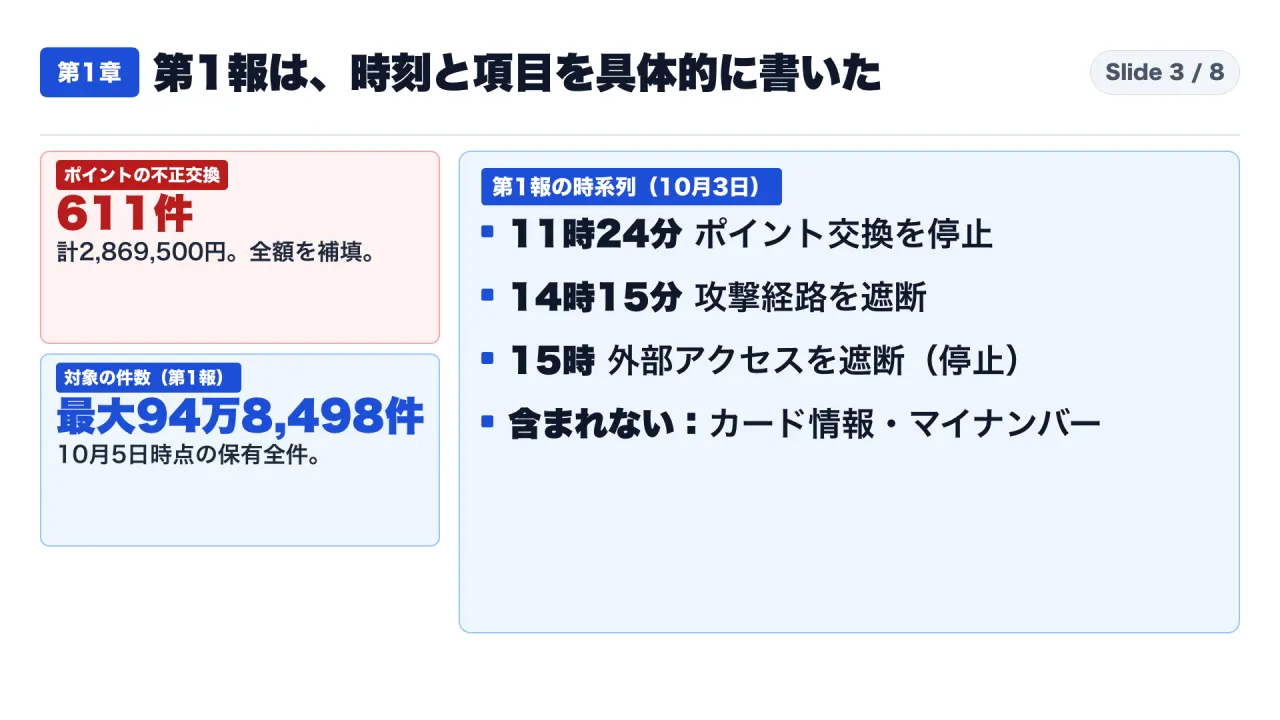
October 03, 2026  17:35 JST:  Service halted completely; user-facing screens display "Emergency Maintenance."
October 05, 2026  19:30 JST:  First official report published disclosing unauthorized access (~48 hours post-halt).
October 14, 2026  17:00 JST:  Second report published correcting exfiltrated record counts and detailing password resets.
October 31, 2026  Baseline:   No final report or service resumption announcement posted on corporate site.
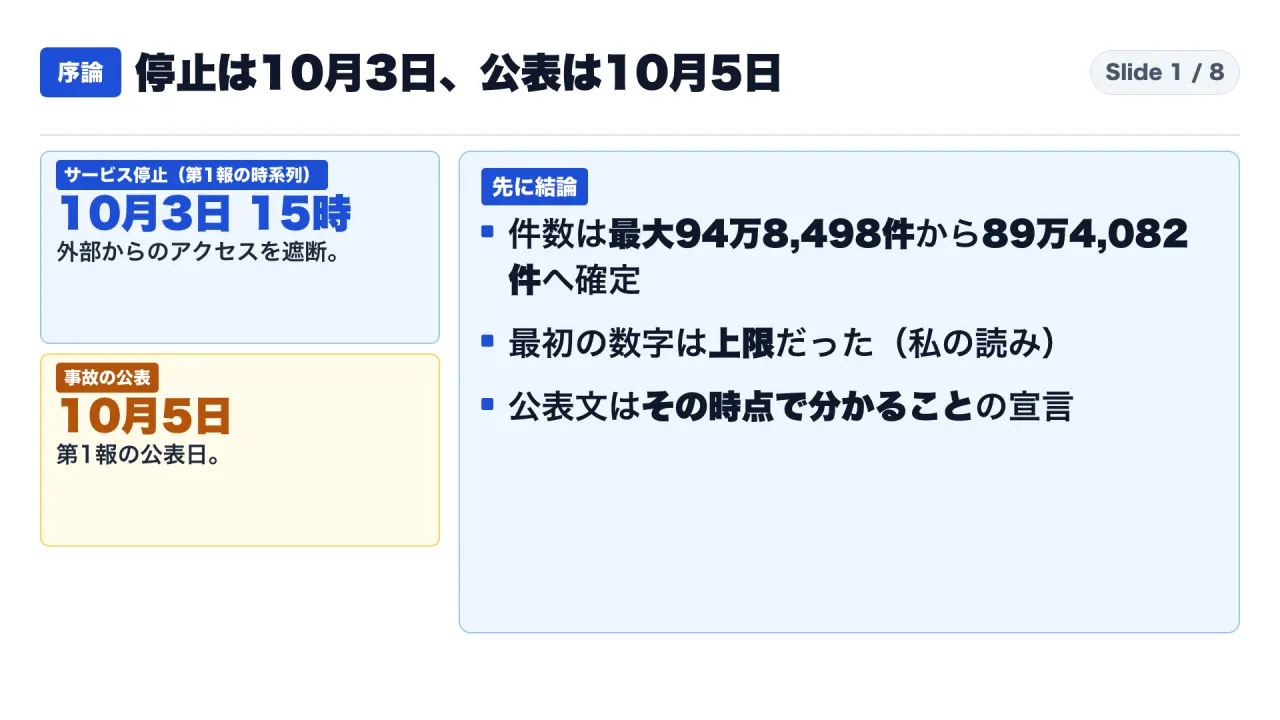
Between the initial system suspension on October 3 and the first public announcement on October 5, site visitors and registered panelists were informed only that the portal was undergoing “emergency maintenance.” In the October 5 First Report, the company acknowledged the reality: the system halt was an emergency containment measure triggered by malicious unauthorized access, apologizing for the delayed explanation.
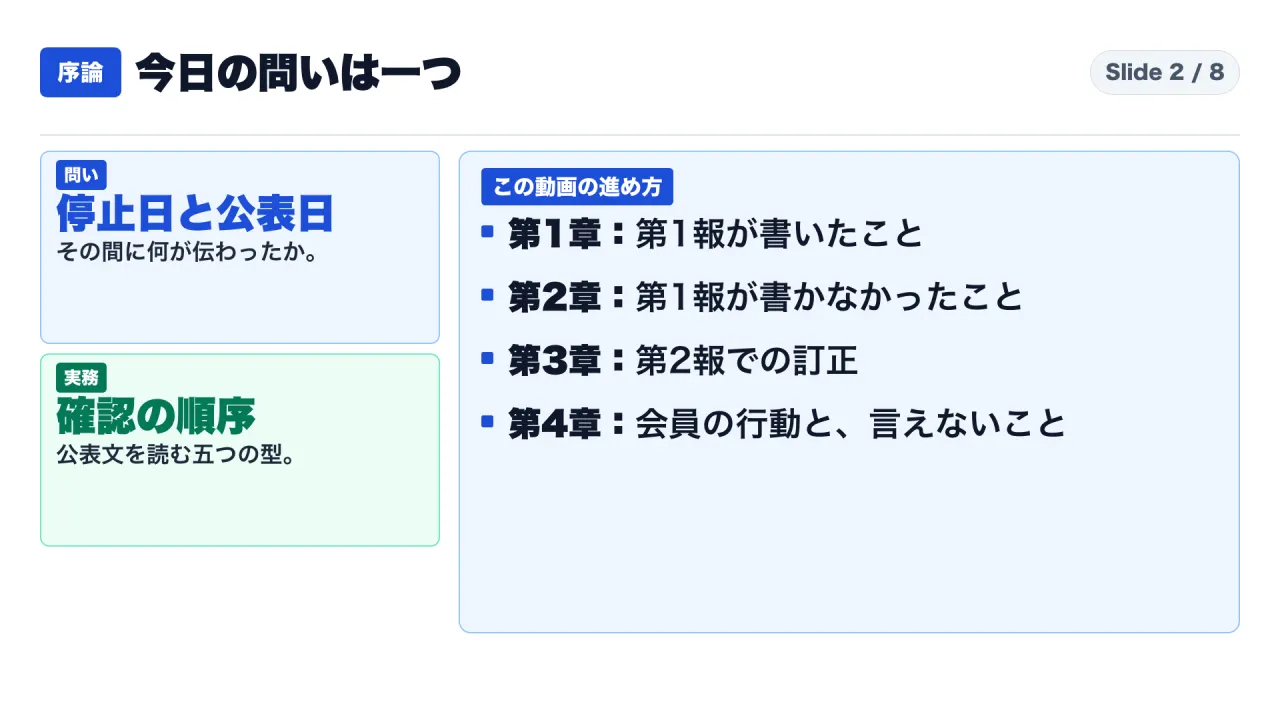
This investigation examines the information architecture of GMO Research & AI’s regulatory disclosures. By contrasting what the First Report disclosed against what it omitted, tracking the empirical revisions introduced in the Second Report, and evaluating required member protective actions, this analysis establishes a repeatable framework for evaluating corporate data breach announcements.
Methodological Taxonomy: Distinguishing Stated Facts, Calculated Metrics, and Governance Inferences
Analyzing corporate security disclosures requires isolating verified statements from prospective interpretations:
- Audited and Stated Facts: Specific timestamps, data attributes, record counts, and operational descriptions published directly within GMO Research & AI’s First Report (October 5, 2026) and Second Report (October 14, 2026).
- Independent Analytical Calculations: Direct mathematical derivations performed by the author (such as calculating the exact elapsed hours between system shutdown and public notification, or computing the net delta between initial and finalized record counts).
- Analytical Governance Inferences: Methodological evaluations regarding corporate crisis disclosure practices formulated by the author. These do not represent legal judgments or securities trading recommendations.
All monetary values and reward point figures are cited in Japanese yen as documented in primary corporate filings.
Technical Terminology and Regulatory Definitions
Navigating consumer data breach filings requires establishing explicit operational definitions:
| Operational Term | Primary Corporate Usage | Technical and Governance Significance |
|---|---|---|
| First Report (第1報) | Initial public security announcement released October 5, 2026 at 19:30 JST. | Provisional status declaration defining maximum potential exposure based on available evidence. |
| Second Report (第2報) | Follow-up diagnostic announcement released October 14, 2026 at 17:00 JST. | Corrective filing refining exfiltrated record numbers, clarifying notification scopes, and mandating credential resets. |
| Exfiltrated Records (件数) | Metric quantifying compromised database rows. | Corporate disclosures utilize “records/cases” (件) rather than “unique individuals” (人). |
| Emergency Maintenance | Public screen display presented to users between October 3 and October 5. | Euphemistic status masking active containment and forensic triage operations from platform members. |
| Unauthorized Point Redemption | Illicit conversion of accumulated survey rewards into digital gift card codes. | Represents immediate, monetized financial loss suffered by platform members prior to system suspension. |
The First Report: Granular Details Provided in Initial Disclosures
Despite omitting the underlying technical entry vector, GMO Research & AI’s First Report provided specific disclosures across several operational dimensions:
Specific Timestamps and Physical Data Categories
The First Report precisely documented the initial platform suspension at 17:35 JST on October 3, 2026. Furthermore, management categorized compromised data attributes into distinct groupings:
- Compromised Personal Information: Member names, registered email addresses, dates of birth, gender, marital status, postal codes, home addresses, telephone numbers, employment status, industry sectors, and employer enterprise size.
- Explicitly Excluded Sensitive Financials: The company stated affirmatively that the compromised database did not contain credit card numbers, bank account details, or government-issued identity documents (such as driver’s licenses or passport scans).
The Direct Monetization: Fraudulent Amazon Gift Code Redemptions
Unlike theoretical data exposures where information remains dormant, the infoQ intrusion involved immediate financial exploitation. Attackers leveraged compromised credentials to convert accumulated member reward points into digital retail vouchers:
- Fraudulent Transactions: 611 individual point redemption transactions executed without member consent.
- Direct Financial Value: 2,869,500 yen converted into Amazon gift codes.
- Corporate Remedy: Management committed to fully reimburse 100% of the stolen points back to affected member accounts.
This quantitative disclosure allowed affected users to immediately assess the commercial severity of the incident. However, the critical analytical vulnerabilities of the First Report lay in what it chose not to state.
The Five Critical Omissions of the Initial Disclosure
Corporate communications teams frequently draft initial breach announcements to reassure stakeholders while investigations remain fluid. Examining the First Report reveals five significant information gaps:
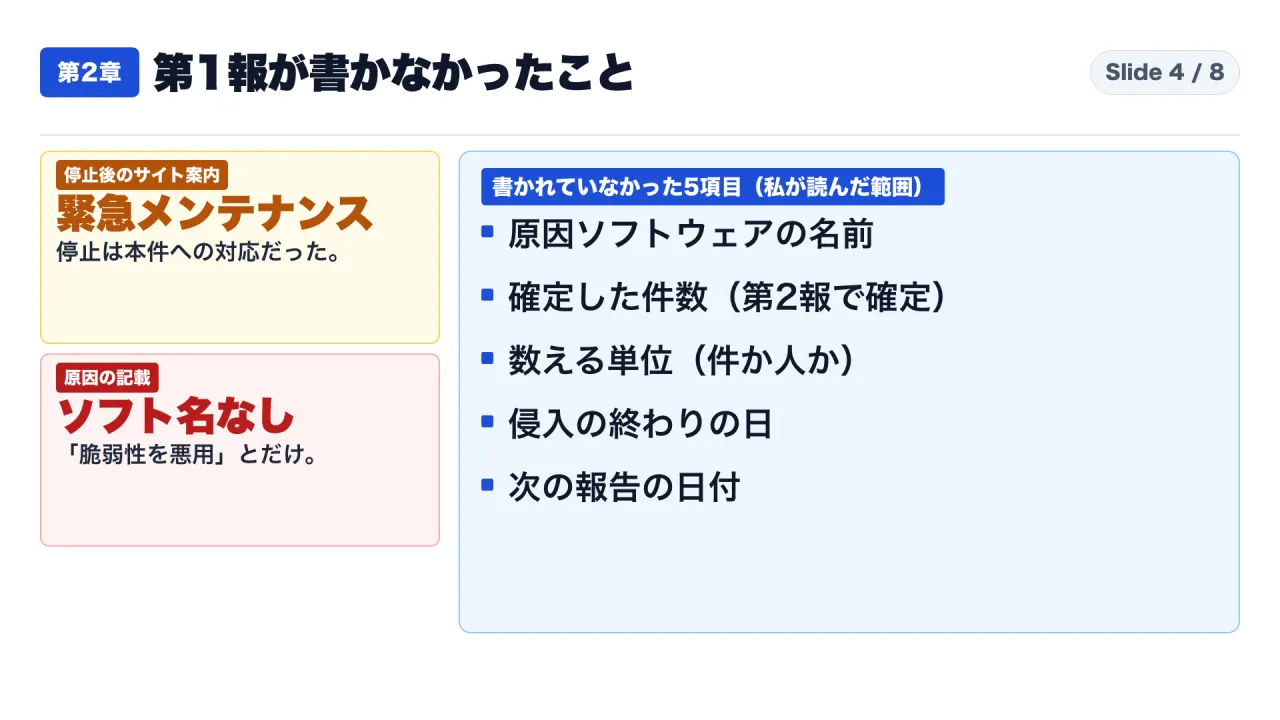
- Omission of the Attack Vector: The filing contained zero technical details regarding the vulnerability, affected web servers, compromised software frameworks, or authentication failures.
- Absence of a Verified Final Count: The report cited a figure of “up to 948,498 records” without distinguishing between verified exfiltrations and baseline database ceilings.
- Ambiguity in Counting Units: Disclosures utilized the ambiguous Japanese counter “件” (records or cases), obscuring whether the figure represented 948,498 unique citizens or multiple records per member.
- Unstated Intrusion Dwell Time: The filing failed to disclose when attackers initially breached the network perimeter, leaving the duration of unauthorized access entirely unquantified.
- Absence of a Committed Follow-Up Date: The report stated that investigation findings and recurrence prevention plans would be shared “as they become available,” providing no calendar commitments for subsequent updates or service resumption.
The Second Report: Numerical Revisions and Mandatory Security Measures
On October 14, 2026, nine days following the initial announcement, GMO Research & AI released its Second Report, introducing critical revisions and operational mandates:
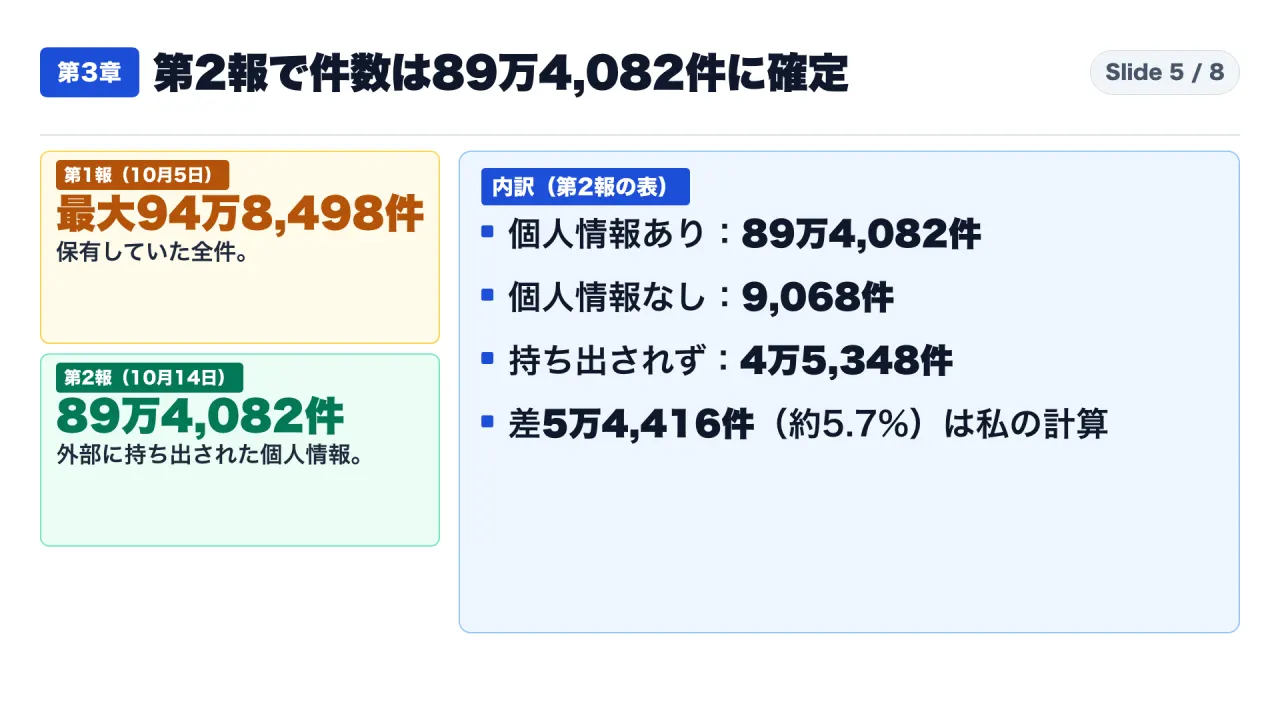
Refining Compromised Records: The 54,416 Delta
The Second Report formally reduced the estimated scope of compromised records:
Reconciliation of Compromised Database Records:
First Report (October 05, 2026):   Up to 948,498 records (Total active database ceiling)
Second Report (October 14, 2026):  894,082 records (Confirmed exfiltrated records)
Net Downward Variance:             54,416 records (Withdrawn members with purged PII)
Forensic investigation established that 54,416 records corresponded to past members who had previously terminated their accounts. While database audit trails preserved historical identification numbers, all associated personal identifying information (names, addresses, phone numbers) had been permanently deleted prior to the intrusion. Consequently, actual personal data exposure was finalized at 894,082 records.
Communication Clarifications and Mandatory Account Resets
The Second Report corrected a major procedural ambiguity regarding user outreach. While the First Report implied that notifications would be targeted sequentially to affected members, the company clarified that it had broadcast notification emails to its entire membership base, inadvertently contacting unaffected users.
Furthermore, management introduced aggressive security countermeasures:
- System-Wide Password Invalidation: Forced invalidation of stored login passwords across all registered accounts.
- Point Redemption Suspension: Freezing all outgoing point exchange gateways pending full security certification.
- Reimbursement Timing: Confirming that stolen reward points would be credited to victim accounts upon platform reopening, accompanied by individual email confirmations.
Platform Member Directives: Three Immediate Protective Actions
The disclosures released by GMO Research & AI outlined specific protective steps required of platform users:
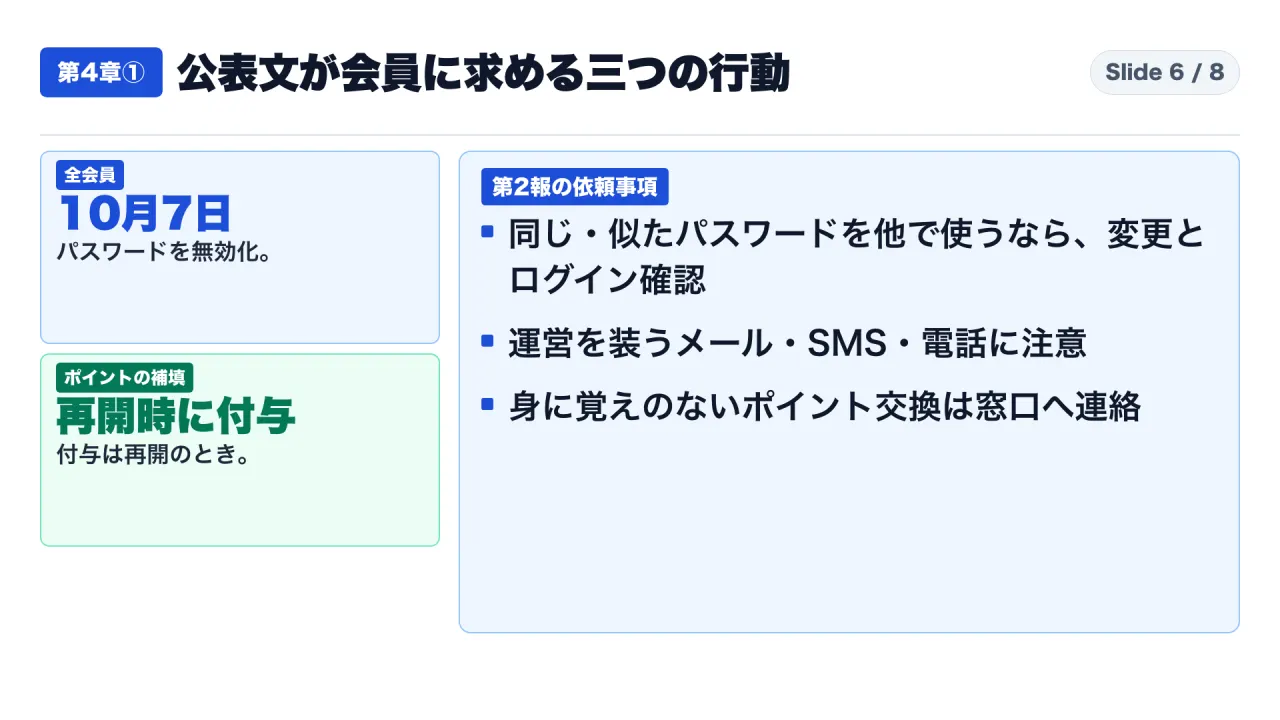
- Universal Credential Invalidation: Because stored passwords were encrypted but exposed, management urged members to immediately change passwords on any external online services sharing identical or similar credentials.
- Elevated Phishing Vigilance: With home addresses, telephone numbers, and email accounts compromised, members were warned to scrutinize inbound emails, SMS messages, and postal mail for targeted social engineering attempts.
- Account Balance Verification: Members were instructed to log in upon service resumption to verify historical transaction ledgers and confirm points restoration.
Analytical Synthesis: The Anatomy of Crisis Information Control
Comparing the First and Second Reports illustrates the predictable evolution of corporate breach communications:
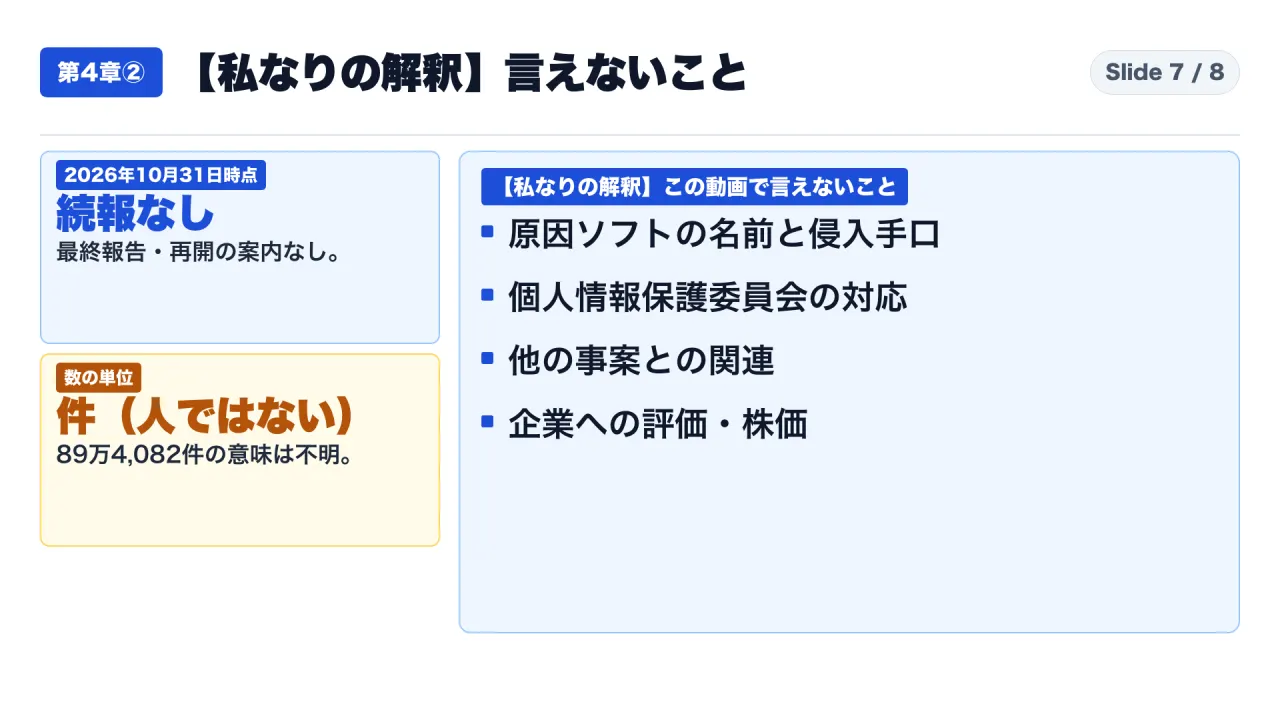
- The Initial Ceiling Strategy: Organizations prefer publishing a conservative, worst-case upper bound (such as total registered users) rather than underreporting initial damages and suffering reputational damage when numbers expand later.
- The Euphemism of “Maintenance”: Labeling active security containment as “emergency maintenance” misleads users during the most critical 48 hours of credential exposure. When attackers hold active credentials, delaying notification prevents users from protecting external accounts.
- Unstated Technical Realities: By October 31, 2026, GMO Research & AI had still not disclosed the technical vulnerability exploited by attackers. For enterprise partners commissioning market research, this leaves third-party supply chain risks unresolved.
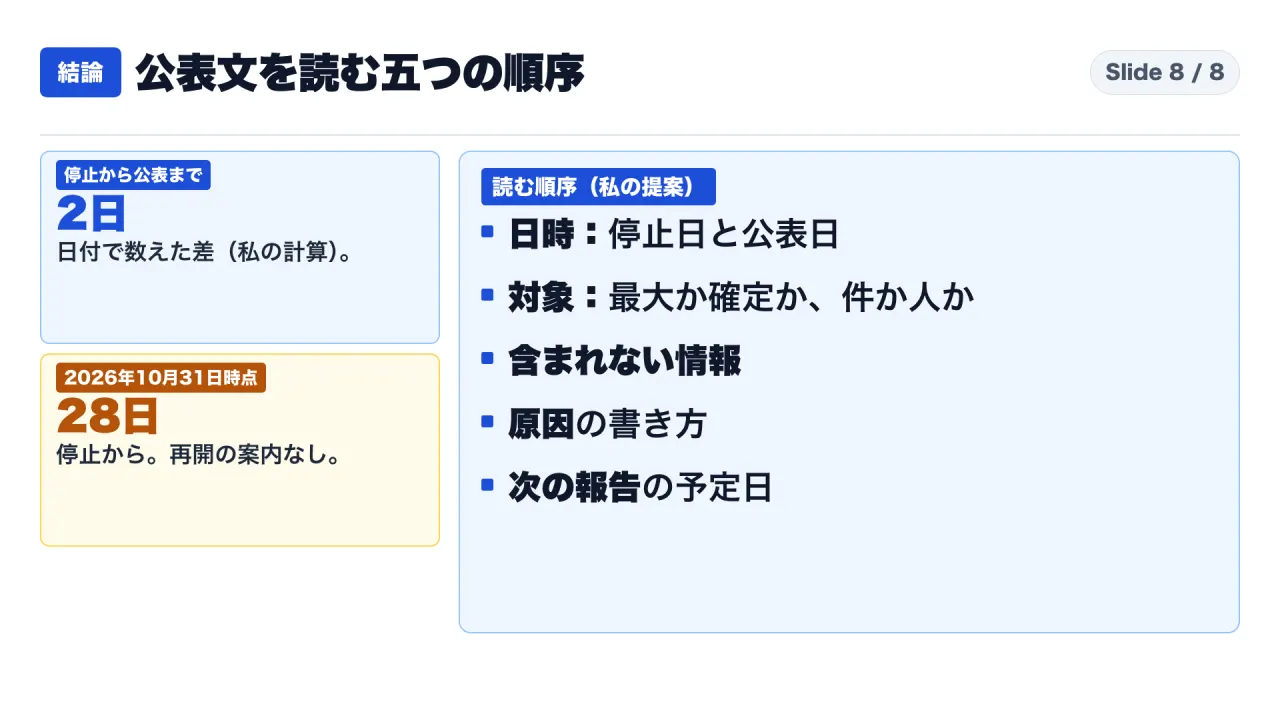
Actionable Framework: A 5-Step Protocol for Evaluating Breach Disclosures
For corporate risk managers, compliance officers, and platform users evaluating security breach announcements, this analysis provides a 5-step auditing framework:
Corporate Breach Disclosure Audit Protocol:
[ ] Step 1: Map the Timeline: Calculate exact elapsed hours between platform shutdown and public breach admission.
[ ] Step 2: Audit Compromised Fields: Separate exposed demographic attributes from excluded financial credentials.
[ ] Step 3: Catalog Omitted Facts: Identify missing items (root causes, dwell times, counting units, next update dates).
[ ] Step 4: Track Revision Deltas: Reconcile variances between provisional upper bounds and verified forensic totals.
[ ] Step 5: Verify Corporate Commitments: Monitor whether promised follow-up investigations and restitution dates are met.
Frequently Asked Questions and Governance Traps
Q1: Was the 948,498 figure in the First Report an erroneous calculation?
No. The First Report framed 948,498 as the maximum potential upper limit based on all records held on October 5. The Second Report confirmed that 894,082 records contained exfiltrated personal data, while 54,416 belonged to withdrawn users whose data had been purged.
Q2: Did the “emergency maintenance” banner deceive platform users?
Official corporate disclosures acknowledge that the service was halted to contain unauthorized access and apologize for delayed explanations, confirming that maintenance screens masked active security triage.
Q3: What specific software vulnerability allowed attackers to access infoQ databases?
Corporate announcements published through October 31, 2026 provide zero technical details regarding software frameworks, operating systems, or vulnerability CVE identifiers.
Q4: Has the infoQ research platform resumed normal operations?
As of October 31, 2026, GMO Research & AI’s official notice portal contained no announcement confirming platform reactivation or publication of a comprehensive final forensic report.