Did the Warnings Ever Reach Top Leadership? Comparing GMO's 2017 Postponed-Fix Report with the November 2026 Security Briefing
A cross-examination of GMO Payment Gateway’s 2017 breach investigation and GMO Internet Group’s November 2026 disclosures reveals the persistent governance failure where critical technical debt and postponed vulnerability remediations fail to escalate to executive decision-makers.
Published: October 31, 2026 | Read time: ~10 min | Watch Video (Japanese)
Executive Summary: When Legacy Systems Cannot Be Stopped, Security Fixes Are Postponed
Enterprise IT architecture frequently confronts a dangerous operational tradeoff: production systems running core revenue pipelines are considered too fragile or business-critical to take offline for maintenance. Over months and years, security patches are deferred, configuration audits are postponed, and technical debt compounds behind firewall perimeters.
This operational dilemma lies at the center of two major cybersecurity incidents within the GMO Internet Group ecosystem:
- The 2017 GMO Payment Gateway Breach: Attackers exploited the Apache Struts 2 vulnerability (CVE-2017-5638 / S2-045) on payment processing platforms managed for public-sector clients, including the Tokyo Metropolitan Government. The subsequent investigation report published in April 2017 revealed that engineering teams had debated migrating away from Struts since 2014, but deferred action because production modifications carried high operational risk. Crucially, the report documented that retaining the vulnerable framework was never escalated to executive management.
- The 2026 Onamae.com Desktop Cloud Incident: In late October 2026, GMO Internet Group suffered unauthorized intrusions into its desktop cloud environment. During an official corporate briefing on November 2, 2026, corporate leadership admitted that external security specialists had formally warned the organization about infrastructure risks in April 2024, yet subsequent countermeasures proved inadequate in both depth and execution speed. However, corporate statements omitted whether those 2024 specialist warnings had ever reached the Chief Executive Officer.
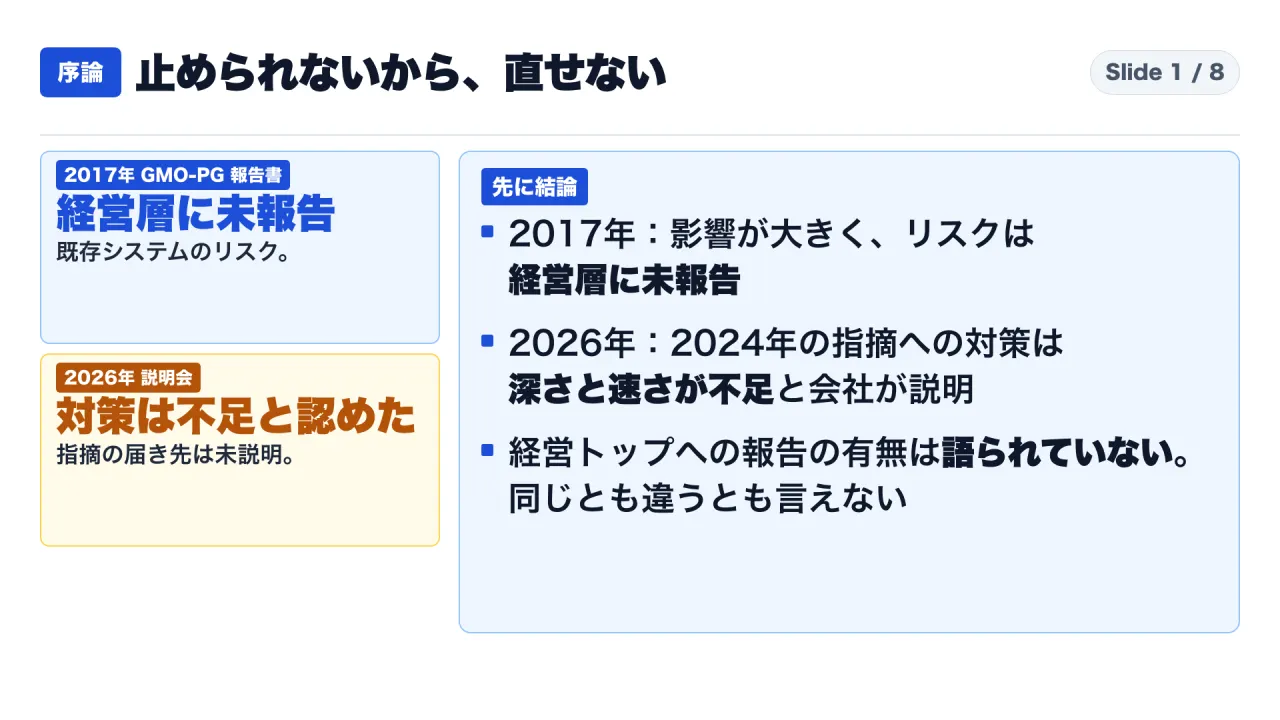
This analysis contrasts primary records from both incidents: the 2017 TSE disclosure against the November 2, 2026 briefing statements, blog disclosures, and board compensation filings.
Methodological Taxonomy: Maintaining Corporate Entity Boundaries and Document Types
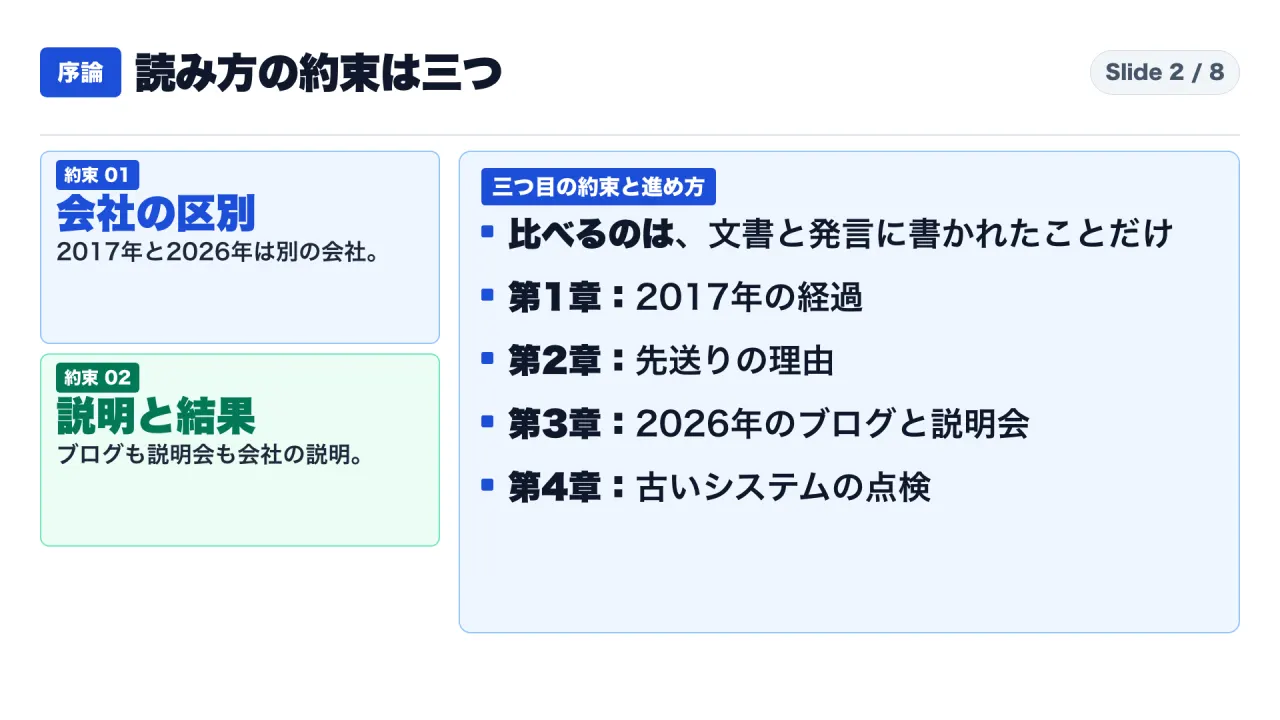
Analyzing corporate crisis management requires rigorous source attribution. Throughout this study, three procedural boundaries are strictly enforced:
- Legal Entity Separation: GMO Payment Gateway, Inc. (GMO-PG, TSE Prime: 3769) is an exchange-listed subsidiary specializing in payment transaction processing. GMO Internet Group, Inc. (TSE Prime: 9449) is the listed holding and operational parent company. Disclosures from one corporate entity cannot be retroactively conflated with the other.
- Document Type Classification: The 2017 investigation report was authored by a dedicated Recurrence Prevention Committee comprising internal managers and external legal counsel, published via Tokyo Stock Exchange regulatory disclosure. In contrast, 2026 disclosures consist of executive remarks from the November 2 press briefing, an official corporate compensation filing, and personal blog posts by Group CEO Masatoshi Kumagai.
- Strict Adherence to Stated Evidence: This study evaluates documented statements and timeline telemetry without imputing unstated motives or technical conjecture regarding undisclosed zero-day exploits.
Baseline Terminology and Regulatory Definitions
To evaluate technical compliance across both security events, key definitions must be established:
| Governance and Security Term | Primary Source Operational Meaning | Regulatory Significance |
|---|---|---|
| Apache Struts 2 (S2-045) | Remote code execution vulnerability in the Jakarta Multipart parser, disclosed on March 6, 2017. | Allowed unauthenticated attackers to execute arbitrary commands via crafted Content-Type HTTP headers. |
| ISMS (ISO/IEC 27001) | Information Security Management System certification maintained by GMO-PG (renewed December 2014). | Confirmed existence of administrative process controls, but failed to prevent zero-day exploitation of legacy code. |
| PCI DSS v3.1 | Payment Card Industry Data Security Standard certification audited in December 2016. | Technical security benchmark for cardholder data environments; did not mandate real-time patching of unassessed dependencies. |
| Postponed Remediation | Operational decision to delay architectural refactoring or patch application due to production stability fears. | Identified in the 2017 report as the root operational cause of prolonged vulnerability exposure. |
| Executive Escalation Gap | The breakdown in organizational communication where technical risks identified by engineers or auditors are withheld from corporate officers. | Common structural failure identified across both 2017 and 2026 corporate postmortems. |
The 2017 Incident: 30 Hours from Zero-Day Disclosure to Active Exploitation
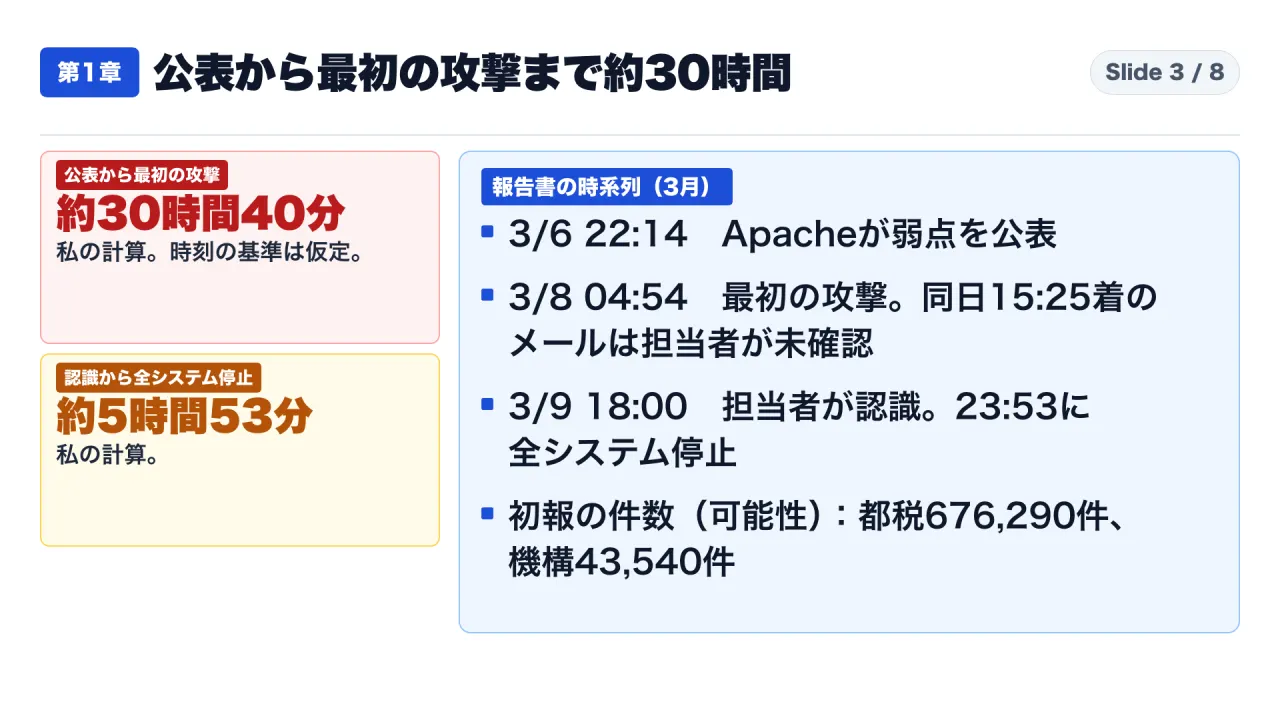
Understanding the governance failure requires reconstructing the timeline documented in GMO Payment Gateway’s April 30, 2017 investigation report:
Timeline of the 2017 Struts 2 Exploitation:
March 06, 2017 ~16:30 JST:  Apache Software Foundation publicly discloses S2-045 vulnerability.
March 07, 2017 ~22:30 JST:  Attackers launch first unauthorized intrusion against GMO-PG servers (~30 hours post-disclosure).
March 08, 2017  11:59 JST:  Security vendor advisory email arrives; remains unread in recipient inbox.
March 09, 2017  21:00 JST:  Internal security personnel recognize active malicious exploitation.
March 10, 2017  03:00 JST:  Management shuts down all legacy production systems and shifts to backup (~6 hours post-recognition).
March 10, 2017  Morning:    GMO-PG issues public notice of unauthorized access and data leakage.
The Anatomy of the 30-Hour Infiltration Window
The 2017 timeline demonstrates the collapse of defensive reaction windows. Attackers operationalized automated exploit scripts within approximately 30 hours of Apache’s public advisory.
Meanwhile, internal defensive procedures stalled:
- The Unchecked Vendor Notification: An urgent vulnerability advisory dispatched by a managed security vendor on March 8 sat unopened in an individual engineer’s inbox because procedures lacked secondary notification routing.
- The Execution of the Shutdown: When engineering leadership recognized active data exfiltration on the night of March 9, they executed an emergency shutdown of all affected production systems within six hours, transitioning operations to an alternate platform.
This operational sequence confirms that taking systems offline was technically achievable. The fundamental breakdown was not the inability to halt servers, but the absence of predefined thresholds to suspend operations preemptively upon public vulnerability disclosure.
Why Patches Were Postponed in 2017: Technical Debt and the Information Silo
The most revealing disclosures within the 2017 GMO-PG investigation report concern the internal decisions that preceded the March 2017 attack.
The Limits of Compliance Certifications
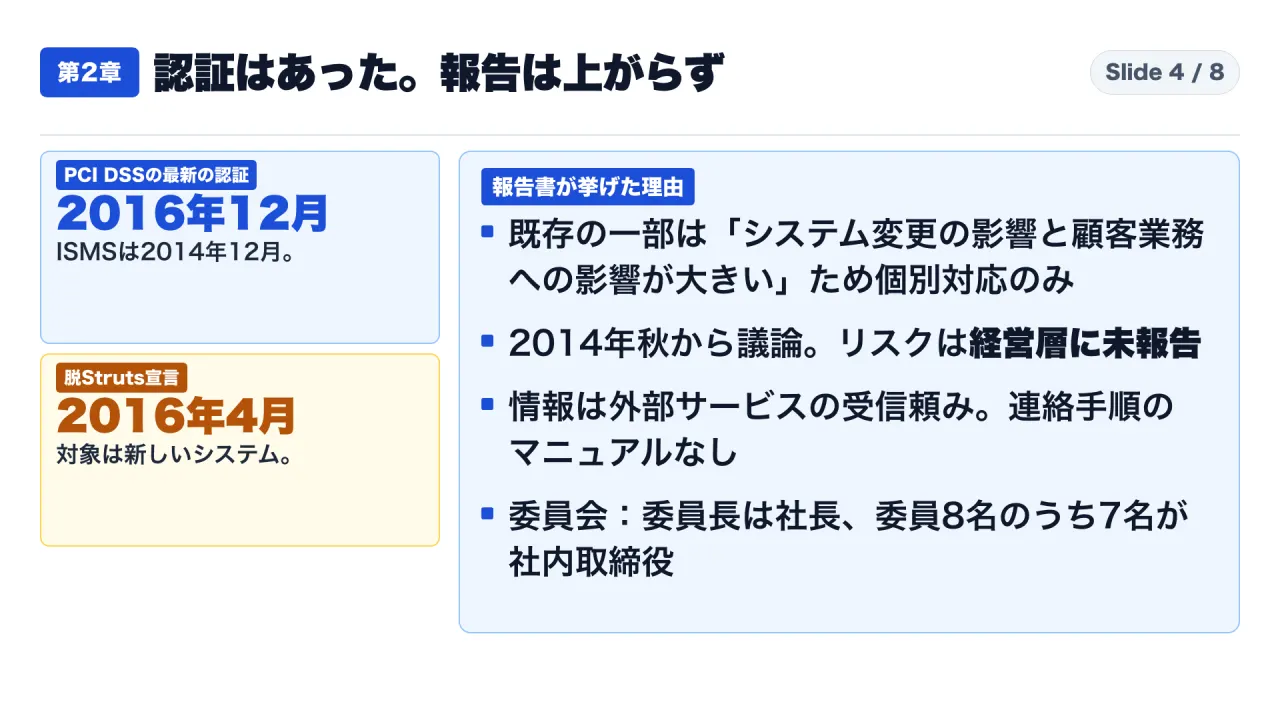
The investigation report opened by detailing GMO-PG’s compliance certifications: active ISMS certification (renewed in December 2014) and PCI DSS Version 3.1 compliance (certified in December 2016).
However, the report delivered a blunt assessment: these compliance frameworks failed to function effectively against zero-day vulnerabilities in legacy architectures. Regulatory compliance checklists confirmed that policies existed on paper, but did not guarantee that legacy production systems were resilient against modern automated attack vectors.
The 2014 “Struts Elimination” Mandate That Never Reached the Board
According to the report, GMO-PG engineering teams had actively debated eliminating Apache Struts 2 from legacy systems as early as Autumn 2014. For newer software deployments, the company mandated modern, secure frameworks.
However, for legacy systems already embedded in client operations, engineering teams concluded that rewriting core codebases presented severe operational risks:
- Operational Friction: Modifying legacy transaction pipelines threatened system availability and client compatibility.
- Individual Discretion: Decisions regarding whether to patch or refactor legacy components were left to the informal discretion of technical leads.
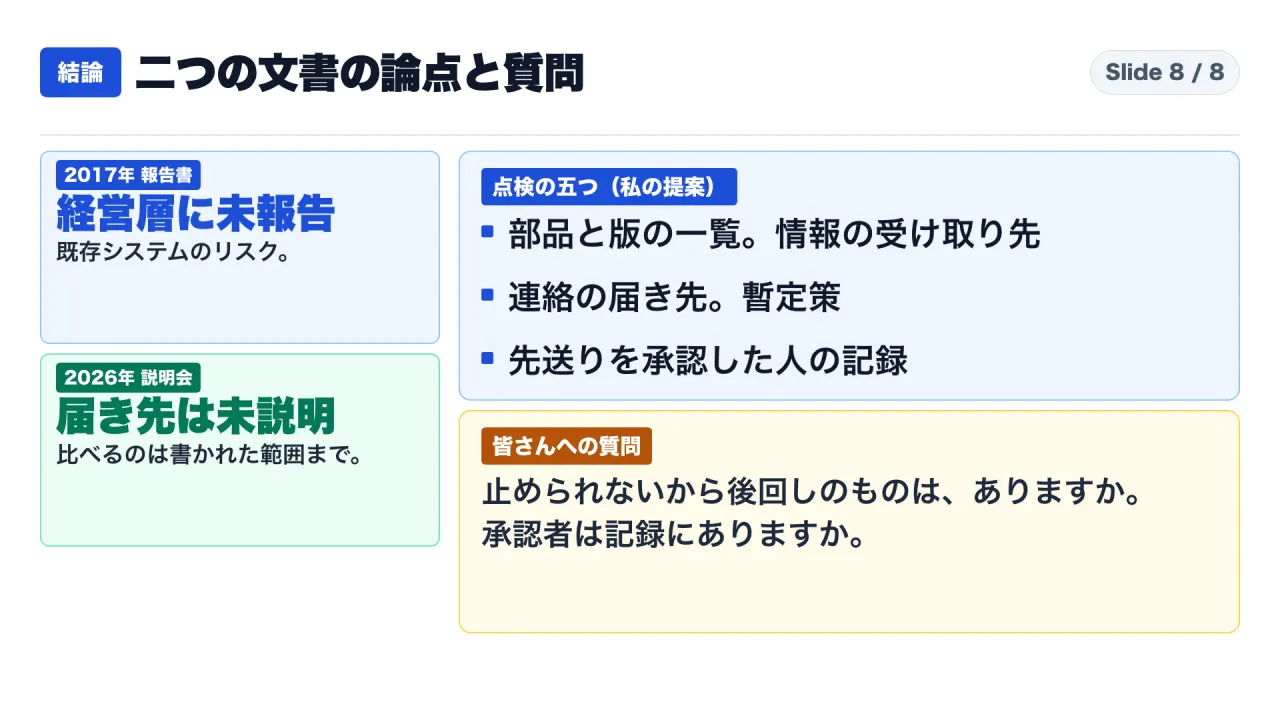
- The Escalation Failure: The investigation report explicitly documented that the operational risk of maintaining obsolete Struts frameworks was never reported to executive management or the board of directors.
Because technical risk was framed solely as a localized engineering scheduling issue rather than an enterprise solvency risk, executive leadership remained entirely unaware of the liability embedded within the legacy infrastructure.
The 2026 Incident: External Warnings, Insufficient Remedies, and Unclear Leadership Visibility
Nine years after the payment gateway breach, GMO Internet Group confronted a remarkably similar structural challenge within its “Onamae.com Desktop Cloud” infrastructure.
The April 2024 Specialist Assessment
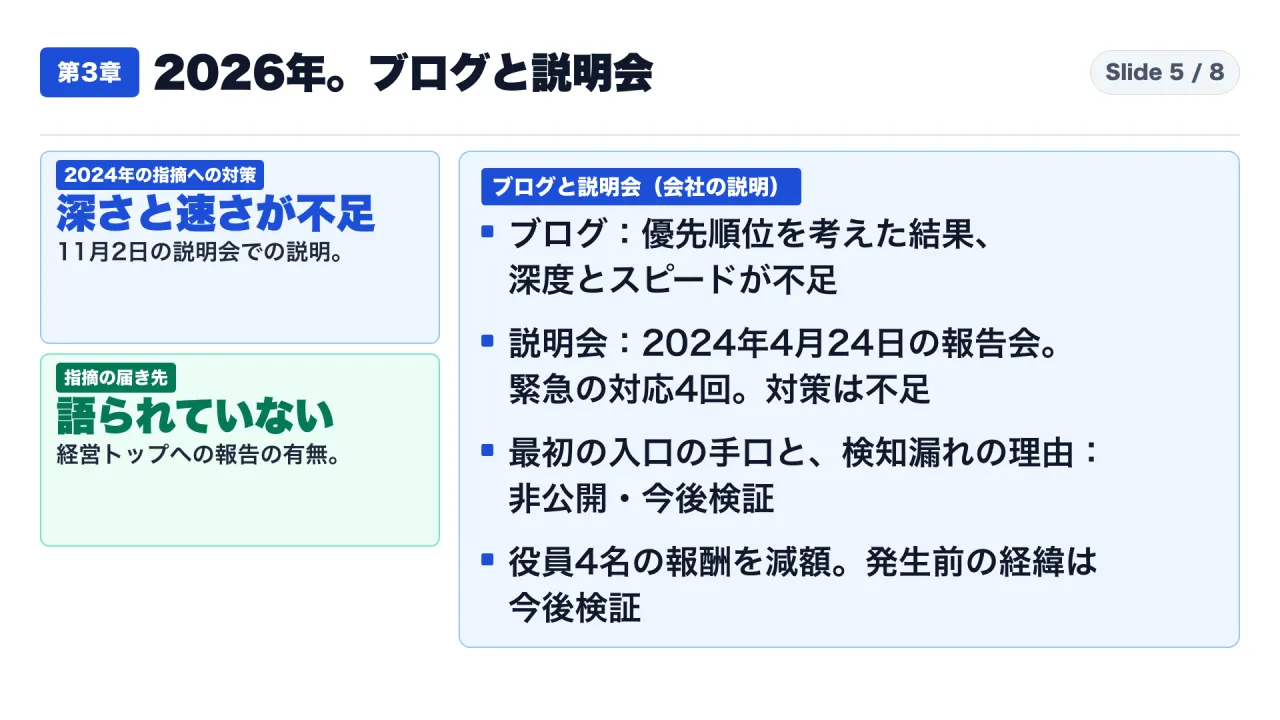
In a personal corporate blog post published in early November 2026, Group CEO Masatoshi Kumagai addressed unauthorized access into the desktop cloud platform. The CEO disclosed that in April 2024, external security specialists had conducted an evaluation of the system and explicitly highlighted vulnerabilities and configuration risks.
During the official corporate press briefing held on November 2, 2026, Group Vice President Yamashita confirmed the sequence:
- The Briefing Sessions: On April 24, 2024, technical personnel conducted internal reporting sessions to review diagnostic findings.
- The Remediation Failure: Vice President Yamashita acknowledged that while operational teams implemented countermeasures, the company’s response was insufficient in both depth and implementation speed.
- The Unanswered Question: Neither the CEO’s blog post nor the executive presentations during the November 2 briefing disclosed whether the findings of that April 2024 security report were ever escalated directly to the Group CEO or corporate board.
Executive Compensation Penalties and Future Verification
Following the briefing on November 2, 2026, GMO Internet Group filed an official disclosure with the Tokyo Stock Exchange detailing board compensation reductions:
- CEO Masatoshi Kumagai: 100% reduction of monthly executive compensation for three months.
- Vice President Yamashita: 50% reduction of monthly executive compensation for three months.
- Additional Executive Officers: 30% to 50% monthly compensation reductions.
The filing noted that the corporate group plans to establish a third-party committee to conduct an investigation into pre-incident operational decisions, technical response adequacy, and internal reporting workflows.
Analytical Synthesis: The Anatomy of Technical Debt Concealment
Contrasting the 2017 and 2026 disclosures illuminates a consistent pathology in corporate technology governance:
- Risk Inversion: Operational teams perceive system downtime for maintenance as an immediate, certain negative outcome (service interruptions, customer complaints). In contrast, unpatched security vulnerabilities are perceived as probabilistic risks that might never materialize. Consequently, local actors consistently choose to postpone maintenance.
- The Silence of Formal Audits: Compliance certifications (ISMS, PCI DSS) measure adherence to documented processes. When legacy systems operate within established operational exceptions, compliance audits regularly pass without flagging underlying architectural rot.
- The Filtering of Bad News: In hierarchical organizations lacking mandatory risk escalation thresholds, middle management filters out technical warnings before they reach the C-suite. As observed in 2017, the decision to postpone Struts refactoring was treated as an internal engineering decision until an international breach forced regulatory intervention.
Actionable IT Governance Playbook: Five Mandatory Audits for Legacy Systems
To prevent operational systems from degenerating into unpatched liabilities, security leaders must implement five non-negotiable operational controls:
Five Governance Controls for Legacy Infrastructure
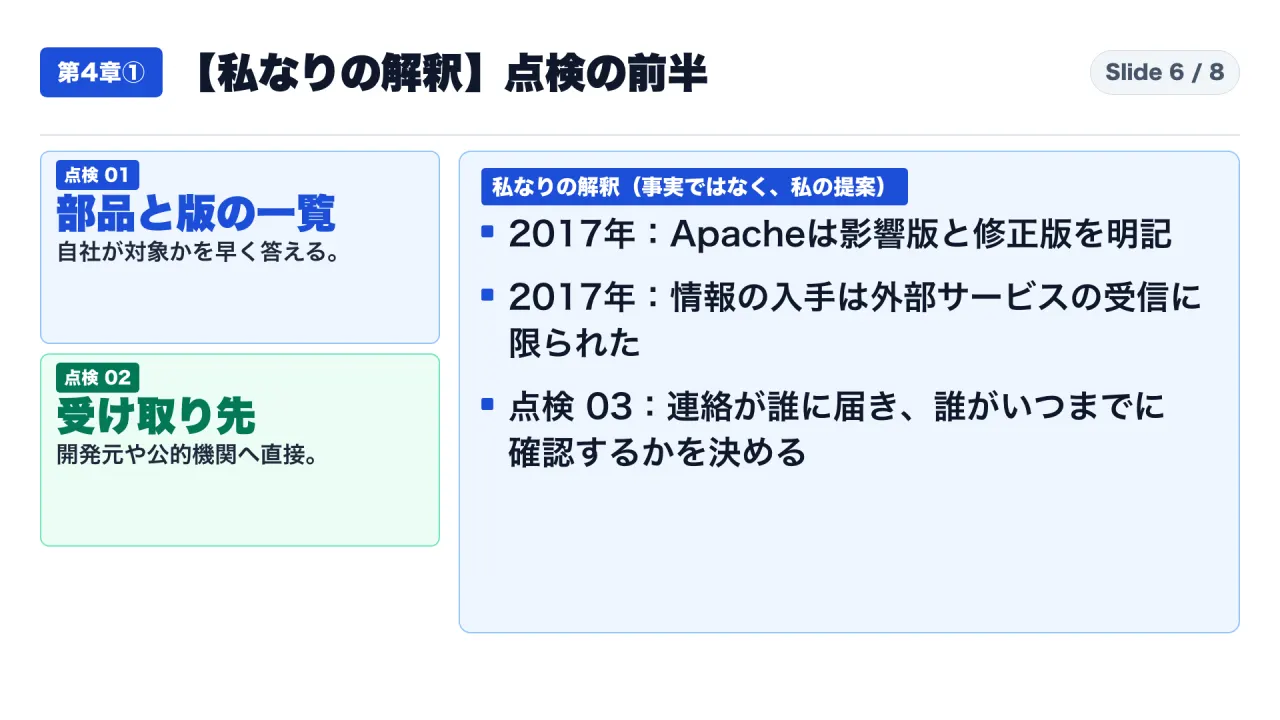
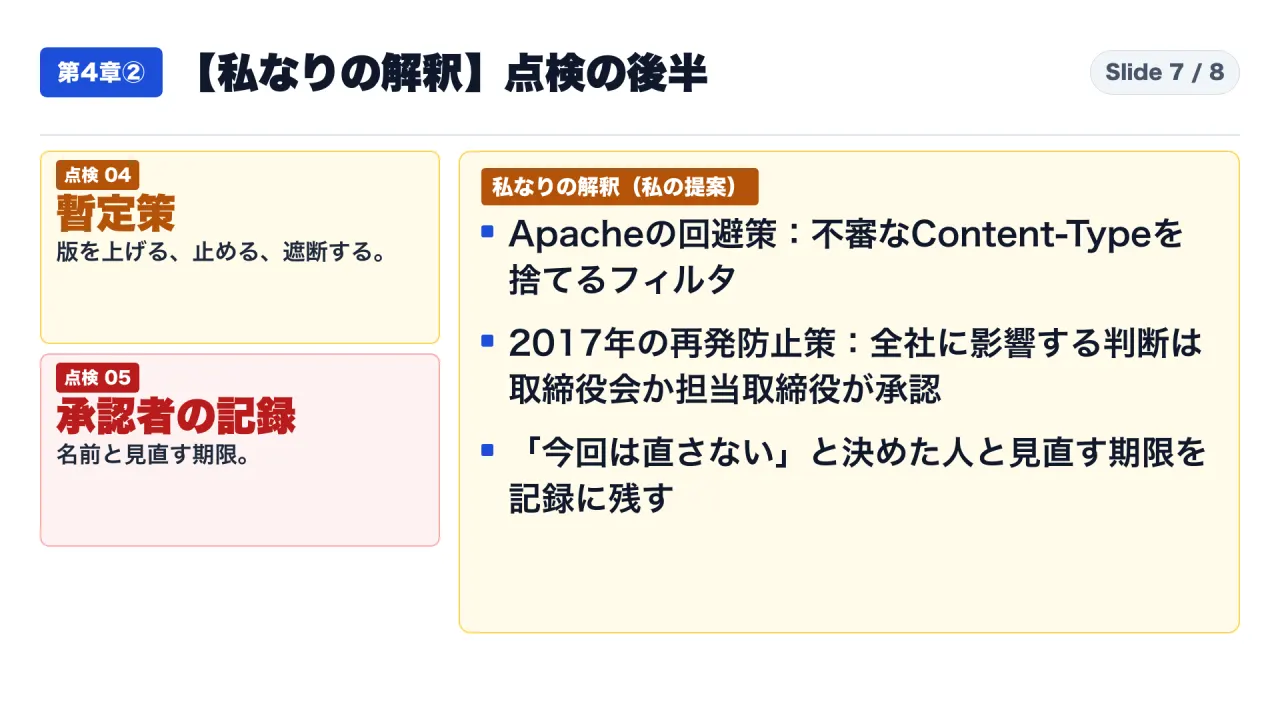
- Maintain an Automated Software Bill of Materials (SBOM): Establish a living, machine-readable inventory of all open-source libraries, frameworks, and operating system components across every production server.
- Direct Ingestion of Security Advisories: Discontinue reliance on manual email notifications delivered to individual staff. Route vendor security feeds and CERT bulletins into automated triage platforms.
- Redundant Incident Escalation Routing: Ensure critical security alerts cannot stall in an individual employee’s inbox. Establish group-level distribution lists with mandatory read receipts and automated 30-minute escalation workflows.
- Pre-Authorized Temporary Mitigations: Document emergency defensive measures (such as WAF string inspection rules, servlet filters, or network-level IP isolation) that can be activated instantly upon zero-day disclosures.
- Mandatory Board-Level Risk Acceptance Sign-Off: Prohibit engineering teams from informally deferring security patches. If a system cannot be updated due to production stability risks, require a formal “Risk Acceptance Document” signed by an executive officer, containing an enforceable expiration date not exceeding 90 days.
Legacy System Deferral Audit Protocol:
[ ] Component Audit: Complete SBOM registered in centralized asset repository.
[ ] Vulnerability Alert Intake: Multi-channel automated ingestion independent of personal inboxes.
[ ] Escalation Redundancy: Secondary on-call contact notified automatically after 15 minutes of inactivity.
[ ] Mitigation Playbook: Pre-tested WAF filtering and traffic isolation rules ready for deployment.
[ ] Executive Risk Sign-Off: Postponement approved in writing by designated corporate officer with 90-day sunset clause.
Methodological Boundaries and Analytical Limits
To maintain analytical rigor, the limitations of this comparative study must be stated:
- Unpublished 2026 Root Causes: GMO Internet Group has not disclosed the initial attack vector, the technical vulnerability exploited, or the specific reasons intrusion detection systems failed in 2026. These items await third-party committee findings.
- Leadership Awareness Status: Public primary sources confirm that 2024 specialist warnings existed, but do not provide documentation confirming whether CEO Kumagai personally reviewed those warnings prior to the 2026 incident.
- Independent Context: The 2017 breach involved public-sector payment processing, whereas the 2026 incident involved remote desktop infrastructure. Technical architectures and threat actor profiles differ significantly.
Frequently Asked Questions and Governance Traps
Q1: Did the 2017 and 2026 security incidents stem from the same software vulnerability?
No. The 2017 incident resulted from the exploitation of Apache Struts 2 (S2-045). In 2026, the specific vulnerability and entry vector have not been publicly disclosed, pending formal third-party investigation.
Q2: Does holding ISO 27001 or PCI DSS certification protect an organization against zero-day exploits?
No. As documented in the 2017 GMO-PG investigation report, formal compliance certifications demonstrate administrative adherence to baseline standards, but cannot guarantee that legacy systems will resist rapid automated exploitation.
Q3: Why did engineering teams postpone replacing Apache Struts in 2014?
The 2017 report stated that engineering leads determined modifying legacy production systems carried excessive operational risk and potential client disruption, leading to informal deferrals without executive escalation.
Q4: Did GMO’s top leadership know about the April 2024 security warnings prior to the 2026 breach?
Available public disclosures do not confirm this. While company leaders confirmed that security reporting occurred on April 24, 2024, official statements did not identify meeting attendees or confirm whether reports reached the Group CEO.
Primary Sources and References
- GMO Payment Gateway, Inc. Investigation Report (April 30, 2017, Tokyo Stock Exchange)
- GMO Payment Gateway Notice of Unauthorized Access and Data Leakage (March 10, 2017)
- GMO Payment Gateway Establishment of Recurrence Prevention Committee (March 14, 2017)
- Masatoshi Kumagai Official Blog Statement (Accessed November 3, 2026)
- Apache Software Foundation Struts 2 S2-045 Security Advisory
- IPA Security Alert for Apache Struts 2 Vulnerability (Wayback Machine Archive)
- GMO Internet Group Official Press Briefing on Desktop Cloud Unauthorized Access (November 2, 2026)
- GMO Internet Group Notice of Executive Compensation Reduction (November 2, 2026, Tokyo Stock Exchange)