Why Intel Cannot Scale Server CPU Shipments Despite Soaring AI Demand: Inside Fab Bottlenecks and External Substrate Limits
Intel’s Q3 2026 disclosures and packaging supply chain telemetry reveal that server processor shortages stem from dual bottlenecks: internal Intel 3 process cycle times alongside an industry-wide shortage of advanced organic packaging substrates that may persist into 2028.
Published: October 31, 2026 | Read time: ~10 min | Watch Video (Japanese)
Executive Summary: Demand Outstripping Supply Across Enterprise Data Centers
Enterprise infrastructure planners face an escalating dilemma across global server procurement pipelines. Lead times for modern compute silicon continue to lengthen, even as corporate balance sheets allocate record capital toward compute modernization.
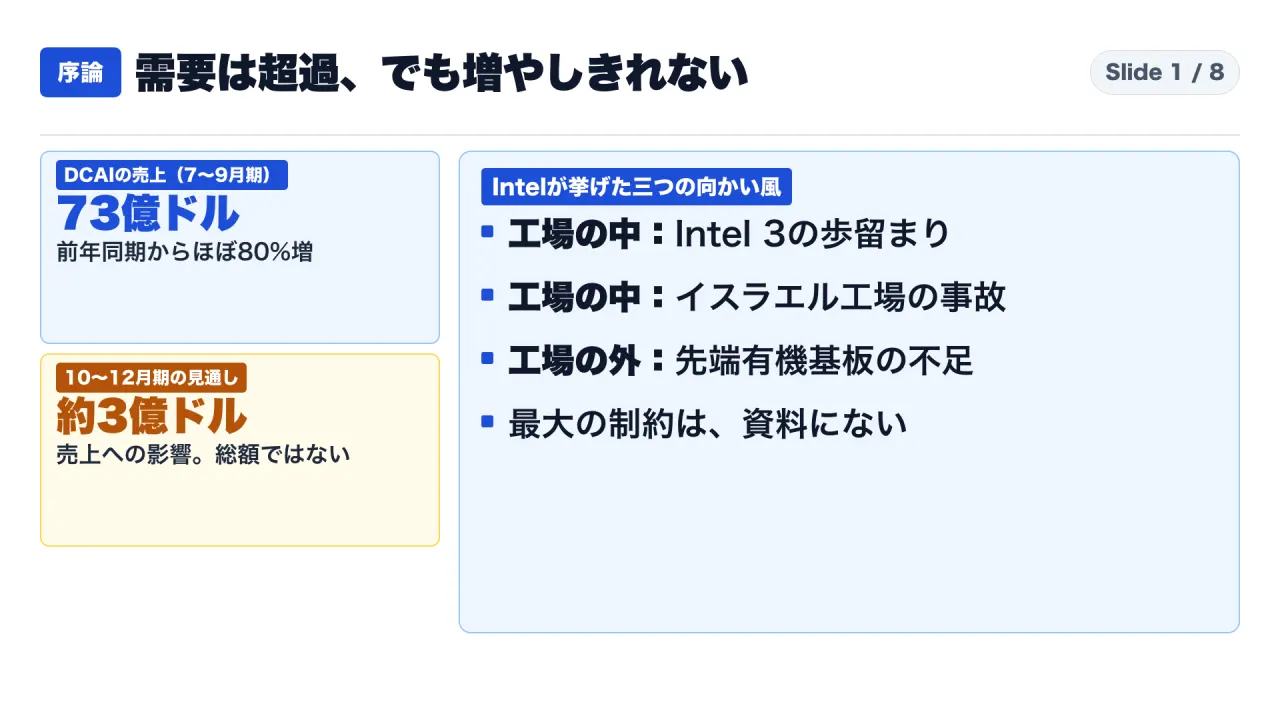
On October 29, 2026, Intel Corporation delivered its third-quarter financial results. During the executive briefing, management stated that demand for its Data Center and AI (DCAI) portfolio continues to significantly exceed available supply. The top-line numbers appeared strong: DCAI generated $7.3 billion in quarterly revenue, up 17% sequentially and nearly 80% year-over-year.
Yet beneath these numbers lies a physical bottleneck: Intel cannot produce and ship enough completed processors to meet customer purchase orders. Intel’s CEO cited three specific headwinds restricting shipment volume:
- Internal wafer processing dynamics: Slower-than-budgeted yield maturation and extended manufacturing cycle times on the Intel 3 fabrication node.
- An unexpected cleanroom interruption: An operational incident in October 2026 at Intel’s Kiryat Gat, Israel facility (referred to as Fab 28 in prepared remarks).
- External packaging component scarcity: An industry-wide shortage of advanced organic package substrates required for Intel’s proprietary Embedded Multi-die Interconnect Bridge (EMIB) packaging architectures.
This bottleneck carries direct operational consequences. Server silicon is constrained by both cleanroom physics and external component supply chains. Intel’s CFO cautioned that industry-wide supply constraints are projected to persist throughout 2027 and into 2028.
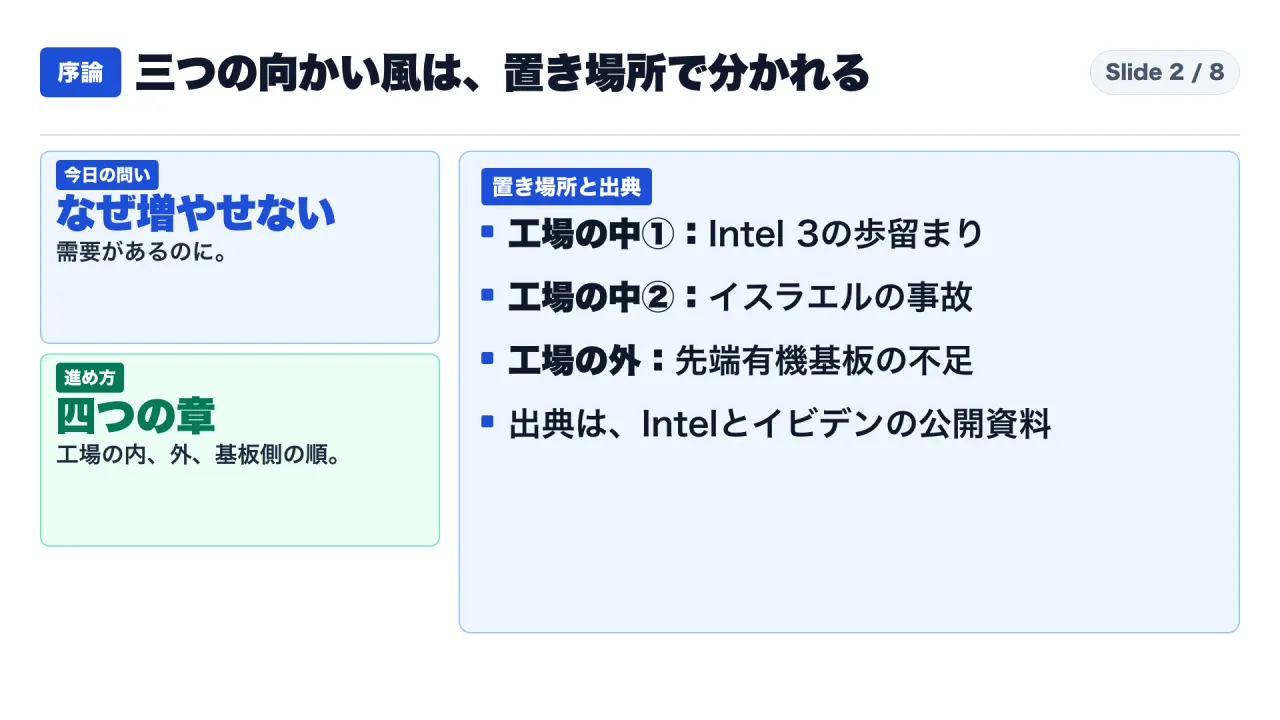
This analysis examines disclosures from Intel’s Form 10-Q filed with the SEC, Intel’s prepared remarks, and packaging telemetry from Ibiden Co., Ltd.
Methodological Taxonomy: Distinguishing Verified Facts, Corporate Guidance, and Analytical Inferences
Semiconductor reporting frequently conflates distinct categories of information. Throughout this analysis, findings are categorized under a strict taxonomy:
- Audited and Stated Facts: Metrics and operational disclosures documented within Intel’s Form 10-Q for the quarterly period ended September 26, 2026, Intel’s official Q3 2026 Prepared Remarks transcript, and Ibiden Co., Ltd.’s FY2026 Q2 Financial Presentation and Institutional Q&A transcript published on October 30, 2026.
- Corporate Guidance and Forecasts: Forward-looking management estimates, non-GAAP targets, and market projections subject to operational uncertainty.
- Analytical Inferences: Structural deductions formulated by the author based on primary source materials. These interpretations do not constitute corporate statements or investment advice.
All monetary values are cited in reported currencies──U.S. dollars for Intel and Japanese yen for Ibiden──to avoid exchange rate distortions.
Baseline Technical Terminology and Structural Definitions
Navigating semiconductor packaging and fabrication disclosures requires establishing precise technical definitions:
| Operational Term | Primary Source Treatment | Technical Significance |
|---|---|---|
| DCAI | Intel financial reporting segment representing Data Center and AI. | Encompasses server microprocessors (Xeon family), accelerators, and custom silicon. Specific SKU revenue breakdowns are omitted. |
| Intel 3 Node | Advanced internal semiconductor fabrication process. | Management notes ongoing progress in node yield (usable dies per wafer) and cycle time (elapsed cleanroom duration). |
| EMIB | Embedded Multi-die Interconnect Bridge. Proprietary Intel packaging architecture. | Utilizes miniature silicon bridges embedded within organic substrates to enable high-density, low-latency die-to-die horizontal interconnects. |
| Advanced Organic Substrates | External high-density multi-layer wiring carriers utilizing semi-additive build-up processes. | Structural foundation upon which silicon chiplets are assembled, providing electrical breakout between micro-bump pitches and motherboard socket contacts. |
| SAP | Semi-Additive Process, an advanced substrate manufacturing methodology detailed in Ibiden disclosures. | High-precision chemical copper deposition technique used to define fine interconnect traces required by multi-die computing platforms. |
| Basis Points | Standardized financial metric utilized in margin variance reporting. | One basis point equals 0.01% (0.0001). A 200 basis point adjustment represents a 2.0 percentage point reduction in gross margin. |
DCAI Segment Dynamics: Shipments Constrained by Production Ceilings
Top-Line Momentum Contrasted with Physical Shipment Volumes
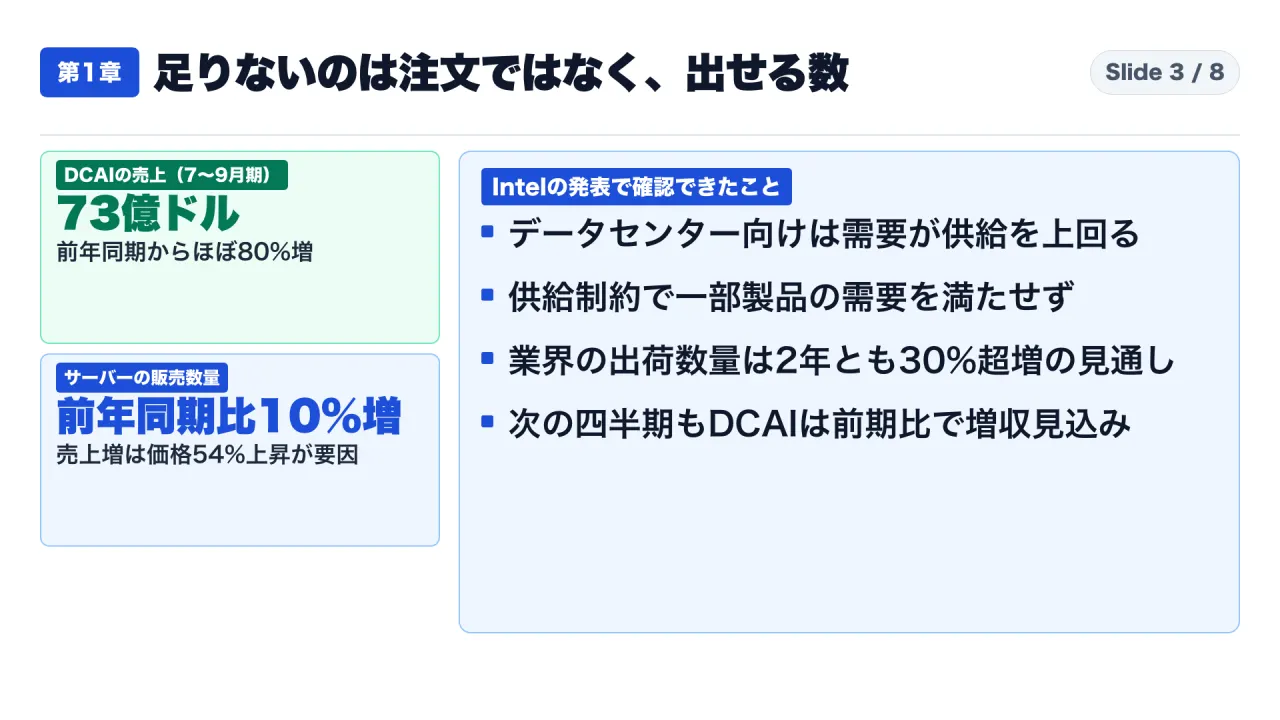
In the quarterly period ended September 26, 2026, Intel’s DCAI segment reported $7.3 billion in revenue, advancing 17% sequentially and approximately 80% year-over-year. Management emphasized that commercial demand outpaced available manufacturing capacity. However, Intel’s Form 10-Q reveals the underlying mechanics:
- Server Unit Shipment Volumes: Increased by only 10% year-over-year.
- Average Selling Prices (ASP): Increased by 54% year-over-year across data center compute platforms.
This divergence demonstrates that revenue expansion was predominantly driven by ASP inflation rather than unit volume growth. Intel’s SEC filing notes that higher ASPs reflected both a customer mix shift toward premium server configurations and strategic price adjustments. In physical terms, Intel delivered only 10% more server processors to global customers than it did twelve months prior.
The Structural Analogy: The Fully Booked Fabrication Schedule
Consider an engineering contractor with project commitments extending two years into the future. Even if prospective clients double their inquiries, the contractor cannot accelerate revenue beyond the physical throughput limits of its equipment and certified workforce.
Similarly, Intel faces a rigid throughput ceiling. The primary operational bottleneck is releasing packaged units through factory gates. Management guides mid-teens sequential revenue growth for DCAI into Q4 2026, yet total volume remains physically constrained.
Internal Cleanroom Bottlenecks: Intel 3 Node Maturation and the Israel Facility Accident
Intel’s executive remarks structured operational headwinds into a deliberate sequence. The first two constraints reside directly inside Intel’s internal fabrication infrastructure.
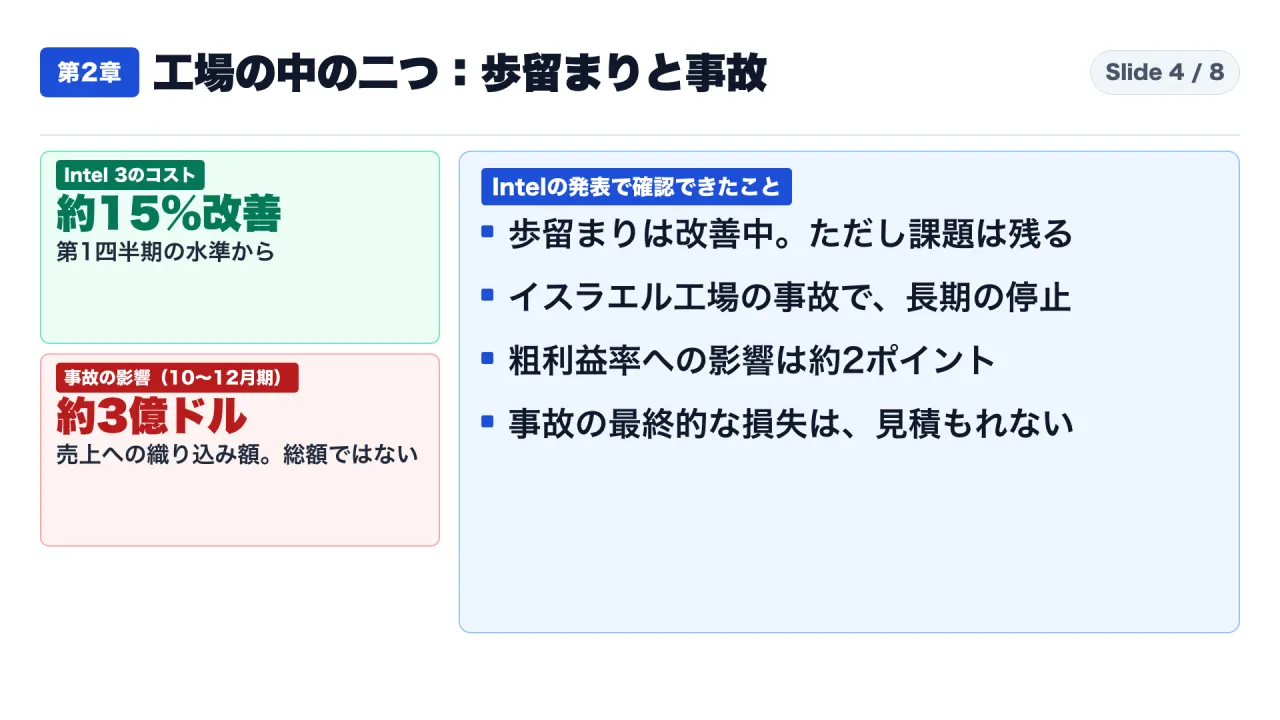
Constraint 1: Intel 3 Yield and Cycle Time Inefficiencies
Intel’s CEO noted that manufacturing performance on the Intel 3 process node continues to improve. However, acknowledging node yield and cycle time as a major headwind confirms that fabrication physics have not reached steady-state industrial targets:
- Cycle Time Friction: When wafer transit times through lithography, etch, ion implantation, and deposition take longer than scheduled baselines, total work-in-progress (WIP) inventory accumulates, delaying finished wafer releases.
- Defect Density and Yield Ramp: Sub-optimal die yield per wafer depresses net usable silicon volume. In high-density server silicon featuring large dies or multi-tile modular assemblies, defective blocks reduce the count of sellable units per finished 300mm wafer.
Constraint 2: The Kiryat Gat Cleanroom Disruption
In October 2026, an operational cleanroom accident occurred at Intel’s manufacturing campus in Kiryat Gat, Israel. The event disrupted operations, triggering production downtime and material scrappage.
- Non-GAAP Outlook Incorporation: Intel management incorporated an estimated financial impact of approximately $300 million and roughly 200 basis points of gross margin compression into fourth-quarter 2026 guidance.
- Operational Downtime: In its Form 10-Q filing, Intel disclosed that cleanroom operations were halted for approximately two weeks, with phased line restarts scheduled before the close of October 2026.
- Duration of Accounting and Margin Ripples: While cleanroom environments resumed baseline functionality within two weeks, Intel warned in its regulatory filing that lingering cost anomalies, equipment recalibration expenses, and margin pressures may ripple through the first half of 2027.
Crucially, the $300 million figure represents a Q4 forward provision rather than an audited loss total. Intel stated in its 10-Q that cumulative losses and insurance recoveries cannot yet be estimated.
External Packaging Bottlenecks: Advanced Organic Substrates and EMIB Architectures
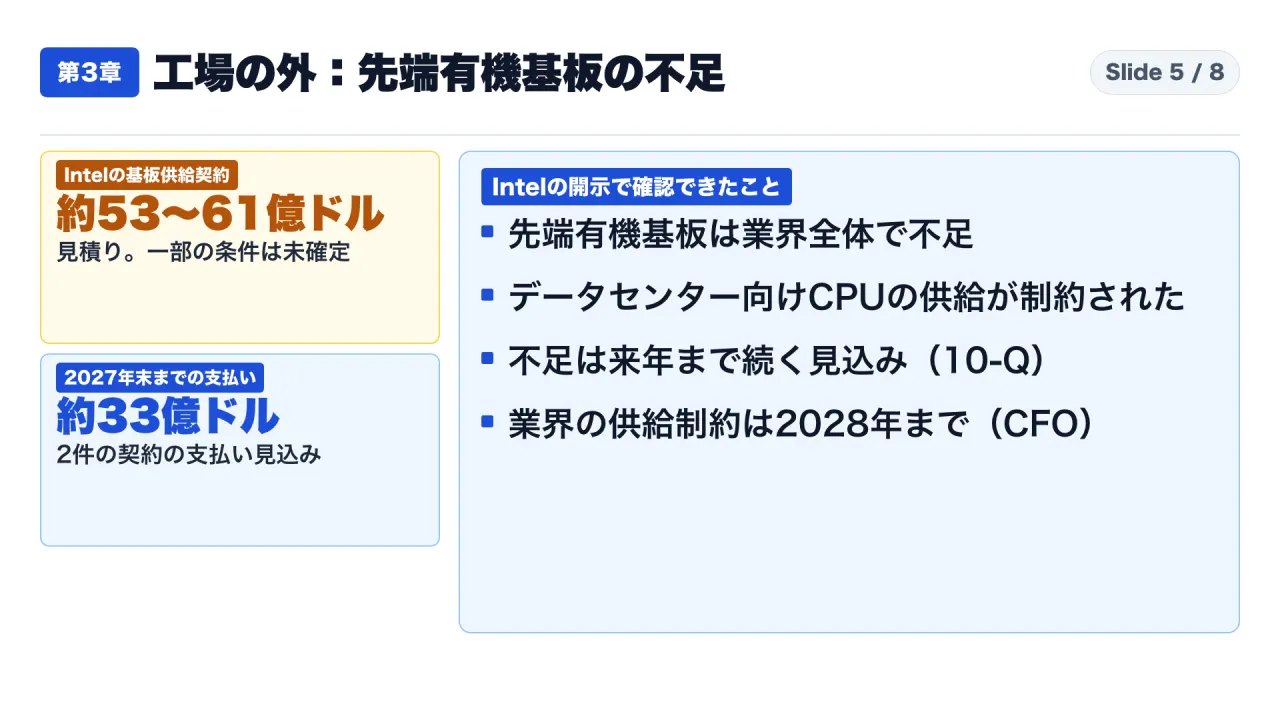
The third constraint identified by management sits entirely outside cleanroom walls: an acute global scarcity of advanced organic packaging substrates required for EMIB integration.
The Decoupling of Silicon Wafers and Finished Packages
In modern multi-die architectures, high-performance computing requires advanced packaging. Intel’s flagship server CPUs leverage EMIB, embedding miniature silicon bridges directly beneath the boundaries of adjacent dies to facilitate high-speed inter-die signals.
These miniature bridges require specialized, high-density organic build-up substrates manufactured with ultra-fine line pitch and multi-layer structural stability. If an assembly plant lacks a matching, flawless advanced organic substrate, fully processed server processor silicon cannot be packaged, tested, socketed, or shipped. The finished silicon wafer remains stranded inventory.
Structural Asymmetry: Substrate Shortages versus Memory Elasticity
Intel’s disclosures highlighted a critical difference between component bottlenecks:
- Memory and Commodity Passives: High-bandwidth memory (HBM) and DDR5 modules represent capital-intensive dependencies, yet distributor buffers and standardized interfaces offer procurement teams tactical flexibility.
- Organic Substrate Inelasticity: Advanced substrates are custom-engineered physical carriers built to proprietary physical layouts. They cannot be sourced interchangeably from secondary open markets or swapped across competitive foundries.
Intel’s management emphasized that this substrate bottleneck is an industry-wide structural shortage. To secure production commitments, Intel disclosed in its Form 10-Q that subsequent to the close of Q3 2026, the company executed two substantial long-term substrate purchase agreements with commitments estimated at approximately $5.3 billion to $6.1 billion for the first contract and approximately $3.3 billion for the second contract. Key terms and final commercial volumes within these contracts remain subject to ongoing determination.
Substrate Foundry Realities: Ibiden Telemetry and 4-Year Capital Construction Horizons
To evaluate the feasibility of resolving this packaging shortage, enterprise planners must examine operational disclosures from leading IC package substrate manufacturers. On October 30, 2026, Japanese advanced substrate manufacturer Ibiden Co., Ltd. held its fiscal year 2026 second-quarter financial briefing, presenting market assessments for advanced Semi-Additive Process (SAP) substrates.
Area-Driven Growth Outpacing Silicon Unit Volume
Ibiden’s technical briefing established that substrate consumption is expanding primarily by physical surface area rather than discrete processor unit counts:
| Silicon Application Segment | Projected SAP Substrate Area Demand (2030 vs 2026 Index: 2026 = 100) | Structural Drivers of Substrate Complexity |
|---|---|---|
| AI Accelerators and Custom ASICs | 540 (5.4x growth) | Large multi-die footprints, multi-layer routing, and thermal expansion matching. |
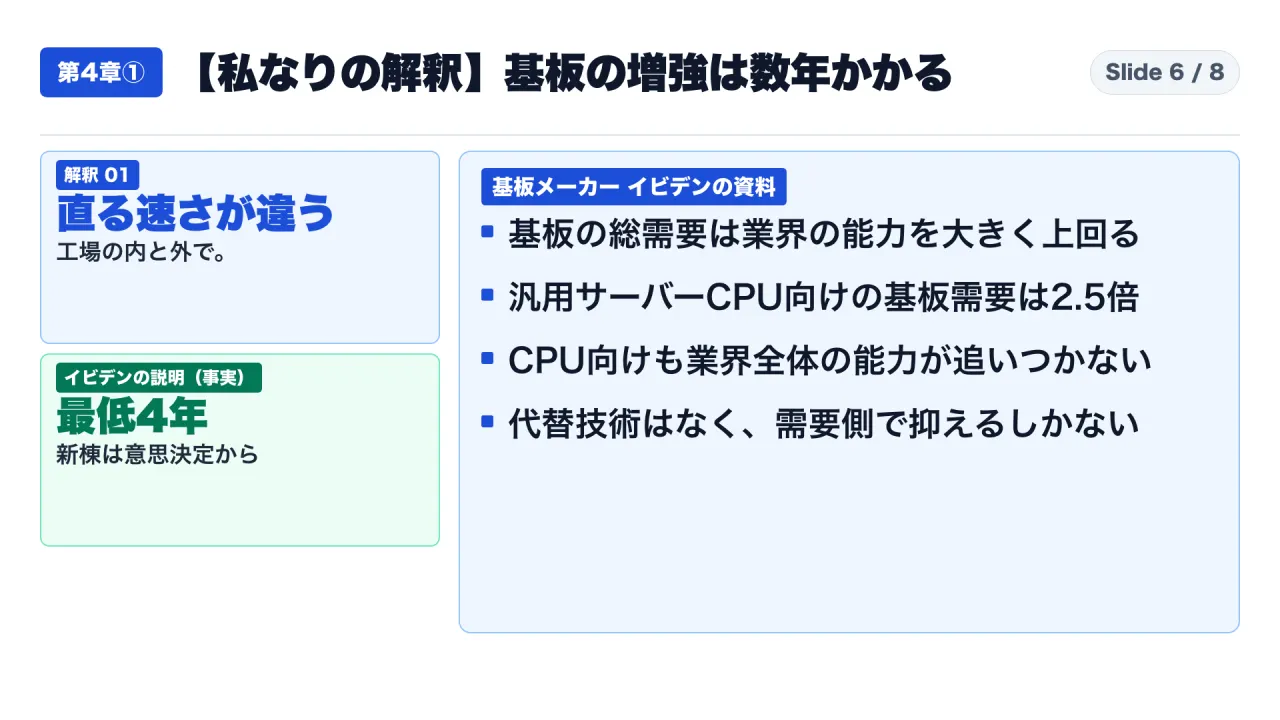
| General-Purpose Server CPUs | 250 (2.5x growth) | Transition from monolithic dies to multi-chiplet modular server topologies requiring expanded carrier surface areas. |
| Network Switching and Interconnect | 350 (3.5x growth) | Co-packaged optics and high-speed SerDes trace density requiring structural mechanical stability. |
Because multi-die processors require massive carriers, a single package consumes substantial panel area, requiring disproportionate square meters of substrate capacity per unit shipped.
The 4-Year Greenfield Construction Reality
In institutional Q&A, Ibiden executives stated that from board approval to volume qualification, constructing an advanced substrate plant, installing tooling, and qualifying lines requires a minimum of four years.
Consequently, substrate manufacturers cannot rapidly expand capacity in response to sudden commercial demand spikes. Substrate fabricators are prioritizing capacity allocations toward high-margin AI accelerator customers, leaving general-purpose server platforms competing for constrained production slots. Ibiden executives observed that resolving supply friction will inevitably require server customers to rationalize demand expectations.
Methodological Boundaries: What Public Disclosures Confirm versus Unverified Assumptions
Maintaining rigorous corporate analysis requires establishing clear boundaries regarding what available corporate disclosures cannot substantiate:
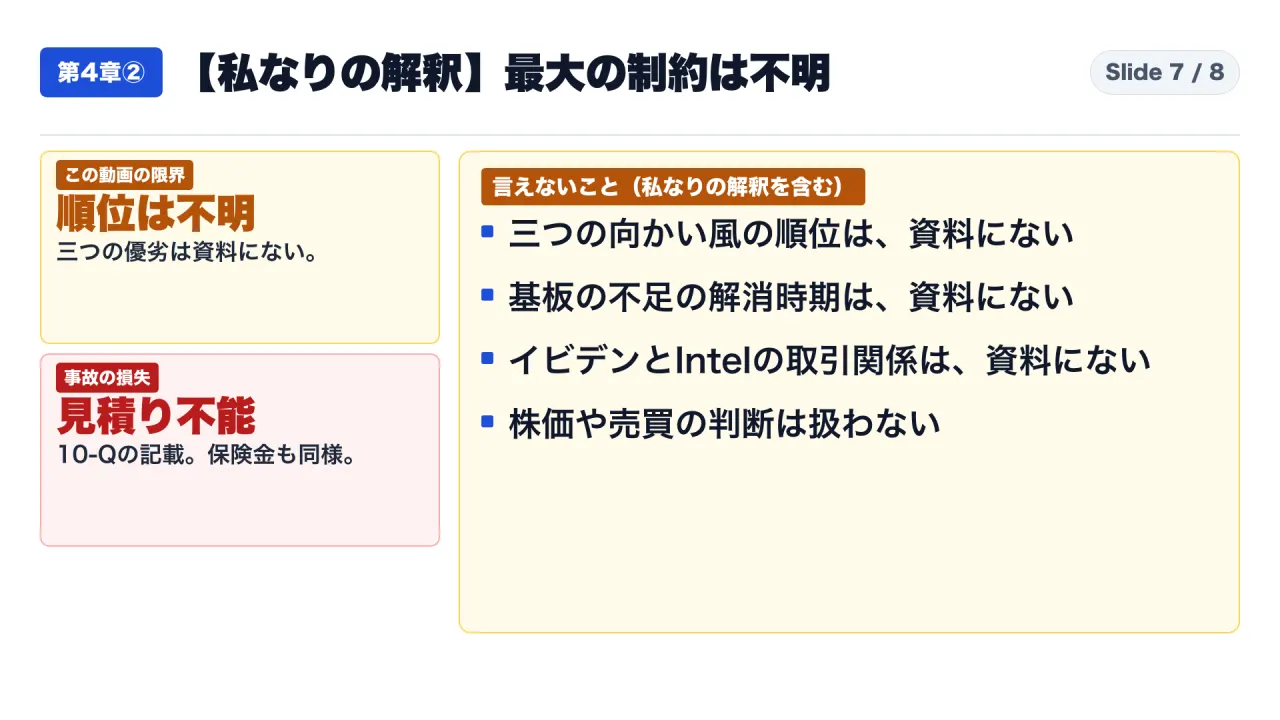
- Relative Headwind Ranking: Neither Intel’s earnings transcript nor its SEC Form 10-Q ranks the three headwinds by severity. Claiming that substrate scarcity is the primary driver, or that the Israel cleanroom accident represents the primary bottleneck, constitutes unverified speculation.
- Substrate Shortage Resolution Timeline: Intel’s CFO projected industry-wide supply constraints extending through 2027 and into 2028. However, neither Intel nor substrate manufacturers provide a specific calendar date for the resolution of EMIB substrate shortfalls.
- Ibiden Customer Relationship: Ibiden’s public disclosures contain no explicit references to commercial contracts with Intel Corporation. Ibiden’s capital investments cannot be cited as direct evidence of Intel capacity relief.
- Finalized Facility Damage Totals: The $300 million and 200 basis point figures provided by Intel represent quarterly non-GAAP guidance provisions. The ultimate net financial impact of the Kiryat Gat incident remains unquantified pending physical audits and insurance adjudications.
Strategic Playbook: Enterprise IT Procurement and Capacity Planning
For enterprise technology executives, systems procurement specialists, and data center operators, these semiconductor supply constraints dictate concrete adjustments in vendor contracting, quotation validation, and infrastructure forecasting:
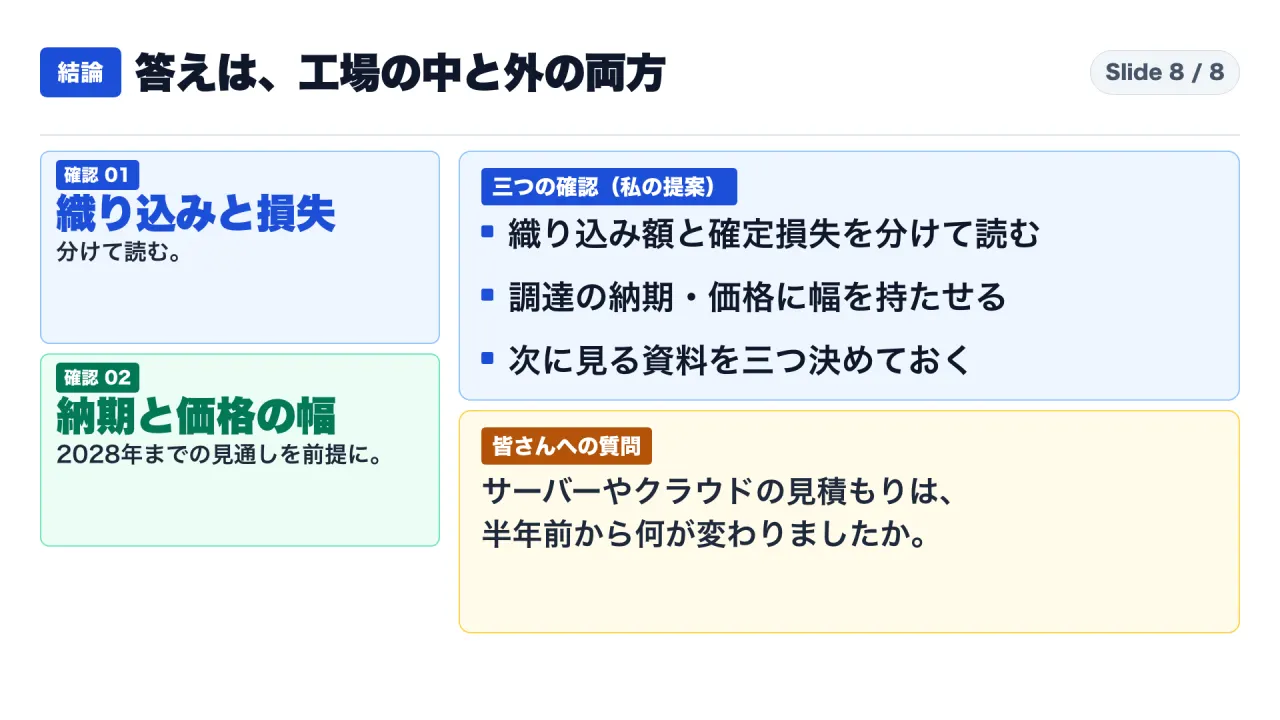
- Separate Guidance Provisions from Cumulative Losses: When evaluating industry reports asserting operational damages, audit whether cited figures represent forward-looking guidance provisions or finalized accounting write-downs. Always reference official regulatory 10-Q submissions.
- Incorporate Delivery Lead-Time Buffers: Because advanced packaging and wafer supply bottlenecks are projected to persist through 2027, enterprise hardware refresh schedules must decouple from historical 90-day procurement cycles. Build minimum lead-time cushions of 6 to 9 months for high-density server configurations.
- Establish Rigorous Contractual Validity Windows: Hardware vendors face volatile upstream component costs. Commercial procurement teams should negotiate price-lock guarantees and clearly document shipment escalation pathways before hardware quotes expire.
Frequently Asked Questions and Governance Traps
Q1: Is advanced substrate scarcity the primary reason Intel cannot fulfill server CPU orders?
Public filings do not substantiate a primary culprit. Intel management cited three co-equal headwinds: Intel 3 yield and cycle times, the Kiryat Gat cleanroom accident, and industry-wide organic substrate shortages. Management did not publish a weighted ranking among these factors.
Q2: Did the Israel cleanroom disruption cause $300 million in physical property damage?
No. The approximately $300 million and 200 basis point margin metrics reflect forward-looking operational provisions incorporated into non-GAAP fourth-quarter guidance. Total cumulative property damages and cleanroom repair costs remain unquantified in regulatory filings.
Q3: Will ongoing capital expenditure by Japanese substrate manufacturers resolve server CPU shortages in 2027?
Unlikely based on supplier telemetry. Greenfield advanced substrate manufacturing facilities require a minimum of four years from board approval to volume qualification. While incremental brownfield line debottlenecking occurs continuously, massive capacity expansions will not materialize on short notice.
Q4: Does the term “demand outstripping supply” apply to Intel’s entire product line?
No. This condition specifically characterizes the DCAI data center compute segment. In consumer client PC markets, management reported that demand exhibited seasonal moderation, accompanied by inventory adjustments across PC original equipment manufacturers.
Primary Sources and References
- Intel Corporation Q3 2026 Prepared Remarks Transcript (October 29, 2026)
- Intel Corporation Form 10-Q for the Quarterly Period Ended September 26, 2026 (U.S. SEC EDGAR)
- Ibiden Co., Ltd. FY2026 Q2 Financial Presentation (October 30, 2026)
- Ibiden Co., Ltd. FY2026 Q2 Institutional Earnings Q&A Transcript (October 30, 2026)