When Unauthorized Access Occurs, How Fast Must Japanese Enterprises Report? ── Decoding KADOKAWA's Day 59 and the MOFA 95-Day Case Studies
Under Japan’s Personal Information Protection Act, preliminary reports are due “promptly” (typically 3 to 5 days) while definitive reports must be filed within 30 days—or 60 days for malicious cyberattacks—a legal reality often obscured by public disclosure timelines.
Published: October 31, 2026 | Read time: ~10 min | Watch Video (Japanese)
Executive Summary: Demystifying “72 Hours” and Public Reporting Myths
When an enterprise experiences unauthorized network access or ransomware involving personal data, executive leadership faces an immediate statutory dilemma: What must be reported to regulators, and what is the exact legal deadline?
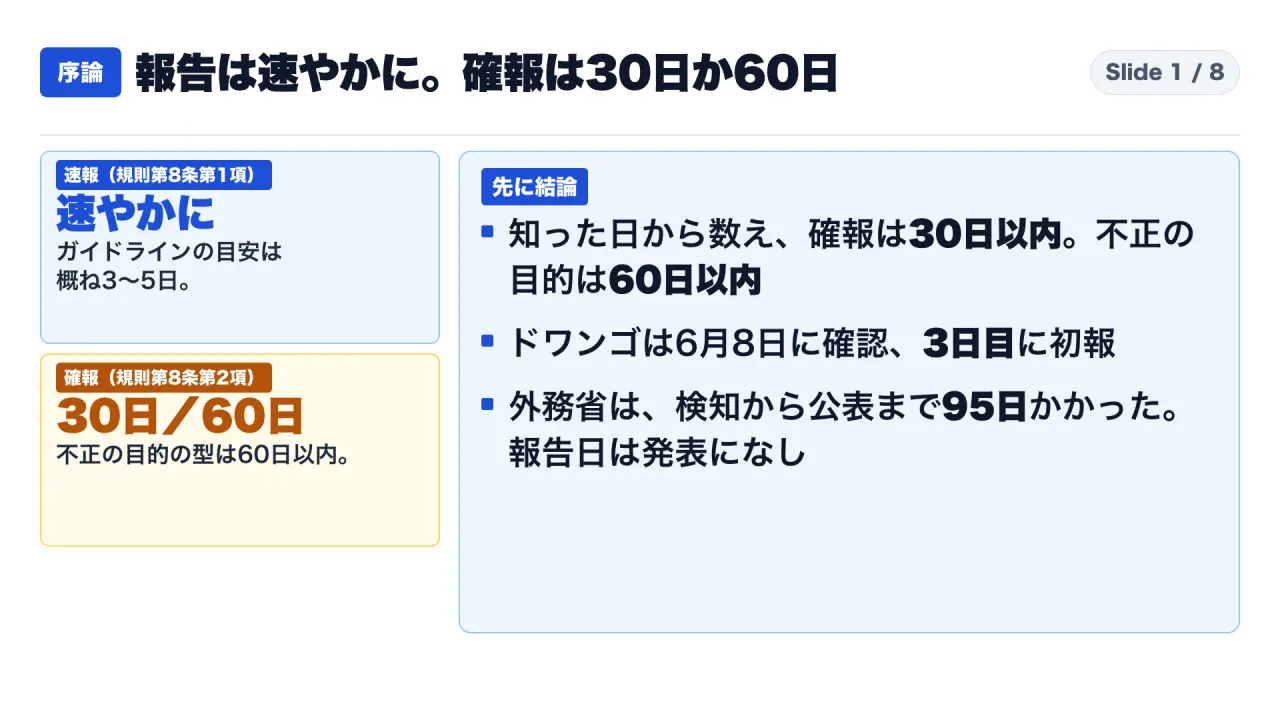
Under Japan’s Act on the Protection of Personal Information (APPI, Act No. 57 of 2003, as amended) and Personal Information Protection Commission Enforcement Rules (PPC Rule No. 3 of 2016):
- Preliminary Reporting (速報): Under Rule Article 8, Paragraph 1, an operator must report “promptly” (速やかに) upon learning of a reportable incident. PPC Guidelines establish an administrative benchmark of approximately 3 to 5 business days.
- Definitive Reporting (確報): Under Rule Article 8, Paragraph 2, an operator must submit a definitive report within 30 days. For incidents involving acts suspected of being committed for an unjust or malicious purpose (Rule Article 7, Item 3, encompassing unauthorized access, external theft, and ransomware), the statutory deadline extends to 60 days.
Two prevalent industry misconceptions must be dismantled:
- The “72-Hour” Myth: A common rumor holds that enterprises must report breaches to the PPC within 72 hours. “72 hours” appears nowhere in Japanese statute; it is frequently conflated with Article 33 of the EU’s GDPR.
- The Immediate 100-Million-Yen Fine Myth: Failure to report does not trigger an immediate 100-million-yen fine. Under APPI Articles 148, 178, and 184, corporate fines up to 100 million yen apply only if an entity violates a formal administrative compliance order issued by the Commission following an investigation.
This analysis examines two real-world case studies:
- KADOKAWA / Dwango (2024): Following ransomware discovered on Saturday, June 8, 2024, Dwango filed its preliminary report with the PPC on Monday, June 10 (Day 3). On August 5, 2024 (Day 59), KADOKAWA disclosed that 254,241 individuals were compromised while updating the commission.
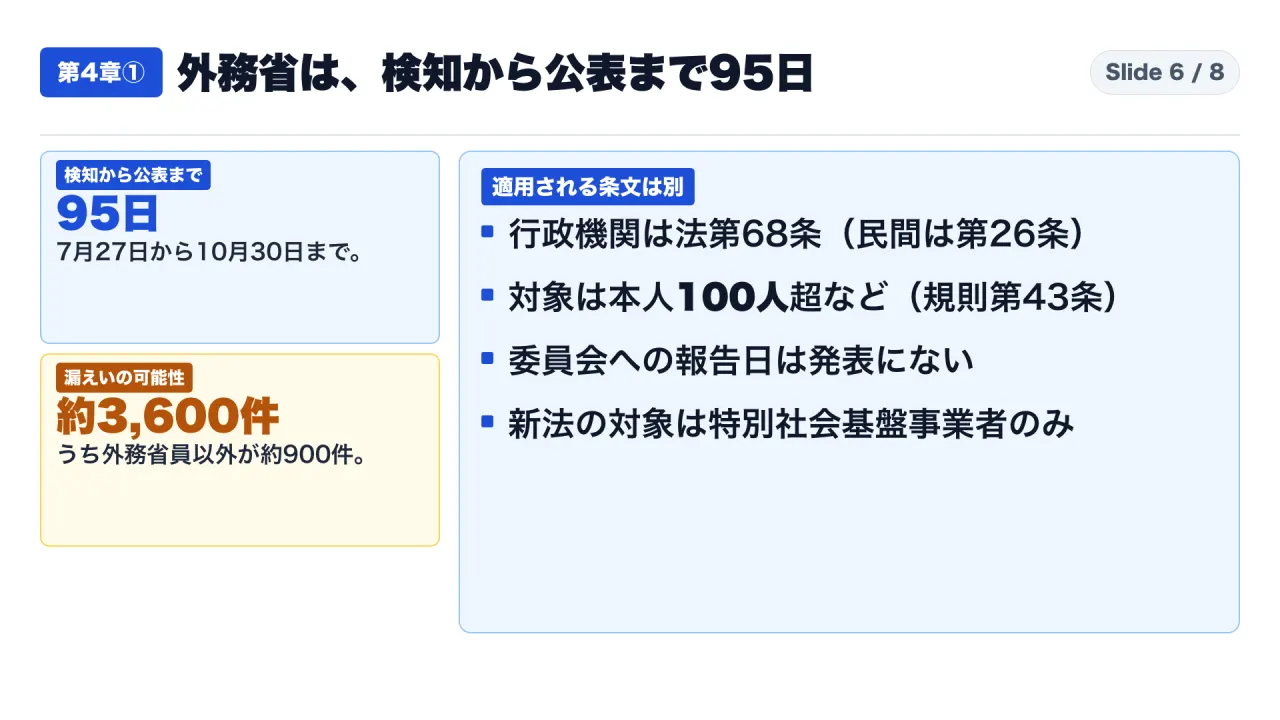
- Ministry of Foreign Affairs (2026): On October 30, 2026, MOFA announced an unauthorized access incident detected on July 27, 2026 (95 elapsed days), potentially affecting ~3,600 email records. However, ministries are governed by APPI Article 68 (not corporate Article 26), and public disclosure dates must not be conflated with regulatory filing dates.
Analytical Framework: Statutory Texts and Terminology
To establish clarity for corporate risk officers, legal counsels, and security leaders, this analysis cross-examines statutory texts, administrative guidelines, and corporate disclosures.
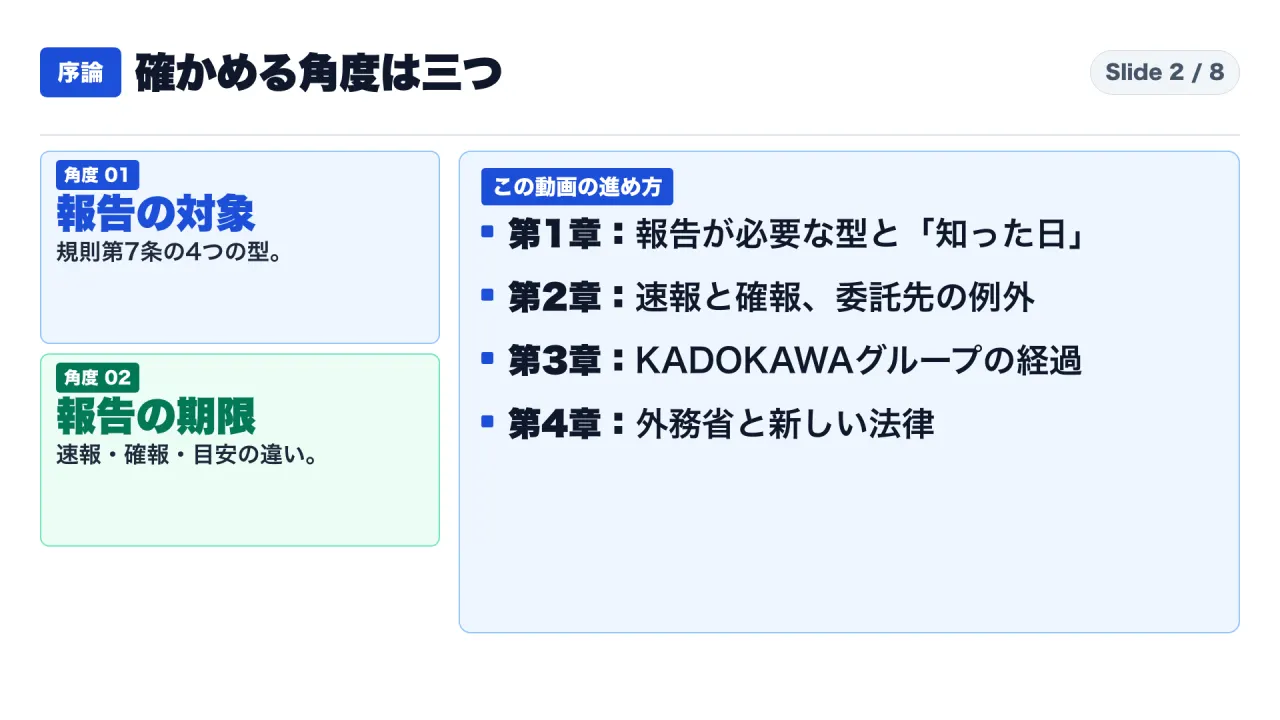
This examination synthesizes primary statutory records:
- APPI, Articles 26 and 68
- PPC Enforcement Rules, Articles 7–10, 43–44, and PPC General Guidelines
- KADOKAWA Corporation & Dwango Co., Ltd. Reports (June 14, 2024, and August 5, 2024)
- Ministry of Foreign Affairs (MOFA) Bulletin (October 30, 2026)
- Cyber Defense Capabilities Enhancement Act (effective October 1, 2026)
Key legal terminology:
- Personal Information Handling Business Operator (個人情報取扱事業者): Commercial entities subject to APPI Article 26.
- Administrative Organs (行政機関の長等): Government ministries subject to APPI Article 68.
- Leakage, Loss, or Damage (漏えい等): Encompasses exfiltration, deletion, or irreversible ransomware encryption.
- Date of Knowledge (知った日): The baseline from which deadlines are calculated, defined as the moment any department or employee of the enterprise becomes aware of the event.
Statutory Architecture: APPI Article 26 and Rule Article 7
Mandatory reporting is triggered strictly when an event falls into one of four statutory categories defined in PPC Enforcement Rule Article 7.
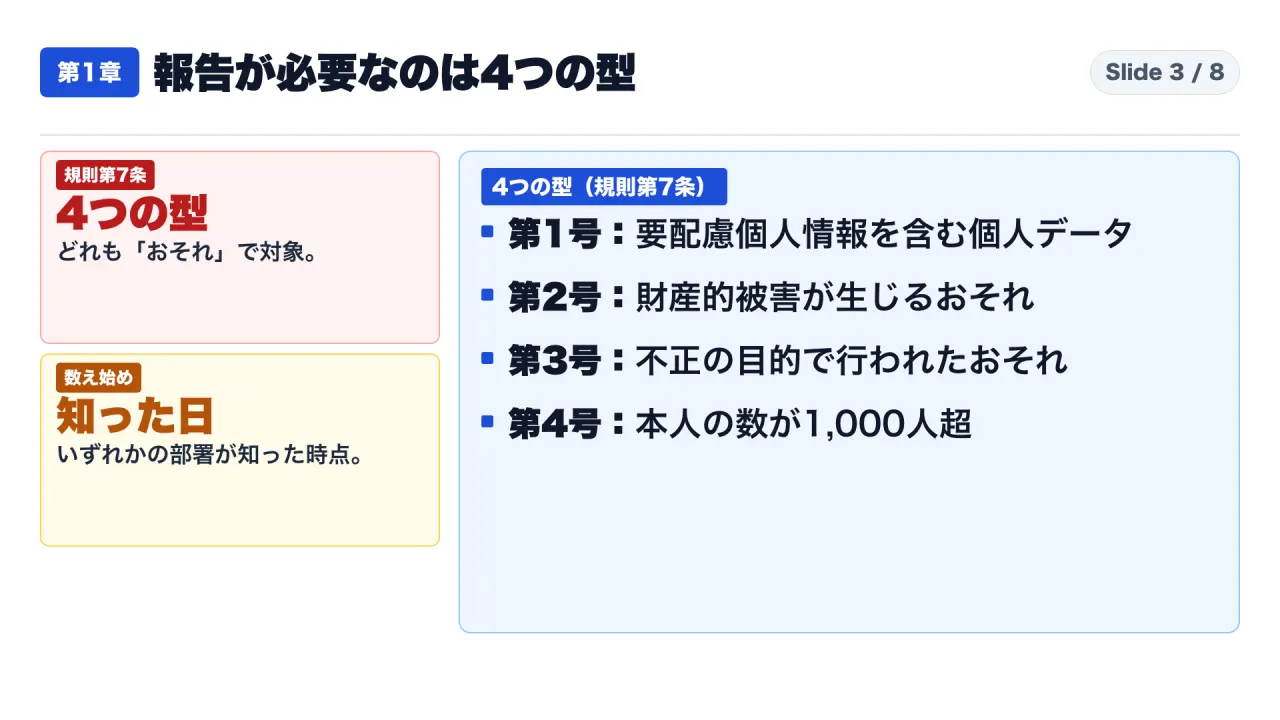
| Provision | Classification | Threshold & Key Conditions |
|---|---|---|
| Rule Art. 7, Item 1 | Special-Care Data | Race, creed, medical history, criminal records, etc. (Exempt if encrypted) |
| Rule Art. 7, Item 2 | Property / Financial Harm | Data directly causing financial loss if abused (credit cards, banking credentials) |
| Rule Art. 7, Item 3 | Unjust / Malicious Intent | Incidents resulting from cyberattacks, ransomware, or internal employee theft |
| Rule Art. 7, Item 4 | Volume Scale >1,000 | Incidents involving personal data relating to more than 1,000 individuals |
Crucial Statutory Caveats
- The “Likelihood” Threshold (おそれ): Rule Article 7 applies whenever a breach has occurred or is likely to have occurred. An enterprise cannot defer reporting simply because forensic investigations have not definitively confirmed exfiltration.
- Absence of Headcount Thresholds in Items 1 through 3: Only Item 4 contains a volume threshold (>1,000 individuals). For Items 1, 2, and 3, an incident compromising a single customer or employee is legally reportable.
- The Starting Point: “Date of Knowledge”: PPC Guidelines clarify that the date of knowledge is triggered when any internal division (such as an IT helpdesk or security operations center) learns of the compromise. It does not wait for executive briefings.
Procedural Mechanics: Preliminary vs. Definitive Reporting
Rule Article 8 establishes a two-tiered reporting mechanism designed to provide regulators with early situational awareness while affording organizations time to execute forensics.
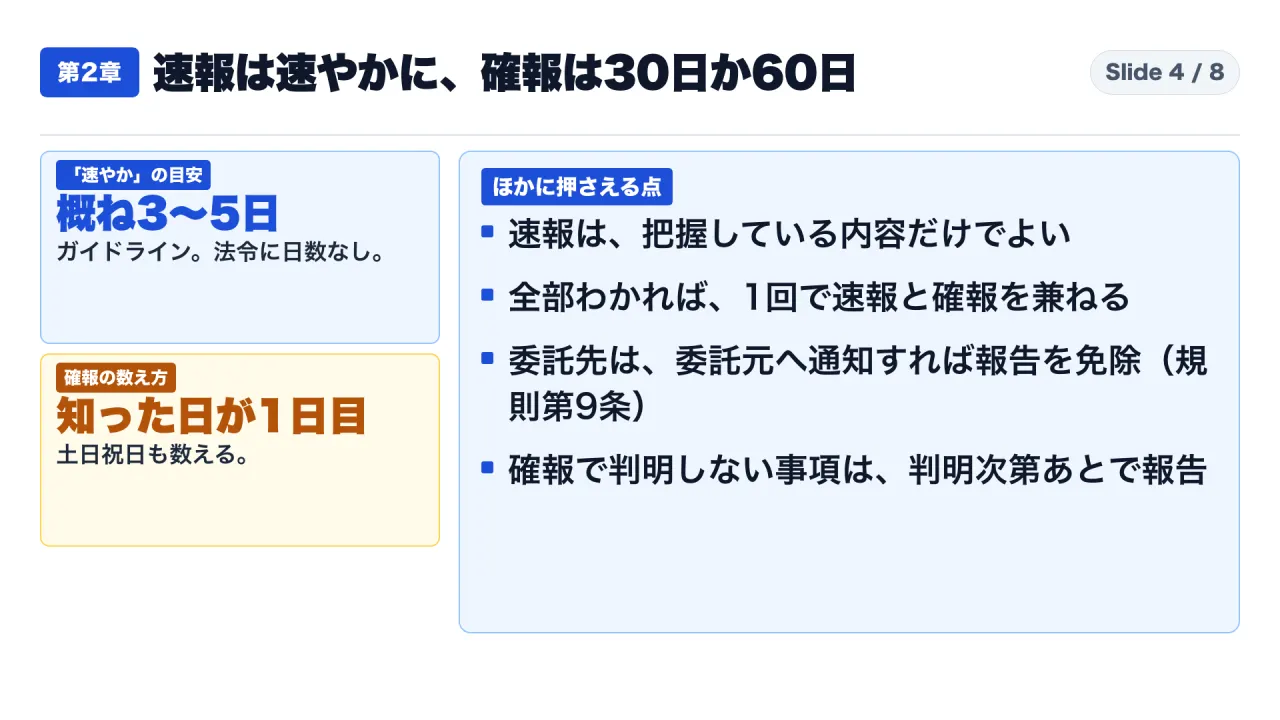
Tier 1: Preliminary Reporting (Rule Article 8, Paragraph 1)
- Filing Mandate: Submitted “promptly” (~3 to 5 business days from the date of knowledge).
- Statutory Content: Must address nine prescribed categories: (1) incident summary, (2) affected personal data items, (3) number of individuals affected, (4) root cause, (5) potential secondary damage, (6) status of subject notifications, (7) status of public disclosures, (8) recurrence prevention measures, and (9) other relevant matters.
- Partial Submissions Permitted: Operators report only facts ascertained at that point in time. Unknown fields (such as victim counts or root causes) may be submitted as “under investigation.”
Tier 2: Definitive Reporting (Rule Article 8, Paragraph 2)
- Standard Deadline: Within 30 calendar days of the date of knowledge.
- Malicious Attack Extension (Item 3): For incidents involving unauthorized access, malware, ransomware, or employee theft, the statutory deadline is 60 calendar days.
- Weekend / Holiday Rollover: If the 30th or 60th day falls on a weekend, holiday, or government New Year closure (December 29 to January 3), the deadline rolls over to the next administrative business day.
- Contractor Safe Harbor: When acting as an outsourced data processor, Rule Article 9 specifies that promptly notifying the commissioning principal discharges the processor’s direct reporting duty to the PPC.
Case Study 1: KADOKAWA / Dwango 2024 Ransomware Timeline
The June 2024 cyberattack against KADOKAWA Corporation and its subsidiary Dwango Co., Ltd. illustrates corporate compliance during a large-scale ransomware event.
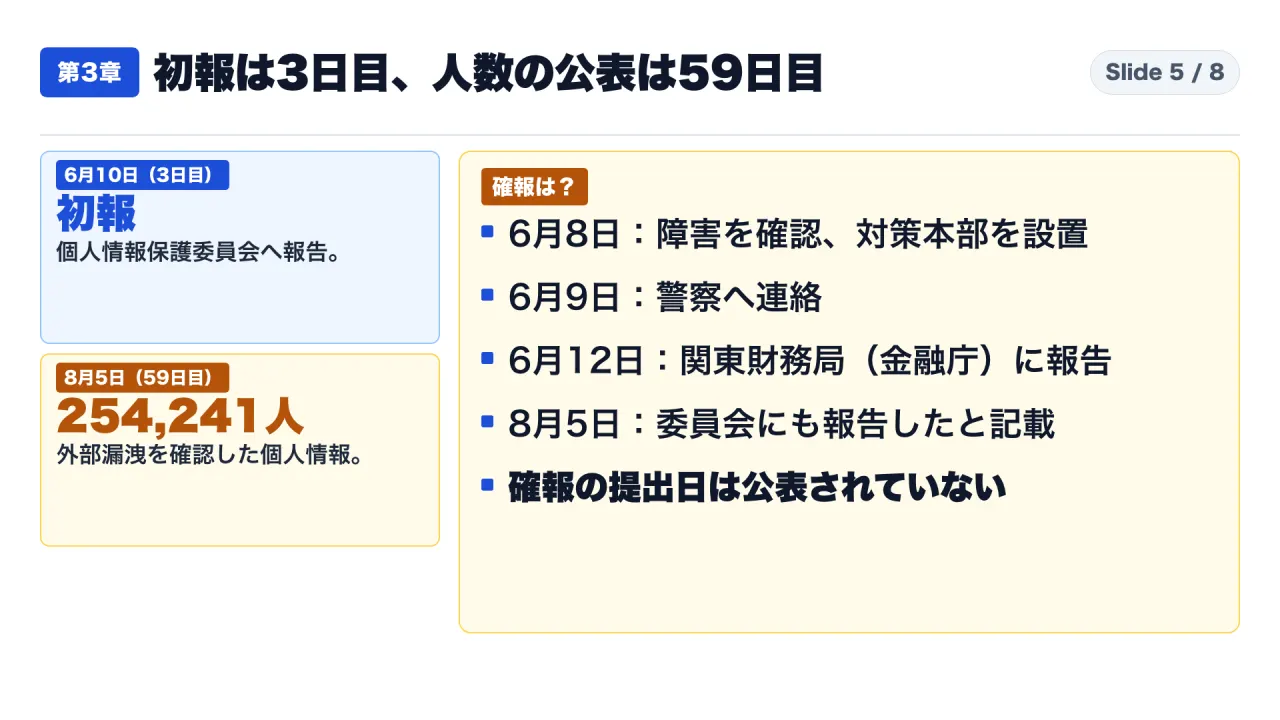
| Date | Operational Event | Calculated Elapsed Day (June 8 = Day 1) |
|---|---|---|
| June 8, 2024 (Sat) | 03:30 JST: Server failures. 08:00 JST: Cyberattack confirmed. Emergency crisis headquarters established. | Day 1 |
| June 9, 2024 (Sun) | Police notified; external cybersecurity forensic firms engaged. | Day 2 |
| June 10, 2024 (Mon) | Preliminary report submitted to the PPC (初報). | Day 3 |
| June 12, 2024 (Wed) | Operational failure report filed with Financial Services Agency (FSA). | Day 5 |
| June 14, 2024 (Fri) | Comprehensive public incident update released (KADOKAWA & Dwango). | Day 7 |
| August 5, 2024 (Mon) | Official public disclosure confirming 254,241 individuals compromised; PPC updated. Service recovery begins. | Day 59 |
Analytical Takeaways
- Day 3 Preliminary Filing: Dwango reported to the PPC on June 10, exactly on Day 3 (the first business day following Saturday’s attack). In its June 14 disclosure, KADOKAWA noted that personal data leakage had not yet been confirmed, but emphasized that preliminary notification to the PPC had already been executed, adhering strictly to the “likelihood” standard.
- Day 59 Public Count Disclosure: On August 5 (Day 59), KADOKAWA released the confirmed total of 254,241 affected individuals across business partners, content creators, and internal employees.
- Statutory Alignment: Under the assumption that June 8 represented the legal date of knowledge and the breach fell under Rule Article 7, Item 3 (60 days), the statutory deadline for definitive reporting would have been Tuesday, August 6. August 5 represented Day 59. However, because public bulletins do not disclose the formal submission date of definitive filings, one cannot assert as statutory fact that definitive reporting occurred on Day 59.
Case Study 2: Ministry of Foreign Affairs (MOFA) 2026 Incident
On October 30, 2026, Japan’s Ministry of Foreign Affairs announced an unauthorized access compromise involving an unclassified external exchange network.
The MOFA Sequence
- Detection: Unauthorized network access was detected on July 27, 2026.
- Public Disclosure: Formal security disclosure was published on October 30, 2026 (an elapsed duration of 95 days).
- Compromised Data: Approximately 3,600 email records were potentially leaked (~900 pertaining to non-ministry personnel). State secrets and classified diplomatic cables were not compromised.
The Divergent Administrative Legal Framework
Comparing KADOKAWA’s 59-day timeline against MOFA’s 95-day elapsed window is a category error:
- Administrative Organs Under Article 68: Government ministries operate under APPI Article 68 and Rules Articles 43 and 44, not corporate Article 26.
- Divergent Headcount Baselines: Under Rule Article 43, Item 4, the volume threshold triggering mandatory administrative reporting is 100 individuals, not the corporate threshold of 1,000 individuals.
- Public Announcement vs. Regulatory Notification: MOFA’s bulletin documents when the breach was disclosed to the public; it does not disclose when the ministry formally notified the PPC. An elapsed public disclosure window of 95 days cannot be cited as evidence of delayed statutory filings.
Intersecting Legislation: Cyber Defense Capabilities Enhancement Act
On October 1, 2026, Japan enacted the Act on Enhancing Cyber Defense Capabilities of Important Telecommunications Systems (Cabinet Order No. 46 of 2026).
Corporate compliance officers must distinguish this new statute from the APPI:
- Designated Entities: Applies strictly to Designated Critical Infrastructure Operators, spanning 15 critical sectors across 258 designated enterprises.
- Reporting Deadlines: Government guidelines require preliminary reports within 3 to 5 calendar days of recognizing an attack, with detailed technical reports within 30 calendar days submitted to the Prime Minister and competent Ministers.
- General Commercial Exemption: Standard commercial enterprises remain governed exclusively by APPI Article 26 and Rules 7 through 10. Leaders must not confuse critical infrastructure mandates with baseline data protection rules.
Analytical Boundaries: What Public Evidence Cannot Prove
Corporate risk assessors must maintain strict evidentiary boundaries when evaluating external security disclosures.
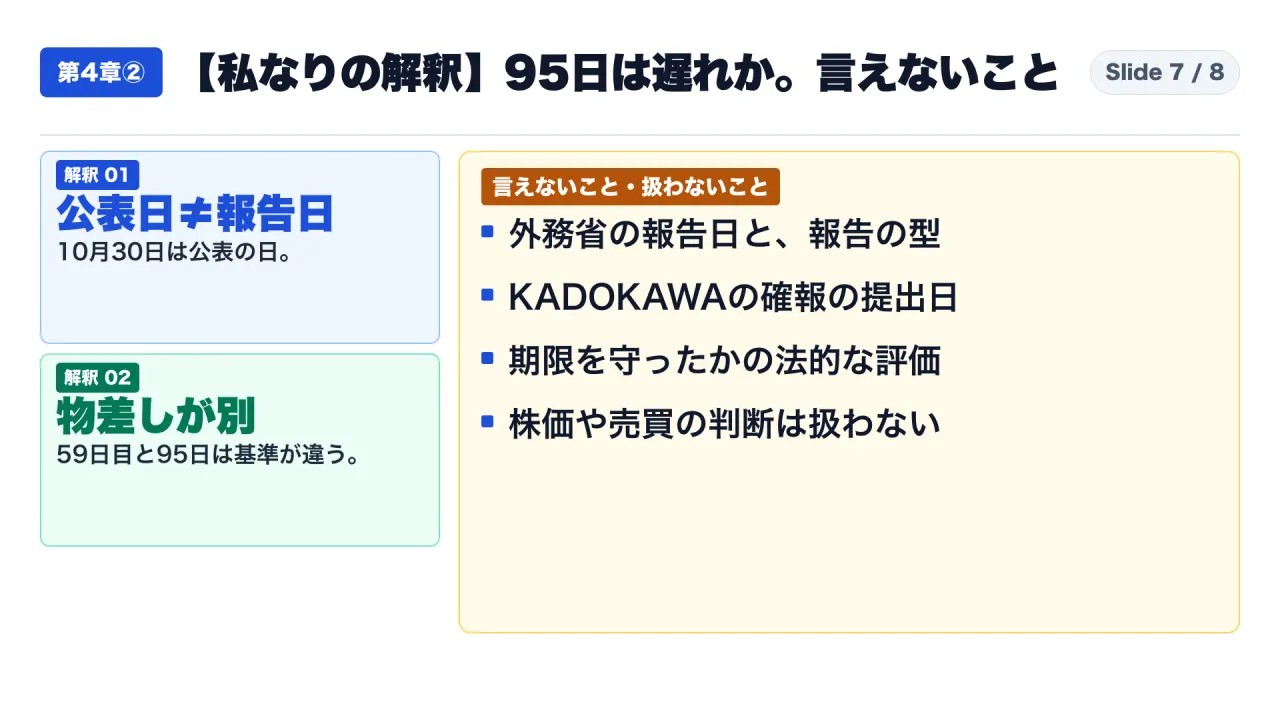
- Incomplete Public Disclosures: Neither KADOKAWA nor MOFA publicly published the formal submission timestamps or statutory category designations of their definitive PPC filings. Regulatory filing dates cannot be inferred from press releases.
- Non-Equivalence of MOFA and KADOKAWA: Comparing MOFA’s 95-day disclosure against KADOKAWA’s 59-day timeline is methodologically invalid given differing statutory baselines (Article 68 vs. Article 26).
- Legal Counsel Prerequisite: Statutory compliance determinations depend on the specific technical facts of an intrusion. This analysis provides operational clarity but does not constitute formal legal counsel.
Strategic Blueprint: Three Incident Response Preparations
To ensure compliance during active cybersecurity crises, corporate governance and IT security teams should implement three operational safeguards.
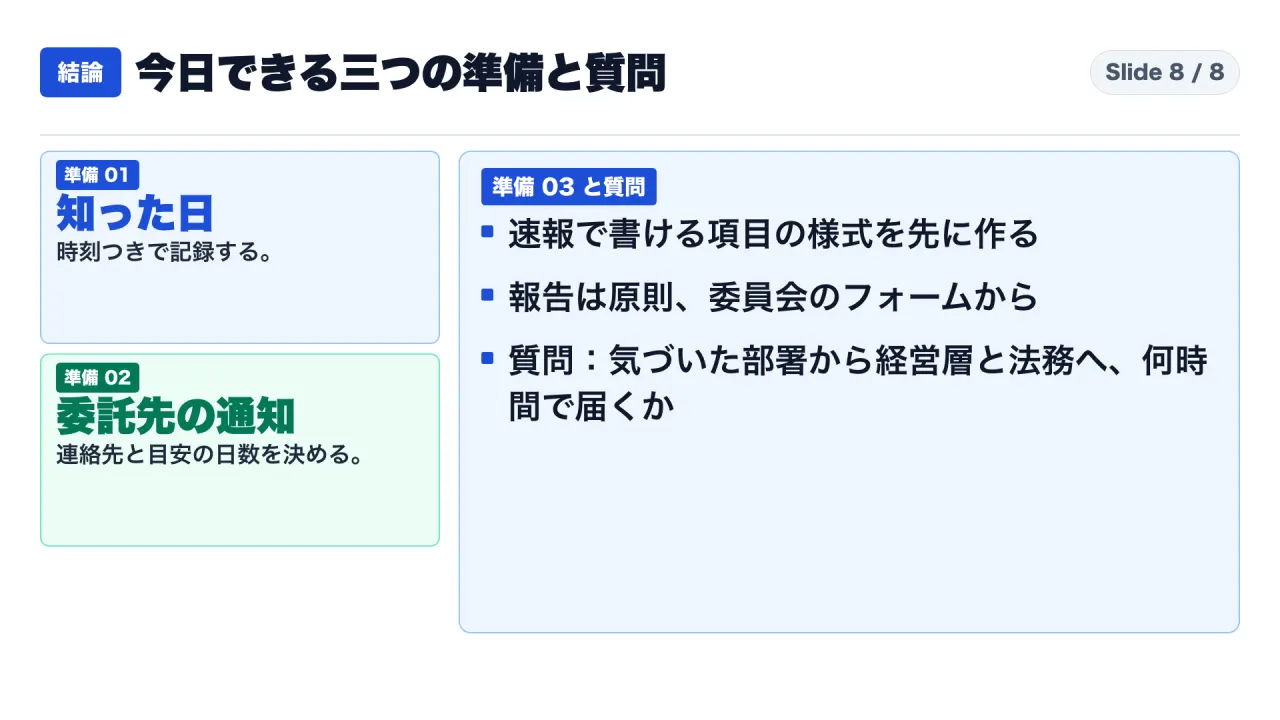
Preparation 1: Codify “Date of Knowledge” Logging in Incident Runbooks
- Standardized Field: Create an immutable field at the top of incident ticket templates: “First Aware Employee, Department, and Timestamp.”
- Operational Alignment: Because PPC Guidelines trigger deadlines from the moment any department discovers an anomaly, train first-line engineers that internal escalation delays do not pause the statutory clock.
- Drill Verification: Execute tabletop exercises verifying that initial incident timestamps are recorded within two hours of event detection.
Preparation 2: Formalize Subcontractor Notification SLAs
- Contractual Review: Audit vendor contracts with third-party software developers, managed service providers, and SaaS vendors handling company data.
- Establish Notification Windows: Embed contractual obligations requiring vendors to notify the enterprise within 24 to 48 hours of discovering an intrusion, including after-hours emergency escalation trees.
- Chain of Custody: Ensure vendor notifications immediately trigger the enterprise’s internal regulatory evaluation process.
Preparation 3: Pre-Populate Preliminary Reporting Templates
- Template Preparation: Draft standardized templates mirroring the nine statutory items required under Rule Article 8, Paragraph 1.
- Embrace Partial Submissions: Document standard operating procedures establishing that incomplete preliminary reports should be submitted within the 3- to 5-day window, explicitly marking unresolved items as “under investigation.”
- Agency Delegation Check: Pre-determine whether the enterprise reports directly to the PPC web portal or to a competent delegated ministry (such as the FSA or METI).
Primary Sources and References
- e-Gov Legal Database, “Act on the Protection of Personal Information (Act No. 57 of 2003, as amended)”: https://laws.e-gov.go.jp/law/415AC0000000057
- e-Gov Legal Database, “Enforcement Rules of the Personal Information Protection Commission (PPC Rule No. 3 of 2016)”: https://laws.e-gov.go.jp/law/428M60020000003
- Personal Information Protection Commission (PPC), “Enforcement Guidelines for the Act on the Protection of Personal Information (General Rules)”: https://www.ppc.go.jp/personalinfo/legal/guidelines_tsusoku/
- Personal Information Protection Commission (PPC), “Breach Notification and Incident Reporting Portal”: https://www.ppc.go.jp/personalinfo/legal/leakAction/
- Dwango Co., Ltd., “Official Incident Update Regarding Cyberattack and Ransomware Impact” (June 14, 2024): https://group.kadokawa.co.jp/information/media-download/1360/73b7af68478b8a51/
- KADOKAWA Corporation, “Second Official Report on Ransomware and Service Interruption” (June 14, 2024): https://group.kadokawa.co.jp/information/media-download/1338/fa5deb642248bb65/
- KADOKAWA Corporation, “Official Disclosure of Confirmed Compromised Personal Data (254,241 Individuals)” (August 5, 2024): https://group.kadokawa.co.jp/information/media-download/1356/d3f77b589c58d083/
- Dwango Co., Ltd., “Service Restoration and Investigation Conclusion Bulletin” (August 5, 2024): https://group.kadokawa.co.jp/information/media-download/1369/7062b6eb47fd83b7/
- Ministry of Foreign Affairs of Japan (MOFA), “Security Bulletin on Unauthorized Access to External Exchange Network” (October 30, 2026): https://www.mofa.go.jp/mofaj/press/release/pressit_000001_04395.html
- e-Gov Legal Database, “Act on Enhancing Cyber Defense Capabilities of Important Telecommunications Systems (Act No. 42 of 2026)”: https://laws.e-gov.go.jp/law/507AC0000000042
- Cabinet Secretariat of Japan, “Enforcement Overview and Guidelines for the Cyber Defense Capabilities Enhancement Act” (October 2026): https://www.cao.go.jp/cybersecurity/pdf/cyber_kaisetsu_202610.pdf