How "Open" Are Mistral Large 4's Weights? ── Reading the Modified MIT License and 1-Trillion Parameter Model Card
While Mistral released the weights to its ~1-trillion parameter model, its modified MIT license mandates separate commercial contracts for Model-as-a-Service providers, while benchmark disparities expose significant variances across evaluation suites.
Published: October 31, 2026 | Read time: ~10 min | Watch Video (Japanese)
Executive Summary: Open Weights vs. Open Source
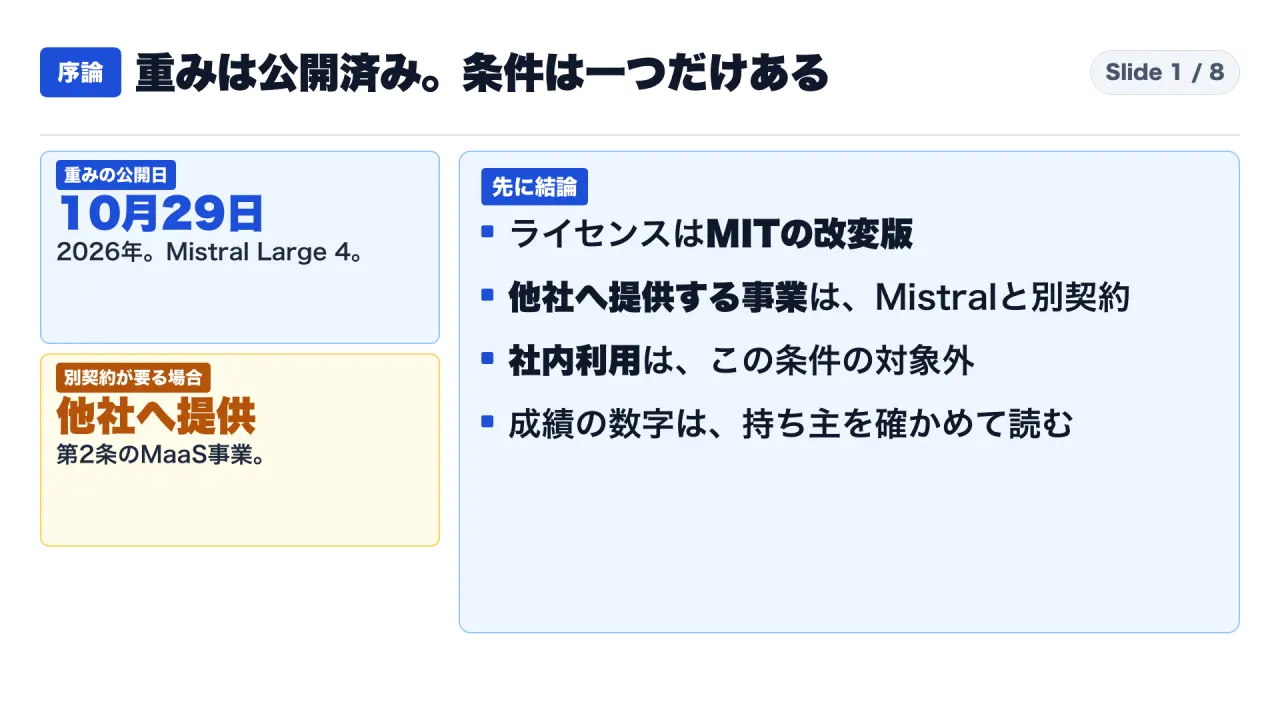
On October 29, 2026, French artificial intelligence laboratory Mistral AI released the model weights for Mistral Large 4 (specifically, Mistral-Large-4-1T-A52B). Promoted across developer communities as a major victory for open-source AI, the release delivered an expansive Mixture-of-Experts (MoE) foundation model boasting approximately one trillion total parameters, a one-million-token context window, and native multi-modal image understanding.
However, a forensic examination of the legal agreement, model card, and accompanying technical documentation reveals critical operational nuances that enterprise engineering teams and legal counsels must understand prior to deployment:
- A Modified MIT License: The model is governed by the Mistral Ecosystem Open-Weight License. While modeled on the standard MIT license, it introduces an explicit commercial restriction: any entity (or affiliate) offering “Model as a Service” (MaaS) hosting to third parties must execute a separate commercial license with Mistral before commercial use. Internal enterprise deployments remain exempt under safe-harbor clauses.
- Evaluation Disparities Across Releases: Independent disclosures published on the identical release date contained unexplained variances in performance metrics. For example, Mistral reported a 41.0% score on Terminal-Bench 4.0, while Hugging Face’s official release blog cited 28.3%.
- Hardware Realities of Deployment: Although only ~49 billion parameters activate per token during inference, self-hosting requires loading the entire ~1-trillion parameter weight matrix. Even under extreme NVFP4 quantization, the model demands at least 606 gigabytes of unified GPU memory, constraining on-premises operations to multi-GPU clusters.
This analysis deconstructs the legal boundaries, architectural specifications, benchmark discrepancies, and case study realities of Mistral Large 4.
Analytical Framework: Three Investigative Dimensions
To evaluate Mistral Large 4 objectively, this analysis separates statutory contractual text, company claims, third-party benchmark methodologies, and independent GitHub revision records.

This investigation synthesizes seven primary sources:
- Mistral Official Launch Bulletin (October 29, 2026)
- Mistral Ecosystem Open-Weight License (Hugging Face repository)
- Mistral Large 4 Model Card (
mistralai/Mistral-Large-4-1T-A52B) - Mistral Large 4 Technical Report (Official PDF, October 2026)
- Hugging Face Technical Release Blog (October 29, 2026)
- Artificial Analysis Cyber Index Methodology
- Vulnerator AI GitHub Repository & Release Telemetry
Core concepts must be defined:
- Open Weights: The distribution of trained model parameters for local download. This differs fundamentally from Open Source Initiative (OSI) compliance, which requires unrestricted redistribution and public access to training datasets.
- Mixture of Experts (MoE): An architecture routing each incoming token through a subset of specialized sub-networks, reducing active computational overhead per token while expanding total parametric capacity.
- Model as a Service (MaaS): Providing third parties programmatic API access to model inference or fine-tuning pipelines.
Architectural Deep Dive: 1 Trillion Parameters and Active Compute
Mistral Large 4 represents an ambitious engineering design that balances massive capacity against inference latency.
Model Topology and Sparsity
According to the official model card and technical report, Mistral Large 4 features:
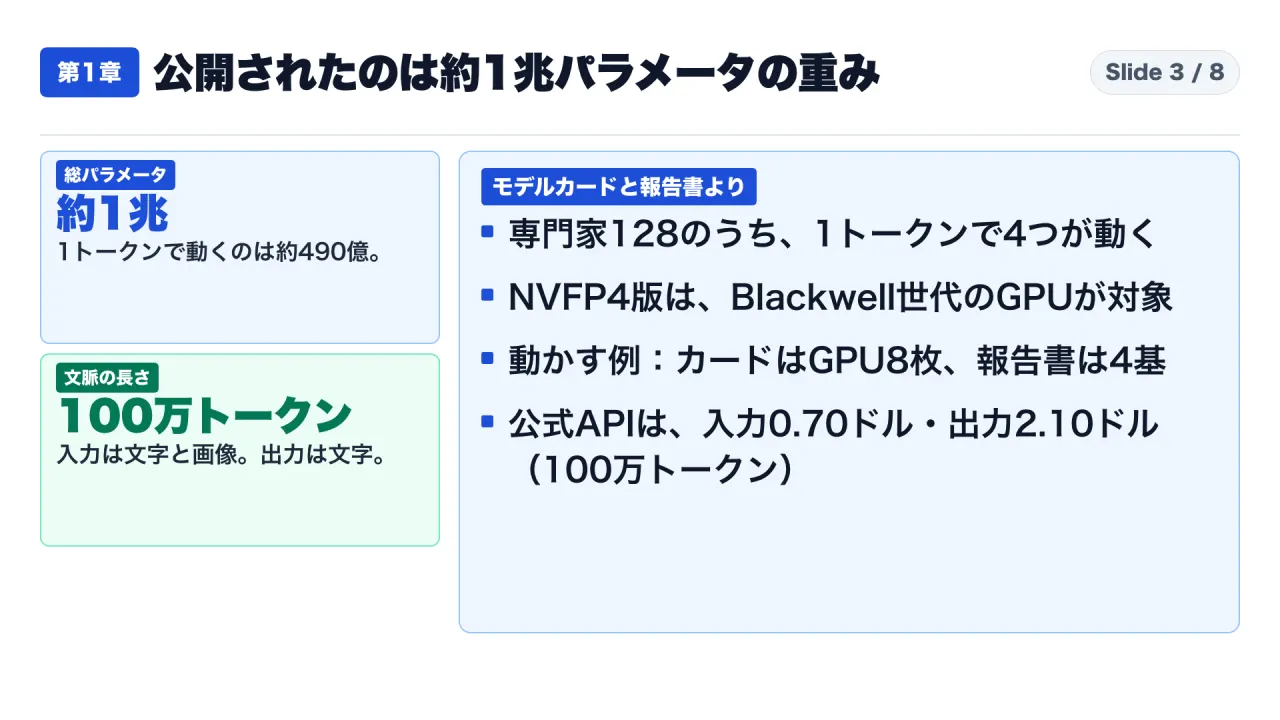
- Total Parameters: Approximately 1 trillion parameters across the full network.
- Active Parameters: Approximately 49 billion parameters activated per token during forward passes (~52 billion when accounting for shared embedding and projection layers).
- MoE Routing: Incorporates 128 discrete expert sub-networks. The routing gate dynamically directs each token to the top 4 experts, supplemented by 1 shared expert that executes across all tokens.
- Context & Modality: Native 1-million-token context window; accepts text and image inputs, producing text outputs. Supports configurable reasoning depth (Low, Medium, High) on a per-request basis.
The technical report documents an important architectural redesign during pre-training. Initially, Mistral engineered the model with an aggressive KV-cache compression strategy to minimize memory footprint. However, long-context agentic evaluations revealed significant performance degradation. Mistral subsequently rebuilt the model utilizing a near-full attention mechanism, before migrating to DeepSeek Sparse Attention (DSA) to achieve acceptable inference efficiency across extended contexts.
Training Cluster vs. Inference Hardware
The scale required to train Mistral Large 4 differs dramatically from runtime requirements:
- Pre-Training Footprint: The model card cites pre-training on 3,800 NVIDIA Grace Blackwell GPUs within Mistral’s European data centers. The technical report specifies 3,840 NVIDIA GB200 GPUs in Paris, running for 45 days (~4.15 million GPU hours).
- Inference Requirements: While the model card outlines a single-node configuration featuring eight high-memory GPUs, the technical report details an optimized NVFP4 quantized checkpoint (606 gigabytes in size). Mistral verified that this NVFP4 variant achieved benchmark parity with FP8 baselines while executing across four NVIDIA GB300 GPUs.
For organizations seeking to bypass local infrastructure management, Mistral provides direct API access priced at $0.70 per million input tokens and $2.10 per million output tokens (effective October 29, 2026).
Legal Dissection: The Mistral Ecosystem Open-Weight License
The defining operational characteristic of Mistral Large 4 is its contractual packaging. The model is not licensed under standard Apache 2.0 or pure MIT terms.
The Modified MIT Structure
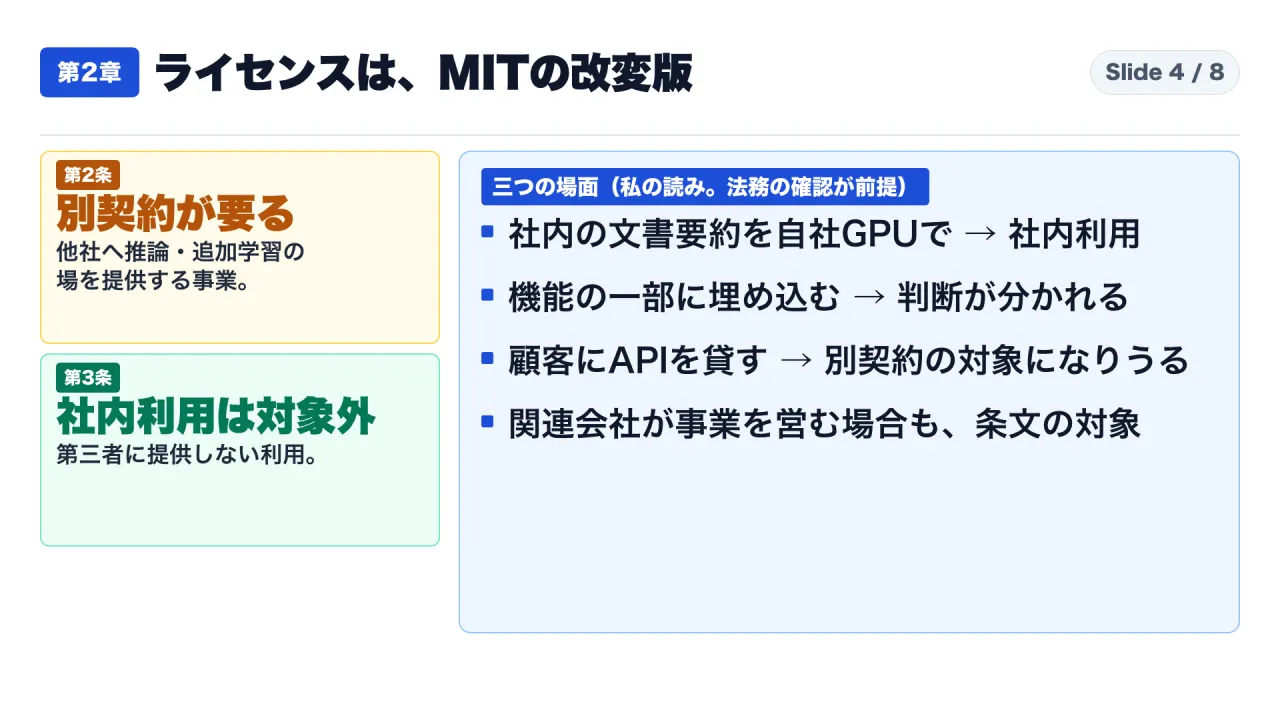
The license preamble identifies itself as a modified version of the standard MIT license. The agreement grants broad baseline permissions: users may run, copy, modify, integrate, publish, distribute, sublicense, sell, fine-tune, and create derivative works from the model weights.
The Section 2 MaaS Trigger
The critical divergence from open-source norms resides in Section 2 (Model as a Service Restriction):
“If you or any of your Affiliates operate a Model as a Service business, you must enter into a separate commercial license agreement with Mistral AI prior to using the Model or any Derivative Works for commercial purposes.”
The license defines a Model as a Service business as any service providing third parties with remote access (via API or web interface) to model inference or fine-tuning, where the third party exercises meaningful control over inputs, configuration parameters, or training data.
The license establishes two explicit carve-outs from the MaaS definition:
- End-User Applications: Products where model capabilities are embedded exclusively into specific, predefined application features rather than exposed as general-purpose inference endpoints.
- Pass-Through Proxies: Intermediaries that merely route requests to third-party hosted models without independent execution.
The Section 3 Safe Harbors
Section 3 carves out two broad exemptions from Section 2 commercial restrictions:
- Internal Enterprise Use (Section 3a): Internal operations within an enterprise where neither the model nor its derivatives are made accessible to external third parties.
- Official Mistral Products (Section 3b): Utilizing the model through Mistral’s official API, Mistral Studio, or authorized partner platforms.
Corporate Legal Implications
For enterprise legal counsels, three contractual ambiguities require careful review:
- Affiliate Exposure: Section 2 applies if the deploying company or any of its corporate affiliates operates a MaaS business. A parent holding company with a cloud hosting subsidiary could inadvertently trigger Section 2 obligations for an unrelated retail subsidiary.
- “Meaningful Control” Interpretation: Software platforms offering customizable prompt configurations or custom agent builders to business clients occupy a legal grey zone regarding whether client customizability constitutes “meaningful control” over inference parameters.
- Pre-Use Execution Mandate: Section 2 requires executing a commercial agreement prior to commercial use. Organizations deploying customer-facing pilots cannot defer licensing discussions until post-launch milestones.
Benchmark Scrutiny: Discrepancies and Methodology Limits
Mistral positioned Large 4 as a frontier competitor in agentic coding and cybersecurity. However, cross-referencing disclosures reveals significant metric variances.
The Coding Evaluation Discrepancies
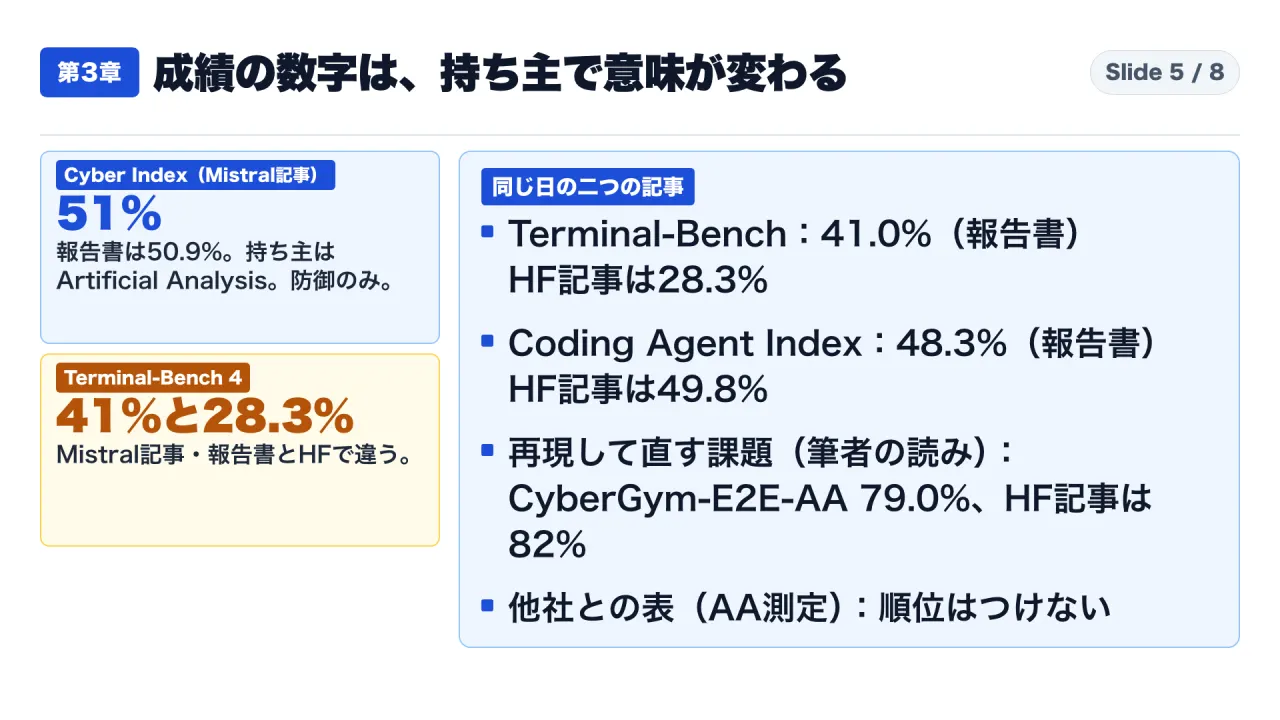
Across public collateral released on October 29, 2026, identical benchmark categories yielded conflicting figures:
| Benchmark Metric | Evaluator / Source | Mistral Tech Report | Hugging Face Release Blog | Variance & Significance |
|---|---|---|---|---|
| Terminal-Bench 4.0 | Agentic terminal execution | 41.0% | 28.3% | 12.7 pp discrepancy; likely reflects different harness sampling configurations |
| Coding Agent Index v2 | Artificial Analysis | 48.3% | 49.8% | 1.5 pp discrepancy; minor evaluation version variance |
| FrontierCode 2.0 | Cognition (Private) | 19.7% | Not Reported | Private evaluation; 0.4 pp lead over next open model (19.3%) |
| Intelligence Index v5 | Artificial Analysis Overall | 26 | 26 | Highest among Western open models, but trailing Chinese frontier weights |
Neither Mistral nor Hugging Face published an explanation for the 12.7-percentage-point divergence on Terminal-Bench 4.0. This discrepancy underscores that benchmark figures published during launch events cannot substitute for internal enterprise evaluations.
The Cyber Index Methodology
Mistral highlighted a 50.9% composite score on Artificial Analysis’s Cyber Index, prompting speculation regarding the model’s offensive cyber capabilities.
A technical review of Artificial Analysis’s methodology clarifies the evaluation:
- Defensive Focus: The Cyber Index evaluates an agent’s ability to analyze source code, identify known Common Weakness Enumerations (CWEs), reproduce bugs, and apply remediation patches without breaking existing software tests.
- White-Box Access: All evaluation tasks provide the agent with full access to repository source code.
- Zero Offensive Exploitation: The benchmark does not measure zero-day exploitation, automated network penetration, or payload weaponization.
- Component Breakdown: Mistral’s 50.9% score comprises CWE-Bench-AA (58.0%), DeepsecBench-AA (16.0%), and CyberGym-E2E-AA (79.0%, contrasting with Hugging Face’s reported 82%).
Mistral Large 4 is validated for defensive vulnerability patching, not autonomous offensive operations.
Case Study Debunked: The Vulnerator AI Adoption Myth
Following the release, commentary circulated across social developer channels claiming that open-source security tool Vulnerator AI had immediately selected and deployed Mistral Large 4 on launch day, demonstrating rapid community adoption.
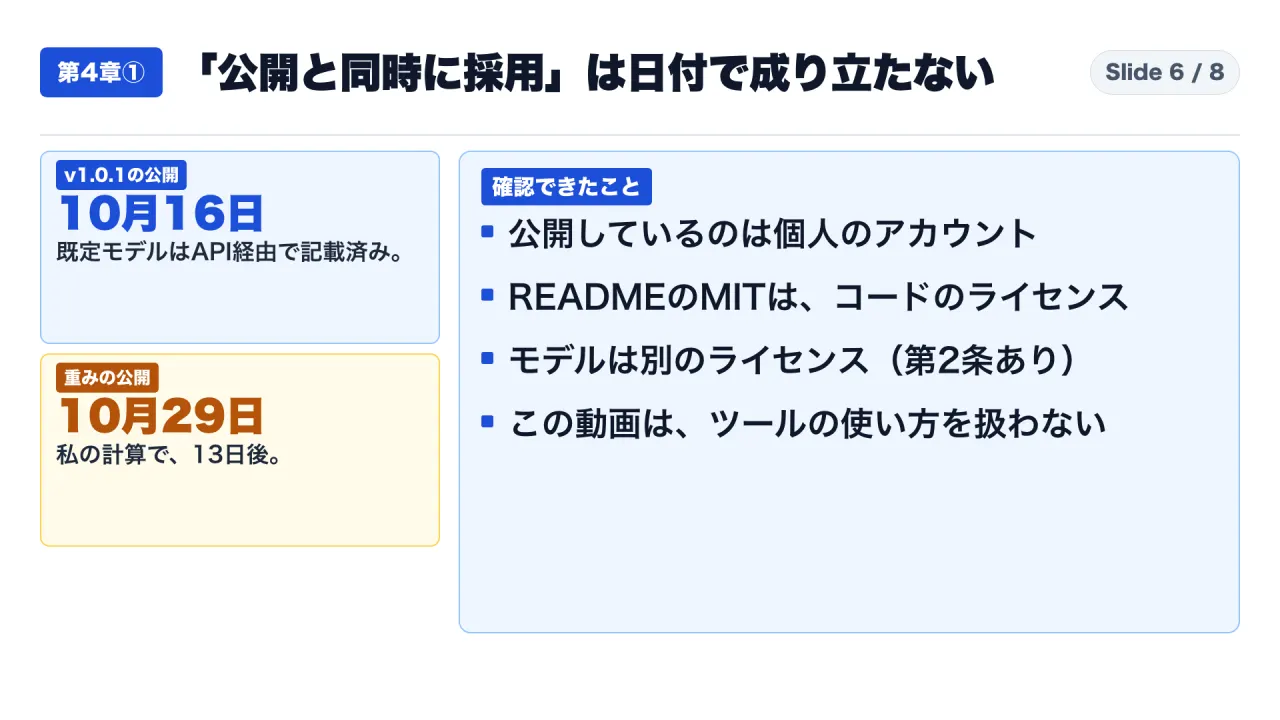
An inspection of GitHub commit histories and release tags disproves this narrative:
- The 13-Day Pre-Release Timeline: Vulnerator AI published its v1.0.1 release on October 16, 2026—exactly 13 days prior to the public distribution of Mistral Large 4 weights on October 29. The release notes explicitly designated
mistralai/mistral-large-4-0as its default model via the OpenRouter API proxy. - API Consumption vs. Weight Self-Hosting: Vulnerator AI never downloaded or self-hosted the 1-trillion parameter model weights. It consumed the model through third-party API endpoints during Mistral’s commercial preview phase.
- License Conflation: While the Vulnerator AI repository is licensed under standard MIT, its software license has no bearing on the underlying model weights. Developers cannot inherit pure MIT rights for a foundation model simply by consuming it within an MIT-licensed wrapper.
Analytical Boundaries: What Documentation Cannot Prove
Enterprise leaders must distinguish established technical facts from unverified assumptions.
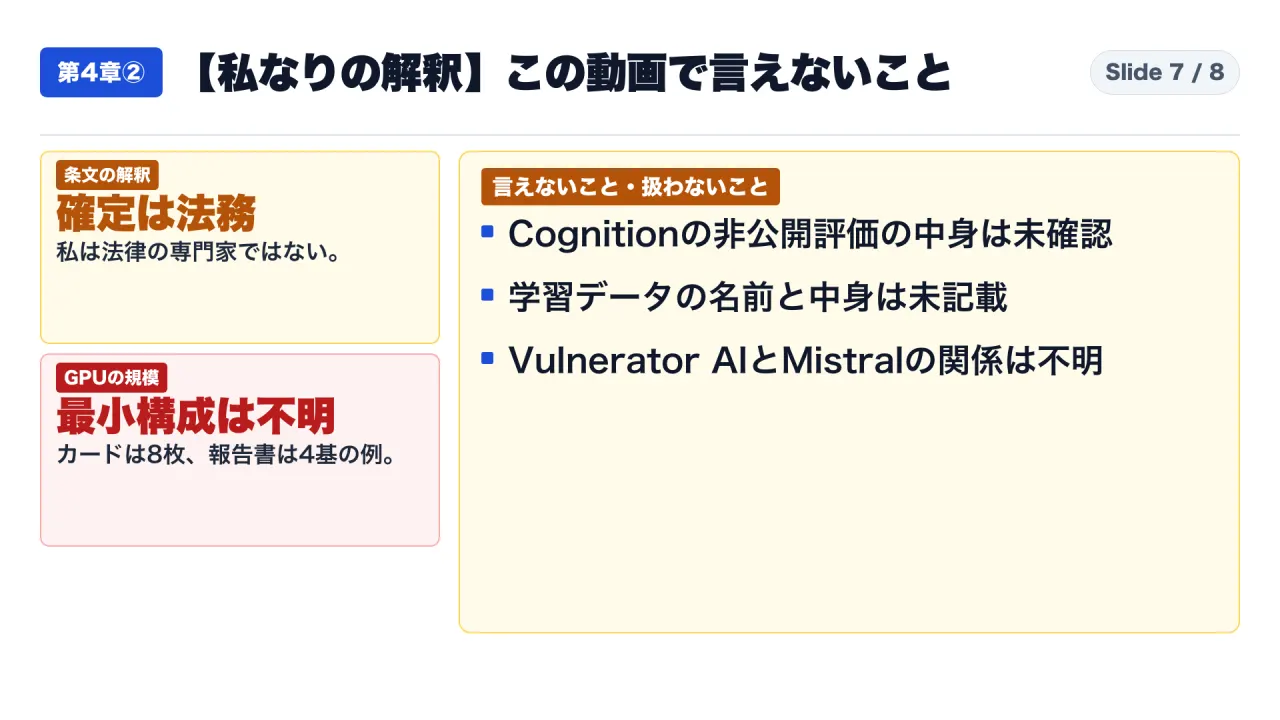
- Definitive Legal Rulings: Contractual interpretations of “meaningful control” and affiliate scope remain untested in commercial litigation. Official legal counsel must guide deployment decisions.
- Minimum Production Hardware Sizing: Published documentation illustrates specific cluster examples (8x GPUs for FP8, 4x GB300 for NVFP4) but does not provide minimum hardware configurations for latency-sensitive production workloads.
- Training Data Provenance: Mistral discloses high-level training data categories (web, code, technical literature) but withholds specific corpora, data curation pipelines, and copyright licensing registries.
- Model Safety Invariance: Refusal behaviors observed in public previews are subject to continuous tuning by Mistral. Production architectures cannot rely on prompt-level model refusals as primary safety boundaries.
Strategic Blueprint: Three Pre-Deployment Audits
Organizations evaluating Mistral Large 4 for enterprise workloads should execute three structured verification audits before provisioning infrastructure.
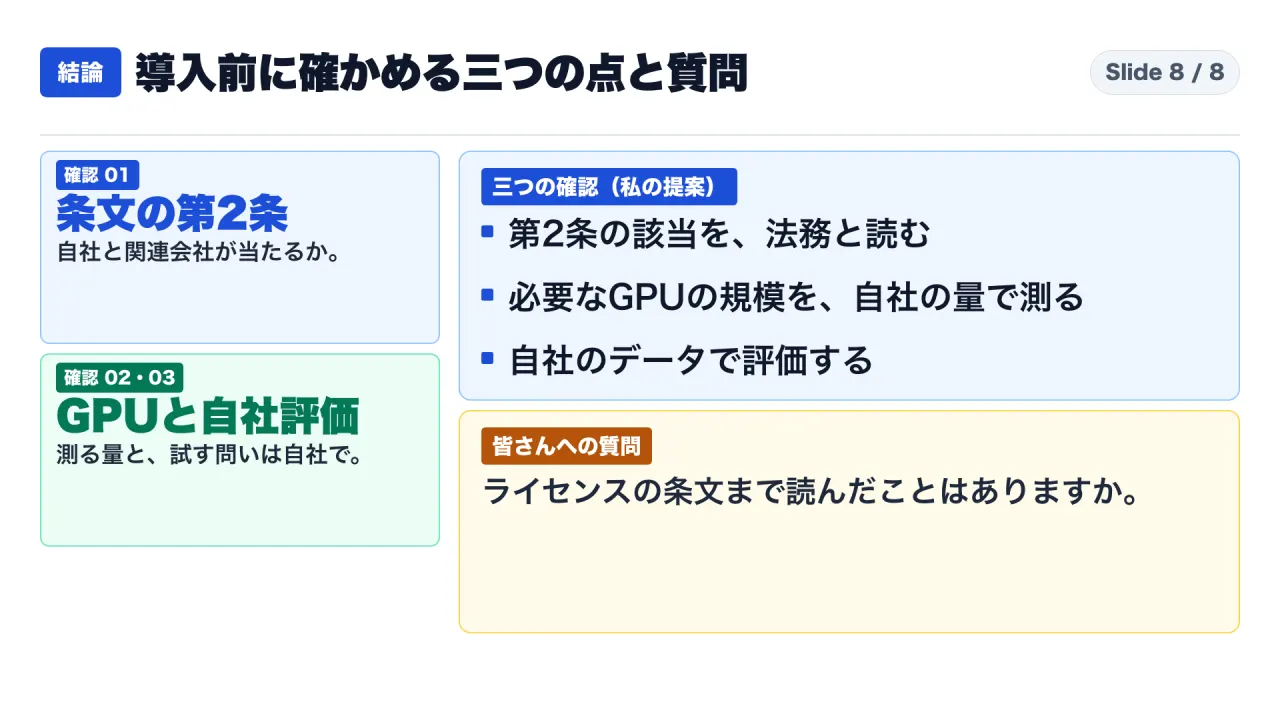
Audit 1: Contractual Scope and Affiliate Review
- Execution: Provide corporate legal counsel with the text of Section 2 and Section 3 of the Mistral Ecosystem Open-Weight License alongside a detailed diagram of the proposed application architecture.
- Affiliate Check: Confirm whether any parent, subsidiary, or corporate affiliate operates a commercial API or hosting service.
- Interface Check: If exposing model capabilities to external clients, verify whether client interfaces restrict user inputs to predefined templates, avoiding the “meaningful control” threshold. If ambiguity persists, contact Mistral’s commercial licensing team directly.
Audit 2: Hardware Footprint and Quantization Sizing
- Execution: Calculate infrastructure total cost of ownership (TCO) against anticipated token volume.
- Memory Footprint: Self-hosting full-precision or FP8 weights requires multi-node GPU topologies. For on-premises deployments, evaluate NVFP4 quantization on Blackwell-class silicon (606 gigabytes minimum memory allocation).
- Economic Breakeven: Model the economic breakeven point between dedicated hardware amortization and managed API consumption ($0.70/$2.10 per million tokens). For intermittent or bursty enterprise workloads, official API endpoints offer significant cost advantages over idle on-premises GPU clusters.
Audit 3: Empirical Domain-Specific Evaluation
- Execution: Ignore general public benchmark leaderboards. Construct an internal evaluation suite comprising 50 to 100 proprietary domain-specific tasks reflecting actual operational requirements (e.g., internal code review, enterprise document synthesis, SQL generation).
- Blinded Testing: Evaluate Mistral Large 4 under identical system prompts, temperature parameters, and reasoning depth settings against competing frontier models. Have internal subject-matter experts score outputs in a blinded evaluation harness. Deploy the model based strictly on domain-specific empirical performance.
Primary Sources and References
- Mistral AI Official Announcement, “Mistral Large 4: Open Weights for the Frontier” (October 29, 2026): https://mistral.ai/news/mistral-large-4-oss/
- Mistral AI Official Model License, “Mistral Ecosystem Open-Weight License” (Hugging Face Repository): https://huggingface.co/mistralai/Mistral-Large-4-1T-A52B/blob/main/LICENSE
- Mistral AI Official Model Card, “Mistral-Large-4-1T-A52B Repository” (Hugging Face): https://huggingface.co/mistralai/Mistral-Large-4-1T-A52B
- Mistral AI Research Team, “Mistral Large 4 Technical Report” (Official PDF, October 2026): https://huggingface.co/mistralai/Mistral-Large-4-1T-A52B/blob/main/assets/technical_report.pdf
- Hugging Face Official Blog, “Inside Mistral Large 4: Architecture, Benchmarks, and Deployment” (October 29, 2026): https://huggingface.co/blog/mistral-large4
- Artificial Analysis, “Cyber Index Methodology and Benchmark Design” (2026): https://artificialanalysis.ai/methodology/cyber-index
- Vulnerator AI Open Source Project, “v1.0.1 Release Notes & Repository Metadata” (GitHub): https://github.com/irraz/vulnerator-ai/releases/tag/v1.0.1