How Fast Can Your Team Verify Zero-Day Exposure? ── Inside React2Shell (CVE-2025-55182) and the Four Defense Audits
With live in-the-wild exploitation confirmed within 48 hours of disclosure, patching React Server Components is only half the battle—engineering teams must execute four systematic audits across dependencies, routing surface, historical logs, and rotated credentials.
Published: October 31, 2026 | Read time: ~10 min | Watch Video (Japanese)
Executive Summary: The False Comfort of “Patch and Forget”
When a critical zero-day vulnerability strikes modern web frameworks, engineering teams almost universally focus on a single question: “Have we deployed the patch?” In modern application security, however, applying a software update is merely table stakes. If an internet-facing service was exposed prior to patching, upgrading the binary does nothing to evict an attacker who has already compromised the host.
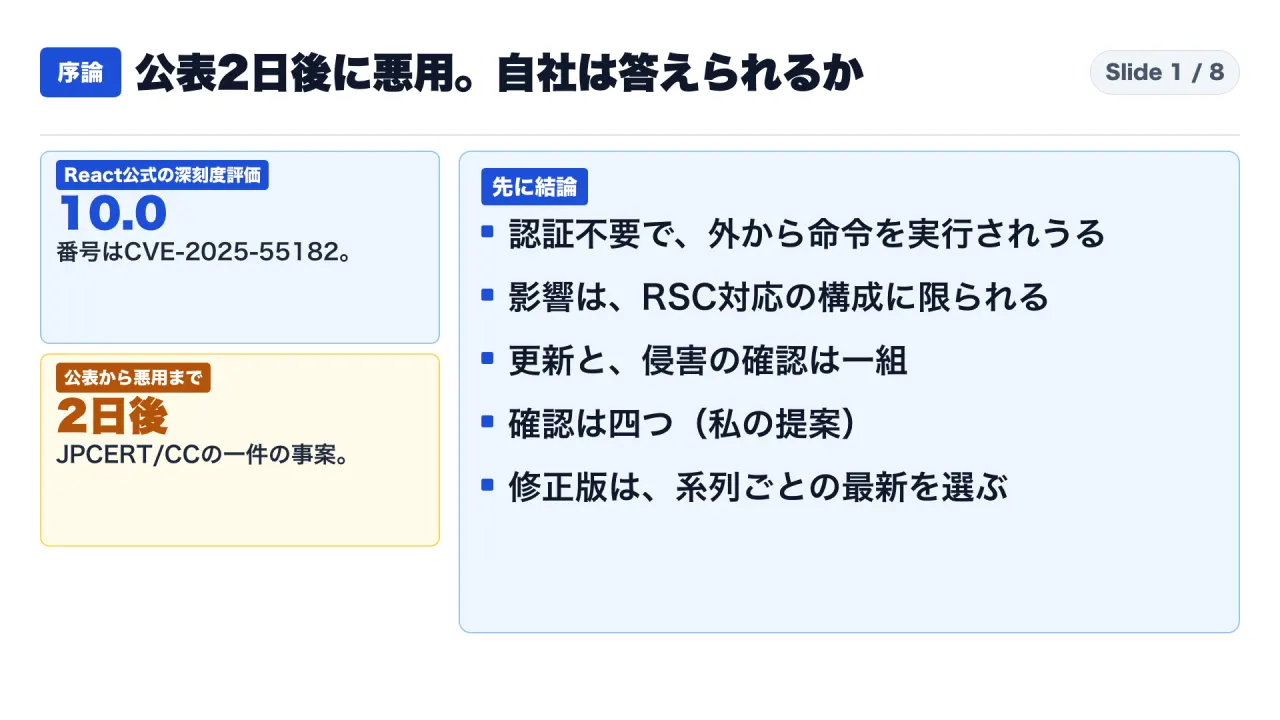
On December 3, 2025, the React core team publicly disclosed a critical remote code execution (RCE) vulnerability in React Server Components (RSC), cataloged as CVE-2025-55182 (colloquially termed “React2Shell”) with a maximum severity rating of CVSS 10.0. The flaw permitted unauthenticated remote attackers to execute arbitrary shell commands across backend application servers by sending crafted HTTP POST requests.
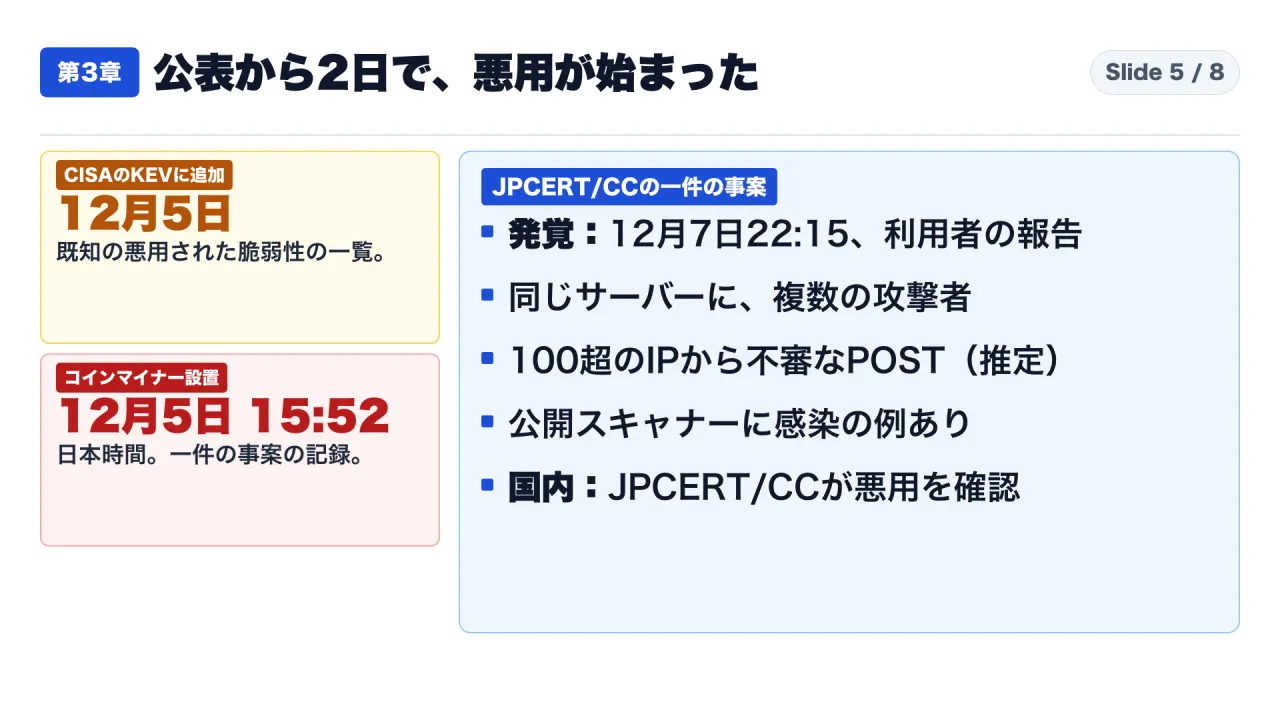
The urgency of this flaw became undeniable when Japan’s national Computer Emergency Response Team Coordination Center (JPCERT/CC) published an in-depth forensic investigation on February 13, 2026. JPCERT/CC documented a real-world enterprise compromise where automated threat actors breached an unpatched production server and deployed an unauthorized cryptocurrency miner at 15:52 JST on December 5, 2025—a mere 48 hours following the official security bulletin. Over the subsequent 48 hours, more than 100 distinct IP addresses struck the same host, deploying conflicting malicious payloads until an opportunistic actor defaced the website.
This article establishes a rigorous four-pillar response methodology:
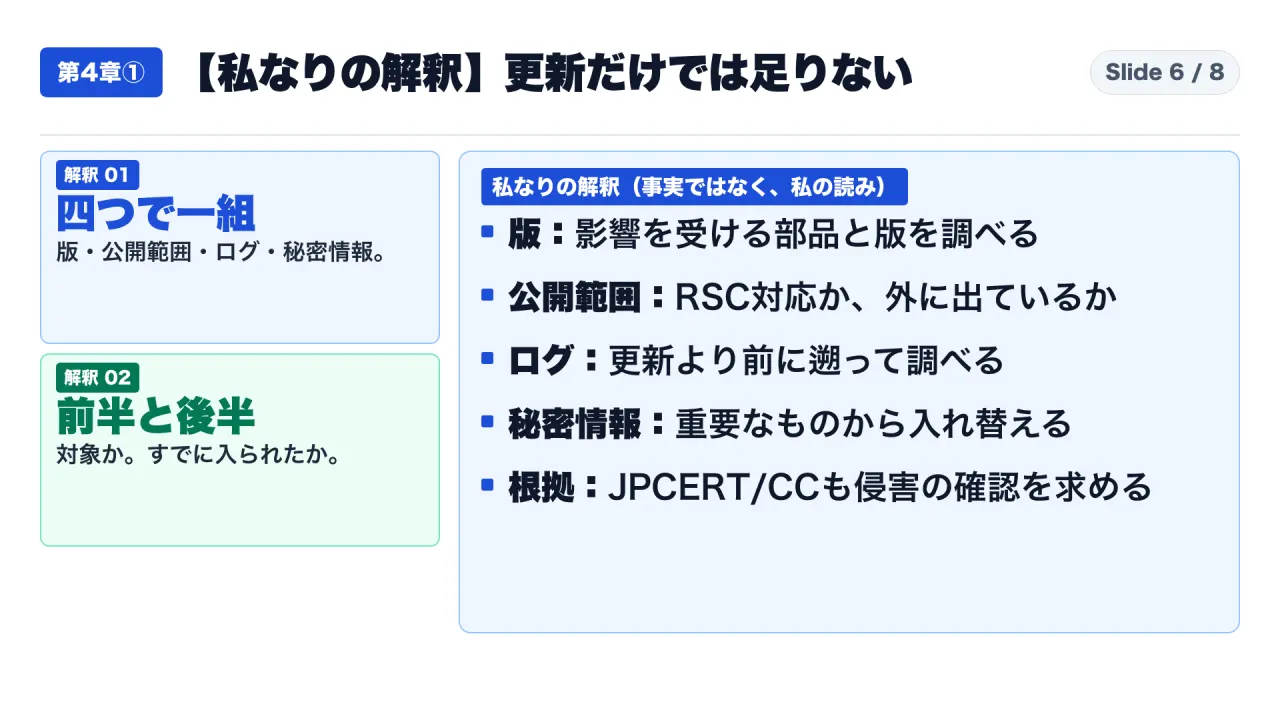
- Version Audit: Verifying whether active dependency trees pull vulnerable packages.
- Exposure Audit: Determining whether deployed services utilize server-side execution architectures (such as Next.js App Router) exposed to the public internet.
- Pre-Patch Log Audit: Scrutinizing web server telemetry prior to the deployment timestamp to detect unauthorized intrusion attempts.
- Credential Rotation: Revoking and reissuing application secrets, API tokens, and database credentials accessible to the server runtime.
Analytical Framework: Distinguishing Facts, Estimates, and Prescriptions
Analyzing high-severity security incidents requires clear demarcation between empirical evidence and prescriptive recommendations.
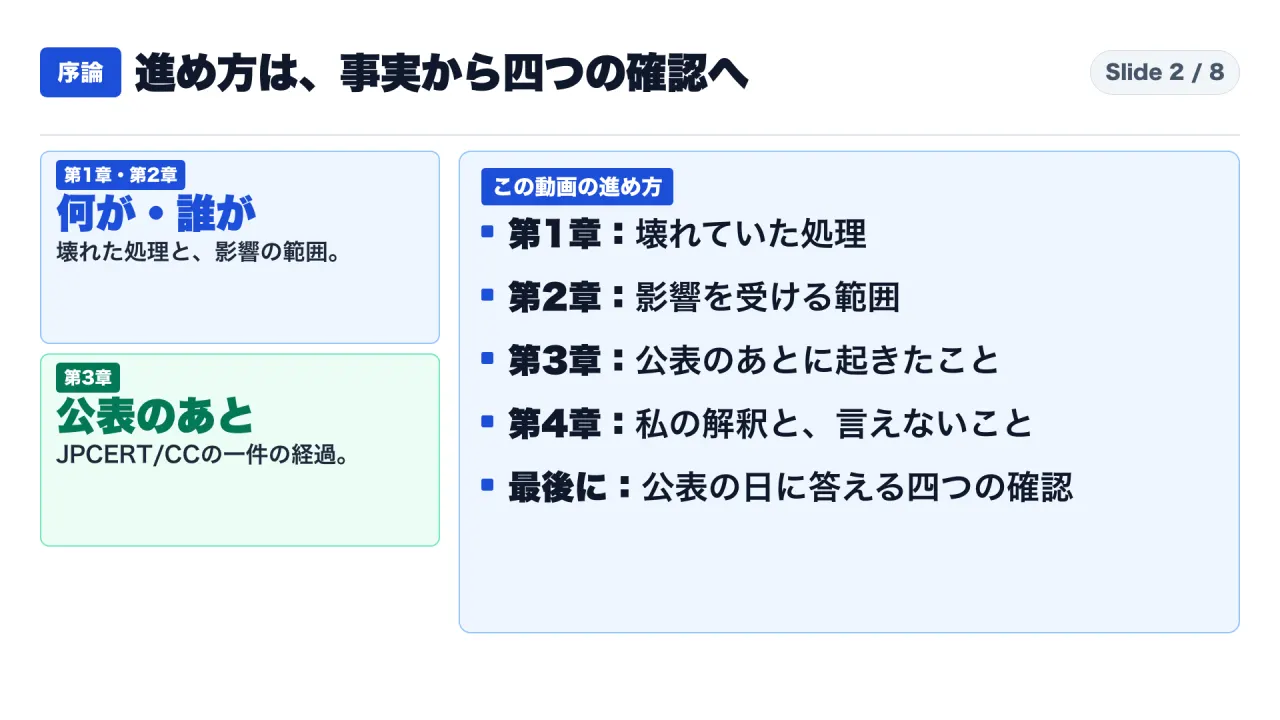
This analysis synthesizes seven authoritative primary records:
- React Advisory (December 3, 2025)
- Next.js Advisory (December 2025, updated January 2026)
- NVD records for CVE-2025-55182 and CVE-2025-66478
- CISA KEV Catalog
- JPCERT/CC Advisory (updated January 7, 2026) and JPCERT/CC Eyes Blog (February 13, 2026)
Key terminology must be standardized:
- Remote Code Execution (RCE): Enables external actors to execute arbitrary commands without console access.
- CVSS v3.1 10.0: Network vector, low complexity, no privileges or user interaction required.
- React Server Components (RSC): Components executing exclusively on the server, streaming representations to clients.
- Server Functions: Asynchronous server functions invoked from client UI via HTTP POST.
- Patch Gap: The temporal window between public disclosure and production deployment.
Core Vulnerability Mechanics: Unsafe Deserialization in Server Functions
To understand why CVE-2025-55182 bypasses conventional perimeter defenses, one must examine the internal mechanics of React Server Components and Server Functions.
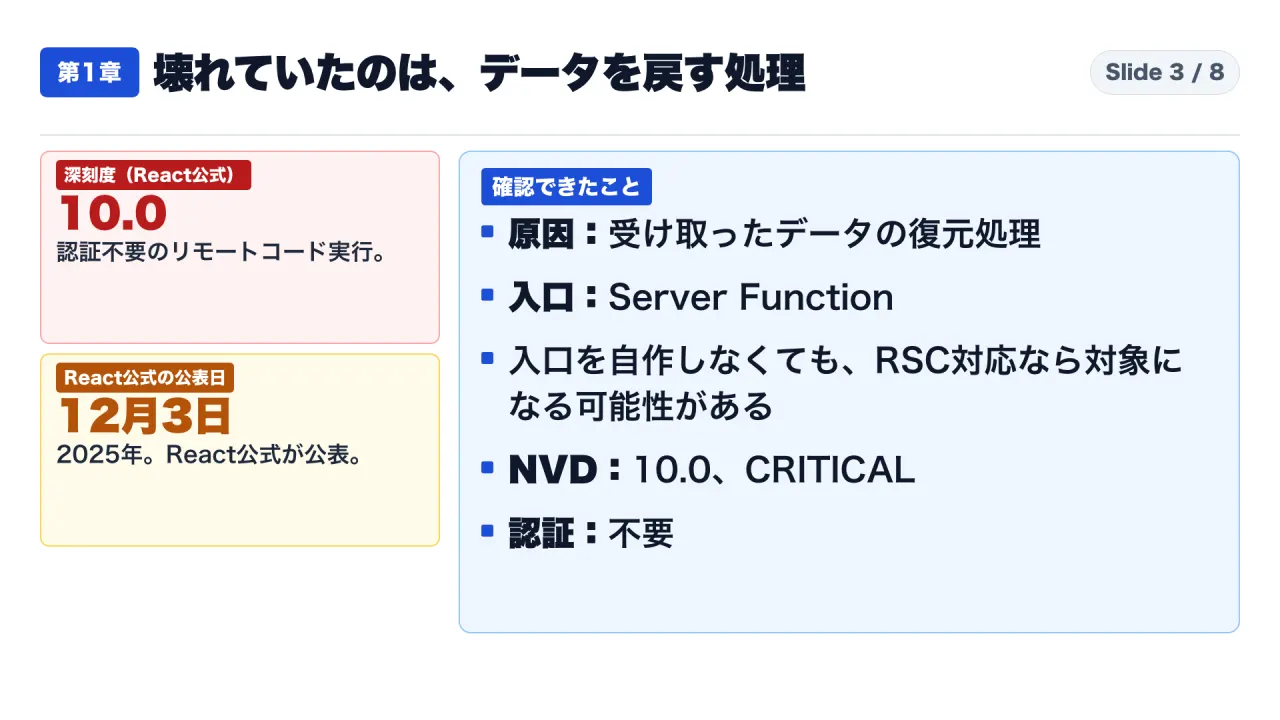
When a browser client invokes a Server Function, the browser serializes arguments into an HTTP POST request. Upon arriving at the backend web server, the React runtime deserializes this payload to reconstruct native JavaScript objects, promises, and component references before invoking the target function.
The vulnerability resided directly in the server-side deserialization logic implemented in React’s bundling integration packages. The runtime parsed untrusted incoming HTTP payloads without adequate schema validation or type sandboxing. By supplying a maliciously crafted object graph, an external attacker could manipulate prototype chains and internal execution callbacks, coercing the Node.js runtime into executing arbitrary system commands with the privileges of the underlying web service process.
Two common engineering misconceptions contributed to delayed enterprise triage:
- “Our application does not define custom Server Functions, so we are immune.”
False. The React core team explicitly clarified that applications built on RSC-enabled frameworks expose deserialization endpoints automatically by virtue of framework plumbing, even if developers did not write explicit
use serverfunctions. - “Our application requires login authentication, so unauthenticated attackers cannot reach us.” False. The vulnerability exists at the network protocol entry point where serialized HTTP payloads are received. The React deserializer processes the incoming payload before application-level authentication middleware can evaluate session cookies.
Affected Scope: Packages, Frameworks, and Duplicate CVE Records
The scope of CVE-2025-55182 is broad yet strictly bounded by architectural choices. It does not affect traditional client-side Single Page Applications (SPAs) or static site generation (SSG) pipelines.
Vulnerable Packages and Mainline Versions
The vulnerability exists in three core React server integration packages:
react-server-dom-webpackreact-server-dom-parcelreact-server-dom-turbopack
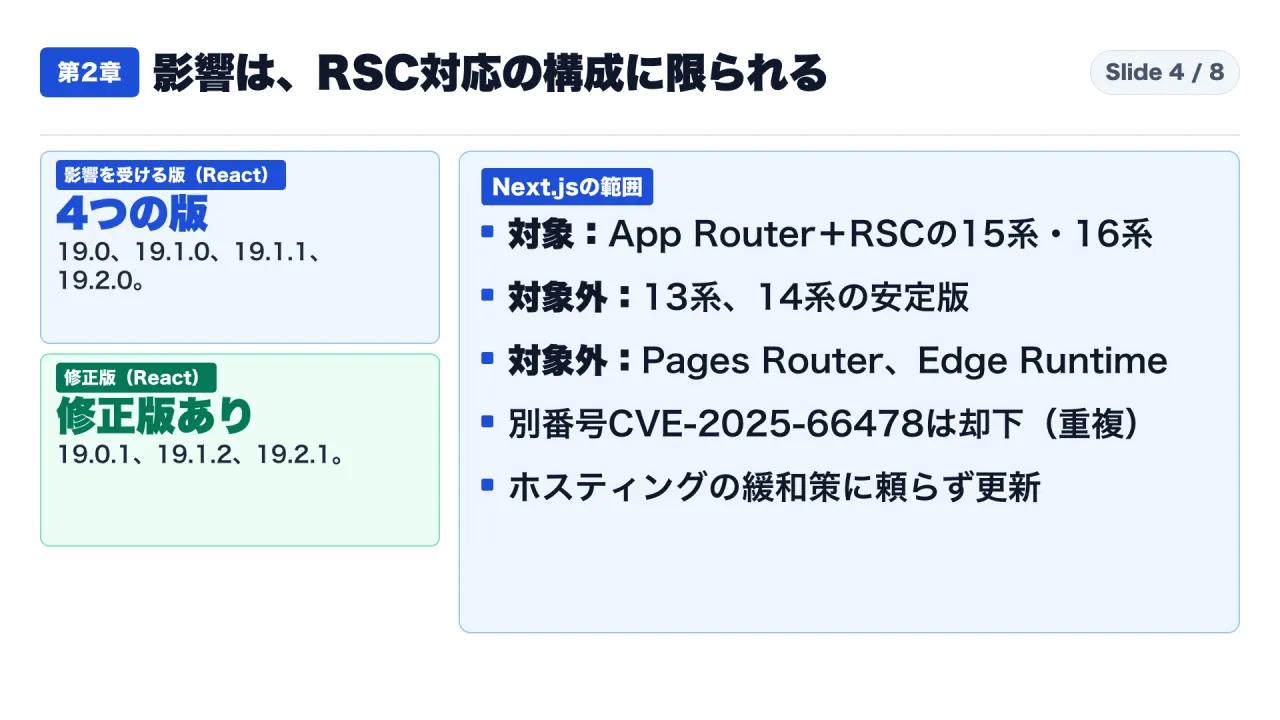
Vulnerable release series: 19.0, 19.1.0, 19.1.1, and 19.2.0. Remediated patch releases: 19.0.1, 19.1.2, and 19.2.1.
Downstream Framework Exposure (Next.js and Beyond)
The React advisory identified six downstream frameworks and bundlers incorporating vulnerable dependencies: next, react-router, waku, @parcel/rsc, @vitejs/plugin-rsc, and rwsdk.
Because of Next.js’s widespread enterprise adoption across e-commerce, SaaS, and corporate portals, exposure within Next.js environments drew primary operational attention:
| Configuration Archetype | Impact Status | Technical Rationale |
|---|---|---|
| Next.js App Router (15.x, 16.x, Canary >= 14.3.0-canary.77) | AFFECTED (CRITICAL) | Natively relies on React Server Components and react-server-dom-* deserialization endpoints |
| Next.js Pages Router (Any Version) | UNAFFECTED | Utilizes traditional server-side rendering (getServerSideProps) without RSC deserializers |
| Next.js 13.x & 14.x Stable Releases | UNAFFECTED | Production stable 13.x and 14.x series predate vulnerable RSC deserializer implementations |
| Pure Client-Side React (Vite, CRA) | UNAFFECTED | React executes entirely within user web browsers; no backend Node.js deserialization runs |
| Next.js Edge Runtime | UNAFFECTED | Sandboxed V8 isolates lack standard Node.js process execution primitives exploited by payloads |
The Duplicate CVE Identifier Trap (CVE-2025-66478)
During initial triage, Vercel issued an advisory under identifier CVE-2025-66478 to track Next.js downstream impact. However, the National Vulnerability Database subsequently REJECTED CVE-2025-66478, designating it a direct duplicate of CVE-2025-55182.
Organizations maintaining software bill of materials (SBOM) repositories must query both identifiers. Automated dependency scanners querying only CVE-2025-66478 may return false negatives, leaving unpatched packages undetected.
Furthermore, on January 26, 2026, the React team updated its advisory to address secondary denial-of-service (DoS) and source code exposure flaws in related components. Engineering teams must upgrade to the latest maintenance release rather than resting on first-generation patch candidates.
Empirical Exploitation Timeline: The JPCERT/CC Forensic Case Study
To understand how rapidly threat actors weaponize critical framework flaws, examine the forensic case study released by JPCERT/CC on February 13, 2026.
The 48-Hour Incursion
| Timestamp (JST) | Operational Event | Elapsed Time & Forensic Significance |
|---|---|---|
| Dec 3, 2025 | React team publishes CVE-2025-55182 advisory | Official public disclosure |
| Dec 5, 2025 | CISA adds CVE-2025-55182 to KEV Catalog | Mandated federal remediation; confirmed ransomware use |
| Dec 5, 2025 15:52 | First unauthorized payload execution (Cryptominer) | ~48 hours post-disclosure; automated exploitation begins |
| Dec 6 - 7, 2025 | Multi-actor compromise: 100+ external IP addresses | Competing threat actors deploy conflicting malware variants |
| Dec 7, 2025 19:46 | Website defacement warning posted on victim site | Threat actor displays 4-language alert demanding patch |
| Dec 7, 2025 22:15 | Incident discovered via external customer report | ~2.5 hours post-defacement; internal telemetry failed to alert |
The sequence reveals critical insights:
- Automated, Indiscriminate Scanning: The compromised organization was not targeted due to geopolitical or corporate prominence. Threat actors deployed automated mass-scanners sweeping IPv4 address blocks for exposed Next.js endpoints.
- Competing Multi-Tenant Intrusions: Between December 5 and December 7, over 100 distinct IP addresses delivered malicious HTTP POST payloads. The host was simultaneously hijacked by cryptomining pools, botnet operators, and external probes.
- Detection Failure: Internal security monitoring failed to detect the cryptominer or the presence of external shells. The organization only realized it was breached when an external customer reported that the production website displayed a defacement message.
Weaponized Scanners Warning
JPCERT/CC highlighted an additional threat vector: public “vulnerability scanners” claiming to verify CVE-2025-55182 exposure. Multiple open-source verification scripts distributed across social platforms were backdoored with trojans. When systems engineers executed these scripts from corporate workstations, the tools installed infostealers. Organizations must only verify exposure using internal source code audits and trusted dependency manifests.
Cross-Examining the Seven Primary Sources
Each primary source serves a distinct diagnostic function. Relying on an isolated source produces dangerous blind spots.
- React Advisory: Authoritative technical definition of affected core packages and upstream patch numbers.
- Next.js Advisory: Framework-specific architectural boundaries (App Router vs Pages Router) and the explicit mandate to rotate application secrets.
- NVD: Formal CVSS vector metrics and duplicate record rejection notices (CVE-2025-66478).
- CISA KEV Catalog: Validates that exploitation is active in the wild and formally mandates post-remediation compromise assessments.
- JPCERT/CC Advisory & Eyes Blog: Documents real-world weaponization timelines, forensic artifact behaviors, and rogue scanner alerts.
All seven sources converge on an unmistakable principle: Applying software updates without post-incident compromise audits leaves environments vulnerable.
Boundary Conditions: What the Evidence Does and Does Not Prove
To avoid unfounded panic or unjustified complacency, engineering leaders must delineate the precise limits of public incident data.
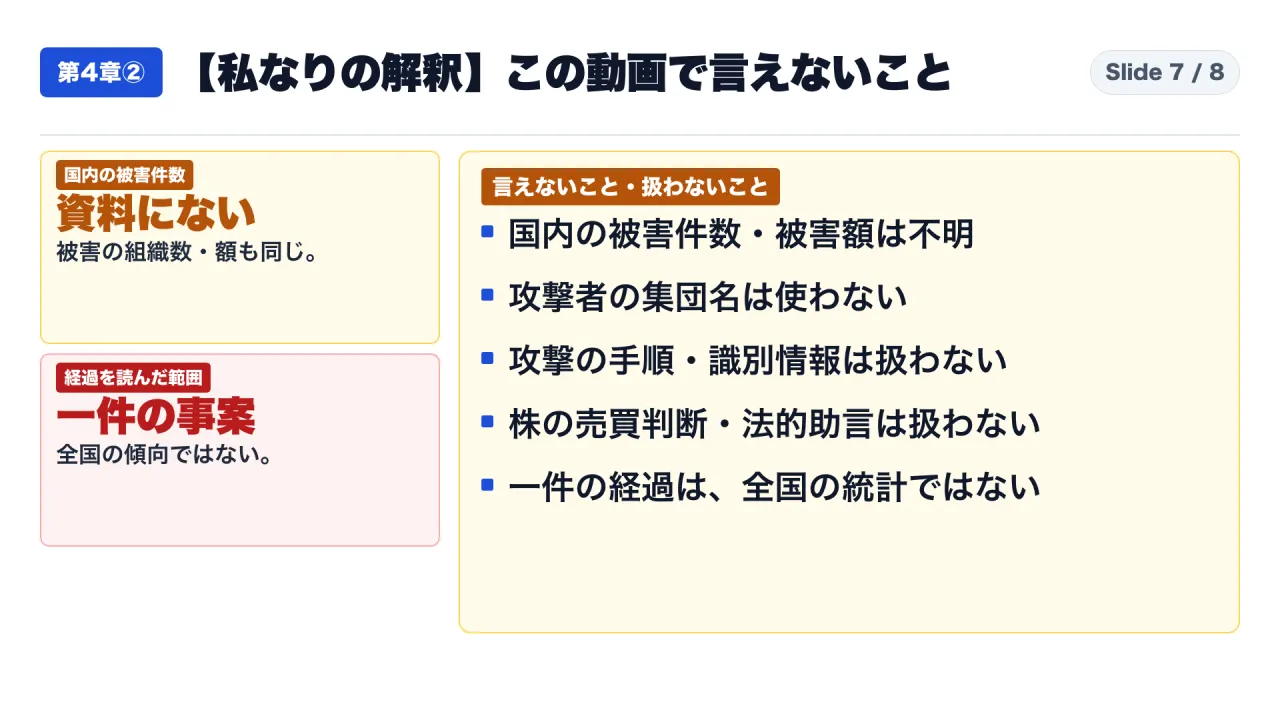
- Single Forensic Incident: JPCERT/CC detailed the timeline of one specific domestic compromise. The report does not quantify total victim counts across Japan or globally.
- Attribution Neutrality: Forensic records do not definitively attribute attacks to specific advanced persistent threat (APT) syndicates; threat actors were indiscriminate.
- No Attack Recipes: Defensive triage requires verifying configurations, not weaponizing proof-of-concept exploits.
- Environment-Specific Exposure: Whether an enterprise is vulnerable depends strictly on component dependencies and routing topologies, not overall brand profile.
The Four-Pillar Operational Response Architecture
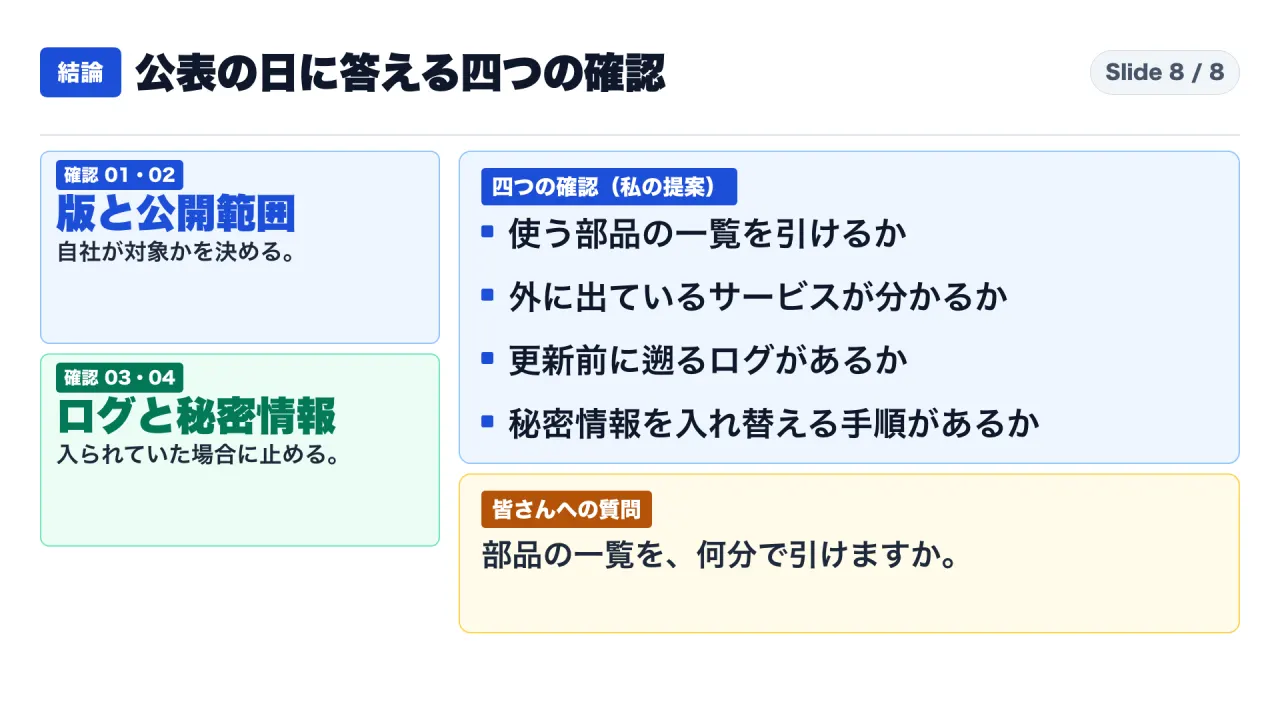
When responding to critical framework advisories, organizations must execute four structured verification phases.
Audit 1: Dependency Manifest Audit
- Execution: Inspect lockfiles (
package-lock.json,pnpm-lock.yaml,yarn.lock) across all software repositories. - Query Targets: Check for
react-server-dom-webpack,react-server-dom-parcel, andreact-server-dom-turbopack. - Target Version: Upgrade to the latest maintenance release in the respective branch (19.0.1, 19.1.2, 19.2.1, or updated framework releases). If automated dependency manifests cannot be queried within 30 minutes, resolving software asset visibility is an immediate operational priority.
Audit 2: Routing Architecture and Exposure Audit
- Execution: Classify all web application deployments into App Router vs. Pages Router architectures.
- Exposure Check: Identify whether the application is directly internet-facing or shielded behind reverse proxies, authentication gates, or private VPCs.
- Rule of Thumb: If the team cannot immediately prove an application uses Pages Router or static export, treat it as vulnerable and assume active exposure.
Audit 3: Pre-Patch Forensic Log Audit
- Execution: Examine web access logs, reverse proxy telemetry, and WAF records covering the window between public disclosure and patch deployment.
- Indicator of Compromise: Search for high-frequency or anomalous HTTP POST requests directed at Server Function endpoints. Look for requests with abnormally large headers, unusual Content-Type parameters, or unexpected base64 payload strings.
- Process Inspection: Inspect host-level telemetry for unauthorized outbound connections initiated by the Node.js process (such as outbound traffic to mining pools or raw IP addresses on unfamiliar ports).
- Log Retention Gaps: If web server logs do not persist beyond 24 hours, the organization cannot verify integrity. Treat the server as potentially compromised and escalate directly to Audit 4.
Audit 4: Secret and Credential Rotation
- Execution: Inventory all credentials accessible to the application environment: database passwords, API secret keys, cloud service account credentials, encryption keys, and session secrets stored in environment variables (
.env). - Next.js Guidance: The Next.js security team issued an explicit recommendation: any application exposed to the internet unpatched past 1:00 PM PST on December 4, 2025, must rotate all production secrets, prioritizing infrastructure access tokens and customer database credentials.
- Execution Cadence: Rotate credentials in order of criticality. Document rotated keys, responsible engineers, and operational sign-offs.
Governance and Executive Reporting Framework
For technical managers and chief information security officers, communicating zero-day response status requires structured clarity. Avoid subjective statements like “our systems appear stable.”
Require engineering teams to provide written status against four standard executive questions:
- Exposure Status: “Are our internet-facing applications utilizing affected RSC/App Router components? What specific package versions are running?”
- Remediation Status: “Have patched binaries been verified and deployed across all production clusters? What was the exact deployment completion timestamp?”
- Forensic Integrity: “What evidence confirms the host was not accessed prior to patch deployment? What time range was covered by the pre-patch log audit?”
- Credential Posture: “Which secrets and service tokens have been successfully rotated? Which remain pending, and what is the mitigation schedule?”
By establishing this four-audit protocol during calm periods, organizations ensure that on future disclosure days, teams respond with structured forensic verification rather than reactive guesswork.
Primary Sources and References
- React Official Core Team Blog, “Critical Security Vulnerability in React Server Components” (December 3, 2025): https://react.dev/blog/2025/12/03/critical-security-vulnerability-in-react-server-components
- Next.js Official Security Advisory, “CVE-2025-66478 Security Bulletin” (December 2025): https://nextjs.org/blog/CVE-2025-66478
- National Vulnerability Database (NVD), “CVE-2025-55182 Detail”: https://services.nvd.nist.gov/rest/json/cves/2.0?cveId=CVE-2025-55182
- National Vulnerability Database (NVD), “CVE-2025-66478 Detail (Rejected)”: https://services.nvd.nist.gov/rest/json/cves/2.0?cveId=CVE-2025-66478
- Cybersecurity and Infrastructure Security Agency (CISA), “Known Exploited Vulnerabilities Catalog”: https://www.cisa.gov/sites/default/files/feeds/known_exploited_vulnerabilities.json
- JPCERT/CC CyberNewsFlash, “Security Advisory on React Server Components Vulnerability” (Updated January 7, 2026): https://www.jpcert.or.jp/newsflash/2025120501.html
- JPCERT/CC Eyes Technical Blog, “Forensic Analysis of React2Shell In-the-Wild Exploitation” (February 13, 2026): https://blogs.jpcert.or.jp/ja/2026/02/react2shell.html